24-25 Annual Report PDF Free Download
1 / 22/22
100%

24
25
A N N U A L R E P O R T
SUMMIT ACADEMY
COMMUNITY SCHOOL FOR ALTERNATIVE
LEARNERS – XENIA

It is hard to believe the 2024-2025 school year has come and gone as it was a year of growth
and celebration for our students and staff at Summit Academy- Xenia. The goals for the school
year included providing meaningful tier one instruction through a gradual release of
responsibility, planning, and implementing targeted interventions to meet the needs of all
learners and utilizing behavioral leadership strategies to promote a positive climate and culture
within the school. By focusing on these goals, our team promoted academic and social
emotional growth for new and returning students.
Our team emphasized academic growth this year by incorporating math and ELA Academic
Target Time and EOC prep courses into daily instruction. Teams of teachers also came together
weekly to review academic and/or behavior data and make instructional decisions based on
student progress. By combining meaningful tier one instruction with targeted interventions for
students performing below grade level, teachers were able to meet the needs of individual
learners in the classroom while promoting growth and achievement at their grade level.
This year our staff continued to build upon the foundation of behavioral leadership strategies
that have promoted positive relationship building with students for three years now. It is
wonderful to see the strides that students are able to make when they have the opportunity to
build trust and rapport with their teachers while taking ownership of their classroom and
learning, particularly across multiple years.
As we close the door on the 2024-2025 school year, I would like to take a moment to celebrate
the journey that our students, staff, and families took together to fulfill Summit Academy’s
mission—to design, develop, and deliver educational opportunities in a therapeutic
environment so everyone can learn. I saw the mission fulfilled day in and day out through the
dedication and hard work of our staff and students. In the words of Dr. Seuss, “Don’t cry
because it’s over. Smile because it happened.”
Yours in Education,
Marissa Raux
Director
24-25 ANNUAL REPORT
dear families

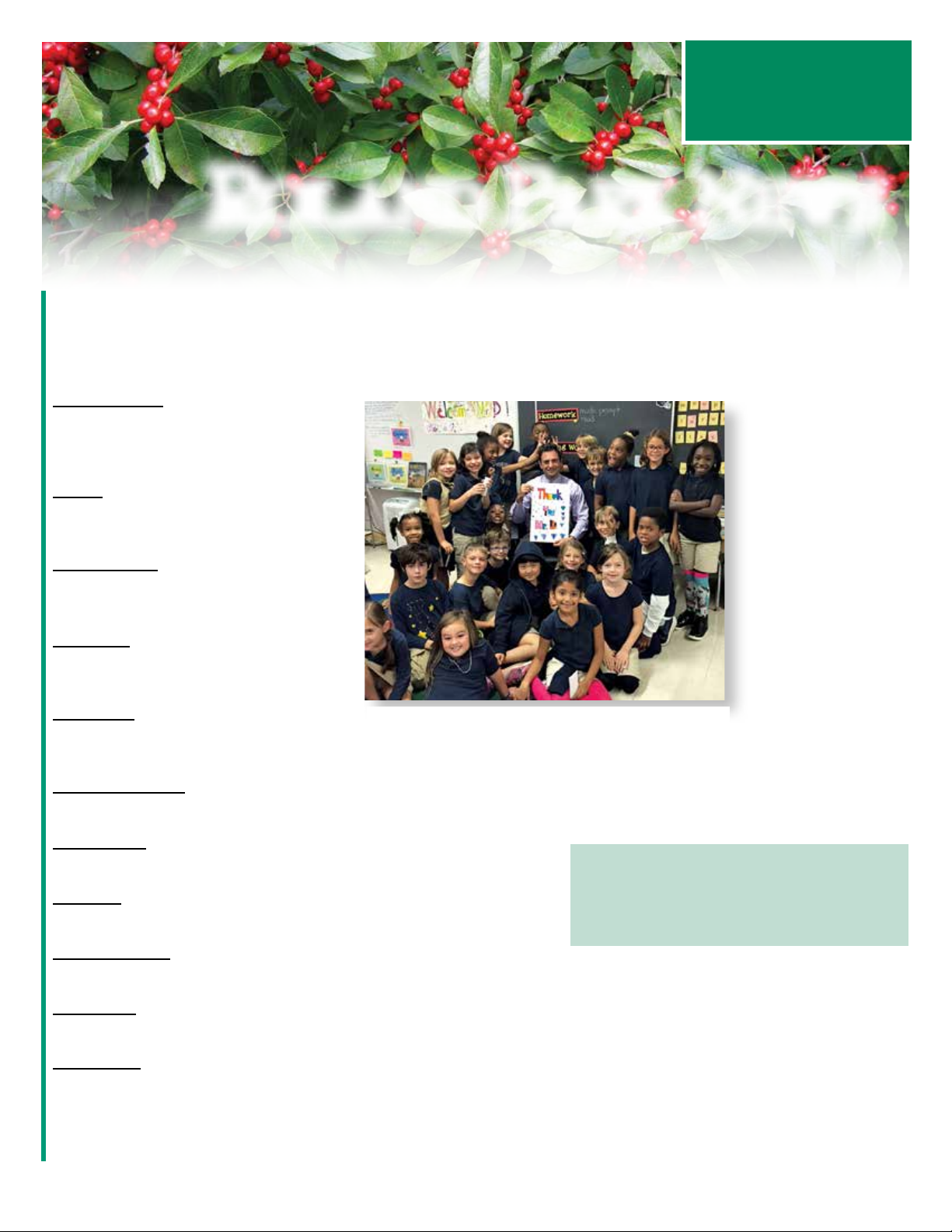
There were numerous highlights from the 2024-2025 school year including, but not limited to,
welcoming new and returning students at our annual open house, hosting our second annual
Trunk or Treat event, implementing a Christmas Giving Tree program, and putting on numerous
events during the second semester. Among these events were a Valentine’s Day Dance, Career
Day, Summit Spotlight Talent Show, Mystery-Themed Family Night, Summer Send Off Dance, Field
Day, Intramural Sports Week, Field Day, and Therapeutic Martial Arts Board-breaking
ceremonies. In addition to saying goodbye to the Class of 2025 in our high school graduation
ceremony, we also bid farewell to our Administrative Assistant, Danita Beason, who is retiring
after 10 years with Summit.
During our Career Day students in grades 6-12 had the opportunity to meet with members from
the community to learn about various career opportunities and pathways.
We hosted a fun-filled mystery themed family night in which students raced to hunt for clues to
locate a missing teacher. By partnering with local law enforcement and through the dedication
of our student detectives, the missing teacher was discovered hiding on the stage!
Our K-2 students were thrilled to go trick-or-treating throughout the building this year where
older students passed out candy.
From therapeutic martial arts to after-school activities, to the talent show to school dances,
Summit students had many extracurricular opportunities this year.
The culmination of the 2024-2025 school year was our 2025 graduation ceremony at which nine
graduates walked across the stage. We wish them well in their future endeavors.
Thank you, Mrs. Beason!
24-25 ANNUAL REPORT
highlights

24-25 ANNUAL REPORT
highlights

24-25 ANNUAL REPORT
our mission
sponsor statement
The mission of Summit Academy Schools is to build
hope, success, and well-being through education
and advocacy for students with special needs.
The Educational Service Center of Lake Erie West (ESCLEW)
served as sponsor for Summit Academy Community
School for Alternative Learners – Xenia during the 2024 -
2025 school year. ESCLEW monitored the school’s
academic and fiscal performance, as well as organization
and operation of the school, and determined that the
school was overall compliant.

OPERATING REVENUES
2025
2024
State Foundation
$2,760,598.00
$2,614,407.00
State and Federal Grants
$246,455.00
$553,532.00
Medicaid Revenue
$154,212.00
$46,745.00
Private Donations
-
-
Classroom Materials and Supplies
$5,569.00
$2,663.00
Other Revenue
-
$1,128.00
Interest on Investment
-
-
TOTAL OPERATING REVENUE
$3,166,834.00
$3,218,475.00
OPERATING EXPENSES
Management Fee Expense
$3,166,834.00
$3,218,475.00
TOTAL OPERATING REVENUE
$3,166,834.00
$3,218,475.00
NET PROFIT (LOSS)
$ -
$ -
24-25 ANNUAL REPORT
financials
Selected Financial Information
For the Fiscal Years Ended June 30, 2024 and 2023
* The 2024 financial information was obtained from the FY24 Audited Financial Statements,
and the 2025 financial information was obtained from the 2025 FINDET Report. Beginning the
2023 Fiscal Year audited financial statements are being presented using Modified Cash.

24-25 ANNUAL REPORT
star assessment
Summit Academy Students take Star Assessments three times each year to measure their
reading and math skills compared to grade-level standards. Their annual growth in these
skills is monitored by Student Growth Percentile (SGP) data, which compares a student’s
academic growth to that of his or her peers nationwide. A student’s peers are students in
the same grade with a similar achievement history on Star Assessments.
The following data shows the percentage of students who met or exceeded the SPG
target of 40 in reading and math between the fall and spring assessment administrations
during the 2023 – 2024 and 2024 – 2025 school years.
20
56
57
20
58
54
2023 - 20242024 - 2025
EARLY LITERACY READING MATH

24-25 ANNUAL REPORT
star assessment
The Student Growth Percentile (SGP) compares a student's growth to that of his or her academic peers
nationwide. These peers are students in the same grade with a similar achievement history on Star
assessments. SGP is measured on a 1–99 scale. Lower numbers indicate lower relative growth, and higher
numbers indicate higher relative growth. For instance, if a student has an SGP of 75, it means the student has
shown more growth than 75 percent of his or her academic peers. Teachers and administrators can use SGP
scores to determine if students grew more than (at or above the 66 growth percentile), less than (below the
35 growth percentile), or as much as (between the 35 and 65 growth percentiles) expected. The SGP
minimum target for all SA schools is the 40 growth percentile.
th
th th th
th
LOW GROWTH TYPICAL GROWTH HIGH GROWTH
110
48%
75
32.8%
44
19.2%
529
38.4%
494
35.8%
356
25.8%
83
51.3%
48
29.6%
31
19.1%
596
38.8%
482
31.4%
457
29.8%
2024 - 2025
2024 - 2025
2023 - 2024
2023 - 2024
EARLY
LITERATURE
READING
557
40.3%
465
33.7%
359
26%
627
40.1%
512
32.7%
425
27.2%
2024 - 2025 2023 - 2024
MATH
STUDENT GROWTH PERCENTILE

24-25 ANNUAL REPORT
star assessment
A benchmark is a standard against which you measure the achievement of a student, grade, school, or district. It is the
lowest level of performance that is considered acceptable. The district benchmark applies to all schools and grades and is
always used for longitudinal reporting. The proficiency rate is the percent of students at or above the district benchmark
on a Star assessment. It uses the most recent score in the given district screening window. Benchmark proficiency is
measured on a 1–99 scale. Lower numbers indicate lower relative achievement, and higher numbers indicate higher
relative achievement. For instance, if a student has a proficiency rate of 65, it means the student has performed better
than 64 percent of his or her academic peers on this specific test. The benchmark structure includes four categories:
At/Above Benchmark = at or above the 40 percentile rank; On Watch = the 25 – 39 percentile rank; Intervention = the
10 – 24 percentile rank; Urgent Intervention = below the 10 percentile rank.
th th th
th th th
STUDENT PROFICIENCY RATE
101
40.1%
60
23.8%
60
23.8%
31
12.3%
719
48.2%
339
22.7%
272
18.2%
161
10.8%
63
36%
45
25.7%
40
22.9%
27
15.4%
546
33.8%
446
27.6%
375
23.2% 248
15.4%
2024 - 2025
2024 - 2025
2023 - 2024
2023 - 2024
EARLY
LITERATURE
READING
656
43.7%
399
26.6%
267
17.8%
180
12%
506
30.8%
458
27.9%
411
25%
267
16.3%
2024 - 2025 2023 - 2024
MATH
URGENT
INTERVENTION
INTERVENTION
ON WATCH
AT/ABOVE
BENCHMARK

24-25 ANNUAL REPORT
student
academic
success

Overall Rating
Approaches Standard
Nationally-Normed Assessment
Achievement K- 8 Reading
Approaches Standard
Achievement Component
Approaches Standard
Nationally-Normed Assessment
Achievement K-8 Math
Approaches Standard
Performance Index
Approaches Standard
9-12 EOC Algebra I
Falls Below Standard
Chronic Absenteeism
Meets Standard
9-12 EOC Biology
N/A
Progress Component
Exceeds Standard
9-12 EOC ELA II
Falls Below Standard
Gap Closing Component
Approaches Standard
9-12 EOC Geometry
N/A
Gifted Performance Indicator
N/A
9-12 EOC American US History
N/A
Graduation Component
Falls Below Standard
9-12 EOC American US Government
N/A
4-Year Graduation Rate
Falls Below Standard
9-12 Credit Earing Rate
Exceeds Standard
5-Year Graduation Rate
Falls Below Standard
School Academic Growth Targets and Metrics
Early Literacy Component
Falls Below Standard
Nationally-Normed Assessment
Growth K-12 Reading
Meets Standard
Proficiency in 3rd Grade
N/A
Nationally-Normed Assessment
Growth K-12 Math
Meets Standard
Promotion to 4th Grade
N/A
Nationally-Normed Assessment
Growth K-12 Reading or Math
N/A
Improving K-3 Literacy
Falls Below Standard
College, Career, Workforce &
Military Readiness
Falls Below Standard
PBIS
Meets Standard
PI vs Similar School #1
N/A
PI vs Similar School #2
N/A
PERFORMANCE ACCOUNTABILITY FRAMEWORK:
CONTRACT ATTACHMENT 11.6
The Performance Accountability Framework (Attachment 11.6) consists of multiple, measurable goals focused on
the academic, financial, and operational expectations for the school year. This document is categorized into five
goal areas: local report card indicator areas, school-specific academic measures, operations, legal compliance,
and financial accountability.
CONTRACT ATTACHMENT 11.6: ACADEMIC PERFORMANCE STATUS
24-25 ANNUAL REPORT

24-25 ANNUAL REPORT
CONTRACT ATTACHMENT 11.6: NON-ACADEMIC PERFORMANCE STATUS
School Fiscal
Performance Targets and Metrics
School Governance
Performance Targets and Metrics
Ratio Assets to Liabilities
Falls Below Standard
Board Engagement
Approaches Standard
Unrestricted Days Cash
Falls Below Standard
Required # of Reg. Board Meetings
Meets Standard
Current Year Enrollment
Variance
Exceeds Standard
Required # of Board Members
Meets Standard
Debt Management
N/A
Proper Meeting Notice
Meets Standard
Total Expense Variance
Meets Standard
Required Board Member Training
Meets Standard
Sponsor Financial
Reporting
Exceeds Standard
Board Member Attendance
Approaches Standard
Audit Findings
Falls Below Standard
Compliance/Organizational & Operational
Performance Targets and Metrics
On-Time Records Submissions
Meets Standard
‘
Accuracy of Records Submissions
Exceeds Standard
Five-Year Forecast Submission
Meets Standard
Annual Budget
Meets Standard
Annual Report
Meets Standard
Emergency Management Plan
Meets Standard
Out of School Suspension K-3
Exceeds Standard
Out of School Suspension 4-8
Falls Below Standard
Out of School Suspension 9-12
Falls Below Standard
Mission Specific
N/A

24-25 ANNUAL REPORT
The multi-tiered systems of support (MTSS) framework is used for academics, behavior,
and social-emotional support in all Summit Academy schools. A joint project of the
curriculum and special education regional teams brought school specific
collaboration to ensure that school leaders understood MTSS and structured their
instructional schedules to maximize MTSS implementation. Implementation support,
classroom observations, and feedback are provided by the regional teams.
Our most consistent and detailed MTSS system is the Summit Academy Reading
Framework. The framework emphasizes training teachers thoroughly in the science of
reading and appropriate instructional strategies. The framework also ensures that our
curriculum materials are aligned to the state standards, support the science of reading,
provide diagnostic assessments, and include evidence-based interventions to best
meet our students’ needs. A curriculum audit has been completed with support from
the regional curriculum administrator and new materials were purchased based on the
guidelines set in the framework. A Reading Framework Action Plan was also
developed, putting measurable goals in place that are focused on increasing our
students’ reading abilities and overall academic performance.

24-25 ANNUAL REPORT
All Summit Academy students are benchmarked (screened) three times each
year using Renaissance Star assessments to compare their reading and math
achievement to grade-level norms and determine their instructional support
needs. The metric used to determine growth in this assessment is a Student
Growth Percentage (SGP) score of 40 or higher, which equates to a year plus
growth. The testing data helps teachers determine whether students are on
track or not on track toward math and reading proficiency, identify reading
and math skill deficiencies, measure student growth, monitor student progress,
prescreen students who are potentially gifted, and deliver targeted instruction.
Following each benchmarking period, teachers will analyze the data
collaboratively in Teacher-Based Teams (TBTs) to determine appropriate
instructional strategies and intervention support needs for their students.
Summit Academy students participate in Ohio state tests as prescribed. With
such a high percentage of students with disabilities, we have found that Star
growth data portrays a more accurate picture of student learning than the
state report cards. Our students will frequently make a tremendous amount of
growth within a year, but since they started so many grade-levels behind their
achievement test scores are still lower than grade-level proficient, which gives
the perception that the students are failing to learn. Stardata provides an
objective, detailed basis on which to make decisions about instruction and
intervention, prioritizing foundational skills in reading and math, thus supporting
students to achieve higher growth and to fill academic gaps that hinder grade-
level achievement.
METHOD OF MEASUREMENT FOR ATTACHMENT 11.6 GOALS

24-25 ANNUAL REPORT
statewide
achievement
R E P O R T C A R D M E A S U R E M E N T S
The Ohio Department of Education has revised the school report card to
analyze performance, determining strengths and areas of improvement for
each district. The new report card includes five components that will receive
ratings from one to five stars. These components are achievement, Progress,
Early Literacy, Gap Closing and Graduation The sixth component, College,
Career, Workforce and Military Readiness, was not required in the 2022 - 2023
school year.
OVERALL RATING

Greater than or equal to 90% of Max Score
Significantly exceeds state standards in
academic achievement
Greater than or equal to 80% but
less than 90% of Max Score
Exceeds state standards in academic
achievement
Greater than or equal to 70% but
less than 80% of Max Score
Meets state standards
in academic achievement
Greater than or equal to 50% but
less than 70% of Max Score
Needs support to meet state standards in
academic achievement
Less than 50% of Max Score
Needs significant support to meet state
standards in academic achievement
24-25 ANNUAL REPORT
ACHIEVEMENT COMPONENT
The achievement component identifies how well students performed on the state tests overall.
Student performance is identified through the Performance Index which measures the
achievement of every student, not just whether they score a proficient level. Each test a student
takes is assigned an achievement level based on the test score, with higher scores resulting in
higher achievement levels.
SCHOOL REPORT CARD RATING
PERCENTAGE OF MAXIUM POINTS EARNED RATING RATING DESCRIPTION

Growth index of at least +2 and
effect size of at least +.2
Significant evidence that the school
exceeded student growth expectations
by a larger magnitude
Growth index of at least +2 and
effect size of less than +.2
Significant evidence that the school
exceed student growth expectations
Greater than or equal to -2 but less than +2
Evidence that the school met student
growth expectations
Less than -2 and effect size of at least -.2
Significant that the school fell short of
student growth expectations
Less than -2 and effect size of less than -.2
Significant evidence that the school fell
short of student growth expectations by
larger magnitude
24-25 ANNUAL REPORT
PROGRESS COMPONENT
Academic growth is measured by looking at the current achievement compared to prior
achievement results on the state tests. This is determined by looking at the growth index and the
effect size to see if there was expected growth or a shortfall in expected growth, relative to Ohio.
SCHOOL REPORT CARD RATING
PERCENTAGE OF MAXIUM POINTS EARNED RATING RATING DESCRIPTION

From 88% to 100%
Significantly exceeds state standards in
early literacy (K – 3)
From 78% to less than 88%
Exceeds state standards in early literacy
(K – 3)
From 68% to less than 78%
Meets state standards in early literacy
(K – 3)
From 58% to less than 68%
Needs support to meet state standards in
early literacy (K – 3)
From 0% to less than 58%
Needs significant support to meet state
standards in early literacy (K - 3)
24-25 ANNUAL REPORT
EARLY LITERACY COMPONENT
The Early Literacy Component measures reading improvement and proficiency for students in
kindergarten through third grade. This component provides a more complete picture of early
literacy in our schools by looking at three separate areas. 1) The proficiency in Third Grade
Reading reports how many students score proficient or higher on the reading segment of Ohio’
State Test for English Language Arts for grade 3. 2) The Promotion to Fourth Grade measure reports
the percentage of students in third grade who were promoted to fourth grade. 3) The Improving
K-3 Literacy measure uses two consecutive years of data to evaluate how well schools are doing
at providing supports to help struggling readers.
SCHOOL REPORT CARD RATING
PERCENTAGE OF MAXIUM POINTS EARNED RATING RATING DESCRIPTION

From 88% to 100%
Significantly exceeds state standards in
early literacy (K – 3)
From 78% to less than 88%
Exceeds state standards in early literacy
(K – 3)
From 68% to less than 78%
Meets state standards in early literacy
(K – 3)
From 58% to less than 68%
Needs support to meet state standards in
early literacy (K – 3)
From 0% to less than 58%
Needs significant support to meet state
standards in early literacy (K - 3)
24-25 ANNUAL REPORT
GAP CLOSING COMPONENT
SCHOOL REPORT CARD RATING
RANGE - PERCENTAGE OF POINTS EARNED
OUT OF POSSIBLE POINTS
RATING RATING DESCRIPTION
There are several measures to determine the gap closing
component, which is focused on student subgroups including all
students, Asian/Pacific Islander, Hispanic, White/Non-Hispanic,
Black/Non-Hispanic, America Indian/Alaskan Native, Multiracial,
English Learner, Economic Disadvantage, and Students with
Disabilities.
The indicators to evaluate student performance and academic
growth include:
The Gifted Performance Indicator
The Chronic Absenteeism Improvement Indicator
The English Language Proficiency Improvement
Indicator
Graduation Goals by Student Subgroup
English Language Arts, Math Achievement by Student
Subgroup
English Language Arts, Math Progress (Growth) by
Student Subgroup

Greater than or equal to 96.5%
Significantly exceeds state standards in
graduation rates
Greater than or equal to 93.5% but
less than 96.5%
Exceeds state standards in
graduation rates
Greater than or equal to 90% but
less than 93.5%
Meets state standards in
graduation rates
Greater than or equal to 84% but
less than 90%
Needs support to meet state standards in
graduation rates
Less than 84%
Needs significant support to meet state
standards in graduation rates
24-25 ANNUAL REPORT
GRADUATION COMPONENT
SCHOOL REPORT CARD RATING
RANGE - PERCENTAGE OF POINTS EARNED
OUT OF POSSIBLE POINTS
RATING RATING DESCRIPTION
The graduation component looks at both the four-year and five-year adjusted cohort graduation
rates, determining the percentage of students graduating with a regular or honors diploma. The
graduation rates are then multiplied by the state law established weights to determine the
component rating.

COLLEGE, CAREER, WORKFORCE AND MILITARY
READINESS COMPONENT
The College, Career, Workforce, and Military Readiness Component is a measure of how
prepared Ohio's students are for future opportunities, whether training in a technical field or
preparing for work or college.
Greater than or equal to 85%
Significantly exceeds state standards in post-
secondary readiness rates
Greater than or equal to 75% but less
than 85%
Exceeds state standards in post-secondary
readiness rates
Greater than or equal to 63% but less
than 75%*
Meets state standards in
graduation rates
Greater than or equal to 53% but less
than 63%
Needs support to meet state standards in
graduation rates
Less than 53%
Needs significant support to meet state
standards in graduation rates
SCHOOL REPORT CARD RATING
RANGE - PERCENTAGE OF POINTS EARNED
OUT OF POSSIBLE POINTS
RATING RATING DESCRIPTION
*If a district or school initially earns a 1 star or 2 star rating but then improves at least 15 percentage points
from the previous year, that school or district will earn a final rating of 3 stars and 2.25 points
toward the Overall Rating.
24-25 ANNUAL REPORT

1694 Pawnee Drive | Xenia | Ohio
937-372-5210 | summitacademies.org | Grades: K - 12