Avoiding the Banana Hole. Psychoanalytic Reading of the Character of Seymour Glass in J.D. Salinger’s Shorter Fiction PDF Free Download
1 / 29/29
100%

Hugvísindasvið
Avoiding the Banana Hole
A Psychoanalytic Reading of the Character of Seymour Glass
in J.D. Salinger’s Shorter Fiction
Ritgerð til B.A.- Prófs
Daði Guðjónsson
Maí 2012

Háskóli Íslands
Hugvísindasvið
Enska
Avoiding the Banana Hole
A Psychoanalytic Reading of the Character of Seymour Glass
in J.D. Salinger’s Shorter Fiction
Ritgerð til B.A. – Prófs
Daði Guðjónsson
Kt.:300881-3359
Leiðbeinandi: Júlían M. D'Arcy
Maí 2012

Summary
This essay examines J.D. Salinger’s post-traumatic stress disorder (PTSD) from his time in
the armed services, as it is apparently portrayed by his character Seymour Glass, through the
application of psychoanalytical theories. After reviewing sources on PTSD and Salinger’s
early short stories about Sgt. “Babe” Gladwaller, Sergeant X in “For Esmé with Love and
Squalor,” and Seymour Glass in “A Perfect Day for Bananafish,” it became evident that all of
these characters were suffering from what is now called post-traumatic stress disorder and that
Seymour Glass was the severest case; this is evident due to his inability to assimilate into
American Post-World War II society, and his desperate attempts at repressing his desires and
memories from the war that still haunted him as well his creator. Various secondary sources,
articles, texts and books will be used to emphasize the arguments that will be made. The first
chapter of this essay will focus on the historical context in which Salinger wrote these stories.
The second chapter will focus on post-traumatic stress disorder and its effect on J. D. Salinger.
The third chapter will focus on the three elements of Freud’s model of the psyche, the id, the
superego, and the ego and why Seymour decided to take his own life. The fourth chapter will
be on J.D. Salinger’s influences and writing style. The last chapter will summarize my
conclusions.
Table of Contents
Introduction…………………………………………………………………………………...1
1. Historical context of Salinger’s works...............................................................................2
2. Post-traumatic stress disorder and its affect on J. D. Salinger………………………...5
3. Psychoanalytic reading of Seymour Glass in “A Perfect Day for Bananafish”………9
4. J.D. Salinger influences and writing style……………………………………………….17
Conclusion................................................................................................................................19
Bibliography............................................................................................................................22

1
Introduction
This thesis examines J.D. Salinger’s post-World War II stories and with a specific focus on
the protagonist Seymour Glass in the short story “A Perfect Day for Bananafish”. The
approach will mainly be a psychoanalytical one, but I also refer to other relevant theories in
order to reinforce the connection between Salinger’s stories and his post-traumatic stress
disorder. Salinger began to publish short stories in periodicals at the advent of World War II.
After the war, his stories, some based on his experiences in the army, appeared increasingly in
The New Yorker. When Nine Stories appeared in 1953, J.D. Salinger was already a national
literary figure, largely due to the popularity of his first novel, The Catcher in the Rye (1951).
Initially having read The Catcher in the Rye, I became intrigued by J.D. Salinger and his
writing. The character Seymour Glass first appeared in “A Perfect Day for Bananafish” and
later featured in Raise High the Roof Beam, Carpenters and Seymour: An Introduction and
Franny and Zooey. Seymour is a somewhat strange character, and perhaps like his creator,
especially difficult to understand, thereby further piquing my interest. To thoroughly
understand the author and Seymour, I examined Richard J. McNally‘s Remembering Trauma,
which delved into trauma theory and repression, The Ego and the Id by Sigmund Freud, and
Francine Shapiro’s and Margot Forrest’s EMDR: the Therapy Book for Overcoming Anxiety,
Stress and Trauma. By reviewing these works, other secondary sources, and various
criticisms on Salinger, it became evident that the war veteran Seymour Glass, like his creator,
suffered from post-traumatic stress disorder. The four chapters in this essay each focus on that
argument.

2
1. Historical context of Salinger’s works
As Eberhard Alsen points out in his book A Reader's Guide to J. D. Salinger: “There is to
date no authorized biography of J.D. Salinger because Salinger has steadfastly opposed any
books about his life.”1 Ian Hamilton attempted to publish a biography entitled J.D. Salinger:
A Writing Life, but Salinger sued Hamilton’s publisher, Random House, because Salinger
claimed that the book contained too much material from his unpublished letters. He
eventually forced the publisher to withdraw the book. Ian Hamilton then published the much-
altered In Search of J.D. Salinger. Alsen argues that: “Hamilton’s book contains very few
facts that shed light on Salinger’s fiction beyond what had been mentioned in various
biographical magazine pieces and in Warren French’s book, J.D. Salinger (1963, rev. ed.
1976). The same is true for Paul Alexander’s book, Salinger: A Biography (1999). However,
the memoir of Salinger’s daughter Margaret, Dream Catcher (2000) – unkind though it is to
her father – presents quite a bit of new information, and some of it corrects mistakes of
previous biographers.”2
What we do know about J.D. Salinger’s writing career is that he attended a creative
writing class course taught by Whit Burnett at Columbia University in 1939. Burnett liked one
of Salinger’s short stories, “The Young Folks,” so much that in the following year it was
published in his magazine The Story. It was Salinger’s first published story and it was
attached with the following biographical information: “J.D. Salinger, who is twenty-one years
old, was born in New York. He attended public grammar schools, one military academy, and
three colleges, and has spent a year in Europe. He is particularly interested in playwriting”
(“Contributors” [1940] 2). The stories Salinger wrote during this stage in his career were
published in so-called “slick” magazines, and dealt with male-female relationships.
In 1941 World War II had started in Europe and The United States had not yet entered
the war. As Eberhard Alsen writes: “The American public demanded upbeat stories about
young men in the Army. Even though Salinger was, at this point, not in the military, he wrote
two such formula stories for Collier’s ... and their titles are ‘The Hang of It’ (1941) and
‘Personal Notes of an Infantryman’ (1942).”3 Salinger was struggling as a free-lance short
story writer when the Imperial Japanese Navy attacked the United States naval base at Pearl
1 Eberhard Alsen, A Readers Guide to J.D. Salinger (Westport: Greenwood, 2002), 1.
2 Alsen, 1.
3 Alsen, 4.

3
Harbor, Hawaii, on the morning of December 7, 1941. The surprise attack led directly to the
American entry into World War II in both the Pacific and European theaters. Margaret
Salinger writes in her memoir entitled Dream Catcher: “In the spring of 1942, Jerome David
Salinger was drafted into the United States army. He, along with thousands of other young
men from all over the country, reported for induction and began the metamorphosis from
civilian to soldier.”4
The stories Salinger wrote during his basic training, before getting assigned to the
Counter Intelligence Corps, dealt with people who were living on Army bases in the United
States. Salinger came from an upper-middle class family, and as Alsen points out “his
experiences in the military exposed him for the first time to members of the American
working class. He seems to have been fascinated with the way the ‘other half’ lived and talked,
and he made three fictional forays into that social territory. In the stories “Soft-Boiled
Sergeant”, “Both Parties Concerned”, and “Elaine”, the central characters all belong to the
lowest stratum of American society and speak very slangy, ungrammatical English.”5
Salinger was assigned to the Counter Intelligence Corps, where he continued to write
and send stories to magazines about his experiences in World War II. In 1944 Salinger was
attached to the 12th Infantry regiment of the 7th Army, which wound up fighting in the five
major European campaigns of World War II. While serving in the army Salinger created his
first alter-ego, Sergeant Frank “Babe” Gladweller, who also had the same Army identification
tag number as Staff Sergeant Jerome Salinger. In the story “Last Day of the Last Furlough,”
Gladweller expresses his ambivalence toward the war through his statement: “it’s the moral
duty of all the men who have fought and will fight in this war to keep our mouth shut, once
it’s over, never again to mention it in any way. It is time we let the dead die in vain.” “Babe”
continues to argue, “all of us talking, writing, painting, making movies of heroism and
cockroaches and foxholes and blood, then future generations will always be doomed to future
Hitler’s. It’s never occurred to boys to have contempt for wars, to point to soldiers pictures in
history books laughing at them.”6 Although Gladweller is against all war, he also
acknowledges that Hirohito and Hitler’s armies must be defeated.
4 Margaret A. Salinger, Dream Catcher: A Memoir (New York: Washington Square Press, 2000), p.43.
5 Alsen, 5.
6 J.D. Salinger, “Last Day of the Last Furlough,” Saturday Evening Post (15 July 1944): 61-62 (As cited in
Alsen, 11 )

4
In the story “A Boy in France,” Gladweller is in an abandoned German foxhole on the
evening after a battle, He is trying to rest and maintain his sanity by reading, and rereading, a
note sent from his sister. In an inner monologue, he imagines that he is back home in the
United States and trying to bolt the door to his room behind him,
I’ll be home and I’ll bolt the door. I’ll put some coffee on the stove, some records on
the phonograph, and I’ll bolt the door. I’ll read my books and I’ll drink the hot coffee
and I’ll listen to the music, and I’ll bolt the door. I’ll open the window, I’ll let in a nice
quiet girl - not Frances, not anyone I’ve ever known - and I’ll bolt the door. I’ll ask her
to walk a little bit in the room by herself, and I’ll look at her American ankles, and I’ll
bolt the door. I’ll ask her to read some Emily Dickinson to me - that one about being
chartless - and I’ll ask her to read some William Blake to me - that one about the little
lamb who mad thee - and I’ll bolt the door. She’ll have an American voice, and she
won’t ask me if I have any chewing gum or bonbons, and I’ll bolt the door.7
The constant repetition of the phrase “and I’ll bolt the door” indicates that Babe Gladweller’s
sanity has been compromised because of the war. As Eberhard Alsen argues: “This is his
mind’s attempt to shut the bloody fighting of the day out of his memory. Like some of the
infantrymen in Salinger’s regiment, Gladweller was close to what was then called ‘combat
fatigue,’ that is, post-traumatic stress disorder.”8 In his essay “Seventy-eight Bananas,”
William Wiegand discusses the “Babe” Gladweller war time stories “Last Day of the Last
Furlough”, “A Boy in France”, and “The Stranger”, and argues:
The Babe Gladweller stories …. foreshadow what is to become the chief concern in
Salinger’s fiction, but they remain unfocused. The war is still an irrelevant part of
them—irrelevant because it was too easy to blame the war for the hero’s state of mind
when probably Babe Gladweller had an incipient case of banana fever. It took Salinger
some years to define Babe Gladweller’s feelings as a disease, to recognize, in other
words, that so-called normal people were not affected with these strange symptoms of
chronic hypersensitivity and sense of loss.9
7 J.D. Salinger, “A Boy in France, ” Saturday Evening Post (31 March 1945): 21 (As cited in Alsen, 29)
8 Alsen, 6.
9 William Wiegand, ”Seventy-eight Bananas,” p.8. Accessed 12 April 2012 <
http://www.jstor.org/stable/pdfplus/25293391.pdf>

5
Salinger continued to write and publish stories from the day of the invasion of Europe
to the day when Nazi Germany surrendered. Salinger was not a combat infantryman and his
main job as a member of the Counter Intelligence Corps was to interview prisoners of war and
civilians. During the last days of World War II, Salinger saw the gruesome concentration
camps with his own eyes. If we examine the available biographical information on Salinger
and compare it to the content of his work, it becomes evident as Alsen argues “that throughout
his career Salinger has worked details from his life into his fiction.”10 In the next chapter, I
will explore Salinger’s experience in World War II and the psychological effects which are
reflected in his second alter-ego, Sergeant X in “For Esmé - With Love and Squalor”, and of
ex-sergeant Seymour Glass in “A Perfect Day for Bananafish.”
2. Post-traumatic stress disorder and its affect on J. D. Salinger
What war does to our minds, is an old question. Homer wrote about it in his Iliad back in 800
B.C.11 The protagonist Achilles is initially unwilling to fight. However, when his friend
Patrokles is killed in war, he becomes seized by rage and carries out war atrocities so cruel
that even the Greek gods tremble. As Lars Weisæth argues in War Violence, Trauma and the
Coping Process, “The Iliad is a description of the soldier both as a victim and a perpetrator.
Until the Bible took over, The Iliad and the Odyssey were the dominating textbooks on this
subject for boys and young men in the Western world. On the one hand they glorified the
virtues of the war hero. On the other hand the books may be read as anti-war stories, with a
message to people in all times.”12
Francine Shapiro and Margot Silk Forrest trace back the history of PTSD as a result of
combat. In their case studies and research book EMDR (Eye Movement Desensitization &
Reprocessing), they argue that: “The psychological impact of combat has been known to
physicians for a long time. In 1871, Jacob Mendes Da Costa did a study of Civil War veterans
who complained of heart pain yet showed no evidence of cardiac disease. He termed their
condition irritable heart, but he could find no way to treat it successfully. After World War I,
10 Alsen, 1.
11 Homer. “The Iliad,” Accessed 11 April 2012. <http://classics.mit.edu/Homer/iliad.1.i.html>
12 Libby T. Arcel, War Violence, Trauma and the Coping Progress. (Zagreb: Nakladništvo Lumin, 1998), p.25.

6
this clinical phenomenon was known as soldier’s heart or shell shock, with the latter term
coined to describe the psychological results of a concussion caused by artillery shells.” 13
They continue by arguing that by World War II:
Psychiatrists had identified the long-term emotional distress seen in war veterans as
combat neurosis. For many, the name reflected the Freudian belief that childhood
events or physiological predisposition was the real cause of the client‘s suffering; war
had merely brought it to light. Until the 1970s, many mental health experts continued
to believe that a normal personality could undergo any amount or type of war stress
without a problem. This line of thinking stigmatized any expression of the trauma. If
veterans talked of their pain, they were regarded as weak or abnormal. Generations of
warriors died with their psychological wounds unrevealed.
Some, however, could not remain silent. Their condition was more commonly
known as battle fatigue, and by the end of World War II, thousands of psychologically
damaged veterans were inpatients in VA hospitals. Even now, World War II and
Korean War veterans are coming into the VA hospitals still in pain from remembered
trauma.14
Shapiro and Forrest also agree that, “[r]etirement seems to trigger the same feelings of
isolation and lack of control that they [veterans] experienced in combat, and with those
feelings come to the haunting mental images of the battlefield.”15
In his book Remembering Trauma, Richard J. McNally, Professor at the Department
of Psychology at Harvard University, writes: “PTSD was first recognized by the American
Psychiatric Association in 1980 in the third edition of its Diagnostic and Statistical Manual of
Mental Disorders (DMS-III).”16 The DMS-III described three clusters of symptoms caused by
exposure to trauma.
McNelly goes on to elaborate the details about each of the three clusters, starting with
the first cluster, which consists of “re-experiencing symptoms, such as having recurrent
intrusive recollection and dreams about the trauma and suddenly acting and feeling as if it
13 Francine Shapiro and Margot S. Forrest, EMDR: The Breakthrough Therapy for Overcoming Anxiety, Stress
and Trauma (New York: Basic Books, 1997), p. 31.
14 Shapiro and Forrest, p. 31.
15 Shapiro and Forrest, pp. 31-32.
16 Richard J. McNally, Remembering Trauma (Cambridge, Harvard UP, 2003), p. 8.
7
were happening again (‘flashbacks’). Rather than merely remembering the trauma, sufferers
seemed to relive it again and again as if it were happening in the present.”17 These symptoms
are evident in Salinger’s life and likely influenced his writing significantly. In her memoir,
Dream Catcher, Margret Salinger recalls her father having recurrent intrusive recollections
many years after his time in the army. She writes:
I remember standing next to my father – I was about seven at the time – for what
seemed like an eternity as he stared blankly at the strong backs of our construction
crew of local boys, carpenters building the new addition to our house. Their T-shirts
were off, their muscles glistening life and youth in the summer sun. After a long time,
he finally came back to life again and spoke to me, or perhaps just out loud to no one
in particular, “All those big strong boys” – he shook his head – “always on the front
line, always the first to be killed, wave after wave of them,” he said, his hand, palm
out, pushing arc-like waves away from him.18
The American Psychiatric Association describes the second cluster as being comprised
of “numbing symptoms, such as blunted emotion, feeling of estrangement from others, and
loss of interest in formerly enjoyable activities.”19 Salinger’s symptoms are also evident in his
decision to become a recluse by moving to an old farmhouse deep in the woods outside
Cornish, New Hampshire, where he grew increasingly wary of his privacy and alienation—
eventually guarding them with a shotgun.20
McNelly describes the third and final cluster as being comprised of “miscellaneous
symptoms, including hyper vigilance for threat, enhanced startle response, sleep disturbance,
memory and concentration impairment, avoidance of distressing reminders of the trauma, and
guilt about having survived when others did not. Post-traumatic stress disorder, then, was
fundamentally a disorder of memory. Most important, terrifying events from the past were
remembered all too well, producing emotional distress in the present.”21 Margaret Salinger
also acknowledges that her father felt guilty about having survived the war when many others
were not as lucky. She writes, “My father has, himself, on many occasions told me ….that the
17 McNally, 9.
18 M. Salinger, 59.
19 M. Salinger, 60.
20 Alsen, 11.
21 McNally, 8-9.

8
only people he really respects are all dead”.22 PTSD symptoms are also evident in another of
her recollections, “Once when my mother asked him to join us on an overnight camping trip,
he said, outraged, “For Christ sake, Claire, I spent most of the war in foxholes. I will never
spend another night outdoors again if I can help it, I promise you.”23
Margaret Salinger was the first person to mention her father’s concentration camp
experience. In her memoir, Dream Catcher, she quotes him saying, “You never really get the
smell of burning flesh out of your nose entirely, no matter how long you live.” She also
writes: “As a counter intelligence officer my father was one of the first soldiers to walk into a
certain, just liberated, concentration camp. He told me the name, but I no longer remember.”24
Eberhard Alsen argues that the camp Salinger walked into “must have been the camp near the
village of Hurlach, Bavaria, seven miles north of the city of Landsberg… the Kaufering
Camp.”25 The day before the American troops liberated the prisoners the SS guards killed
most of prisoners by closing the barracks and burning them alive before retreating, leaving
only a handful of prisoners still alive.26
Although Salinger never wrote about what he witnessed at the camp, we do know that
the experience had a tremendous effect on him and his writing. We also know about
Salinger’s nervous collapse, which he suffered sometime in May of 1945, from a letter he
wrote to Ernest Hemingway, whom he had met briefly in Paris after the city’s liberation in
1944. Hemingway was a war correspondent at the time and holding court at the Ritz Hotel.
Salinger, being an admirer of his, sought out Hemingway and presented him with his short
story “Last Day of the Last Furlough.” Hemingway responded positively to the story and is
reported to have said about Salinger: “Jesus, he has a helluva talent.”27 Their meeting was a
“warm” one and the foundation for a friendly correspondence between the two writers. 28
After examining the information in Salinger’s letter addressed to Ernest Hemingway
Eberhard Alsen argues that “we know that he checked himself into ‘a General Hospital in
Nurnberg’ because he had been in ‘an almost constant state of despondency’ … In this letter –
which can be examined in the Princeton University Library – Salinger worries that he may
22 M. Salinger, 47.
23 M. Salinger, 44.
24 M. Salinger, 43.
25 Alsen, 7.
26 Anton Posset, “Die amerikanische Armee entdeckt den Holocaust.” Themenshefte Landsberger Zeitgeschichte
2 (1993): 41 (As cited in Alsen, p.11.)
27 John Skow, “Sonny: An Introduction,” Time (15 September 1961) 86-90. (As cited in Alsen, 8)
28 M. Salinger, 60.

9
receive a psychiatric discharge from the Army.”29 Salinger was adamant about getting an
honorable discharge as opposed to a psychiatric one and successfully managed to get the army
doctors to send him back to his duties after only a few weeks at the hospital. Although his
letter never described the horrifying sights he must have witnessed, he does illustrate the
psychological after-effects of war both in the uncollected stories he wrote during the war and
in his post-World War II stories. Salinger’s experience is “best reflected in his most
autobiographical story”30. “For Esmé—with Love and Squalor”. The protagonist, Staff
Sergeant X, is a member of the Counter Intelligence Corps who has recently been treated for a
nervous breakdown at an Army hospital in Germany shortly after Victory day. Sergeant X is
trying to write a letter to a young girl named Esmé, whom he had met briefly in England
before being shipped to fight Hitler’s armies in France. We know that Sergeant X is mentally
ill based on Salinger’s description of him: “Then, abruptly, familiarly, and, as usual, with no
warning, he thought he felt his mind dislodge itself and teeter, like insecure luggage on an
overhead rack,” as he struggles to handwrite a quote from novel The Brothers Karamazov by
Fyodor Dostoyevsky, “What is hell? I maintain that it is the suffering of being unable to
love.” But what he writes is “almost entirely illegible”, 31 because of his mental illness. The
story was first published in the New Yorker on April 8, 1950 and some Salinger scholars like
Frederick Gwynn and Joseph Blotner have said that it is “the high point of Salinger’s art”.32
Dostoyevsky’s question and answer about love ultimately become substantial for the analysis
of one of Salinger’s most memorable characters, the World War II veteran Seymour Glass in
“A Perfect Day for Bananafish”. The next chapter will examine Seymour’s psyche in his last
moments and focus on the three elements of Freud’s model of the psyche: the id, the superego,
and the ego.
3. Psychoanalytic reading of Seymour Glass in “A Perfect Day for Bananafish”.
Seymour Glass is the oldest of the Glass siblings and appears first in the short story “A
Perfect Day for Bananafish” published in The New Yorker in 1948. He would later appear in
the Glass family series Raise High the Roof Beam Carpenters and Seymour: An Introduction
and Franny and Zooey and is the author of the letter that comprises “Hapworth 16, 1924”.
29 Alsen, 8.
30 Alsen, 8.
31 J.D. Salinger, “For Esmé—with Love and Squalor,” in Nine Stories (New York: Little, Brown and Company,
2001), 105.
32 Frederick L.Gwynn and Joseph L. Blotner, The Fiction of J.D. Salinger ( Pittsburgh: U of Pittsburgh P,
1958.), 143. (As cited in Alsen, 94)

10
What we do know about Seymour is that he is born in 1917, the firstborn of the vaudeville
performers Les Glass and Bessie Gallagher. We know that he was an incredibly gifted child
because at the age of six he starts to frequent the New York Public Library and reads
everything he can find. In 1936 he received his Ph.D. from Columbia University and two
years later at the age of 23, became a professor of English. In 1941 he was drafted into the
army and to begin basic training, and his time in the army seems to reveal the first evidence of
his emotional collapse. The first indication that something might be wrong with Seymour is
when he fails to show up for his own wedding, but then “elopes” with his bride Muriel later
that day. Two years later he is shipped to the “European Theater of Operations”, experiencing
an emotional breakdown soon after and receives psychological treatment at an Army hospital
in Germany.33 He mostly remains in the psychiatric wards of Army hospitals for the next
three years. Returning to New York around March 12 in 1948. He spent the next days with his
wife’s family, where it became apparent that his psychiatric treatment was unsuccessful. His
rudeness to Muriel’s grandmother, calling Muriel names, and eventually wrecking his in-laws
car in an apparent suicide attempt are signs that indicate his decline.
After this abnormal behavior, Seymour and Muriel travel to Florida on their second
honeymoon and arrive at their hotel on March 17.34 Their holiday resort becomes the setting
of Salinger’s short story “A Perfect Day for Bananafish”, giving us a glimpse into Seymour’s
psyche and why he decided to carry out the irredeemable act of firing a bullet through his
right temple.35 The story begins with Muriel in the hotel room reading a magazine article
called “Sex Is Fun - or Hell”. She is interrupted by her worried mother, who rings to ask, “Are
you all right, Muriel?”. The reason her mother is concerned about her well-being is because of
Seymour’s mental state. “Muriel. Now listen to me … Your father talked to Dr. Sivetski ... In
the first place, he said it was a perfect crime the Army released him from hospital. … He very
definitely told your father there’s a chance – a very great chance, he said – that Seymour may
completely lose control of himself.”36 Muriel’s mother goes on to say that they are “worried”
about her. We also read that Seymour’s illness is having a physical effect on his body, that he
is looking “pale”, although he “lies there” on the beach, because he won’t take his bathrobe
off. His reason for this is that “he doesn’t want a lot of fools looking at his tattoo”, even
33 J.D. Salinger, Nine Stories (New York: Little, Brown and Company, 2001), 6.
34 Alsen, 237.
35J.D. Salinger, 18.
36 J.D. Salinger, 6.

11
though he doesn’t have any tattoos. As we continue reading it becomes more obvious that
Seymour is suffering from a severe mental illness. He is alone and feels estrangement from
others, even his wife, whom he calls a “spiritual tramp”. Sybil Carpenter and Sharon Lipshutz,
two very young girls that are also staying at the resort, seem to be the only people Seymour
feels he is able to connect with.
After the phone conversation between Muriel and her mother ends, we are introduced
to Sybil Carpenter, a young girl who is also a resident at the hotel. She asks her mother “did
you see more Glass?” Her disinterested mother tells her to stop saying that and instructs her to
“run and play, pussy” while she has a drink at the hotel. Sybil runs straight to the beach where
Seymour is lying and he tells her that “I was waiting for you.” He “puts his hand on Sybil’s
ankle” and compliments her bathing suit by saying “If there is one thing I like, it’s a blue
bathing suit.” Sybil corrects him and tells him that it’s “yellow.” Seymour then asks her to
“come a little closer.” He realizes his mistake and tells her that she is right. Seymour puts his
hands on Sybil’s ankles for the second time and compliments her again “you are looking
fine.” They discuss another little girl named Sharon Lipshutz who is also staying at the hotel.
We read that Seymour has let Sharon sit on the piano seat with him at the hotel. Sybil is
jealous of her rival and remarks that he could have “pushed her off.” Seymour tells her “I
pretended that she was you.” She tells him that next time he should “push her off.”
After this disturbing conversation between the adult Seymour and young Sybil, they
decide to go into the water. Seymour takes his robe off and leads Sybil into the ocean waves
where he tells her the story about imaginary bananafish. He tells her that they “lead a very
tragic life.” And that they “swim into a hole where there’s a lot of bananas…. They’re very
ordinary – looking fish when they swim in. But once they get in, they behave like pigs.”
Seymour continues, “Naturally, after that they’re so fat they can’t get out of the hole again.
Can’t fit through the door….” And, “They die.” Sybil asks why and Seymours answers,“Well,
they get banana fever. It’s a terrible disease.” Sybil plays along with Seymour’s story, telling
him “I just saw one.” Suddenly Seymour picks up one of Sybil’s feet and kisses it. “Hey”,
Sybil says; “Hey, yourself,” Seymour replies and tells her that they had enough and must go
in now. Sybil says “Goodbye” and “runs without regret back to the hotel.” Seymour then puts
his robe on, walks back to the hotel and meets a woman in the elevator. He accuses her of
looking at his feet and remarks: “I have two normal feet and I can’t see the slightest God-
damn reason why anybody should stare at them.” He then returns back to his room, where

12
Muriel is a sleep in the bed, sits down on the unoccupied twin-bed, and fires a bullet through
his right temple.37
The powerful ending leaves the reader with an obvious question: Why did Seymour
decide to take his life? To delve into Seymour’s psyche we can examine Sigmund Freud’s
fundamental structural theory related to the analysis of the character and the author.
According to his psychoanalytic theory, the personality is composed of three elements id, the
ego and the super-ego which work together to create complex human behaviors.38 The id, is
driven by the pleasure principle and strives for immediate gratification of all desires, wants,
and needs. If these needs are not satisfied immediately, the result is a state of anxiety or
tension. The ego, operates on the reality principle, which strives to satisfy the id's desires in
realistic and socially appropriate ways. The ego weighs the costs and benefits of an action
before deciding to act upon or abandon impulses.39 The last component of the mind is the
superego. The superego is the aspect of personality that holds all of our internalized moral
standards and ideals that we acquire from both parents and society – our sense of right and
wrong. The superego provides guidelines for making judgments. According to Freud, the key
to a mentally healthy mind is keeping the right balance between the id, the ego, and the
superego.40
While many aspects of Freud’s theory have been discounted by contemporary
psychologists, the fundamental ideas he expressed have withstood the test of time.41 To
simplify his complex theory we can look at Ernest Hemingway’s Iceberg Theory, also known
as the theory of omission. The facts float above water; but, the supporting structure and
symbolism operate out of sight.42 I will explain Hemingway’s theory and influence on
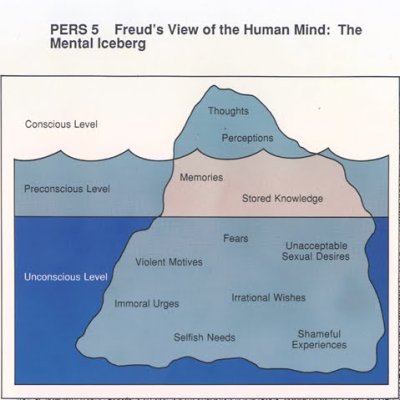
Salinger’s writing in greater detail in the next chapter. The pictures below map the human
mind as “The Mental Iceberg” and might provide some help in understanding the theory.
37 J.D. Salinger, 18
38 Kendra Cherry. “The Id, Ego and Superego: The Structural Model of Personality”. Accessed 10 April 2012.
<http://psychology.about.com/od/theoriesofpersonality/a/personalityelem.htm>
39 Cherry., internet
40 Cherry., internet.
41 “Critical Psychological Analysis Of Literature”. Accessed 11 April 2012.
<http://www.essortment.com/critical-psychological-analysis-literature-61188.html>
42 Paul Smith, ”Hemingway's Early Manuscripts: The Theory and Practice of Omission, ”
Accessed 22 April 2012 < http://www.jstor.org/stable/3831126?seq=1>

13
43 44
Freud called the largest part of the mind, the id, the pleasure-principle or the
unconscious level because it remains hidden from public view. This is where the individual
stores his fears, unacceptable sexual desires, immoral urges, selfish needs, shameful
experiences, and violent motives. Sometimes the id pokes through the “waterline”, but in
most psychologically well-adjusted people, this is balanced by the two other elements. This is
not the case in Seymour’s psyche in “A Perfect Day for Bananafish.” As Alsen points out
there are basically two types of interpretations of the story. One relies on “psychological
interpretations and are based exclusively on close readings of the short story”; the other one
on “philosophical or religious ones that consider information about Seymour Glass from later
stories. One type of interpretation tends to see Seymour Glass as a psychotic, the other as a
victim or even a saint”.45
First we have critics that see Seymour as a negative character and focus on the sexual
theme at the story’s beginning with Muriel reading the article “Sex Is Fun - or Hell”, bringing
to mind Dostoevsky’s quote mentioned in “For Esmé - With Love and Squalor”: “What is hell?
I maintain that it is the suffering of being unable to love.” Fredrick Gwynn and Joseph Blotner,
the authors of The Fiction of J.D. Salinger, see Seymour as a negative character and they
argue that, “Seymour is destroyed by his own hypersensitivity pathetically heightened by lack
of love.” By love they mean sexual love, for they identify “Seymour’s sexual inadequacy” as
43 “Freud’s View of the Human Mind: The Mental Iceberg.” Accessed 11 April 2012.
<http://24.media.tumblr.com/tumblr_lyy8tmCtQR1rp1j4do1_400.jpg>
44 “Freud’s Conception of the Human Psyche.” Accessed 11 April 2012
<http://allpsych.com/images/iceberg.gif>
45 Alsen, 94

14
the story’s “underlying motif.”46 Dostoevsky would argue that Seymour is experiencing hell
because of his inability to love.
Frank Metcalf also explains Seymour’s suicide by pointing to his sexual problems,
arguing that the bananafish represents the young Sybil Carpenter because she is wearing a
yellow bathing suit; he maintains that Seymour’s suicide is the result of his guilt because of
his “sublimated pedophilic desires.” Metcalf concludes: “The nearly conscious desires
expressed in his bananafish story and his erotic pretense with the girl are made fully conscious
to him by Sybil’s innocent responses to his story and to the kiss on her foot. The only
solution … is suicide.”47 Metcalf does have a point. Seymour only disrobes in front of her,
something he will not even do in front of his wife, repeatedly puts his hands on Sybil’s ankles,
asks her to come closer, creates the story about bananafish swimming into a “banana hole”
which are disturbingly phallic, and finally he kisses her feet.
Seymour’s desire to connect with Sybil is evident, but not all are convinced that he is a
pedophile and or that his id has some unacceptable sexual desires towards Sybil. He does tell
her that she has enough fun and instructs her to return to the hotel. Although hand-kissing can
mean romance or humility, kissing another person’s feet is a considered to be only an act of
humility. It also has a biblical reference, as Luke writes about the sinful woman that kissed
the feet of Jesus to show her subordination and her desperate attempt to be saved.48 Based on
this logic Sybil can be viewed as Seymour’s savior; but, when she brings him back to reality
with a simple “Hey”, he realizes that he is beyond salvation and repair.
There are also some critics that maintain that feet represent the soul, as they serve to
support the entire body and keep it upright.49 The reason for Seymour’s affection for Sybil
could be because he believes her soul to be innocent and that he wants to connect with it; she
is also alienated and does not seem to connect with her disinterested mother. She does not
judge or realize that Seymour is ill, keeps an open mind, and is willing to participate in
Seymour’s imaginary story. This could also be the reason for his attraction to Sharon as he
46 Frederick L. Gwynn, and Joseph L. Blotner, The Fiction of J.D. Salinger (Pittsburg:U of Pittsburgh, 1958.),
19-20 (as cited in Alsen, 94).
47 Frank Metcalf, “The Suicide of Salinger’s Seymour Glass,” Studies in Short Fiction 9 (Summer 1972): 246 (as
cited in Alsen, 94)
48 King James Bible Online. Accessed 13 April 2012. <http://www.kingjamesbibleonline.org/Luke-7-38/>
49 Wor. H. Meij. “Barefoot”. Accessed 10 April 2012. <
http://cointrade.awardspace.com/MasonicKnowledge/Barefoot.html>

15
explains to Sybil: “She’s never mean or unkind. That’s why I like her so much.”50 Seymour
mistakes the color of Sybil’s bathing suit, “If there’s one thing I like, it’s a blue bathing suit,”.
The color blue is often associated with the Virgin Mary, who is often depicted in paintings as
wearing blue, and with girls who have similar pure qualities. In addition, it is the color that
usually indicates life and, purity, just as water does. 51 Seymour himself is wearing “royal
blue” trunks when they go into the water, perhaps a reference to his desperate attempt to
regain his innocence after the war.
It is also fitting that he tells Sybil the story about bananafish that are living under the
“waterline”, away from public view, or, as Freud would explain, in the id. There are some
critics, among them Kenneth Hamilton, Alfred Kazing, and Eberhard Alsen, “that identify the
bananafish (prual) of the title as the materialistic people who surround Seymour and their
banana fever as the materialism which kills their soul”.52 Although their argument does have
some foundation, the strongest argument is provided by William Wiegand who examines the
central symbol of the bananafish in his essay entitled “Seventy-eight Bananas.” Many critics
agree with his argument that Seymour himself is the bananafish because “he has become so
glutted with sensation that he cannot swim out into society again. It is his own banana fever”53;
Wiegand continues to argue that “banana fever” is caused by “the weight of his experience”
and by “a psychological conflict between the desire to participate in and the need to withdraw
from society.”54 The second cluster of post-traumatic stress disorder symptoms comes to mind
when we read about “banana fever” and symptoms such as feeling estrangement from others,
which clearly shows itself in Seymour’s relationships with his wife, her family, and other
hotel guests.
Seymour’s experiences in the war have made him a person who may “completely lose
control of himself”. The “banana hole” could symbolize the foxholes Seymour fought in
during the war, or simply war in wider context, and “eating a banana” could symbolize killing
a person. Seymour gives us another look inside his troubled mind when he mixes “memory
50 J.D. Salinger, 15
51 Michael Thomas, “Symbolism: Colors, ” Accessed 12 April 2012. <http://www.three-
musketeers.net/mike/colors.html>
52 Alsen, p. 94
53 William Wiegand, ”Seventy-eight Bananas,” p.6. Accessed 12 April 2012
<http://www.jstor.org/stable/25293391?seq=6> (Also cited in Alsen, 94)
54 Wiegand, 12-13.

16
with desire,”55 the preconscious level, or super-ego with the unconscious level, the id. He is
mixing shameful experiences and irrational wishes with stored knowledge and memories. At
this point in the story he is experiencing an extreme case of post-traumatic stress and
depression, or as Sigmund Freud argues in The Ego and the Id:
The fear of death in melancholia only admits of one explanation: that the ego gives
itself up because it feels itself hated and persecuted by the super-ego, therefore, living
means the same as being loved- being loved by the super-ego, which here again
appear as the representative of the id. The super-ego fulfills the same function of
protecting and saving that was fulfilled in earlier days by the father and later by
Providence or Destiny. But, when the ego finds itself in an excessive real danger
which it believes itself unable to overcome by its own strength, it is bound to draw the
same conclusion. It sees itself deserted by all protecting forces and lets itself die….
The great significance which the sense of guilt has in the neuroses makes it
conceivable that common neurotic anxiety is reinforced in severe cases by the
generating of anxiety between the ego and the super-ego (fear of castration, of
conscience, of death). 56
Seymour’s ego has let itself die and he feels unable to continue living a life where the
id, which contains his shameful experiences, fears and violent motives, has taken control of
his thoughts and perceptions. He finds himself living in Dostoevsky’s hell: unable to love his
wife or even his own ego. His preconscious level, or super-ego, which stores his knowledge
and his traumatizing memories, and the id have taken over. As Freud explains in greater detail:
The id, to which we finally come back, has no means of showing the ego either love or
hate. It cannot say what it wants… Eros, [Greek God of love] and the death instinct
struggle within it …..It would be possible to picture the id as under the domination of
the mute but powerful death instincts, which desire to be at peace and (prompted by
the pleasure principle) to put Eros, the mischiefmaker, to rest; but perhaps that might
be to undervalue the part played by Eros.57
Essentially Seymour desires to be at peace and avoid the war which is going on in his
mind. He is so haunted by guilt and terrifying experiences from the past that his desperate
55 J.D. Salinger, 13
56 Sigmund Freud, The Ego and the Id, standard edition (New York: W. W. Norton, 1990), 61.
57 Freud, 62.

17
attempts to regain his sanity and balance in post-war society are useless. He is showing
symptoms of PTSD and has “completely lost control of himself”. As Wiegand and Seymour
himself conclude “the ‘perfect day’ is the day when the bananafish is able to end all his
suffering by killing himself.” 58 His creator attempted to find another way out of the “banana-
hole” and the next chapter will focus on J.D. Salinger’s influences and writing style.
4. Influences on J.D. Salinger’s writing and style
Unsurprisingly, examining Salinger’s early works brings to light his fondness of his friend
Ernest Hemingway’s style of writing, using few words for a “less is more” approach type to
writing. Hemingway believed the true meaning of a piece of writing should not be evident
from the surface story because the crux of the story lies below the surface. In Death in the
Afternoon he elaborates,
If a writer of prose knows enough about what he is writing about, he may omit things
that he knows and the reader, if the writer is writing truly enough, will have a feeling
of those things as strongly as though the writer had stated them. The dignity of
movement of an iceberg is due to only one-eighth of it being above water.59
Their short stories also have two similar themes, bad marriages in which there are no
meeting of minds between couples, and most notably, the psychological effects of war:
Salinger in “For Esmé with Love” and “A Perfect day for Bananafish”, and Hemingway in his
short stories “Now I Lay Me”, “In Another Country”, and “A Way You’ll Never Be”.
When comparing Salinger’s “A Perfect Day for Bananafish” to other works of
literature it also becomes evident that he studied F. Scott Fitzgerald. In 1920 Fitzgerald
published the novelette “May Day”, where the ending describes the “irrevocably married”
main character Gordon Sterret taking a revolver to his hotel room and firing a shot “just
behind the temple.”60 The ending is strikingly similar to the style and ending of “A Perfect
Day for Bananafish.”
In the mid-1940s Salinger started to develop the whimsical style, meaning
spontaneous writing, that eventually found full expression in his work after the publication of
58 Wiegand, 7.
59 Ernest Hemingway, Death in the Afternoon (London: Grafton Books, 1986),170-171.
60 F. Scott Fitzgerald, “May Day,” Accessed 11 April 2012.
<http://www.sc.edu/fitzgerald/mayday/mayday.html>

18
his most successful and famous novel, The Catcher in The Rye; and, in his alter ego Buddy
Glass, a recluse and a writer and the narrator of the Glass family series, whom Salinger credits
as the author of most of his work including “A Perfect Day for Bananafish”, and The Catcher
in the Rye. In 1953, after the success of his novel, Salinger decided to retire from society and
move into an un-winterized farmhouse deep in the woods of upstate New York, not far from
the Canadian border.61 This move would ultimately lead to Salinger’s mental decline, which is
echoed in Shapiro and Forrest statement that “retirement seems to trigger the same feelings of
isolation and lack of control that they [veterans] experienced in combat, and with those
feelings come to the haunting mental images of the battlefield.”62
Sadly the farmhouse became Salinger’s “banana hole” and his “banana fever”
symptoms progressed. Salinger started experimenting with health regimens, such as drinking
urine or sitting in an orgone box.63 He also became preoccupied with religious ideas derived
from Vedanta Hinduism, Taoism, and Zen Buddishm which show up in his Glass family
novellas “Zooey” (1957), “Seymour - An Introduction” (1959), and “Hapsworth” (1965).
The novellas all received more negative than positive reviews and although Stanley
Edgar Hyman stated that “Salinger is the most talented fiction writer in America,” he also
acknowledged that the decline of Salinger’s fiction from “one of the finest short stories in our
time, ‘A Perfect Day for Bananafish,’ to one of the most boring ever written, ‘Seymour - An
Inroduction,’ is appalling.”64
This radical change in style and increasing eccentricity become apparent in the
Seymour Glass stories “A Perfect Day for Bananafish” (1948) and the last story he ever
published “Hapsworth 16, 1924” (1965). As Alsen explains: “The style of the story [‘A
Perfect Day for Bananafish,’] adds to its compactness, for it has a Flaubertian polish that
reveals painstaking craftsmanship and innumerable revision. Every word is le mot juste, and
there is virtually not a sentence in the whole story that can be omitted without changing the
overall meaning. By contrast, the form of Hapsworth 16, 1924 is in every respect the
opposite.”65
61 Alsen, 11
62 Shapiro and Forrest, pp. 31-32.
63 M. Salinger, 194
64 Alsen, 166
65 Alsen, 242

19
Salinger died at the age of 91, on 27 January 2010. His literary representative, Harold
Ober Associates, announced the death, saying it was of natural causes. “Despite having
broken his hip in May,” the agency said, “his health had been excellent until a rather sudden
decline after the new year. He was not in any pain before or at the time of his death.”66
From examining the sources available and knowing that Salinger was living as a
recluse until his death, we can conclude that he did not receive cognitive-behavioral therapy
or group therapy (which are generally felt to be a more promising treatment for PTSD); and,
that he indeed suffered from post-traumatic stress disorder, the lingering effects of which are
well depicted in the veterans Sergeant X and Seymour Glass in “For Esmé - with Love and
Squalor” and “A Perfect Day for Bananfish.” Sadly, the evidence points to the fact that the
mental health of this great craftsman had not been excellent until the year 2010 when he again
became “a man with all his fac – with all his f-a-c-u-l-t-i-e-s intact.”67
Conclusion
Although post-traumatic stress disorder is widely acknowledged to be a severe type of anxiety
disorder and very much a real disease, there still are skeptics. Among them is Derek
Summerfield, a psychiatrist who has flatly denied that PTSD exists and argues that the PTSD
is infact invented.68 The historian Ben Shephard also draws the same conclusion in his book A
War of Nerves: Soldiers and Psychiatrists,69 on the basis of his studies of the conceptual
development of the diagnosis of trauma. Although there are skeptics who deny the existence
of PTSD, they remain few and far between and fail to make a convincing argument.
The fact that PTSD is both officially recognized and widespread, however, does not
mean that it is fully understood and the question of how to best treat it is guaranteed to raise
hackles in the world of psychotherapy.70 What the experts do agree on is that it is very
difficult to cure. According to a study conducted in 2008 by RAND Corporation, nearly 20%
of military service members who have returned from Iraq and Afghanistan — 300,000 in all
66 Charles McGrath, “J. D. Salinger, Literary Recluse, Dies at 91,” Accessed 11 April 2012.
<http://www.nytimes.com/2010/01/29/books/29salinger.html?_r=1>
67J.D. Salinger, 114.
68 Derek Summerfield, “The invention of Post-Traumatic Stress Disorder and the social usefulness of a
psychiatric category, ” British Medical Journal 322 (2001), 94-95 (as cited in Jolande Withuis, “Does PTSD
Really Exist? On Trauma, Trauma Culture, and Trauma Abuse”). Accessed 12 April 2012.
<http://www.niod.knaw.nl/documents/publicaties/NIODWithuisPTSD.pdf>)
69 Ben Shephard, A War of Nerves. Soldiers and Psychiatrists 1914-1994 (London: Jonathan Cape, 2000). (As
cited in Withuis)
70 Shapiro and Forrest, 32

20
— report symptoms of post-traumatic stress disorder or major depression, yet only slightly
more than half have sought treatment.71 We still hear and read horrifying stories in the news
about service men and ex-service men that suffer from PTSD and do not get the appropriate
treatment, e.g. the recent the case of Staff Sgt. Robert Bales, who is believed to have
slaughtered 17 Afghan civilians on the night of March 11, 2012. Dr. Harry Croft, former
Army doctor and psychiatrist, who has evaluated more than 7,000 veterans for PTSD, says the
rampage in Afghanistan means it is time for the military to take a closer look at the impact of
soldiers serving multiple tours of duty.72 Salinger’s stories of his troubled war veterans
Seymour Glass and Sgt. X are relevant for they show us how the characters’ experience war
and its aftermath. They are just as relevant as Homer’s Iliad, Hemingway’s short stories and
Virginia Wolf’s Mrs Dalloway, and can all be read as anti-war stories, with a strong, timeless
message.
Trauma can be caused by numerous experiences, ranging from something you feel
powerless to prevent, someone being intentionally cruel, or something that happened in
childhood.73 This means that we should take a wider perspective of Salinger’s stories because
they can also provide the reader with help in dealing with trauma and depression, or as
Salinger’s daughter expresses so eloquently in Dream Catcher:
The ways in which my father sought to reattach himself and characters to their
moorings, before I was, the ways he found to save them and himself from hell—“the
suffering of being unable to love”—is a central interest to me, as his daughter and as a
person who also has experienced her own mind “suddenly lurch and teeter like
insecure luggage on the overhead rack.” When and how my father and his character
reached out in a moment of personal crisis and re-established connection, or instead,
did the reverse and bolted the door.74
Regrettably, Salinger did both. He made his own “banana-hole”, consumed just about
every religion and pseudo-science health regimens on offer, as a desperate attempt to fight off
71 Terri Tanielian and Lisa H. Jaycox, “Invisible Wounds of War Psychological and Cognitive Injuries,Their
Consequences, and Services to Assist Recovery,” Accessed 12 April 2012
<http://www.rand.org/content/dam/rand/pubs/monographs/2008/RAND_MG720.pdf>
72 Suzanne Kianpour and David Willis, “Afghan rampage prompts PTSD debate in US military town,” Accessed
11 April 2012. <http://www.bbc.co.uk/news/world-us-canada-17440473>
73 Lawrence Robinson, Melinda Smith, and Jeanne Segal, “Healing Emotional and Psychological Trauma
:Symptoms, Treatment, and Recovery,” Accessed 11 April 2012.
<http://www.helpguide.org/mental/emotional_psychological_trauma.htm>
74 M. Salinger, 70-71.

21
his “banana fever” and regain his former health. In the end he “bolted the door” leaving
behind his faithful readers, supporters, and more importantly, the ones who truly counted on,
admired and loved him, most notably his daughter Margaret.
22
Bibliography
Alsen, Eberhard. A Readers Guide to J.D. Salinger. Westport: Greenwood, 2002.
Arcel, T. Libby. War violence, Trauma and the Coping Progress. Zagreb: Nakladništvo
Lumin, 1998.
Cherry, Kendra “The Id, Ego and Superego: The Structural Model of Personality.” 10 April
2012. <http://psychology.about.com/od/theoriesofpersonality/a/personalityelem.htm>
“Critical Psychological Analysis Of Literature.” 11 April 2012.
<http://www.essortment.com/critical-psychological-analysis-literature-61188.html>
Fitzgerald, F. Scott. “May Day.” 11 April 2012.
<http://www.sc.edu/fitzgerald/mayday/mayday.html>
Freud, Sigmund. The Ego and the Id. Standard edition. New York: W. W. Norton, 1990.
“Freud’s Conception of the Human Psyche.” 11 April 2012
<http://allpsych.com/images/iceberg.gif>
“Freud’s View of the Human Mind: The Mental Iceberg.” 11 April 2012.
<http://24.media.tumblr.com/tumblr_lyy8tmCtQR1rp1j4do1_400.jpg>
Gwynn, Fredrick L. and Blotner Joseph L. The Fiction of J..D Salinger. Pittsburgh: U of
Pittsburgh P, 1958.
Hemingway, Ernest. Death in the Afternoon. London: Grafton Books, 1986.
Homer. “The Iliad.” 11 April 2012. <http://classics.mit.edu/Homer/iliad.1.i.html>
Kianpour, Suzanne and Willis, David. “Afghan rampage prompts PTSD debate in US military
town.” 11 April 2012. <http://www.bbc.co.uk/news/world-us-canada-17440473>
“King James Bible Online”, 13 April 2012. <http://www.kingjamesbibleonline.org/Luke-7-
38/>
McGrath, Charles. “J. D. Salinger, Literary Recluse, Dies at 91.” 11 April 2012.
<http://www.nytimes.com/2010/01/29/books/29salinger.html?_r=1>
McNally, Richard J. Remembering Trauma. Cambridge: Harvard UP, 2003.
Meij, Wor. H. “Barefoot.” 10 April 2012. <
http://cointrade.awardspace.com/MasonicKnowledge/Barefoot.html>
Metcalf, Frank. “The Suicide of Salinger’s Seymour Glass.” Studies in Short Fiction 9
(Summer 1972): 246. 243-246.
Posset, Anton. “Die amerikanische Armee entdeckt den Holocaust.” Themenshefte
Landsberger Zeitgeschichte 2 (1993): 41
23
Robinson, Lawrence, and Melinda Smith, and Jeanne Segal. “Healing Emotional and
Psychological Trauma: Symptoms, Treatment, and Recovery.” 11 April 2012.
<http://www.helpguide.org/mental/emotional_psychological_trauma.htm>
Salinger, J.D. “A Boy in France, ” Saturday Evening Post (31 March 1945): 21
——. “Last Day of the Last Furlough,” Saturday Evening Post (15 July 1944): 61-62
——. Nine Stories. New York: Little, Brown and Company, 2001
Shapiro, Francine, and Margot S. Forrest. EMDR: The breakthrough therapy for overcoming
anxiety, stress and trauma. New York: Basic Books 1997.
Shephard, Ben. A War of Nerves. Soldiers and Psychiatrists 1914-1994. London: Jonathan
Cape, 2000.
Smith, Paul. “Hemingway's Early Manuscripts: The Theory and Practice of Omission, ”
22 April 2012 < http://www.jstor.org/stable/3831126?seq=1>
Skow, John. “Sonny: An Introduction.” Time (15 September 1961): 86-90
Summerfield, Derek. “The invention of Post-Traumatic Stress Disorder and the social
usefulness of a psychiatric category.” British Medical Journal 322 (2001): 94-95 (As cited in
Jolande Withuis. “Does PTSD Really Exist? On Trauma, Trauma Culture, and Trauma
Abuse.” 12 April 2012.
<http://www.niod.knaw.nl/documents/publicaties/NIODWithuisPTSD.pdf>)
Tanielian, Terri, and Lisa H. Jaycox. “Invisible Wounds of War Psychological and Cognitive
Injuries,Their Consequences, and Services to Assist Recovery.” 12 April 2012
<http://www.rand.org/content/dam/rand/pubs/monographs/2008/RAND_MG720.pdf>
Thomas, Michael. “Symbolism: Colors.” 12 April 2012. <http://www.three-
musketeers.net/mike/colors.html>
Wiegand, William. “Seventy-eight Bananas.” 12 April 2012 <
http://www.jstor.org/stable/pdfplus/25293391.pdf>