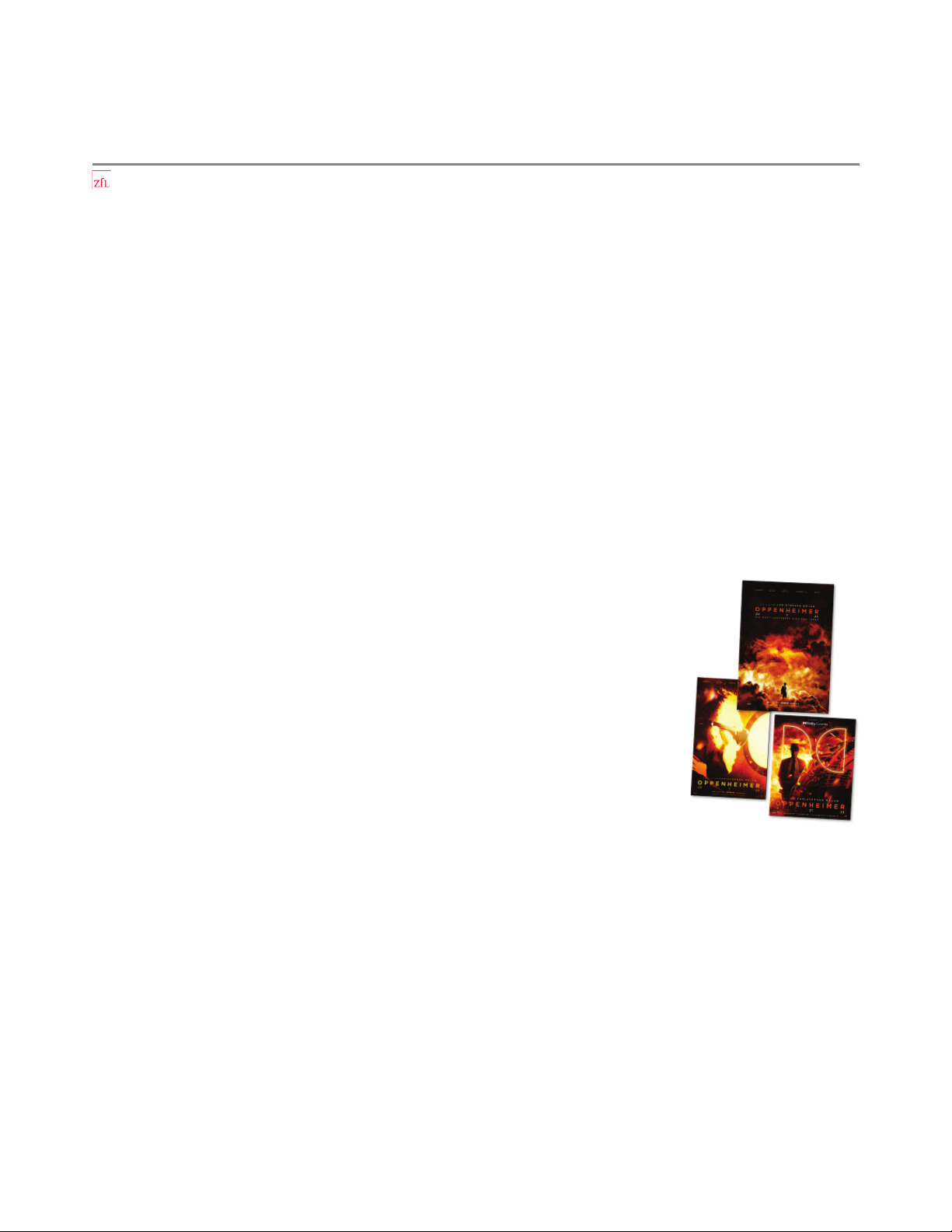
Christopher Nolan and the Contradictions of J. Robert Oppenheimer PDF Free Download
1 / 11/11
100%

The biopic director argues that the physicist who oversaw creation of the atomic bomb
was both the most important person who ever lived and hopelessly naïve.
By
Dennis Overbye
Dennis Overbye covers physics and astronomy for The Times. In 2021 he wrote about
visiting the Trinity
site
, where the first atomic bomb was exploded.
Published
July 20, 2023
Updated
July 21, 2023,
1:31 p.m. ET
With the biopic “
Oppenheimer
,” due July 21, the writer-director Christopher Nolan,
known for brain-twisting films like “Interstellar” and “Inception,” addresses an old
childhood dread — one based not on science fiction but on real science, namely the
threat of thermonuclear war and human annihilation.
The film follows the story of
J. Robert Oppenheimer
, the cerebral, charismatic and
tortured physicist (played by
Cillian Murphy
, the star of “
Peaky Blinders
”) who was
tapped to lead the Manhattan Project in Los Alamos, N.M., to build the atomic bomb
during World War II.
The subsequent bombing of Hiroshima and Nagasaki ended the war against Japan in
1945 (Germany had already surrendered) and Oppenheimer was hailed as a hero. But
only a few years later, in 1954,
his security clearance was revoked
in an infamous
hearing of advisers to the Atomic Energy Commission that declared him a security
threat based on leftist ties at the University of California, Berkeley — among other
things, a girlfriend and his brother, Frank, were both Communist Party members —
and his opposition to building an even bigger bomb, the “Super” or hydrogen bomb
espoused by his colleague Edward Teller.
That was the end of Oppenheimer's career in government circles and of his ability to
influence the future of atomic energy in the Cold War. As a result he became a martyr
to the scientific community. Many physicists, including Albert Einstein, were
disappointed that the United States had dropped the bomb without warning on an
enemy that was already defeated, while Oppenheimer hoped that the advent of the
bomb would make war unthinkable and lead to international controls on such weapons.
Once the Russians had the bomb, however, that dream had no chance with hard-liners
like the president at the time, Harry S. Truman, who called Oppenheimer a “crybaby.”
Christopher Nolan and the Contradictions of J.
Robert Oppenheimer
https://www.nytimes.com/2023/07/20/movies/christopher-nolan-
oppenheimer.html

The film’s huge cast includes Matt Damon as the crusty Maj. Gen. Leslie Groves, who
was in overall charge of the project, and Robert Downey Jr. as Adm. Lewis Strauss,
chairman of the Atomic Energy Commission. Strauss led the postwar charge against
Oppenheimer, and his nomination for secretary of Commerce under President Dwight
D. Eisenhower was killed by the Senate partly because of his role in Oppenheimer’s
downfall.
The movie, adapted from the Pulitzer Prize-winning biography
“American
Prometheus”
by Kai Bird and Martin J. Sherwin, is the most recent in a stream of
books, features and documentaries that have chronicled the tragic birth of atomic
weapons, including another Pulitzer Prize winner, “The Making of the Atomic Bomb,”
by Richard Rhodes; a seven-part BBC series, “Oppenheimer”; “Fat Man and Little
Boy,” starring Paul Newman as Groves; another documentary, “The Trials of J. Robert
Oppenheimer”; and even a John Adams opera, “Doctor Atomic.” (The director is well
aware that his film faces another rival, “Barbie,” opening on the same day, and offered
a “no comment” on the choice facing filmgoers.)
Over tea at his office in a quiet residential neighborhood in Los Angeles, Nolan
discussed why he thought Oppenheimer was the most important person who ever
lived, choosing between myths and the record, Cillian Murphy’s haircut and how he
came to make this movie. These are edited excerpts from our conversation.
In the production notes you say, “Like it or not, J. Robert Oppenheimer is the most
From left, Cillian Murphy, Olli Haaskivi, Matt Damon and Dane DeHaan in a scene set at Los
Alamos.
Melinda Sue Gordon/Universal Pictures

important person who ever lived.” Why?
In Hollywood, we’re not afraid of a little hype. Do I genuinely believe it? Absolutely.
Because if my worst fears are true, he’ll be the man who destroyed the world. Who’s
more important than that?
Maybe the man who pushed the button that did destroy the world.
Got to have a button to push.
I think it’s very easy to make the case for Oppenheimer as the most important person
who ever lived, because he is the person who facilitated and achieved atomic weapons
and indeed the hydrogen bomb, because he let Teller work on it. So he is the individual
who was able to marshal the forces effectively.
Is there a parallel universe in which it wasn’t him, but it was somebody else and that
would’ve happened? Quite possibly. That’s the argument for diminishing his
importance in history. But that’s an assumption that history is made simply by
movements of society and not by individuals. It’s a very philosophical debate.
Apparently within about 15 minutes of hearing that the atom had been split, he was
suggesting that you could make a bomb in a chain reaction. But I think a lot of
scientists had that same, “Oh, this could be a bomb.”
His story is central to the way in which we live now and the way we are going to live
forever. It absolutely changed the world in a way that no one else has changed the
world. You talk about the advent of the printing press or something. He gave the world
the power to destroy itself. No one has done that before.
That’s a pessimistic view if his invention actually ended the world. If it didn’t, he’s still
the most important man because the bomb would’ve stopped war forever. We haven’t
had a world war since 1945 based on the threat of mutual assured destruction.
So there are two ways of looking at this contribution. And we don’t know which one is
right. A lot of what he said about arms control and the way in which events would
unfold has proven to be absolutely true. A lot of it has also seemed hopelessly naïve.
This is a story that doesn’t have an ending yet.
For better or for worse, I really believe him to be one of the more clearly ambiguous
figures in history.

The burning question that I have is why? Why Oppenheimer now? I mean, this is a
story I’ve grown up with my whole life as a child of the nuclear age.
There are certain stories that you want to kind of wait until you feel ready to tell them.
[This] story is one that I’ve known about since I was a kid growing up in the shadow of
nuclear weapons in the early ’80s in the United Kingdom. It was very much in the pop
culture. It was the days of the
Campaign for Nuclear Disarmament
and protests of
Greenham Common
and about the stationing of nuclear cruise missiles. For me, it’s
always seemed one of those stories that I don’t think it’s been told in any definitive
movie sense. And yet it’s one of the most important and dramatic stories there are.
So reading “American Prometheus” — it’s such a well-researched and well-told book —
gave me confidence. That could be the basis, you know, of a film or a screenplay.
It seems like nuclear dread has come back
.
I was talking to Steven Spielberg about this recently. He grew up at the time of the
Cuban Missile Crisis, the ’60s, high Cold War. It was a period in which there was an
enormous amount of fear. And then the wave I described in the early ’80s. A lot of
things pop culturally came out of that, including Sting’s song,
“Russians,”
about global
tensions, that refers to “Oppenheimer’s deadly toys.”
I think our relationship with nuclear weapons in pop culture is very complicated, and it
Murphy as Oppenheimer. “The film certainly tries to embrace the iconic nature of who the
man was but also understand that it’s self creative and self-conscious,” Nolan said.
Universal
Pictures
ebbs and flows. When I first told one of my teenage sons what I was writing, he
literally said to me, that’s just not something anybody worries about anymore.
I went to the book to fact-check the movie and was surprised to read that Truman
really did call him a crybaby.
Doesn’t seem very presidential, does it?
Given recent history it sounds very presidential to me. That was an enormous
dramatic point in the film for me because it just made it so completely clear how badly
Oppenheimer had misled himself.
That’s a good way of putting it. There are different accounts of that meeting, but these
are things that Truman recollected.
I feel it’s only fair to present things the way he saw ’em. Because in that moment,
you’re looking for a huge shift in perception about the reality of Oppenheimer’s
situation. Those two men come into that room with completely different expectations
about what that meeting is. And I think that was a massive moment of disillusion, a
huge turning point [for Oppenheimer] in his approach to trying to deal with the
consequences of what he’d been involved with.
It’s hard for me to not think that Oppenheimer could be accused of taking himself too
seriously. All these comments, “the physicists have known sin” and “
I am become
death
.” Do you think he was trying to have it both ways, like, we want to build this
fantastic gadget, but then we want to be stopped from using it. It’s kind of like a serial
killer saying catch me before I kill again.
Or like a tech-company scientist saying, regulate me, please.
I think there is a very high degree of self-consciousness, self-awareness, particularly
the way he presents himself to the world. And I think he had an incredible strategic
mind. He could be accused of naïveté in a lot of ways, but it’s the sort of naïveté, the
mistakes he made were the sort of mistakes that only the most brilliant strategic
people could make, because they think they’re smarter than everybody else. They
don’t necessarily read the room exactly as they should.
The film certainly tries to embrace the iconic nature of who the man was but also
understand that it’s self creative and self-conscious.
The other thing I wondered: How much of his opposition to the Super was because it
had been Teller’s idea?
That’s pretty harsh, but you put your finger on something really important that I hope
is there in the texture of the film, which is how the personal interacts with the historic
and the geopolitical. Would this have happened anyway without this individual?

In “American Prometheus,” when you realize that Los Alamos in New Mexico was just
a place that he liked to go camping with his brother, it’s just beautiful.
And the first thing he does as director is sequester the best physicists in the U.S. in a
sort of intellectual boot camp in his beloved New Mexico.
He made that happen. So the manner in which atomic energy was unleashed on the
world was certainly very personal to Oppenheimer. And that provides great drama as
it applies to his relationships. There’s an enormous amount of camaraderie and a
clubbish atmosphere in the scientific community, but huge rivalries and jealousies. It
was a very competitive field.
With disastrous consequences; the world is now full of H bombs on submarines,
missiles and bombers, 45 minutes from Armageddon.
That’s where you have different spheres of influence and different scientists appealing
to different aspects. What you see in the early ’50s is Oppenheimer trying to align
himself with the Army as opposed to the Air Force. The Air Force program was all
about genocidal hydrogen bombs, and Oppenheimer came up with this tactical new
approach, bring battle back to the battlefield. He pivoted to play the Army against the
Air Force. The lesson that I think is very interesting is that he was very, very strategic
in his thinking and still got crushed and still came across as naïve.
Truman called Oppenheimer a crybaby. The physicist “was very, very strategic in his
thinking and still got crushed and still came across as naïve,” Nolan said.
Universal Pictures

I think Oppenheimer’s ambition exceeded his intellect, even though he was one of the
most brilliant people. He wasn’t the best mathematician. He wasn’t the top quantum
physicist. He was in the top, but he wasn’t the actual top. He hadn’t won a Nobel Prize
like a lot of his contemporaries. But his ambition was to be the best, the most famous. I
think that quality of ambition coupled with his understanding of scientists, he knew all
of them. He was a very charming person.
He clicked with Groves, who didn’t even seem to like scientists.
Nobody thought Oppenheimer was the right guy to run Los Alamos except Groves,
which is kind of amazing.
How did that work?
I was able to put Kip Thorne [the Caltech physicist and Nobel laureate!who was an
executive producer of “Interstellar”] on the phone with Cillian. When Kip was at
Princeton, he was able to attend seminars at the Institute for Advanced Study, which
Oppenheimer ran. So Kip was able to speak to how Oppie would allow a sort of group
discussion to take place and then step in at just the right moment to summarize.
Apparently he could do this very quickly. He could summarize something very long
and complex that a fellow scientist had said, then move the discussion to the next
stage.
That quality of orchestration was necessary for such a vast project to become a
success.
Is this like what a movie director does? You corralled an enormous number of top
actors for this movie.
Each actor was coming to the table with research about what their real-life counterpart
had been. They had tons of homework to do. [Laughs] They had a great resource with
“American Prometheus.” They then did their own research and what it meant for me,
which isn’t something I’d ever really been able to do in the past. So, for example, with
the scene in the section classroom with all the scientists, we would be able to improvise
the discussion. The script is there, but they could come into it with passion and
knowledge based on all of their own learning.

Were there any surprises for you in the way the actors played their parts?
It was a continual process of surprise. Sometimes you’d have a really invigorating
discussion about what’s really going on, because this is a story where people’s
behavior, political or personal, is riddled with ambiguities.
For example, there’s a moment where James Remar, who played [Henry L. Stimson,
Truman’s secretary of war], kept talking to me about how he learned that Stimson and
his wife had honeymooned in Kyoto. And that was one of the reasons that Stimson took
Kyoto off the list to be bombed.
I had him crossing the city off the list because of its cultural significance, but I’m like,
just add that. It’s a fantastically exciting moment where no one in the room knows how
to react.
How do you shoot with such a giant cast and so many locations?
Anytime you get into myriad locations, a lot of different actors, it’s always going to be a
puzzle. I did insist on scheduling it around Cillian’s haircut. [Laughs] Because I’m very
allergic to wigs in movies. I really wanted the film to not have any obvious artifice
when it came to the way characters presented themselves.
One of the key moments that really hooked me on the story, which I referred to in my
last movie, “Tenet” [2020], was this idea that when the scientists did their calculations,
they couldn’t completely eliminate the
possibility that they might set fire to the
Nolan on the set with Murphy. The actors brought their own research to the shoot.
Melinda
Sue Gordon/Universal Pictures
atmosphere
and destroy the world. And they went ahead and pushed that button. But
my feeling was, what if you could be in that room? What would that be like?
How do they feel about that? You can minimize that and say they thought it was a tiny
possibility. But having done a lot of giant explosions on film sets myself, where safety is
the absolute most important thing, the tension around those ignitions is unbelievable.
It’s very hard for the special effects guys to quantify to us exactly how it’ll sound,
exactly how it’ll look. So as that countdown comes, it’s incredibly tense, and
extrapolating that to the Manhattan Project, to the Trinity test, I couldn’t even imagine.
I was excited to try to give the audience a feel of that, to live in that room.
In this case, it worked and the world survived. Who did that calculation?
It came from Teller. One of the few things I’ve changed is it wasn’t Einstein who
Oppenheimer went to consult about it, it was Arthur Compton who directed an outpost
of the Manhattan Project at the University of Chicago. But I shifted that to Einstein.
And Einstein is the personality people know in the audience. But the calculation came
from Teller. And I think he took almost the perverse kind of pride, you know? Those
are the nature of the discussions. Horrifying.
At the time, Oppenheimer and Einstein were on opposite sides of an argument that
what we now call black holes could exist. Einstein said no, Oppenheimer said yes. In
that scene by the pond, they just walked past each other in silence, which I interpreted
as the tension in that disagreement.
I saw the relationship between them as very much one of the master who’d been
supplanted and whose work had been taken over by the younger. That to me is the
fundamental thing going on in the film.

Oppenheimer does come across in the movie as a tremendously tortured person, and
sparks always seem to be going off in his head.
Well look, the film is my interpretation of his life. I wanted it to be a strong
interpretation, a very personal interpretation. I didn’t want to make a documentary. As
far as the adherence to the historical record, I think the film is much more accurate
than people will imagine. A lot of the things that potentially seem like contrivances
turn out to be true.
A quick question about the Trinity test, when Oppenheimer, Groves and the physicists
and engineers set off the first nuclear bomb. How did you get that shot? Was some of it
old footage from the test itself?
The way we approached [the] Trinity test was to forgo computer graphic imagery
because I think computer graphics are inherently a bit safe, a bit anodyne, so I
challenged my effects crew to come up with analog, real-world types of imagery that
we could use to pull this off because we knew the Trinity test had to be a showstopper
in the film. Some of the things they came up with were extremely small and
microscopic that play as bigger. Some were absolutely massive and required all kinds
of complicated safety protocols and involved the actors in some very small version of
what it must have been like to be there out in the desert at night in those bunkers
waiting to detonate that device.
It’s hard to believe you ginned this up in the short time since “Tenet.”
Tom Conti as Einstein opposite Murphy. In the film, Oppenheimer consults the eminent
physicist, but in reality he consulted another colleague.
Melinda Sue Gordon/Universal Pictures
I wrote the script relatively quickly once I started writing, but I had a lot worked out
beforehand.
Many years ago, I had written a script about the life of Howard Hughes that never got
made because I wrote it right as Scorsese was making his own film. [Laughs] But I
cracked the script to my satisfaction, and that gave me a lot of insight on how to distill
a person’s life and how to view a person’s life in a thematic way, so that the film is more
than the sum of its parts. So in some ways, the script, yes, it took me a few months, but
it was really a culmination of 20 years of thinking.
As I do interviews and the film’s coming out, I’m always asked, do you know what
you’re doing next?
And the answer is always the same. For me, I do one thing at a time and I put
everything into it obsessively, and the film is not finished. Well, the way I like to put it
is, the audience finishes the film.
So when the film goes out in cinemas that’s when the film is done and it becomes what
it’s going to be in the culture. And that usually has a profound impact on where I go
next. It’d be much more sensible to work on three things at once and have the next
thing all lined up. A lot of filmmakers do that. I’ve just never been any good at it.
Dennis Overbye
joined The Times in 1998, and has been a reporter since 2001. He has written two books:
“Lonely Hearts of the Cosmos: The Story of the Scientific Search for the Secret of the Universe” and “Einstein
in Love: A Scientific Romance.”
More about Dennis Overbye