IP Alert: Supreme Court Weighs in on Apparel Design Copyrightability in Star Athletica v. Varsity Brands PDF Free Download
1 / 4/4
100%

Supreme Court Weighs in on ApparelSupreme Court Weighs in on Apparel
Design Copyrightability inDesign Copyrightability in
Star Athletica v. Varsity Brands
By Darrell G. Mottley
On March 22, 2017, the U.S. Supreme Court, in a 6-2 decision, affirmed the August 2015,
ruling by the U.S. Circuit Court of Appeals for the Sixth Circuit in Star Athletica LLC v. Varsity
Brands Inc., and affirmed that two-dimensional graphic designs are entitled to copyright
protection as “pictorial, graphic, and sculptural works” under the copyright law for useful
articles under certain circumstances. This is the first time the U.S. Supreme Court has ruled
on copyright protection for apparel.
Why is this case important?Why is this case important?
Fashion is part of the creative economy. The fashion and apparel design sector brings
together fashion creatives, executives, and entrepreneurs in more than 200 countries.
According to industry reports, fashion is a more than $1.2 trillion global business with more
than $250 billion spent yearly in the United States. Copyright protection for fashion design
has been difficult to obtain and is very limited, mainly due to previous copyright rulings
that clothing designs are utilitarian or functional.
Background –Background – Varsity Brands v. Star Athletica
Despite the general reluctance to grant copyright protection to apparel designs, Varsity
Brands, Inc., received U.S. copyright registrations for several of its cheerleading uniform
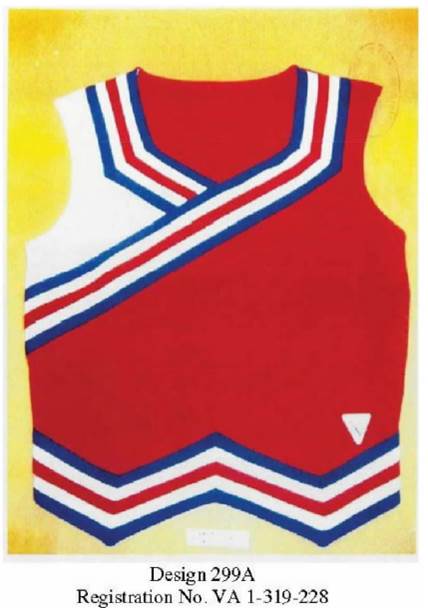
designs for “two-dimensional artwork.” The Varsity designs included graphical elements
such as stripes, chevrons, zigzags, and colorblocks.
IP Alert: Supreme Court Weighs in onIP Alert: Supreme Court Weighs in on
Apparel Design Copyrightability in StarApparel Design Copyrightability in Star
Athletica v. Varsity BrandsAthletica v. Varsity Brands
https://bannerwitcoff.com 1

Varsity Brands’ copyrighted
design
Star Athletica also sold cheerleading uniforms. Star Athletica advertised cheerleading
uniforms that were similar in appearance to Varsity’s designs, and so Varsity sued for
copyright infringement based upon their registered designs.
The district court ruled that Varsity’s copyrights of the arrangement of stripes, chevrons,
zigzags, and colorblocks of cheerleader uniform designs were invalid because the noted
arrangement was not separable from the uniforms. Dissatisfied with the result, Varsity
appealed the district court’s judgment to the U.S. Court of Appeals for the Sixth Circuit. On
August 19, 2015, Varsity prevailed at the Sixth Circuit. The district court’s judgment was
vacated and Varsity won on the issue of whether the designs are copyrightable pictorial,
graphic, or sculptural works. On May 2, 2016, the Supreme Court agreed to review the
appellate court decision.
The Separability Test Explained and Examined by the Supreme CourtThe Separability Test Explained and Examined by the Supreme Court
The difficult hurdle for copyright protection of clothing designs as useful articles is to pass
the so-called “separability” test. The separability test permits copyright protection only if,
and to the extent that, the design incorporates graphic, pictorial, or sculptural features that
are conceptually or physically separable from the utilitarian aspects of the article. 17 U.S.C.
§101. Courts have struggled to formulate an effective test for determining conceptual
separability. The Supreme Court in Star Athletica now sets forth a new two prong test —
A feature incorporated into the design of a useful article is eligible for copyright
protection only if the feature (1) can be perceived as a two- or three-dimensional work of
art separate from the useful article and (2) would qualify as a protectable pictorial,
graphic or sculptural work — either on its own or fixed in some other tangible medium
of expression — if it were imagined separately from the useful article into which it is
incorporated.
In applying the new test, which is strikingly the same as the statutory language in the
Copyright Act, the Court rules that “the designs on the surface of the respondents’
cheerleading uniforms in this case satisfy these requirements.” However, while the two-
dimensional surface decorations are protectable, the Court explicitly confirms that the new
test “does not render the shape, cut, and physical dimensions of the cheerleading uniforms
eligible for copyright protection.” Further, the Court notes that Varsity’s copyrights “may
prohibit only the reproduction of the surface designs in any tangible medium of expression
— a uniform or otherwise.”
The Court in reaching its decision rejected several arguments advanced by Star Athletica to
https://bannerwitcoff.com 2

invalidate the cheerleader uniform designs of Varsity. As advanced by Star Athletica, the
broad definition of “utility” is that the uniform identifies the wearer as a cheerleader or
member of cheerleading team. Hence, the feature of the uniform would not be separable
from the utilitarian aspect. The Court rejected this line of reasoning stating that “[t]he focus
of the separability inquiry is on the extracted feature and not on any aspects of the useful
article that remain after the imaginary extraction.” Additionally, the Court rejected Star
Athletica’s argument that there must be a nexus of marketability of the pictorial, graphic,
or sculptural feature separated from the useful article. Finally, the Court rejected Star
Athletica’s argument that copyrightability of pictorial, graphic, or sculptural features must
be based on an inquiry of whether the designer’s artistic intent, methods, reasons, and
purposes were exercised independently of functional influences.
The DissentThe Dissent
Writing for the dissent, Justice Breyer did not agree that Varsity’s designs are eligible for
copyright protection. He writes that “[e]ven applying the majority’s test, the designs cannot
“be perceived as . . . two-or three-dimensional work[s] of art separate from the useful
article.” He writes that under the first prong of the new test —
“You will see only pictures of cheerleader uniforms. And cheerleader uniforms are useful
articles. A picture of the relevant design features, whether separately “perceived” on
paper or in the imagination, is a picture of, and thereby “replicate[s],” the underlying
useful article of which they are a part.”
Thus, the designs of Varsity are not capable of existing independently of the utilitarian
aspect of being cheerleading uniform. Of note, Justice Breyer points to design patents as
providing protection of useful articles.
Key TakeawaysKey Takeaways
Of note, the majority opinion did not provide much guidance on how to apply the new test.
Hence, to present a stronger case of copyright protection for an article of apparel, the
copyright owner should clearly identify the pictorial, graphic, or sculptural feature in the
work of art, and make sure that the utility function of the clothing (e.g., useful article) can
be defined separate and apart from any graphical, pictorial, or structure features.
As noted by the majority opinion, the test “does not render the shape, cut, and physical
dimensions of the cheerleading uniforms eligible for copyright protection.” Design patents
are an important vehicle to protect apparel designs. The dissent mentions several times
that design patents could be used to protect apparel designs, instead of copyrights.
Nevertheless, selection of design patent protection should be based on dynamics,
including strategies to maximize design rights, design prosecution and examination,
enforcement, and related factors.
In most cases, high-value fashion designs will need a blend of design patent, copyright, and
trademark protection to combat fashion piracy. Clients and attorneys will need to carefully
consider the best routes for intellectual property protection of each article to determine
which is most consistent with the client’s business objectives.
Click here to download the opinion in Star Athletica LLC v. Varsity Brands Inc.
Click here to download a printable version of this article.
https://bannerwitcoff.com 3
Posted: March 23, 2017
https://bannerwitcoff.com 4
















![[ PDF Database Document ] - BTCC Cryptocurrency Exchange BYD Aktie Prognose & Kursziel 2024, 2025, 2030: BYD-Aktie kaufen oder nicht?](https://s3.us-east-1.amazonaws.com/outstation.idea/pdf-mt/8720638253975465984/pdf/fd8496a7-505d-4e0c-9335-aab95ac51498/imgs/page1.png)