READING VATICAN COUNCIL II IN THE LIGHT OF JUBILEE 2025 PDF Free Download
1 / 84/84
100%

www.malankaralibrary.com

www.malankaralibrary.com

THE DIVINE SHEPHERD’S VOICE
dSacrosanctum Concilium
dInter Mirifica
dLumen Gentium
dOrientalium Ecclesiarum
dPersonalism of Emmanuel Mounier
Volume 15 January - March 2024 Issue 1
www.malankaralibrary.com

www.malankaralibrary.com

CONTENTS
EDITORIAL
Jubilee 2025: Pilgrims of Hope 01
Dr. Antony Madalaimuthu
ARTICLES
Reading Sacrosanctum Concilium 05
in the Context of formation
Frs. A. Hiruthaya Lawrence & A. Prabhu
Ethical Dilemmas of Social Media: 19
Exploring Inter Mirifica’s Perspectives
Fr. L. Rex Alex Silvester
(Re) Reading of Lumen Gentium: 32
Its Importance and Relevance to
Church in India Today
Fr. Augustin Prabhu
Orientalium Ecclesiarum: A Journey on 45
Synodality in the Spirit of Catholic
Eastern Churches
Dr. Thomas Pramod OIC
Lumen Gentium: Dawn of a 56
Synodal Church
Fr. Innaci Sahayaraj
SPECIAL SEGMENT
Personalism of Emmanuel Mounier 65
Dr. Christopher
www.malankaralibrary.com

www.malankaralibrary.com

v
INTRODUCING THE AUTHOR AND
THE ARTICLE
Article: Reading Sacrosanctum Concilium in the Context of
Formation
Author: Frs. A. Hiruthaya Lawrence and A. Renold Prabhu are
the priests of the Diocese of Otacamund. Fr. Hiruthaya Lawrence
holds a Licentiate in Canon Law from St. Peter’s Pontifical Institute,
Bengaluru. Currently he teaches Canon Law at Good Shepherd Institute
of Theology, Coimbatore. He can be contacted at
hiruthayalawrence@gmail.com Fr. Renold Prabhu teaches Liturgy in
the same institute. He can be contacted at
renoldprabhu1610@gmail.com
Abstract: The article entitled Sacrosanctum Concilium: In the Context
of Formation is an attempt to re-read The Constitution on the Sacred
Liturgy in the context of formation. It is structured with three parts.
In the first part, the author makes a brief survey of the document in
which it points out that this is the first and most influential document
in the Second Vatican Council. It enlightens all the faithful to join
together in the active participation of divine worship. It encourages all
the people of God to become the temple of the Lord by a meaningful
celebration of sacred liturgy. In the second part, the author explains
the significant aspects of the reform of the sacred liturgy in which its
importance in the priestly formation is well clarified. The third part
of the article delves the spirit of the liturgical renewal. Eventually, the
article invites all to re-read the document in the context of priestly
formation.
Article: Ethical Dilemmas of Social Media: Exploring Inter
Mirifica’s Perspectives
Author: Rev. Fr. L. Rex Alex Silvester is a priest from the Diocese
of Kumbakonam. He holds a Licentiate in Spiritual Theology from St.
Peter’s Pontifical Institute (Indian Institute of Spirituality), Bangalore.
At present he is a Staff and the Librarian at St. Peter’s Pontifical
Seminary/Institute. He can be reached at rexsilva86@gmail.com
www.malankaralibrary.com

vi
Abstract: This article examines the impacts of social media in the
context of Inter Mirifica. On one hand, social media has provided a
platform for users to engage in open discussions, mobilize social
movements and express diverse perspectives. It has brought
marginalized voices to the forefront, enabling a more inclusive public
discourse. Furthermore, social media has facilitated information
dissemination during times of crisis and played a crucial role in
organizing relief efforts. These aspects align with the objectives set
forth by Inter Mirifica, highlighting the positive influence social media
can have on society. However, social media also presents various
challenges that warrant careful consideration. The unrestricted nature
of these platforms has allowed misinformation and fake news to spread
rapidly, leading to societal polarization and undermining trust in
traditional media sources. Additionally, the anonymity social media
provides has given rise to cyber bullying, violence, and online
harassment, directly contradicting Inter Mirifica’s call for respect and
human dignity.
Article: (Re) Reading of Lumen Gentium: Its Importance and
Relevance to Church in India Today
Author: Rev. Fr. Augustin Prabhu is a priest of the Archdiocese of
Madurai. At present, he is doing doctoral studies in Canon Law at
L’Institut Catholique de Paris, France. Fr. Augustin can be reached at
maduraiaugustin@gmail.com
Abstract: The article The (Re) Reading of Lumen Gentium: Its
Importance and Relevance to Church in India Today” is divided into
two parts. The first part deals with “What IS (constitutes) the Church?
It intends to portray the nature and composition of the Church. The
second part deals with “what DOES the Church? (Mission of the
Church) in the world she finds herself in?” The reflection contained
here in this article is largely oriented towards Indian Church. For, “In
India … people are not Christian in the same way they are in Rome.
That is why it is the main task of the theologian to discern, to ponder:
what does it mean to be Christian today, “in the here and now”?
Eventually the article invites the readers to re-read the Dogmatic
Constitution of the Church in to today’s context of Church in India.
www.malankaralibrary.com

vii
Article: Orientalium Ecclesiarum: A Journey on Synodality in the
Spirit of Catholic Eastern Churches
Author: Rev. Dr. Thomas Pramod OIC is a priest of the Syro
Malankara Catholic Church and belongs to the Congregation of The
Order of the Imitation of Christ (OIC). He holds a Doctorate in
Systematic Theology from the Pontificio Istituto Orientale, Rome. At
present he serves as one of the Proto-presbyters of the Ecclesiastical
District of Trivandrum Major Archdiocese. He can be contacted at
tompram@gmail.com
Abstract: Synodality which is the very beginning to the Church is
presented as ‘the genetics of Christianity.’ From the commencement
to the present era, it has been evolving in various constructive forms.
Second Vatican Council (1962-65) considered as ‘the New Pentecost
event’ has reinvigorated the Church and led her to ‘the springtime’ in
the modern history. The Council is a paradigm shift which commits
her to ‘the aggiornamento’ and ‘the ressourcement’ in the expression
of the Christian faith. New insights have emerged in the ecclesiology
of the Church. This greatest religious event which can be called ‘a
pastoral council’ and ‘a council of the Church’ manifests the pristine
nature of the Church and anticipates the Synodal essence of the Church.
It manifests significantly the essence and the existence of the synodal
Church. This article is a pensive exertion to evaluate the decree of
Orientalium Ecclesiarum in the light of Synodal spirituality while it
celebrates the jubilee of its promulgation.
Article: Lumen Gentium: Dawn of a Synodal Church
Author: Rev. Fr. Innaci Sahayaraj is a priest of the Diocese of
Dindigul. He holds a Licentiate in Dogmatic Theology from the
University of Urbaniana, Rome. Currently, he is doing Doctoral studies
at Lateran University, Rome. Father Shahayaraj can be reached at
lawri.sahay@yahoo.com
Abstract: The currently existing worldwide frameworks, political
system and economic structures neither allow nor facilitate the people’s
voice, their cry and their opinion to be heard by their own neighbour,
by their leaders and by their society. In this context, the Church
believes that she has the potential opportunities to foster various
www.malankaralibrary.com

.
forms of communication to show that there is a space for listening,
discerning and decision making through synodality. The opening was
done already in Lumen Gentium (Dogmatic Constitution on the Church)
and it continues at present in various levels. Sacramentality of the
Church which fights against the instituionalised clericalism and
decentralization of the power is the synodal Church. Pope’s synodal
ecclesiology is a call to develop the ecclesiology of Lumen Gentium.
This article examines the theory of Lumen Gentium and practicality
of synodal Church.
Article: Personalism of Emmanuel Mounier
Author: Rev. Dr. Christopher is a priest of the Diocese of Coimbatore.
He holds a Licentiate in Philosophy from L’Institut Catholique de
Paris, France and a Doctorate in Philosophy from Urbaniana University,
Rome. Currently he serves as a professor of Philosophy at Sacred
Heart Seminary, Poonamalee, Chennai. He can be contacted at
christoin@gmail.com
Abstract: Personalism emerged in the nineteenth century as an historical
movement within Philosophy which studied the human person as a
subject. Emmanuel Mounier was one of its chief proponents.
Personalism does not begin by defining the notion of a person because
a person is not a complete product but is in constant construction. In
order to construct himself, a person should be involved in ‘action.”
Going in and out of him (her) self, sharing, loving, being a
communitarian and being faithful etc., are a few actions which sculpt,
chisel and shape him and her to be a person. As Personalism strongly
objects to individualism and Spiritualism, it provides an inclusive
approach to a person.
viii
www.malankaralibrary.com

1
JUBILEE 2025:
PILGRIMS OF HOPE
Pilgrims of Hope – is the theme for the forthcoming Ordinary
Jubilee in 2025. The Holy Father Pope Francis constantly invites us to
prepare ourselves in all the possible ways to celebrate the Jubilee year
meaningfully marking 2025 years of the birth of our Lord Jesus Christ.
As the process of preparation for this great event in the Church, the
year 2023 was observed as the year of learning – by studying the
treasures of the documents of Vatican II. This year 2024 is the year of
prayer based on the wealth of resources from the Documents of Vatican
II. This would eventually take us to the meaningful celebration of the
Jubilee in the next year 2025.
Pilgrims of Hope is the fitting theme in the present context of the
world. We are pilgrims of hope moving towards the Kingdom of God
on earth. Our pilgrimage takes place in the midst of uncertainties and
hardships of war and destruction due to bitterness and enmity. There is
so much of jealousy, hatred and envy causing divisions in the societies.
There is so much of political, social and economical discrimination,
exploitation and corruption. There is so much of greed and accumulation
of wealth on the one side, while the vast majority of the people are
starving for the basic needs on the other. There is so much of violation
of human rights and annihilation of human lives. All these evil elements
in today’s world make us lose our hope and confidence. An average
human being is tossed with a basic question whether there is a hope for
life.
In this context of confusion and chaos, stress and strains, the theme
for the Jubilee 2025: Pilgrims of Hope announced by the Holy Father
Francis rings the bells of hope and faith. In his letter to Msgr. Rino
Fisichella, Pope Francis writes: “we must fan the flame of hope … the
forthcoming Jubilee can contribute greatly to restoring a climate of hope
and trust … that is why I have chosen as the motto of the Jubilee,
‘Pilgrims of Hope’” (cf. https://www.iubilaeum2025.va/en/giubileo-
EDITORIAL THE DIVINE SHEPHERD’S VOICE
January - March 2024 | Volume 15 | Issue 1
www.malankaralibrary.com

2
2025). Thus, the theme for the Ordinary Jubilee 2025 shines forth with
the rays of hope which shows the paths of repentance and renewal. The
paths of hope and faith invite everybody to return to the roots of human
values. It is the wonderful time for rectifying the wrongs and reconciling
ourselves with one another, with nature and with entire creation. It is a
call for all to become the peace-makers and eventually to be the children
of God.
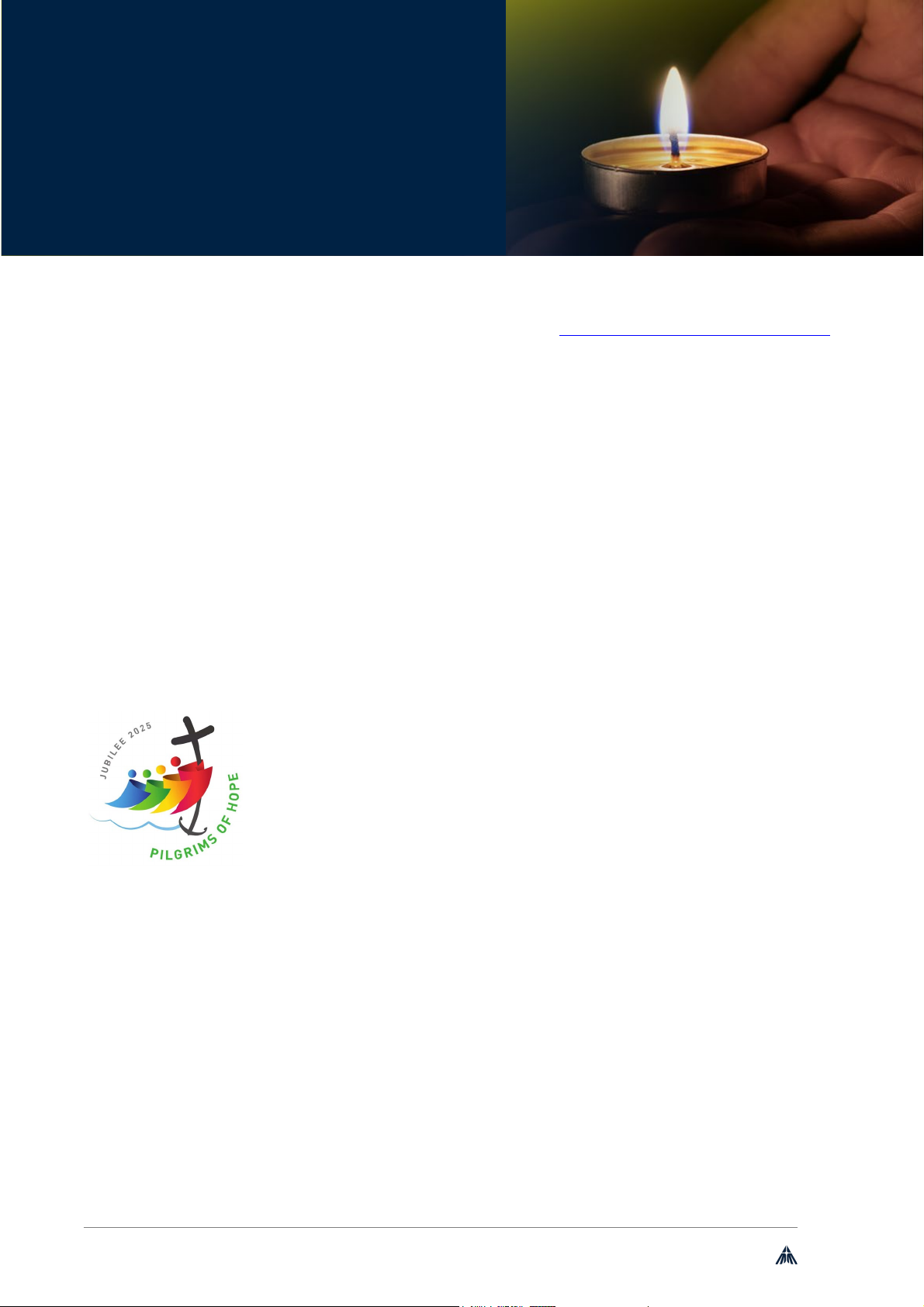
The logo chosen for the Jubilee 2025 is remarkable and significant.
It was designed by Giacomo Travisani and selected from among 294
entries from 48 countries. It is designed with four human figures in
four colours. They represent the entire humanity hailing from the four
corners of the world. They embrace each other in solidarity and fraternity.
The figure at the front holds fast to the cross, which gives the humankind
dare and hope. The rough waves under the figures represent the present
context of the world which is marked by turmoil and troubles. The
lower part of the cross has been elongated and turned into the shape of
an anchor which is a symbol of hope. The image illustrates the pilgrim’s
journey not as an individual effort, but as a collective and communitarian
enterprise. At the bottom of the logo lies the motto of the Jubilee Year
2025: ‘Peregrinantes in Spem’ (‘Pilgrims of Hope’).
The Dicastery for Evangelization which coordinates the
celebrations spells out seven characteristics of the Jubilee: 1. Pilgrimage
(journeying with others crossing the boundaries), 2. Holy Door (It is a
powerful sign symbolizing Jesus as the door through whom we go to
the Father), 3. Reconciliation (placing God at the centre of our lives,
we are called to reconcile with others), 4. Prayer (being open to God’s
presence), 5. Sacred Liturgy (participating meaningfully in the public
prayer of the Church), 6. Profession of faith (by professing our faith,
we witness our baptismal identity) and 7. Indulgences (experiencing
God’s mercy).
The purpose of the Jubilee is threefold: 1. To celebrate Jesus. In
the Jubilee Year, we primarily celebrate Jesus. We commemorate his
birth, life, teaching, ministry, passion, death and resurrection. 2. To
celebrate the Church. The Church is our Mother and Teacher. We renew
our commitment to our Holy Catholic Church by owing our communion
and contribution. 3. To celebrate us. We celebrate each one of us, with
unique gifts and charisms, ministries, lifestyles and values. Thus,
www.malankaralibrary.com

3
celebration of Jesus, Church and us happens in the context of our synodal
journey in communion, mission and participation.
The year 2024 intensifies our preparation to participate vibrantly
in the celebration of Jubilee 2025. As it is stated above, this year is
observed as the year of prayer. We are invited to be united with each
other in prayer; praying for each other in the Church and the world. Let
our prayers be rooted in faith, expectant in hope, and enlivened in love.
Let us understand the prayers in the Bible, learn the traditional prayers
of the Church and pray to Mary and the saints. Let us adopt prayer as a
way of our everyday life. Let us be united in the prayer of the Church,
pray with the Psalms, explore the treasures of the Fathers of the Church,
and meaningfully pray in liturgical and paraliturgical celebrations.
Thus, in the context of Jubilee 2025, with the purpose of
journeying together with the universal Church, The Divine Shepherd’s
Voice has chosen a general theme of “Re-Reading of Vatican Council
II in the Light of Jubilee 2025 for the year 2024. The four issues of the
journal will focus on the context and contents of the Documents of the
Second Vatican Council which eventually invite us to re-read them in
today’s context. They may enlighten us to discover the treasures and to
learn the rich sources of the teachings of the Church which will lead us
to celebrate our Christian identity rooted in the sacrament of baptism.
The current issue of The Divine Shepherd’s Voice carries five
articles besides the special segment which are based on the first four
documents of the Second Vatican Council: (i) Sacrosanctum Concilium
(The Constitution on the Sacred Liturgy), (ii) Inter mirifica (Decree on
the Means of Social Communication), (iii) Lumen Gentium (Dogmatic
Constitution on the Church) and (iv) Orientalium Ecclesiarum (Decree
on the Catholic Eastern Churches). We offer our sincere thanks and
appreciations to all our contributors and wish the readers a fruitful
reading!
Dr. Antony Madalaimuthu
Editor
{
www.malankaralibrary.com

4
"Dear Brothers and Sisters,
I ask you to intensify your prayer to
prepare us to live this event of grace well
and experience the power of God's hope. That
is why today we begin a year of prayer."
- Pope Francis
21st January 2024
www.malankaralibrary.com

5
"Don't touch that! If you do, everything will collapse!" We
aresure those who read this article would agree with us that these
were the exact words used by a number of us especially when it
comes for the celebration, participation and renewal of liturgy. In
fact, everyone recognizes the importance of this moment for the
liturgical life of the Roman Catholic Church. Fairly good number of
Catholics who think that the post-Vatican II liturgical renewal has
run into a dead end and that the reform itself needs to be reformed.
On the other hand, sixty years on one can argue, as we shall, that
the reform is really just getting underway and needs to be supported
by considerable attention to what we will call "liturgical renewal" or
perhaps better, "the spiritual renewal of the liturgy."
Our starting premise in this short work is that the liturgical
reform of the past sixty years has been the work of the Holy Spirit
and a tremendous gift to the Church. This does not mean that we
should ignore areas in which the reform could be improved, but it
does mean that we need to move forward and not back. We will
address our theme in three parts. The first part will be a brief survey
of the document. In the second part we will comment on two of the
most significant aspects of the reform. The final part will examine
three areas in which we believe ongoing work is needed.
Brief Survey of the Document
The document entitled "Sacrosanctum Concilium,"1 is a
document on "The Constitution on The Sacred Liturgy" and was
READING OF SACROSANCTUM
CONCILIUM IN THE CONTEXT OF
FORMATION
FR. A. Hiruthaya Lawrence &
Fr. A.Renold Prabhu
1Vatican Council II, Constitution on the Sacred Liturgy, Sacrosanctum Concilium,
04 December 1963, in A.A.S., 56 (1964) 97-138. Austin FLANNERY (ed.), Vatican
Council II: The Conciliar and Post Conciliar Documents, vol. 1. Theological
Publications in India, Bangalore 2004, (hereafter Sacrosanctum Concilium is cited
as SC).
DSV 15:1 (2024) 5 -18 January - March 2024
www.malankaralibrary.com

6
2Josef Jungmann, Commentaries on Vatican II, vol I trans. Francis A. Brunner,
New York: Benziger Press, 1967, 28.
3Josef Jungmann, Commentaries on Vatican II, vol I.
4Pamela Jackson, An Abundance of Graces:Reflections on Sacrosanctum
Concilium, Hillenbrand book series, 2004.
the first document issued by the Council fathers of Vatican II, and
arguably the most influential. The everyday lives of millions of
Catholics around the world have been influenced by what it had to
say. It was approved by an overwhelming majority of the Council
Fathers (2,147 to 4), and promulgated by Pope Paul VI on
December 4, 1963. It set in motion the most far-reaching liturgical
reform in Catholic history. It is primarily meant to draw believers,
and beckon all the faithful to join Christ in the act of worship in
glorifying the Father, preparing and making the people of God a
holy and living temple of the Lord, a dwelling-place for God in
spirit, to the measure of the fullness of Christ. This document is
divided into seven chapters.2
Method of Reading the Constitution in Today's Context
When reading the Constitution today, it is important as it is in
reading any historical document to understand its context. For this
purpose, commentaries can be helpful. The most venerable and
detailed commentary on the Constitution can be found in Volume
I of the Commentaries on Vatican II (Herder, 1967). Written by
Josef Jungmann, SJ, a peritus at the Council, the commentary
analyzes the text article by article.3 More recent commentaries,
such as Pamela Jackson's An Abundance of Graces (Hillenbrand,
2004) summarize the contents of the document more briefly and
also show how it has been interpreted and implemented since the
Council.4
The structure of the document gives clear evidence that it
was meant to serve as a blueprint for renewal. It begins with a
short introduction that states the goals of the Council overall. Such
a statement is found in no other document of the Second Vatican
Council, and it is quite important for understanding the Council as
a whole, as well as for understanding why the liturgical work of the
The Divine Shepherd’s Voice, Vol. 15 Lawrence & Prabhu
www.malankaralibrary.com

7
Council was central to its agenda. The largest and most detailed
chapter of the Constitution is the first, entitled "General Principles
for the Restoration and Promotion of the Sacred Liturgy." It is
followed by chapters devoted to the Eucharist, the other sacraments
and sacramentals, the Divine Office, the liturgical year, sacred
music, and finally, sacred art and furnishings. An appendix on the
revision of the calendar appears at the end.
UPDATES AFTER THE COUNCIL
To carry out the Council's directives in the Constitution, a host
of practical decisions had to be made after the Council by the
Pope, the consultative bodies that advised the Pope, the
conferences of bishops, and so on. It could not have been otherwise.
The Constitution set a huge project in motion one that is still going
on today.
Since the Constitution's appearance in 1963, there have been
seven official instructions on its proper implementation. They give
specific permissions and guidance in carrying out the reform. Three
of these instructions appeared in quick succession: Inter Oecumenici
(1964), Tres Abhinc Annos (1967), and Liturgicae Instaurationes
(1970). The other four appeared much later: Varietates Legitimae
(1994), Liturgiam Authenticam (2001), Magnum Principium (2017),
and Traditionis Custodes (2021).These are Vatican documents
written for the worldwide Church. There are also other documents
written by Popes, Episcopal Conferences, and individual bishops
that provide inspiration and guidance in carrying out the mandate
of the Constitution on the Sacred Liturgy.5
Ongoing Process of the Document on Renewal
In 1985, the Extraordinary Assembly of the Synod of Bishops
would look back and reflect that "the liturgical renewal is the most
visible fruit of the whole work of the Council." Pope John Paul II,
on the document's twenty-fifth anniversary, would agree: "For many
5Piero Marini, A Challenging Reform: Realizing the Vision of the Liturgical
Movement, Collegeville, Minn.: Liturgical Press, 2022. 34-39.
Sacrosanctum Concilium January - March 2024
www.malankaralibrary.com

8
6John Paul II, Theology of the Body, starting September 5, 1979 and ending
November 28, 1984, at https://www.ewtn.com/library/papaldoc/jp2tbind.html.
7Video-Message of His Holiness Benedict XVI to Young Participants in The 49th
International Eucharistic Congress in Québec (Canada) Saturday, 21 June 2008
at https://www.vatican.va/content/benedict-xvi/en/messages/pont-messages/2008/
documents/hf_ben-xvi_mes_20080621_quebec.html.
8Pope Francis, Address to SacrosanctumConcilium Conference 50th anniversary
of the Second Vatican Council constitution on the Liturgy, SacrosanctumConcilium
on February 21, 2014.
athttps://www.ewtn.com/catholicism/library/address-to-sacrosanctum-concilium-
conference-4988.
people the message of the Second Vatican Council has been
experienced principally through the liturgical reform."6
Another 20 years have passed since that time, and interest in
the Constitution has not diminished but grown. On its fortieth
anniversary, Pope John Paul II opined that "With the passing of
time and in light of its fruits, the importance of Sacrosanctum
Concilium has become increasingly clear" (Spiritus et Sponsa, 2).
Pope Benedict XVI, on June 2008, in a homily delivered via satellite
to the 49th International Eucharistic Congress in Quebec, exhorted
the faithful to study this document. "I would like everyone to make
a commitment to study this great mystery (the Eucharist)," he said,
"especially by revisiting and exploring, individually and in groups,
the Council's text on the liturgy, Sacrosanctum Concilium, so as to
bear witness courageously to the mystery."7
On February 21, 2014, Pope Francis has issued a message
on the occasion of a symposium devoted to the 50th anniversary
of Sacrosanctum Concilium, the Second Vatican Council's
Constitution on the Sacred Liturgy. Stating that the anniversary
evokes "sentiments of gratitude for the profound and widespread
renewal of liturgical life made possible by the conciliar Magisterium,
to the glory of God and the edification of the Church," the Pope
continues till date the mission of liturgical renewal in the "commitment
to receive and implement" the document's teaching in a fuller
manner. Now let us explore some of the significant aspects of the
reform on the sacred liturgy.8
The Divine Shepherd’s Voice, Vol. 15 Lawrence & Prabhu
www.malankaralibrary.com

9
SIGNIFICANT ASPECTS OF THE REFORM ON THE SACRED
LITURGY
Being the first issuance of the Council, SC lays out the
objectives of Second Vatican Council in the introduction. They are
four-fold: "To impart an ever-increasing vigor to the Christian life
of the faithful; to adapt more closely to the needs of our age those
institutions which are subject to change; to foster whatever can
promote union among all who believe in Christ; to strengthen
whatever can help to call all mankind into the Church's fold" (SC
1). We see clearly in these ideals that the vision of the Council
was to renew the life of the Church for the sake of evangelizing
the modern world. Perhaps, in this present time, we are just
beginning to understand that this was the fundamental purpose of
Vatican II. Fittingly, it focuses on the Eucharist, by which "the work
of our redemption is accomplished" and which is the source and
summit of the Christian life (SC 2). The document also shows
perhaps even more importantly that a certain spirituality must be
developed both by the Seminarians and faithful in order to step
into the world and to embrace the agenda it advances.
With the revision of the General Instruction of the Roman
Missal (GIRM) in 2002, and the new translation of the Roman
Missal, there is much discussion over the changes within the liturgy.
We hear of the rewording of certain prayers; some of these prayers
roll off the tongue while others do not. With the publication of the
2002 GIRM, there have been slight changes in the posture of the
assembly and in the position of the ministers around the sanctuary.
With this in mind, will look at the liturgy through the lens of the
Constitution on the Sacred Liturgy, in order to place in perspective
the current transition. Let us explore this concerns in detail in the
second part.9
9General Instruction of The Roman Missal
athttps://www.vatican.va/roman_curia/congregations/ccdds/documents/
rc_con_ccdds_doc_20030317_ordinamentomessale_en.html
#ii._arrangement_of_the_sanctuary__for_the_sacred_synaxis__
(eucharistic_assembly).
Sacrosanctum Concilium January - March 2024
www.malankaralibrary.com

10
Importance of the Liturgy in Priestly Formation
In the ecclesiastical formation of future priests, a formation
renewed following the prescriptions of the Second Vatican Council,
the Sacred Congregation for Catholic Education has been working
for many years to provide suitable helps to the Bishops'
Conferences. To the various documents and pedagogical assistance
already produced with this end in view, this Instruction on Liturgical
Formation in Seminaries is now added. Its purpose is to offer
suitable directives and norms so that the liturgical life and the
study of the sacred liturgy in institutions of priestly formation might
be better adapted to modern needs. The great importance which
the sacred liturgy occupies in the life of the Church demands that
the contemporary candidate for the priesthood be given a proper
formation both in the area of correct practice and in assiduous
study, so that he will be most able to carry out his pastoral ministry
in this field. The importance of the sacred liturgy in priestly formation
is clear to all. Priests indeed are consecrated to God by
the bishop not only to preach the Gospel but most of all to pasture
the faithful.10
Foster Creativity in the Formation not Novelty
The students might be introduced with greater spiritual profit
into the riches of the liturgy, and to prepare them practically for
their future ministry, a healthy variety in the way of celebrating and
participating in the liturgy should be fostered (SC 27). This variety
concerns the ways of celebrating Mass, the celebrations of the
Word, whether penitential or baptismal, and bestowing blessings,
whether with greater or lesser solemnity, adapted to various
circumstances and exigencies, as these are permitted or
recommended in the liturgical books and in the prescriptions of the
Apostolic See.
This means the art of making the right choice from among the
various possibilities offered in the liturgical books or even of
10 Alexander Schmemann, "Liturgy and Theology," in Liturgy and Tradition:
Theological Reflections of Alexander Schmemann, Thomas Fisch, ed. New York:
St Vladimir's Seminary Press, 1990, p. 57.
The Divine Shepherd’s Voice, Vol. 15 Lawrence & Prabhu
www.malankaralibrary.com

11
choosing, composing, and using new texts adapted to various
occasions (for instance, in the bidding prayers or admonitions). It
is the duty of the teachers in the seminary, however, not only to
help and lead the students, but also to correct them patiently so
that there is formed in them a genuine notion of the Church. Thus
the future priests will be educated not only in how to use
efficaciously in their pastoral practice the various possibilities offered
by the renewed liturgy, but they will also be educated to observe
proper limits.11
In order to foster a healthy formation and renewal on the
scared liturgy a sound spirituality has to be imparted. They are as
follows.
Spirituality of the Constitution on the Sacred Liturgy
A question arises; can a Church document have spirituality?
The Constitution gives evidence of its authors' spiritual interests,
commitments, and concerns, that spirituality plays a significant
role. The first instruction issued after the Constitution, "For the
Right Implementation of the Constitution on the Sacred Liturgy"
(Inter Oecumenici, 1964), makes clear that spiritual formation is
essential to the agenda of the Constitution. Makes clear that spiritual
formation is essential to the agenda of the Constitution. "Necessary
before all else . . . is the shared conviction that the Constitution on
the Liturgy has as its objective not simply to change liturgical
forms and texts but rather to bring to life the kind of formation of
the faithful and ministry of pastors that will have their summit and
source in the liturgy" (SC 5 - 10).
There are many elements of spirituality. For this work one can
limit to the following: a dynamic Christocentric spirituality and his
Paschal Mystery, a profound love for sacred scripture and
commitment to active participation in the liturgy and respect for the
genius of the diverse cultural circumstances as a primary
manifestation of the reality of the Church.
11 Alexander Schmemann, "Liturgy and Theology," in Liturgy and Tradition:
Theological Reflections of Alexander Schmemann, Thomas Fisch, ed, p. 67.
Sacrosanctum Concilium January - March 2024
www.malankaralibrary.com

12
Christocentric Spirituality and His Paschal Mystery
The Constitution on the Sacred Liturgy is deeply imbued with
a Christocentric spirituality grounded in the Paschal Mystery. Christ's
paschal sacrifice, his body broken and blood poured out for the life
of the world, stands at the absolute center of the liturgical event.
Again and again, the document invokes the Paschal Mystery (Cf.
SC 5, 6, 10, 61, 81, 102, 104, 106, 107, 109).
What are the implications of a paschal spirituality? First, it
means that salvation in Christ is an event that transforms us. It is
dynamic. We participate in the paschal event by remaining open
to change and continuing conversion. Second, a paschal spirituality
invites us to replicate the pattern of Christ's self-giving sacrifice,
consciously and deliberately. "If we have died with Christ, we believe
that we will also live with him" (Rom 6:8). A paschal spirituality is
ordered toward self-giving love that is lavish and does not count
the cost. "If any want to become my followers, let them deny
themselves and take up their cross daily and follow me" (Lk 9:23).
Finally, by embracing the paschal mystery, we begin to
understand and engage with the logic of the liturgical year, which
relishes Sunday as the day of the Resurrection, and reaches its
high point at Easter (Cf. SC. 102, 106, 107). The truth of Christ's
Paschal Mystery is present in all of our life passages, if only we
perceive it. Catechumens experience this truth on their journey to
the waters of Baptism. The tears of reconciled sinners confirm it.
And in the Eucharist, we celebrate itrichly, fully, and beautifully.
Christ's Paschal Mystery is the axis on which the world turns and
our challenge as we go forth.12
Profound Love for Sacred Scripture
The Fathers of the Second Vatican Council directed that "the
treasures of the Bible are to be opened up more lavishly" (Cf. SC
51). They wanted the liturgy to provide "richer fare" for the faithful
that, Christ is truly present in the word, as well as in the sacrament
12 Maximilian Heinrich Heim, Joseph Ratzinger: Life in the Church and Living
Theology: Fundamentals of Ecclesiology, San Francisco: Ignatius Press, 2007,
P 62, 74.
The Divine Shepherd’s Voice, Vol. 15 Lawrence & Prabhu
www.malankaralibrary.com
13
of the altar (Cf. SC 7). Thus, the spirituality of the Constitution
includes, importantly, a passion for scripture. A spirituality of the
word allows the sacred text to speak in its proper language. By
paying careful attention to the literary form, the cultural context,
the author's intention, and the Church's tradition
of interpretation, the faithful come to a sound appreciation of the
scripture's meaning.13
Spirituality of Participation and Cultural Adaptation
Let us begin with a question. What are the implications of a
spirituality of participation? First of all, it requires everyone to
shoulder responsibility for the prayer, worship, and discipleship
that make up a community of faith. "Just as the body is one and
has many members, and all the members of the body, though
many, are one body, so it is with Christ" (1 Cor 12:12).
The Constitution on the Sacred Liturgy urges that the faithful
should be present at the celebration of the sacred mysteries not as
"strangers or silent spectators" (Cf. SC 48), but should "take part
in them fully, actively, and as befits a community" (Cf. SC 21). This
is the Church, the body of Christ. As we participate in the liturgy,
so too are we called to participate in the mission of Christ that
goes out to the world (Cf. SC 2). "Liturgical services are not private
functions, but are celebrations of the Church . . ." (Cf. SC 26).
Even when the gathering is small, it is the Church that prays. Each
individual is part of something greater than him or herself.14
The Constitution on the Sacred Liturgy makes provision for
the adaptation of the Church's liturgical rites to reflect the genius
of various human cultures of the world (Cf. SC 37-40). The liturgy
need not look the same everywhere, as long as the "substantial
unity" (Cf. SC 38) of Catholic worship is preserved.
It is, first of all, a spirituality of respect for the human person.
Culture is deeply interwoven in the fabric of the human person,
13 Thomas R Whelan, "Liturgical Formation: To What End," Anaphora 2 (2008) 1-
20.
14 Thomas R. Whelan, "Multicultural Worship: Theological Reflections on
Experience," Mission and Migration, Stephen Spencer, ed., Calver, Sheffield:
Cliff College Publishing, 2008, p. 173-187.
Sacrosanctum Concilium January - March 2024
www.malankaralibrary.com

14
and respect for culture is part of our calling to respect human
persons. Second, it is a spirituality of peace in which the Gospel
and the Catholic faith are understood not as something imposed
by conquest, but good news that resonates with the best and
deepest yearnings of the human soul. Finally, it is a spirituality of
mission which sees in the global church a great harvest of faith,
ready to be gathered and shared in the prayer of the Church, for
the glory of God.15
In the final part let us examine certain areas in which ongoing
work is needed for the liturgical renewal
SPIRIT OF THE LITURGICAL RENEWAL
Two words that capture the spirit of the liturgical renewal of
the Conciliar period are aggiornamento and ressourcement.
Aggiornamento is an Italian word that means bringing things up to
the present day. Pope John XXIII called for the Church to update
its presentation of its message. His call was motivated by pastoral
concern. He did not want the Church to lose touch with the
contemporary concerns and struggles of its people.16
Ressourcement, a French word, means "back to the sources," that
is, the study of liturgical history reaching back to the early centuries.
Far from a sterile, archeological interest in the past, going back to
the sources was a springboard for renewal, asking new questions
of ancient texts.17
At first glance, ressourcement may seem incompatible with
aggiornamento, but actually they are complementary. "Sound
tradition," protected by the Constitution (Cf. SC 23) enumerates
that by going back to the sources, by studying and understanding
the history of the liturgy, one can discern what is essential, what
must be handed on in order to preserve the health of the Church
in the present and sustain it in the future. A keen appreciation for
15 Jozef Lamberts, Pope Pius X and Active Participation in Worship, vol 99 (October
2023) 300-323, p 312.
16 Pope John XXIII, Motu Proprio Superno Dei nutu, Promulgated June 5, 1960, in
Acta Apostolicae Sedis (hereafter, AAS) 52 (1960): 433-437.
17 Giuseppe Alberigo and Joseph A. Komonchak, History of Vatican II (Maryknoll,
NY: Orbis, 1995), 1:171.
The Divine Shepherd’s Voice, Vol. 15 Lawrence & Prabhu
www.malankaralibrary.com

15
33
how the Church's message is heard today, in turn, helps the Church
pass on its living tradition effectively, so that it can be grasped and
owned by a new generation.
With this clarity on both the terms let us venture into some of
concerns that arises in our mind regarding the spirit of liturgical
renewal.
Why Sacrosanctum Concilium was the first of the 16 documents
of the Council? Is it an ongoing re-interpretation today?
The liturgy being debated and promulgated first is undoubtedly
due to the fact that there had been at least a decade of liturgical
reform previously. The bishops had already been engaged in this
question as well as the fundamental importance of its subject. As
Pope Paul VI said when promulgating it, "our first required duty is
to bring prayers to God" and in considering the Sacred Liturgy first
of all, "the right order of things…has been conserved."Historically,
however, Paul VI did not wait for the Council's ecclesiology to be
articulated before beginning the work of implementing Sacrosanctum
Concilium. That work began in earnest early in 1964, within months
of its promulgation, at which point there were still two sessions of
the Council remaining.
A school of thought exists which interprets Second Vatican
Council as an "event," whereby is meant that the Council canonized
an overriding and ongoing dynamic process of change. Overriding,
that is, the specific provisions of conciliar constitutions and the
contexts in which they were formulated, and ongoing in that this
view insist that these texts must be re-interpreted today in the light
of this dynamic: "What would the Council have said now," etc. This
elevation of process into a hyper-hermeneutic is utterly foreign to
the historical reality of Council itself. This following of a so-called
"spirit of the Council" rather than its "letter" is a way of reading into
the Council documents whatever one wishes regardless of what
they in fact say.
Sacrosanctum Concilium January - March 2024
www.malankaralibrary.com
16
There seem to be two great temptations regarding the
liturgy in our time, the first being to make it "relevant" and
even entertaining, the second being to make it narrow and
almost museum-like, with a fixation on esoteric details. How
does SC help avoid these two extremes?
The Sacred Liturgy is relevant to each of us because of what
its true nature is: it is the saving action of Jesus Christ in his
Church. Sacrosanctum Concilium is very clear about this. Through
the liturgy we are made Christians (baptism, confirmation, and first
Holy Communion), formed and sustained in our Christian life (Holy
Mass and the regular reception of the Blessed Eucharist, liturgical
prayer such as the Divine Office, the Blessings, etc.), given the
graces required for our particular vocations (matrimony, holy orders),
and strengthened and healed as necessary (penance, anointing of
the sick, rites of Christian burial, etc.).
But yes, when the true nature of the liturgy is not understood
the temptation is to make of the liturgy something that is appealing
or "relevant" primarily to those who will be present. An objective
sense of celebrating the liturgy of the Church is lost, leading to that
subjectivity whereby, as Cardinal Ratzinger once observed, "the
community celebrates itself." And of course once we go down this
path there is the need to be constantly doing something new and
different so that the "audience" does not become "bored." No, the
liturgy is not entertainment, it is ritual worship. The ritual worship
of the Church, given to us in tradition and not made up by us.
Rather, it is something we celebrate faithfully and as fully as we
are able.18
There can be, as one can say, a tendency to make the liturgy
a museum exhibit, something untouchable, to almost put it "behind
glass" as it were. In part this may be a reaction to the extremes
and abuses of previous decades and to the liturgical subjectivity
that still exists in many places and all the more seminary is not an
exception. People can become hyper-sensitive when questions of
18 Jared Wicks, S.J., "Six Texts by Prof. Joseph Ratzinger as peritus Before and
During Vatican Council II," Gregorianum 89, no. 2 (2007): 240-241.
The Divine Shepherd’s Voice, Vol. 15 Lawrence & Prabhu
www.malankaralibrary.com

17
6
changing the liturgy arise. As mentioned, Sacrosanctum Concilium
speaks of retaining sound tradition whilst being open to legitimate
progress. This is not a new or a "modernist" idea: the history of the
liturgy shows its organic development. The liturgy must develop,
organically, over time. Benedict XVI spoke of augmenting the Missale
Romanum of 1962 with newly canonized saints and more prefaces,
etc., and that would be a welcome and natural development,
certainly.Till date Pope Francis through his apostolic letters insists
on the renewal of the liturgy to enable the people of God to
participate more meaningfully.19
One very happy development since the Council is the
widespread expectation of those who are regularly present at
liturgical rites of participating in them. This is true for celebrations
of the newer and of the older rites. When there is such participation,
we are not looking at a museum piece, regardless of whether its
date is 1570 to 1962 or 1970 to 2023.
On this 60th anniversary of Sacrosanctum Concilium, what is
the one thing we should recall about it?
We cannot return often enough to the constitution's purpose
because the Sacred Liturgy is the source and summit of the life
and mission of the Church, we must form people to be able to
participate fruitfully in it. Ritual reform itself is not what is essential:
being able to drink the living water offered by he who comes to us
in the Sacred Liturgy is Lord Jesus Christ. This notion enables
active participation of all in the liturgical celebration, which is founded
on the sacramental structure of the Church and on the Priesthood
of Christ. Naturally, it is guided by liturgical norms which have their
roots in theology. True participation, active and interior is dependent
upon the liturgical formation of the clergy, bishops, priests and
deacons. Those who have a role of presiding and leadership in the
liturgical assembly need to be properly prepared and to understand
19 Benedict XVI, "To the Council with Enthusiasm and Hope," L'Osservatore Romano,
English edition, February 20, 2013, p. 9.
Sacrosanctum Concilium January - March 2024
www.malankaralibrary.com

18
their function of service to the people of God.
In order that this participation should be seen to as a sign of
unity Pope Pius XII pointed out that it is necessary: "that the clergy
and people become one in mind and heart, and that the Christian
people take such an active part in the liturgy that it becomes a truly
sacred action of due worship to the eternal Lord in which the
priest, chiefly responsible for the souls of his parish, and the ordinary
faithful are united together" (Mediator Dei 199).20
Conclusion
In summary, we have been able to delve into this documents
written by the Council Fathers, and promulgated by Pope Paul VI,
and to a great extent, pointed out that in and through the liturgy,
especially in the spiritual formation of liturgy, the work of our
redemption is accomplished.The special virtue of studying the
Constitution is that it is like the hub of a wheel. One can see,
radiating outward from it, countless works of fidelity by the praying
Church. Not only Popes and bishops, pastors and religious, but all
faithful Catholics have a part to play in its vision and mission.
Within all the baptized is the call and privilege to be caught up in
the work of the liturgy.The eternal praise of the Father by the Son,
through the Holy Spirit. If at times we fail to do our part as well as
we should, it remains, nevertheless, a great work and a vibrant
calling.
20 Aidan Nichols, O.P., "A Tale of Two Documents: SacrosanctumConciliumand
Mediator Dei," Antiphon 5 (2000) 24.
{
The Divine Shepherd’s Voice, Vol. 15 Lawrence & Prabhu
www.malankaralibrary.com

19
1https://www.statista.com/statistics/272014/global-social-networks-ranked-by-
number-of-users/html (accessed January 17, 2024).
2https://www.facebook.com/ogilvy/posts/the-average-person-scrollsthrough-
300feet-of-mobilecontent-every-day-thats-eq/10155968756602994/ html
(accessed January 17, 2024).
ETHICAL DILEMMAS OF SOCIAL
MEDIA: EXPLORING INTER
MIRIFICA’S PERSPECTIVES
Fr. Rex Alex Silvester
Today, almost everyone is active on at least one social media
platform. The widespread use of social media has been a
significant trend in the past decade, as platforms like Facebook,
Twitter, and Instagram have become essential components of
people’s lives, exerting a profound influence on their behaviour,
perceptions, and decision-making. As of 2023, the number of
active social media users worldwide has reached nearly five
billion, and on average, users spend two hours and twenty seven
minutes per day on these platforms.1 Facebook reveals that the
average person scrolls through approximately three hundred feet
of content on their mobile device each day – an equivalent height
to the Statue of Liberty.2 When it comes to expanding connections
in any field, social media is often the first option considered. It
has emerged as a dominant force in contemporary society,
revolutionizing information exchange and the formation of
interpersonal connections. This article aims to examine the
multifaceted impact of social media on society, within the context
of Inter Mirifica, a significant document issued by the Second
Vatican Council. It will explore both the positive and negative
aspects of social media.
Defining Social Media
Today social media is a catch word everywhere and people’s
lives are founded on social media. We can confidently say that
the social media creates and shapes the life and the thinking of
the people. A new culture is being created through social media.3
Before delving into social media, it is important to understand
DSV 15:1 (2024) 19 -31 January - March 2024
www.malankaralibrary.com

20
3John Singarayar, “Social Media and Church’s Mission,” Vidhyajothi 83, 10 (October
2019): 791-795.
4Francis Arackal Thummy, “Social Media: The Paradox of Connected and Yet
Disconnected Lives,” Jeevadhara 295, 1 (January 2020): 19-34.
5Caleb T. Carr & Rebecca A. Hayes (2015). Socialmedia: Defining, developing,
anddivining. Atlantic Journal of Communication, 23(1),4665.https://
www.tandfonline.com/action/showCitFormats?doi=10.1080%2 F15456870.
2015.972282 html (accessed January 12, 2024).
6S. Periannan, “Church and Social Media,” Jeevadhara 295, 1 (January, 2020):
55-67.
what it is all about. There are numerous definitions of social media
circulating in the online world. Throughout the years, due to the
ever-changing nature of social media, its definitions have also
evolved. For the third decade of the 21 century, here is a
comprehensive definition: Social media refers to internet-enabled
tools for interaction that, in addition to chat, allow users to share
various forms of content such as texts, photos, videos, advertise
products, create online groups and communities, and link to
resources. This is a tool centred definition.4 Carr and Hayes state
that social media refers to internet-based platforms that facilitate
mass personal communication, among users, and derive their
value mainly from user-generated content.5
Social Media and the Church
By its very essence, the Church is called to engage in
effective communication. This mandate, bestowed upon the
Church by the Lord, is clearly stated in the Scripture: “Go,
therefore, make disciples of all the nations; baptise them in the
name of the Father and of the Son and of the Holy Spirit, and
teach them to observe all the commands I gave you” (Mt 28:19-
Gospel to humanity. Additionally, the Church has embraced a
diverse range of media platforms, including folk media,
interpersonal communication, traditional media, modern mass
media, and the emerging fields of new media and social media.6
Folk media, which encompasses traditional techniques of
conveying information through sound, images, signs, and
language, played a significant role until the 15 century.
Subsequently, with the advent and proliferation of the printing
press, mass media in the form of print media, television, cinema,
radio, and advertisements dominated the information industry until
the 20 century. Although the inception of new media, specifically
The Divine Shepherd’s Voice, Vol. 15 Rex Alex Silvester
www.malankaralibrary.com

21
7A. Stephen, “Catholic Social Teaching on Media,” Vaiharai 22, 1 (JanuaryJune,
2017): 20-33.
8S. Periannan, “Church and Social Media,” 55-67. 55
9Joseph Lional, “From Vigilantti Cura to Aetatis Novae and the PresentTimes:
Evolution in the Church’s Teaching on Social Communication,” Vidyajothi 70, 8
(August 2006): 590-600.
10 Vatican Council II, Inter Mirifica (IM), Decree on the Means of Social
Communication, in Vatican Council II: The Conciliar and Post Conciliar Documents,
vol. 1, ed. A. Flannery (Mumbai: St Paul’s, 2007), 262-269.
11 A. Stephen, “Catholic Social Teaching on Media,” 20-33.
internet-based digital technology, can be traced back to the
aftermath of World War II, it has increasingly dominated the world
of communication over the past two decades. Social media, in
particular, serves as a platform that reinforces human and social
connections, facilitating a culture of borderless free enterprise.7
The Church acknowledges that social media and networks are
truly a ‘gift from God.’8
Inter Mirifica
The Catholic Church’s initial encounter with the media in a
form similar to its modern state occurred at the First Vatican
Council of 1869-70.9 Until the mid-nineteenth century, the Church
held a traditional perspective on the media and harboured deep
mistrust towards any contemporary developments, adopting a
defensive stance against its influences.
The turning point in this historical relationship was marked
by the issuance of Inter Mirifica the Decree on the Means of Social
Communication, on December 4, 1963, during the Second
Vatican Council.10 Inter Mirifica being one of the most challenging
conciliar documents to receive approval, with 164 votes against
it, representing the highest number of non placet (against) votes
throughout the entire Council.11 The following are the positive
points and incentives given by Inter Mirifica:
1. This is the first time in Church history that an ecumenical
council has delved into the topic of social communication and
produced a comprehensive document. The significance of a
council document surpasses individual pronouncements by
the Pope, such as encyclical letters or speeches at specific
events.
Inter Mirifica January - March 2024
www.malankaralibrary.com

22
11 A. Stephen, “Catholic Social Teaching on Media,” 20-33.
12 IM 5.
13 A. Stephen, “Catholic Social Teaching on Media,” 20-33.
14 IM 18.
2. The Council acknowledges that every human person in
society has a ‘right to information.’12 The council believes that
communication as a substantive natural right of every human
being. It was an extraordinary breakthrough in the Church
understands of communication and human rights.
3. The influential contribution of Inter Mirifica lies in its dedicated
focus on the importance of communication. It urges individuals
to utilize media for evangelization purposes and remain
conscious of developments in the media world.
4. Inter Mirifica comprises two chapters, with the first highlighting
the moral responsibilities associated with media usage. The
second chapter emphasizes the potential of media to enhance
and expand the apostolate. In essence, the Church’s
discussion on media centers around two aspects: how they
can be utilized to achieve our goals, specifically
evangelization, and the ethical conduct that should be
expected from the mass media. As Inter Mirifica suggests
the Church views media as “instruments” rather than “agents”
in its relationship with them.13
5. The Council decree introduced a new terminology in the realm
of “Social Communications.” Various terms such as mass
communication and mass media were rejected, and instead,
the expression “Social Communications” was chosen. The
preparatory commission believed that terms like ‘diffusion
techniques’, ‘audio-visual media’, or even ‘mass media’ should
not be limited to technical means of transmission alone.
Rather, they should embrace communication as a process
that occurs between and among human beings.
6. Additionally, the decree Inter Mirifica establishes a “world day
of communications.”14 This provides a unique opportunity for
the Pope and bishops to remind the faithful of their
responsibilities in this field.
7. The Council decree also suggests the establishment of a
comprehensive office for the instruments of social
The Divine Shepherd’s Voice, Vol. 15 Rex Alex Silvester
www.malankaralibrary.com

23
15 IM 19.
16 IM 15,16.
17 IM 3.
18 IM 17.
communication at the Vatican.15 In 1964, Pope Paul VI
established the Pontifical Council for Social Communications.
Furthermore, the Council decreed the establishment and
proper support of national offices for the press, cinema, radio,
and television worldwide. These offices should primarily focus
on unifying efforts, shaping conscience, and providing
encouragement to Catholics working in these fields.
8. Inter Mirifica underscores the importance of providing
professional training to Church personnel in order to effectively
confront the challenges of the current era. This includes a
specific emphasis on media education and the active
involvement of laypeople.16
9. A notable contribution of the decree is its proposition that
mass media should be employed for the purpose of
evangelization. The council expresses the following on this
matter:
“The Church claims as a birth right the use and possession
of all instruments of this kind which are necessary or useful
for the formation of Christian and for every activity undertaken
on behalf of human salvation.”17
10. The Sacred Synod urges the Church to fulfil her obligation of
upholding and supporting Catholic newspapers, magazines,
movie enterprises, radio and television stations, and programs
that are primarily aimed at disseminating and safeguarding
the truth while reinforcing the Christian fabric of human
society.18
Regarding the Church’s perspective, its primary focus has
been on the content of the media rather than the dynamics of
media itself. This is why the Council asserts that the principles of
moral order are relevant in considering two aspects: firstly, the
subject matter or content that each medium conveys in its own
unique way, and secondly, the circumstances in which said
content is communicated.19
Inter Mirifica January - March 2024
www.malankaralibrary.com

24
19 IM 4.
20 Annie George, “Lessons on Social Media: Implications For Ministry With Children
And Youths,” Bangalore Theological Forum 2, (December 2021): 250-267.
What the Council envisaged about media is rarely
experienced in today’s media world, including Catholic media.
There is a substantial disparity between the ethical principles
recommended by the Decree on the Means of Social
Communication and the actual practices observed in the media.
Since the promulgation of Inter Mirifica 60 years ago, the scenario
of social media has evolved significantly.
Benefits of Social Media
Today, social media has become an integral part of
everyone’s life. Media has the power to strengthen or weaken
society, and its impact on society and culture is vast and complex.
It influences every aspect of life - social, economic, cultural, and
religious. When used correctly, media can help us become better
individuals. The positive impact of social media is immeasurable.
In order to illustrate the appropriate use of social media, I will
highlight a few examples.
Connectivity and Sharing
Connectivity is one of the most significant benefits of media.
Social media has become synonymous with connectivity and
provides a meeting point for different cultures. It links countless
users from all over the world, enabling the sharing of information
globally and simplifying interaction between people. This results
in the formation of global relationships. Media is the best platform
to convey feelings and opinions. Anyone can let their creativity
shine through the platform and have it shared by millions of others.
Sharing artistic works with others can open the door to
achievement and numerous milestones.20
Education
The use of communication media in education is
unimaginable. Social communication plays an ever-growing role
in the vast field of human education. It allows experts in different
fields to make their work accessible to more people. In places
where educational facilities are inadequate, media can provide
The Divine Shepherd’s Voice, Vol. 15 Rex Alex Silvester
www.malankaralibrary.com

25
21 John, “The Contributions of Communication Media to Human Progress,” Catholic
Mind 59, 1256 (October 1971): 22-61.
22 L. Kumpiluvelil, Basics of Social Communication (New Delhi: Don Bosco, 2010),
170.
23 K. J. Kumar, Mass Communication in India (Mumbai: JAICO, 2003), 44.
24 J. Srampickal, Media Education: Emerging Trends and Perspectives (Delhi:
NISCORT, 1997), 188.
25 R.Pen, Critical Understanding of Communication (New Delhi: Don Bosco, 2010),176.
religious instruction and basic education to fight illiteracy.21 It is a
useful tool for instructing people in agriculture, medicine, hygiene,
and various forms of community development. Additionally, media
helps people express themselves and leads them to knowledge.
Learners and educators can enrol in global collaborative platforms
to facilitate constructive learning. It also aids in skill improvement
by fostering knowledge and creativity.22
Information and Updates
As the decree demands, access to needed information
is a basic human right. Today, with modern information
technology, people have access to an unprecedented amount of
information. However, this overload can be overwhelming.23 The
electronic media and satellite communications have made the
world a global village, promoting civic responsibility by providing
all possible information about affairs and issues. Hence, we
receive a lot of information about the world we live in. Information
leads to better understanding, unity, and communication among
people and nations. When transformed into knowledge,
information becomes power. Shared knowledge can contribute
to the enhancement of human wellbeing.24 Communication media
helps people stay informed and updated about events happening
across the globe or in other people’s lives. Unlike traditional media
such as television, radio, or newspapers, digital (social) media
allows everyone to convey information accurately and present
the real picture. It aids in showcasing real-world news across the
globe.25
Social Media for the Faith Development o
There is tremendous work being done within the Church
that suggests the use of social media to enhance faith
development starting from the late 1990 when the internet started
to gain popularity. The Church has been slow in fully utilizing the
Inter Mirifica January - March 2024
www.malankaralibrary.com

26
26 W. D’Souza, “Use of Scripture in Social Media,” Kristhu Jyoti 37, 4 (December
2021): 401-411.
27 J. R. Bryson, L. Andres, A. Ersoy and L. Reardon, eds., Living with Pandemics
(Massachusetts: Edward Elga, 2021), 2-35.
Accord
internet. Quoting the message of Pope Benedict XVI on the 44
World Communication Day in 2010, Walter D’Souza writes:
“Priests stand at the threshold of a new era: as new technologies
create deeper forms of relationships across greater distances,
they are called to respond pastorally by putting the media ever
more effectively at the service of the Word.”26
The Church’s call was to use social media to enhance the
spread of the Word. The church’s online activity was limited to
displaying happenings within the Church and passing on
information to its parishioners through its websites. With the
pandemic, an online revolution has occurred within the Church.
Live-streaming is the new trend, with parishes now streaming
the Holy Eucharist, adorations, and even prayer meetings. Most
interactions with parishioners no longer occur within the confines
of the Church, but through Zoom, Google Meet, etc.27
There is already limited use of social media to communicate
Scripture, other than sharing “good morning” messages with
Scripture quotes or images, circulating personal Scripture
reflections in chat or audio form, and sharing Scripture texts via
audio or video formats by various individuals.
Social Media: A Virtual Hope during Pandemic
One of the most challenging experiences for human beings
in our time is the Covid-19 pandemic. It has not only taken the
lives of millions but also exploited the psychology of billions. No
one can afford to underestimate the role of social media during
the pandemic. However, social media has become the saviour
during this difficult reality of our lives. Thanks to social media, it
is heartening that a number of kind-hearted individuals have come
together to alleviate the suffering of many by providing food,
medicines, and sharing accurate news and health information.
The pandemic has brought about sudden exponential growth not
only in its user base but also in how these social media platforms
are being used to connect individuals and social groups. In
The Divine Shepherd’s Voice, Vol. 15 Rex Alex Silvester
www.malankaralibrary.com

27
28 S. Periannan, “Church and Social Media,” 55-67.
29 F. A. David, “Social Media: A Concern Today,” Indian Journal of Spirituality XXIX,
2 (April-June 2016): 163-177.
October 2019, approximately 2.82 billion people were using social
networks, and by the end of 2021, this number increased to 3.09
billion users.28
Concerns Arising from Social Media
The media has a significant direct impact on the public. While
it is true that the media promotes many new and positive values,
one cannot ignore the false, artificial, transient, and meaningless
values that are also being promoted. These values challenge
the existing and well-established values and often lead to the
degeneration and degradation of culture. Therefore, it is
imperative that we examine these so-called “new media values”
and address the issues that give rise to them.
Privacy and Data Protection
Social media platforms have access to vast amounts of
personal data, which raises significant privacy concerns.
Mishandling or exploitation of users’ personal information
undermines their dignity and autonomy. Ethical guidelines should
be in place to ensure data privacy and protect users from potential
harm.
Cyber Bullying and Online Harassment
The anonymity offered by social media can lead to malicious
behaviour, such as cyber bullying and online harassment,
including hacking, denial of service attacks, malware
dissemination, cyber defamation, and among others. These
actions not only harm individuals but also degrade human dignity.
Social media platforms should actively promote positive online
behaviours and provide mechanisms to promptly report and
address such issues.
Consumerism
Social media places a greater emphasis on Consumerism,
having and accumulating possessions rather than on being and
becoming. It perpetuates the belief that the more one possesses,
the happier, more accepted, and respected they are in society.29
Inter Mirifica January - March 2024
www.malankaralibrary.com
28
30 Joseph Srampickal and Leela Joseph, A Text Book For Media Education (Bandra:
Better Yourself, 2002), 334.
31 J. Srampickal and L. Joseph, A Text Book For Media Education, 335.
Consumerism sometimes interferes with the normal desire for an
adequate supply of life’s necessities by replacing it with an artificial
and insatiable quest for material possessions and the financial
means to acquire them.30 The younger generation today finds
entertainment in different places and interests. Malls have replaced
parks, Churches, temples, and other community gathering places.
Many individuals no longer make an effort to meet their neighbours
or get to know them personally.
Blind Ambition
The business orientation of Social Media and its consumerism
and commercialization often work with one goal in mind: to make
a profit by any means necessary. In this regard, it promotes
negative values such as one-upmanship, a win-at-all-costs mind
set, and cut-throat competition. The youth, who are directly targeted
by advertisements, are influenced to take someone as a role model
to imitate, and as a result, they fail to become their true selves
and instead strive to be what others appear to be in videos,
pictures, and advertisements. Values such as humility, generosity,
hospitality, meekness, simplicity, patience, and fortitude are
disregarded. False pride in material possessions often leads to
self-glorification, narcissism, and self-conceit. With this ambitious
attitude, success is linked solely to money, property, prestige, and
being rich and famous.31
Promotion of Violence
Certain social networking sites have had a profound impact
on society. Some youth post their crimes online and inadvertently
trigger the social media platform to later haunt them with the fear
of being caught. Numerous crimes such as robbery, sexual
harassment, sexual acts, murders, addictions, etc. have been
exposed thanks to internet policing. Sometimes, individuals are
proud of their hunting exploits and feel compelled to inform their
friends and family through social networking, only to be caught
themselves. This reveals the reality of the problem, which was
discovered and betrayed due to our own negligence. It is critical
The Divine Shepherd’s Voice, Vol. 15 Rex Alex Silvester
www.malankaralibrary.com

29
32 R. Pen, “Mass Media and Plurality of Values,” Divyadaan 16, 3 (September-
December 2005), 329-330.
33 David, “Social Media: A Concern Today,” 163-177.
to know how to properly use social media and to be aware of its
ethical implications. Having only partial knowledge can lead to
the ruin of our lives.
Sexual Promiscuity
As sexual beings, it is natural for humans to have sex as it
is a fundamental aspect of our lives, created by God to
complement both male and female. In the Indian culture,
discussing sex has traditionally been considered taboo, although
this perception is gradually changing. However, every culture
and religion has developed norms to protect their principles
regarding sex, romance and marriage.
Given that sex is a divine gift, it is inappropriate to diminish
its significance, dehumanize it, or make it vulgar. Instead of
honestly portraying real life and reflecting its realities, films and
television programs seem to thrive on creating an artificial world
filled with sexual nudity and pornography. Media culture has
blurred the boundaries between childhood and adulthood, as well
as between private and public spheres. The media seems to rely
on a combination of violence and vulgarity to attract audiences.
Dance performances have now transformed into provocative
movements, including hip-thrusting and breast-shaking, with
seemingly no limits.32
Valueless Values
The media can be viewed as a reflection of the values
prevalent in society, encompassing sexual, moral, and religious
values. It serves as a window into reality, offering insights into
the world that surrounds us. Conversely, media is also seen as a
driving force for change. The values portrayed in the media may
not exactly mirror those adopted by society but can act as a
catalyst for steering society’s values in new directions. The media
constructs a fantasy world that becomes a reality for the
consumer. As we develop trust in the media, we start to believe
that what it presents to us is authentic and truthful.33
Inter Mirifica January - March 2024
www.malankaralibrary.com

30
34 S. Palathingal, “Visual Media E-Value-Action,” Kristu Jyoti 11, 3 (September 1995):
49-50.
In the media, only the present matters, and both the past and
the future are forgotten. The media assesses individuals based
on status symbols, categorizing them according to possessions
such as cars, homes, and the establishments they frequent, as
well as the schools their children attend and the shopping malls
they visit. Those with more money, influence, and power are seen
as the most successful. Increased wealth provides power over
others, independence, and influence. Cinema and television shape
our roles, powers, attire, language, gestures, values, and
assumptions. We are influenced by and replicate some of these
media representations in our real lives, inadvertently losing sight
of authentic values and adopting the values promoted by
commercialism as portrayed in the media.34
Response of the Church
Since the late seventies, there have been a growing number
of special studies and publications devoted to ethics in
communication. However, the Church has played a unique role
in providing fundamental principles that can influence secular
considerations as well. The Church’s contribution to
communication ethics lies in its application of Christian moral
principles to the use and consumption of social communication
means. It is essential for all users of these means to be aware of
and faithfully apply the principles of moral order.
As the fruit of Inter Mirifica, The Pontifical Council for Social
Communication in the Vatican has issued four documents that
specifically address ethics in social communication. These
documents include: 1. Pornography and Violence in Media: A
Pastoral Response published in 1989. 2. Ethics in Advertising
published in February 1997. 3. Ethics in Communication
published in June 2000, and 4. Ethics in Internet published in
February 2002.
These documents provide valuable insights into the
ethical considerations of social communication. The Church’s
unique contributions to these discussions include its vision of
human dignity and inviolable rights, as well as its vision of human
The Divine Shepherd’s Voice, Vol. 15 Rex Alex Silvester
www.malankaralibrary.com

31
35 Pontifical Council for Social Communication, Ethics in Communication (Nairobi:
Pauline, 2000), 7.
community. The Church emphasizes the media’s responsibility
to contribute to the authentic and integral development of
individuals and to promote societal well-being.35
Conclusion
The present reality is marked by the abuse of human
dignity, the erosion of traditional values, and a culture of
permissiveness and violence that is perpetuated by the media.
As we have transitioned from the age of audio-visuals, television,
and computers to the multimedia age, this rapid change has
created a revolutionary and unsettling environment for both media
controllers and recipients.
If we do not establish our own standards and embrace
the right values, there is a real risk of being swept away by media
hype. This situation calls for media education. As Christians, we
must critically examine the messages conveyed by the media,
determining whether they are beneficial to our lives. The media
constantly encourage us to live at a high level; thus, we need to
be vigilant against messages that glorify violence, degrade our
customs, introduce alien ways of life, offer pornography as
entertainment, and undermine the authenticity of the Christian
community and human dignity.
As a Christian community, it is our task to emphasize
that the media should stay within its proper parameters, which
include informing, educating, entertaining, upholding values, and
glorifying Christ in all that we read and see. Can media that
glorifies pornography and violence be used to transmit religious
messages? Here, we can apply the parable of the wheat and
weeds growing together, as ultimately, the discernment rest with
us. We are aware of the rules and guidelines, and it is up to us to
make informed choices. We must never forget that social media
is a double-edged sword.
{
Inter Mirifica January - March 2024
www.malankaralibrary.com

32
1The Indian Ministry of Human Resource and Development in its address on the
Literacy Day held on 6th September 2003 released the decennial statistics on the
literary rate at India since 1951. The literacy rate at the national level was just at
28% over a population of 44 crores in 1960.
https://archive.pib.gov.in/archive/releases98/lyr2003/rsep2003/06092003/r
060920031.html, (consulted on 18th January 2024), https://en.wikipedia.org/wiki/
1961_census_of_India, (consulted on 18th January 2024).
2India counts nearly 300 regional languages that are still alive and dynamic; 22
languages are recognized official regional and state languages and there exist
two administrative languages at the national level (English and Hindi). Cf:https://
en.wikipedia.org/wiki/ Languages_official_status_in_India (consulted on 18th
January 2024). The statistics are less known about the translation of Vatican II in
all regional languages.
DSV 15:1 (2024) 32-44 January - March 2024
Introduction
Nearly sixty years since their promulgation, the documents of
the Vatican II are widely read, studied, discussed, debated, and
invitations to apply the directions and the contents contained therein
are on the ascent and profusely reinvigorated worldwide at the
ecclesial level. To celebrate Jubilee 2025, the Indian Church, in
unison with the Universal Church, like all other churches present
all over the world, celebrates it at three phases.
In India, the year 2023 was dedicated to a year of prayer as
a spiritual preparation for the Jubilee and this year 2024 is destined
to reflect the documents of Vatican II at the national, regional, and
diocesan and even at the parochial level as an intellectual
preparation before it arrives at the concrete celebration in 2025.
At this juncture, a common Indian Catholic Christian mind
poses this question: “Do we need to read Vatican II even before
rereading it in an Indian context?” For, the aforesaid question
presupposes the reality that at the promulgation of the documents
of Vatican II in 1960, the two third of Indian population did not know
even to read,1 and each regional Church had to wait at least thirty
to forty years for a translation of these documents into their regional
languages.2 The efforts of the Indian Church were and are centred
(RE) READING OF LUMEN GENTIUM:
ITS IMPORTANCE AND RELEVANCE
TO CHURCH IN INDIA TODAY
Fr. Augustin Prabhu
www.malankaralibrary.com

33
3We do not deny in any way absolutely efforts taken at the national and regional
levels to form the clergy, religious, candidates to priestly and religious life and
considerably a minor group of laity (Educated and those involved in ecclesial
activities by their association to various commissions at the regional and diocesan
level). We intend only to hold and uphold the fact that this mission has not reached
the grass-roots levels in the parishes.
4John Paul II, Apostolic letter Novo Millennio Ineunte, 2001, n° 57.
5Benedict XVI, Address to the Roman Curia, 22 December 2005.
6The Lord… continues to ask the Church, his Bride: “Do you love me?”. The Second
Vatican Council was one great response to this question. To rekindle her love for
the Lord, the Church, for the first time in her history, devoted a Council to examining
herself and reflecting on her nature and mission. Cf: Pope Francis, Homily given
on 60th Anniversary of the beginning of Vatican II, 11 Octobre 2022.
Lumen Gentium January - March 2024
largely around the spreading of the Sacred Scripture and very less
oriented towards the formation of the faithful in the richness of the
Sacred Tradition, particularly of Vatican II.3 Besides, we need to
also accept genuinely the fact that if a survey were to be conducted
even this day, one would assure that a considerable number of
practising Catholics in India would have neither heard of Vatican II
and nor known its importance and their application to the Church
today. Exaggeration is to be excused or tolerated or to be discerned
considering the concrete ecclesial conditions of each reader!
Since the close of Vatican II, directions to make known and
relevant Vatican II to the Particular Church are regularly given by
the Roman Pontiffs. For our study, let us cite the recent three
Pontiffs. At the advent of the Third Millenium, Pope John Paul II
invited a rereading the documents of Vatican II saying, “I feel more
than ever in duty bound to point to the (Vatican II) Council as the
great grace bestowed on the Church in the twentieth century: there
we find a sure compass by which to take our bearings in the
century now beginning.”4 Pope Benedict XVI, following the
perspective of his predecessor spoke to the Roman Curia of the
relevance and importance of the rereading of the documents of
Vatican II saying, “ Today we can look with gratitude at the Second
Vatican Council: if we interpret and implement it guided by a right
hermeneutic, it can be and can become increasingly powerful for
the ever necessary renewal of the Church.”5 Pope Francis invites
to return to the spirit of the Council if ever we would want to know
of our love for God and for His Holy Mother Church and to
understand and acknowledge the love of God and His Church for
us.6 Responding to this incessant calling of the Universal Church
and to the timely invitation of the Indian Church to make known the
www.malankaralibrary.com

34
7It (The Council) has not merely concentrated on intellectual understanding but
has also sought to express itself in simple, up-to-date, conversational style, derived
from actual experience and a cordial approach which make it more vital, attractive
and persuasive; it has spoken to modern man as he is. Cf: Pope Paul VI, Address
during the last general meeting of the Second Vatican Council, 7 December 1965.
8 Philips, L’Église et son mystère au deuxième Concile du Vatican : histoire, texte
et commentaire de la Constitution Lumen Gentium, coll. Unam Sanctam, Tome I,
Paris, Desclée et Cie, 1967, p. 15.
9Pope Francis, Video message to the participants in an international theological
congress held at the Pontifical Catholic University of Argentina, Buenos Aires, 1-
3 September 2015. “It rekindles our hope so as to stir up today the same question
that our fathers pondered yesterday: Church, what do you say about yourself?”
10 LG n° 1.
11 Cf: Fernando Filoni, “Church : Who are you? – A meditation for the solemnity of
Sts. Peter and Paul”, 29 June 2020.http://www.santosepolcro.va/content/
ordineequestresantosepolcro/en/gran-magistero/il-gran-maestro/lista-news-gran-
maestro/chiesa—chi-sei-.html (Consulted 19th January 2024).
Second Vatican Council at the local level and get it interiorized , an
attempt is made to present the document Lumen Gentium in simple
style with the intent to respect the mandate of Pope Paul VI to do
alike.7
What IS (constitutes) the Church? – Nature and Composition
of the Church
Nature of the Church (Doctrinal – Hierarchical – Charismatic –
Synodal)
“Church! What do you say of yourself?”8 is the question to be
always posed for the renewal of the Church at its universal and
local levels and to understand her nature, reminded Pope Francis,
quoting pope Paul VI who posed the same question during the
Council.9 To this question, the Council Fathers responded, “The
Church is in Christ like a sacrament or as a sign and instrument
both of a very closely knit union with God and of the unity of the
whole human race.”10 The sacramentality of the Church and her
indissoluble union with Christ, hence, can never be reduced to a
temporal human organisation guided by opinions, ideologies and
consents, supposedly held by the majority, according to the most
current forms of socio-political organisation. The Church can neither
be reduced to a mere human institution, even less to the ‘right’ or
‘left’, to the prerogative of ‘conservatives’ or ‘progressives’.
Existentially and ontologically, she therefore derives her nature from
the very nature of the incarnate Son of God.11 Hence, at the
The Divine Shepherd’s Voice, Vol. 15 Augustine Prabhu
www.malankaralibrary.com

35
12 Pope Francis, Letter to the People of God, 20 August 2018.
13 Christophe Théobald, Mon Expérience du synode (octobre 2023), conférence à
Centres-Sèvres, Paris on 16 Janvier 2024.
14 Respect due to ‘auctoritas’ derives from the person for the person he or she is,
while ‘potestas’ demands respect for the position or office one holds.
doctrinal/dogmatic level, the sacramentality of the Church is to be
always fostered by keeping the Church is the locus of God’s
Presence and Grace to humanity. The hierarchical nature of the
Church as an institution, constituted of human persons, receives
greater attention in LG. Until the Council, hierarchy was seen as a
privilege and with the Vatican II, hierarchy becomes a service and
a responsibility. The Indian Church, largely and commonly
understood to be represented by the clergy and religious, is invited
to discern the way the members of the hierarchy practise their role
and place in the Church. In all humility, we are to accept the fact
the Indian Church is pre-eminently clerical. Pope Francis defines
clericalism this way:
Clericalism (is) an approach that “not only nullifies the
character of Christians, but also tends to diminish and
undervalue the baptismal grace that the Holy Spirit
has placed in the heart of our people”. Clericalism,
whether fostered by priests themselves or by lay
persons, leads to an excision in the ecclesial body
that supports and helps to perpetuate many of the
evils that we are condemning today.12
In India, clericalism is fostered by people largely who dare not
to question even the erring members of hierarchy when they are
wrong, considering ‘questioning’ to be a sign of being uncharitable
and unchristian on their part. Clericalism is equally nurtured by
those members of the clergy that forget the baptismal equality of
all people of God and who refuse to accept that the words ‘hierarchy,
authority and obedience’ no longer have the same meaning as they
once did before the Council. With the evolution of the society, the
Church is obliged to evolve and progress. The Church grows by
changing her habits.13 Reading of the Council document in Indian
context demands of the clergy to educate the baptismal equality of
all in the Church and to seek the respect that flows from their
auctoritas and never from their potestas.14 The laity, on their part,
Lumen Gentium January - March 2024
www.malankaralibrary.com

36
must be catechised of their just place and role in the Church so
as not to create a conflict of powers in the Church.
To rightly understand the ampler of the charismatic and synodal
nature of the Church proposed by the Conciliar documents, a look
into her understanding in 1900s will be of great help. Pope Pius X
wrote in response to the French Law of Separation of state and
religion in 1906 this way:
… it follows that the Church is essentially
an unequal society, that is, a society comprising two
categories of persons, the Pastors and the flock, those
who occupy a rank in the different degrees of the
hierarchy and the multitude of the faithful. So distinct
are these categories that with the pastoral body only
rests the necessary right and authority for promoting
the end of the society and directing all its members
towards that end; the one duty of the multitude is to
allow themselves to be led, and, like a docile flock, to
follow the Pastors.15
Sixty years before the Council, the nature of the Church was
understood as an unequal society that kept the laity as the passive
receivers of the mission of the Church. With the Council, the Church
becomes the society of equals, though hierarchically arranged,
through baptism, and everyone is called to become the active
member and mutual collaborator of the mission of the Church,
each according to his charisms and gifts. The Council instructs:
Let the spiritual shepherds recognize and promote the
dignity as well as the responsibility of the laity in the
Church. Let them willingly employ their prudent advice.
Let them confidently assign duties to them in the
service of the Church, allowing them freedom and room
for action… The latter, on the other hand, aided by the
experience of the laity, can more clearly and more
incisively come to decisions regarding both spiritual
and temporal matters. In this way, the whole Church,
strengthened by each one of its members, may more
effectively fulfil her mission for the life of the world.16
15 Pope Pius X, Encyclical Letter Vehementer Nos, 11 February 1906. VN n° 8.
16 LG n° 37.
The Divine Shepherd’s Voice, Vol. 15 Augustine Prabhu
www.malankaralibrary.com

37
17 Pope Francis, Apostolic Exhoration Evangelii Gaudium, 24 November 2013, EG
n° 120.
18 Cf. Yves Congar, Le Concile de Vatican II, Beauchesne, Paris, 1984, pp.120-122.
19 Cf. LG n° 10: The Roman Pontiff, as the successor of Peter, is the perpetual and
visible principle and foundation of unity of both the bishops and of the faithful.
Can. 331/CIC 1983: The bishop of the Roman Church, in whom continues the
office given by the Lord uniquely to Peter, the first of the Apostles, and to be
transmitted to his successors, is the head of the college of bishops, the Vicar of
Christ, and the pastor of the universal Church on earth. By virtue of his office, he
possesses supreme,
This conciliar understanding of the charismatic and synodal nature
of the Church has gained greater importance, since the pontificate of
Pope Francis, sixty years since the conclusion of the Council.
All the baptized, whatever their position in the Church
or their level of instruction in the faith, are agents of
evangelization, and it would be insufficient to envisage
a plan of evangelization to be carried out by
professionals while the rest of the faithful would simply
be passive recipients. The new evangelization calls for
personal involvement on the part of each of the
baptized. Every Christian is challenged, here and now,
to be actively engaged in evangelisation.17
The pontifical invitation comes to remind and awaken in each
of the baptised the sense of baptismal equality in the Church and
personal responsibility to engage in the mission of the Church, as
intended to be nature of the Church in LG. Indian Church needs
lots of humility to accept this baptismal equality of all and must be
courageous to let go of clericalism for the greater well-being of the
Church.
Members of the Church or Membership of the Church?
LG clarifies the distinct identity of the various members included
in the expression ‘People of God’. The term, ‘People of God, a term
attributed, even before the incarnation of Christ and is until now
being acclaimed to refer exclusively to the Jews alone, was chosen
by the Council Fathers to affirm the biblical continuity and at the
same time to acknowledge the universality, thus expelling all sorts
of exclusivism.18 In the texts of Vatican II, ‘People of God’ is
comprised of the following: The Roman Pontiff, successor of St.
Peter is the first among the equals by his and for his full, supreme,
and universal power over the whole Church.19 “The pope’s power
Lumen Gentium January - March 2024
www.malankaralibrary.com

38
20 LG n° 22. full, immediate, and universal ordinary power in the Church, which he
is always able to exercise freely.
21 LG n° 20.
22 Cf. LG n° 28-29.
23 LG n° 31, 44.
24 Cf. A.G. Noorani, “Conversion to Hindu Raj”, in Frontline, 24 December 2014,
https://frontline.thehindu.com/the-nation/conversion-to-hindu-raj/
article23591396.ece, (Consulted on 18th January 2024). The Ghar Wapsi is an
ideology that rejects Christians and Muslims as equal citizens unless they become
Hindus. For deeper understanding of Ghar Wapsi: https://en.wikipedia.org/wiki/
Ghar_Wapsi (a detailed bibliography is found on this subject here)
of primacy overall, both pastors and faithful, remains whole and
intact.”20 The Pope is the perpetual and visible principle and
foundation of unity of all the people of God. Bishops, successors
of the Apostles, are the visible principle and foundation of unity in
their particular churches, in and from which comes into being one
and only Catholic Church.21 Priests are the co-workers with the
bishops and the deacons, in their turn, are co-workers with the
bishops and priests.22 Then come the religious and the laity each
with their just place and mission in the Church and in the society.
However, each according to his place (in the hierarchy) and
according to his vocation (sacred or secular) become one as the
members of the Universal Church.23 Unlike the previous Ecumenical
Councils of the Church in the past, LG attributes not only to those
baptised in the Catholic Church, but also to everyone on the Earth
the honour of being called ‘the People of God’ and thus beneficiaries
of the mission of the Church.
In a multi-religious and multi-cultural Indian context, this idea
of including all as the members of the Church, though indirectly,
poses problems to the existence of Church in India where
fundamental religious political parties propagate their agenda with
a clarion call to return to the Mother Religion, Ghar Wapsi (In Hindi
means ‘Returning Home).24 Ghar Wapsi is an ideology that rejects
Christians and Muslims as equal citizens unless they become
Hindus. Religion, far from being a personal choice, propagation for
inscription in a particular national religion (taking shape gradually
and invisibly!) is proposed for one’s peaceful existence and co-
existence in a country. While confident in the democratic and secular
nature of the Indian Constitution that assures religious freedom,
the Indian Church is also aware of the impending dooms to her
existence if and when such fundamental groups continue to occupy
The Divine Shepherd’s Voice, Vol. 15 Augustine Prabhu
www.malankaralibrary.com

39
25 LG n° 16.
26 LG n° 16 -17.
27 By ‘members of the Church’, we intend to include those love Christ even without
being attached to the Catholic Church and by ‘Membership of the Church’, we
mean to include only those baptised in the Catholic Church.
28 The task of evangelizing all people constitutes the essential mission of the Church.
Evangelizing is in fact the grace and vocation proper to the Church, her deepest
identity. She exists in order to evangelize. Pope Paul VI, Evangelii Nuntiandi, n°
14.
29 Mt 28:19: Go, therefore, and make disciples of all the nations, baptizing them in
the name of the Father, and of the Son, and of the Holy Spirit.
the governance of the nation. The Church in India is also very
conscious of the discrete attempts relentlessly made at the national
wide with a systematic political agenda to arrive at this end.
In such a conflictual context, making it known the catholic
biblical understanding and the spirit of the Council that all belong
to the ‘People of God’ requires discernment before its proclamation
and its just interpretation. To cite an example, LG holds that “finally,
those who have not yet received the Gospel are related in various
ways to the People of God”.25 The document includes the Jews, the
Muslims, all faithful of all religions and the sincere seekers of Truth
in all humanity into the fold of ‘People of God’. In addition, faithful
to the missionary mandate of the Lord to announce the Good
News to all creatures, The Church, instructing her faithful, herself
prays and labours that “the entire world may become the People of
God”.26 A literal understanding and fundamental interpretation of
this Conciliar declaration in a country like India that moves towards
religious fundamentalism might harm the image of the Church, as
desired by the Council. How then to understand her statement
“People of God” – Does it refer to the ‘members of the Church’ or
‘membership in the Church 27’?
This naturally takes us to discuss and propose the role and
mission of Church in India, keeping in mind the spirit of the Council.
What does the Church? - Mission of the Church
Nature of the Mission (Evangelisation – Herself and the World)
The Church exists for evangelisation,28 being faithful to the
missionary mandate of the Lord to his Apostles to announce the
Good News unto the last and until the last times.29 This is the focal
point of Vatican II that proclaimed the need for the faith to be
Lumen Gentium January - March 2024
www.malankaralibrary.com

40
\
30 This Sacred Synod gathered together in the Holy Spirit eagerly desires, by
proclaiming the Gospel to every creature, to bring the light of Christ to all men, a
light brightly visible on the countenance of the Church. LG n° 1.
31 This idea of evangelisation to modern times was at the heart of Pontiffs that
succeeded the Council. Eg: Pope Paul VI - Evangelii Nuntiandi (1975), Pope John
Paul II - Catechesi Tradendae (1979) et Redemptoris Missio (1990), Ecclesia in
Europa (2003), Pope Benedict XVI - Ubicumque et Semper (2010), Lineamanta
for the synod of Bishops on the New Evangelisation (2011), Pope Francis -
Evangelii Gaudium (2013). Besides, The XIII Ordinary General Assembly of the
Synod of Bishops took place in Rome from 7 to 28 October 2012 on the theme
‘The New Evangelisation for the transmission of the Christian faith’. The new
evangelisation targets three categories of people: 1. The baptised and practising
faithful (ordinary pastoral work); 2. The baptised and non-practising; 3. Non-
believers and atheists. Cf. EG 14.
32 The Church is an evangelizer, but she begins by being evangelized herself, in
Pope Paul VI, Evangelii Nuntiandi, 1975, n° 15.
33 LG n° 35. Cf. Pope Paul VI (during his address on the last general meeting of
Vatican II on 7th December 1965): Never before perhaps, so much as on this
occasion, has the Church felt the need to know, to draw near to, to understand, to
penetrate, serve and evangelize the society in which she lives; and to get to grips
with it, almost to run after it, in its rapid and continuous change.
34 The Code of Canon Law 1983, The modifications of Roman Curia, rearrangements
of Vatican financial administration and the empowerment of laity at all levels are
a few salient examples.
communicated anew30 to the modern world and to evangelise beyond
the confines of the Catholic community.31 In this evangelising
mission, the locus of evangelisation is the Church herself32 in prima
and then in fine the World in which She exists because “this
evangelization, that is, this announcing of Christ by a living testimony
as well as by the spoken word, takes on a specific quality and a
special force in that it is carried out in the ordinary surroundings of
the world.”33 The Church evangelizes herself through conversion
of her structures. The Spirit of the Council is neither to do away
with the hierarchical structures nor to diminish their importance but
to reorient and make them more efficient. The post-conciliar
reformations34 at the universal and national and diocesan levels are
vivid examples. A decentralisation of power and the rightful
delegation of missionary roles and activities are the methods
proposed by the Vatican II for her personal conversion. The Indian
Church is invited to discern how far she has delegated the
missionary mandate and decentralised her power centres with
reference to the Conciliar spirit as expressed by Pope Francis in
EG (n° 16):
The Divine Shepherd’s Voice, Vol. 15 Augustine Prabhu
www.malankaralibrary.com

41
35 Cf. Pope Francis, Address on the commemoration of the 50th anniversary of the
Institution of the Synod of Bishops, on 17th October 2015.
36 Pope Paul VI, Address during the last general meeting of the Second Vatican
Council, 7 December 1965.
37 For example, the ten points for the empowerment of the Dalits promulgated by
the Indian Church in 1990 are not practised in all the dioceses of the country.
It is not advisable for the pope to take the place of
local bishops in the discernment of every issue which
arises in their territory. In this sense, I am conscious
of the need to promote a sound ‘decentralization’…
The Pope is not, by himself, above the Church; but
within it as one of the baptized....
He continues that the bishops at the national level and regional
level must listen to one other and arrive at collegial decisions and
the pastors at the local level must admit the charisms and the
capacity of the faithful to lead themselves, led by the Holy Spirit.35
The idea of decentralization of power and delegation of mission
based on the baptismal equality are the keyways that would help
the Church convert herself. This conversion starts from the top of
the hierarchy until the least of the structures established in the
Church. Indian Church is a bit far away in concerns of
decentralisation and delegation when comes to the government of
the national, regional, diocesan and parochial Church. The presence
of participative structures and their efficaciousness ought to become
central when one speaks of (re)reading of Vatican II. Together with
her own conversion, she is invited to evangelize the world though
apostolic works of charity and justice. For, “the Catholic religion
and human life reaffirm their alliance with one another, the fact that
they converge on one single human reality: the Catholic religion is
for mankind. In a certain sense it is the life of mankind.”36 Hence,
anything that touches humanity should also be the concern of the
Church and her evangelisation. In this regard, Indian Church must
admit that she does not have sufficient efficacious plan37 neither at
the national nor at the national level to respond to those issues that
affect human dignity in India. Casteism is the cancer of the Indian
society and of the Church, and some members of her hierarchy are
promoters, and some are silent observers of casteism in the Church
and while the large majority of the faithful are victims. The Indian
Church is less interested in affairs that affect human dignity and
Lumen Gentium January - March 2024
www.malankaralibrary.com

42
38 Cf. Pope Paul VI, Address during the last general meeting of the second Vatican
Council, 7 December 1965.
39 B.R. Ambedkar, Speech delivered to the Bombay Presidency Mahar Conference,
31st May 1936, Bombay, https://franpritchett.com/00ambedkar txt_ambedkar
_salvation.html, (consulted on 14th January 2024).
She rarely cares for the corruption that affects the society as she
herself engages in a sort of negotiation on principles in order to
maintain her institutions and to retain social status.
A self-introspection becomes a must for the Indian Church.
According to Pope Paul VI, any Christian is somewhat suspicious
when he stops admitting his need of criticism from other parties38
and from the members of his own Church in his quest for
evangelisation that is rooted in the reading of the signs of the time.
This leads us to reflect the methods of evangelisation to be adapted
to our Indian culture.
Methods of Mission (Witness and Martyrdom in view of
Transformation)
The Church in India must be ready and willing to opt and
adapt new methods, new language (language in favour of human
dignity of each in the country and in the Church) to bear witness
to Gospel values by responding to the human issues sincerely to
accept the Truth and to propound the same to her people of God.
Here it is good to cite Dr. Ambedkar who, while conscientizing the
downtrodden for conversion of religion from Hinduism that upholds
casteism as a religious principle, did not propose to them Christianity
as an option for “religion is not to be only identified with the definition
but essentially what it practises in its daily living”.39 He was convinced
that the Church (in India) had best of her definition on equality (Cf.
Gal 3:28) yet practised casteism in the day today life. She held the
liberation of the masses as her evangelical mandate (Cf. Lk 4:18-
19) yet took sides with oppressing social groups by her silence and
inertia. Things have not very much changed since then. Hence, at
this juncture, the method envisaged shall be the method of
participation in the transformation of the society realizing the truth
that,
The Divine Shepherd’s Voice, Vol. 15 Augustine Prabhu
www.malankaralibrary.com

43
40 Synod of Bishops, Justice in the World, 1971.
41 Pope Paul VI, Address during the last general meeting of the Second Vatican
Council, 7 December 1965.
42 Pope Francis, Evangelii Gaudium, n° 14. Witness vs martyrdom: The word ‘martyr’
comes originally from the ancient Greek legal term for ‘witness’, for someone
who gives testimony or evidence in a court of law. The Church attributes to those
who offer themselves for the love of God and his People.
43 Pope Paul VI, Address during the last general meeting of the second Vatican
Council, 7 December 1965.
Action on behalf of justice and participation in the
transformation of the world fully appear to us as a
constitutive dimension of the preaching of the gospel,
or, in other words, of the church’s mission for the
redemption of the human race and its liberation from
every oppressive situation.40
True that the Church in India is proud for works of charity for
the needy, but she cannot take greater pride for her participation
in the interest of justice and in her struggle against a caste-free
and corruption free society of which she herself is a victim and
propagator. The Church in India is afraid to speak the Truth and
stand for the Truth as she fears the consequences of losing her
privileges and as that might pave way to martyrdom, not due to the
proclamation of her Faith but for her propagation of justice and
equality. Hence, The Church in India should take upon the path of
transformation as her primary mission. By this “Men will realize that
the council devoted its attention not so much to divine truths, but
rather, and principally, to the Church - her nature and composition,
her ecumenical vocation, her apostolic and missionary activity.41
Thus, it is not by proselytizing that the Church (in India) will grow
but eventually through attraction and witness42 not only by her
works of charity by essentially through her works of justice in
collaboration with all people of good will, i.e, the People of God.
Conclusion
The jubilee year 2025 becomes an occasion to all of us to (re)read
the Conciliar documents to understand their relevance to life and
mission of the local Church. “The Church has, so to say, declared
herself the servant of humanity, at the very time when her teaching
role and her pastoral government have, by reason of the council’s
solemnity, assumed greater splendour and vigour.”43 Hence, the
Lumen Gentium January - March 2024
www.malankaralibrary.com

44
questions of our people, their suffering, their battles and their
dreams, their trails and their worries possess an interpersonal value
that we cannot ignore if want to talk of the nature and mission of
the Church in any context. If not, all the teachings of the Church
run the grave risk of becoming a mere ideology.44 Hence, in our
own time, it is most urgent that the mission of the Church
corresponds more fully to the special conditions of the world today
that awaits continual renewal.45 Towards this realization of fullness
of life to all people of God, promised by the Lord, the Church
invites everyone to be bold, creative in the task of rethinking goals,
structures, style and methods of evangelisation in our respective
communities.46 It is not only recommended but also obligatory that
every baptised in the Church feels obliged to engage in the
transformation of the Church and that of the society, which we all
await for.47
44 Ibid.
45 LG n° 36.
46 Pope Francis, Evangelii Gaudium, n° 33.
47 Pope Francis, Letter to the People of God, 20 August 2018.
{
The Divine Shepherd’s Voice, Vol. 15 Augustine Prabhu
www.malankaralibrary.com

45
1 Cf. J. Madey, Orientalium Ecclesiarum, 18. The Expressions like Eastern and
Oriental are used here synonymously.
2 Cf. Vatican Council II, Christus Dominus, n. 6.c.
3 Cf. Vatican Council II, Lumen Gentium, n. 23.a.
4 Cf. J. Madey, Orientalium Ecclesiarum, 19.
5 Cf. J. Madey, Orientalium Ecclesiarum, 20.
ORIENTALIUM ECCLESIARUM:
A JOURNEY ON SYNODALITY
IN THE SPIRIT OF
CATHOLIC EASTERN CHURCHES
Dr. Thomas Pramod OIC
Introduction
Second Vatican Council considered as the epoch-making event
has awakened the conscience of the Church to recognize the
individuality of the Oriental Churches. The Decree on the Eastern
or Oriental Churches, by the title Oreintalium Ecclesiarum (hereafter
OE) was promulgated on 21 November 1964. It is for the Oriental
Churches which are in communion with the Catholic Church and
whose presence is making the Universal Church more Catholic.1
The individual Churches are perceived as part of ‘the One Church
of Christ.’2 The Universal Church appears and exists only in the
Local Churches.3 By the very title Orientalium Ecclesiarum, there
is an underlined aspect of communion with the Oriental Catholic
Churches which are in communion with the successor of St. Peter.
The throne of the Supreme Pontiff is presented as the principle and
the guarantor of the unity and the communion.4 As Cardinal Franjo
Šeper said, “The notion of communion as characterizing the Church
is able to give the synthesis of the conciliar work in the field of
ecclesiology.”5
A Renewed Ecclesiology of OE
OE is presented as a renewed ecclesiology. The appreciation
and the acknowledgements of OE on the Eastern Churches are
DSV 15:1 (2024) 45-55 January - March 2024
www.malankaralibrary.com

46
Thomas Pramod
The Divine Shepherd’s Voice, Vol. 15
like this: “The venerable and the tradition of the Eastern Churches
which has come from the Apostles through the Fathers and is the
part of the divinely revealed, undivided heritage of the Universal
Church.”6 OE clearly underlines the antiquity, apostolicity, ecclesiality
and individuality of the Eastern Churches. The Council is bold
enough to admire the diversity of the expressions of the faith. The
communion with all their diversity shows the wholeness of the
Universal Church. It substantiates the significance of the concept
of Rite, which is constituted by the unique liturgy, theology, spirituality
and ecclesiastical discipline. Each Rite enjoys equal rights and
obligations. Such an appreciation is presented as ‘a corrective force’
in the understanding of the Individual Churches.7 It opens the
horizons of exercising the divine obligation for the spreading the
Good News under the supervision of the Roman Pontiff. The
augmentation of the jurisdiction of the Individual Churches is the
matter to be mentioned expressly here.
Rationale to be Appreciated
The Decree which insists on the preservation of the spiritual
heritage of the Oriental Churches indicates the reason to appreciate
the Eastern Churches: “Indeed, the Church founded by the
Redeemer himself has its roots and origins in the East. Ex Oreinte
lux! From the East the light! History of the early Church is basically
the history of the Oriental Churches. The Apostles, their Disciples
and the later messengers of the Gospel were Orientals, and it is
to them that we owe the doctrinal development, the organization of
the Churches, last not least the victorious struggle against heresies
which threatened the very existence of the Church, its faith and
mission…”8 This profound inspection mentions the primary reason
for this promotion as their succession of the apostolic faith. The
heritage adjoins precious patrimony to the Universal Church. The
Church as ‘the mystical body of Christ’ unites the people of God
who are united organically “in the Holy Spirit by the same faith, the
same sacraments and the same government.”9
6S. Rose, The Impact of Orientalium Ecclesiarum on the Indian Oriental Churches
from an Ecclesiological Perspective, 64.
7Cf. S. Rose, The Impact of Orientalium Ecclesiarum on the Indian Oriental
Churches from an Ecclesiological Perspective, 64.
8J. Madey, Orientalium Ecclesiarum, 48.
9S. Rose, The Impact of Orientalium Ecclesiarum on the Indian Oriental Churches
from an Ecclesiological Perspective, 66.
www.malankaralibrary.com

47
10 Cf. S. Rose, The Impact of Orientalium Ecclesiarum on the Indian Oriental
Churches fro an Ecclesiological Perspective , 67.
11 Cf. S. Rse, The Impact of Orientalium Ecclesiarum on the Indian Oriental Churches
from an Ecclesiological Perspective, 69.
12 S. Rose, The Impact of Orientalium Ecclesiarum on the Indian Oriental Churches
from an Ecclesiological Perspective , 69.
13 Cf. S. Rose, The Impact of Orientalium Ecclesiarum on the Indian Oriental Churches
from an Ecclesiological Perspective , 42.
14 Cf. Vatican Council II, Orientalium Ecclesiarum, n. 1.
15 Cf. Vatican Council II, Unitatis Redintegratio, n. 2.
The very concept of being ‘mystical’, appreciates the unity
and diversity in the Church and the equality of each organ in the
body. The presence and the action of the Holy Spirit in the Church
is estimated as an inevitable constituent for this renewed
ecclesiology and subsequently ‘the Body’ is known as ‘the Pneumatic
Body.’10 The unifying elements of the Church as the same faith, the
same sacraments and the same government constitute the reality
of communion with the Lord and the people of God. The concept
of the Church as the communion of the Churches corresponds to
the quality of the Church as ‘the icon of the Holy Trinity.’11 The
source and the final destiny of the Holy Communion is the Holy
Trinity: “The Triune God is the ontological basis of ecclesial
communion.”12
New Understanding on the Mystery of Communion
One of the drastic outlooks of the Council is to recognize the
Universal Church as ‘a Communion of Churches.’ Communion is
evaluated as the mystery nature of the Church since it is the
imperative of the Gospel. OE in general promotes the communion
as ‘the bedrock’ of the ecclesiology. This broader insight insists on
going back to ‘the pristine form’ of the Church and to move away
from ‘imperial, monarchical, pyramidal, juridical, triumphalistic and
centralistic structures’13 of the Church. This aspect, which promotes
‘the communion of charity,’ holds high esteem for the Eastern
Churches and respects the venerable antiquity since it considers
them as the inevitable part of the undivided heritage of the Universal
Church. The tradition of the Christian East is appreciated as ‘a
divinely revealed and undivided heritage.’14
As Unitatis Redintegratio, the Decree of Ecumenism mentions
there is ‘brotherly communion of faith and sacramental life’ that
binds them together.15 Second Vatican Council was aware of the
Orientalium Ecclesiarum January - March 2024
www.malankaralibrary.com

48
16 Cf. Vatican Council II, Lumen Gentium, n. 23.b; Rom 12: 5; I Cor 12:12-27; Eph
3:6; Col 1:18: All these Pauline insights undoubtedly mention that Jesus Christ is
the head of the body, which is the Church, while the parts of the body are the
members of Church.
17 Cf. Vatican Council II, Christus Dominus, n. 11.a.
The Divine Shepherd’s Voice, Vol. 15 Thomas Pramod
reconsideration of the patterns of the Church and the renewal in
the mission according to the needs of the time. It was aware of the
ecumenical relations as well. OE is an earnest attempt to return to
the tradition of the first millennium. The early Church enjoyed the
consultative and synodal nature as it was seen in the Council of
Jerusalem. The Decree acknowledges the pluralistic ecclesiology,
spirituality and traditions of the ancient Eastern Churches. Such
kinds of patrimonies are the patriarchal and synodal prerogatives,
restoration of the canonical discipline, promotion of ancient liturgy
and the collaboration with the separated brethren etc. The Decree
also provides the complementarity to the ecumenical relations with
the Eastern non-Catholic Churches. Consequently, the Council has
committed to paper two separate Decrees: one on the Eastern
Catholic Churches and the other on the Ecumenism. In a nutshell,
the Council through the documents is an earnest attempt ‘to go
back to the pristine purity of the Church traditions.’
Communion in Analogous Fashion
OE accentuates the apposite understanding of the Church as
the communion of Churches. Consequently it recognizes the
Universal Church as ‘the Body of the Churches.’16 It is an orientation
for the reciprocal recognition of the Particular Churches as part
and parcel in it. The Decree imparts guidelines to go beyond the
reality of ‘ecclesiological unilateralism,’ which betrays the values of
communion. It opens the horizons to preserve the concept of ‘Rite’
which are constituted by the principles of liturgy, theology, spirituality
and ecclesiastical disciplines. It admits that the Individual Churches
imbibe ‘a mutual interiority’ with the Universal Church because in
them ‘the one, holy, catholic and apostolic Church of Christ is truly
present and active.’17 The admirable bond of unity is supervised by
the successor of St. Peter. There arises no question of superior or
inferior on the basis of numerical strength. Variety in the expressions
of the same faith in no way can be considered as contradictory.
www.malankaralibrary.com

49
The Decree treats the tradition of the Oriental Churches not as
‘museum pieces’ rather ‘living organisms’18 and ‘the co-bearer of an
integral divine revelation.’19
A Renewed Ecclesiology for Participation
OE underscores the view of Pope Pius XII on the Eastern
Churches: “The Eastern Rites to be in equal esteem and equal
honor, for they adorn the common Mother Church with a royal
garment of many colors.”20 While describing the nature of the Church,
OE upholds that the mystical body of Christ is made up of the
faithful who are organically united in the Holy Spirit by the same
faith, the same sacraments and the same government. It
wholeheartedly acknowledges the wonderful bond of unity within
the Church. The participatory role is prescribed as a commitment
to the changing needs of time and place. The co-existence of the
Individual Churches is the mind of the Decree and it shows the
synodal character of the Church.
This participative ecclesiology which is underscored here
submits the understating of brotherhood or sisterhood of Churches.
It is a re-establishment of the ancient tradition existed in the archaic
Churches. Furthermore, the encouragement of the Eastern practices
like usage of the living languages in the liturgy, communion under
species, con-celebration, minister of the Chrismation; Episcopal
collegiality etc. depicts the attitude of the Council.21 OE keeps in
mind the words of St. John Crysostom: “From their very origins the
Churches of the East have had a treasury from which the Church
of the West has drawn largely for its liturgy, spiritual tradition and
jurisprudence. Nor must be underestimate the fact that the basic
dogmas of the Christian faith concerning the Trinity and the Word
of God made flesh from the Virgin Mary were defined in ecumenical
councils held in the East. To preserve this faith, these Churches
have suffered, and still suffer much.”22
18 Cf. J. Madey, Orientalium Ecclesiarum, n. 32. The expression of being organic
demands to be faithful to the individual heritage and to avoid the blind imitation of
the developments.
19 Cf. K. Anatolios, “The Decree on the Eastern Catholic Churches”: Orientalium
Ecclesiarum, 348.
20 Pius XII, Orientalis Ecclesiae, On Saint Cyril, Patriarch of Alexandria, 27, Vatican
Archive, http://www.vatican.va/holy_father/pius_xii/encyclicals/documents/hf_p-
xii_enc_09041944_orientalis-ecclesiae_en.html.
21 Cf. J. Madey, Orientalium Ecclesiarum, n. 50.
22 John Chrysostom, In Ioannem Homelia XLVI, PG 59,260-262.
Orientalium Ecclesiarum January - March 2024
www.malankaralibrary.com

50
23 Vatican Council II, Unitatis Redintegratio, 14-17.
24 Cf. Vatican Council II, Unitatis Redintegratio, 14-17.
25 J. Madey, Orientalium Ecclesiarum, n. 50.
26 Cf. K. Rahner, Toward a Fundamental Theological Interpretation of Vatican II, 71.
The Divine Shepherd’s Voice, Vol. 15 Thomas Pramod
Torch Bearing Step for Mission
The mind of the Council is to preserve and foster the fullness
of Christian tradition and the Decree accepts the ‘legitimate variety’
in the different theological expressions of the Oriental Churches.
They have to be seen as complementary because they are rooted
in the Holy Scripture, fostered through the liturgical life and nourished
by the apostolic tradition. They are “directed toward a right ordering
of life, indeed toward a full contemplation of Christian faith.”23 It
heartens the heritage of liturgy, spirituality, theology and discipline
because they belong to the ‘full catholic and apostolic character of
the Church.’24 The Council encourages the mission of the Churches
in view of the good of the souls. With regards to the mission, the
Decree insists on the changes in the attitude regarding the internal
and the organic life of the churches: “Oriental Churches are not
archaic relics and museum pieces, but living organism.”25 It exhorts
to avoid blind imitations or external adaptation from other traditions
and must deplore such ‘hybridism’ and re-discover their own identity
and personality.’ The missionary nature in the movement of
evangelization is evaluated as mandatory. All share the equal rights
and the obligations in this process. The successor of Peter is
presented in this aspect as the high authority and competency to
co-ordinate the missionary activities of the Universal Church. The
missionary zeal of the Oriental Churches to spread the message
of Gospel must not be hindered in any way. In a nutshell, the
Council by the promulgation of OE emphasizes the apostolic
patrimony of the Eastern Churches and promotes the equating
diversity with authentic catholicity. The unique socio-cultural contexts
in which the Rites are shaped are valued. This reciprocal influence
through the Decree of OE is conducive for the self-actualization of
the Church ‘as a World Church.’26 Substantially OE can be presented
as the Eastern Catholic Ressourcement theology.
Synodal Church
Pope Francis in his address on the occasion of the 50th
anniversary of the institution of the synod of Bishops said: “It is
precisely this path of synodality which God expects of the Church
www.malankaralibrary.com

51
27 Pope Francis, Address of His Holiness Pope Francis on the Occasion of the
Ceremony Commemorating the 50th Anniversary of the Institution of the Synod of
Bishops (17 October 2015), http;//w2.vatican.va/content/Francesco/en/speeches/
2015/October/documents/papa-francesco_20151017_50-anniversario-
sinodo.html.
28 Cf. Congregation for the Doctrine of the Faith, Letter to the Bishops of the Catholic
Church on Some Aspects of the Church Understood as Communion, 1
29 Cf. Eph 4:4-6.
30 Cf.Vatican Council II, Lumen Gentium, n. 7.
31 Cf. Synod 2021-2023: For A Synodal Church, Preparatory Document, 40. Parrhesia
is a Greek biblical concept which signifies freedom of speech and confidence; it
is the freedom to speak to God as the children of God and address God as the
Father. It is achieved through the reception of Baptism. The Syriac translation is
galyut appe which is translated as ‘uncovering of face.’
of the third millennium.”27 The synodal attitude of the Church
comprises the re-interpretation and the actualization of the Decree
on the Eastern Churches. The very concepts of the Decree enable
the spirituality of synod as the appropriate recognition of the Church
as the core of the mystery of the Church. The new-fangled
recognition opened the ways for the renewal of the Church. It
underlines the nature of the Church as the communion of the
Churches which provides the new horizons for the deeper exploring
of her character. This section attempts to explore the principles of
OE in the light of the spirituality of Synodality.
Synodality to Explore the Mystery of Communion
The epoch making Council of Second Vatican Council is ever
remembered for its greatest ecclesiological character of the re-
discovering of the communion and collegial character of the Church.
The synodal outlook of the Church imbibes the vertical as well as
the horizontal dimensions of the communion and admits it as the
gift from God and the initiative of Him as part of the paschal
mystery.28 This new approach strengthens the devotion to the Holy
Trinity through the expression of the sacramental celebration. The
concept of communion is presented as ‘sacramental.’29 It is achieved
through the reception of the sacraments of initiation namely the
Baptism and the Eucharist. This spirituality provides the ambiance
for the unity with ‘the mystical Body of Christ.’30 The sacramental
rootedness of communion gives the faithful the potentiality of
parrhesia.31 It treats the baptized as children of God with the privilege
of calling God as Abba.
Orientalium Ecclesiarum January - March 2024
www.malankaralibrary.com

52
32 Cf. F. Thonnippara, Jerusalem Council: A Paradigm for a Synodal Church, 29.
33 Congregation for the Doctrine of the Faith, Letter to the Bishops of the Catholic
Church on Some Aspects of the Church Understood as Communion, 2. The biblical
references are Mt 28: 19-20; Jn 17:21-23; Eph 1:10.
34 Cyprian, Epist.ad magnum,6: PL 3,1142.
35 Vatican Council II, Lumen Gentium, n.7.b.
36 Augustine, Contra Faustum, 1220: PL 42,265.
37 Leo the Great, Sermo 63, 7: PL 54,357.
28
The Divine Shepherd’s Voice, Vol. 15 Thomas Pramod
Participative Dimensions of Synodality
The Jerusalem Council held in 49 CE is a paradigm for
regaining the synodal or the participatory nature of the Church.32
The spirituality of Synodality constructs an invisible covenant with
God and the visible communion with the people of God. This
communion in the participative dimension is based on the priestly,
kingly and prophetic privileges of the baptized and with the motive
of journeying together towards the harbor of salvation. Participatory
dimension demonstrates the view that the Church is not a closed
reality in on herself. It is recorded that “She is permanently open
to missionary and ecumenical endeavor, for she is sent to the
world to announce and witness, to make present and spread the
mystery of communion which is essential to her: to gather together
all people and all things into Christ.”33 The participation is for
establishing ‘the inseparable sacramental unity.’34
Synodality admits that the participation is a commitment
necessitated by the agreement in faith of all the baptized. The
sacramental bond, which is the creative force and the source of
communion, makes the process of participation fruitful. The Holy
Eucharist is presented as the root and the center of the communion
and subsequent participation. It is mentioned that, “really sharing
in the body of the Lord in the breaking of the Eucharistic bread we
are taken up into communion with him and with another. Because
the bread is one, we, though many are one body, all of us who
partake of the one bread.”35 Hence St. Augustine mentions that the
Eucharist is the sacrament though which in the present age the
Church is made.”36
Similar point of view is made by St. Leo the Great: “Our
sharing in the body and blood of Christ leads to no other end than
that of transforming us into that which we receive.”37 The sharing
of sacramental bliss belongs to the participatory dimensions. It
www.malankaralibrary.com

53
38 Cf. Pope Francis, Address to the Permanent Synod of the Church of Ukraine,
5July 2019.
39 Cf. Pontifical Biblical Commision, Unitj et diversitj dans l’Eglise, Lib. ed. Vaticana
1989, 14-28; Vatican Council II, Lumen Gentium, n. 23.a.
40 John Paul II, Address, General Audience, 27-IX-1989, n.2: Insegnamenti di
Giovanni Paolo II, XII, 2 (1989), 679.
41 S. George Kochuthara, Synodal Church, 4.
42 Cf. C. STENSCHKE, Synodality in the Early Christian Community of Jerusalem
According to the Acts of Apostles, 7.
encourages all the ecclesial bodies to be participative in the mission
of the Church and creates the new structures of participation. As
Pope Francis explains “being a Church means being a community
that walks together.”38 The synodal structures enhance the chances
of subsidiarity and de centralization.
Synodal Journeying with the Individual Churches
The Council which underlines the characteristics of the
Church of Christ as one, holy, catholic and apostolic, acknowledges
subsequently that it becomes present in the Particular Churches
with all its universal elements and is constituted after the model of
it.39 The synodal Church which promotes the communion in the
analogous fashion exterminates the inclination towards ‘the
ecclesiological unilateralism.’ It promotes the mutual interiority with
the whole. By the very recognition of the Individual Churches, OE
emphasis the self-understanding of the Church as communion and
in the recent times the Synodality practice it. It is mentioned that
“the universality of the Church involves, on the one hand, a most
solid unity, and on the other, a plurality and a diversification, which
do not obstruct unity, but rather confer upon it the character of
communion.”40 It encourages the beauty of plurality in different
ministries, charism and diverse apostolate of the Individual
Churches. The presence and the active role of the Holy Spirit is
vital in the promotion of communion in the Church.
Synodal Pathway of Mission
The Jerusalem Council which is described in the Acts 15:20-
21 is the model for the synodal mind of the Church41 and is
presented as ‘an apostolic synodality’42and the launching of a new
mission in the Church. The Apostles represented the Universal
Church and were sent to be the Founders of the Local Churches.
Orientalium Ecclesiarum January - March 2024
www.malankaralibrary.com

54
The Divine Shepherd’s Voice, Vol. 15 Thomas Pramod
The descending of the Spirit of God enkindled the gathering to
imbibe the synodal journey for a mission in the bond of perfection.43
The Church is visible “wherever the sacraments are celebrated,
the Gospel is proclaimed and diakonia is practiced.”44 It is mentioned
that “synodality is the means of enacting a consensus ecclesiae”45
and modus vivendi et operandi of the people of God. It is said that
“synodality can lead the Church to a pastoral and missionary
conversion to recover the original freshness of the Gospel.”46 As an
ideal for Christian life it promotes constant reform. It is focused on
the communion ecclesiology based on ‘a dialogue in charity.’ The
horizon of synodality opens ears to listen and respond according
to the Spirit of God. Synodality is described as the fundamental
quality of the Church and the active participation of all the faithful
in the God-given mission and life of the Church. In essence, it
encourages the ‘missionary synodality’ which means a way of being
active in the participatory dimension of the people of God.47
Walking Together with Other Christian Communities
The spirituality of the synodality builds horizontal communion
with other Christian denominations. It is acknowledged that “the
Church knows that she is joined in many ways to the baptized who
are honored by the name of Christian, who do not however profess
the Catholic faith in its entirety or have not preserved unity or
communion under the successor of Peter.”48 The synodality is open
to accept the elements of the Church of Christ in other Christian
communities. The cornerstone of synodality keeps a close bond
with the Eastern Christian communities as it is prescribed in OE.
It opens the scope to value the apostolic succession and the validity
of their celebrations of the sacraments. The dialogue, which is
promoted by the synodal spirituality, tries to heal the wounds of
separations, happened in the history.
Substantially the synodality is an invitation for entering into
the heart of ecumenical commitment of the faithful. It promotes the
aspects of prayer, dialogue and collaboration with other Christian
43 Cf. Col 3: 14.
44 P. Neuner, Papal Primacy and Infallibility in the Context of Synodality, 55.
45 P. Neuner, Papal Primacy and Infallibility in the Context of Synodality, 56.
46 S. George Kochuthara, Synodal Church, 4.
47 Cf. J. S. Palakeel, Journeying Together to Evangelize: A look at the Synodal Church
of Pope Francis, 126.
48 Vatican Council II, Lumen Gentium, n.15.
www.malankaralibrary.com

55
49 Cf. F. Thonnippara, Jerusalem Council: A Paradigm for a Synodal Church, 39.
50 Pope Francis, Episcopalis Communio, n.7; cf. also Pope Francis, Evangelii
Gaudium, 31.
communities. Pope Francis demands for an open Church, “a Church
which is open and ready for dialogue, not forgetting the differences
of opinion.”49 Synodality opens the horizons of unity and ecumenical
openness: “it is important to acknowledge with joy that, in our time,
ecumenical dialogue has come to recognize synodality as something
that reveals the nature of the Church, something essential to its
unity in the variety of its manifestations. There is convergence on
the notion of the Church as koinonia, which is realized in each
Local Church and in its relation with the other Churches, by means
of specific synodal structures and processes.”50
Conclusion
Pope Francis is well aware of the fact that reform is sign of life
and it is needed essentially while she is alive in the pilgrimage.
Through synodality which is the actualization of OE, he intends to
recognize the essence of the Church and invites to breathe the
wind of reformation in the outlook of ecclesiology. It is the
continuation and the re-interpretation of the documents of the
Second Vatican Council, in this regard specially of the Decree on
the Eastern Churches. The constitutive elements of the synodality
like communion, participation and mission are sowed to the soils
of the Church. By joining hand with OE, synodality, ‘the constitutive
element’ of the Church has shifted from ‘a pyramidal ecclesiology’
to ‘a communion model ecclesiology’.
{
Orientalium Ecclesiarum January - March 2024
www.malankaralibrary.com

56
Introduction
We are in the preparation for the 2025 Jubilee Year ‘Pilgrims
of Hope’. The purpose of Jubilee 2025 is to celebrate Jesus, the
Church and the faith of the people. Pope Francis encourages the
study of the four Constitutions of the Second Vatican Council:
Sacrosanctum Concilum, Dei Verbum, Lumen Gentium and Gaudium
et Spes to understand the themes of the Council so that the people
of God can explore Jesus, the Church and their life in the world
today. The document particularly Lumen Gentium expresses an
aspiration of the Council Fathers to a new dimension which is away
from juridical and static perspective to a Church which is more
open and vibrant. Present XVI Ordinary General Assembly has
begun in 2021 with the theme “For a Synodal Church: Communion,
Participation and Mission”. Even though there is no explicit mention
of the word ‘synodality’ in Vatican II it forms part of the reception
and development of the Council. This article aims at how Lumen
Gentium has preannounced or prefigured synodality for the present
Church.
Dogmatic Constitution Lumen Gentium
Lumen Gentium, the Dogmatic Constitution on the Church, is
one of the principal documents of the Second Vatican Council. It
was promulgated by Pope Paul VI on 21 November 1964. The
document contains eight chapters. Chapter one teaches that the
Church is a mystery filled with the hidden presence of God. It is a
sacrament and a sign to the world. The primary role of the Church
is to proclaim the Gospel of Jesus Christ through the power of the
Holy Spirit. Through this proclamation the Church provides
opportunity to receive Christ to the people (LG 1-8). Chapters two
to five present a picture of the Church rooted in our identity as the
people of God. It highlights on the different roles played by priests,
bishops, laity and religious in the mission that Christ has given us
(LG 9-38). Chapters six and seven enumerate on the universal call
to holiness. It insists that holiness is not reserved only to the saints,
LUMEN GENTIUM:
DAWN OF A SYNODAL CHURCH
Fr . Innasi Sahayaraj
DSV 15:1 (2024) 56-64 January - March 2024
www.malankaralibrary.com

57
1https://www.vatican.va/content/francesco/en/apost_constitutions/documents/papa-
francesco_costituzione-ap_20180915_episcopalis-communio.html.
Lumen Gentium January - March 2024
priests and religious rather all of us are called to holiness in the
way we live our Christian life (LG 39-47). Chapter seven speaks
about the Pilgrim Church. It reminds that when we are created in
the image and likeness of God, baptised in the life of the Spirit we
are on a pilgrimage which leads is to the heavenly kingdom (LG
48-51). The whole chapter eight helps us to understand the person
of Mary and her place in the life of the Church (LG 52-69).
Synodality: Prophetic Vision of Lumen Gentium
There is something new and different in this synod. Pope
Francis has expressed to have profound changes in the Synod of
the Bishops on the occasion of 50th anniversary of its institution in
2015. Hoping that the entire people of God will be consulted in the
preparation of synodal assemblies, the Pope proposed a plan to
create a new synodal Church based on the premise: Given its
supernatural sense of faith (sensus fidei), the entire people of God
cannot go wrong and has the spirit of finding ways that the Lord
opens to his Church.
The synodal Church would be one of mutual listening between
the faithful people, the college of bishops and the bishop of Rome
to know what the Holy Spirit says to the Church. Therefore, Pope
Francis has modified the Synod of the Bishops through Apostolic
Constitution Episcopalis communio (15 September 2018) to involve
the people of God. Thus, the synod is divided in three phases: the
diocesan phase in which the diocese will listen and gather the
information from the laity, the continental phase in which continental
bishops’ conferences meet to discuss the results of the diocesan
consultations to deepen the input according to cultural context of
each continent, the universal phase in which the continental bishops
will present the report to Vatican based on the information got from
the people of God for the conclusion of the document and approval
of the Pope.
The first process of synod is to listen to the voice of the
people of God. In this way, the synod becomes a suitable instrument
to give their voice through bishops.1 Synodality is not an approach
to problem solving but an ecclesial process based on the
ecclesiology of the people of God as it is laid out in Lumen Gentium.
www.malankaralibrary.com

58
2 Lumen Gentium (LG), 35.
The Divine Shepherd’s Voice, Vol. 15 Innasi Sahayaraj
Returning to the biblical and patristic source Lumen Gentium
presents the Church as ‘Sacrament and the People of God’. This
recovery of the doctrine of ‘common priesthood of the faithful’ who
participates in the one priesthood of Christ in their own way is the
innovative achievement of the Vatican II (Cf. LG 10). The laity is
considered to be centre in the life of the Church. By the virtue of
baptism, all members of the Church become the children of God
and their active participation in the mission of the Church is
indispensable and crucial.
This has put a definitive end to the age-old practice of
distinction between a teaching hierarchy and a learning laity.
Synodality refers to interpersonal relationships and communication
patterns among the baptized. A synod calls to reform clerical
practices that perpetuate the idea that a person or group in the
Church makes decisions without seeking input or listening to the
people. In order to form binding relationships that strengthen the
Church, synodality requires that we converse and listen to one
another. Binding means ‘mutual need’ as mentions Lumen Gentium.
It says, “For the distinction which the Lord made between sacred
ministers and the rest of the People of God bears within it a certain
union, since pastors and the other faithful are bound to each other
by a mutual need. Pastors of the Church, following the example of
the Lord, should minister to one another and to the other faithful.”2
It involves more than just conducting surveys or gathering
suggestions.
As we read signs of the time together, listen to one another
and to the greater society, synodality is an invitation to support
processes of conversion. The present synod looks to achieve some
sensus ecclesiae (one with the whole Church). It does not mean
to eliminate or limit the decision making power of the bishops or
Pope. In fact, it strengthens the mutual relationship from which
emerge decisions since every exercise of authority in the Church
has to be at the service of the people of God. Synodality enables
the lay faithful recognizing a requirement for representation in
different components and process of ecclesial discernment. It is
not merely a numeric representation but an inclusion of various
cultures, charisms, gifts and ministries.
www.malankaralibrary.com

59
3 LG, 12.
4LG,12.
5“One is constituted a member of the Episcopal body in virtue of sacramental
consecration and hierarchical communion with the head and members of the
body. But the college of body of bishops has no authority unless it is understood
together with the Roman Pontiff, the successor of Peter as its head” LG, 22.
Lumen Gentium January - March 2024
At the same time, it’s not intended to refer to a simple decision-
making procedure. It does not involve group decision-making that
weighs options, assigns duties, and implements plans. Instead,
synodality articulates a core feature of the Church’s identity: its
central mission of evangelization, carried out under the direction of
the Holy Spirit, and its fundamentally communal dimension. The
people of God are graced with the gift and responsibility of
proclaiming the gospel to all and they participate in the governance
of the Church according to their own duties, roles and ways of
acting. The Holy Spirit showers special graces upon them “to fit
and ready to undertake the various tasks and offices which
contribute toward the renewal and building of the Church” (Cf. LG
12).3
A revolutionary significance of Lumen Gentium to understand
synodality as the dawn of a renewed Church is sensus fidei of the
People of God. It states, “The entire body of the faithful, anointed
as they are by the Holy One, cannot err in matters of belief. They
manifest this special property by means of the whole peoples’
supernatural discernment in matters of faith when from the Bishops
down to the last of the lay faithful. They show universal agreement
in matters of faith and morals.”4 This convergence constitutes an
important resource for the synodal communion, participation and
mission of the Church.
Lumen Gentium teaches that the sacramentality of the
episcopate bestows the offices of sanctifying, teaching and
governing authority during the Episcopal consecration. However,
they can be exercised only in hierarchical communion with the
Pope and with the members of the college. This collegial character
of the Episcopal order forms the universal Church.5 Synodality needs
collegiality and vice versa. The Episcopal ministry combines both
particular dimension which is in relation to the people of local
Church and universal dimension which is in relation to the
communion with other bishops and the Pope. Thus, the efficient
www.malankaralibrary.com

60
6Evangelium Gaudium, n.102
The Divine Shepherd’s Voice, Vol. 15 Innasi Sahayaraj
demonstration of synodality requires implementation of the collegial
ministry of bishops. Yet ecclesial synodality transcends the juridical
nature of Episcopal collegiality. The more Church is synodal, the
more the Church is collegial and vice versa. Therefore, it is assumed
that Lumen Gentium has prophesied the dawn of the synodal Church
by retrieving the sacramental character of the Church.
Synodality: Broader Vision of Lumen Gentium
LG 2-4 speak of the Trinitarian form of ecclesiology. The
dynamic relation of the Father, the Son and the Holy Spirit is uttered
and reflected in the formation and vivacity of the Church. This is
the foundation for synodality which disposes explicit communion
and dynamic relationship. Pope Francis utilizes the term ‘synodality’
in a broader sense having adopted the teaching of Lumen Gentium.
Synod does not absolutely pass on to the ecclesial composition
headed by the collegial bishops but it is the observable communion,
path of ecclesial union which all the baptized individually partake
in their own way. Pope Francis while commemorating the 50th
anniversary of the institution of the synod of bishops has addressed
that ‘path of synodality’ is the expectation of God in the third
millennium. It is like an inverted pyramid in which the base is in the
peak and vice versa. It is not Pope – Episcopal College – the
People of God but the people of God – Episcopal College – the
Pope.
The vast majority of God’s people are represented by the laity,
and their involvement in the various ecclesial communities offers
valuable insights, popular piety, dedication to routine pastoral care,
and proficiency in a variety of social and cultural contexts. The
Church will be empty without them. Therefore, it is essential to
create spaces where the laity can express themselves and share
the wealth of their experience as Lord’s disciples in order to
overcome the barriers caused by a lack of formation and the
negative effects of the clerical mentality that run the risk of relegating
the lay faithful to a subordinate role.6
As the entire People of God share responsibility for the mission
of the Church, consultative methods involving more active
www.malankaralibrary.com

61
participation must be initiated. Authority of the Episcopal college is
not delegated by the faithful through an electoral process, therefore
this is not a matter of creating a form of “lay parliamentary”, and
rather, it seems to be a specific charism that the Spirit has given
the ecclesiastical body. The bedrock of the synodality is to listen to
the people of God, to continue to listen to the pastors and to
culminate in listening to the Pope.7 The collegiality must be at the
service of the synodality.
Synodal Church - Pilgrim People
The term ‘synod’ signifies ‘walking together’. According to
Lumen Gentium, the Church is a people on pilgrimage who are
traveling toward God’s Kingdom which is her ultimate goal. Lumen
Gentium, chapter 7 explains clearly the unity of the pilgrim Church
and the heavenly Church. Since the heavenly Church descends
and the pilgrim Church ascends to her homeland, they meet one
another in various ways to form one Church. The people of God on
earth and the people of God in heaven are brought together as one
Church. “Until the Lord shall come in His majesty, and all the angels
with Him and death being destroyed, all things are subject to Him,
some of His disciples are exiles on earth, some having died are
purified, and others are in glory beholding ‘clearly God Himself
triune and one, as He is’; but all in various ways and degrees are
in communion in the same charity of God and neighbour and all
sing the same hymn of glory to our God.”8
The notion of journeying together and making pilgrimages is
significant. The pilgrim people are linked to two ecclesiological
themes: People of God and communion. Communion is relational.
The Triune God and the pilgrim community are related to one
another. People of God while walking towards the Kingdom of God
share the mission of Christ on earth. As a result, the synodal
Church might be defined as a pilgrim community whose members
share the priestly, prophetic and kingly mission of Christ.
7“The Synod of Bishops must increasingly become a privileged instrument for
listening to the People of God…the Synod exists separately from the rest of the
faithful… it is a suitable instrument to give voice to the entire People of God,
specifically via the Bishops” Episcopalis Communio, n. 6.
8LG, 49.
Lumen Gentium January - March 2024
www.malankaralibrary.com

62
Synodal Church – Communion
The term unity or communion appears in the first chapter
under the common title of Lumen Gentium, ‘The mystery of the
Church’. The Church is regarded as the sacrament of unity: “Since
the Church, in Christ, is in the nature of sacrament – a sign and
instrument, that is, of communion with God and of unity among all
men.”9 Both vertical and horizontal elements of communion are
clearly declared here. The Latin term ‘communio’ means, ‘having
something in common, union, harmony, fraternity, sharing and
participation. Institutional ecclesiology is replaced by the communion
ecclesiology of the People of God. This dimension of unity or
communion in Lumen Gentium is expansive undeniably. It refers
to the different and various levels of communion – with the Trinity,
with the people, with hierarchy, with local churches and local
communities. This is the foundation of synodality and collegiality. It
brings up and down the pyramidal model of the Church. The Church
to be synodal is to live in communion with everyone. There is a
sense of belonging and solidarity which portrays everyone as
brothers and sisters. Synodality brings all People of God united
from laity to Pope.
Synodal Church – Participation and Mission
The pilgrim people are called to participate in the journey of
the Church. Participation is a vital feature of communion and mission.
The faithful are united to Christ and his Church through baptism.
The Holy Spirit enables them to participate in the priestly, kingly
and prophetic mission of Christ. A synodal Church is active when
there is active participation in the priestly celebrations of the
community such as prayer, sacrifice, Eucharistic celebrations etc.
A synodal Church is active when there is active participation in
prophetic mission of Christ.
Proclaiming the Good News of salvation and announcing the
Gospel of justice and peace is the co-responsibility of every baptized.
A synodal Church is alive when there is active participation in
kingly mission of Christ. This mission has the role of making the
Kingdom of God a reality in the present world while looking forward
9LG, 1
The Divine Shepherd’s Voice, Vol. 15 Innasi Sahayaraj
www.malankaralibrary.com

63
to its fullness in an eschatological world. While participating in the
mission of justice, peace and collaboration, denouncing injustice,
corruption and culture of death is very important in the synodal
Church.
Conclusion
Synodality expects not only a participation of the faithful based
on the baptismal virtue but it is an essential condition for the right
communication of revelation.10 Synodality is the new way of
presenting the Church that leads to ecclesiology apt for the third
millennium. Through this, Pope Francis calls for a synodal Church,
a listening Church, a discerning Church where hierarchy and the
faithful pray, meet, work together, discern and deliberate together,
take counsel together and build up the Church which includes
every one and excludes none.
Synodality is not the mode of acting for the Church but
mode of being for the Church on mission. Episcopal collegiality is
put into the context of synodality that includes all the faithful who
walk, participate and have communion in decision making and
discernment process. In fact, synodality completes the Episcopal
collegiality. Synodality at the level of the local Church encourages
the lay and ordained ministers to have ecclesial participation through
listening and learning to avoid authoritarianism. The Church becomes
an ‘apostle of listening’ which is open to sincere dialogue,
transparency and accountability.
Synodality is the work of the Holy Spirit. Listening, decision
making and reflecting together lead to democratization of the Church
like parliamentary or political model without the Holy Spirit.
Collegiality and synodality both need to be open to the Holy Spirit
with apostolic courage, with evangelical humility and trusting prayer.
In his address to the assembly of the synod of bishops in 2018,
Pope Francis said, “Synod is not a parliament. It is protected space,
so the Holy Spirit may act.”11 He reminded again the same while
10 Cf. D. Vitali, “La funzione della chiesa nell’intelligenza della fede,” in Rassegna di
teologia, 49 (2008), 15-28, 28.
11 FRANCIS, Address for the Opening of the XV Ordinary General Assembly of the
Synod of Bishops on Young People, the Faith, and Vocational Discernment, 3
October 2018, http://www.vatican.va/content/francesco/en/speeches/2018/
october/documents/papa-francesco_20181003_apertura-sinodo.html.
Lumen Gentium January - March 2024
www.malankaralibrary.com

64
{
addressing the gathering of the faithful in Rome that synodality is
not about gathering of opinions but listening to the Holy Spirit who
is the protagonist of an ecclesial moment.12
To sum up, Lumen Gentium prefigures synodality. As Lumen
Gentium includes everyone excluding none as stranger, synod on
synodality incorporates everyone. That’s why we talk, discuss and
dialogue about ‘listening’, ‘radical inclusion’, ‘participation’ and ‘co-
responsibility’. The ‘People of God’ in Lumen Gentium does not
separate the rainbow people, women, children and others. In the
same way, synodal Church does not negate anyone.
In the hierarchy of the Church, the People of God become
first in the inverted pyramid. While expecting a fruitful outcome of
the synod at the end of the process, one cannot deny the fear of
failure or divisive and destructive effects in the Church. Even though
synodality is the ecclesiology of communion, participation and
mission, we should not wrap secularist or Marxist content in spiritual
language and finally add the Holy Spirit. It should not lead to a
crisis filled consequence. It is a crucial moment in the history of the
Catholic Church to apply the synodal path in practice. Let the Holy
Spirit speak to us as spoken to the Fathers of the Church in previous
councils.
12 Cfr. FRANCIS, Address to Leaders of Catholic Action in France, 13 January 2022,
https://www.vatican.va/content/francesco/en/speeches/2022/january/documents/
20220113-azionecattolica-francia.html.
The Divine Shepherd’s Voice, Vol. 15 Innasi Sahayaraj
www.malankaralibrary.com

65
PERSONALISM OF
EMMANUEL MOUNIER (1905-1950)
Dr. Christopher
1E. Mounier, Personalism, trans. Philip Mairet (London: Routledge and Kegan Paul
Ltd., 1952), p. x.
2J. A. Lazaro, “Emmanuel Mounier’s Personalism, Human Dignity, REID (vol.2,
n.10, 2019), p. 2-3.
Introduction
In the early 1930s, a new generation of French thinkers had
emerged. This new generation believed that the values, ideas and
the structure of the society that were constructed earlier should be
revamped, reconstructed and restructured. Those emerging thinkers
voiced their criticisms against the status quo using various little
journals. One among those observant journals was the Esprit (The
Spirit). Its proficient founder was Emmanuel Mounier.1 He wrote
against the socio-political, economic and financial crisis that took
place between 1929 and 1933, in almost all of Europe. He believed
that Nazism, Fascism and the Totalitarian governments were the
root cause of this crisis.
Along with other French thinkers, Mounier understood how
this crisis had brought damage not only at the political or economic
level, but all the more at the humanitarian level. They alleged that
those ‘isms’ had done an irreparable damage to the very dignity of
a human person and had shaken the pillars of personhood. This led
Mounier to use the Socratic revolt to rescue human values that had
been seized from the human person by the political systems in
force at the time.
He had to pay a heavy prize for fighting against the disorder.
He was taken prisoner by German forces, suffered several
condemnations and deprivations and he had to die very young
because of these tortures, but he fought with all vigor in defense of
ideals that he believed would benefit the human person.2
Preliminary Remarks
1. Personalism emerged in the nineteenth century as an
historical movement within philosophy which studied human person
DSV 15:1 (2024) 65-71 January - March 2024
www.malankaralibrary.com

66
as subject. It concentrated on what is unique in him, what makes
him simply a person, a ‘subject.’ Thus, a person is not an object to
be examined, nor can he be reduced to a concept, but is a center
of re-orientation of the objective universe. It establishes the existence
of free and creative persons, unique subjects who are in no way
interchangeable and irreducible.3
2. Personalism did not originate with Mounier. The roots of it
could be found in the works of Charles-Bernard Renouvier (1815-
1903), a French neo-critical idealist philosopher, and in the writings
of Soren Kierkegaard (1813-1855), Karl Jaspers (1883-1969), Max
Scheler (1874-1928) and Gabriel Marcel (1889-1973). By now, we
could have understood that Personalism had branched from the
Theistic Existentialism or Right wing Existentialism.
Kierkegaard and some later existentialists focused on the issues
concerning the existence of human beings like essence, love,
morality, faith, death etc. Other thinkers continued to focus on the
very meaning and nature of the person himself, and it was these
thinkers that came to be known as, personalists.4 The foremost
proponents of Personalism were the French Paleontologist Pierre
Teilhard de Chardin (1881-1955) and Pope Saint John Paul II (1920-
2005).)
Mounier was influenced by most of these above said
philosophers and also by the thinking and the writings of Blaise
Pascal (1623-1662), Karl Marx (1818-1883), Friedrich Nietzsche
(1844-1900) and Henri Bergson (1859-1941).
3. Mounier was a profound Christian. Mounier himself
confessed that he had a Christian affiliation, “It is no secret that the
positions I am defending here are of Christian inspiration, and that
many of the elements gathered, especially in Esprit, are profoundly
Christian.”5 Moreover, he had organized circles where the Christian
Theologians and Philosophers met regularly to discuss the various
issues of that era. It is regarding this commitment to the Christian
faith that, at the time of his death in 1950, Mounier would be praised
as a ‘man of the Church’ as well as a ‘God’s persevering witness.’6
3A. Ligneul, Teilhard and Personalism, trans. Paul Joseph Oligny (New York: Paulist
Press, 1968), p. 3-4.
4C. Costin, “The Concept of Person in Mounier’s Philosophy,” Journal for the Study
of Religions and Ideologies (vol. 18, n. 52, 2019), p. 8.
5E. Mounier, Oeuvres 1931-1939 (Paris: Éditions du Seuil, 1961), p. 217.
6J. A. Lazaro, “Emmanuel Mounier’s Personalism, p. 9.
The Divine Shepherd’s Voice, Vol. 15 Christopher
www.malankaralibrary.com

67
Nevertheless he never hesitated to criticize the French Church when
it failed to stand up to the teachings and to the values of Christ. He
said that, here, in France, Faith, Hope and Charity seemed to have
given way to security, economy and social immobility. The more
Christianity becomes conservative, defensive, sulky, afraid of the
future, the less it becomes truly Christian.7
Human Person
1. “Personalism does not begin by defining the notion of
person,” said Mounier, “because definitions are done analyzing the
external aspects or functionary aspects of human beings.” 8 For
Mounier, a person is not a complete product to describe who, what
and how he is. He is in constant construction. Becoming truly a
person is not reduced to the fact that each person is born and
exists as a human being. He is ever becoming and he carries in
him the entire history of human struggle. He is born to humanize
humanity.
For example, here is my friend. He has a unique feeling of his
body and mind which I cannot have; but I can look at that body and
mind from without, examining its dispositions, its heredity, its form,
and its maladies. I can treat his body and mind as an object of
physiological, psychological, historical or other disciplines. Although,
after all these investigations, I come to know that it is not he. The
analyses will never be able to refer to the person who he is. A
thousand photographs put together will not amount to a man who
walks, thinks and wills. He is something else. He is a total reality.
He is not a separate entity but a total unity. The essence of the
person, being indefinable, is never exhausted by its expressions.
Being a person is a living activity of self-creation. It is the
movement of becoming personal. Thus personhood goes way
beyond all the conclusions and compulsions, definitions and
dichotomies. Personalism looks at a person as a whole. Let us
examine further.
2. Modern Western Philosophy divided the nature of Human
beings into two: body and spirit or spiritual and material. Marxism
and the materialistic philosophies viewed man as a matter while the
idealists looked at man as idea, mind or spirit. Mounier attacked
7E. Mounier, Personalism, p. xiii.
8E. Mounier, Personalism, p. xv.
Personalism of Emmanuel Mounier January - March 2024
www.malankaralibrary.com

68
9 E. Mounier, Oeuvres 1931-1939, p. 230-231.
10 E. Mounier, Personalism, p. 3.
both the standpoints and said that searching only the biological
(Sigmund Freud 1856-1939) or economic (Karl Marx) solutions to
the human problems will be imperfect and precarious if it does not
take account of the profound aspirations of man.
He thus began to re-establish the pre-established harmony among
body, soul, nature, universe, immanence and transcendence etc.
Human beings are body in the same degree that they are spirit. He
described, “Man is material and transcendental at the same time.
It is a method by which the real and the ideal are no longer in
conflict.”9
‘I exist subjectively,’ ‘I exist bodily’ are one and the same. I
cannot think without having my being; I cannot be without my body,
which is my expression – to myself, to the world and to everyone.
My body takes me out of myself into the problems of the world and
the struggles of mankind. It is the foundation which may easily
convey the meaning of all my consciousness and of all spiritual life.
By being material I understand my responsibilities to become more
human and by transcending myself I become one with the entire
cosmos. “My moods and my ideas are shaped by the climate, by
geography, by my situation upon the crust of the earth, by my
heredity and perhaps beyond all this by unfathomable currents of
cosmic rays. Thus in personhood every element of spiritual and
material are interwoven. There is nothing in me that is not mingled
with the earth and the blood.”10
3. However, Mounier differentiated Personalism from
Spiritualism and Individualism. He confirmed that Personalism is
not a kind of spiritual doctrine that would just spiritualize the
personhood. Rather, it analyses every human problem in the entire
range of concrete human life, from the lowliest material conditions
to the highest account of the profound spiritual possibilities.
As he proceeded, Mounier also attacked the attitude of
individualism. Individualism is a system of morals, feelings, ideas
and institutions in which individuals can be organized in isolation.
Here, humans turn to others with primary mistrust, calculations and
self-vindication. Egoism encroaches them like cockroach. The
relationships are made only as profit making associations.
The Divine Shepherd’s Voice, Vol. 15 Christopher
www.malankaralibrary.com

69
In Personalism, the person detaches himself from his concrete
attachments. The person purifies himself when relating with others.
Everything is done not out of self-attention or self-glory but out of
love for others and for the world. Thus, he becomes transparent
with himself and to others. He is not occupied with himself, but
becomes gracefully the man for others.11
That is why, Mounier’s Personalism is known as ‘tragic
optimism.’ A person must bear witness to the eternal verities by
committing himself in the temporal affairs of his times. It is also
called ‘the open adventure’ because the person has no real meaning
outside the evolving historical situations it is meant to elucidate. His
Personalism does not offer any final or definitive schematization for
a person since human condition is never static.12
Primary Actions of a Person
Human person is one who always engages in constructing
himself. There are a series of original actions to shape his
personhood.13
1. Going Out of the Self: Mounier calls it as self-dispossession.
It is decentralizing himself in order to become available for others.
Only those who are liberated can ever liberate others or the world.
2. Understanding: It is re-centering oneself. A true person
ceases to see himself from his point of view and begins looking at
himself from the standpoint of others. This assists the person to
love nothing for himself and to cease to be anything (personal
achievements).
3. Taking All upon himself: It is sharing. Person voluntarily
and wholeheartedly shares the destiny, the troubles, the joy and
the task of others.
4. Givin:. The vitality of personhood is seen not in self-defense,
nor in life and death struggle but in generosity or self-bestowal. It
is giving without measure, without hope of reward, a donation.
Generosity annuls the solitude of the subject.
5. Faithfulness: Love or friendship cannot be perfect except
in continuity. This continuity is not prolongation or repetition of
11 E. Mounier, Oeuvres 1931-1939, p. 270.
12 C. Costin, “The Concept of Person in Mounier’s Philosophy,” p. 13-14.
13 E. Mounier, Personalism, p. 21-23.
Personalism of Emmanuel Mounier January - March 2024
www.malankaralibrary.com

70
same thing but it is a perpetual renewal. Personal faithfulness is a
creative faithfulness just as that of creative fidelity.14
6. Love: Love becomes the irrefutable behavior and attitude of
a person. This is existential cogito. I love therefore I am; I love
therefore the being is; and only because of love the life has value.
Love should shake me out of my self-assurance, my habits, and my
ego-centric torpor.
7. Self-Recollection: As Mounier exhorts the person to go out
of himself, he also stresses that he should go into himself. Personal
life begins with the ability to recollect oneself, to reflect in order to
reorient, reconstitute and to reunite oneself to one’s own center.
This is withdrawal, but this withdrawal or drawn backward is to go
forward very strongly.
8. Privacy or Intimacy: Intimacy is not a simple feeling. It
represents the joy of a return to the internal sources of being for
refreshment. This is the feeling of being at home. It is not sheltering
into a private life but instead it is demystifying the private life. It is
retiring within oneself to continue his adventure to the ultimate end
of self-knowledge.
9. Community: The self-reflection and intimacy should take a
person to the community because the person is only realized in the
community. It does not mean that the person should be lost in the
masses. In the communitarian world everyone sees the other as his
neighbor, as his own. I exist only to the extent that I exist for others.
10. Transformation: The aim of being a person is societal, for
Mounier. Man cannot live in and with the world in a relationship of
indifference, inauthenticity and numbness. It is necessary to wake
up. A theory of action is not an appendix to Personalism but it is
its central chapter. The person is an agent of transformation in the
society where he is. He should learn to question and problematize
all the situations that happen around him. He affirmed that “Man’s
supreme adventure is to fight injustice wherever it is found and
whatever the consequences.”15.
14 G. Marcel, Being and Having (New York: Harper and Row, 1965), p. 94.
15 E. Mounier, Personalism, p. xiii.
The Divine Shepherd’s Voice, Vol. 15 Christopher
www.malankaralibrary.com

71
Conclusion
To conclude, Mounier’s Personalism advocated for an ‘integral
humanism’ that integrated the material, spiritual, and social
dimensions of human existence. He sought to bridge the gap
between secular and religious thought by emphasizing the holistic
nature of human experience. Mounier averred that persons possess
a unique value which cannot be reduced to materialistic, nihilistic,
positivistic, fascistic and totalitarian calculations.
Additionally, Mounier rejected extreme forms of individualism
and advocated the communitarian approach to personhood. He
emphasized the importance of human relationships and social bonds.
He argued that only in a community, ‘persons’ would find their true
fulfillment by engaging in authentic, meaningful interactions with
others. Mounier’s philosophy did influence the Catholic Theology,
especially the theological movement called as ‘Communio,’ which
sought to bridge the gap between the Church and the modern
world.16 Mounier’s ideas continue to be relevant in contemporary
discussions on ethics, human rights, democracy and social justice
especially in the global context of fascist governments getting the
support of the majority and their totalitarian attitude of governance.
He invites each one of us to critically analyze our presence as
persons in the communitarian contexts where we live our day-to-
day life. Mounier’s Personalism comes very closer to the themes of
the Synodal Church that we are into now: Communion, Participation
and Mission.
Mounier’s Personalism does not stand beyond criticisms. The
critics have indicated primarily, that his philosophy had a very strong
religious influence, which could have biased his thought process.
Secondarily, Mounier’s conclusions regarding personhood could be
utopian and impractical for he did not offer concrete solutions to the
real problems of the world. Thirdly, they accuse him of giving too
much importance to the communitarian aspects of the persons and
forgetting the individual freedom and diversity.17
16 M. Brown, “Emmanuel Mounier: A Life of Faith and Philosophy,” Catholic Philosophy
Quarterly (vol. 25, n. 3, 2020), p. 331.
17 S. John, “Mounier’s Intellectual Influences,” Philosophy Today (vol. 40, n. 2, 2019),
p. 159.
Personalism of Emmanuel Mounier January - March 2024
{
www.malankaralibrary.com
72
.
www.malankaralibrary.com

www.malankaralibrary.com

www.malankaralibrary.com