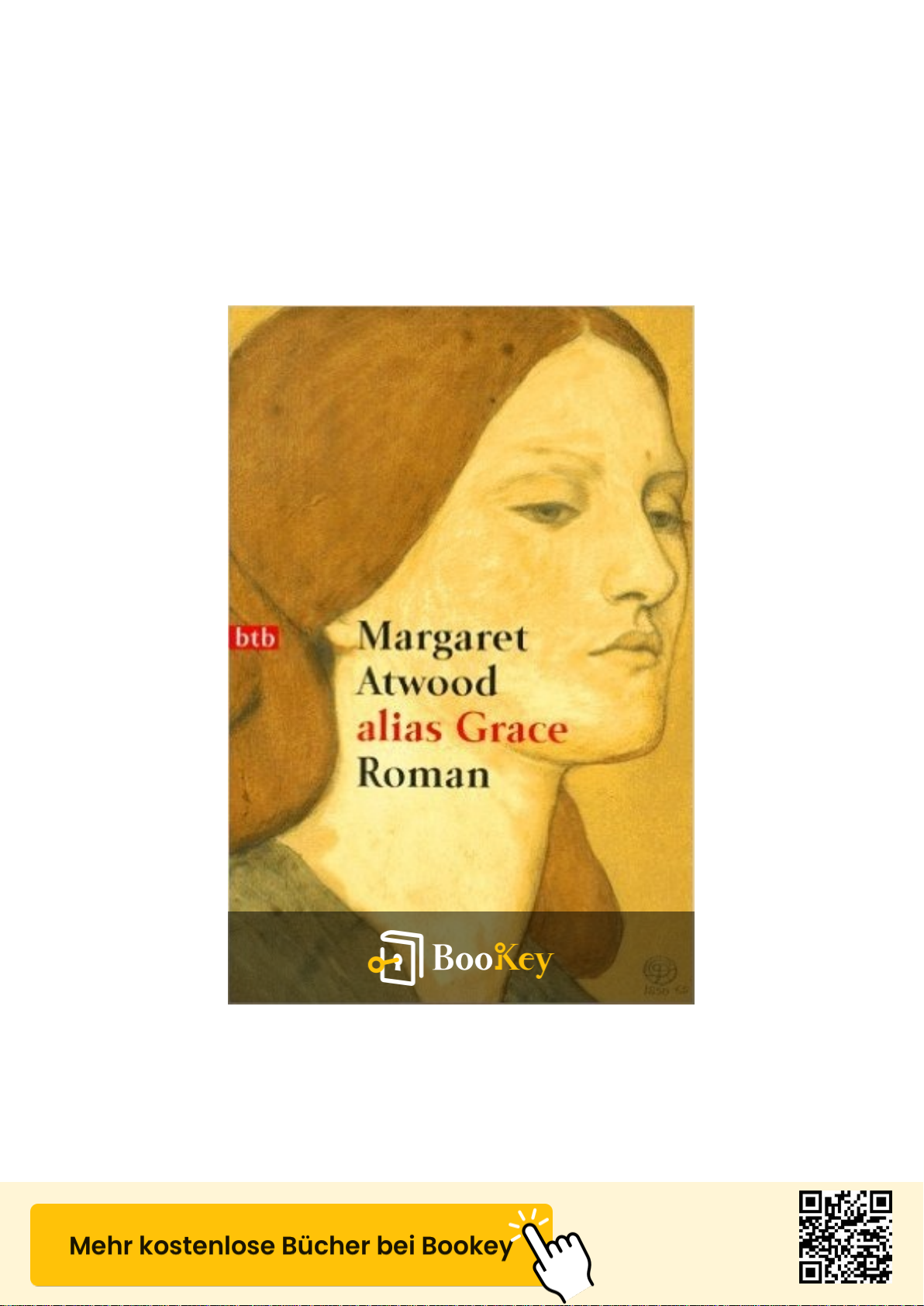
'The Yellow Wallpaper' and 'Alias Grace': Utilizing Literary Texts as Pedagogical Tools in the EFL Classroom PDF Free Download
1 / 46/46
100%

University of Rijeka
Faculty of Humanities and Social Sciences
Anja Najman
'The Yellow Wallpaper' and 'Alias Grace': Utilizing Literary Texts as Pedagogical Tools in
the EFL Classroom
Master’s Thesis
Rijeka, 2025
University of Rijeka
Faculty of Humanities and Social Sciences
Department of English
Anja Najman
0009084051
'The Yellow Wallpaper' and 'Alias Grace': Utilizing Literary Texts as Pedagogical Tools in
the EFL Classroom, MA Thesis
Submitted in partial fulfilment of the requirements for the M.A. in English Language and
Literature and Pedagogy at the University of Rijeka
Supervisor: Sintija Čuljat, PhD
September 2025

Abstract
The thesis 'The Yellow Wallpaper' and 'Alias Grace': Utilizing Literary Texts as Pedagogical
Tools in the EFL Classroom examines the pedagogical use of literary texts The Yellow
Wallpaper and Alias Grace in Croatian educational system, as well as different approaches and
practices that can be used in the immediate instructional process. This is executed by reviewing
the outcomes specified in the Croatian Curriculum of English language and how they can be
fulfilled through teaching these literary texts by implementing different activities and
assessment methods. Following the goal of the educational system to adequately prepare
students for the challenges of the modern world, this thesis focuses on cultivating knowledge,
skills and values through teaching these literary texts.
Key words: teaching literary texts, The Yellow Wallpaper, Alias Grace, outcome-based
education, curriculum

Table of contents
Introduction ............................................................................................................................................. 1
1. The educational system and its demands ...................................................................................... 2
1.1. The hidden curriculum ........................................................................................................... 3
2. Teaching literary texts in response to educational and societal challenges in Croatia .................. 4
3. English language learning outcomes connected to reading and reading evaluation ..................... 5
4. Teaching literary texts to learners of English as a second language: short stories and novels ...... 7
5. Different approaches to teaching literature ................................................................................... 9
6. Themes and plots in The Yellow Wallpaper and Alias Grace ........................................................ 10
6.1. Patriarchy and gender roles ................................................................................................. 12
6.2. Medical maltreatment of women ........................................................................................ 14
6.3. Power and control ................................................................................................................ 16
7. Exploring the main themes of the texts: Social influence and compliance with social injustice . 17
8. Exploring cultural resonance of The Yellow Wallpaper and Alias Grace ...................................... 20
9. Creating interest in reading literary texts ..................................................................................... 23
9.1. Examining the title Alias Grace ............................................................................................ 23
10. Students’ prior linguistic knowledge and potential for acquisition of new vocabulary ............... 25
11. Screen adaptations as teaching resources ................................................................................... 30
12. Reading assessment...................................................................................................................... 35
13. Conclusion .................................................................................................................................... 36
Bibliography ........................................................................................................................................... 38
1
Introduction
This thesis will explore how teaching English literature can benefit students in Croatian
schools with special focus on teaching two literary works, The Yellow Wallpaper by Charlotte
Perkins Gilman and Alias Grace by Margaret Atwood.
Creativity and innovation are among the many qualities that define an effective English teacher.
While incorporating literary texts into language teaching may no longer be considered
groundbreaking, it remains a widely used method for teaching new vocabulary and reinforcing
grammatical structures. However, beside these applications, literary texts are a powerful
pedagogical tool in teaching English as a foreign language.
In addition to subject-specific learning outcomes that students are expected to achieve by the
end of each lesson, there are also learning outcomes related to civic competences. These
competences equip individuals with the knowledge, skills, and values necessary to become
responsible democratic citizens who uphold and respect equal rights (European
Commission/EACEA/Eurydice, 2017). Recognizing the significance of education for
democratic citizenship and human rights, the Council of Europe (Committee of Ministers, 2002)
emphasized its integration into the educational system a priority objective of educational
policymaking and reforms.
Schools fulfil an essential role in preparing students for the challenges they will encounter in
life. Rosenblatt (1937) emphasized this expectation stating that a student “must be given the
knowledge, the habits, the flexibility, that will enable him to meet unprecedented and
unpredictable problems” (3). Although this might be an unrealistic expectation, modern
education retained a similar perspective where adaptability and critical thinking are essential
for success.
The aim of this thesis is to demonstrate the potential of literature as a powerful pedagogical tool
in teaching English as a second language by specifically focusing on The Yellow Wallpaper by
Charlotte Perkins Gilman and Alias Grace by Margaret Atwood and exploring how these texts
can benefit students’ cultural awareness, foster critical thinking skills and help them fight
stereotypes and prejudice in alignment with the Croatian national curriculum.

2
1. The educational system and its demands
Contemporary society transformed the way educational systems work. Our ability to
function and work in the society depends greatly on our educational system. The importance of
learning and knowing facts decreased and critical thinking, problem solving, lifelong learning
and skill development became a priority. Content based curriculum, which was the most
common model of curriculum until the 1980s, was therefore found lacking and insufficient in
preparing students for the challenges they would face after formal education (Baranović,
Domazet, Jokić, Marušić, & Puzić, 2006). The subsequent changes and developments of
curriculums were connected to these insufficiencies.
Curriculum can be defined as a methodical and structured plan of connecting teaching methods,
content elements and learning materials as well as the assessment methods and aligning them
with specific learning outcomes (Zrilić, 2018). The transformation from the rigid cramming of
information while teaching merely to fulfil plans and cover prescribed content, to designing
lessons in order to achieve specific learning outcomes, created a more flexible and student-
centred approach to education. This means that, in most educational systems today, teachers
also have more freedom to choose the method and content they will use to achieve the learning
outcomes.
The educational system in Croatia as we know it today has been continuously developing. A
big step toward achieving a modern, inclusive, and outcome-oriented approach to education
was the development of The National Curriculum Framework for Preschool Education,
Compulsory Education and General Secondary Education (Nacionalni okvirni kurikulum za
predškolski odgoj i obrazovanje te opće obvezno i srednjoškolsko obrazovanje). This document
was adopted with the goal of ensuring the development of individuals in all areas - ranging from
science, technology, and economy to culture, social cohesion, and the role of the individual as
a citizen, as well as their personal growth (Ministarstvo znanosti, obrazovanja i športa, 2011).
The holistic approach to teaching with emphasis on cross-curricular topics (civic education,
health, personal and social development, learning to learn) was the main distinction between
this curriculum and previous educational policy documents.
However, the implementation of these recommendations has been a challenge. While cross-
curricular topics are embedded into all subjects, teachers often struggle to implement it without
the training in the field (Diković & Zečević, 2020).
3
In a way, the Holistic Curricular Reform (Cjelovita kurikularna reforma) published in 2016
was a solution to the shortfalls of The National Curriculum Framework for Preschool
Education, Compulsory Education and General Secondary Education. The reform emphasized
key concepts such as the development of key competence, learner-centred education, societal
and economic relevance, teacher autonomy, active learning and others (Jokić & Ristić Dedić,
2018). However, the practical implementation of this reform did not happen.
Evidently, the shift from traditional fact-based teaching methods occurred in the Croatian
educational system following international examples of positive changes in education.
However, with the implementation of new practices also comes trial and error. In Croatia, the
process of implementation required a holistic approach. Teachers, who directly influence the
way knowledge and skills are transferred, lacked training, tools and professional support to
successfully apply these changes. As the main proposition of this thesis is that literary texts
(specifically Alias Grace and The Yellow Wallpaper) can be used as tools for teaching, one of
the focuses is to apply its concepts with a goal to improve the implementation of new practices
in Croatian educational system. Pursuing this goal, teachers are crucial agents because they
influence the process learning through ‘hidden curriculum’.
1.1. The hidden curriculum
Besides the formal curriculum, we also need to acknowledge the hidden curriculum or a
curriculum that manifests implicitly. Hidden curriculum can be described as unarticulated and
unintentional learning that often occurs through a role model (Neve & Collett, 2017). Hidden
curriculum exists on all levels of schooling and is not confined to formal education but can be
recognised in family life, health care, media and other social settings that implicitly shape the
way we think (Illich, 1971). In formal education, school culture, learning environments,
unwritten rules, school routines and other elements shape the hidden curriculum. However,
most notably, teachers become role models for students and either consciously or
subconsciously through their actions, topics for discussions, sayings, gestures and forms of
evaluations teach different values (Fraenkel, 1976).
In teaching literature, there is also an implicit influence in how teachers shape the students’
views about reading in general and the values they derive from reading the texts. Attitudes
towards reading and the motivation to read are two thoroughly researched interrelated
4
constructs. What motivates us to read can therefore be categorised into five different aspects:
learning orientation or reading to understand and know what we read, intrinsic motivation or
reading for the pleasure of reading, extrinsic motivation such as reading to get good grades or
rewards, self-efficacy and to improve reading skills and social motivation, e.g. sharing books
(Guthrie and Wigfield, 2000, as quoted in Sainsbury & Schagen, 2004). Depending on the
source of students’ motivation, teachers need to adapt their approach to nurture positive
attitudes towards reading from the onset. This includes how teachers introduce students to
reading, the way they discuss the key themes of the texts, and how they evaluate and assess
students in their reading assignments. Knights (2017) explained that teachers need to be self-
aware about their teaching methods which can positively or negatively affect the environment
of learning, especially in reading and teaching texts where there is a possibility of multiple
interpretations and each class can be a way to teach new values. Students or readers are the ones
who come to their own conclusions about the text they have read. The feeling they have towards
the text is based on their own beliefs and worldviews. However, teachers are there to guide
them through discussions and questions. They offer possible meanings of the texts and bring
different elements into focus in their lessons. Teaching literature can, therefore, be a very good
way to teach students moral values and content that is not only based on factual knowledge. In
addition, one of the main features of curriculum is that teachers are given the freedom to
incorporate additional content into their lessons as long as they serve as a tool to fulfil required
outcomes and goals. So, even though there are literary texts already prescribed as obligatory in
both elementary and secondary school education, teachers can choose other materials and
literary texts based on their literary value. Keeping this in mind, this thesis proposes the
inclusion of the texts The Yellow Wallpaper and Alias Grace in secondary school education,
specifically within English language instruction or as part of an elective reading course.
2. Teaching literary texts in response to educational and societal challenges in
Croatia
Literary texts can always be used in classrooms to provide a unique insight into social
concepts and norms and explore the complexities of the human mind. With the ongoing
globalisation, there is a need to educate students in order to improve their global understanding,
facilitate learning that creates openness towards differences between people and battle

5
stereotypes and prejudice. If a society is prejudiced and if it has stereotypes, discrimination of
certain groups is highly probable. In this day and age, discrimination is still a frequent
occurrence in Croatia. We hear about it in the news and read about it in the papers. Fredman
(2016) defines direct discrimination as treating someone less favourably because of a protected
characteristic. It can be based on someone’s ethnicity, religion, racial background, culture or
other characteristics. Moreover, it cannot be denied that even among school children there are
challenges in adhering to social norms contributing to violence and bullying in schools
(Đuranović, Klasnić & Lapat, 2013). In addition to preparing individuals to be critical thinkers
and become competent citizens, educational facilities must also have a goal to prevent bullying
and discrimination. Therefore, moral education must be incorporated into the education system.
Teaching literature may be beneficial to learn moral values such as respect, justice, caring,
responsibility, trustworthiness and civic competences indirectly (Ahmad, 2021).
3. English language learning outcomes connected to reading and reading evaluation
Incorporating new materials into lessons is not a process that can be done superficially and
without a holistic approach. It should be based on triadic alignment which encompasses careful
consideration of learning objectives, learning activities and assessment methods at the same
level of cognition included in the process (Pape-Zambito & Mostrom, 2018). Cognitive levels
are classified by Bloom’s Taxonomy. The taxonomy is organised into six classes starting from
the lowest order of thinking skill: knowledge, comprehension, application, analysis, synthesis
and evaluation (Bloom, Engelhart, Furst, Hill, & Krathwohl, 1956). Figure 1. illustrates the
cyclic nature of the process of triadic alignment.
Figure 1. Triadic alignment
OBJECTIVES
LEARNING
ACTIVITIES
ASSESSMENT
METHODS

6
In the curriculum of English language in Croatian schools, there are general outcomes, i.e. what
is expected to be achieved by the student. The outcomes are also specified through objectives
which clarify how to fulfil the outcomes in practical contexts and indicate the cognitive level
that is expected from students based on Bloom’s taxonomy. Taking into consideration the level
of English language proficiency of students and the complexity of language in Alias Grace and
The Yellow Wallpaper, the inclusion of these works as unaltered educational materials in
schools can only be accomplished in secondary school instruction. Moreover, looking into the
learning outcomes specified in the Curriculum of English Language that determine the
expectations for secondary school students from 1st to 4th grade in general grammar schools,
it is evident that the complexity increases with each grade. For example, the outcome in the
domain of communicative language competence in 1st grade (A.1.1.) is “analyses a simple
adapted or authentic medium-length text while listening or reading”; for the 2nd grade (A.2.1.),
it is “analyses simple authentic and longer adapted texts while listening and reading”; for the
3rd grade (A.3.1.), “analyses longer authentic or adapted texts while listening and reading”; and
for the 4th grade (A.4.1.), “evaluates longer authentic or adapted texts while listening and
reading” (Ministarstvo znanosti i obrazovanja Republike Hrvatske, 2019, 14, 19, 25, 30).
Evidently, the complexity of the outcomes increases – this is signified by the verb used in the
specific outcome which indicates a higher-order thinking skill, e.g. analyse in the 1st, 2nd and
3rd grade and evaluate in the 4th grade. According to Bloom’s taxonomy “to evaluate” is a
higher-order thinking skill than “to analyse”.
Similarly, the advancement in the thinking-skill level that is expected from students as they
progress to a new grade is also reinforced through length of the texts in focus. In other words,
for the first grade, the text in focus should be medium length (adapted or authentic) while for
the fourth grade, it should be a longer authentic or adapted text – the length gradually increases.
Since Alias Grace and The Yellow Wallpaper are both longer texts, a novel and a short story,
the predetermined outcomes and expectations of students are that they should be able to analyse
and evaluate such literary texts in the 3rd and 4th grade. On the other hand, the texts can also be
taught in the 1st and 2nd grade. However, due to the outcomes A.1.1. and A.2.1., an option for
teaching these literary works could be choosing shorter excerpts from the texts to use in
classroom, and adapt them by simplifying vocabulary or providing a glossary.
In the Curriculum of English Language there are two other domains that should be taken into
account in order to align them with the teaching of literary works beside the domain A.

7
communicative language competence. Domain B. is intercultural communicative competence
and domain C. is autonomy in language learning. The outcomes that can be achieved by
reading, implementing activities connected to reading in lessons and using alternative
evaluation methods are numerous. In a way, activities connected to reading foreign language
literature in classrooms can be intended to fulfil certain outcomes from all three domains,
providing students with tools to communicate in a foreign language in a more nativelike
manner, giving them a powerful intercultural insight and teaching them strategies to learn and
think critically about information they receive.
4. Teaching literary texts to learners of English as a second language: short stories
and novels
In teaching languages, it is important that students are exposed to authentic language use.
Short stories have certain advantages when it comes to teaching a language and focusing on
reading comprehension. Erkaya (2005) argues that short stories give educators possibilities to
teach all four skills – reading, listening, writing and speaking to students of all levels of
linguistic competence. Educators might choose short stories to teach in class not only due to
their pedagogical value and advantages but also due to their length. Novels and short stories
share common elements, but short stories are less likely to include multiple narrators, non-
chronological order of events, numerous characters and a complex plot, so novels may present
a greater challenge for ESL learners and for teachers due to difficulties of adapting activities
(Lazar, 1993).
However, educators should not shy away from teaching novels. Even though reading entire
novels in a foreign language can be challenging for students, once a habit of reading longer
texts is made, novels can be captivating and rewarding. On that account, when choosing literary
works for teaching, educators should always consider students’ prior reading experience and
reading habits. Besides literary background, several other factors should be taken into account
when choosing literary texts (Lazar, 1993). These include:
• Students’ culture – whether they will understand the text and find this diversity
enriching or not be interested in the text because it is does not reflect their own
reality.
8
• Students’ level of language proficiency – educators have to consider the
vocabulary of the text such as archaisms, metaphors, dialect or register and
whether it is too complicated for the students, as well as specific language norms
that could make the process of learning difficult and unenjoyable
• Text length – educators have to account for the time needed to work on the text
in class as well as for the time the students have to work on it during independent
study.
• Accessibility of texts – what books are already available and if there are no
available text, how easily can they be made available (for example online
versions)
• Pedagogical potential – what activities can be done to explore the text and are
there and additional materials that would help the students learn more about the
text or the author (for example a screen adaptation).
• Curricular alignment – is the text connected to the rest of the course and can the
text be used in accordance with the teaching methods and learning outcomes.
Taking these factors into account, pedagogical value can be found in two literary works that
were published in different times but set in a similar period. A fictional short story, The Yellow
Wallpaper, by Charlotte Perkins Gilman, first published in 1892 and Alias Grace, a historical
fiction by Margaret Atwood published in 1996 but set in the 19th century. The story follows
multiple timelines. Most of Grace’s life is retold by Grace during her interviews with dr Jordan.
The interviews take place in 1859, and Grace gives dr Jordan recollections of her difficult
childhood, her journey from Ireland to America, her employment and the murder of her
employer Thomas Kinnear and his housekeeper Nancy Montgomery in 1843. The book
concludes in the late 1880s.
The connection between these two literary works is not only in the time setting but also in the
themes and messages the authors wanted to convey in their works. Both The Yellow Wallpaper
and Alias Grace implicitly criticised social issues prevalent in the 19th century. Specifically, the
literary works are the most similar in confronting patriarchy, gender roles, oppression of women
and medical mistreatment of women. In addition, Atwood’s novel examines the important
topics of identity, memory and truth (Monacelli, 2018). Even though the themes of the texts
were based on and described in relation to 19th century societal problems, the messages they
send can be viewed and compared from the perspective of modern-time societal problems.
9
The Yellow Wallpaper and Alias Grace are longer texts that require a higher level of language
proficiency as well as the utilisation of higher-order thinking skills from students.
Consequently, it can be confirmed that, based on curricular requirements, these literary texts
are suited for students in secondary schools in their 11th or 12th year of English language
learning.
Moreover, student’s culture, pedagogical potential and curricular alignment is discussed
throughout this paper. These factors are incorporated into classroom activities. Each activity is
based on different approaches in reading as well as the intended outcome and its pedagogical
potentials.
5. Different approaches to teaching literature
Using literature in language teaching can have different purposes. Therefore, the aim in
teaching The Yellow Wallpaper and Alias Grace in English-language courses in Croatian
secondary schools should not be limited only to language acquisition purposes. There are three
distinct approaches in teaching literature, these include a language-based approach, an approach
where literature is used as content and using literature for personal growth (Lazar, 1993).
Following this, Beach, Appleman, Hynds and Wilhelm (2013) listed practices involved in
teaching literature:
1. Taking a different perspective – Practice that focuses on the notion that adolescents
often believe their perspective is the only one. These practices require students to
assume a viewpoint of a character that differs from them with respect to gender,
race, historical period or class.
2. Building a social world based on the setting of a literary text – Practice that involves
constructing a text world based on the students’ knowledge of historical and cultural
aspects that shaped the world described in the literary text.
3. Explaining the actions of characters – Practice that focuses on students’ ability to
connect traits, goals and beliefs of characters to the specific reasons for their actions.
4. Inferring meanings – Practice of inferring implied meanings of symbols and themes
in the text.
10
5. Connecting prior knowledge of world and other texts to the text in focus – Practice
that focuses on students drawing conclusions from what they already know and
connecting it to new concepts.
6. Posing questions, solving dilemmas and rereading – Practice based on an argument
that students struggle with understanding the literary text after the initial reading.
Therefore, it crucial for educators to address students’ questions and dilemmas about
the text, help them resolve those dilemmas and encourage them to reread the literary
text with the new understanding.
7. Examining the text critically – Practice based on critically examining literary text
from a perspective of different critical lenses, such as feminist or Marxist.
These practices can be incorporated into different phases of teaching literature. The phases in
teaching literature are:
1. Pre-reading (activities to create interest, motivate and provide students with relevant
vocabulary before reading),
2. While-reading (activities to help students understand author’s goal, content or text
structure) and
3. Post-reading (activities for students to reflect on the text and relate to it from their own
viewpoint) (Yazar, 2013).
In order to make reading lessons and reading itself more enjoyable and productive, different
approaches and practices can be combined and carried out through planned stages of reading
lessons. Therefore, the activities to teach the texts The Yellow Wallpaper and Alias Grace will
be also divided into those stages and based on approaches in focus for specific lessons.
6. Themes and plots in The Yellow Wallpaper and Alias Grace
Coser (1972) identified a link between the central themes of literary works and sociological
themes believing that literature makes commentary and critiques societal manners and morals
while also making an impact on society and trying to bring change. It can be argued that this is
also the basis of teaching literature. Besides improving vocabulary, grammar, writing and
reading skills in both foreign and native language and benefiting general knowledge, reading
facilitates personal development.
11
Each text presents its reader with a different set of ideas, values and worldviews where author’s
personality and social context as well the time and place in which the text was written play a
significant role in the reader’s understanding of the text creating an interaction between reader’s
own set of values and beliefs (Rosenblatt, 1937). Due to this interaction, a literary text can never
be objectively written nor objectively read. The writer draws upon their own ideas, opinions
and worldviews, incorporates it into their writing and the reader observes the texts from their
own point of view. Even though this is an inevitable occurrence when reading, the process is
still significant. By learning how to reflect on the important themes and messages from their
own point of view and learning how to come to conclusions based on evidence and arguments,
readers are improving their critical thinking skills. Similarly, with literary works where a theme
or a message of the story is central to the time or culture in which it was written, readers can
examine it from the perspective of their culture and time.
With the examples of The Yellow Wallpaper and Alias Grace, the time setting is 19th century.
The Yellow Wallpaper is a short story written in the form of diary entries. The narrator,
diagnosed with nervous hysteria by her husband, a medical doctor, keeps her diary secret
because her husband believes that writing is bad for her health. Moreover, in her short story,
Gilman reflects on and condemns the oppression of women in a patriarchal society that is
occurring in her day while Atwood uses past transgressions of the society to warn about the
present. In addition, due to the fact that Alias Grace was written and published more than a
century after the time setting of the novel, we see its depictions of the society and the ongoing
problems in the 19th-century Canada as Atwood’s representations of the era. Nevertheless, this
difference in the time the two literary works were published provides us with a great opportunity
to compare the ways central societal problems were criticised and brought forward by the two
authors. In the dynamic and changing society we live in, with many different cultures,
languages and ethnicities, determining what values should be passed to younger generations
can be difficult, but in education, it is essential that certain character traits are acquired where
people are guided by universal moral values (Akin, Dunne, Palontares, & Schilling, 1995). The
literary works chosen for this thesis share common themes but also examine themes that are
distinctive for their own narratives. In the following paragraphs, the focus is on the themes
present in the literary texts which are essential for learning and discussing in secondary-school
education and are connected to curricular goals.
12
6.1. Patriarchy and gender roles
The main premise of patriarchy is simple; men have power over women. Beauvoir argues that
patriarchy is grounded in the belief that women are biologically weaker than men, but her
philosophy contradicts this idea (Beauvoir, 1997, as cited in Irshad & Banerji, 2013).
By reading The Yellow Wallpaper written from the perspective of a narrator who is a middle-
class woman married to a doctor, free from financial problems and even from responsibilities,
readers do not envision a woman who is a victim of her circumstances. Despite this, the
consequence of patriarchy is her being driven to madness from the control she experienced that
was framed as an act of care (Lanser, 1989). She was forbidden from writing, socialising, and
from all forms of physical exertion. The short story takes place in a summer house her husband
rented in hopes that it would lift her spirits. However, her stay there only worsens her condition.
She spends most of her time in a room in the attic with a yellow wallpaper which preoccupies
most of her attention and she fixates on it, first hating it and later starting to like it but growing
more into madness.
The depiction of patriarchy in the short story is almost casual and implied as just the way things
are. A very good example of this is in the sentence “John laughs at me, of course, but one
expects that in marriage” (Perkins Gilman, 3). The husband disregards the concerns of his wife
as silly and funny not even considering her medical condition as serious believing that “there
is really nothing the matter with one but temporary nervous depression – a slight hysterical
tendency – what is one to do.” (Perkins Gilman, 4). There are also other men mentioned in the
story. One of them is the narrator’s brother who “is also a physician, and also of high standing,
and he says the same thing”, referring to the diagnosis the narrator’s husband gave (Perkins
Gilman, 4). From the start of the story, we can notice a pattern of putting men and women into
traditional gender roles and generalising their character traits. The men are described as logical
and rational, while women are described as irrational and illogical which is an embedded belief
in patriarchal societies, particularly of the time the short story was written (Ghandeharion &
Mazari, 2016).
However, even though the patriarchy and the way it has influenced the narrator is portrayed as
ordinary, the story progresses into a serious indirect criticism of patriarchy. The narrator’s
health worsens, and she becomes obsessed with the wallpaper believing there is a woman
behind the wallpaper shaking it and that the wallpaper has a smell that follows her “even when
I go to ride, if I turn my head suddenly and surprise it – there is that smell!” (Perkins Gilman,
13
25). This fixation with the wallpaper and becoming so obsessed with it that she started to believe
there is a woman behind it is a result of not having control over her own life. Her husband
controlled every part of her life from how she spent her time, where she went, what she could
and could not do and even when she could see her own family, secluding her from the society
by choosing a house that is remote and isolated (Tonmoy, 2014). In addition to being controlled,
she is also infantilised by her husband, who patronises her by calling her a “little girl” and
dismisses her concerns by telling her “Bless her little heart!” said he with a big hug, “she shall
be as sick as she pleases! But now let’s improve the shining hours by going to sleep, and talk
about it in the morning!” (Perkins Gilman, 19-20). It is evident that he does not take her
seriously and sees her more as a child that needs to be taken care of than his equal partner.
In the short story, we never find out what the narrator’s name is, she is anonymous. This brings
forward the fact that this is not just one specific case, but one of many, it illustrates the
experience of many women’s sufferings in 19th-century America, but also today anywhere in
world (Ghandeharion & Mazari, 2016).
Throughout her novel, Atwood brings the issue of patriarchy into light and through the character
of Grace Marks illustrates the instilled ways of the society. However, she contradicts the belief
that women are weaker than men. Grace sees and believes that by marrying well she can live a
better life, and this is her wish in the beginning, to earn money for her dowry and become a
mistress in a house (Goldblatt, 1999). Marrying is seen as getting ahead in life and there is a
certain safety when you are married. However, with the conviction of murder, Grace needs to
use the narrative in her own advantage. Due to her being considered by the court and the public
as the weaker sex, she was not punished by death as James McDermott was, but by life in prison
(Irshad & Banerji, 2013). Grace was a ‘victim’ of the patriarchal society but when it came to
life or death, she escaped the fate of the other women in her life that were dear to her. Even
from her descriptions of her early childhood we see the negative pattern of women close to
Grace dying. Her mother, who died during their voyage to Canada, was an example of a woman
suffering due to her husband’s actions. His alcoholism and inability to provide for his family as
well as her own weakness contributed to Grace’s traumatic childhood and troubled life. Her
mother was passive and voiceless even though she and her sister “both had education, and could
embroider and play the piano” (Atwood, 208). In other words, she had no influence nor choice
in what happened to her and her family. Even Grace claimed for her mother that “she was a
timid creature, hesitating, weak and delicate, which used to anger me. I wanted her to be
stronger, so I would not have to be so strong myself” (Atwood, 209).
14
On the other hand, Mary Whitney, the first friend she met during her first employment, was the
direct opposite of her mother. Grace described Mary as “a fun-loving girl, and very mischievous
and bold in her speech when we were alone. But towards her elders and betters her manner was
respectful and demure … behind their backs she made jokes about them…” (Atwood, 304).
Mary taught Grace many things about working as a housemaid and about the ways of society.
Grace looked up to her in a way, frequently contemplating what Mary would say about a certain
situation. However, despite her astuteness and insight into the ways of the patriarchal society,
Mary died because she had not followed her own advice. She died from complications after an
illegal abortion, because the person who impregnated her refused to own up to it, even though
she at first believed he would. Mary was also very different from Nancy Montgomery, a
housemaid at Grace’s new employment. While Mary encouraged Grace to challenge patriarchal
and class-based ideologies, Nancy treated Grace as her superior even though they had the same
social background which amplified Grace’s subordination (Azam, Faheem, & Batool, 2025).
The reason behind her behaviour is that Nancy was their employer Thomas Kinnear’s lover.
This gave Nancy more freedom to do what she wants and work less. However, the society
frowned upon their secret relationship because of their class differences, which was why they
could not be officially married.
The complex social relations in the novel and what ultimately happened to the characters serve
as a lesson and a warning about the consequences of living in a society where women are
subordinate and oppressed. Grace is portrayed both as a victim and a murderer, a person that
controls the narrative but also a person traumatised by the events in her life since early
childhood (Azam, Faheem, & Batool, 2025). Grace’s mother, Mary and Nancy as well as Grace
have all been subjected to different types of oppression by the patriarchal society. Moreover,
the three women have all influenced Grace in her beliefs and formation of character.
6.2. Medical maltreatment of women
The Yellow Wallpaper places strong emphasis on the medical maltreatment of women, and it is
one of the main themes. In her essay, Why I wrote The Yellow Wallpaper, Charlotte Perkins
Gilman describes her own struggle with mental health, where she was also advised to practice
the ‘rest cure’ by a famous physician which did not help her, but only worsened her condition
(Perkins Gilman, 1913). She wrote the essay because she saw how many people reacted to The
Yellow Wallpaper and she wanted to explain the reasons behind it. She claims that her intent
15
was not to make people go insane, instead she wanted to save people from going insane and she
fulfilled her goal (Perkins Gilman, 1913). The rest cure was a popular treatment at the time,
prescribed only to women. The implications behind this “treatment” were that there was nothing
physically wrong with the women being treated, only some emotional or mental instability
which was because of too much work. And women are too fragile to exert themselves,
intellectually or physically.
On the other hand, in Alias Grace, there are several instances where women were medically
maltreated. The first is the illegal abortion that Mary Whitney has. When she got pregnant, her
choices were limited. Since she was not married, she knew that her employer would send her
away “and she would have to go on the streets, and become a sailors’ drab, as she would have
no other way of feeding herself and the baby. And such a life would soon be the end of her”
(Atwood, 357). Mary saw the abortion as her only hope, she believed she would die on the
streets if she had a baby. However, the abortion she had was botched and she bled to death.
Mary died when she was “fifteen or sixteen years old” and her death is the result of
“misogynistic indifference and self-righteous disregard for women’s medical needs” (Horvitz,
103). Her death is also one of many that happened and are still happening today due to the
inaccessibility of proper medical care and can be interpreted similarly to how the narrator’s
situation in The Yellow Wallpaper was interpreted, as a message and a way to bring focus on
this issue.
Secondly, in Grace’s descriptions of the time she spent in the mental asylum also provide an
insight into maltreatment, neglect and poor living conditions as well as misdiagnosis of women
as insane when in fact:
“…a good portion of the women in the Asylum were no madder than the Queen of
England. Many were sane enough when sober, as their madness came out of a bottle,
which is a kind I knew very well. One of them was in there to get away from her
husband, who beat her black and blue, he was the mad one but nobody would lock him
up; and another said she went mad in the autumns, as she had no house and it was warm
in the Asylum, and if she didn’t do a fair job of running mad she would freeze to death;
but then in the spring she would become sane again because it was good weather…”
(Atwood, 64)
In the 19th century men and women were under great pressure due to high standards of the
society. However, women were especially impacted by such standards. Madness as such was a

16
condition only women were diagnosed with, it was a gendered condition closely linked to
female morality and sexuality where any transgressions from traits that were considered
feminine such as motherhood, caring or patience were considered as unnatural and morally
insane (Sen, 2005). The gendering of madness is even mentioned in the previous excerpt from
the novel – a woman is in the asylum to escape her husband that beats her, while the husband
whose behaviour can be described as a symptom of madness, remains free.
6.3. Power and control
The two literary works portray two types of power over a group of people. One is the power of
a higher social class – money, reputation and social standing in both The Yellow Wallpaper and
Alias Grace were key in maintaining power over someone. In The Yellow Wallpaper, John is
an influential physician which means that he can use his good reputation to basically control
every element of his wife’s life. Similarly, in Alias Grace, almost every character exerts power
over Grace because she was a mere servant. This dynamic is visible in the power of her
employers over her, her treatment by the physicians and workers in the asylum and penitentiary
and even the influence of Nancy Montgomery who was the same social class as Grace.
The other form of power is tied to the gender dynamics. Women were in a severe disadvantage.
Besides the perception that they are the weaker sex and not complying to the norms and societal
expectations of women meant they were insane, women’s own agency and control over their
own life was non-existent. However, both main characters seek this and strive to achieve it. The
narrator in The Yellow Wallpaper challenges her husband’s control by writing a journal in secret
and through her journal we find out about her emotional turmoil. Her state worsens, and while
spending most of her time in her room, she starts seeing women in the wallpaper and imagining
that they cannot get out. To free them she even started peeling the wallpaper.

17
7. Exploring the main themes of the texts: Social influence and compliance with
social injustice
One of the main themes of the text is the narrator’s subordination in her marriage and
descriptions of her relationship with her husband which embody the usual roles of women in
marriages in the 19th-century American setting of The Yellow Wallpaper. We might see her
husband John as the villain now, but this was the usual marriage dynamic of that time, women
were considered weak, and it is no surprise that his recommendation as a physician was to rest,
avoid physical and mental exertion at all costs and isolate in a remote house. In addition, the
people she did interact with also conformed strongly with the traditional gender roles. The
people that surround her are mostly men – her husband, her brother, Weir Mitchel, and the
women who she mentions are Mary and Jennie who are happy with their domestic occupations,
looking after the children and being a housekeeper (Ford, 1985). The characterisation and
actions of other characters in the short story illustrate how individuals follow the societal norms
and do not consider questioning them. In the 19th-century America and Britain, it was the norm
that women were associated with the private sphere and men with the public sphere, where the
private sphere meant that women are “to be pious, pure and domesticated” (Ross, 228).
To illustrate this dynamic to students and improve their understanding, it can be beneficial to
adapt and implement the activity proposed by Collie and Slater (1987) for the text The Yellow
Wallpaper. Below is an example of a possible way this activity a can be implemented in four
steps.
Stage: Pre-reading activity
Approaches: Reading for personal growth
Practices: Taking a different perspective
Specific outcomes: Writes texts of very complex linguistic structures of varying lengths, styles,
and purposes
Applies a wide range of critical thinking skills: constructs arguments and evaluates opinions,
attitudes, and values, applying them to problem-solving situations and to making decisions
related to personal experiences and contemporary issues
Title: “If I were them” – writing task
18
Task Description:
Step 1: Present students with the important information connected to the theme
The main character is a young woman who feels she is unwell, she is struggling mentally
and feels nervous and anxious all the time. Her husband and brother are doctors and
assure her that what she is feeling is not serious. Her husband claims her health will
improve with some rest and forbids her from writing and working. While staying in a
house they rented in a village, she has limited social interactions. As the time progresses,
she feels she is not recovering, and she describes her feelings in a secret diary.
Step 2: Provide students with relevant excerpts from the text to give them insight
into interactions and relationships between the characters
Excerpts in focus:
a) A dialogue between the narrator and her husband
“What is it, little girl?” he said. “Don’t go walking about like that—you’ll get
cold.”
I thought it was a good time to talk, so I told him that I really was not gaining
here, and that I wished he would take me away.
“Why darling!” said he, “our lease will be up in three weeks, and I can’t see how
to leave before. … Of course if you were in any danger I could and would, but
you really are better, dear, whether you can see it or not. I am a doctor, dear, and
I know. You are gaining flesh and color, your appetite is better. I feel really much
easier about you.”
“I don’t weigh a bit more,” said I, “nor as much; and my appetite may be better
in the evening, when you are here, but it is worse in the morning when you are
away.”
“Bless her little heart!” said he with a big hug; “she shall be as sick as she
pleases! But now let’s improve the shining hours by going to sleep, and talk
about it in the morning!” (Perkins Gilman, 19)
b) Narrator’s description of her sister-in-law
19
“There comes John’s sister. Such a dear girl as she is, and so careful of me! I
must not let her find me writing.
She is a perfect, and enthusiastic housekeeper, and hopes for no better
profession. I verily believe she thinks it is the writing which made me sick!
But I can write when she is out, and see her a long way off from these windows.”
(Perkins Gilman, 12)
Step 3: Give students instructions for the task
Write a diary entry (about 150-200 words) as if you were the woman in the story (the
narrator). Use the excerpts provided to help you envision her situation and relationships
with people close to her. Use the following questions as a guide:
1. Where are you now, what do you see around you?
2. How do you feel right now about this situation?
3. What is your next move/what are you planning to do?
4. What is currently your worst fear?
Step 4: Once students have completed their diary entries, choose two or three
examples (with students’ permission) to be read out loud in class. Briefly discuss
their perspectives.
This activity is in alignment with the outcome: Secondary school (first foreign language –
English), domain A, 4th grade, learning outcome A.4.5. that states that student “writes texts of
very complex linguistic structures of varying lengths, styles, and purposes.” (Ministarstvo
znanosti i obrazovanja Republike Hrvatske, 2019, 106). Additionally, this activity aims to help
students develop their writing skills, and they the ability to express themselves creatively. It is
a step away from a simple “write an essay” task while still not being too time-consuming and
challenging to implement. On the other hand, in instances where essays are well set, they can
be very “powerful pedagogic tools” because they demand arguments to be original and
thoroughly sustained (Gibson, 99). Therefore, total exclusion of essays as an in-class
assignment or an assessment method is not required.
Another outcome targeted by this activity is that students are expected to make well-thought
conclusions and logical inferences as elements of critical thinking, make predictions about
consequences and possible solutions, elaborated from the outcome: Secondary school (first
foreign language – English), domain C, 4th grade, learning outcome C.4.5. “Applies a wide
20
range of critical thinking skills: constructs arguments and evaluates opinions, attitudes, and
values, applying them to problem-solving situations and to making decisions related to personal
experiences and contemporary issues.” (Ministarstvo znanosti i obrazovanja Republike
Hrvatske, 2019, 110).
8. Exploring cultural resonance of The Yellow Wallpaper and Alias Grace
It goes without saying that the setting and historical context of the two literary works are
very remote to Croatian students. The Yellow Wallpaper is set in the 19th-century America and
Alias Grace in the19th-century Canada. The society then was shaped by different social norms
and expectations, religious practices, traditional gender roles and class hierarchies. There is a
chance that students could perceive this as unrelatable and irrelevant to the realities of the
modern times. However, experience has shown that history tends to repeat itself, besides that,
sometimes issues relevant to today’s world reflect the ones in the past. Weinstock (2003)
emphasizes the importance of teaching The Yellow Wallpaper not to portray deeply sexist
society of the 19th century, but to connect it to contemporary issues which, in more ways than
expected, remain similar. Although gender inequality is less frequent today, it does not mean it
no longer happens. The Yellow Wallpaper brought forward a problem of medical neglect of
women whose serious mental health problems were disregarded and treated as a mild emotional
instability. The narrator’s experience can be described as medical gaslighting, a phenomenon
that in majority affects women and other marginalised groups and is characterised by the
dismissal and minimisation of a person’s symptoms without appropriate medical examination
(Kaur Dhillon, 2025). This phenomenon is very frequent today and it does not only include
mental health problems, but also other symptoms that are not visible or measurable. Such was
the narrator’s illness, her symptoms were not taken seriously, and she was “treated” in a wrong
way.
Similarly, although occurrences Grace described may seem shocking to us and we believe that
such things do not happen today, Alias Grace like many of Atwood’s literary works, serve as a
warning and a cautionary tale, reminding the reader that injustice, gender inequality and other
societal issues are still persistent.
21
What does this mean for implementation in classrooms? In order to make sure that students
have enough knowledge to understand these texts and their cultural background, having pre-
reading activities is very important. The results of a study done by Spencer and Sadoski (2006)
have shown that a pre-reading activity helped students achieve better scores than the students
that did not have a pre-reading activity. The pre-reading reading activity included a list of key
terminology that was given to students followed by a brainstorming of the terms and a short
discussion. Since The Yellow Wallpaper and Alias Grace are set in 19th-century America and
Canada, respectively, the pre-reading activities can be similar. A list of key terminology, a
brainstorming activity and discussion can therefore be useful to implement, but there are also
more creative ways to introduce students with the key concepts of the text. Before reading
literary texts, it is important for students to know the historical context of the 19th century: social
norms, class structure and gender norms. One creative, practical and well-liked activity by the
students is an anticipation guide, a strategy where major ideas of a text are forecast by using
statements (Defrioka, 2017). Below is an example of an anticipation guide task for The Yellow
Wallpaper and Alias Grace aligned with the outcome Secondary school (first foreign language
– English), domain B, 4th grade, learning outcome B.4.1. that requires students to engage in
discussions about complex cultural elements relevant to members of other cultures and to justify
the importance of multilingualism” (Ministarstvo znanosti i obrazovanja Republike Hrvatske,
2019, 107).
Stage: Pre-reading activity
Approaches: Reading for personal growth
Practices: Inferring the meaning of themes, connecting prior knowledge of world and
other texts to the text in focus
Specific outcome: Expresses opinions and believes about complex cultural elements
that are significant in other cultures and gives evidence-based reasons for their views.
Title: Exploring the historical context of The Yellow Wallpaper and Alias Grace
Task description: Read the following statements and decide whether you agree or
disagree. Explain your opinion for each statement.

22
Statement
Agree/
Disagree
Why?
Women in the 19th century were equal to men.
☐ / ☐
...
Traditional gender roles were normal in the past but don't exist now.
☐ / ☐
...
In the 19th century, the upper class held power over the lower class.
☐ / ☐
...
Mental illness in the 19th century was diagnosed equally in men and
women.
☐ / ☐
...
Iti s possible to manipulate others without lying.
☐ / ☐
...
People in power (doctors or lawyers) always have the best decisions.
☐ / ☐
...
In 19th century, social class had no effect on fairness of trial.
☐ / ☐
...
Possible follow-up activity:
Stage: Post-reading activity
Approaches: Reading for personal growth
Task Description: After reading the texts, review the statements once again. Have your
opinions changed? Describe how the texts influenced your beliefs about these
statements.
This task provides the educators with the insight into students’ existing knowledge of the culture
and their misconceptions. In addition, it helps educators track the students’ progress and their
ability to infer certain characteristics of the target culture from the text. The task is focused on
the key themes of both text such as power dynamics, gender roles, truth and how it can be
manipulated, social class structure and attitudes towards mental illness. In this activity students
also write the reasons for their opinions which guides them to base their opinions on certain
evidence they can interpret. With the follow-up activity, educators can measure if the outcomes
have been achieved based on how the students’ opinions changed after reading.
23
9. Creating interest in reading literary texts
Educators have to keep in mind that not all students are particularly enthusiastic about
reading. Starting a book can be difficult and daunting because readers are thrown into unknown
contexts, new characters and unfamiliar settings. This can demotivate students right from the
beginning. Therefore, sparking students’ interest in the book is one of the first important steps.
Collie and Slater (1987) recognised that literary texts mostly do not start with content that
instantly grabs our attention and for this reason they suggested activities that would “warm-up”
students for the text (16). Some of the activities include:
1. Discussing the title of the literary text or the design of the cover – if the title is
interesting or the cover design is intriguing, educators can use them to engage
students’ attention by examining it in class.
2. Using guided fantasy – students are instructed to picture a setting from the
beginning of a literary text and imagine themselves in that setting, they focus on
how they feel, what they see or what they would say.
3. Examining excerpts from the text – students are given chosen parts of a literary
text with a goal to familiarise them with main characters and their personalities
or with the central theme of the text.
4. Comparing the beginnings of selected literary texts – educators present students
with three or more opening paragraphs from literary works and give them
instructions to compare the text in aspects of writing style, character introduction
or overall mood.
5. Exploring one of the main themes – using the main theme of a text as a writing
prompt for students where they put themselves in that situation and create a story
from their own perspective.
The following chapters exemplify how the discussed activities can be adapted and combined to
be applied for the texts The Yellow Wallpaper and Alias Grace.
9.1. Examining the title Alias Grace
A title of a literary work is an orientation and a guide to reading of the work (Wilsmore, 1987).
In other words, by examining the title we can get a glimpse into the literary work. The title
24
Alias Grace can be examined from two perspectives when teaching ESL students. First is from
the perspective of literal meaning of the word ‘alias’ which is defined as “a false name,
especially one used by a criminal” and as a term “used when giving the name that a person is
generally known by, after giving their real name” (Cambridge University Press, n.d.). In
addition, using native language in foreign language teaching is beneficial as well. Therefore,
students can be asked to provide Croatian equivalents, translations or definitions of the word
alias. The literal meaning can serve as the beginning of exploring deeper and implied
connotations of the term alias in the title. So, another perspective to explore the title is to
consider its figurative meaning. One of the connotations, as described in the dictionary, is that
the term alias is associated with criminals, because criminals often use a different name to hide
their identity. Therefore, students can give their predictions about whether they think there is a
connection with anything illegal about the character Grace and what crime she could have
committed. On the other hand, the title implies that Grace is the alias even though it is the real
name of the main character.
Stage: Pre-reading activity
Approaches: Language-based approach, using literature as content
Practices: Explaining the actions of characters, inferring meanings of symbols
Specific outcome: Critically evaluate the main message, key information and implicit
meanings in the text
Title: Read between the lines
Task description: To guide students in their process of reflection on the implied
meaning of the title, educators can ask questions such as:
1. What can the word alias in the title tell us about Grace (the main character)?
2. What associations do you get with the word alias in the title – do you think about
the aliases criminals use?
3. Do you think Grace is a criminal? Why? Why not?
4. What crimes do you think she might have committed?
5. Based on the title, do you think we can trust Grace as a narrator?
The questions give students opportunities to predict some of Grace’s character traits. While this
will hopefully spark their interest in the novel, it also facilitates the development of an important
skill for reading comprehension – inference. To infer is to “read between the lines”, and for
25
successful understanding of the text, inference is crucial. Lee (2013) concluded that inferencing
is making a connection between the information from the text and world knowledge.
Accordingly, this activity, where the focus is exploring the implied meaning behind the title,
provides students with factual information they might not yet possess, such as the meaning and
use of the world alias, but also allows them to draw upon their own knowledge to come to
conclusions and predictions about the text. Developing the skill of inferencing is embedded in
the learning outcome: Secondary school (first foreign language – English), domain A, 4th grade,
learning outcome A.4.1. “Evaluates a longer authentic or adapted text while listening and
reading” which is elaborated to cover that students should be able to critically evaluate the main
message, key information and implicit meanings in the text (Ministarstvo znanosti i
obrazovanja Republike Hrvatske, 2019, 105). Students should be encouraged to actively think
about the text they are reading and try to make connections between the text and their previous
knowledge, to approach the text critically and consider what is the truth, what are facts and
what is unspoken.
10. Students’ prior linguistic knowledge and potential for acquisition of new
vocabulary
For language teachers who decide to teach literature to their students, one of the major
challenges is to find texts that match the language proficiency of students but are still valuable
in bringing new vocabulary in a way that is interesting. Literary texts can serve to model the
authentic use of vocabulary and syntax for students. However, literary masterpieces are mostly
the only literary texts deemed valuable in school settings, and they frequently have an archaic
style which makes it difficult for students to understand (Lengyel, 1975). In addition, students
become less interested in the texts that are difficult for them to follow. When reading The Yellow
Wallpaper, it is inevitable that students will come across some archaic and unknown words
because it is an older text. Similarly, Alias Grace is a longer novel and it is impossible for
students to know the meaning of every single word. Therefore, it is crucial to prepare students
and teach them that it is not absolutely necessary to translate or search for meaning of every
single word they do not understand. They can use different reading strategies such as guessing
the meaning of the word based on the context, especially if knowing the exact meaning of the
word is not crucial for understanding the text. In addition, some words derive from other words,
26
so it is beneficial to dissect an unknown word and see if its root form is familiar. Zhang (2007)
suggested these reading strategies in the while-reading stage to enhance students’ learning
autonomy in language learning. A positive aspect of these strategies is that students can utilise
them in out-of-classroom reading.
On the other hand, the literary texts should also be taught because of their potential as language
learning materials. While reading the texts, some vocabulary and language structures should be
in focus. Beglar and Hunt (2005) suggested encouraging students to engage in “communicative
output” activities as one of the principles for teaching foreign language vocabulary (8). In other
words, an effective way to successfully learn and internalise new vocabulary is to use it in
speech or writing. To better assure that new vocabulary is retained in memory, students should
encounter and use them more it once. Accordingly, educators should aim to introduce activities
that encourage use of key vocabulary in the while-reading phase. A challenge here for educators
is how to choose key vocabulary from entire literary texts. One way could be connecting them
to a theme which can encourage conceptualisation. Tinkham (1997) researched thematic and
semantic clustering of words and their impact on vocabulary learning and concluded that
thematic clustering facilitates the learning of new vocabulary. In addition, choosing vocabulary
that will also be useful to students for communicative and academic purposes is also a necessity.
For the text The Yellow Wallpaper one example of vocabulary that can be chosen for thematic
clustering can be connected to mental and emotional state:
1. Horror (p. 3) – horrid (p. 9)
2. Opposition (p. 4)
3. Stimulus (p. 4) – stimulating (p. 10)
4. Hysterical tendency (p. 4)
5. Nervous condition (p. 5)
6. Confuse (p. 7) – confusion (p. 15)
7. Irritate (p.7) – irritating (p. 13), irritant (p. 20)
8. To be fond of (p. 9)
9. Discouraging (p. 10)
(Perkins Gilman, 1892)
The words were purposely not selected for their semantic relatedness, but for their shared
connotations and their link to the narrator’s mental state and emotions. In addition, some words
and their derivations were used several times in the short story which can be a great learning
27
opportunity. For example, the word horror was used on the 3rd page of the short story and its
derivational form horrid was used on the 9th page. Therefore, when students already know or
learn the meaning of the word horror, they can use the vocabulary learning strategy where they
break down the word horrid and connect it to the word horror.
On the other hand, students should also be given opportunities to use these words in classroom.
Below is a suggestion for a creative and visually stimulating classroom activity where students
have to write a description of the narrator based on an illustration.
Stage: While-reading activity
Approaches: Language-based approach
Practice: Building a social world based on the setting of a literary text
Specific outcomes: Uses a wide range of creative expression techniques
Writes texts of very complex linguistic structure, of varying lengths, styles, and
purposes.
Title: Illustration description
Task description: Write a 250-word description of the given illustration of the narrator.
For this task you have to use 6 out of 9 given words or their derivations: horror (horrid),
opposition, stimulus (stimulating), hysterical tendency, nervous condition, confuse
(confusion), irritate (irritating, irritant), to be fond of, discouraging. Use the following
questions as writing prompts:
How does the woman look? How does the woman feel? What does her room look like?
Describe the wallpaper. How would her mental health be described today, how is it
described in the story?
Illustration in focus:

28
Figure 2: AI-generated illustration of the narrator in a yellow-walled room, inspired by
Charlotte Perkins Gilman’s The Yellow Wallpaper (created by ChatGPT, 2025).
Firstly, with this task students are improving their writing skills as well as their vocabulary.
Secondly, they are visually stimulated and can write about what the illustration reminds them
of while also learning and using key vocabulary. Lastly, the students can make comparisons
about the culture and society’s beliefs about mental illness then and today, which is based on
their reading comprehension.
Using key vocabulary is also necessary in speech. A creative and frequently used activity in
foreign language learning where students interact with each other and get opportunities to speak
is role-playing. Such an activity can be introduced in the while-reading stage of the text Alias
Grace. Below is an example of a possible way this activity a can be implemented.
Stage: While-reading activity
Approaches: Language-based approach
Practice: Explaining the actions of characters, taking a different perspective
Specific outcome: Uses a wide range of creative expression techniques
Speaks at length using very complex linguistic structures
Title: Who is Mary? Role-playing activity
Task description: Read the following excerpt of a dialogue between dr Jordan and
Grace. What happens next? Work in pairs and come up with a continuation of the
29
dialogue. Make 5–7 turns of dialogue between the characters and prepare to act them
out in front of class.
Dialogue in focus:
Situation: Grace describes why she used Mary Whitney as her alias
Grace, he says then, who is Mary Whitney?
I give him a quick look. Mary Whitney, Sir? Now where would you get such a name as
that? I say.
It is written underneath your portrait, he says. At the front of your Confession. Grace
Marks, Alias Mary Whitney.
Oh yes, I say. It is not a good likeness of me.
And Mary Whitney? he says.
Oh, that was just the name I gave, Sir, at the tavern in Lewiston when James McDermott
was running away with me. He said I should not give my own name, in case they came looking
for us. He was gripping my arm very tight at the time, as I recall. To make sure I would do as
he told me.
And did you give any name that came into your head? he says.
Oh no, Sir, I say. Mary Whitney was once a particular friend of mine. She was dead by
that time, Sir, and I did not think she would mind it if I used her name. She sometimes lent me
her clothing, too. (Atwood, 203-204).
Both of these activities can be utilised to achieve the outcome Secondary school (first foreign
language – English), domain A, 4th grade, learning outcome C.4.4. Uses a wide range of
creative expression techniques: critically evaluates existing ideas and creates new ones
connected to personal experiences and contemporary topics” (Ministarstvo znanosti i
obrazovanja Republike Hrvatske, 2019, 109). Another intended outcome for the “illustration
description” activity is Secondary school (first foreign language – English), domain A, 4th
grade, learning outcome “A.4.5. Writes texts of very complex linguistic structure, of varying
lengths, styles, and purposes.” (Ministarstvo znanosti i obrazovanja Republike Hrvatske, 2019,
106). On the other hand, the role-playing activity aims to fulfil the Secondary school (first
foreign language – English), domain A, 4th grade, learning outcome “A.4.3. Speaks at length
30
using very complex linguistic structures.” (Ministarstvo znanosti i obrazovanja Republike
Hrvatske, 2019, 105). In the activity students work together to predict the continuation of the
conversation based on what they have already read and found out about the characters. In
addition, they have to plan an interaction which is meaningful and well thought out in terms of
the use of language and relevance to the theme.
11. Screen adaptations as teaching resources
Many dynamic and creative methods and activities for teaching The Yellow Wallpaper and
Alias Grace have already been discussed. In addition to the methods mentioned, although we
are now trying to limit the time spent using screens, literary screen adaptations have been
proven as useful pedagogical tools along with reading the literary works. It can be a challenge
to find adaptations that closely follow the original text, and it may be frustrating for some to
see a literary masterpiece being altered just to appeal to mass audiences. Nevertheless, these
adaptations help students understand the text better as well as make the themes and linguistic
features that are beyond their grasp less complex. An advantage of utilizing literary adaptations
is providing context of the texts and creating a link between past and present by translating
archaic language and adapting cultural and historic references to be more familiar to students,
however a disadvantage is that students can start using them as their primary source (Karaktan
& Verma, 2025). While literary adaptations likely retain the main themes and messages of the
source text and therefore hold similar values for moral education, many linguistic aspects are
often lost. With texts we have an opportunity to experience different types of narrative passages
where we read about descriptions of places, people and feelings as well as inner monologues
and dialogues between characters. Readers have the chance to visualise characters and places
on their own. On the other hand, with for example TV series or films, many of these valuable
perspectives are lost.
Regarding critical thinking skills, research has shown that incorporating adaptations into
classrooms as additional learning material can enhance skills such as deduction, inferencing
and induction (Djamàa, 2018).
The novel Alias Grace was adapted into miniseries directed by Mary Harron where she and the
screenwriter Sarah Polley faithfully translated Grace’s ambiguousness and inscrutability as well
31
as the open-endedness of the narrative onto the screen in each episode (McMahon, 2021).
Because of this accuracy in adapting the novel into a miniseries, its use in classroom can be
very beneficial. However, to prevent students from relying too much on it and disregarding
reading completely, activities connected to watching the series should be conducted as post-
reading activities. In addition, time constraints should also be taken into account. With students
having already read the whole not so short novel, incorporating only one episode of the
miniseries as an obligatory task would serve as a sufficient visual background and as a tool for
further learning and outcome fulfilment. Watching all episodes would be optional and entirely
up to students to decide if they want to.
One way to utilise the series to help students understand the concept of unreliable narrator better
and to visualise in what ways Grace has characteristics of an unreliable narrator. Grace is seen
as an unreliable narrator because of her tendency to manipulate truth when talking to others and
using her appearance to be seen as an innocent girl not capable of killing anyone. While not
directly connected to outcomes that describe the development of critical thinking skills in the
curriculums, teaching the concept of an unreliable narrator can be a tool to fulfil some outcomes.
Specifically, learning to recognise an unreliable narrator and examine elements that define it
can be utilised as a practice of inferencing skills. In addition, with morally questionable
unreliable narrators, educators may ask students why they think the narrators chose to
manipulate the truth and thus creating a situation where they put themselves in the narrator’s
shoes and try to understand or empathise with the narrator (O’Connor, 1994).
Hanafi (2024) distinguished three types of unreliable narrators – naïve (unreliable because of
the inability to completely understand their experiences), morally ambiguous (unreliable
because their actions are morally ambiguous and they want to manipulate readers to rationalise
their behaviours), and mentally unstable (unreliable because their narrative is impacted by their
psychological disorder). With Grace, it can be argued that she is both a morally ambiguous and
psychologically unstable type of unreliable narrate. This is illustrated numerous times in the
novel. One example where the moral ambiguity can be seen in her conversation with dr Jordan
when he gives her an apple and she gives him answers to appear less intelligent than she really
is:
“He gives his one laugh. Can you tell me what it is, he says.
I look at him, then look away. An apple, I say. He must think I am simple; or else it’s a
trick of some sort; or else he is mad and that is why they locked the door—they’ve
32
locked me into this room with a madman. But men who are dressed in clothes like his
cannot be mad, especially the gold watch-chain—his relatives or else his keepers would
have it off him in a trice if so.
He smiles his lopsided smile. What does Apple make you think of? he says.
I beg your pardon, Sir, I say. I do not understand you.
It must be a riddle. I think of Mary Whitney, and the apple peelings we threw over our
shoulders that night, to see who we would marry. But I will not tell him that.” (Atwood,
81-82)
In this scene, Grace is careful what to say, she believes that dr Jordan thinks she is stupid, and
she formulates her responses and gives him her “stupid look” to maintain that belief (Atwood,
82)
On the other hand, Grace claims she has gaps in her memory, and she does not remember any
events connected to the actual murders of Nancy Montgomery and Thomas Kinnear. The
claimed memory loss as well as descriptions of her deceased friend Mary Whitney taking over
her body when her actions are morally questionable, make the reader truly question what the
actual truth is.
The fact that Grace is not to be trusted completely is perfectly depicted in the mirror scene in
the first episode of the series. The scene begins with an inner monologue where Grace states:
“I think of all the things that have been written about me — that I am an inhuman female
demon, that I am an innocent victim of a blackguard forced against my will and in danger
of my own life, that I was too ignorant to know how to act and that to hang me would
be judicial murder… that I am well and decently dressed, that I robbed a dead woman
to appear so… that I am of a sullen disposition with a quarrelsome temper, that I have
the appearance of a person rather above my humble station, that I am a good girl with a
pliable nature and no harm is told of me, that I am cunning and devious, that I am soft
in the head and little better than an idiot. And I wonder, how can I be all these different
things at once?” (Alias Grace, 2017)
This text is almost the same as in the novel, only a small part was excluded in the series. The
scene in the series depicts Grace deliberately changing her posture and expressions, she tilts her
head, alters her look and watches how with this difference her personality also seemingly
changes (Alias Grace, 2017). The viewers get the feeling that Grace is using different versions
33
of her personality, and it seems as if she is checking how she can portray herself in a different
light (Paquet-Deyris, 2021). Furthermore, in this scene in the series it is already evident that
Grace is capable to control how she is viewed by others, and she does it intentionally. In the
same scene in the novel, the readers still cannot discern that she is not just a victim of societal
prejudice and expectations of women. After watching this part in the beginning of the episode
in classroom, a short pause from watching can be made to discuss students’ feelings and
thoughts about the scene. Some questions that educators can ask are:
- How does this scene make you feel?
- What does her observation of her facial expressions tell you about Grace?
- Compare your beliefs about Grace in the beginning of reading the novel and in the
beginning of watching this episode.
These questions and the comparison task encourage students to actively think about Grace as a
possible unreliable character and their ability to recognise it while reading and by seeing
Grace’s character portrayed in this way in the series.
Having already read the novel and after answering the questions, students already have all
information needed to come to a conclusion that Grace is not a completely trustworthy narrator.
At this point, the concept of the unreliable narrator can be explicitly explained to students by
giving them the definition and some famous examples of unreliable narrators in literature and
film. A possible activity for students during watching the episode is to note subtle and obvious
actions or statements which reveal hidden aspects of Grace’s character and foreshadow later
events. The intended learning outcomes for this activity are aligned with the Nacionalni
kurikulum za nastavni predmet Engleski jezik (Ministarstvo znanosti i obrazovanja Republike
Hrvatske, 2019):
1. Secondary school (first foreign language – English), domain A, 4th grade, learning
outcome A.4.1 – Evaluates a longer authentic or adapted text while listening and
reading; elaborated to include the ability to critically evaluate the main message, key
information, and implicit meanings in the text (105).
2. Secondary school (first foreign language – English), domain C, 4th grade, learning
outcome C.4.6 – Critically evaluates information from various types of texts and
sources, and delivers extended presentations on complex topics; uses different types of
digital and other media; critically interprets and evaluates information for objective use,
exchange, and presentation (110).
34
3. Secondary school (first foreign language – English), Domain C, 4th grade, learning
outcome C.4.5 – Applies a wide range of critical thinking skills: constructs arguments
and evaluates opinions, attitudes, and values, applying them to problem-solving
situations and to making decisions related to personal experiences and contemporary
issues (110).
In addition, teaching stylistics is not one of the aims in English language instruction in Croatian
secondary school. However, with teaching the students about narrative techniques, this example
is one way to still incorporate some aspects of teaching stylistic to fulfil prescribed outcomes.
Furthermore, students can subsequently use this knowledge to read The Yellow Wallpaper from
a critical point of view. In other words, while reading this short story, readers should keep in
mind that it is written only from a singular perspective and a personal point of view (Galullo,
1999). Because of this, students have to be taught and reminded to question and reexamine what
they have read in this short story as well as in their following reading experiences and to employ
this technique in everyday life.
When considering including the screen adaptation of The Yellow Wallpaper into the teaching
materials there are several options to choose from. However, the adaptations are not as popular
nor as easily accessible as the 2017 Netflix adaptation of Alias Grace. The most recent
adaptation was the 2021 film directed by Kevin Pontuti. Another screen adaptation was a film
released in 2012 and directed by Thomas Logan. Due to the inaccessibility of the screen
adaptations, their utilisation in the learning process can be skipped. Regardless, the 2012 film
has an interesting plot summary on IMDb which can be used as an discussion point included in
the after-reading stage: “After a devastating fire, Charlotte and John rent a countryside house
and attempt to start life over, though Charlotte, upon seeing visions of her deceased daughter,
retreats to the house's attic and pulls away from her husband and sister” (IMDb, n.d.). In this
description of the adaptation, we see a striking difference from the original plot of the short
story. The narrator, named Charlotte in the film, has a different reason to close herself in the
attic room. She is mourning the loss of her daughter and is tormented by visions of her daughter.
Despite altering the plotline, the adaptation can provide an interesting discussion point in
classroom. Students can connect this departure from the original with their learning background
in sociology and psychology. The filmmakers felt the need to give the character a reason to
descent into madness. The oppression and patriarchy were not enough to make the character
relatable. In other words, even today, or in 2012 at least, there was a presumption that the society
would not see the reasons from the short story serious enough for a woman to break down, they
35
had to come up with a tragic loss and a great trauma to make them sympathetic to Charlotte. As
a classroom activity educators can introduce the film to students by giving them the description.
To encourage students to connect the changes made in the adaptation to their previous learning
in sociology, educators can ask questions:
- Why was the reason behind narrator’s mental illness changed from oppression to
personal trauma?
- What does that say about society’s sympathy towards oppressed women today?
- Is grief seen as a more acceptable reason for women’s decline in health than systemic
oppression and patriarchal control?
In addition to connecting their knowledge gained from other school subjects, this activity
enables students to show what they learned from pre-reading and while-reading activities that
were previously discussed.
12. Reading assessment
Many educators today have similar experiences with reading assessments when they were
students in secondary schools because most of the time, when reading was assessed, the task
was to write an essay. Development of essay writing skills is an important goal because of the
state graduation exams that students have to take to enrol to universities. Croatian language is
one of the obligatory subjects in which students must take exams and it includes writing an
argumentative essay about a topic concerning a literary text that was a part of compulsory
reading. In contrast, English-language state graduation exam also contains an essay writing
task. However, the task is not directly connected to any obligatory reading materials. Because
of this English language teachers do not have to worry to assess students’ reading
comprehension by using an essay as a tool, at least not as frequently.
There are two types of assessment. Summative assessment, which measures student’s
performance after a certain learning period with a goal to rank the students based on their
achievements, and formative assessment that measures student’s performance during the
learning process with a goal to give them feedback (Chen, Chen & Horng, 2019). Because
formative assessment focuses on the process of learning and improvement possibilities after
certain feedback, assessing reading would be more beneficial if it was done formatively and
36
through a longer period of time. One way to integrate this into assessing reading comprehension
of The Yellow Wallpaper and Alias Grace without adding extra activities or tasks, is to assess
students continuously. However, drawback of this method is that it is time demanding for the
educator and requires continuous monitoring and recording students’ achievements. While
students’ written tasks serve as evidence of their learning which makes tracking the progress
easier, activities that are done orally such as discussions, should be sufficiently documented.
13. Conclusion
This study demonstrates different ways incorporating The Yellow Wallpaper and Alias
Grace as learning materials can be helpful to achieve learning outcomes in secondary school
education. It has shown that reading in a foreign language is not merely a linguistic enrichment
tool but also a way to encourage students’ personal growth and development. Moreover, it can
serve as a teaching aid for educators worldwide that set out to incorporate The Yellow Wallpaper
or Alias Grace in their English as a foreign language classroom.
Because of the scope of learning possibilities with these novels, students can use their
knowledge in their personal lives as well as for academic purposes. They can utilise their
knowledge about the society’s perspective on mental illnesses in the past while engaging with
literary texts that deal with this topic, such as Charlotte Brontë’s Jane Eyre (1847) and Caleb
Carr’s The Alienist (1994). The time setting, central themes and educational potentials in The
Yellow Wallpaper and Alias Grace are interconnected creating a unique opportunity to design
a learning plan where students build on their previous experiences and use their prior knowledge
while reading the texts sequentially. In other words, educators can plan to teach Alias Grace in
the beginning of the school year and The Yellow Wallpaper towards the end of the school year.
In that way, they can observe how the students advanced in engaging with the text. For example,
they can observe whether students read the text critically and question the narrator’s version of
the story. They can also observe if they recognise the characteristics of the society of that time
period and if they are keeping in mind that we can also view a literary text from a contemporary
point of view and compare it to the society today.
Evidently, there are many challenges educators can come across when teaching these literary
texts. One of these challenges are time constraints. It is generally known that in educational
37
system there are always unforeseen circumstances that slow down the learning process. But it
is on educators to decide which learning outcomes they aim to fulfil with the texts and based
on that they can choose which of the suggested activities are most suitable for the learning needs
of their students.

38
Bibliography
1. Ahmad, M. M. (2021). Teaching of literature in the EFS/ESL classrooms: An effective
tool to instil moral values. Journal of Language and Linguistic Studies, 17(3), 1536–
1550. https://doi.org/10.52462/jlls.111
2. Akin, T., Dunne, G., Palontares, S., & Schilling, D. (1995). Character education in
America’s schools. Innerchoice Publishing.
3. Atwood, M. (1996). Alias Grace. Virago Press.
4. Azam, S., Faheem, M. A., & Batool, J. (2025). Haunted by abjection: The interplay of
power and horror in Margaret Atwood's Alias Grace. Policy Journal of Social Science
Review. 3(4), 451–460.
5. Baranović, B., Domazet, M., Jokić, B., Marušić, I., & Puzić, S. (2006). Nacionalni
kurikulum za obvezno obrazovanje u Hrvatskoj: različite perspektive (No. 18). Institut
za društvena istraživanja.
6. Beach, R., Appleman, D., Hynds, S., & Wilhelm, J. (2013). Teaching literature to
adolescents. Routledge.
7. Beglar, D., & Hunt, A. (2005). Six principles for teaching a foreign language
vocabulary: A commentary on Laufer, Meara, and Nation’s “Ten Best Ideas”. The
Language Teacher, 29(7), 7-10.
8. Bloom, B. S., Engelhart, M. D., Furst, E. J., Hill, W. H., & Krathwohl, D. R. (1956).
Taxonomy of educational objectives: The classification of educational goals. Handbook
I: Cognitive domain. Longmans, Green.
9. Cambridge University Press. (n.d.). Alias. In Cambridge Dictionary. Retrieved June 23,
2025, from https://dictionary.cambridge.org/dictionary/english/alias
10. Chen, C. M., Chen, L. C., & Horng, W. J. (2019). A collaborative reading annotation
system with formative assessment and feedback mechanisms to promote digital reading
performance. Interactive Learning Environments, 29(5), 848–865.
https://doi.org/10.1080/10494820.2019.1636091
11. Collie, J., & Slater, S. (1987). Literature in the language classroom: A resource book
of ideas and activities. Cambridge University Press.
12. Coser, L. A. (Ed.). (1972). Sociology through literature: An introductory reader (2nd
ed.). Prentice-Hall.

39
13. Council of Europe (Committee of Ministers). Recommendation Rec (2002)12 of the
Committee of Ministers to member states on education for democratic citizenship.
Council of Europe, 2002.
14. Defrioka, A. (2017). Anticipation guide: A strategy of teaching reading comprehension.
Proceedings of ISELT FBS Universitas Negeri Padang.
15. Diković, M., & Zečević, M. (2020). Children and youthʼs acqusition of the civic
competence: a comparative analysis of the Republic of Croatia and England. Economic
Research-Ekonomska Istraživanja, 33(1), 1222–1239.
https://doi.org/10.1080/1331677X.2019.1710235
16. Djamàa, S. (2018). From book to screen: Adopting cinematic adaptations of literature
in the EFL classroom to hone students’ critical thinking skills. Computers in the
Schools, 35(2), 88–110. https://doi.org/10.1080/07380569.2018.1463010
17. Đuranović, M., Klasnić, I., & Lapat, G. (2013). Teachers' pedagogical competences in
primary education. Život i škola, LIX(29), 44–44. https://hrcak.srce.hr/121332
18. Erkaya, O. R. (2005). Benefits of using short stories in the EFL context. Asian EFL
Journal, 8, 1–13.
19. European Commission/EACEA/Eurydice. (2017). Citizenship education at school in
Europe – 2017. Eurydice Report. Publications Office of the European Union.
https://op.europa.eu/en/publication-detail/-/publication/6b50c5b0-d651-11e7-a506-
01aa75ed71a1/language-en/format-PDF/source-56573425
20. Ford, K. (1985). “The Yellow Wallpaper” and Women’s Discourse. Tulsa Studies in
Women’s Literature, 4(2), 309–314. https://doi.org/10.2307/463709
21. Fraenkel, J. R. (1976). Teaching about values. In C. Ubbelohde & J. R. Fraenkel (Eds.),
Values of the American heritage: Challenges, case studies and teaching strategies (pp.
152–213). National Council for the Social Studies.
22. Fredman, S. (2016). The reason why: Unravelling indirect discrimination. Industrial
Law Journal, 45(2), 231–243. https://doi.org/10.1093/indlaw/dww019
23. Galullo, L. (1999). Gothic and the female voice: Examining Charlotte Perkins Gilman’s
“The Yellow Wallpaper.” Women’s voices in fiction (Vol. 1). Yale-New Haven
Teachers Institute.
https://teachersinstitute.yale.edu/curriculum/units/files/99.01.07.pdf.

40
24. Ghandeharion, A., & Mazari, M. (2016). Women entrapment and flight in Gilman’s The
Yellow Wallpaper. Revista Alicantina de Estudios Ingleses, 29, 113–129.
https://doi.org/10.14198/raei.2016.29.06
25. Gibson, J. (2017). Beyond the essay? Assessment and English literature. In B. Knights
(Ed.), Teaching literature: Text and dialogue in the English classroom (pp. 99–113).
Palgrave Macmillan. https://doi.org/10.1057/978-1-137-31110-8_7
26. Gilman, C. P. (1892). The Yellow Wallpaper. Project Gutenberg.
https://www.gutenberg.org/ebooks/1952
27. Gilman, C. P. (1913). Why I wrote The Yellow Wallpaper. The Forerunner. Retrieved
from https://www.library.csi.cuny.edu/dept/history/lavender/whyyw.html
28. Goldblatt, P. F. (1999). Reconstructing Margaret Atwood’s Protagonists. World
Literature Today, 73(2), 275–282. https://doi.org/10.2307/40154691
29. Hanafi, H. (2024). Engaging with the unreliable narrator: Teaching literary perspective
and subjectivity. Akofena, 5(13), https://doi.org/10.48734/akofena.n013.vol.5.37.2024
30. Harron, M. (Director). (2017). “Part 1” (Alias Grace, season 1, episode 1) [TV series
episode]. In S. Macdonald & N. Suzuki (Producers), Alias Grace. Netflix.
31. Horvitz, D. M. (2000). Intertextuality and poststructural realism in Margaret Atwood’s
Alias Grace and Charlotte Perkins Gilman’s “The Yellow Wallpaper.” In Literary
trauma: Sadism, memory, and sexual violence in American women’s fiction (pp. 99–
130). SUNY Press. https://doi.org/10.1515/9780791491898-007
32. Illich, I. (1971). Deschooling Society. New York: Harper & Row.
33. IMDb. (n.d.). The Yellow Wallpaper (2012) - plot summary. IMDb. Retrieved July 12,
2025, from https://www.imdb.com/title/tt0790788/
34. Irshad, S., & Banerji, N. (2013). Challenging essentialism: Women’s voice in Alias
Grace of Margaret Atwood. Research Journal of English Language and Literature,
1(2), 8-14.
35. Jokić, B., & Ristić Dedić, Z. (2018). Metodološki priručnik za izradu kurikuluma:
Područja kurikuluma, međupredmetne teme, predmeti. Institut za društvena istraživanja
u Zagrebu.
36. Karaktan, A., & Verma, A. (2025). The role of literary adaptation in teaching English
literature: A pedagogical approach. Idealistic Journal of Advanced Research in
Progressive Spectrums (IJARPS), 4(4), 103–109.
https://journal.ijarps.org/index.php/IJARPS/article/view/677

41
37. Kaur Dhillon, J. (2025). Psychological effect of medical gaslighting on female patients:
A systematic review. International Journal of Innovative Science and Research
Technology, 10(6), 845–852. https://doi.org/25jun646
38. Knights, B. (ed)(2017). Teaching Literature: Text and Dialogue in the English
Classroom. Springer.
39. Lanser, S. S. (1989). Feminist Criticism, “The Yellow Wallpaper,” and the Politics of
Color in America. Feminist Studies, 15(3), 415–441. https://doi.org/10.2307/3177938
40. Lazar, G. (1993). Literature and language teaching: A guide for teachers and trainers.
Cambridge University Press.
41. Lee, H. C. (2013). Thinking matters: Inferencing in ESL reading lessons. TESOL
Journal, 4(1), 92–104. https://doi.org/10.1002/tesj.75
42. Lengyel, G. (1975). THE ROLE OF LITERATURE IN TEACHING ENGLISH AS A
FOREIGN LANGUAGE. Angol Filológiai Tanulmányok / Hungarian Studies in
English, 9, 59–70. http://www.jstor.org/stable/41273703
43. McMahon, F. (2021). Filming Alias Grace. In S. Wells-Lassagne & F. McMahon
(Eds.), Adapting Margaret Atwood (pp. 233–247). Palgrave Macmillan.
https://doi.org/10.1007/978-3-030-73686-6_14
44. Ministarstvo znanosti i obrazovanja Republike Hrvatske. (2019). Kurikulum nastavnog
predmeta Engleski jezik za osnovne škole i gimnazije u Republici Hrvatskoj. Narodne
novine, broj 7/2019.
45. Ministarstvo znanosti, obrazovanja i športa. (2011). Nacionalni okvirni kurikulum za
predškolski odgoj i obrazovanje te opće obvezno i srednjoškolsko obrazovanje. Zagreb:
Ministarstvo znanosti, obrazovanja i športa Republike Hrvatske.
46. Monacelli, C. (2018). Gender Politics and Social Class in Atwood’s Alias Grace
Through a Lens of Pronominal Reference. European Scientific Journal, 14(35), 150-
164. https://doi.org/10.19044/esj.2018.v14n35p150.
47. Neve, H., & Collett, T. (2017). Empowering students with the hidden curriculum. The
Clinical Teacher. doi:10.1111/tct.12736
48. O’Connor, J. S. (1994). Seeking Truth in Fiction: Teaching Unreliable Narrators. The
English Journal, 83(2), 48–50. https://doi.org/10.2307/821154
49. OpenAI. (2025). AI-generated image of the narrator in a yellow-walled room from The
Yellow Wallpaper [Image]. ChatGPT. https://chat.openai.com/

42
50. Pape-Zambito, D. A., & Mostrom, A. M. (2018). Improving teaching through triadic
course alignment. Journal of Microbiology & Biology Education, 19(3), 1–6.
https://doi.org/10.1128/jmbe.v19i3.1642
51. Paquet-Deyris, A.-M. (2021). The unreliable female (narrator) in Mary Harron’s
miniseries Alias Grace. In S. Wells-Lassagne & F. McMahon (Eds.), Adapting
Margaret Atwood (pp. 95–111). Palgrave Macmillan. https://doi.org/10.1007/978-3-
030-73686-6_7
52. Rosenblatt, L. M. (1937). Literature as exploration. Modern Language Association of
America.
53. Ross, C. (2006). Separate Spheres or Shared Dominions? Transformation, 23(4), 228–235.
http://www.jstor.org/stable/43052674
54. Sainsbury, M., & Schagen, I. (2004). Attitudes to reading at ages nine and
eleven. Journal of Research in Reading, 27(4), 373-386.
55. Sen, I. (2005). The Memsahib’s “Madness”: The European Woman’s Mental Health in Late
Nineteenth Century India. Social Scientist, 33(5/6), 26–48.
http://www.jstor.org/stable/3517966
56. Spencer, D., & Sadoski, M. (1988). Differential effects among cultural groups of
prereading activities in ESL. Reading Psychology, 9(3), 227–232.
https://doi.org/10.1080/0270271880090304
57. Tonmoy, M. M. (2014). Depiction of patriarchal domination in “The Yellow
Wallpaper”. Bangladesh Research Foundation Journal, 125–130.
58. Weinstock, J. A. (2003). The pedagogical wallpaper: Teaching Charlotte Perkins
Gilman's "The Yellow Wall-paper". Peter Lang.
59. Wilsmore, S. J. (1987). The Role of Titles in Identifying Literary Works. The Journal of
Aesthetics and Art Criticism, 45(4), 403–408. https://doi.org/10.2307/431331
60. Yazar, U. (2013). Teaching reading to EFL students to make them better readers.
fJournal of Studies in Education, 3(3), 35–48. https://doi.org/10.5296/jse.v3i3.3895
61. Zhang, L. J. (2007). Constructivist pedagogy in strategic reading instruction: Exploring
pathways to learner development in the English as a second language (ESL) classroom.
Instructional Science, 36(2), 89–116. https://doi.org/10.1007/s11251-007-9025-6
62. Zrilić, S. (2018). Razlikovni kurikulum kao pretpostavka uspješne inkluzije. Magistra
Iadertina, 13 (1), 161-180. Preuzeto s https://hrcak.srce.hr/217840