2025 Modern Risk and Exposure Management Platforms PDF Free Download
1 / 28
/28
100%

OCTOBER 2025
2025 MODERN RISK AND
EXPOSURE
MANAGEMENT
PLATFORMS

Disclaimer
The purpose of this image is to provide a high-level depiction of various
risk and exposure management categories, and it is not intended to rank
the vendors (many of them cross categories in capabilities). It is also not
all-inclusive, but rather based on the vendors we have interacted with in
some capacity.
MODERN RISK & EXPOSURE MANAGEMENT ECOSYSTEM (2025)
VM (ASSET SCANNER) RBVM (PRIORITIZATION + EM HUB)
APP CONTEXT (ASPM)
REMEDIATION OPS
ATTACK SURFACE MGMT
(EASM / CAASM)
BAS / ATTACK PATH VALIDATION
CLOUD CONTEXT / IDENTITY
CONTEXT & VISIBILITY LAYER
THREAT INTEL FEEDS
Page 2 of 28

Introduction ..................................................................................................................................4
Actionable Insights .................................................................................................................... 5
Quick Recap on Industry Definitions ..................................................................................6
Evolution of Vulnerability Management into Exposure Management ....................7
Factors that led to Modernization ........................................................................................ 8
Introducing Modern Risk and Exposure Management Platorms ...........................9
Key Trends in Risk and Exposure Management in 2025 ........................................... 11
Risk vs Coverage ...................................................................................................................... 12
Dynamic Threat Assessment .............................................................................................. 13
Contex for Exposure .............................................................................................................. 14
Remediation Assistance ........................................................................................................ 15
Practitioner’s Guide to the Right Solution ...................................................................... 16
Vendor Assessment Framework ........................................................................................ 19
Vendors .......................................................................................................................................20
Tonic Security ........................................................................................................................... 22
Vulnerability Risk and Exposure Management - SACR Prediction ....................... 24
Conclusion ................................................................................................................................. 25
Table of Contents
Page 3 of 28

Introduction
Vulnerability management is not what it
was in the 2000s. Factors like CVSS scores,
vulnerability counts, and the number of
resolved CVEs are no longer the primary
standards. Today, organizations do not
need reminders to scan their resources for
vulnerabilities because most already do so.
The main struggle now is prioritization: knowing
what truly maters, understanding the impact
of not fixing it, and showing how to quickly
address it.
In 2025, the combination of faster atacker
breakout times, the use of AI to scale exploits,
expanding atack suraces, and increased
board-level scrutiny and liability for CISOs
has made exposure management a top
organizational priority. As a resul, the traditional
ways of defining exposure or risk and
calculating the probability of exploit have been
evolving.
Practitioners are asking deeper questions to
justify risk scores, the what, why, and how:
what factors constitute an evolved definition
of “exposure,” why this maters to their
organization, and how to remediate this risk to
deliver measurable outcomes to the board.
The market has responded accordingly.
Vendors are quickly converging categories:
Vulnerability Management (VM), Risk-Based
Vulnerability Management (RBVM), Atack
Surace Management (ASM), Cyber Asset
Atack Surace Management (CAASM),
Application Security Posture Management
(ASPM), and Breach and Atack Simulation
(BAS). These capabilities, under the CTEM
umbrella, are now integrated within modern risk
and exposure management platorms.
To bring key insights into this market, we
conducted a deep dive into the world of risk
prioritization and exposure management. We
interviewed practitioners and security leaders
from both large and small organizations to
understand their primary concerns around
risk and exposure. We also analyzed vendors
that categorize themselves under the CTEM
umbrella to assess how they have evolved in
addressing practitioner concerns.
The goal of this repor is to ariculate
practitioner concerns, assess how leading
vendors are addressing them, present
unbiased findings from platorm deep dives,
in-depth questionnaires, and customer
interviews, and produce a practical framework
for organizations looking to operationalize risk
management.
This repor highlights the major trends shaping
exposure management in 2025 and their
impact on security teams. We examine how
exposure programs deliver value today, where
they must evolve, and the characteristics that
distinguish modern platorms. The analysis
focuses on vendor convergence across VM,
ASM, CAASM, and CNAPP, the shif toward
exploitability and runtime-driven prioritization,
and the growing role of automation and AI
in defining Modern Risk and Exposure
Management Platorms.
To maintain vendor neutrality, we examined
practitioner perspectives, vendor strategies,
customer references, and independent
market research. To ground these concepts
in practical assessment, we evaluated
vendors using our DDPER (Deployment,
Data Collection, Prioritization, Exposure,
Remediation) framework.
The repor also provides a step-by-step
practitioner guide to selecting the best
risk and exposure management solution for
organizational needs. It is designed to separate
utility from hype and provide security leaders
with a clear framework for evaluating exposure
and risk in their environments.
Page 4 of 28

Actionable Insights
• Risk and Exposure Management
is being redefined
Modern exposure platorms are challenging how
exposure was calculated in the past by moving
past configuration reads and perorming true
network reachability, ingesting contex from
unstructured data sources and even looking at
social chater for probability of exploitation beyond
KEV and EPSS databases.
• AI and automation are maturing
into core utilities:
AI agents are shifing from hype to function,
assisting with ownership mapping, remediation
orchestration, and contexual analysis to reduce
operational overhead and mean time to remediation
(MTTR).
• Capability convergence is accelerating:
VM, RBVM, ASM, CAASM, ASPM, BAS, CTEM and
CNAPP are merging into unified Risk and Exposure
Management platorms, providing dynamic scoring,
contex driven exposure reduction loops.
• Aggregator style platorms are rising
Aggregator-style exposure management platorms
focus on consolidating data from muliple scanners,
posture tools, and threat feeds into a single
normalized risk view. They excel in organizations
with mature, diverse toolsets.
• Pure scanning platorms prioritize depth
and native visibility
Pure scanning or unified platorms perorm
their own continuous scanning across cloud,
infrastructure, identity, and application layers. They
ofer immediate visibility and control, eliminating
dependency on exernal data sources.
• Remediation operations
bridge security and IT
Leading platorms now include bi directional
ticketing, fix aggregation, SLA tracking, and
automated verification to ensure findings translate
into measurable risk reduction.
• Board reporing is outcome based, not
activity based
Success metrics now track risk reduction, exposure
trends, and exploitability validation, not the number
of vulnerabilities fixed or scans completed.
• Market divergence is emerging
Platorms are evolving into two broader categories,
aggregators that unify muli tool data for contexual
prioritization, and in-house scanning platorms
that integrate scanning, analyics, and automated
remediation in-house.
• Practical guide to selecting the right
solution
The Practitioner’s Guide helps organizations choose
and implement the right exposure management
solution by outlining a clear, step-by-step
framework to assess needs and then rank vendors
against those needs to pick the right solution.
• SACR Prediction
Aggregator platorms are adding lightweight in-
house scanning to reduce reliance on exernal
tools and ofer a single source of truth. Meanwhile,
pure-play scanners are expanding into contexual
analyics and automated remediation. Both are
converging toward autonomous, outcome-driven
exposure management focused on measurable risk
reduction.
Page 5 of 28

Quick Recap on Industry
Definitions
Taken together, these challenges show why vulnerability management has had to evolve.
The industry’s definitions have shifed over time as well: from traditional Vulnerability
Management to Risk-Based approaches, to more unified pipelines, to Continuous Threat
Exposure Management. Before outlining the priorities security leaders are seting for 2025, it
is imporant to establish this progression and align on the definitions of the diferent models in
the vulnerability management world.
1. VM (Vulnerability Management)
This is the basic foundation. It includes a program for scanning all assets for vulnerabilities and
providing a list of vulnerabilities with priorities that are based on CVSS scores. This does not take any
other environmental factors into account.
2. Risk-Based Vulnerability Management (RBVM)
An evolution of VM that integrates “risk” to prioritize remediation. Key inputs include exploit intelligence
from databases such as the Known Exploited Vulnerabilities (KEV) catalog, which identifies what is
being exploited now, and the Exploit Prediction Scoring System (EPSS), which identifies what is likely
to be exploited soon.
3. Unified Vulnerability Management (UVM)
A consolidated approach to vulnerability management that ingests vulnerability findings from muliple
sources, normalizes and deduplicates them and helps with prioritization based on centralized view.
4. Atack Surace Management (ASM)
It maps every internet-facing asset and service, ties each one back to its owner, and calls out
exposures like open pors, misconfigurations, leaked credentials, or expired cerificates. The goal isn’t
just visibility, it’s also validation. When combined with Breach and Atack Simulation (BAS), security
teams can understand which exposures are truly exploitable.
5. Application Security Posture Management (ASPM)
ASPM gathers data from every par of the application lifecycle, including SAST, DAST, SCA, secrets
management, IaC, supply chain, cloud configurations, and runtime environments, to give teams
a unified view of risk. But it is not just about visibility. ASPM adds asset posture contex, clarifies
ownership, and connects with existing worklows.
6. Continuous Threat Exposure Management (CTEM)
A term defined by Garner for a program defined with continuous identification, validation, prioritization,
and reduction of exposures across the enterprise atack surace. Emphasizes ongoing discovery,
business contex, atack-path validation, and measurable reduction of exposure.
Page 6 of 28

Evolution of
Vulnerability
Management
into Exposure
Management
Vulnerability management used
to mean running periodic scans
that generated long lists of issues,
with severity ranked mainly by
CVSS scores. That approach no
longer fits. The modern cloud-
native applications, dynamic
infrastructure, and a constantly
shifing threat landscape has
changed expectations. What
organizations want are solutions
that move beyond static feeds
and config reads, providing
prioritization that reflects real
exploitability and business contex,
platorms under the CTEM
umbrella are evolving to address
these needs, thus leading to the
evolution of Modern Risk and
Exposure Management Platorms.
Page 7 of 28

Factors that led to Modernization
Before diving into the key characteristics of modern risk and exposure management
platorms, it’s imporant to understand the factors that led to the evolution of vulnerability
management into broader and more advanced exposure management platorms.
Understanding these gives you the lens through which to judge what “modern” really
means in 2025.
1. Noise and Aler Fatigue: From Detection Overload to Decision Overload
Most traditional vulnerability tools still behave like finding lists, not risk reducers. They provide good
insights on the vulnerabilities discovered, maybe even provide contex on exploit based on KEV or
EPSS feeds but less details in terms of active risk peraining to that specific customer’s environment.
The resul is aler fatigue, missed SLAs, and growing backlogs that neither reflect true risk nor move
remediation forward in a measurable way.
2. Shallow Prioritization and Contex Gaps: Fixing What’s Visible, Missing What’s Critical
In legacy vulnerability platorms, risk ranking ofen leans on exernal signals (CVSS scores, EPSS, KEV)
without factoring in internal contex like network exposure, identity privileges, runtime state, or asset
criticality. This drives mis-prioritization, where teams spend cycles fixing non-exploitable issues while
missing real atack paths. Not having exploitability or reachability analysis leaves security teams with a
long list of vulnerability issues with misaligned priorities.
3. Activity Over Outcomes: Doing More, Achieving Less
Dashboards that highlight the number of CVEs fixed rather than actual risk reduction create a false
sense of progress. Activity metrics are not risk metrics. Without environment-aware prioritization,
worklows optimize for throughput instead of impact, widening the gap between security teams
focused on reducing exposure and engineering teams measured on delivery, not ticket counts.
4. Data Integrity and Trust Challenges: Proving More, Fixing Less
Conflicting feeds, backpors, and false positives can waste time that should be spent accurately
remediating risks. Discovering more vulnerabilities is no longer an automatic proof of a beter
scanner, as false positives ofen consume more practitioner time to resolve than addressing actual
risk. Practitioners want platorms that reduce false positives and duplicates to improve trust and the
accuracy of risk assessment.
Page 8 of 28

Introducing Modern Risk and
Exposure Management Platforms
There are several key ways we see vulnerability risk and exposure management being
redefined in 2025, driven by practitioner concerns, pro-active security modeling, fast-
paced threat landscape and introduction of AI from hype to utility. Modern risk exposure
management platorms transform past approaches to defining exposure with exploit
contex derived beyond static configuration reads, true network reachability analysis via
simulations, probability of exploit beyond static feeds like EPSS and KEV, social intelligence
derived from internet chater, bi-directional integrations with ticketing platorms to
reduce stale risk states and AI-assisted prioritization and remediation. They unify asset
intelligence, threat contex, business data, and automation to measure, explain, and act on
real risk. Here are some new trends related to how vendors are approaching vulnerability
risk and exposure management in 2025 -
CROSS-DOMAIN
RISK FACTORS
EXPLOITABILITY
CONTEXT BEYOND
STATIC FEEDS
DYNAMIC RISK
SCORING
BI-DIRECTIONAL
INTEGRATIONS WITH
ITSM
APPSEC AND CODE
CONTEXT
AGENTIC AI
PRIORITIZATION AND
REMEDIATION
EVOLUTION OF MODERN RISK AND EXPOSURE
MANAGEMENT
Page 9 of 28

Unstructured Data Sources
We are also seeing an emergence of analyzing unstructured data sources
to gain additional contex about the business criticality of an asset based on
information from sources such as ITSM and ticketing systems, collaboration
platorms like slack, knowledge repositories and dev tools.
Exploitability Beyond Feeds
Some modern platorms are looking beyond exploitability databases like KEV
and EPSS, using social, community, and open-source chater to detect exploit
trends early, feeding those signals into exploitability scoring and contexual risk
models
Focus on Remediation
Modern platorms are turning AI from hype to utility by using AI agents
for decision automation to perorm correlation, ownership resolution, and
remediation orchestration. There is still some hesitancy on how much AI should
be involved in this process, however clients of these vendors have shared
positive feedback.
AppSec and Code Context
Modern platorms are shifing from infrastructure-centric vulnerability scanning
to unified exposure management that connects code, cloud, and runtime
layers in a single risk model. By integrating application-security signals from
SAST, DAST, SCA, and code repositories with contexual and runtime data,
they link vulnerabilities in production back to their source. This convergence
is turning exposure management into a code-to-cloud discipline, aligning
exploitability insights, developer ownership, and remediation worklows within
one continuous loop for proactive security.
Process Graphs
Atack paths are becoming common, but we are seeing a rising trend of
visualizing business process graphs combined with exposure contex.
Control Optimization to Contexual Exposure Modeling
Modern platorms incorporate runtime verification, network reachability, exploit intelligence,
presence of compensating controls and business contex to measure true exploitability rather than
just relying on exposure presence via asset configuration.
Page 10 of 28

Key Trends in Risk and Exposure
Management in 2025
We interviewed practitioners and asked them about their priorities in this evolving vulnerability
management scope and what pain points they would really like to see addressed. We then
mapped these against the practical ways vendors are solving these concerns to give you
insights on the key trends on Risk and Exposure Management platorms.
Page 11 of 28

Risk vs Coverage
In 2025, the botleneck isn’t whether you can scan everyhing. Most orgs already run muliple
scanners. The resul is fragmented visibility and higher operational overhead. The real challenge is
unifying visibility and prioritizing true risk across fragmented environments. In shor, risk priority is
now a popular pain point over raw coverage.
Leaders emphasized the need for comprehensive visibility with contexualized risk priorities
across all assets in increasingly dynamic environments. Practitioners consistently voiced the
need for a single, unified coverage model that can give them visibility with an easy onboarding
experience.
How vendors are addressing this -
• Unified Visibility: Providing comprehensive coverage across all asset types including containers, code
repositories, virual machines, and cloud workloads in dynamic environments.
• Broad Data Ingestion: Aggregating insights from muliple feeds such as threat intelligence feeds,
exploitability databases, and third-pary scanners for a consolidated risk view.
• Beyond CVEs: Expanding scope to include insights on asset posture, coverage gaps, cloud security
posture, identity exposure, data, business contex and network contex to create a complete picture of
organizational risk.
Page 12 of 28

Dynamic Threat Assessment
Crowdstrike’s global threat repor 2025 repors the fastest eCrime breakout at 51
seconds, with average lateral movement occurring in under an hour. 79% of detections
were malware-free, emphasizing identity and living-of-the-land tradecraf. Mandiant’s
M-Trends 2025 repor shows global median dwell time rose to 11 days. Add to this the
rise in third-pary and supply-chain exposure, plus the scale of GenAI-driven atacks, and
the picture is clear: exposures have never been faster to exploit or broader in impact.
Defenders need platorms that can keep pace. That means staying current with the latest
threats and delivering immediate contex when a new vulnerability emerges. Security
leaders want fast, clear answers to the question: “Am I impacted by this zero-day, and how
high are the chances of its exploit in my environment?” Addressing that requires tools that
combine discovery with business contex and exposure validation so teams can focus on
what maters most - fixing.
As one security leader said, “Don’t just show me what’s wrong, show me what I need to
prioritize right now with the limited resources I have and show my team how to fix it”.
How vendors are addressing this -
• Contex-driven exploitability analysis: Increasing validation of exploitability based on atack paths,
blast radius and other impact driven factors.
• AI-assisted or agentic remediation worklows: Findings are automatically convered into tickets with
full contex and step-by-step guidance, routed to the correct asset owners via bi-directional integrations
with ServiceNow or Jira to maintain true risk states.
Page 13 of 28

Context for Exposure
If all we ever looked at was the severity rating
that comes bundled with a vulnerability feed,
every organization would end up with the same
flat priority list. But reality does not work that way.
Risk is not one size fits all; it is shaped by whether
an asset is exposed to the internet, whether it is
reachable, and how that environment is actually
configured.
That is why a blanket score does not cut it.
Two companies could have the same critical
vulnerability, but for one it is buried behind layered
defenses, while for the other it is siting on a wide
open asset in production. The stakes and the
urgency are entirely diferent.
Security leaders do not just want to know what
is theoretically severe; they want to know what is
practically severe for their environment. Contex,
exposure, reachability, and atack surace are
the layers that make vulnerability prioritization
meaningful. Without them, security teams struggle
to understand what truly demands urgent action in
their environment.
Security leaders want dashboards that reflect contex. Board metrics must show risk reduction, not just CVE
counts. The priority is reducing exposure and protecting critical assets by ranking issues with reachability,
exploit intel, control posture, coverage gaps and business impact.
How vendors are addressing this -
• Reachability Contex: Evaluating internet-facing assets, their network reachability, lateral movement
paths, and overall atack path / blast radius.
• Business Criticality: Prioritizing based on data sensitivity (PII) and business contex such as production
environment impact.
• Compensating Controls: Factoring in network segmentation, EDR coverage, WAF protections, or IAM
policy conditions to refine true exposure.
• Exploit Intelligence: Integrating live threat data from CISA KEV, EPSS, and exploit feeds to identify
active exploitation and probable atack vectors.
• Layered Prioritization: Combining reachability, exploit intelligence, and atack path contex to establish
a more accurate, risk-based remediation order.
Page 14 of 28

Remediation Assistance
In our interviews, leaders consistently said discovery is easy; fixing is the botleneck.
Platorms that help prioritize what to remediate nex and integrate directly into worklows
(e.g., ServiceNow, Jira) are seen as genuinely helpful. Dedicated FTEs (Full Time Employees)
for operating security platorms is a norm that is breaking in the world of AI capabilities
reducing the operational overhead. Practitioners want platorms that can enhance the
operator’s experience and reduce the overhead on their teams.
How vendors are addressing this -
• “Ops-Ready” Recommendations: Clear, technically precise steps writen for operations teams,
bridging communication gaps between security and development teams.
• Smar worklow automation: Auto-assign tickets, bi-directional integrations with ticketing platorms to
assess true risk state and track progress, was valued higher than just visualization.
Page 15 of 28

Practitioner’s Guide to
the Right Solution
Step by Step Framework to Identify which solution fits best for your
organization’s use cases
Page 16 of 28

Step 1: Unification or Single Solution
The first step is determining whether your organization requires an aggregator or a single-platorm
coverage model.
Aggregator platorms consolidate findings from
muliple scanners, cloud tools, and vulnerability
systems into one unified remediation pipeline. These
are ideal if you have a mature tool stack but struggle
with normalization, deduplication, and operational
orchestration.
Unified exposure platorms provide native
scanning or posture assessment along with
correlation and remediation worklows. These are
typically preferred when consolidation and simplified
deployment are higher priorities than maintaining
muliple overlapping tools.
Step 2: Deployment Contex
Check whether the solution fits the deployment model that is preferable in your organization.
Regulated or Sovereign Data Requirements: If
operating in sectors such as finance, healhcare,
or critical infrastructure, confirm that vendors can
suppor on-premises or air-gapped deployment.
Some modern platorms remain SaaS-only, which
may not align with strict residency mandates.
Agentless vs. Agent-Based Collection: Evaluate
whether you can deploy agents across workloads,
endpoints, or cloud assets. Many platorms now
use read-only APIs or network sensors to achieve
visibility without agents.
Integration Overhead: Platorms with prebuil
connectors for scanners, ITSM, EDR, and cloud
providers reduce time-to-value significantly.
Step 3: Map Current Visibility Gaps by Priority
Before evaluating features, document where your current exposure visibility is weakest.
Establish a top-down priority list across the following five visibility domains:
Area: Network Reachability Assessment
Guiding Question: Can you easily determine which
vulnerabilities are exernally reachable or exposed
through internal routing?
(Look at vendors that excel in true network
reachability via active simulation or other techniques)
Area: Exploit Presence
Guiding Question: Do you have real-time insights
into exploitability factors?
(Look at vendors that go beyond EPSS and KEV
feeds to determine probability of exploit)
Area: Business Context
Guiding Question: Can you easily connect technical
assets to business criticality, owners, and sensitivity
levels?
(Look at vendors that excel in deriving contex,
sometimes even looking at unstructured data
sources or dev tools)
Area: Sensitive Data Visibility
Guiding Question: Are you able to easily identify
assets with critical / sensitive data in it?
(Look at vendors that can provide in-depth data
scanning (DSPM) capabilities beyond config reads)
Guiding Question: Impact of Exploitation
Can you easily visualize how one compromise could
traverse identities, network, and data?
(Look at vendors with exploit paths and blast radius
visibility)
Page 17 of 28

Step 4: Evaluate Remediation Assistance
Afer prioritization, there is still the need for remediation which is your responsibility. It’s imporant
to learn what assistance these platorms can provide in remediation operations.
Modern solutions now ofer Remediation Operations (RemOps) or worklow automation that
connect security and IT directly.
• Automated Ticketing: Platorms generate and
route contexualized remediation tickets directly
into Jira or ServiceNow with ownership and SLA
metadata.
• Task Consolidation: Muliple CVEs or
misconfigurations are merged into a single “fix
item,” reducing duplicate efor.
• Verification Loop: Closed tickets are
automatically revalidated via telemetry syncs to
ensure exposures are truly resolved.
Step 5: Business Reporing
This may not be an imporant factor for you if you create customized dashboards outside of the
security tooling you use. However, if you do need this visibility from within the platorm then you
should consider these factors :
• Custom Reporing and Dashboards: Look for
platorms that allow dynamic filering by contex
such as environment, business unit, or SLA.
• Residual Risk Metrics: Ability to quantify how
compensating controls reduce risk even before
patch deployment.
• Natural Language Summaries: Some platorms
generate narrative summaries or executive-ready
visuals automatically, aligning technical exposure
with business impact.
Page 18 of 28

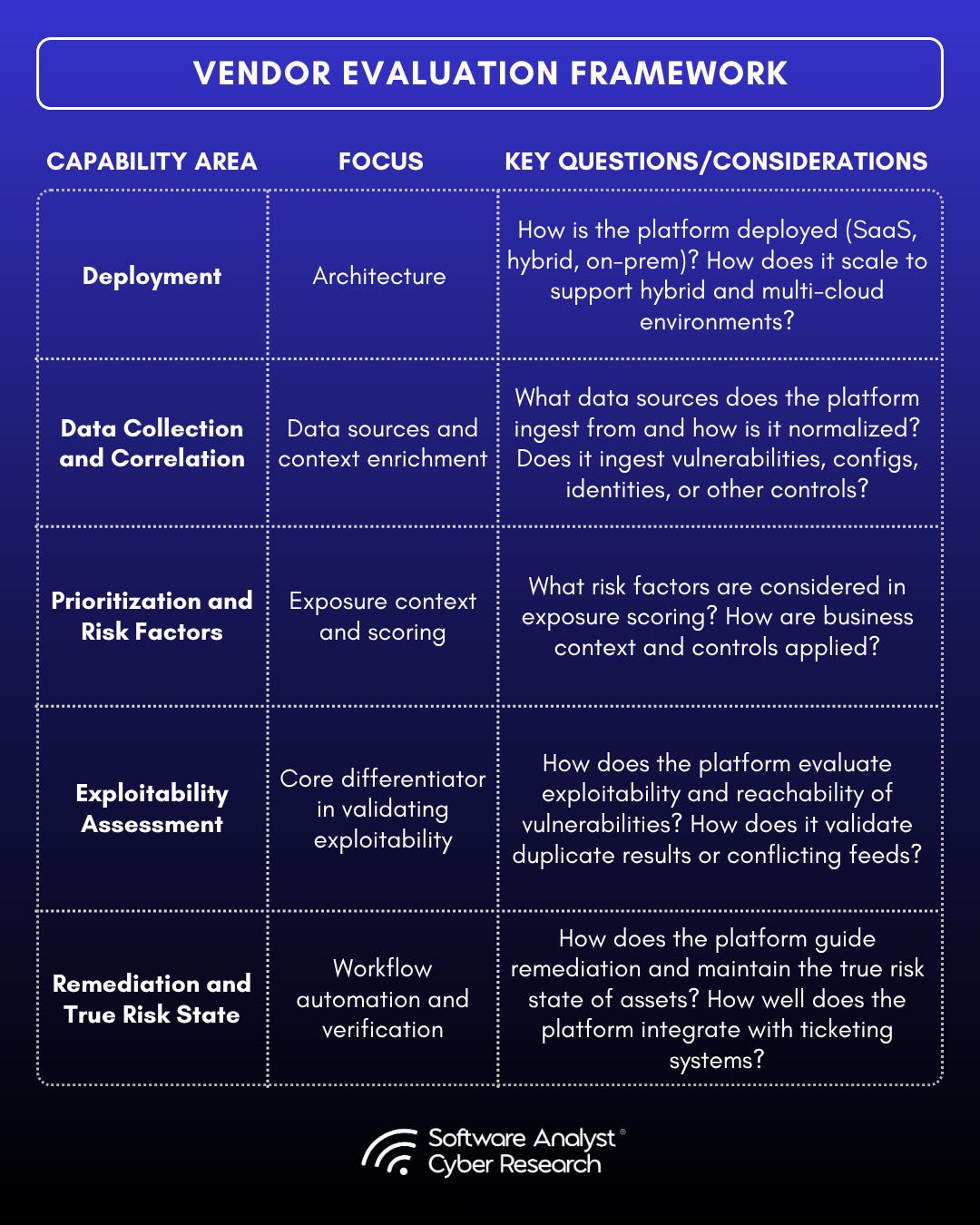
Deployment Architecture
How is the platform deployed (SaaS,
hybrid, on-prem)? How does it scale to
support hybrid and multi-cloud
environments?
Data Collection
and Correlation
Data sources and
context enrichment
What data sources does the platform
ingest from and how is it normalized?
Does it ingest vulnerabilities, configs,
identities, or other controls?
Prioritization and
Risk Factors
Exposure context
and scoring
What risk factors are considered in
exposure scoring? How are business
context and controls applied?
Exploitability
Assessment
Core differentiator
in validating
exploitability
How does the platform evaluate
exploitability and reachability of
vulnerabilities? How does it validate
duplicate results or conflicting feeds?
Remediation and
True Risk State
Workflow
automation and
verification
How does the platform guide
remediation and maintain the true risk
state of assets? How well does the
platform integrate with ticketing
systems?
VENDOR EVALUATION FRAMEWORK
CAPABILITY AREA FOCUS KEY QUESTIONS/CONSIDERATIONS
Vision (Not a weighing factor)
What is the vision of the company for future readiness? What areas do they see their platorm evolving?
Vendor Assessment Framework
Page 19 of 28

TOP VENDORS ANALYZED
Vendors
To understand key innovations
peraining to vulnerability risk
and exposure management
platorms in 2025, we did a
deep dive into 10 vendors
through in-depth product
briefings, customer interviews
and in-depth questionnaires,
beyond marketing materials.
We focused on core
diferentiators, and the
approach they’re taking in
addressing risk prioritization
and exposure visibility
concerns.
Page 20 of 28


Tonic Security
Tonic Security is a cybersecurity starup that recently emerged from stealh. Tonic focuses on
reducing exposure by combining asset discovery, organizational contex, threat intelligence,
business impact assessment, and adversarial validation to prioritize remediation efors.
Tonic’s approach to exposure management centers on an AI Data Fabric and a security
knowledge graph that ingest structured and unstructured data, add business contex, and cut
false positives so teams can focus on issues that materially impact the organization.
Key capabilities include large-scale data collection and harmonization, contexualization of
findings with business impact, business process graphs and agentic worklows that accelerate
mobilization from finding to fix. The platorm aims to reduce tool pivots, provide a business-led
view of posture, and slash remediation time across vulnerability and exposure worklows.
Mapping Tonic Security’s capabilities against our analysis framework
Voice of the Customer
A customer of Tonic sent us their reasoning
for choosing Tonic security for their exposure
management program. His opinions below -
Life before Tonic
Before adopting Tonic, customer’s risk and
exposure management program faced several key
limitations and critical gaps:
Lack of Business Contexual Intelligence, siloed
data: Critical business and operational data were
scatered across systems like Jira, Confluence,
Ofice365 emails/Teams, and GLPI, limiting visibility
and slowing down decision-making. Manual
Processes, Limited Business Alignment: Security
tools lacked the ability to map technical findings to
business impact, making it hard to prioritize based
on risk to key processes. Compliance Blind Spots
and Fragmented Data Sources
“Asset intelligence was slow and fragmented.
Enriching assets with actionable contex took
hours or days and happened frequently, making
triage and prioritization ineficient.. Much of the
vulnerability management relied on manual
collection and correlation, which increased
response times and reduced agility… Security tools
lacked the ability to map technical findings to
business impact, making it hard to prioritize based
on risk to key processes. Risk data was scatered
across muliple systems, making it dificul to get a
unified view of exposure.”
Why Tonic
“AI-Powered Business Contexualization: Its
data fabric automatically analyics exracts and
harmonizes contex across business, organizational,
and operational dimensions, enabling faster and
more accurate triage
• Eficiency and Focus: Our team moved into
“beast mode,” achieving more with existing
tools, reducing false positives, and gaining
control over information silos
• Automated Insights: AI-driven analyics that
surace hidden risks and provide actionable
recommendations without manual intervention.
• Unified Risk Intelligence: A centralized platorm
that aggregates and normalizes data across
silos, giving us a real-time, holistic view of risk
exposure.
• Trustworhy Reasoning: Tonic’s transparent
and explainable logic gave you confidence in
its outputs, allowing for decisive action without
second-guessing
Page 22 of 28

• Accelerated Remediation: Mean Time to
Respond (MTTR) dropped significantly, and
ownership of assets became clearer, improving
accountability and reducing exposure windows”
What they would like to see more
“Deeper Integration with On-Prem Systems: Expand
and streamline integration with Jira, Confluence,
and other legacy systems to ensure full contex
exraction across hybrid environments. In addition,
adding seamless ingestion of vendor and supply
chain risk data to expand exposure visibility beyond
internal systems
Enhanced Visualization of Business Blast Radius:
Improve the UI/UX for mapping asset impact on
business processes - make it more intuitive and
actionable for both technical and non-technical
stakeholders with customizable dashboards and
Predictive Risk Alers
Continuous Feedback Loop for Contex Accuracy:
Introduce mechanisms for users to validate and
refine the contex Tonic generates, ensuring it
evolves with organizational changes and remains
aligned with business priorities”
Deployment
Tonic suppors flexible deployment options,
including SaaS, on-premises, and fully sel-hosted
air-gapped deployments, paricularly suited for
regulated sectors such as financial services. Their
defaul preference is SaaS deployment.
Data Collection and Correlation
Tonic aggregates and deduplicates data from a
wide range of sources, including ITSM systems,
CMDBs, EDR/XDR tools, IDPs, virualization, and
backup platorms. Beyond standard integrations
with existing vulnerability scanners, Tonic also
natively scans, ingests, indexes, and analyzes
unstructured data sources, such as institutional
wikis, collaboration tools, and messaging
systems, to discover assets and exract business/
organizational contex (e.g., asset criticality). This
enables discovery of assets beyond regular
methods, with automatic contexualization.
• Data sources and collection:
○ Vulnerability scanners (e.g., Tenable, Qualys,
Rapid7), ITSM and ticketing systems (e.g.,
ServiceNow, Jira), EDR/XDR tools (e.g.,
CrowdStrike, SentinelOne), Identity providers
and CMDB platorms, Collaboration and
knowledge management systems (e.g.,
Confluence, Slack, Microsof Teams, Google
Workspace), Virualization and backup
solutions.
Prioritization and Risk Factors
Tonic Security moves beyond CVSS scoring by
taking into account -
• Business Contex: Unlike traditional methods of
deriving business contex, such as from asset
labels and asset config, Tonic derives contex
automatically from unstructured data sources
and messaging platorms by considering
additional factors like:
○ Asset criticality.
○ Business processes enabled by assets
(hosts, applications).
○ Number of high privileged users logged in.
○ Sensitive data that may reside on the asset.
• Ownership Contex: Ownership at the
individual, team and deparmental levels,
structural dependencies, and hierarchy
alignment.
• Operational Contex: Asset function,
patch status, system dependencies, and
business process posture maturity (a unique
diferentiator).
• Temporal Contex: Recency of detection,
exploitation timelines, change frequency, patch
cadence, as well as asset lifecycle and history.
• Network Reachability: Reachability of assets
(e.g., internet exposure derived from asset and
network config.)
• Exernal Feeds: Exploitability of findings
(e.g., KEV, EPSS and other databases), threat
intelligence insights, and resilience of assets/
control gaps (e.g., lacking recent backup or
missing EDR agents).
Page 23 of 28

Tonic consolidates all ingested data into
contexualized views: business, organizational,
geographical, operational, temporal, and adversarial,
forming its “Six Degrees of Contex” framework.
A key diferentiator is its ability to automatically
exract business, operational, and organizational
contex from unstructured sources such as
ITSM tickets, Notion, Slack, Confluence, and
email, without needing manual input. This allows
automated inference of asset criticality, role,
and interdependencies across the application
ecosystem, enabling dynamic and accurate
prioritization.
Exploitability Assessment
• Core Diferentiator: Tonic integrates with ITSM,
EDR and other security systems for asset
discovery, and exends visibility into institutional
knowledge bases and collaboration tools to
uncover shadow assets and exposures. Its
integrations with internal knowledge bases and
collaboration tools help surace assets and
dependencies that exist outside conventional
inventories. For example, Tonic can identify
assets referenced in IT tickets or business
continuity plans that are missed by conventional
scanners.
Another diferentiator is Tonic’s business dashboard
which provides a high-level, process-centric view
of risk, helping CISOs and GRC teams understand
how business operations map to security exposure.
• Explainability: The platorm includes a
confidence algorithm that validates the reliability
of atributed contex within its knowledge
graph. It evaluates data volume, recency, source
credibility, coherence, coverage, and user
feedback to generate a transparency score.
This provides visibility into how trustworhy
contexual information is. It also validates
the reachability of assets and simulates
potential business impact through blast radius
visualization.
Tonic allows organizations to define data source
precedence (for example, ServiceNow as the
system of record) to reconcile conflicting data
inputs. A human feedback loop enhances
recommendation mechanism, allowing users to
validate or challenge atributions, enabling the
model to improve reliability and accuracy over
time.
Remediation and True Risk State
• Enables end-to-end remediation worklows
by identifying responsible owners, initiating
tickets, tracking fixes, and managing exceptions
through compensating controls or risk
acceptance processes.
• Uses agentic automation to help security teams
understand remediation progress and the
impact of changes.
• Integrates with ticketing and worklow systems
such as Jira and ServiceNow to suppor
automatic task assignment, ticket creation,
exception handling, and remediation tracking.
• Employs domain-specific agentic AI to
enrich downstream systems like CMDBs and
SIEMs, keeping contexual data consistent as
exposures evolve.
• Maintains an accurate view of asset risk by
verifying remediation outcomes through
integrations with scanning and patching tools,
and identifying root causes when discrepancies
occur.
Vision
Tonic’s vision centers on making contex the core
principle of exposure management. By helping
security teams determine what truly maters and
why, and by mapping risk to business processes,
the platorm aims to reduce data noise, improve
cross-functional communication, and streamline
decision-making.
Page 24 of 28

Analyst Take
There are the strengths and areas to watch in our opinion
Strengths
• Automatic business contex from
unstructured data: Tonic exracts and
normalizes contex from tickets, wikis, Slack/
Teams, email, and docs to auto-populate
business, operational, and organizational
contex for each asset, uncover shadow assets,
and classify crown jewels without manual input.
• Confidence scoring with transparent
evidence and human feedback: A confidence
algorithm scores each atribution using data
volume, recency, source quality, coherence, and
coverage, while users can upvote or downvote
and suggest corrections to continuously
improve accuracy.
• Flexible Deployment Options: SaaS, on-prem,
and airgapped
• Process Graphs: Mapping exposure to process
graphs
• Automation & Remediation Worklow: Domain
specific agentic AI provides strong automation
capability to drive down MTTR but also keep
other relevant systems and teams up to date as
exposure changes.
Areas to Watch
• Lack of Validation Phase Capability: Full atack
path analysis is described as upcoming, so
current depth of validation may be insuficient
for teams seeking proof of exploit paths.
• Reliance on installed tools and data within:
Value is driven by ingesting many third-pary
sources and unstructured content. Gaps,
conflicting feeds, or weak data hygiene can
reduce accuracy.
VALIDATION VIA BAS OR
REACHABILITY SIMULATION
STRENGTH MAPPING
AI-DRIVEN / AGENTIC AI
FEATURES
APPSEC AND CODE
CONTEXT
COMMUNITY EXPLOIT
INTELLIGENCE (SOCIAL
CHATTER)
CONTEXT FROM
UNSTRUCTURED DATA
SOURCES
DATA AND IDENTITY CORRELATION REMEDIATION OPERATIONS
Page 25 of 28

Looking ahead we see the evolution of vulnerability and risk management platorms in
two directions
Aggregators expanding in-house scanning
Aggregator-style platorms or unified vulnerability management platorms, which today focus on normalizing
and correlating data from third-pary scanners, CNAPPs, and posture tools will increasingly introduce in-
house scanning capabilities. This trend addresses the needs of organizations that either:
• Lack an existing vulnerability management stack, or
• Want a single-source-of-truth without relying on exernal data dependencies.
Expect vendors that have historically positioned themselves as “aggregator and unified VM layers” to
develop lightweight agentless scanning modules for basic asset discovery and vulnerability enumeration.
These capabilities will complement their correlation and remediation engines, giving them dual value as
both aggregator and source of vulnerability intelligence.
Pure-Play Platforms moving up the
stack
Meanwhile, pure-play vulnerability
and exposure platorms that already
provide native scanning and posture
management will continue expanding
upward into contexual analyics and
remediation orchestration. They will evolve
from point scanners into autonomous
exposure management suites capable of:
• Correlating vulnerability, identity, data
posture and network contex;
• Going deeper on runtime exploitability
to challenge the aggregators; and
• Investing heavily in agentic AI for
automating remediation worklows
This evolution will be driven by customer
demand for outcome-based risk
reduction metrics, not volume-based
vulnerability counts.
Vulnerability Risk and Exposure
Management - SACR Prediction
Page 26 of 28

Conclusion
Vulnerability management and the need for reducing aler fatigue by prioritizing true risk
continues to be a core requirement for organizations. The traditional KPIs of CVSS scores
and vulnerability counts no longer represent success; instead, measurable risk reduction,
exploitability validation, and remediation velocity define modern maturity.
The convergence of historically distinct categories VM, RBVM, ASM, CAASM, ASPM,
CNAPP, and BAS, with an evolution beyond CTEM capabilities - under the modern risk
and exposure management umbrella reflects how practitioners and threat actors now
operate. The evolution described in this repor signals that exposure management is
becoming the connective tissue between asset intelligence, control validation, and
remediation operations.
EXPOSURE MGMT SOLUTIONSDATA SOURCES ITSM / SIEM / SOAR
PLATFORMS
EXPOSURE MANAGEMENT FABRIC
Page 27 of 28