From Novel to Musical: A Study in Adaptation PDF Free Download
1 / 24/24
100%

English Thesis
27 May 2011
From Novel to Musical: A Study in Adaptation
Musical theatre is a genre unique to itself. A combination of the straight play,
music, singing, and dance, the musical as we know it has progressed much since The
Black Crook played on Broadway in the late nineteenth century.¹ While some musicals
have their origins in the collaborators’ collective imaginations, many musicals get their
story lines from works in other mediums, including film, theatre, opera and literature.
However, musicals derived from written narratives have fascinated me the most. While
all adaptations have their challenges, there is something unique in adapting a novel into a
musical.
There is a different experience in each medium. The novel, a long prose piece, is
read alone, as the singular reader’s mind engages with the narrator’s written words. The
musical, as live theatre, is seen in a performance space, while the plural audience watches
and listens to any number of actors perform in real time. While these qualifiers by no
means stand as rules for either form, the different experiences that people have in each
medium indicate the changes writers, lyricists and composers have to make in creating a
work of performance based on a work of literature.
This paper aims to analyze those changes. What does it mean to write a musical
based on a novel? What are the changes made in the storyline, characters, and themes?
Which characters and side plots get shortened or cut, and which ones get expanded on or
added? Why do some musical adaptations become successful and others become the
dreaded Broadway flop? Are there some stories that cannot be told in the musical form?
I will be looking at three musicals to answer the questions above: Ragtime,
Oliver!, and Wicked. Each musical has made their Broadway debut; some of them have
even been revived. Two of them have American origins, and one is strictly British. Each
has received various levels of success and failure. And all have been adapted from
novels.
I will look at how the original language of the novel is transformed into the
dramatic language of its musical adaptation as shown through the following four
productions:
The novel Ragtime is very American in origin, with its source book by E.L.
Doctorow being a historical novel about the lives of three families and famous historical
periods in the early 20th century. I will be looking at the plot and character changes,
specifically in the diminishing of Houdini and other historical characters with the added
significance of the three families, and the development of Mother and Father, and
Younger Brother.
Based on the novel Oliver Twist by Charles Dickens, Oliver! is the only musical
on this list with British creators in both mediums. The musical has often been thought of
as a symbol of national pride in England. I will be looking at the plot and characters of
the musical and its source novel, specifically with Oliver’s position as the main character
and the controversial anti-Semitism of Fagin’s character.
Wicked the musical is just one adaptation of the ever evolving story of the Wizard
of Oz. It is based on the novel by Gregory Maguire, who in turn based his story on both
the film The Wizard of Oz and its source, the L. Frank Baum series of books that began
with The Wonderful Wizard of Oz. With such a dizzying progression of adaptations, I
will stay close to Maguire’s retelling, told from the point of view of the Wicked Witch of
the West, and the main storyline changes made to the musical.
Studying Adaptation
According to Simone Murray’s essay “Materializing adaptation theory: the
adaptation industry,” adaptation studies have gone through three waves. The three waves
she enumerates are fidelity criticism, structural criticism, and post-structural/ cultural
studies criticism. Fidelity criticism looks at the changes an adaptation makes on its source
material and how faithful the adaptation is. Structural criticism analyzes the changes in
structure an adaptation makes and how these changes reflect each form. Cultural studies
look at the social groups involved in producing and consuming the adaptations and their
source material. In addition to these three waves, Murray proposes a fourth course of
study, the adaptation industry. This mode of study involves analyzing “industrial
dimensions of adaptation in contemporary media culture” (9). Murray argues that
adaptation studies have “struggled to achieve academic respectability since its inception
in the 1950s,” which is partially due to a history of confining intellectual analyses, or the
three waves enumerated above (1). Murray encourages adaptation scholars to analyze the
financial, contextual, sociological ways that the producers (of both the source text and the
adaptation) generate the work.
In addition to giving a structural and societal analysis of both the source texts and
their musical adaptations, I wish to also understand the “adaptation industry.” While
Murray’s argument is sound in saying that older forms of criticism such as structural
analysis are outdated, I will need to use structural and societal analyses in addition to
looking at new adaptation industry form of criticism. Murray focuses her essay on the
majority of adaptation studies, which involve book to film retellings. Few scholars have
traced my subject, the novel to musical adaptation. Thus, I choose to employ structural
and cultural forms of criticism in addition to analyzing the adaptation industry as I look
through the transition from novel to musical.
“Strange New Music”: Looking at Ragtime
Ragtime is a story of stories. In adapting the novel to the musical, certain stories
gain importance and focus, while others fade offstage.
The 1975 novel by E.L. Doctorow weaves together fictional and historical
characters in early twentieth century New York. The historical characters include
entertainer Evelyn Nesbit, magician Harry Houdini, businessman J. P. Morgan,
entrepreneur Henry Ford, radical activist Emma Goldman, and African American civil
rights leader Booker T. Washington. The main fictional characters are made up of three
families: a well-to-do white family living in New Rochelle, an African American couple
and their newborn baby, and a Jewish immigrant father and daughter. Every character in
Doctorow’s novel gets equal representation, as the omniscient narrator shifts to every
character’s perspective. The fictional and historical characters interact throughout the
novel so seamlessly that it is easy to forget the fictional characters were not real people.
By the novel’s close, it is clear that Doctorow weaves together a complex narrative that
gives an overarching view of modern age America.
Doctorow’s novel had its share of critical and commercial success. According to
researcher Douglas Strassler, Ragtime was the novel that catapulted Doctorow into the
literary spotlight: “Although it was his earlier book, The Book of Daniel, that garnered E.
L. Doctorow his first critical recognition, it was not until three years later that he
experienced major success with 1975's Ragtime.” The book was a bestseller, even
becoming “the year's top-selling novel” (Strassler). While the book was immensely
popular at the time of its publication, critical reception was not unanimous. Many found
fault with Doctorow’s blend of history and fiction, one critic even saying that Doctorow
“grasps arbitrarily and wildly at public facts and events” (Strassler). Other critics
enjoyed Doctorow lyrical prose, intriguing characters, deft handling of a complex plot.
Or, as George Stade wrote in the New York Times Book Review, “The outrageous, the
hyperbolic, the impossible - these are the elements from which Doctorow fashions a
coherence so factitious and arbitrary it no longer distorts, but attains a purity and comic
integrity of its own” (Strassler). Strassler concludes that despite all the differing opinions
surrounding the book, Ragtime “enjoyed its moment in the literary hotseat during its
1975 publication,” having both critical and commercial success.
In adapting Ragtime, the musical’s writers had the challenge of bringing the
intricate plot and historical events to the stage in a musical form. The end result is that
the musical simplifies the historical characters and amplifies the fictional characters.
Instead of the novel’s seamless fusion of fiction and history, the musical focuses on the
fictional characters with a historical backdrop of secondary characters. This can be seen
in the 2009 Broadway revival’s interpretation of the musical, which had the three main
families and their respective ensembles on center stage, with the historical characters
framing them in the balcony seats and on high platforms above them. Two characters I
will be focusing on in the switch from novel to musical are Houdini and Sarah. In the
musical, Houdini’s character diminishes and Sarah’s character strengthens, while in the
novel both characters are given equal emphasis.
In Doctorow’s novel, Houdini, like many of the other historical figures in
Ragtime, has many passages told from his perspective. He even dominates most of
Chapter 27, as the novel turns from Sarah’s funeral (described in the previous chapter) to
the death of Houdini’s mother. The change ties fiction and fact together, as both
Coalhouse Walker, Jr., Sarah’s fiancée, and Houdini grieve over their loved ones. In the
novel, Doctorow describes Houdini grieving in great detail:
His mother had been dead for some months but every morning he awoke
with his wound as fresh and painful as if she had died the night before. He
had canceled several bookings. He shaved only when he remembered to,
which was not often, and with his reddened eyes and stubble and baggy
suit he looked like anything but the snappy magician of international fame.
(197-198)
The chapter continues to describe Houdini’s feelings about his mother’s death, and his
tireless search to discredit clairvoyants as he himself wants some communication with her
from the other side, and the progress of his career. In Doctorow’s novel, Houdini is a
strongly etched character, a conflicted man who manages the art and business of his
career while yearning to speak to his mother once more. In contrast, the musical
adaptation reduces his presence in a few songs and some dialogue. Houdini’s character
gets further diminished in the 2009 revival, as one of his solos was cut in the production.
As a result, Houdini becomes a caricature of an entertainer in the musical.
Meanwhile, Sarah’s change is a reversal from her presentation in Doctorow’s
novel to the musical. In the novel, Sarah “had a child’s face, a guileless brown beautiful
face” (Doctorow 70). She does not have much written from her point of view, as the
courtship between her and Coalhouse Walker, Jr. is seen from Mother’s family’s
perspective. Later in the novel, Doctorow writes, “Nobody knew Sarah’s last name or
thought to ask. Where had she been born, and where had she lived, this impoverished
uneducated black girl with such absolute conviction of the way human beings ought to
conduct her lives?” (187) While this thought was from the family’s perspective,
Doctorow makes no effort to answer the question. Sarah is simply “a girl of perhaps
eighteen or nineteen years” an innocent girl with “no guile” (187-188). When Coalhouse
tells her that he will not marry her until he has his car restored, she believes that trying to
meet the president in person would be a feasible way to set things right. Doctorow’s
descriptions of Sarah make her to be a girl, weakened by her innocence.
Ragtime the musical paints Sarah in a different light. Sarah is still a young
African American woman who is plagued by racism. In the novel and the musical, she
goes to meet the president and is brutally attacked by the police. But the musical adds
something powerful to Sarah, in the form of a solo where she can express all of her
emotions from attempting to kill her son. The novel does not explore the complex idea of
Sarah murderous attempt, and why she did it. In the song “Your Daddy’s Son,” Sarah
tells her baby all about the romance she had with Coalhouse, and the fact that he does not
know about the baby. In the bridge of the song—and the climax of the song’s emotion—
she talks of her attempt to end her son’s life:
Couldn't hear no music,
Couldn't see no light.
Mama, she was frightened,
Crazy from the fright.
Tears without no comfort,
Screams without no sound.
Only darkness and pain,
The anger and pain,
The blood and the pain!
I buried my heart in the ground!
In the ground-
When I buried you in the ground.
After the bridge, Sarah returns to the original rhythm and melody of the song’s first
verses, save for one moment, when she interrupts the refrain “You had your daddy’s
hands” with a higher pitched “Forgive me.” This moment in the song shows a turning
point in Sarah, as she wants forgiveness for trying to kill her own son. In “Your Daddy’s
Son,” Sarah is given a powerful moment in the musical to think about her actions, and
accept her son into her life. A moment that never happened in Doctorow’s novel.
A happier time for Sarah and Coalhouse. (Left, Original Broadway
Production: Audra MacDonald as Sarah and Brian Stokes Mitchell as
Coalhouse Walker, Jr., Right Broadway Revival: Stephanie Umoh as Sarah
and Quentin Earl Darrington as Coalhouse Walker, Jr.)
“You've got to pick-a-pocket or two”: Making Oliver!
Before Charles Dickens’ classic Oliver Twist became a novel, it was first
published as a serial from February 1837 to April 1839. Oliver Twist follows the story of
orphan Oliver. He lives in a workhouse for the poor, where he is neglected and not fed
well. After inadvertently starting a riot in the workhouse for wanting “some more” gruel,
he becomes apprenticed by an equally neglectful undertaker and runs away to London.
There, he becomes part of a gang of children who pick pockets for a living under the care
of their leader, a Jewish criminal named Fagin. After a series of events that involve
Nancy, a prostitute who used to steal for Fagin when she was younger, Bill Sikes,
Nancy’s abusive lover, and Fagin himself, Oliver Twist ends happily for its protagonist.
A wealthy benefactor takes Oliver in, and Oliver finally has a family.
Though the story of Oliver Twist first originated as a written narrative, one may
argue that Oliver Twist was a tale meant to be told in a performance medium. According
to David Perdue, Oliver Twist is “[o]ne of the most dramatized of Dickens’ works,”
“appearing in 10 theaters in London before the serialization of the novel was even
completed” (Oliver Twist). Dickens’ writing also lends itself to the theatrical, as Perdue
writes that a “close association with the theater had an important impact on Dickens the
author. Theatrical characters abound in the novels and the stories are told in such a visual
way that they easily lent themselves first to illustrations in the novels, stage
dramatizations, and finally to film” (Dickens on Stage). Dickens’ visual theatricality can
be seen in the scene where Fagin is first described:
In a frying-pan which was on the fire, and which was secured to the
mantelshelf by a string, some sausages were cooking; and standing over
them, with a toasting-fork in his hand, was a very old shriveled Jew,
whose villainous-looking and repulsive face was obscured by a quantity of
matted red hair. He was dressed in a greasy flannel gown, with his throat
bare, and seemed to be dividing his attention between the frying-pan and a
clothes-horse: over which a great number of silk handkerchiefs were
hanging (Chapter 8).
Dickens sets up the scene with many details, bringing to light many elements that are
already stage-worthy. The “mantelshelf” and the “clothes-horse” where the silk
handkerchiefs were hanging? Set elements. The “greasy flannel gown” and “matted red
hair”? A job for the costume designer. And the actor who could play Fagin already has
clues into the character work, from his old age, his “shriveled” body, and a “villainous-
looking face.” Dickens himself was a part of the theatre. An amateur actor, Dickens
often directed, stage managed, and oversaw his own theatricals. Such experience
eventually led to him reading from his own novels: “In 1853 Dickens began giving
public readings of his works, first for charity, and beginning in 1858, for profit. Before
this time no great author had performed their works in public” (Perdue, Dickens on
Stage). Thus, Oliver Twist was all too ready to be adapted into a stage musical in 1960.
Oliver! with music, book, and lyrics all by Lionel Bart, has all of the main plot
elements of the novel. However, one important change in Oliver! begs the following
question: is Oliver really the main character of his own musical? One would think that
with the show named after him, he would have a significant number of scenes, musical
numbers, and solos. This is not true in the musical. Though Oliver sings throughout the
production, he only has one solo, “Where Is Love,” in the entire show. In comparison,
Fagin and Nancy have many more numbers in which they star: Nancy leads the chorus in
“It’s a Fine Life” and “Oom-Pah-Pah,” is featured in “I’ll Do Anything,” and has her own
torch song, “As Long as He Needs Me,” which she reprises later in the musical. Fagin
also has many numbers, from “You’ve Got to Pick a Pocket or Two” to his comic solo
“Reviewing the Situation.” The adult characters, with their abundance of numbers, seem
to overshadow young Oliver in the musical.
One can look to the 2009 West End revival of Oliver! to see the emphasis placed
on characters other than the adorable orphan. As critic David Benedict wrote on the
production, “If serious Harry Stott as Oliver is more becalmed it’s because the script
offers him even less to do.” Even the publicity for the show centered on the characters of
Nancy and Fagin. First, a reality show about casting the revival’s leads, I’ll Do Anything
For You, focused on casting not only Oliver, but Nancy as well. Moreover, the celebrity
getting top billing was comic actor Rowan Atkinson, who played Fagin in the production.
With so much buzz around the actors playing Nancy and Fagin in the 2009 West End
revival, Oliver himself faded in the background.
Perhaps, the musical is actually about another character: Fagin, the criminal
leader of his gang of pick pocketing boys. After all, the musical ends with him, as he
sings a reprise of “Reviewing the Situation.” As Lionel Bart wrote in the libretto:
(Emerging from under the bridge recess—HE sings)
Can somebody change? It's possible.
Maybe it's strange but it's possible.
All my dearest companions and treasures,
I've left 'em behind.
I'll turn a leaf over,
And who can tell what I may find?
(Alone and friendless, FAGIN walks over the bridge off into the
dawn, as a slow reprise of HIS refrain is played).
Fagin, then, has had some change in his character, unlike the consistently adorable
Oliver. In singing “Reviewing the Situation,” Fagin is “reviewing” and reflecting on his
life. He is in a questioning state, wondering if someone can change, and finding it to be
possible. Though Fagin is alone and friendless he is walking “into the dawn,” and
offering him redemption. This hopeful ending is a far cry from Dickens’ novel; while the
musical gives Fagin life, Dickens’ novel has him arrested and awaiting execution.
Fagin’s redemption at the end Oliver! turns him from a “villainous-looking and
repulsive” criminal into a man with a second chance. Despite its exclamatory title, the
musical Oliver! emphasizes other characters besides the hapless titular orphan.
“I have been changed for good”: Wicked
Wicked: The Life and Times of the Wicked Witch of the West was written by
Gregory Maguire. Published in 1995, Wicked retells the story of The Wizard of Oz (a
story with its own book to film progression) from the villain’s point of view: the Wicked
Witch of the West, now christened Elphaba.² The novel creates a whole new fantasy
world of Oz, with some familiar places (The Emerald City and Munchkinland) and new
ones (The Vinkus, a renaming of Baum’s “Winkie Country”). Maguire also writes for an
older audience, while Baum’s books which were aimed for children. Wicked has dark
imagery, violence, and even has a close look into Elphaba’s love life. Moreover,
Maguire’s narrative delves into larger themes than a desire for ruby slippers. In Wicked,
prejudices (against Elphaba’s green skin is one of them), political and social injustice,
and the true nature of good and evil are some of the themes explored. As a review of the
novel in Publishers Weekly states: “Maguire combines puckish humor and bracing
pessimism in this fantastical meditation on good and evil, God and free will, which
should, despite being far removed in spirit from the Baum books, captivate devotees of
fantasy” (Fiction Review). Also, the book has an air of tragedy to it, as Elphaba has the
same end as Baum’s Wicked Witch: dying from Dorothy’s thrown bucket of water.
Maguire’s novel gives The Wicked Witch many things. First, he gives her a name,
which makes her a person with an identity more than simply a “witch.” Maguire also
transforms a simple stock villain into a complex character who questions the very nature
of good and evil. Also, Wicked is a narrative sympathetic with Elphaba. The Wicked
Witch is no villain in the novel; instead, the real baddie is the Wizard of Oz, now a
totalitarian dictator. Finally, Maguire writes Elphaba’s death not as the vanquishing of a
villain, but a tragic end.
The musical adaptation of Wicked makes Elphaba an even more sympathetic
character. Focusing on Elphaba’s time at Shiz University and her transformation into the
Wicked Witch of the West, Elphaba becomes a young woman who feels like an outsider
because of her green skin. The dramatic genre has also changed; instead of a tragedy, the
musical is a drama with comedic elements. While the musical’s Elphaba faces the same
prejudices and sociopolitical conflicts, those conflicts are resolved very differently from
Maguire’s tragic conclusion.
First off, Elphaba, despite her moniker “the Witch,” is not particularly magical in
Maguire’s novel. At Shiz, Elphaba specializes in life sciences, while Glinda chooses
sorcery as her major, under Madame Morrible’s encouragement (Maguire 176, 91-92).
Elphaba’s feelings toward magic are largely dismissive during her Shiz years: “Spells,
changings, apparitions? It’s all entertainment,’ said Elphaba. ‘It’s theatre… I think
sorcery is trivial.’” (137-138). Elphaba does pursue sorcery, but it her magical
development takes place later in her adulthood. The musical, on the other hand, repaints
Elphaba as a young woman with great magical ability at the start. In the musical,
Madame Morrible encourages Elphaba, not Glinda, to study magic:
Oh, Miss Elphaba:
Many years I have waited
For a gift like yours to appear…
With a talent like yours, dear
There is a defin-ish chance
If you work as you should
You'll be making good.
Without being established as magical at the beginning, Elphaba’s position in the novel is
more complex. During her Shiz years, Elphaba is more interested in science and political
activism, and her relationship with magic is not established until later on in the novel.
Meanwhile, in the musical, Elphaba’s early onset of a magical ability puts her into the
position as the young heroine with a great gift.
As mentioned previously, the novel and musical versions of Wicked have two
different genres: the novel is a tragedy, while the musical is a drama with comedic
elements. Within these two genres, the portrayal of Elphaba’s character is defined
differently. In Maguire’s novel, Elphaba is the tragic hero, fated to her demise: “Wicked
is an epic story, built along the lines of a Shakespearean or Greek tragedy, in which the
seeds of Elphaba’s destiny are all sown early in the novel” (Maguire 408). With her
green skin and rebellious political leanings, Elphaba is a character consistently at odds
with her world. She fights to endure until the very end of the novel:
She would emerge. She always had before. The punishing political
climate of Oz had beat her down, dried her up, tossed her away—like a
seedling she had drifted, apparently too desiccated ever to take root. But
surely the curse was on the land of Oz, not on her. Though Oz had given
her a twisted life, hadn’t it also made her capable? (Maguire 4)
Still, by the book’s close, there is no more hope for Elphaba. Her lover Fiyero is dead,
her family still estranged from her, and her final desire is never fulfilled, as she dies
without ever getting the ruby slippers from Dorothy. Maguire ends Wicked with an
epilogue that reveals the end of the other characters, and he has this to say of Elphaba:
And of the Witch? In the life of a Witch, there is no after, in the ever after
of a Witch, there is no happily; in the story of a Witch, there is no
afterword. Of that part that is the life story, beyond the story of the life,
there is—alas, or perhaps thank mercy—no telling. She was dead, dead
and gone, and all that was left of her was the carapace of her reputation for
malice. (406)
Elphaba, for all her fighting, is “dead and gone” at the close of Maguire’s novel, with
nothing left behind but an evil reputation.
The musical of Wicked, however, is another matter entirely with respect to
Elphaba’s character. Like Fagin, who suffers a less-than-glorious death in Oliver Twist
but survives in the musical adaptation, Elphaba dies at the hands of a little girl in
Maguire’s novel but lives in the musical. While Maguire’s Elphaba does have an
aversion to water, Elphaba of the musical has no such aversion. She escapes under a trap
door, with the rest of Oz thinking she is dead. Also, Elphaba gets another benefit that
Oliver!’s Fagin does not have: Elphaba does not exit “alone and friendless.” Instead,
Elphaba escapes with Fiyero, who becomes the Scarecrow³. Thus, the story of Elphaba
in the musical adaptation of Wicked does get a happy ending.
Ultimately, however, the major difference between Wicked the novel and Wicked
the musical is the themes each work poses first. While Maguire’s novel is a treatise of
the nature of good and evil, the musical adaptation of Wicked emphasizes the friendship
between Glinda and Elphaba. In the novel, Glinda and Elphaba’s friendship is there, but
understated. During one scene, Glinda convinces Elphaba to try a hat on, with the intent
to make fun of her later:
Galinda expected to have to bite the inside of her lip to keep from
laughing… But Elphaba dropped the whole sugary plate onto her strange
pointed head, and looked at Galinda again from underneath the broad
brim. She seemed like a rare flower, her skin stemlike in its soft
pearlescent sheen, the hat a botanical riot…
“Entrancing,” she said. ‘There’s some strange exotic quality of
beauty about you. I never thought.”
“Surprise,” said Elphaba, and nearly blushed, if darker green
constituted a blush—“I mean, surprise, not beauty. It’s just surprise… It’s
not beauty.”
“Who am I to argue,” said Galinda, tossing her curls and striking a
pose, and Elphaba actually laughed at that, and Galinda laughed back,
partly horrified as she did so. (Maguire 78-79)
Later, Glinda thinks, “So Elphaba, no longer a social liability, had all the potential of
becoming an actual friend.” (Maguire 134). Just before Elphaba parts with Glinda for a
long time, Glinda thinks, “how I have changed… From despising the colored girl to
claiming we are blood!” (177) In Maguire’s novel, Glinda and Elphaba grudgingly
become friends.
Yet their last conversation in the novel is not a happy one. Glinda and Elphaba
are unable to make peace after Glinda gives Dorothy the ruby slippers:
They stood glaring at each other. They had too much common history to
come apart over a pair of shoes, yet the shoes were planted between them,
a grotesque icon of their differences. Neither one could retreat, or move
forward. It was silly, and they were stuck, and someone needed to break
the spell. But all the Witch could do was insist, “I want those shoes.”
(348)
Despite their friendship, Glinda and Elphaba cannot resolve their differences by the end
of Maguire’s novel.
The musical gives a different interpretation of Glinda and Elphaba’s friendship.
In the musical, the song “Popular” resembles Maguire’s bonnet scene, but the scene
becomes an up-tempo, humorous solo for Glinda as she attempts to give sullen Elphaba a
makeover. While Glinda in the novel never supports Elphaba’s political ambitions, she
considers it for a moment in the musical during the song “Defying Gravity:”
ELPHABA
Together we'll be the greatest team
There's ever been, Glinda
Dreams, the way we planned ‘em
GLINDA
If we work in tandem
BOTH
There's no fight we cannot win
Just you and I
Defying gravity
Their last time together in the musical is a far cry from the tense reunion in Maguire’s
novel. While they still have their differences, they sing a touching ballad to each other,
saying, “Who can say if I've been changed for the better?/ But because I knew you/ I
have been changed for good.” Their final parting in “For Good” is more sentimental and
heartbreaking, as they recognize the strength of their friendship.
In Wicked the musical, Elphaba is a magically talented, though misunderstood,
heroine. She still fights the Oz political machine, but instead of dying as a maligned
villain, she lives and escapes with her love. The musical’s Elphaba is also more
emotionally grounded, as she is able to sustain a friendship with Glinda, both women
changing each other “for good.”
Even wicked witches like hair accessories. Idina Menzel as Elphaba (left) and
Kristin Chenoweth as Glinda (right) as part of the Original Broadway Cast of
Wicked.
“Who Will Buy?”: What Makes a Musical Successful – An Economic and
Societal Analysis
The previous section analyzed the structural changes that were made when the
novels Ragtime, Oliver Twist, and Wicked were adapted into full-length musicals.
Keeping those changes in mind, this section attempts to answer the question: why were
these changes made in a societal context? And how successful were these musicals
financially?
As mentioned in the structural analysis of Ragtime, the musical adaptation
emphasized Doctorow’s fictional characters at the expense of the historical characters.
While the change disrupts the democratic representation Doctorow gave to all of his
characters, it provides a more cohesive narrative in the musical format. Because musicals
have songs as well as dialogue, there is less time available to create well-rounded,
principal characters. And with the many historical and fictional characters in Ragtime’s
world, it would be best to focus on a smaller number of characters to create a more
focused, creative work. The result is a more appealing, cohesive drama that is easier to
grasp than an intricate plot where every character is complex.
Why choose the fictional characters over the historical characters, then? As
illustrated earlier, Houdini was just as complex a character as Sarah, and could have had
an opportunity to become a lead in Ragtime.4 Instead, the focus was put on Sarah, as
audiences are more readily able to relate to the fictional characters. The fictional
characters resemble real people more than historical figures, which often appear to be
larger than life. On the other hand, the struggles of characters like Sarah and Coalhouse
are more accessible to audience members.
And the formula seemed to pay off. Ragtime the musical premiered on Broadway
on January 18, 1998. It had a book by Terrence McNally, music by Stephen Flaherty,
and lyrics by Lynn Ahrens. The lavish production, including a working Model T
automobile, also featured Broadway stars Marin Mazzie as Mother, Brian Stokes
Mitchell as Coalhouse Walker, Jr., and Audra McDonald as Sarah. Audra McDonald
won the Best Featured Actress Tony Award for her performance, and the musical also
received Tony Awards for Best Book and Best Original Score. Running for a total of 834
performances, Ragtime closed on January 16, 2000. The award-winning musical also had
a 2009 Broadway revival featuring Christiane Noll as Mother and Bobby Steggert as
Mother’s Younger Brother. With a long first Broadway run and multiple Tony Award
wins, Ragtime became a critical and commercial success.
Like Ragtime, Oliver! has achieved large levels of commercial success. The
musical is beloved in England, with the musical being revived three times in the West
End, London’s equivalent of Broadway. The most recent revival premiered in the West
End on January 14, 2009 at the Theatre Royal, Drury Lane. It starred Rowan Atkinson as
Fagin, Jodie Prenger as Nancy, and a rotating cast (Laurence Jeffcoate, Harry Stott, and
Gwion Wyn Jones) as Oliver; and the production closed on January 8, 2011.
The Broadway transfers of Oliver! are not as cut and dry. The Broadway
premiere of Oliver! was a success, premiering on January 6, 1963 and closing on
November 14, 1964 after a total 774 performances. A revival was produced soon after,
opening in 1965 and running for sixty-four performances. The 1984 Broadway revival,
on the other hand, was another story. A transfer of the 1983 London revival and starring
Ron Moody as Fagin and Patti LuPone as Nancy, this production of Oliver! only ran for
seventeen performances.
Why didn’t American audiences respond as positively to the 1984 Broadway
revival as to the original 1963 production? Since the 1984 revival there have not been
any new Broadway revivals of Oliver!, while the West End has seen two additional
successful revivals. One possible answer to this question is that American audiences are
not comfortable with the possibility of anti-Semitism in Fagin’s character. Let us return
to the scene where Dickens first describes Fagin. He is a character with many
contradictions. Though his face is “villainous-looking,” he grins upon meeting Oliver and
acts as host, offering him sausages and a handshake. He calls Oliver and the other boys
“my dears,” but threatens Oliver with his life when the boy sees Fagin’s hidden treasure.
Fagin is an imaginative and complex character, but Dickens refers to him constantly as
“the Jew” rather than his name.
Though Fagin is a representation of the anti-Semitism of Victorian England, he
has also been sanitized through the musical adaptation. Fagin is now a comic relief
figure who entertains audiences with his funny solo songs. He is not condemned to die as
a thieving Jew, as in the novel, but is able to live at the show’s close with a new
perspective on life. So, while Fagin is no longer the controversial, anti-Semitic villain in
Oliver! that he was in Dickens’ novel, his reputation from the novel could still negatively
influence audiences, therefore influencing the limited legacy of Oliver! on Broadway.
The logo for the 2009 London revival of Oliver! Would American audiences be
offended by Fagin’s hook-shaped “L” for a nose?
Wicked has attained great levels of success in the eight years since it premiered on
Broadway. Both the 2003 Broadway and 2006 West End productions are still running,
and the Broadway production often breaks earnings records and performs to capacity
crowds. The Broadway production also won three Tony Awards, including a Best
Actress win for Idina Menzel, who originally played Elphaba.
The musical’s success is so great that it can be difficult remembering that
Maguire’s novel was also a great commercial success. Why then were so many changes
made to the musical’s storyline? A possible answer is the commercial and societal
strength of the musical’s theme of friendship between Elphaba and Glinda. While the
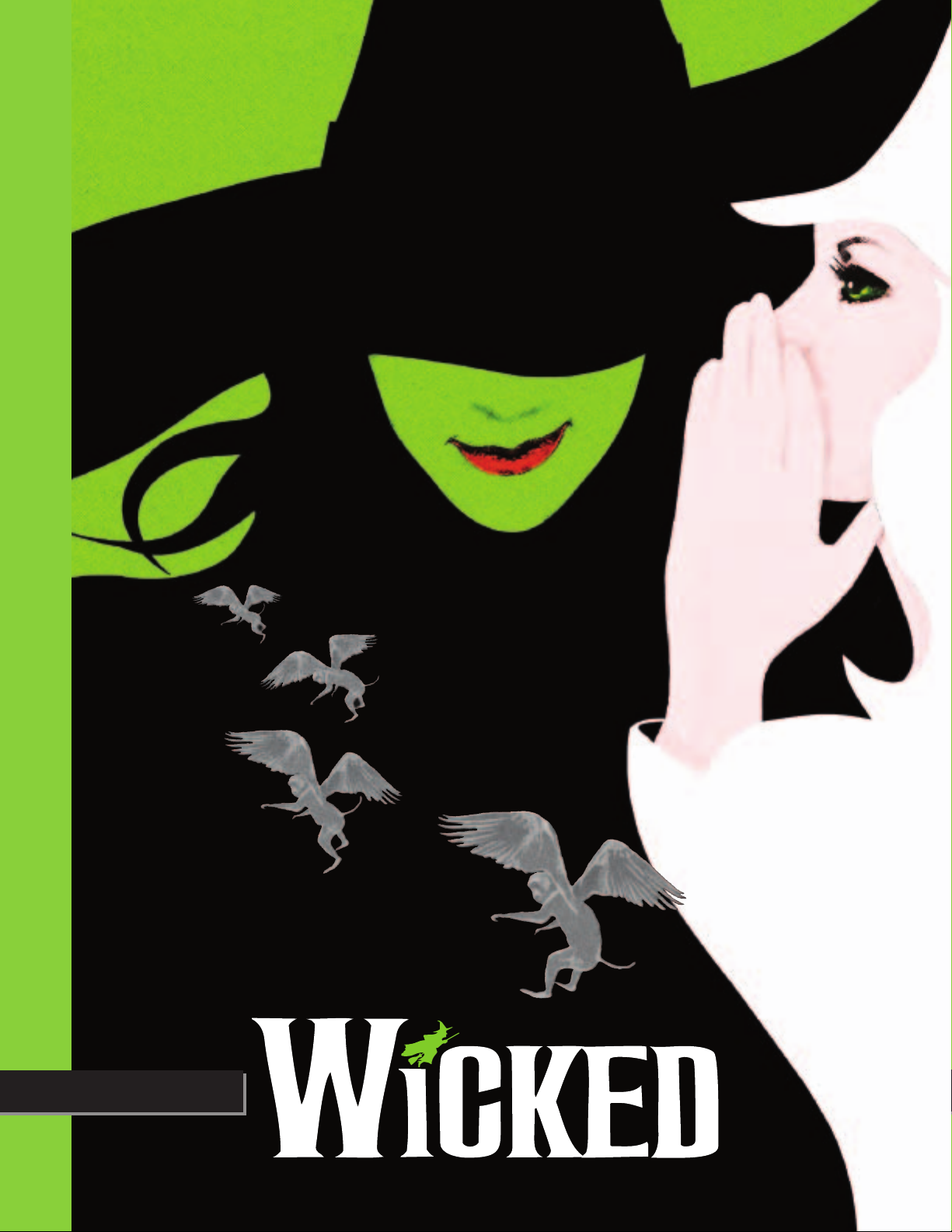
original cover design of Maguire’s Wicked featured the Witch in the center, the musical’s
logo is of Glinda whispering a secret to a smirking Elphaba.
A solitary tragic hero or a friend with a secret? The cover design of Gregory Maguire’s
novel and promotional poster for the Broadway production.
The musical’s emphasis on Elphaba’s and Glinda’s friendship is a heartfelt, positive spin
on the Oz mythos that audiences have responded to enthusiastically.
Curtain Call: A Conclusion
What happens when a novel gets adapted into a musical? Dialogue is written,
music is composed, and storylines and characters are changed to make a new, dramatic
work. This paper analyzed three adaptations: Ragtime, Oliver! and Wicked. All three
musicals differed structurally from their narrative counterparts. E.L. Doctorow’s
balanced combination of history and fiction in Ragtime morphed into a more focused
emphasis on the fictional characters in the musical. Oliver Twist the story about a little
And Wicked, a tragic and sympathetic rendering of a former villain developed into a more
orphan who could, became a musical that spent more time on the grownups’ adventures.
joyful adventure that celebrated the friendship of two witches. Their structural differences
lead to various measures of success, with mixed levels of critical acclaim, awards, and
financial merit, in some part owing to their structural forms, as well as their societal
value.
Endnotes:
1. The Black Crook is considered one of the first pieces of musical theatre. As noted
in the Encyclopedia Britannica, it included “French Romantic ballet and German
melodrama.” With a book by Charles M. Barras, lyrics by Theodore Kennick,
and music by Thomas Baker, Giuseppe Operti, and George Bickwell, The Black
Crook opened on September 12, 1866 in New York City.
2. Interestingly enough, Gregory Maguire named Elphaba after the author of the
original Wizard of Oz stories: “Maguire fashioned the name of Elphaba
(pronounced EL-fa-ba) from the initials of the author of The Wizard of Oz, Lyman
Frank Baum—L-F-B—Elphaba (407).
3. In Maguire’s novel, Elphaba imagines that Fiyero could be the scarecrow, but
Maguire later writes: “There was nothing but straw and air inside the Scarecrow’s
clothes. No hidden lover returning, no last hope of salvation” (392).
4. It looks like Houdini will get his musical moment in the spotlight. A new musical
called Houdini is in the works, with “Danny Elfman (Music), David Yazbek
(Lyrics), Kurt Andersen (Book), and Jack O’Brien (Director)” all attached to the
project (Blank).
Works Cited
Benedict, David. “Oliver!” Variety.com. 15 Jan 2009. Web. 16 May 2011.
<http://www.variety.com/review/VE1117939340?refCatId=33>.
Blank, Matthew. "Schedule of Upcoming Broadway Shows." Playbill. 15 May 2011.
Web. 26 May 2011. <http://www.playbill.com/celebritybuzz/article/80060-
Schedule-of-Upcoming-Broadway-Shows>.
Dickens, Charles. Oliver Twist. 1838.
Doctorow, E. L. Ragtime. New York: Random House Trade Paperbacks, 2007. Print.
“Fiction Review: Wicked: The Life and Times of the Wicked Witch of the West by
Gregory Maguire / Author, Douglas Smith / Illustrator William Morrow &
Company $26.99 (416p) ISBN 978-0-06-039144-7.” Book Reviews, Bestselling
Books & Publishing Business News | Publishers Weekly. Publishers Weekly, 30
Oct. 1995. Web. 12 May 2011. <http://www.publishersweekly.com/978-0-06-
039144-7>.
Maguire, Gregory. Wicked: the Life and Times of the Wicked Witch of the West. New
York: Harper Collins, 1995. Print.
Murray, Simone. “Materializing adaptation theory: the adaptation industry.” Literature-
Film Quarterly 36. 1 (2008): 4+. Literature Resource Center. Web. 21 Mar. 2011.
“Musical.” Encyclopædia Britannica. Encyclopædia Britannica Online. Encyclopædia
Britannica, 2011. Web. 31 Mar. 2011. <http://www. britannica.
com/EBchecked/topic/399126/musical>.
Perdue, David. “Dickens on Stage.” David Perdue's Charles Dickens Page. Web. 3 May
2011. <http://charlesdickenspage.com/stage.html>.
Perdue, David. “Oliver Twist.” David Perdue's Charles Dickens Page. Web. 3 May
2011. <http://www.fidnet.com/~dap1955/dickens/twist.html>.
Strassler, Douglas. "Contemporary Reception: Ragtime. " 20th-Century American
Bestsellers. Graduate School of Library and Information, University of Illinois,
Urbana-ChampaignScience, 2006. Web. 28 Apr. 2011. <http://www3. isrl.
illinois. edu/~unsworth/courses/bestsellers/
search. cgi?title=Ragtime>.
Wolf, Stacy. A Problem like Maria: Gender and Sexuality in the American Musical. The
University of Michigan Press. 2002. Print.!