NUDE BRUCE REVIEW PDF Free Download
1 / 77/77
100%


2"
NUDE BRUCE
REVIEW
Issue 6
Andrew A. Mobbs &
Timothy Snediker – Editors-in-Chief
&
Ciarra Proulx – Fiction Editor
&
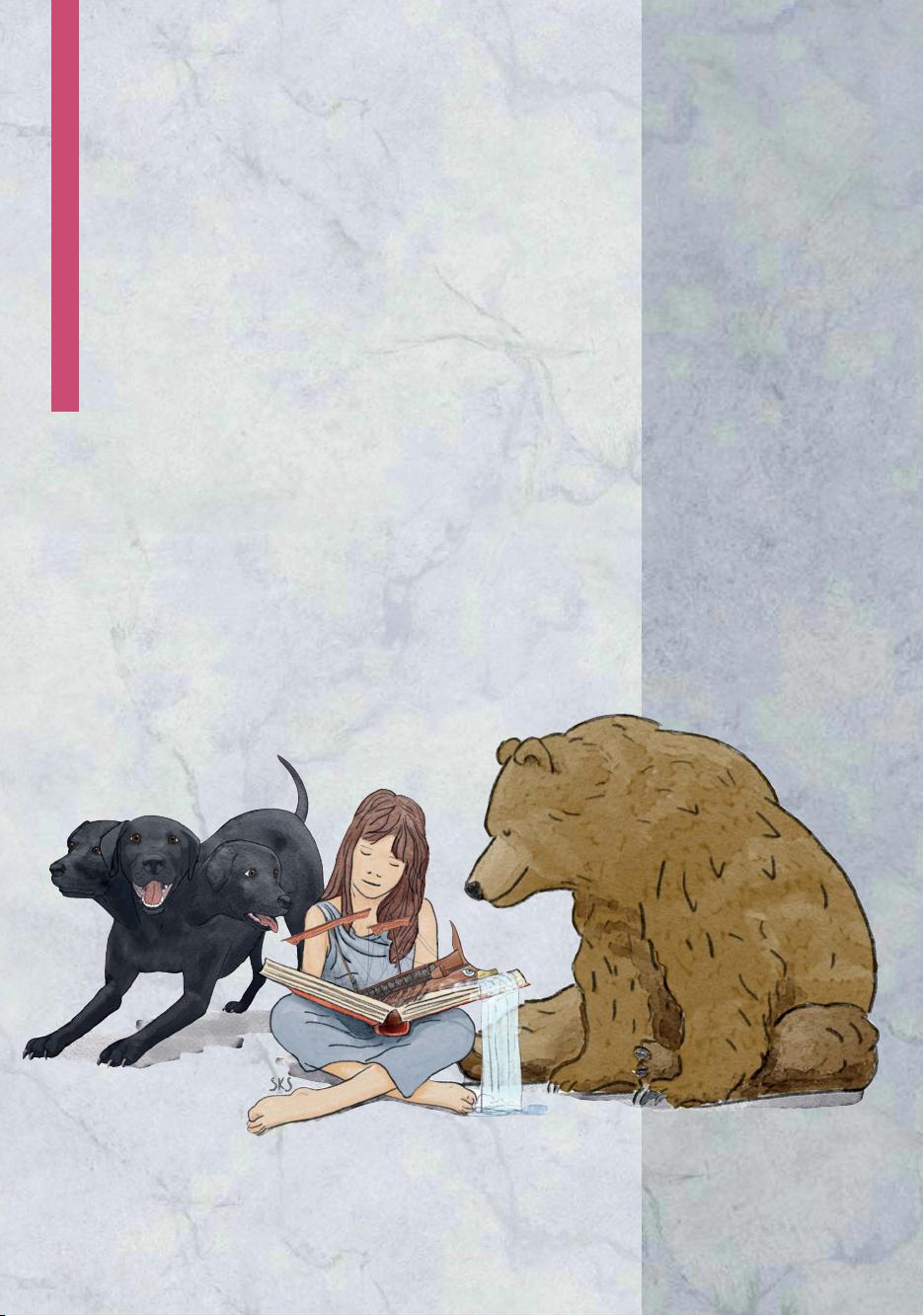
Joel Martinez– Cover Illustration
© Copyright 2016 Nude Bruce Review.
All rights reserved and stuff
3"
4"
Table of contents
(&) 6
Poetry
Why Dogs Would Be Great
Film Directors – James Croal Jackson 20
I dream in corners – AJ Huffman 22
That Crazy Assassin – Jack D. Harvey 34
Young and Hot – Corey Mesler 39
Reading Ashbery – Robert Beveridge 53
Berkeley Buzz – Thomas Piekarski 55
Talking is Hard – Jessica Demarast 69
The dog and the arrow – Tomas Sanchez Hidalgo 71
Fiction
In the Hour of Living Authentically – Keith Witty 23
Fisherman’s Daughter – Melissa Jenks 36
Big Willie – Hassan Riaz 45
Flying Lilies – Kenneth Pobo 57
Nobel – Jason Keuter 59
Non-Fiction
An American, a Turk,
and a Syrian Walk Into a Bar – Alan Orr 8
Keying a Car – Julie Rea 40
5"
6"
(&)
Behold,
Into the maelstrom of 2016, like a comet swinging low as sweet
chariots do, ‘round and ‘round the ambulant ambit of ailing
planet Earth, who runs a fever and leans toward fascism; into and
throughout the ragged ecotones, into and around the
shimmering, stove-top streets; here in the heat and heave of
summer does plunge a familiar, ne’er effete, figure: our beloved,
beneficent Nude Bruce.
Issue 6 of Nude Bruce Review is—thank god awmighty—more of
the same: poetry, fiction and non-fiction to accompany any and
all who pass these months huddled next to the A/C, savoring
every licking tongue of recycled air. This issue is heavy on prose,
and poems lurk here and there, like heat lightning on the horizon.
Joel Martinez, an illustrator and friend of Bruce, produced the
cover art for this issue. Joel resides in the land of Arkansas,
where the breeze comes and the breeze goes. We love you, Joel.
We know that a poem can mean the difference in good times and
make the difference in bad times. We’re proud to present these
poems and prose to you, whoever you are. All thanks and praise
to the authors who shared their work with us, and for letting us
share the work with you, wherever you are. All power and glory
to the radicals in the streets this summer. May the Bruce be with
you.
The editors,
Andrew Alexander Mobbs
Timothy B. Snediker
Ciarra Proulx
7"
8"
An American, a Turk,
and a Syrian Walk into a Bar
by Alan Orr
The wind comes in gusts and blows sand across the
beach; it feels like a hum against my feet and ankles. Little
dunes form on the backsides of beach chairs and umbrellas
that are stacked and padlocked. The beach is busy but not
crowded. A Turkish teenager in cut-off shorts and a crushed
cowboy hat held in place with one hand jogs up and asks if I
want a paddleboat to go to the castle. I pat my heart and say,
“Thank you,” which suffices for no. The boy scans the beach
for other arriving tourists, sees none, and returns to his fleet
of five or six boats pulled up on the sand.
My wife, Sara, is sitting on a small purple towel from the
trunk of our car. She faces into the wind to keep her hair out
of her eyes. The beach where she sits is clean enough despite
the beer bottle pop-tops and other small bits of trash that
sparkle in the sand. Nearby, a grocery bag drags in the surf.
When I arrive, I hand Sara a beer from the shop on the
corner, and we share it between us, making sure to cover the
top whenever the wind kicks up sand. There are mostly male
bathers and children playing on a sandbar. Past that, across
the water, is a creamy-colored castle on an island. Kizkalesi:
kiz for female, kale for castle. It’s Ottoman, blocky, of the
desert, but in the sea.
9"
Sara and I are about halfway through our beer when a
small Syrian child comes up and offers us bottles of water
from a small plastic bag for the equivalent of forty cents each.
She holds the bag by one of its handles, and it almost touches
the ground by her feet. She says the price again and calls Sara
sister in Turkish. Sara speaks to her slowly in Turkish, and we
buy two bottles. The girl urges us to buy a third. We explain
that we’re just two people and that’s why we only want two.
For a moment the girl seems to understand. She looks down
the beach and shifts her bag from one hand to the other.
Then she looks back and offers us a third bottle again. Sara
asks the girl how old she is. She’s seven. Sara asks for her
name. The girl answers shyly and then runs off. We lean back
on our elbows and drink the water. It is cold. The wind
begins to die down as the heat comes back up.
Sara and I have made the trip to the coast for a long
weekend; we have driven down through the mountains from
the landlocked city we call home. We have lived there about a
year. Whenever we take our highways, we see blue terrapin
tents tucked into the corners of fields. In the evening, Syrian
men walk along the highway shoulders returning to the tents.
Sometimes they carry groceries from downtown.
Before we left, we were stuck in traffic as two Syrians
pulled a cart of discarded plastic bottles across the street.
They spoke in Arabic, and the smell from the bottles was sick
and sweet. The two men stopped at the nearest trashcan and
10"
began to dig through it. No gloves. Behind us cars honked
with impatience. Most of the Turks I know have said they
don’t know what their country is coming to. They say the
Syrians are taking their jobs.
From where we sit on the beach, the Syrian border is
about two hundred miles away. It’s May, 2015. Turkey
considers both ISIS and the Kurds fighting ISIS to be
enemies; the country seems to be content to watch them
bleed each other out. Cooperation between the US and
Turkey against ISIS is still uncertain. Everyone is just sitting
around, waiting for the next move.
Down the beach, a scene of Desert Storm ennui begins
to play out. Loud utterances of American English erupt from
a large group of short-haired, muscular men. These are the
airmen of the Incirlik US Air Force Base; they wear aviator
sunglasses, short shorts, and grey tank tops. Two voices get
louder, and I turn to watch as a stalky blonde man sets his
can of beer down, another man his American football. The
two face each other and interlock arms to wrestle. The other
airmen form a circle and goad them on. There’s a lot of
grabbing at the back of the head and neck. One of the men
tumbles into the sand and scrambles up again. Through the
men, in the distance, I see the Syrian girl. She walks in a wide
semi-circle around them.
Each night that we’ve been here, American country
music has blared out of a street-level patio on the same
narrow road where Sara and I are staying. When we walk by
11"
we see Hint of Lime Tostitos and Jif Peanut Butter being
washed down with Budweiser. You can’t get those things in
Turkey. American children run between the tables and
around the knees of the men and their wives.
Last night when we returned to our hotel, I asked the
owner what he thought of the Americans from the airbase
coming to his town. We were drinking tea on the porch, and
the lyrics of the country music down the road were crisp and
clear.
The owner, a lanky and friendly Turk, said, “The
families are okay. I don’t like the young guys. They get too
drunk and loud, especially at night. And they get into trouble,
you know, with some of the women here.”
“Most of them,” he said, “stay at the hotel over there
because it’s owned by an American who was in the military or
something. He’s married to a Turkish woman. But sometimes
there are too many guys, so they stay at my hotel, too.” The
owner drummed on the arms of his chair. “They keep us in
business when no one else is here because of the base.
Turkish tourists won’t come until August.”
“They seem obnoxious,” I said. “I’m not one of those
Americans who thinks all Americans are great. We’re,” I
pointed to Sara and myself, “just English teachers.”
“You know,” the hotel owner said, “let me tell you
something.” He leaned forward. “One time this big general
stayed at my hotel. This guy had lots of decorations.” The
owner brushed his shoulders. “During the day the general
12"
was talking about how America is just helping spread peace.
All this Bob Marley stuff. The general said that he really
believes that America can help countries become
democratic.”
“I liked him,” the hotel owner said. “I agreed with him.
But at night this general completely changes. When he got
drunk he started saying that America is the best mother
fucking country and that if the Middle East doesn’t listen,
America is going to blow it all up.”
I shook my head. “That’s messed up.”
“But, like I said, they help us through the slow season,”
the owner said. “So I can’t say no when they want to stay
here.”
On the beach, my wife and I have finished our beer. The
afternoon is burning away, but there’s still plenty of day left.
Some friends of ours from our city are meeting us here.
They’re an American couple, Mark and Carrie, and Mark’s
sister, Emily. All of us are teachers. Emily has brought her
three half-American, half-Turkish sons. We’re not supposed
to drink around the kids, so I sneak off to dispose of our can
when I see them approaching.
When I return, the middle boy, a year older than the
Syrian girl, is whining about who is going to get a turn with
the inner tube first. He calls the inner tube a simit, which is a
food like a bagel. It’s a heated conversation. Emily takes the
boys into the water, although the issue is unresolved.
13"
With Mark and Carrie, we chat about the drive to the
coast until I ask Mark if he wants to swim to the castle. It’ll
take just over an hour, round-trip, and Mark says he’s up for
it. Sara goes to find Emily and the boys in the water. Carrie
hangs out on the sand. Before Mark and I go, we use
shoelaces to make a sling to bring our flip-flops as we swim.
We jog into the waves, jumping over them until it’s deep
enough to dive. We do the breaststroke for a while, and once
that gets tiring, we swim like jellyfish, backwards, looking
back at the costal town.
“What do you think of the Americans near us on the
beach?”
“The Air Force guys? What about them?”
Mark and Emily grew up on military bases, the children
of an Army dentist.
A paddleboat filled with airmen passes about fifty
meters away; they’re on their way to the castle as well. They
shout and raise their beers to another boat of guys, making it
clear that it’s a race.
“They’re driving me nuts. I don’t like what they
represent.”
“The military or America?”
“America as represented by the military.”
“We represent a lot of the same things, man,” Mark
says. “As much as you and I might not want to, we do.”
14"
“Like heavy-handed exported American culture? Being
loud all the time? Neocolonialism through the English
language or what?”
“Yeah, maybe that. And globalization and diversity.”
“They’re so damn awful, though. Part of me wants to
believe that I’d be as offended if it were people from another
culture being loud tourists. But it’s the closeness to home
that’s getting me. It’s hard to disassociate with them without
disassociating with myself.”
Mark glances over at me. “I’ve had a lifetime of it.”
His words hang in the salty air. The waves bring us up
and down, though they become smaller as we approach the
island. The airmen in the paddleboats have reached the island
ahead of us. They are still shouting like they’re on a
rollercoaster everyone’s enjoying together. Mark and I drift
into the shallows and watch for broken glass in the rocks as
we put on our flip-flops.
The castle walls tower above our heads, and Turkish
paddleboaters wander around the ramparts. Mark and I take
the gravel path through the entryway and explore a series of
metal planks constructed over small hallways of the castle’s
interior. Eventually we climb up a narrow stairway passage to
the highest turret that faces the coast. On the way we get
stuck in a traffic jam with a Turkish family, and a small boy
asks his father, “Isn’t there a boy castle?” We emerge onto
the top of the crumbling turret. Here, among tourists taking
selfies, we have a view of the gradient blues of the sea with
15"
the town and other Ottoman ruins in the distance. There’s
space on the turret for us to sit, so we dangle our feet and try
to find Carrie on the beach and Sara, Emily, and the boys in
the shallows.
Mark says, “We’re lucky to be here,” and I agree.
“Last night at dinner,” he says, “we met this Syrian
waiter from Aleppo who could speak Turkish, and English.
We were chatting, and he found out we were teachers, so he
asked me if we could line up a teaching job for him. His
English was okay. Not bad, but not that good.”
“Too bad we don’t have that much sway at the
university,” I say.
“I know, right? The guy said that the restaurant where
he works pays him half of what the Turkish waiters make
because he’s Syrian. He works twice the hours to make up for
it, and he says he brings in most of the foreign tourists. You
can see him doing it, too. He speaks to everyone who walks
by. We left him a good tip.”
Mark begins to suggest that we all go there tonight, but
he’s suddenly cut off when American English comes
booming up the turrent’s stairway. A group of five airmen
soon emerge from the passage and onto the tower. They push
each other out of the way, trying to get a clear view.
“You can see all those motherfuckers on the beach,”
one of them says. He begins to wave.
“Fuck’em.” This airman raises his fist and middle finger.
16"
Another one climbs onto a shorter airmen’s back and
shouts toward shore.
From where I sit on the edge, I look straight down,
fearing I’m going to get nudged off the tower. Then I turn to
look a few of them in the eyes because I’m curious to see
whether they’ll say something to a fellow countryman abroad.
They don’t give Mark or me a second glance. One of the
airmen drops the beer bottle he is carrying, but he catches it
before it shatters on the rock floor.
Bored of the view, two of the men begin creeping out
on one of the castle’s narrow walls; there are drops of twenty-
feet on either side. The wall leads to a wider area where a
flagpole in the rock displays the red Turkish flag with its star
and crescent moon. One by one, the rest of the airmen
follow. They bumble across, tripping and catching each other
before they fall.
“They’re so young,” I say, and Mark shrugs and agrees.
When the airmen have reached the area with the
flagpole, they try again to get the attention of the men on
shore by jumping and waving. A black-haired one tries to
climb the flagpole but doesn’t get far before he slides back
down. In the wind their voices carry. An assertive malicious
voice says: “We should take this fucking thing down and raise
an American flag.”
Mark and I stare hard at the airmen.
A couple of them begin to try to untie the ropes that
hang down to the base of the pole.
17"
“We have to get out of here,” Mark says, getting up.
“This stuff happens outside of bases. It could be bad news.”
Although tourists are coming up the turret passageway,
we stick close to the wall and are able to get down. We walk
in strides on the path to the shore where we tie on our flip-
flops. Mark dives off a rock and begins to swim away. Before
I leave the shore, I see three Turkish ladies in a paddleboat
trying to land their boat. They wear headscarves, tunics, and
jeans. One of them jumps into the shallows and nearly gets
soaked. She still has trouble pulling the boat up, so I come
over and explain in broken Turkish that I will help. They
consent and say thank you when their boat is on shore. I
swim to catch Mark, first doing the crawl and then switching
to breaststroke.
Eventually, we turn over on our backs and watch the
few remaining airmen disappearing from the turret. The
Turkish flag remains in place. It twists and turns in the wind.
The temperature of the sea is cool, but not cold. We have
about twenty minutes to go. We are still watching when the
airmen return to their paddleboats; they try to jump from one
boat to the other just after they’ve launched.
When Mark and I come up on shore, Emily and her
boys are still out playing, but Sara has returned. She and
Carrie hand us dry towels. I try to describe the castle to Sara,
but Sara looks past me toward the beach. I turn, expecting
the airmen, but see the young Syrian girl who sold us the
18"
water instead. She is not carrying a bag of water bottles this
time. She walks straight to Sara and calls her sister again. The
girl holds her fist out, and Sara opens her hands to receive a
collection of seashells. The shells are for Sara, the girl says. In
Turkish Sara says they are beautiful and says the girl is very
sweet. She blushes and runs away, kicking up sand.
At dinner that night we meet the Syrian waiter who only
vaguely remembers Mark, Carrie, and Emily from the night
before. Carrie reminds the waiter that we’re teachers, and he
asks again whether we can help him get a teaching job. We
say we’re just teachers, not administrators. He quickly looks
away and says he understands. He rushes to his next table.
We give him an American-sized tip, which is double the local
custom. When we leave, Mark carries one of his sleeping
nephews from the restaurant to their hotel a few blocks away.
Sara and I wait in the lobby while Mark and Carrie give
their nephews a formal goodnight. When Mark and Carrie
return, we go back to the beach with some beers, and we are
careful to make sure the bottle tops get into the trash. A stray
dog rolls around under a street light. Down the beachfront
walkway is a group of Syrian girls sitting on a curb. It’s hard
to tell, but one of them looks like the Syrian girl with the
shells. She holds the hand of a girl even smaller than herself.
We sit on a bench in the sand and watch as the castle
across the water lights up in blue, then green, then red, then
pink. Its upside-down image is reflected in the dark water. A
neon-colored beachside club is at our backs. Without
19"
warning, the club turns up the Turkish dance music so loud
that the bass seems to vibrate the sand. The club’s windows
are open, and we can see that the place only has a few
customers. A blue string of lights outlines a massive mirror
behind the bar. Heading toward the club on the beachfront
walkway are airmen, first only in pairs and then in larger
groups. We pass even more airmen on our way back to our
hotels. The young Syrian girls have disappeared.
This is the beach town of Kizkalesi. We are the
Americans abroad.
20"
Why Dogs Would Be
Great Films Directors
by James Croal Jackson
It was tough to leave for work this morning,
collie’s silhouette usually at the top of the stairs
a shadow slinking, eyes glowing.
Your heart nearly stopped flailing its arms
as it sank deeper and deeper into the ocean.
When you watched Silver Linings Playbook
you saw your dog in the face of Bradley Cooper
those dark eyes shining in the greater darkness–
driving home with the key stabbing the ignition,
you drove wanting anything to please you.
It wasn’t in the trees or the swaying lights
or the Post-It notes crumpled in the bagless bin–
no, collie ran in circles. You reached for a treat,
your heart compiling sand and blowing glassworks–
collie on set with Bradley Cooper, his eyes
on her galvanized eyes and all she wants is ham
you’ve never seen a ham this juicy and
why am I excited about ham and
21"
collie with her eyes makes Bradley
see the ham, want the ham,
want the ham like never before.
22"
I Dream in Corners
by AJ Huffman
of mirrors that are not
really there. I play at reflection,
a foolish child wearing ghosts
two sizes too big. I try to work myself
into angles of plausibility,
but the light is too soothing,
and I am always the one softening
into nothing more than a misted breath
of a scar.
23"
In The Hour of Living Authentically
by Keith Witty
“As they told you before you made your way back here,
my name is Kristen and I’m a graduate-assistant here in the
PhD program. Full disclosure: these sessions are private, but
they are between three people as I am monitored by a full
professor and our session will be reviewed later and I will be
judged for my competence. Is that okay with you, Seth?”
“That’s fine.”
“Great. Let’s begin. Why are you here to see me today,
Seth?”
“Because I told my friend I wanted to lay on the
sidewalk and wait for a cyclist to hit my neck. So my friend
drug me here.”
“Do you know why you said that? Clearly he seemed
concerned that you meant it.”
“I’ve been depressed. That’s a self-diagnosis.”
“What makes you think that you’re depressed? And just
like you were read in the form you filled out – I’m just
restating here – you don’t have to worry about me gabbing
this to the world or anything like that. This is totally between
you and me.”
“That’s a really hammy line, but I’ll answer the question.
Some days I just kind of feel worthless. That I’m a horrible
person and everyone has yet to figure it out.”
“What do you mean ‘has yet to figure it out’?”
“Give me a minute to think about that. I don’t think I’ve
ever articulated it.”
24"
“I’m in no way pressuring you, Seth. I want you to know
that. I need you to feel that. If you want to sit here for an
hour in silence we can do that, but I would like to help you.
That’s what every here is hoping to do for you.”
“You have to stop that. Is that not weird for you to
say?”
“What do you mean?”
“That just seems like such a line. Every single part of
what you said to me to make me feel better seems like it was
read from a card someone slipped under the door. I’m sorry.
I just wonder how a person could ever authentically mean
that.”
“Would you prefer I say something else? I do actually
want you to feel okay to speak with me about anything. That
line is probably a company one, you’re right, but it’s also
open-ended. Now we’re talking about it.”
“No, no, I’m sorry. I don’t know why I honed in on it. I
know you’re just trying to make me feel better.”
“You said you feel depressed. What does that feel like?
Have you figured out a way to put it?”
“It feels weird to say, but I generally have a lot of
friends. I don’t understand why they like me. At any minute
they’re going to realize that half the jokes I make are true, but
because I understand cadence I can make them laugh
anyway.”
“I have two questions, Seth: First, I want you to tell me
what you mean by cadence. Secondly, is it possible you’re
underestimating your friends?”
“Cadence is essentially the way you say something. Let’s
say I talk to my friend Ben, who grows a beard, and he’s
proud of his beard, and I tell him his beard looks like a small
bear took a shit on his face and that while aforementioned
25"
shit was in descent it got matted up in some fur and then
you—you as in Ben—called it good. Ben laughs. Thinks I
don’t mean it. I do mean it. His beard looks like exactly that.
But I’m trapped inside the way I say things. It’s impossible to
explain; I’m realizing that as I try to explain it.”
“And you don’t think Ben knows you mean it?”
“There’s no way he does. And that’s nothing against
Ben. Ben is a sharp cookie, Kristen. If Ben realized that then
there’s no way he would stay my friend. What kind of person
stays friends with a person that tells them something like
that?”
“Friendship isn’t a rational thing most of time. People
work together and that’s that.”
“I don’t buy that. I’m all for questioning rationality; I
kind of think it’s the new geo-centrism. Though not as
absolutely fucking stupid. It works, yeah, but have you ever
traced something through cause and effect? Eventually that
whole thing requires you to believe it doesn’t follow its own
logic. Take rocks, for example—”
“I’m stopping you. You’re out in left field. Bring it back
in. By your own logic, do you think Ben and you rationally
work?”
“Yes and no. But the basis of our friendship is on
common ground, common interests. We work as good
friends because we understand a lot of the same things.”
“But he doesn’t understand this.”
“I don’t know. Maybe.”
“I’m going to ask you some questions, Seth. Is that
okay?”
“Oh my God. I’m not fragile. You talk to me like I’m
melting ice.”
“I’ll work on it. You want me to be more frank?”
26"
“I don’t know. I’m just an asshole. I’m sorry.”
“I’ve heard worse in here. Let me ask these questions
though. Have you ever been the victim of physical or
emotional abuse?”
“The answer is my mother. Am I supposed to say ‘my
mother’ as an answer to all these questions?”
“Only if it’s the actual answer.”
“Well then how’s this: Not physical. Emotional is
debatable.”
“Tell me.”
“My mother.”
“The root of your depression may be that emotional
abuse.”
“We don’t have time for me to tell this story, Kristen.”
“Give me a short version. I’m not being nice. This is me
not being nice like you wanted.”
“Well if you go all meta and do me the favor of telling
me you’re fulfilling my wants by not being what I didn’t want
then that’s pretty nice of you, isn’t it?”
“Short version.”
“Fine. There was this girl – Let me have a preamble to
say that I thought crazy women—and I don’t mean that in
some patriarchal meninist bullshit way, okay?”
“Continue with the story. I won’t go down these rabbit
holes with you.”
“So. Before this girl, I really did think that crazy women
were just a plot device for TV shows. I’m sure there are crazy
guys out there, too. Actually I know there are. I had this
friend Donnie, punched a hole in the wall beside the face of
his girlfriend—”
“Story, Seth.”
27"
“Alright. This girl, I meet her. She seems cool. She’s not.
She keeps wanting to argue. I’m not a fighter, Kristen. My
grandpa told me to walk away from fights because they’re not
worth it. Well one day she has me cornered and she’s yelling
at me. Gives me an option to leave. I take it. I grab my shoes
and get up and she freaks the fuck out even more. So me, I’m
just confused—say what the fuck you mean, you know?—and
I sit back down on the bed. She grabs my shoes and flings
them at the wall and dents it. Then she locks herself in the
bathroom. When she comes out she’s calm. Gives me some
sort of ultimatum: spend tomorrow with her and if at the end
of the day I still want to go then she won’t do anything to
stop me. That sounds like a good deal, right? Fucking wrong,
Kristen. I was young and stupid. And she was only wearing
panties. When a girl is just down to her panties. Holy shit,
Kristen. I don’t think I’m subconsciously scared of vaginas or
something like that; I just like panties. Why I am telling you
this?”
“Move on.”
“Yeah, so I agree to this final day. Meanwhile, I had
been texting my older sister, telling her I was trying my best
to get the fuck out of there. She was telling me that I needed
to do just that. But I had that final-day-date thing that was a
sure-fire bet. I’m out. I’m done. No worries. So I wake up in
the morning and the girl—”
“What is this girl’s name?”
“Ellen. So I wake up and Ellen isn’t there. I reach over
to the windowsill and grab for my phone and it’s not there.
I’m panicking at this point. She’s fucking going through my
phone, I figure. Sure enough, I walk out of the bedroom and
she’s sitting in the living room floor. She has clothes on.
Which, Kristen, all that goes through my head is that she has
28"
yet to have clothes on since I tried to leave and now that
she’s out of the bedroom she does. I hear all these stories
about women who want to do it places other than the
bedroom and I never get to date them. Is the living room
really too much to ask?”
“Continue the story.”
“Yeah. Sorry. So she’s sitting in the floor, right, and
beside her is my phone. So I asked her, ‘you go through my
phone?’ and she says, ‘No, I don’t know how that got here.’ I
picked up my phone and it was a text screen to my mother.
My mother, Kristen. Here’s the thing. I had sent one text
right before I fell asleep to my sister and closed the app.
When I open my message app it always opens to the last
screen that was used. So Ellen is busted. I call her a liar, tell
her I’m taking a shower and then I’m leaving.”
“Why would you take a shower? Why not just go?”
“Cleanliness is next to Godliness, Kristen.”
“If you want help you have to actually answer my
questions, Seth.”
“I’m getting to it. I go to the bathroom and lock the
door and I just hear screaming from the other room. There’s
stomping and other noises, but the sound I catch onto the
most is the opening and slamming of drawers in the kitchen.
My mind immediately sprints to ‘here’s Johnny!’ I figure that
she has a knife. I don’t take a shower. I am not going to be in
an Alfred Hitchcock movie. I just stay sitting there on the
toilet. I text my friend Anthony and tell him what’s going on
and he doesn’t believe me. Tells me I’m on my own. I needed
him to come pick me up and he said no.”
“Wait, why did you need him to pick you up?”
“The same reason I took a shower there. A day or so
before this we had been having problems. I walked out to my
29"
truck and my back passenger tire was slashed. Literally
slashed. Big freaking hole in the side of it. I couldn’t change it
because Ellen was in the middle of moving to this new
apartment so we had removed my spare tire from the back of
the truck to make room for more boxes. So I was stranded
and Anthony wouldn’t come get me. We are not friends
anymore. Not really because of this. Mainly because he’s a
two-clowner. One of those guys that if you tell him you had a
clown at your birthday party he’ll say he had two.”
“Okay, so you’re trapped in the bathroom.”
“Yeah, and I tell her I’m not going to come out of the
bathroom because I think she has a knife. Upon hearing this
she goes into to full apology mode, saying she lost her cool
and that she was sorry that she freaked me out. She swears
she doesn’t have a knife. I wait in the bathroom for another
hour. I finally peek my head out and she is sitting there on
the bed. There’s no knife. I tell her I’m going to take a
shower, but I’m still pissed she read my phone. And the
language here, Kristen, I just want to say that it wasn’t this
filthy. I was deeply religious at the time and now I’m trying to
make up for lost words. But really, part of the reason this was
so traumatic of a relationship was due to the fact that we
were having a lot of sex and I wasn’t sure how I felt about it.”
“Why did you start having sex with her if you were
religious? Was she not?”
“We both were, actually. Extremely religious. We just
got carried away a couple times and it turned into a daily or
nightly thing. We’ll get to it. Now I’m telling you to let me
finish.”
“Continue.”
“So I finish showering and figure my only option is to
go with her all day and do whatever it is that she has planned
30"
out. It wasn’t fun. It was mainly awkward. She took me to see
the professor of the class in which we had both met. I hope
to God the professor could see that I was not wanting to be
there and that Ellen was off her rocker. Man, do I hope that
more than almost anything else in the world. We talked to
this professor for an hour or so. Then it gets blurry. I really
don’t remember much except that I went to work and Ellen
sat in the car outside of my work the entire time. Just waiting
for me. When I got off it was night and she told me she had
one more place. This place was church. She took me there
and we went in. She told me that she wanted me to pray to
God and ask him for guidance because she knew that God
would show me that I needed to be with her. That we
belonged together. This story is still so long, Kristen.”
“It’s fine. Keep going.”
“I have been to seminary in my life. I spent a year there
before deciding it wasn’t for me. At the time, I was so
devout… what she was doing was hard to handle. I really
didn’t want God to somehow tell me that I was supposed to
stay with her. I don’t know how to explain it. We prayed at
the altar for a few minutes. Her for longer. While she was
praying—oh yeah, I should explain. While I don’t remember
a lot of what we did, I do remember that I felt like this day
wasn’t going to end. She kept coming up with things to do
and I was sure this day would extend into the next. So on the
way to the church I screamed at her. She’s the only person
I’ve ever screamed at in my entire life. I screamed at her to let
me go. That I just wanted to leave. That I didn’t want to be
with her and that I was miserable. It is, still, to this day, the
most pain I have ever felt emotionally. I needed out. I felt like
there wasn’t going to be a way. My family lived four hours
away. My friends who I lived with were mad at me because I
31"
had ‘abandoned’ them for Ellen. But really I hadn’t. It was
just that every time I tried to go see them without her she
threw a fit and acted like I didn’t want her to be around my
friends. There just wasn’t any way out of it. But yeah… so
while she was praying I just kept thinking how much bullshit
it was that God was doing this to me. That I was in so much
pain and it seemed so unnecessary. I know there are starving
kids in Africa, but this was unfair. I had been nothing but a
spokesperson for God my entire life and this is the girl that
he has put in my path? Even if it was for growth that’s
bullshit. You don’t need that much pain to learn a lesson. She
got up and asked me what God said to me and I told her that
God told me we needed to break up. She paused and simply
told me that I was praying wrong.”
“What does that mean? How does one ‘pray wrong?’”
“I don’t know. It just pissed me off.”
“Okay. We will probably return to that at some point,
but we’re burning through minutes and I want you to finish
the story.”
“Well being told that sent me over the edge and I told
her I had to get my tire. I yelled at her. I made her scared of
me. It was horrible. I took her car and went and got my tire
and I couldn’t lift it onto the truck to put the lug nuts into it
after removing the flat. I got up the nerve to call my best
friend Bernard and he told me he had thrown out his back
but would come down to help in any way he could. He was
still pretty angry with me. He told me later that my entire
friend group had taken to referring to me as Kuwabara,
which is this character from a ridiculous anime called Yu Yu
Hakusho… but it’s the guy that everyone despises because he
is so annoying. I don’t hold it against them. They don’t
anymore call me it anymore. We don’t really joke about it,
32"
though. It did mean something. But anyway, Bernard showed
up and he really couldn’t do anything but stand and watch.”
“Where is Ellen during all of this?”
“She’s in her apartment. All I told her was that I was
going change my tire and then we would talk.”
“I see. Keep going.”
“Well there were like three guys that walked by us that
refused to help me. I don’t know if we looked suspicious or
what. But nobody would give me the time of day. Finally a
guy did, and he was cool about it. I just told him I was a
weakling and that Bernard had thrown his back out. He
laughed and did the rest of the job for me. Really great guy.
So I turned to Bernard next and I told him that I needed one
more favor from him. I needed him to stand outside Ellen’s
door while I went in and broke up with her. I wanted him to
count to thirty and then knock on the door and I would
leave.”
“And that’s how you ended the relationship?”
“Pretty much. I went in and I threatened her with a
restraining order. Which seems harsh, but I couldn’t get into
all the details here. This is the short version. She asked me if
my sister was putting me up to this and I told her it was just
me. That we were done and that she wasn’t allowed to talk to
me or my family or my friends again. Then Bernard knocked
on the door and I left. But, what’s funny about it, is that it
didn’t end that tidy. That would have been a dream. She ran
out after me and told me I still had her keys. Ha-ha. That’s
the real end. I tossed her the keys and went back to Bernard
and then we went to Wendy’s. The best tasting spicy chicken
sandwich of my life was served to me that night.”
“Have you considered that this trauma is at the root of
what you’re feeling?”
33"
“The sandwich was more delicious than traumatic.”
“Answer my question.”
“I guess, no. I haven’t.”
“I would think about that if I were you. That was
question one, though. We need to do question two. We only
have a few minutes left, so I hesitate to ask… Have you ever
thought about or attempted to hurt yourself?”
“My mother.”
34"
That Crazy Assassin
by Jack D. Harvey
Jerry Lee bopped off,
they say,
two wives, Lewis and Lois,
unbidden angels,
they lost their way,
they say,
suffering faces upturned
to unmerciful heaven;
they were his babes,
lost in the woods, maybe,
for a long day and a night.
In death,
in the waning moon,
their color the color of
pool tiles,
color of cream, their flesh
holy lamb’s blood
overspread,
drove him to be
done with them.
Hear his left hand still
thundering in the dark;
balls of fire
in the lonesome night,
feet of iron
jumping down the hills,
35"
shaking down the country roofs.
The personal friend of Satan,
nothing loath,
leans towards the deep,
his weight a feather
in the balance;
his song
atonement for
those fretted murdered souls.
Death, the taker, takes;
Whiteboy’s innards,
shaking his shoes,
move with pity;
his mother, the giver,
is nowhere, everywhere;
gentle earth to earth.
At the grave site
the sermon slow,
the singing weary;
the women
one by one file off,
no strangers to the slaughter.
Again and again,
Agamemnon’s daughter
bleeds on the altar;
grief
by the windless shore
that would bring
tears to the eyes
of an army.
36"
Fisherman’s Daughter
by Melissa Jenks
The water was so cold it made her fingertips silver-blue. In
the 3000 miles she'd traveled this was the coldest she'd been.
The pain coursed from her shoulder blades to the soft skin
that eased into scales at her waist. As always, the lower half
of her body felt fine. Her arms, though, burned blue, her
nipples chafed and raw.
She'd swam, in winter, to the Boston Medical Center to
hear an expert lecture on synesthesia. Humans believed that
no one paid them any attention, but in truth others were just
as susceptible to the human condition as humans themselves.
Autistics, cancer patients, Buddhists, all of them swam
thousands of miles beneath the waves to press their fluted
ears against the substructure of various buildings to hear
specialists pontificate. They'd listen for hours, for days,
delicate vibrations passing through molecules of earth and
thence into water.
Since she was a tadpole she'd been unable to distinguish
among her senses, or had them confused, as if it wasn't hard
enough being half-human, half-fish. Always homeless, her
human self suffering the indignities of water, her piscine cells
unable to survive without. But unlike her family, she felt pain
in her body as color—heat as red, pleasure as yellow, rough
edges as purple. Their midnight singing she felt in the depths
of her bones, a grinding vibration. The small fish she
crunched between her teeth she could not taste but only hear.
A long view through clear water gave her a metallic twang on
the back of her tongue.
37"
Her nose was the only thing she could rely on, and she'd
follow scents for weeks, just a trace of blood in the water, a
smell she recognized and she'd swim till she ached, till the
effort burned pink in her muscles, till she'd found the person
or fish she'd been tracing, each scent a welcome. After her
family kicked her out, she found a scent and traced it to the
Mediterranean, where the last whale of its kind, a fellow
outcast, swam off the coast of Albania. She'd rested on his
back, his lumpy skin a carpet of orange below her exhausted
body. He was still her only friend but when they tried to
mate it hadn't worked, despite the yellow shivers in her fish
half, the sensual smoothness of his high-pitched song.
Finally, tracing vibrations in her tail, rumors that echoed
through earth, she'd learned the name for her disease:
synesthesia, a crossing of the wires in her human brain, wires
that forbade her from seeing the world clearly.
She swam to the closest access point, oily and clotted
with garbage, the metal joists that stretched into the water
from the hospital. She pressed her ear to the flat surface of
rebar. The words she heard as sharp twinges in the muscles
of her chest, but she listened, distracted from the silver cold,
and found the threads of meaning. Humans were so stupid.
All of this talk about acceptance and belief. All the stupid
fucking doctor was doing was studying it. When a girl took
the podium, another girl with the same disease, when she
spoke of it as a gift—the colors that appeared when she
listened to opera, the numbers she experienced as smell—the
mermaid began to cry. The tears traced green paths down
her face.
It wasn't till swimming back, out from the harbor,
weeping, that she realized her tail was wrapped in
monofilament. When she struggled, a net from the lobster
38"
boat swooped down. Out of the water for only a few
minutes and her limp body ceased processing oxygen, and she
appeared, to the humans, as a giant striped bass. They ate
her. That night, the fisherman's daughter awoke, a whale's
song shaping a grinding sharpness in the knobs of her spine.
39"
Young and Hot
by Corey Mesler
Sometimes the sound
from the other room
was poetry.
We dared each other
to listen. You began
to unbutton your shirt.
40"
Keying a Car
by Julie Rea
I keyed a car a little while back in a moment of rage. I
don’t admit this without guilt. I don’t drive anything aside
from my wheelchair, but I do respect the philosophy that you
don’t mess with a person’s ride unless severely provoked.
The car-keying occurred a few minutes away from my
Philadelphia-area apartment. I was on my way home when I
went to cross the street. The car, a beat-up silver thing, was
blocking the crosswalk as it waited for the light to turn. The
front bumper was badly dented, and on the passenger side,
part of the body of the car had been cut away, revealing
rusting metal underneath. The car’s occupants were two
women.
The driver of the silver car was on her cell phone. She
looked at me and then away, the phone not moving from her
head. She would have known that I had the light and that she
was in the way. She could’ve backed up; the next car in line
was giving her a wide berth. And there was no way I could go
in front of her without rolling into rush-hour traffic.
In a fury, I went alongside the silver car, my wheels
sleeping in the muck of the gutter. I took out a giant key and
scratched the door with it as hard as I could. I saw the
passenger watching, and I held up the key and smiled.
Here, a contextual note is necessary:
After living in New York City for over fifteen years, I
got used to pedestrians having the right of way in crosswalks.
Accidents happen, but the norm is for drivers to yield to the
carless. I appreciate New York’s attitude towards pedestrians.
41"
Wheelchair users are not equipped to leap out of the path of
a pile of motorized steel.
I moved to Philly in 2009, and compared to NYC,
drivers are a lot more casual here about rolling through
crosswalks when pedestrians have the right of way. At my
first close call with a car in Philly, a NYC-style statement of
alarm, generously laced with F-bombs, flew out of my mouth.
I saw the driver’s eyes go wide, maybe with surprise, as at a
glance, I don’t look dangerous: There’s my wheelchair, my
thick spectacles, and the fact that I’m a 110-pound chick who
often wears little flowery dresses in warm weather.
It took a while for me to stop swearing at and pounding
on the hoods of cars that didn’t yield and thus almost
clobbered me. At the urging of friends who wisely foresaw I
would end up in the hospital after chewing out the wrong
person, I reluctantly abandoned my one-woman war against
careless drivers.
But on the day I reneged on my surrender and keyed the
car, I was angry long before I got to the intersection. My cat
had died a handful of days prior. She was euthanized after a
series of violent seizures. Although she had lived almost a
good eighteen years, I was pissed about her dying badly. I had
been up when it happened, at about two in the morning,
awake because of bad nerve pain, a chronic condition related
to my spinal cord injury. As always, my little tortoiseshell cat
had come to me purring as I clutched myself in the dark. But
a half-hour later, she was dying. There was nothing, aside
from getting her to the animal hospital so she could be put to
sleep, that could be done. My friends and I had spent
thousands of dollars and hours in medical care for the cat. I
stupidly believed that these efforts would allow her to die in
her sleep, curled up on her heating pad. I had been ready to
42"
lose my cat; she was old and ailing. But I had not been
prepared to watch her frail body frantically strain as she
suffocated from seizure after seizure.
I have a hard time venting healthily. I bottle things up.
People more sound than I, who shepherd his or her beloved
pet to the hereafter, I imagine go home afterwards and have a
good cry. I am not like that. After my cat died, I took up
smoking cigarettes again. I didn’t cry. I slept on the couch
several days, leaving my boyfriend in the bed alone. I didn’t
want to be touched. I watched various Real Housewives
franchises, using the bickering and other dysfunctions to
drown out everything else.
Back to keying the car: after I had done the deed and
was rolling across the street, I heard an angry squeak from the
driver, who had rolled down her window: “Did you do
something to my car?”
I turned to grimly nod at the driver, thinking at her, yes, I
messed with your car. Watch out, or I’ll mess with you too. For the
first time since my cat’s death, I felt strong.
Somebody in the line of cars behind the one I’d keyed
rolled down her window to ask if I was okay. I gave the
thumbs up to convey that everything was copacetic.
But then, the car that I’d keyed did a near-suicidal U-
turn out into the heavy traffic and came roaring after me,
driving against the one-way traffic, half the car on the
sidewalk, half on the street.
I cut through a parking lot to try to get away, but
snowdrifts blocked my way out.
The silver car slammed on its brakes, pinning me
between it and the snow. I could have gone around the car,
but I froze, fearing it would run me down.
43"
The driver got out, her fingers clenching her giant
cellphone. She yelled that I had done something to her car.
I acknowledged that I had keyed her car with as much
scorn as I could manage. I smiled. I wanted the little woman
to take a swing at me so that I would have an excuse to hit
her. My arms are long and strong, and I could feel the
muscles in my biceps tense with the pleasant anticipation of
throwing a punch. I gave the driver the double middle finger
as incentive to come get me.
Here was a situation that I could address in a way that I
couldn’t when my cat was dying a bad death.
“Okay,” the driver said, “Okay.” She nodded as if to say
We’ll see what you get and started towards me.
It was then that a couple appeared by my side. It was the
woman who had earlier asked if I was okay, the one to whom
I had given the thumbs-up. She and her companion had
parked their car and arrived to defend me.
They spoke to the enraged driver. They said that they
had seen her blocking the crosswalk and that I had been right
to do what I did.
The driver snarled something about bullshit. The phone
disappeared and she ducked back in the car.
I thanked my defenders and scooted away.
When I got home I erupted into tears. I cried because if
the couple hadn’t had intervened, I probably would have
taunted the driver until she slapped my glasses off my face,
pulled my hair, shoved me out of my wheelchair, and I would
have hit and clawed right back. I cried, for the first time, over
the loss of my cat and the torturous way in which she died.
After this incident, I bought an air horn. It’s strapped to
my wheelchair, and it makes a giant sound. Before trying it
44"
out in the field, I had thought that drivers rushing or blocking
me in intersections would yield upon hearing the horn.
However, several times, I’ve blasted my horn at near
misses. Not yet has a driver stopped. My speculation is that
drivers who hit the gas so they can beat me across the
sidewalk would do this regardless of a horn or an obscene
word or gesture.
But at least I am seen. Maybe my horn will keep all
future similar experiences merely close calls.
And being able to sound my horn negates my desire to
pull out my key, raise my middle finger, pound on hoods, and
scream epithets. My horn has conferred upon me a sort of
grace, which remains even during my saddest moments.
It remains to be seen whether or not I’ll be done in by a
car, but I may have found a way to maintain my dignity while
respecting other people’s property.
45"
Big Willie
by Hassan Riaz
Bill needed this time in Los Angeles, a break from all
that campaigning, schmoozing, and strategizing, to reconnect
with himself, throw his game, and remind himself that he still
had the magical touch, especially after having spent two
backbreaking weeks in Iowa. Politics was too serious these
days, and now that he was nailed into an election all over
again, he needed juice, fun, time to himself. He'd learned his
lesson about indiscretions, of course, and wanted to avoid
situations that could lead to temptation, but at the same time,
a man needed to unwind. Hillary had been less than pleased
this morning when she'd learned that he'd taken the jet to
L.A. Not only hadn't he gotten her permission to head out of
town, which she wouldn't have given to him anyway, but he'd
left before all-important New Hampshire. She'd called him
on the plane and then when he'd landed at LAX on his cell
over and over again, and each time he'd told her not to worry
because he'd be back in three days, Monday night at the
latest. If he was on point--and that's what this weekend of
politically correct debauchery was all about, an opportunity to
recharge and focus himself--he only needed a day in New
Hampshire to will her to victory.
He was rolling solo on a Friday night. When his
motorcade hit up the valet station at the club on Sunset at
midnight, the attendants in the red vests didn't know what to
do with the string of black, tinted, two-ton armored SUVs.
They didn't have enough space out front, but made some, of
course, because even though this was Hollywood and

46"
celebrity was ubiquitous, Bill was rolling hard, even for out
here, and no one was used to this level of domination.
Forget Leonardo and Justin and Brad--Oscars and Grammies
be damned--and the usual cast of characters. They were just
blips on the radar, celebrities for celebrity sake, but he was
the real deal, the big cheese, el presidente, per se.
The promoter put him up in the club's VIP room, but
he didn't stay there, because velvet couches and table service
weren't for him. He was a man of the people and needed to
be amongst them, and there were a lot of people, guys and
girls, too many to count, crammed into every corner of the
club. Once the babes found out that he was in the house,
they congregated towards him, and no matter what their
political persuasions might have been, they wouldn't leave
him alone. He danced to reggaeton with honies who did that
whole butt-popping thing, threw back shots with models and
actresses, and posed for pictures with long limbed go-go
dancers who possessed the kind of confidence that came only
from spending a good chunk of time around a pole. Even
the men recognized his game, and gave him pounds and
props, and slapped him on the back each time he had another
collection of honies shaking their hips around him. By the
end of the night, he had the whole place jumping around and
moving in unison, party-over-here-fuck-you-over, and when
the club closed at 2:00 a.m., he filed out with the rest of the
revved up, life-loving patrons, and asked twenty of his newest
friends if they wanted to hit up a late night diner to grab a
burger or maybe some breakfast, and of course, they agreed,
because he was Big Willie, and the weekend was just getting
started.
#
As she was accustomed to doing, she sent Al, who was
47"
in town doing his slideshow on global warming, to the hotel
in Century City the next day in order to keep an eye on him,
and although Bill tried to ditch Al by telling him that he was
headed to dinner with one of the bigwigs of fundraising out
here, Al, like he tended to do, invited himself along. Of
course, there were no plans with any titans, just a baller
dinner at a steakhouse on the Strip with a few of his new
crew from the night before. Over steak and crab cakes, Al
kept talking about energy conservation, destruction of the
rain forests, and the general end of the universe as they knew
it, as if he were on a cable news show instead of at the
hippest restaurant in Hollywood with a dozen ultra-fine
hotties on a Saturday night. Bill could feel the attention of
the table waning with every additional doomsday
proclamation, and didn’t want the babes to think that the
most successful administration since Ike--and yes, that
included the current--was all about gloom and procedure. He
tried to shut Al up by kicking him under the table, but as he
attempted to do so, he brushed against the stilettos of a
brunette with huge knockers, and somehow her heels and his
cap toes came off, and he found himself enmeshed in an
exhilaratingly refreshing game of footsies. Although he
wouldn't have minded sharing with the girls some of his own
stories, such as the time Abdullah and Yasser brought out the
belly dancers at the summit at Sharm-el-Sheikh in 2000, the
activity beneath the table at least partiality made up for the
banality occurring above it.
After dinner, they hit a lounge on Argyle. By now, not
only had the news channels and entertainment shows gotten
wind of his weekend, but cell phone pictures of him vibing
had surfaced on TMZ as well, so the place was infested with
paparazzi. But the Secret Service agents had anticipated the

48"
scenario and planned accordingly. By the time the motorcade
rolled up to the front of the lounge, Bill, Al, and the gang had
already snuck into it via an unmarked car through the service
entrance in the back. Bill spent most of his night near the
pool on the outdoor patio so that he could enjoy the sixty-
five degree February weather, while Al ducked inside and
held court on the purple couch in the corner. Hillary called
repeatedly, and whenever she did, Bill darted inside, and put
Al on the phone, so that his former main man could relay to
her that all was well and calm here in L.A. After the fifth call,
though, Bill stopped handing the phone over to Al, because
Al had thrown back a few too many martinis with a blondie
from the Valley, and so not only was he slurring his words,
but he was calling Hillary "big momma" and "senator-ita"
when he spoke to her. Bill motioned to the bartender to cut
Al off, and subsequently took it upon himself to explain to
Hillary about the thumping and giggling in the background,
and when he ran out of explanations after a few more of her
calls, he told her that the battery on his cell was dying, and
turned the phone off.
At 1 a.m., the DJ called him to the stage that was set
above the steaming pool and someone handed him a
saxophone, and before he knew it he was belting out Coltrane
with everything that he had, and the audience was clapping
and shouting and whooping it up, and the DJ was tossing in a
breakbeat groove, and the crowd was swaying to the rhythm,
and girls were tossing off their clothes and jumping into the
pool for a nighttime dip, and despite all the problems out
there--terrorism, health care costs, Trump--all felt right with
the world. At the end of the night, a couple of enthusiastic
sax encores later, he returned inside, pulled a wobbly Al to his
feet, and told the girl hanging off of him that Al had to go
49"
home. The Secret Service agents snuck them out the back
and into the SUVs that had just pulled up, and as the
motorcade blasted down a side street, Bill asked Al how he'd
enjoyed the night. Al rested his head on Bill's shoulder,
burped, and said "I loved it, Big Willie, but please don't tell
Tipper."
#
On Sunday morning, he pampered himself with a
straight shave and haircut at a men's day spa in Beverly Hills,
before heading to Santa Monica to do some shopping in the
afternoon. He bought a couple of humongous flat screens--
one for watching the news and the other for sports--and
when the salesperson asked him to where he wanted the
televisions shipped, he told the sales guy to send them to his
office in Harlem, so that the missus wouldn't give him grief
about his purchases. He hit the Promenade and downed
some wings and a couple of beers at a sports bar while he
chatted up the waitresses, all of whom had nice legs, and all
of whom were more than impressed with his ability to throw
back the hottest hot sauce.
By the time he returned to his hotel, he felt energized
again. Al called him as he was heading out the door of his
hotel room, and since Bill didn't want to babysit him, he let
the call go to voicemail. Plus, he was too busy trying to think
of creative answers to Hillary's questions of where he was and
what he was doing and when he was coming to New
Hampshire to devote any more attention to Al. She was
calling every ten minutes.
His plans for hitting a rooftop bar had been leaked,
because as the motorcade barreled down Wilshire that night,
every variety of news van was in pursuit, and after
consideration, he told Secret Service to kill the bar idea, find
50"
one of those hip boutique hotels instead, book a suite, grab a
DJ, and commandeer a bartender, because tonight he wasn't
going to the party, the party was coming to him. The agents
took care of the logistics, and he took care of the guest list,
texting every cool dude and variety of babe he'd met over the
last couple of nights. When he descended upon the hotel, the
suite was set and people were already rolling in. He mingled,
danced, and even bartended mojitos, as house music blasted
the space and people popped and locked and dime stopped.
The guests in the neighboring suites complained about the
noise, but Bill, ever the diplomat, broke bread, and personally
invited them over, and as they immersed themselves in drink
and dancing and even some stimulating conversation, their
grumblings faded. Even Arnold, the Governator, who'd
heard about the party from a friend of a friend, rolled
through, and smoked a couple of stogies, chatted up a few
babes, and tossed back a couple of longnecks--blue and red
together at last.
At 4 a.m., the DJ killed the house music and put on
some downtempo, and the exhausted partygoers, who
unanimously remarked that they'd never attended a better
party, filtered out into the night. Bill stood at the door of the
suite as his guests left, and when a few of the girls tried to
invite themselves back to his hotel room in Century City, he
smiled, pointed to his ring, and politely declined. He'd gone
down that miserable road before and wasn't going to repeat
the same mistakes. This weekend was about fun, not dumb.
As his guests left, he made sure to remind everyone to get
ready for the California primary in June, maybe something
more chill since he'd have his wife in tow, but just as fun.
#
Hillary arrived at his hotel room at dawn. She pulled the
51"
comforter and sheets off of his sleeping body. He opened his
eyes, and the first and only thing he saw was her glaring down
at him. He kissed her, and without a word, pushed himself
out of bed, so that he could get ready to head to New
Hampshire.
52"
Reading Ashbery
by Robert Beveridge
Sometimes I forget
that the ways people talk
can be twisted, scoured
into Lautreamontian lines
that writhe and wriggle
into the subconscious
like a man on the street telling you:
“whatever you do,
don't think of orange elephants.”
And so the parade begins
orange elephants who sing
old John Lee Hooker tunes
down West Mechanic Street.
And to think that I saw it—
oh, forget it.
* * *
In the background a neon
bar sign spits green haze
into the night.
No, that's not it—
the emerald dress
and necklace
53"
of a sixteen-year-old prostitute
flashes with the change
of a traffic light.
No.
Robert Quine plays
with a Rolling Rock bottle
under a spotlight.
Whatever,
a flash of green.
Orange out of the corner
of your eye.
A smear of lavender lipstick
on a front tooth
soon to be kissed away
by a teenager.
Remember the wriggle
the twist
watch for the flash
of raggedy orange tail
in your rearview mirror
54"
Berkeley Buzz
by Thomas Piekarski
I know of no other city than Berkeley
that would name a middle school after
a radical like Malcolm X.
Back in the days when Berkeley hummed
they were more than tolerant of liberals
like Mario Savio, who touted free speech,
drawing overflow crowds at Sather Gate
and blocking the entrance to Sproul Hall.
In Berkeley they backed Bobby Seale
and his ravenous Black Panthers
with zeal unusual in any era.
That’s when extreme emotion was
status quo. The people loved
to get riled up,
avidly anti-establishment.
Berkeley years ago one of the first cities
to declare itself a nuclear free zone.
And now the sign hung on Durant Street
designates it a drug free zone as well.
But it really isn’t drug free, because
plenty of junkies still call People’s Park
sweet home, along with winos and drifters.
55"
And as for nuclear free, what can this
possibly mean? The atom’s been split
and you’re not going to stuff that genie
back in the bottle.
The university students mix well
with lots of screwy types and tourists
along Telegraph Avenue.
These days I feel this relative indifference
amongst the population. Be they dismissive,
laissez-faire, uninvolved or introverted,
it’s as if they couldn’t care less about changes
that don’t bode well for the human race.
It doesn’t bother them that skyscrapers pop up
like hotcakes in the area, bold structures
the Earth can’t afford anymore. They’ll apply
great strain on the electric grid and water
resources, depleting the Earth of materials
that should remain untouched for generations.
Collectively the people have no clout, perhaps
because they’ve forgotten how to shout.
And yet among them the geniuses we must
count on to dig us out of a hole. Without
the likes of Cal and its brilliant minds
there would be no solutions possible.
We would bow to pollution and consumption
and let humanity fade away.
56"
One could look at our Earth as a huge
battery, its native riches immense,
barely tapped over billions of years.
And then comes modern man
with his heavy hand
draining it of life and limb.
We’re seeing Capitalism at its most vain,
but Capitalism isn’t the only culprit.
The cup from which midnight oil
is daily sipped is running perilously low.
And Berkeley keeps its fingers crossed.
57"
Flying Lilies
by Kenneth Pobo
My exceptional brother Al, an Admiral, graduated #2 in
his Naval Academy class. I graduated from Humbrick
College, a middling number jostled by other middling
numbers. My exceptional wife Marge has won the
businesswoman of the year award three times in our bland
but cheery town of Walona. She doesn’t hold my not being
exceptional against me. Al does. In a speech I heard him use
the word “excellence” seventeen times. Seventeen! It was
like a sack of hammers thrown at the many unexceptional
heads there.
But I see things they don’t. Marge likes the word “tip
top.” She tells me how she keeps her office “tip top”—and
her ledgers. “Tip top” makes me feel like a high mountain is
about to roll down on me, a glacier that melts just from
looking at it. I don’t tell her it bugs me. We’ve been married
twenty-one years. We have some silent spaces. That’s not
exceptional, is it?
When I tell Marge about the flying lilies I see, a tango
they do with fireflies, she says, “That’s nice Wally, but I don’t
see them. Point them out.”
I try to but they go so quickly. She squints. She doesn’t
believe they are lilies but doesn’t think I’m lying. I don’t lie.
Much.
Our kids, Sheena and Robby, don’t see the flying lilies
either. Sheena would rather listen to Breaking Benjamin than
sit out on the porch with me. She’s seventeen and I probably
embarrass her. I know I’m out of it but I don’t really want to
58"
be with it either. I’m the guy in gym class who could climb
halfway up the rope—then fall on his ass.
At fourteen, Robby’s already come out to us. That
seems exceptional. Marge disagrees.
“It’s not 1977 anymore, Wally.”
“But how does he know that yet?”
“Trust me. He does.”
I trust her. That’s a big part of marriage, right? Al
trusted his first wife, Andrea, but she left him for a hippy
painter. While I didn’t like seeing Al hurt, I couldn’t say I
was sad for Andrea. The admiral needs to stay excellent at all
times. And be tip top.
I planted the lilies. Callas, Asiatic, tigers, Easter. Even
a twenty-five bulb surprise pack that I got on the cheap at
Waymore’s Nursery.
My garden is the closest I get to exceptional, excellent,
or tip top. I admit that much of it dies. I get lazy about
watering. Weeding bores me. But my lilies have been
commented on.
And not because they fly.
They get deep creamy centers, some with red speckles. I
haven’t told Marge yet, but I ride for several miles in a
crimson Asiatic. I’m always safely returned. Silences in
marriage. She wouldn’t want to know. Lily flying is
exceptional—but not in the way the Admiral wants.
Whatever. Why not fly when the invitation is so genuine?
59"
Nobel
by Jason Keuter
Some organization that alleges about itself that it works
more diligently than anyone else to somehow limit the
proliferation of chemical weapons won the Nobel Peace Prize
but announcement that the prize had been awarded had to
wait.
The Nobel committee had a difficult time reaching the
group through its offices and ended up leaving a message,
something to the effect of, “you just won the Nobel Peace
Prize, please get back to us as soon as you can, so we can
inform you officially, which we prefer to do, and have been
doing so by unwritten custom, ever since the first prize and
medal and monetary award was given out. Once we receive
from you confirmation that you are fully cognizant of having
been awarded the prize, we can then tell the press, which
these days, requires no actual press at all, the kind that prints,
as it consists mostly of reporters from TV, but why diddle
daddle making these kind of points? Anyway, please contact
us once you get this message. Many thanks.”
The message was left in English by a secretary, who
went by another title but nonetheless performed all the
functions of a secretary, including being very attractive, some
said extremely, though mostly to themselves, in desperate or
bitter private moments.
In directing her to leave this message, the Nobel
Committee assumed this group checked its message machine,
and in continuing to direct her to leave still more messages
after checking back with her and being told that, as of yet,
60"
there’d been no response, continued directing her based on
the same assumption. The committee’s queries to the
secretary indicated also they assumed the group read its
emails, and read also the comments posted on its website,
means of making contact she had tried also and was queried
about also and then told to try again also. She had, in fact,
said, to the committee’s emissary standing nervously at her
desk, in an offhanded way that she would keep trying, and
then the phone rang and she spoke into it in pretty rapid
English and started flipping through some manila files on her
desk after pressing the phone to her shoulder with her ear.
The emissary stood above her and looked at her anxiously
mouthing, “is that them?” in Swedish, and she simply shook
her head no.
He stood near and above her, and she had the phone
between her shoulder and ear and spun to try hinting he
should leave with a look that only enticed him further to stay,
if entice has come to mean that he was so stunned by her
beauty that he stuck in his spot like a man in gravity boots or
an ankle deep pool of quick drying cement. She sent him
away with a flutter of her hand, which an instant later was
clicking her computer mouse and navigating its way towards
the group’s website, which loaded slowly. There, she left a
comment, saying she was writing on behalf of the Nobel
Committee, and asked, again, for their immediate response,
and assured them further it was not a hoax, typing in she
wasn’t a Kenyan trying to rip them off, and that last part she
deleted, smirking the whole time. She next hunted around
their site for an email, and found one finally, that was
different from the other one she’d been using, and she sent to
it more or less the same message, with assurances again that it
was no hoax. She was forbidden from saying through these
61"
insecure mediums they’d won any prize and was thus left
imploring them to simply contact her, the representative of
the Peace Prize committee.
She went back to the website and saw it had a
microscopic number of visitors, and concluded most of them
were inadvertent. The site kept count with some old
fashioned looking counter. The number was an odd one, in
the low hundreds.
The Nobel Committee kept expecting an instant
response and kept sending the same smitten emissary to
request that she call back, which she dutifully did, and
continued getting the machine.
The secretary always called anyone not actually Swedish;
hers was the clearest, most perfect kind of British English.
Then the emissary showed up, and she said she would
not call again. She couldn’t stand intellectuals, and hated also
the committee. She did not tell this to the emissary but
invoked instead Swedish labor statutes and scared him half
out of her wits saying she had no need to involve her union,
as their contractual clauses protecting her from being
harassed by futile work that detracted from other imperative
tasks were all simply rewrites of national laws that union took
credit for.
The bits about not being able to tolerate intellectuals
and hating the committee she ranted to her boyfriend over
dinners. That night she ranted they were giving awards out to
groups that can’t answer phones.
“What if we were calling to alert them to the existence
of a massive chemical stockpile? Do they have a special
hotline phone that flashes red?” She asked.
There was no turning back. The prize had been
announced within the pretty big circles of people that are
62"
privy to such things, and it couldn’t be rescinded; and, even if
it could, what would be the reason? Failure to perform basic
clerical tasks?
Such a thing had never been done, someone had
thundered, and we wouldn’t be starting now. When Henry
Kissinger had tried returning his peace prize because the
actual peace he negotiated never came to be, he was refused.
A Nobel Prize is for life, no matter how wrong it might later
turn out to be. Minority factions had begun grumbling about
their own secretaries growing restless not being able to plan
all the attendant ceremonial functions until the group called
back.
She bitched over a plate of smoked slivers of fish, and
her beau concurred the whole batch of them were all idiots.
Then came the next day, and she said to a new, more
composed and contemptuous and fastidiously and
fashionably dressed representative from the committee who
had to come to her desk to ask her to call the group again
because she was not responding to the Nobel Committee’s
emails the following:
“You gave a peace award to a group of absent minded
men who have absolutely no record of ending any kind of
violent conflict and an equally spotty record of answering
their own phones, and spotty is a nice way to say nonexistent.
And you are now taking from the wrong of giving them the
award some kind of carte blanche permission to harangue me
in violation of my contract, and, what’s more, the portions of
the contract you are now violating also happen to be statutes
passed by the very representative body you are apparently
merely pretending to represent.
“Now, the fault lies not with me, nor does it lie with
your sniveling predecessor, who performed the task allotted
63"
you functionaries by the committee of coming in here
constantly and harassing me because you awarded a peace
prize to a group without checking first whether they were apt
in the most elemental principles of office communication
logistics. Well, it turns out they’re not.
“We can guess they got the phone because they
intended to answer it, they thought it a good idea but
ultimately could not muster the will to actually answer it –
they got a message machine next, thinking, okay, in this
interim period of not answering our own phones, we’ll get an
answering machine, thereby signaling an interest in one day
fulfilling the underlying communicative motive of getting the
phone itself, and we will then be able to at least know who is
calling when we are refusing to answer the phone. So far we
have failed to call back – not being in the office from which
our presumed heroically diligent and unremitting efforts to
rid the world of chemical weapons is directed, when in
actuality, the office is little more than a place to put a desk
and atop it, a phone neighbored by an old fashioned
answering machine – the kind with cassette tapes; if you’re
wondering how I know that, they make a rather obvious
noise and the sound is awful and nothing digital nor
computerized has come on the market to mimic it. “
She said this with a dart of her eyes at his pants pocket
in which he had tapped his own cell phone to quiet its old
fashioned jangling ring.
“But the messages are all there, and one day, they tell
themselves, we will respond to them, even though the
mounting number discourages us, and we hide, leave the
office, and more and more these days, just don’t show up,
and pawn everything off on our own secretary, who has come
to realize that she hardly need show up since none of them
64"
do either, and they are the wimpy absent minded sort, more
likely to shuffle around gloomy in worn wool and tweeds
mumbling than ever take action and fire someone. Oh, and
since the secretary is presumably not protected by Swedish
labor statutes, they can do that with impunity, but they don’t
have the balls.
“They thus go on proclaiming themselves heroic, willing
and able to rid the world of the horror of chemical weapons,
a war riddled world in which very, very, very, very few wars
involve the use of chemical weapons, and you catch wind of
their bragging, probably vicariously, through second, third,
probably tenth hand sources, and you give them your stupid
prize, they, who shirk in terror from answering their own
damn phone.”
He left shell shocked and with renewed appreciation for
the reasons why no one else volunteered to get a status
update from her and concluded also that the progressively
more manifest signs of terrified dishevelment exuded by his
predecessor had little, if anything to do with her legendary
stunning looks, of which he ‘d been apprised by a few
chortling pigs he worked in a neighboring department related
tangentially to the prize in economics.
Her boyfriend listened impatiently to her lament that
night over candlelight in a Stockholm Italian restaurant. She
mentioned all of the above to him, and he said the group
sounded like Macbeth – able to slice through an entire rebel
army but cowering like a puppy before his shrew of a wife.
She told him she did not wish to get into all the ways his
analogy fell apart, but couldn’t help herself and asked which
army the prize winners had sliced through, to which he
readily said “good point” and snapped in half a dry thin reed
65"
of a tasteless breadstick and looked with mild beseeching at
their passing waiter in a futile, silent plea for more water.
He joked about the unseriousness of her job and asked
her if her considerable salary as a secretary was not itself a
kind of farce too.
“You’re taking their side,” she said.
“Well, Nobel Prize aside, aren’t they really like us? Who
among us does not experience a jolt of dread whenever the
phone rings; who among us doesn’t watch it ring in neurotic
torment? Who among us doesn’t stare at the name and
number on our cell phone, dreading answering the phone in
that moment and dreading equally the caller’s knowledge that
we know they called?
“Really, shouldn’t the Nobel committee start awarding
people for bravery for simply answering our phones?”
His phone rang and his father’s name came up, and he
slid it over to her as the space alien ring tone played loud
enough to be embarrassing, surrounded as they were by the
luxury restaurant portion of Stockholm’s dining public; the
phone’s vibration rattled a bit the silverware until it edged
over an clanged a bit on her plate, and the waiter came
storming over in shock and awe at their umbrage, and she hit
cancel.
“He’ll know I hung up,” he said.
“Coward,” she said.
The waiter arrived and spoke emphatically about their
cell phone policy, employing an almost anachronistically
formal form of address and near parody like righteousness in
tone.
She explained that she worked for the Nobel Committee
and received many urgent calls and couldn’t suspend her
66"
duties because he was too daft to have recognized her when
she came through the door.
He apologized and nodded walking away backwards.
She looked at her boyfriend and said, “I meant you’re
taking the side of the Nobel Committee,” she said. “For
giving the Peace Prize to people who can’t even answer their
phone.”
He said that she was wrong – that they didn’t merit the
prize for other reasons. That war is everywhere and not
fought anywhere with chemical weapons. That Assad in Syria
will say okay to them and agree to having the Russians come
in as inspectors and say no weapons here, and Assad will use
machine guns and bullets and just mow everyone there down,
hang them from lampposts and set them on fire and things of
that like.
“And cut off their heads,” she said.
“Yes, and put them on pikes all over town,” he said.
“They’ll bring back the crucifixion,” she said.
“I don’t see why not,” he said.
“And they’ll give the prize next to the group that doesn’t
answer phones trying to put a stop to that.”
A new waiter arrived and asked if he could take their
order.
“We’ve yet to look at the menu,” she said.
The boyfriend chimed in that they already knew what
was on it and ordered for them both. She didn’t mind. She
never ate much of anything there anyway. Elsewhere she ate
and snacked freely and never gained weight. These kinds of
restaurants were nothing more to her than another place to
be. In such places, she felt herself no different than an
unanswered phone on a cluttered neglected desk and
delighted in ringing out just as obnoxiously to the distress of
67"
those in attendance, who wished for some secretary or
servant or other kind of lackey to run over and pick her up
and make all their little neurotic fears all go away.
68"
Talking is Hard
by Jessica Demarast
I swallow 40 milligrams of fluoxetine
alongside my vitamins, every morning
to keep from disappearing,
though I’ve never explicitly thought
of killing myself.
I don’t want to die.
But sometimes I don’t eat and now
I stand naked on the scale, unable
to see the numbers climbing,
I know.
my mother worries when she hears me crying,
into the telephone, a three hour drive to her arms.
Talking is hard and my family’s no good with secrets
So Grandma ends every message,
“Always remember that I love you.”
1 in 10 people develop depression in their lifetime.
But I never believed it until
a boy in my class took a gun to his head
five months before graduation.
They said no one saw it coming
69"
but I’m pretty sure that’s a lie.
We’re not as mysterious as we think we are.
70"
The Dog and the Arrow
By Tomas Sanchez Hidalgo
A dog
is my dog,
and he sees towards me an arrow:
it departs swiftly,
through the white smocks,
reaching the arrow,
and it avoids him,
and he avoids the arrow.
A dog
is my dog,
and chases an arrow:
needle of worthy end
to a good man,
body of peace
and cruel field
of horizontal extermination
(desired sword
by the
wild bull itself,
which is the voice of its master).
A dog
is my dog,
and he forgets an arrow,
watering with his warm verb
to the touch,
like a dropper,
a harsh plateau,
71"
barren:
other lives,
human and my own.
My dog
tries to regret an arrow,
and the dog is a whole life,
and in no life
I turn into an arrow.
My friend
chased an arrow,
and the arrow is beautiful.

72"
LIST OF CONTRIBUTORS
(listed alphabetically)
A.J. Huffman has published twelve full-length poetry
collections, thirteen solo poetry chapbooks and one joint
poetry chapbook through various small presses. Her most
recent releases, Degeneration (Pink Girl Ink), A Bizarre
Burning of Bees (Transcendent Zero Press), and Familiar
Illusions (Flutter Press) are now available from their
respective publishers. She is a five-time Pushcart Prize
nominee, a two-time Best of Net nominee, and has published
over 2500 poems in various national and international
journals, including Labletter, The James Dickey Review, The
Bookends Review, Bone Orchard, Corvus Review,
EgoPHobia, and Kritya. She is also the founding editor of
Kind of a Hurricane Press. www.kindofahurricanepress.com.
Alan Orr is an English language and literature teacher. He
currently lives in Thailand. Previously, he has been a reader of
submissions for Thin Air Magazine, and has published stories
and essays in Four Ties Lit Review, Nude Bruce Review, and
Ash Magazine.
Corey Mesler has published in numerous anthologies and
journals including Poetry, Gargoyle, Five Points, Good
Poems American Places, and Esquire/Narrative. He has
published 8 novels, 4 short story collections, numerous
chapbooks, and 5 full-length poetry collections. His new
novel, Memphis Movie, is forthcoming from Soft Skull Press.
He’s been nominated for many Pushcarts, and 2 of his poems

73"
were chosen for Garrison Keillor’s Writer’s Almanac. With
his wife he runs a bookstore in Memphis. He can be found
at https://coreymesler.wordpress.com.
Hassan Riaz is a physician, financier, and writer. His fiction
has appeared in Slice Magazine, Perceptions Literary
Magazine, and Paragraph Line, among several others.
Jack D. Harvey’s poetry has appeared in Scrivener, Mind In
Motion, Slow Dancer, The Antioch Review, Bay Area Poets’
Coalition, The University of Texas Review, The Beloit Poetry
Journal, The Piedmont Journal of Poetry and a number of
other on-line and in print poetry magazines over the years,
many of which are probably kaput by now, given the high
mortality rate of poetry magazines. He has been writing
poetry since he was sixteen and lives in a small town near
Albany, N.Y. He was born and worked in upstate New York.
He is retired from doing whatever he was doing before he
retired.
James Croal Jackson’s poetry has appeared in The Bitter
Oleander, Rust+Moth, Glassworks, and other publications.
He grew up in Akron, Ohio, spent a few years in Los
Angeles, traveled the country in his Ford Fiesta, and now
lives in Columbus, Ohio. Find out more at jimjakk.com.
Jason Keuter’s stories have appeared in a number of
publications, most recently in Wraparound South, Dappled
Things, Abstract Jam, The Corvus Review, Icarus Down
Review, Cowboy Jamboree, and Brilliant Flash Fiction. He
currently resides in Italy.
74"
Jessica Demarast’s writing has been featured in Black Fox
Literary Magazine, Yoga International, and Om Yoga
Magazine in the past year. She is also a contributing writer at
Chivomengro.com, a creative nonfiction publication based
out of Champlain College.
Joel Martinez is a freelance graphic designer and amateur
doodle maker born in Chicago. He currently works as a
screen printer in Fayettville, AR at Half & Half printing. You
can find his more of his work on Instagram under the name
@ohmyghostmeat
Julie Rea’s work has been published by Atonal Apples, The
Promethean, Thoughtsmith, The Intima: A Journal of
Narrative Medicine, and The Otter and has been read by
Abington Theatre. Her work was most recently published in
the anthology Mosaics: A Collection of Independent Women.
She is a graduate of the City College M.F.A. Creative Writing
Program and the N.Y.U. School of Law. Currently, she lives
in the Philadelphia area and writes about life in a wheelchair
and other fascinating subjects.
Keith Witty is a student at the University of Central Arkansas
getting his Master of Arts in teaching after receiving his
bachelor's in Religious Studies from the same school. When
he is not substitute teaching he spends his time writing,
reading, and avoiding the sunlight. He lives in Valley Springs,
Arkansas for the time being.
Kenneth Pobo had a new book out in November 2015 from
Urban Farmhouse Press called Booking Rooms in the Kuiper
75"
Belt. His work has appeared in: Slant, Mudfish, Caesura,
Indiana Review, and elsewhere.
Melissa Jenks’s nonfiction has appeared in Lonely Planet,
the progressive biweekly the Christian Century, and the
anthology 180: Stories of People Who Changed Their Lives
by Changing Their Minds. Her fiction has appeared in the
Maine journals Echoes, Vera, and Upcountry. She has been
awarded a full fellowship by the Haystack Mountain Artist
Residency and a grant from the Vermont Studio Center, as
well as an Honorable Mention in a contest for new writers by
Glimmer Train.
Thomas Piekarski is a former editor of the California State
Poetry Quarterly. His poetry and interviews have appeared in
dozens of literary journals internationally, including Nimrod,
Portland Review, Mandala Journal, Cream City Review,
Poetry Salzburg, Boston Poetry Magazine, The Journal,
Gertrude, and Annapurna. He has published a travel book,
Best Choices In Northern California, and Time Lines, a book
of poems. He lives in Marina, California.
Tomas Sanchez Hidalgo is a Spanish writer [and that’s all
we know about him!].
Robert Beveridge makes noise (xterminal.bandcamp.com)
and writes poetry just outside Cleveland, OH.
Recent/upcoming appearances in Chiron Review, Random
Sample Review, and Guide to Kulchur, among others.
76"
fin