Technology for Aging 2021 Market Overview PDF Free Download
1 / 24/24
100%

Technology for Aging
2021 Market Overview
January 2021
Laurie M. Orlov
Principal Analyst
Aging and Health Technology Watch

Market Overview Technology and Aging January 2021
2021 Market Overview Aging and Health Technology Watch Page 2
FORWARD
A pandemic crisis is followed by a technology accelerator. Last year’s report was initially
posted on March 5 – prior to the widespread news of the Covid-19 pandemic and its
implications. Consider how the entire country has been homebound and older adults have been
without access to face-to-face medical appointments. When no visitors are allowed in senior
living and social isolation is extreme, many technologies noted in this report became more useful
– and the absence of access became painfully obvious. Vendors have stepped up, and public
officials, non-profit organizations, and infrastructure providers saw gaps and began work to
address them.
Getting technology into the lives older adults will be top of mind in 2021. It took the aging
of the baby boomers, a pandemic emergency, and the sheer size of the aging population to
transform a 2009 market niche into this 2021 market category worthy of investment-- less about
products specifically designed for older adults as about the marketing of many existing offerings
that are useful to them. This includes smartphones, smart speakers and displays, virtual
assistants, smart home technology, virtual reality, and in-home sensors. Each of these categories
is viable for older adults with more targeted marketing or packaging, enabling software, or
bundles into solutions for in-home caregiving and/or healthcare.
The older adult market presents a challenge and an opportunity. Large players like Google,
Amazon, and BestBuy increasingly see a market opportunity worth seizing. In addition,
Medicare Advantage plans continue to cover some in-home technology to help seniors remain
independent. The uses of digital health technologies, including remote patient monitoring and
remote consultation, continue to grow. Various government grants and programs were launched
during 2020 in order to cope with an aging population and the isolating effects of the Covid-19
pandemic. Many will continue into 2021.
What’s new in this version of the report? Most everything. Every line in this Market
Overview has been reviewed and updated to reflect current trends, demographic data about older
adults where available, policy changes, new products and services as well as inclusion of
available data about what tech they own and/or prefer. To make space for interesting new
examples, some previous offerings were removed to enable inclusion of more than 30 recent
entrants (some of them winners of innovation competitions).
Here’s to the year of 2021 – with innovation and growth for all!
Laurie M. Orlov

Market Overview Technology and Aging January 2021
2021 Market Overview Aging and Health Technology Watch Page 3
WHO SHOULD READ THIS REPORT?
This report was revised in January of 2021, updating products, services, websites, and apps – and
adding many new entrants. It serves as a market overview with a single purpose: it is intended to
describe the need for, and the current market of, offerings to help aging adults live full lives in
their homes of choice. As such, it is relevant to:
• Vendors and entrepreneurs marketing to baby boomers and seniors
• Social networking sites targeting baby boomers or seniors
• Advocacy and tech training groups
• Retirement Communities that serve independent adults
• Senior living communities, and long-term care providers
• Senior housing developers
• Home care and home health agencies
• Geriatricians
• Hospitals and integrated service delivery networks
• Government agencies and policy makers
• Geriatric care managers (Aging Life Care)
• Naturally Occurring Retirement Communities (NORCs)
• Startup incubators
• Venture capital and angel investors interested in the boomer/senior market
• Caregivers, seniors, and family members

Market Overview Technology and Aging January 2021
2021 Market Overview Aging and Health Technology Watch Page 4
2021 TRENDS ARE DRIVEN BY AGING AT HOME EXPECTATIONS
The Covid-19 pandemic transformed the attitude of older adults about their future. The majority
of older adults today live in their own homes – 76% of those aged 65-69 and 68% of those aged
80 and over. And most (76%) would like to stay there if they can – by the end of 2020, senior
living occupancy had fallen sharply. Consider that the fastest growing demographic over the next
20 years will be households in their 80s (see Figure 1). For those who live in cities, after age 80
they want to live in their own home or nearby. However, as the calculators of net worth by age
indicate, unless a home is sold, the 80+ population – the fastest growing age group in the next 20
years – will not have enough money to pay their health-related costs.
Figure 1 Rising age of households Source: JCHS Housing America’s Older Adults
What do older adults want? Within that context, aging in place reflects the desire or ability to
remain in their home of choice, whether it is a private home, condo, apartment, or group settings.
These group options includes variants of senior living – which in 2021 has reached its lowest
occupancy level in eight years and costs an average of $4000/month nationally, it’s likely out of
reach by most middle class homeowners. And aging at home spurred recent investor interest in
the mature market. During 2020, Rock Health issued its Aging in Place report, mixing a plethora
of health and caregiving startups. Their focus, along with growth in investment and the launch of
VCs like Primetime Partners, typify interest in caregiving and age-related spaces. Why?
Rising health costs and health policy drives care into the home. As Medicare penalties for
hospital readmissions grow, hospitals seek to better control their destiny in the face of closings.
They are providing outpatient clinics and buying rehab facilities (aka skilled nursing facilities, or
SNFs) and managing hospital-to-home care transitions. Insurers try to reduce readmissions with
improved care coordination and care transition programs. Not surprisingly, 2020’s Medicare
reimbursement for use of telehealth technology was continued and expanded for 2021. And
0
2
4
6
8
10
12
14
16
18
20
50-64 55-59 60-64 65-69 70-74 75-79 80+
Households (millions)
Age of Household Head
2018 2019 2020

Market Overview Technology and Aging January 2021
2021 Market Overview Aging and Health Technology Watch Page 5
some Medicare Advantage plans now cover at least one pair of hearing aids. Also during 2020,
new categories came into sharper focus – including new areas like teledentistry and telefitness.
Paid home care picks up where families and senior housing leave off. On average, home care
fills a care gap of 20-27 hours per week at a presumed lower cost ($22.50/hour paid to agency)
than a move to assisted living. However, non-medical home care work (or personal care aide)
has been one of the fastest growing job categories in the US, and costs rose 7.1% in 2019,
according to Genworth. Pay averages around $12/hour for the worker. And for much of the
industry, median caregiver turnover reached 82% in 2018. Staff challenges are top of mind for
home care agencies (see Figure 2). As the projected shortage of home care workers worsens –
especially in urban areas in which workers cannot afford to live – shortage predictions are dire,
as many as 7.8 million unfilled jobs by 2026.
Caregiving – a dilemma of high costs and demand for workers. The most recent data
indicates that 22% of adults age 85+ need help with personal care. As families and seniors
compare the costs of aging at home to aging in a senior living community, the cost projections
begin to look similar – with the median monthly cost of full-time home care now at $4480,
versus $4300 per month for senior living, according to Genworth Financial. And there has been
an 88% increase in the number of open Certified Nursing Assistant (CNA) jobs.
Figure 2 Home care demand Source: Bureau of Labor Statistics
Stark consumer economic realities challenge senior living occupancy... Average net worth of
the 75+ inclusive of home equity is $200,000. Low level of savings slows moves to assisted

Market Overview Technology and Aging January 2021
2021 Market Overview Aging and Health Technology Watch Page 6
living, where move-in age is closer to mid-80’s (see Figure 3). With more than half of assisted
living residents aged 85+, this has become a frailer demographic, needing help with multiple
ADLs. But boomers are right behind them – and will be even less able to move in. They have
simply not saved enough – holding an average retirement savings portfolio in their 70’s of
$186,800. That’s not enough to live on after retirement and later afford more than a few years at
a private assisted living community with an average nationwide monthly now at $4091.
…And life expectancy at age 65 is still substantial, especially for women. For example, in
2020 updated life expectancy used in pension fund calculations projects that women aged 65 can
expect to live until they are 87.4; men can expect to live on average to be 84.7. But the
combination of limited savings and longer life expectancy has raised fear of outliving assets.
Worried about outliving their savings, for 25% of workers, in 2019, 80 was the new 65. But the
unemployment rate post Covid-19 exceeded 15%, pushing many older adults into reverse
mortgages, as senior living move-ins dropped and occupancy fell to 80% in 2021.
Figure 3 Median Net Worth of Americans by Age Source: OfDollarsAndData.com

Market Overview Technology and Aging January 2021
2021 Market Overview Aging and Health Technology Watch Page 7
Policy Makers Care More about Aging and Caregiving
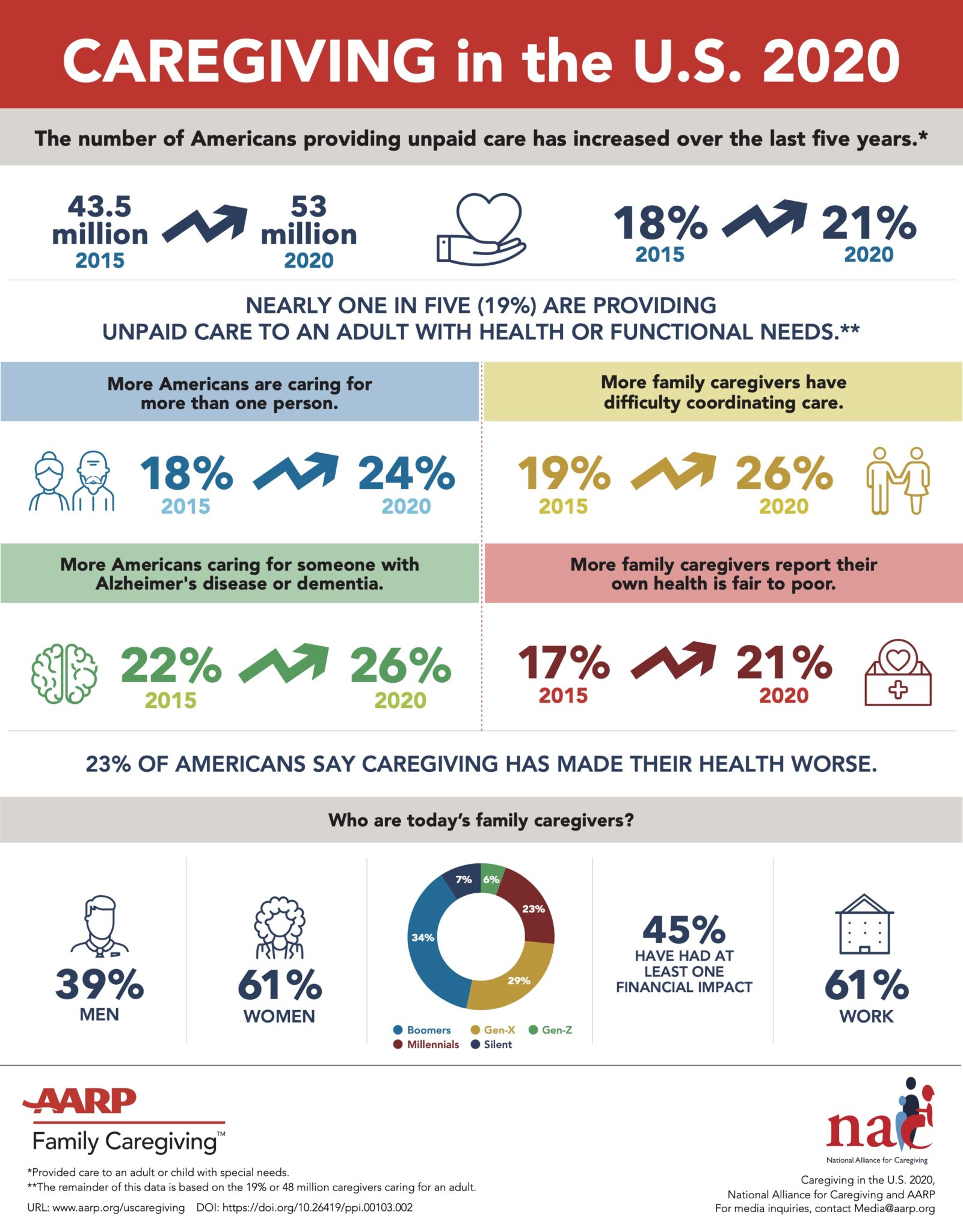
Caregiving and other demands of an aging population were highlighted in 2020. AARP and
the National Alliance for Caregiving (NAC) published the 2020 Caregiving in the US report,
identifying 53 million Americans as caregivers, 5 million more than in their 2015 report. The
Older Americans Act was re-authorized in 2020 with a 35% increase in funding. During 2020, a
follow-up report was released detailing progress from the 2019 White House technology
innovation initiative, including numerous grants and programs launched nationwide. In addition,
the VA launched an expanded Family Caregiver Assistance program.
Data breaches and scams have worsened, and so has the risk to seniors. The closing of
physical locations like Social Security offices or bank branches has yet to accelerate the urgency
of helping offline seniors to move online. Seniors and their families should be cautious, however,
as 2020 also turned out to be another memorable year for healthcare data breaches. In one
ransomware attack, the healthcare organization paid the ransom. In October, 2020, the FTC
presented its annual report to Congress, Protecting Older Consumers, showing the sharp
difference in fraud loss for the oldest population (see Figure 4). In addition, financial
exploitation of the elderly has been on the rise, with an especially long list during Covid-19 –
creating more opportunity for caregiver, healthcare, and banker involvement.
Figure 4 Rising median loss via scams – worse for 80+ [Source: FTC]

Market Overview Technology and Aging January 2021
2021 Market Overview Aging and Health Technology Watch Page 8
THE PANDEMIC SHARPENED FOCUS ON THE DIGITAL DIVIDE
Despite enablers, tech adoption by the oldest adults has not kept pace. The surveyed ubiquity
of technology has led to a belief that it is everywhere it needs to be, with media assumptions
about the benefit of smartphones and online tools, ownership of devices, or access to broadband
speeds. But barriers remain. For example, smartphone adoption of the 70+ at just 62%. The
ongoing barriers to adoption range from setup complexity, price, poor usability, forced
obsolescence, continuous updates, and lack of standardized professional training (See Figure 5).
However, the as the pandemic wore on, dependency on technology became more apparent. One
recent Pew survey indicated that most older adults would view an outage of either their
cellphones or access to the internet as a big problem (See Figure 6). And the enablers and
barriers to technology adoption have persisted into 2021 (See Figure 7).
DEVICE ADOPTION GAPS WILL PERSIST IN 2021
Device
Age 65+
Age 70+
Source
Cellphone (not
smartphone)
39%
Pew 2019
Smartphone
53%
62%
40% (age 74-91)
AARP 2019
Pew 2019
Wearable
17% (age 50+)
11%
AARP 2019
Pew 2019
Tablet
49%
40%
AARP 2019
Computer (Desktop,
Laptop)
71%
73%
AARP 2019
Census 2017
Use the Internet
73%
44-60%
Pew 2019
Home broadband
59%
N/A
Pew 2019
Smart Speaker
19%
12%
AARP 2019
Pew 2019
Need help with
setup/tech training
73%
N/A
Pew 2017
Very confident re:
privacy
12%
13%
AARP 2019
Figure 5 Tech Adoption, Source, age 65+, age 70+
DID YOU KNOW Nearly 4.4 million patients (and donors)
had data exposed in healthcare breaches reported to the
federal government just in September 2020?

Market Overview Technology and Aging January 2021
2021 Market Overview Aging and Health Technology Watch Page 9
Figure 6 View of problem of a technology outage (Pew December 2020)
57
50
39
59
50
40
38
48
55
53
55
44
49
23
29
30
27
28
27
31
26
26
28
25
30
28
13
15
22
11
16
21
21
17
13
15
13
19
16
6
4
9
2
5
10
8
7
5
3
6
6
6
Urban
Suburban
Rural
College+
Some college
HS or less
65+
50-64
30-49
Ages 18-29
Women
Men
U. S. Adults
Very big Moderately big Small Not at all

Market Overview Technology and Aging January 2021
2021 Market Overview Aging and Health Technology Watch Page 10
Key Enablers for Tech Adoption
Key Barriers to Tech Adoption
ONC Interoperability – including family,
caregivers of patient
Device ownership and trust of technology,
especially fraud-related
White House recommendations for ‘zero-
effort technologies’, specialized training
Availability of standardized training
programs across US
Smartphone-wearables to track wellness,
motivate activity
Perceived value and training among older
users
Medicare Advantage reimbursement
changes to support device use
Device management forced
obsolescence, upgrades, software
versions
Discounts available for broadband (low-
income)
Standard price of home broadband
Voice First (Amazon speakers, Google
Assistant) broad visibility, deployment
Concerns about privacy with always-
listening devices
Figure 7 Tech Adoption – Enablers and Barriers Will Persist into 2021
Medicare Advantage features tech-enabled services in the home. During 2020, 36% of
Medicare beneficiaries (24 million people) were enrolled in Medicare Advantage plans. Given
the growth rate, expect further growth in 2021. Besides further solidifying support for telehealth,
most Medicare Advantage plans provide hearing, dental, fitness, and vision health benefits. In
2021 some plans will also offer other services during the Covid-19 emergency such as pest
control, food and delivery of fresh produce, and non-medical transportation. And senior housing
companies are increasingly offering Medicare Advantage plans to residents.
The senior housing industry sees technology as a growing priority. The pandemic placed a
spotlight on the gaps in senior housing use of technology. In 2021, expect the industry to make
more investments in broadband access, video, telehealth capabilities. Digital marketing,
including virtual tours, will have growing importance.
Fall detection innovations move off body into the room, enhanced with AI. More offerings
emerged recently seeking to detect falls without a wearable on the body. These include an AI-
enhanced video tool for memory care like SafelyYou, or in-room fall detection like Echo-Care.
Monitoring changes in movement over time will help prevent falls – UnaliWear (on the wrist)
or changes in balance on a smart scale (Zibrio); or through a smartphone app (Kinisis Balance).
Investors ramp up interest in the older adult market. Population demographics matter – and
2020 saw the emergence of new investing interest in the older adult market. Primetime Partners
launched a $32 million fund including opportunities in aging in place, financial security, and care
management. They join Ziegler Linkage, Generator Ventures, Toyota AI Ventures and
Nationwide among investors in offerings for an aging demographic.
DID YOU KNOW that one in four of the 54 million adults aged
65+ falls each year? According to the CDC, the estimated cost
of falls across the U.S. healthcare system is $50 billion annually.

Market Overview Technology and Aging January 2021
2021 Market Overview Aging and Health Technology Watch Page 11
TECHNOLOGY UNDERPINS, DOES NOT REPLACE SERVICE OR FAMILY ROLES
The categories of technology required to age successfully include independent market segments
– each useful – but together, they complete a puzzle for a fulfilling and interactive life for older
adults, enabled as needed with the support of families and caregivers (see Figure 8):
Figure 8 The Interdependency of Technology Categories for Older Adults
Communication and engagement. For all ages, isolation during and after the pandemic is
untenable without the technology to connect to others. As 2021 begins, tech vendors will
promote a gaggle of gadgets to mitigate all barriers, emphasizing voice and ‘no-touch’ offerings
over tablets. The 2021 versions of voice-first interfaces (like Alexa, Google Assistant, or Siri)
raise the bar on in-home tech experiences for the growing numbers of owners, now at least a
quarter of all households. The disrupted hearing technology market will see new hearables
emerge. Expect hearing aids that are more attractive, lower cost, or more available through
direct-to-consumer channels.
Safety and security. The ability to remain at home depends on whether the home is free from
obstacles and dangers, especially for the 46% of women aged 75+ who live alone. The
traditional PERS industry is morphing and expanding.The pivotal entrance of Apple’s fall
detection legitimized the market for caregiving smart watch wearables with fall detection.
Other vendors are offering voice-enabled PERS services – HandsFree Health launched
Wellbe Emergency Alert Smartwatch and Constant Companion delivers Alexa for
Caregiving. Other in-room approaches to fall detection are now in-market (like
Essence’s radar or SafelyYou’s AI/Video offering) .

Market Overview Technology and Aging January 2021
2021 Market Overview Aging and Health Technology Watch Page 12
Health and wellness. The abrupt shutdown of health visits during the pandemic triggered
frenetic adoption of telehealth – now firmly entrenched as a care option. Even 2020’s virtual
HIMSS, traditionally focused on the enterprise Health IT market, includes a number of
technologies that involve patients (seniors) directly. 2020 saw growth, but significant challenges
persist in the remote patient monitoring (RPM) market – not the least of which is confusing
regulation as to what type of interaction may be reimbursed. And older adults surveyed in June
expressed concerns about telehealth visits (see Figure 9).
Figure 9 National Poll on Healthy Aging Source: University of Michigan October 2020
Learning and contribution. Experts have noted that once the basic needs of communication,
safety, and health are addressed people have both the need and capacity for more. This includes
learning, staying aware and active in society, and contributing through virtual volunteering. With
a growing numbers of older workers, organizations like AARP and OATS help an older person
obtain job-related skills. Older adults also leave a legacy of photos and stories for loved ones.
Caregivers still underutilize technology. According to the May 2020 survey of 1499 caregivers
by the National Alliance for Caregiving and AARP, 53% of responders indicatirf use of any of
tools (see Figure 10). This is only a modest increase over the 2009 report, in which 45%
reported use of any technology. Recognizing that caregivers themselves may be aging, the report
surveyed an additional 160 caregivers aged 75+, included in the 1499 total.

Market Overview Technology and Aging January 2021
2021 Market Overview Aging and Health Technology Watch Page 13
Figure 10 Caregivers’ Use of Technology 2020 from AARP/NAC Caregiving in the US
2021 Technology Trends that Will Help Older Adults
Across all consumer devices, wireless charging pads and stands have made coping with mobile
technology easier. Charging plugs are less likely to wear out before the device is retired. Across
many devices today, consumers will find assistive features (for vision and hearing limitations)
that are built in. Older adults would benefit greatly if vendors and stores selling devices (or
providing training) spent time introducing them to those features (See Figure 10).
AI is behind the scenes – everywhere. The availability of a growing trove of data about our
behavior has enabled the ever-smarter world of voice interactions and sensors. But the
accumulation of this behavior information over time enables analytics that will augment simple
monitoring and alerts. Pattern analysis, dashboards, and predictive analytics have permeated
tech innovation for years, including healthcare, but have been slow to enter the world of
caregiving for older adults. That is changing – and new entrants, for example, StackCare and
CarePredict, offer tools that learn patterns to alert about issues that caregivers need to address.
Wearables became more visible – enabling PERS on the wrist. Today, 30% of the PERS
industry is mobile, validating the emergence of wearables other than pendants to take out and
about. While Philips auctions its innovation-free Lifeline business – others offer caregiver
watches that provide a less visible, more useful safety alternative when living alone, walking the
dog, or being afraid of falling. BellPal, Freedom Guardian, Bay Alarm Medical, UnaliWear,
HandsFree Health, FallCall Lite (Apple) – connect to a required response center.
Voice first technology – in everything. In 2020, Voice First category of technologies moved
far beyond smart speakers and voice assistants. Every brand now has an opportunity to have its
13%
14%
17%
30%
35%
53%
Checked up on recipient
Electronic lists/spreadsheets
Assistive devices
Personal health records
Tracked recipient's finances
Any of these

Market Overview Technology and Aging January 2021
2021 Market Overview Aging and Health Technology Watch Page 14
own voice with voice cloning. Speaking to your car (Hey Mercedes!) is a requirement and the
brands will make it so, even without connecting your phone. Expect moving forward that older
users to be willing to trade concerns about privacy via an always-listening device against ease of
interaction with voice assistants everywhere. 2021 will also produce progress in multi-wake
word detection, even a bit of interoperability across platforms.
Amid market disruption, hearables market continues to resonate. The hearing technology
market is seeing disruption from multiple angles. Smart hearables will again be news at CES
2021, including a range of earbuds, AI-enabled hearing aids with fall detection, and smartphone
adjustable sound – especially appealing for older adults in noisy restaurants. Add integration
with voice capabilities like Siri, Google Assistant, and Alexa plus the ability to stream audio
content directly to in-ear devices. With the introduction of Over-the-Counter Hearing aid sales
(and recommended guidelines), coupled with the beginnings of insurance reimbursement, those
with mild-to-moderate hearing loss are likely to benefit.
ADVICE TO VENDORS: IT’S TECH-ENABLED SERVICES, NOT PRODUCTS
Probably the biggest issue that keeps more of today’s technology out of the homes of seniors is
the difficulty of marketing to them (“We are not old!”) and their afraid-to-interfere adult
children. Therefore, it’s important to sell through channels that reach them at whatever stage of
aging, pricing right for resale and possible white labeling. Vendors must find:
One go-to-market channel is not enough. Depending on the product or service, it may need a
mix of resellers/distributors, face-to-face, and online sales. The 2020 FCC broadband survey
revealed 42 million Americans without high speed Internet access, including 41% of the 65+
market. If that population needs a technology or service, caregivers may search online sites on
their behalf, depending on need, like Best Buy’s Aging in Place or DMEConnected. New
entrants must form partnership early – at the pilot stage with channels like these or PERS dealers
who resell medical alert devices, for example.
Privacy and security features will be built into design of software and websites.
Cybercrimes targeting the elderly have ballooned to a cost of $650 million in annual losses, and
that includes only those that are self-reported. For safety-oriented apps and sites that include the
role of the senior, it’s critical to verify identify among provider and user roles. Two-factor
authentication will likely as part of online (and future voice) health-related services.
Technologies must be well-supported and intuitive. Most people have a laundry list of
frustrations with technology, regardless of age. The failure of previous direct-to-consumer
approaches underscored the fallacy of inventor-centric thinking that ‘if we create it, they will buy
it from us’ or at least find it Amazon. But what if it is a device fitting into a Wi-Fi home network
with other devices, a printer, and a webcam? Instead, remote configuration and support partners
must be a major part of the offering – or doom the user and family to frustration and tech
abandonment.
Device and app vendors must be capable of integration and extension. Despite standards
initiatives, task force recommendations or ONC Interoperability (2019), many of today’s gadgets

Market Overview Technology and Aging January 2021
2021 Market Overview Aging and Health Technology Watch Page 15
still don’t communicate – especially with each other’s proprietary systems or data sets (like
Electronic Health Records). So mobile health devices, apps or medication reminders may be
useful, but touch a tiny aspect of the whole person. Patients struggle to get their own records in a
transferrable form upon discharge.
Upgrades must be invisible or painless. Consumers already gravitate towards software
applications that mostly work with ones they already use, including Gmail, Facebook, FaceTime,
Zoom, Siri, and Google Assistant – most working across devices. Personalized interfaces (like
Amazon and Netflix) updated in the cloud, are expected.
The right customer or referral – families and service providers partners. Direct-to-consumer
marketing of products and services takes deep pockets just for the advertising – note the growing
number of ads for low-cost hearing aids. For early stage companies, start locally – get to know a
local home care agency, senior living company, or home security company. What they have in
common? Entry into the home. What else? Contacts in the area who can sponsor pilots.
Standards enable users and integrators to cross tech boundaries. Times are changing – as in
this smart home interoperability initiative – a recognition that, despite intense competition,
consumers likely own a wide variety of devices and software that should be able to work better
together. Amazon launched a similar initiative for voice offerings like smart speakers and voice
assistants. Ensure that the new offering works across multiple platforms and comes in multiple
form factors – voice, smartphone, web, for example.
Access to ongoing training and refreshers – much work needed. To be sure, the oldest are
likely to approach smartphones as just another variation of flip phones – until they can learn of
their utility in a store, online, from their family, or in community training centers. Automatic
updates and application software changes push users back for refreshers to avoid considerable
frustration. Despite the efforts of senior centers and other non-profits like NCOA and its Online
Banking training, training services lag the pace of tech change and may not keep up with rapid
growth of threats, including hackers’ ability to pinpoint location and/or steal identifying
information.
The real user need – a service problem solved. Seniors and their adult children may not
imagine on their own what to do with sensor networks, web cams, or smart speakers. A home
security company could someday help explain the benefits, for example, of care coordination,
when selling tech to a home health agency. Instead of offering point products out of context,
vendors should fit solution descriptions, service provider stories, and senior support processes
along the continuum of needed care and socialization. This necessitates a grasp of the decision
points that spike need and interest, using these as part of websites and marketing (see Figure 11).

Market Overview Technology and Aging January 2021
2021 Market Overview Aging and Health Technology Watch Page 16
Figure 11 Technology needs of older adults evolve over time
“Every technology is of value to older adults – for example, new technologies like
conversational AI and personalization algorithms can help create a customer segments of one
with personalized solutions offered to each older adult.” – Saeed Elnaj, CIO, National Council
on Aging
HOW DOES THE TECHNOLOGY MARKET FOR OLDER ADULTS EVOLVE?
The marketplace of products and services today is still fragmented, with ever-shifting cottage
industries comprised largely of startups, challenged by channel complexity and end user
resistance. According to AARP’s Longevity Economy projections, the 50+ population will
control 51% of technology spending by 2030, less than a decade away. That market will be
dominated by the largest players, who will acquire a plethora of startups. Benefits of new tech
will accrue to all, but will challenge users at every intro. Service providers, caregivers for older
adults, and senior living organizations will need to keep up (see Figure 12)
What are the key trends to watch in 2021?
As 2021 begins and the population aged 65+ exceed 53 million, trends emerge, accelerated by
the pandemic. Because of the sheer size of the older adult market, vendors see them as
constituents of the market of technology for multiple age and health segments.
In-home healthcare services will persist and expand. The dream of reimbursement for remote
care is became a reality during 2020. Telehealth services will remain to replace or supplement in
person visits, and Hospital at Home has emerged. Remote patient monitoring (RPM) as a way to

Market Overview Technology and Aging January 2021
2021 Market Overview Aging and Health Technology Watch Page 17
move more care into the home. And regulation changes in the past year are have begun to turn
the adoption tide. Upcoming at CES 2021, consider the forecast for Connected Health
Monitoring Devices (see Figure 12). Vendors are beginning to learn that older people,
consumers of a significant portion of healthcare spending, will need many of the Digital Health
technology categories.
Figure 12 Source: Consumer Technology Association January 2021
Smart displays and voice first interfaces will be ubiquitous. For older adults, touchless
technology and voice-enabled interactions are ideal, especially when accompanied by a display
of large font text and engaging videos. Why? Because it is easier for them – turning frustration
into a valued service world in which what you say should get you what you need. Voice
interfaces will be expected in smart displays like the Amazon Show and will be added to every
feasible device (and new car) and gain widespread use in independent and senior living.
Hearing technology markets will be further disrupted in 2021. As it did in 2020 with Livio,
in 2021, Widex Moment, 2021 CES Innovations Award winner, uses machine learning to
enhance the quality of sound for the wearer. Lower cost hearing aid options including financing
alternatives are now part of the mix. Expect hearables to further evolve; over-the-counter hearing
aid purchases to be FDA-legitimized; retail and at-home self-service/self-fitting services expand
(further enabled as a result of Covid), individuals with hearing loss may opt in to improving what
they can hear in home and when out and about.

Market Overview Technology and Aging January 2021
2021 Market Overview Aging and Health Technology Watch Page 18
Caregiver shortages, prolonged isolation, and aging all boost in-home monitoring. Fifty-
three million Americans are providing care to someone with health or or functional needs – in
short, they are family caregivers. The intersection of three simultaneous trends of aging alone at
home, worsening caregiver shortages and turnover, and the percentage of adult children working,
interest in monitoring technology in the home will grow, including in-home hubs that can
manage web cameras, sensors, smart doorbells or enable voice-first emergency response
(Amazon CareHub).
Virtual reality use cases will continue and grow -- slowly. Virtual reality tool possibilities
expanded during 2020, particularly in the area of caregiver training (Embodied Labs) and more
senior living communities are deploying virtual reality for resident engagement (MyndVR,
Rendever). In 2021, VR began to be used for training future doctors and surgeons, and it is also
being used for pain reduction. But many senior living initiatives to date have been well-
publicized pilots, and it is unclear how quickly engagement deployments will grow given
visitation restrictions and budget constraints.
The absence of widely available tech training and support should prompt innovators. It’s
not just seniors who need help. The proliferation of devices and their non-simplicity gave birth
to Best Buy’s Geek Squad into Total Tech Support (any device) and $10 million of funding for
learning platform GetSetUp. New technology requires training and support – and profit for
companies that can deliver it cost effectively. With the aging of baby boomers, newer offerings
like Support.com (any connected device) will tailor messages to reach an older adult audience.
Cyber-Seniors trains young people to be technology tutors for older adults. National efforts will
emerge to provide tech training for older adults in 2021.
Category Changes 2021
and beyond
Current
Moving Forward
Telehealth, Remote
Patient Monitoring
MD resistance, Covid-
driven reimbursement
MDs embrace, CMS
permanently reimburses
Voice First technology
Smart Speakers,
Voice assistants
Touchless smart display,
branded voice assistants
Hearing technology
High price hearing aids,
sold by audiologists
DTC, hearables, low cost
hearing aids, self-service
Caregiver technology
Assisting care workers,
time recording, PERS
In-home augmenting
care, sensors, voice tech
PERS, fall detection
On body pendant, private
pay
Add in-room sensing,
insurance reimbursed
Senior In-home Fitness
New post-Covid category
Telefitness, MD referral
Virtual reality for seniors
Experimental
Engagement, pain
control, caregiver
training
Tech training for Seniors
Fragmented, senior center
Nationwide availability
Figure 12 Where is the market heading for technology and older adults?

Market Overview Technology and Aging January 2021
2021 Market Overview Aging and Health Technology Watch Page 19
About the Author:
Laurie M. Orlov, a tech industry veteran, writer, speaker and elder care advocate, is the founder
of Aging and Health Technology Watch, a market research consultancy that provides thought
leadership, analysis and guidance about technologies and related services that enable boomers
and seniors to remain longer in their home of choice. In addition to her technology background
and years as a technology industry analyst, Laurie was a certified long-term care ombudsman
and received a graduate certificate in geriatric care management from the University of Florida.
In her previous career in the technology industry, Laurie held senior positions in IT
organizations, followed by 9 years as a leading industry analyst at Forrester Research. While
there, she was often the first in the industry to identify technology trends and management
strategies. She has spoken regularly and delivered keynote speeches at forums, industry
consortia, conferences, and symposia, most recently on the business of technology for boomers
and seniors. She advises large organizations as well as non-profits and entrepreneurs about trends
and opportunities in the age-related technology market and was a participating expert on the
Think Tank for The Philips Center for Health and Well-Being; the Personal Connected Health
Alliance Aging Task Force; and the AARP Inclusive Technology Roundtable. She also testified
before the US Senate on the role of technology for older adults. Her perspectives have been
quoted most recently in The New York Times, Wall Street Journal, Kiplinger, Consumer
Reports, and Home Care Magazine. She has a graduate certificate in Geriatric Care Management
from the University of Florida and a BA in Music from the University of Rochester. Her other
recent research reports include The Future of Remote Care Technology and Older Adults
2020; Voice, Health and Wellbeing 2020; The Future of Voice First Technology and Older
Adults (2018); and Tech-Enabled Home Care (2017) as well as many client white papers.

Market Overview Technology and Aging January 2021
2021 Market Overview Aging and Health Technology Watch Page 20
2021 Technology Categories and Vendors (Examples)
For inclusion as an example-only technology to facilitate aging in place, the vendor meets two of
these criteria (those firms listed are only examples, not an exhaustive list). Because of growth of
relevant technology announcements during 2020 and into 2021, more startups, including pre-
launch and innovation award winners are included than previous versions. In addition, please
note that the “**” entries can be new for this publication of the 2021 Market Overview, though
they may have been in business previously but were not included in the 2020 report. The criteria:
a) Incorporate messaging to and about boomers and/or seniors – or their family or
professional caregivers.
b) Is expected to be broadly available, not just in a single region.
c) Addresses one or more categories described in this document.

Market Overview Technology and Aging January 2021
2021 Market Overview Aging and Health Technology Watch Page 21
Sub-
Category
Purpose
Platform
Contact
Category: Communication
Alango
Hearables**
Hearables
Speech recognition
enhancement
Microphone-based
sound improvement
Alango.com
Amazon Echo
Show
Cloud-based
Screen with voice-
enabled AI access
Smart display
amazon.com/
echo
Embodied
Labs
Virtual
Reality
Caregiver training
Experience Headset
embodiedlabs.
com
Connected
Living
Senior
Living
Engagement of
residents
Suite of software
connectedLiving.
com
Google Nest
Hub Max**
Cloud-based voice hub
Smart Display
store.google.com
grandPad
Senior tablet
Simple interface
Android
grandpad.net
iN2L
Engagement
System
Games, health,
movies, spiritual
content
PC Workstation,
Tablet
in2l.com
Consumer
Cellular**
Smartphone
Moto G Power
3-day battery life
consumercellular.
com
HeardThat**
Hearing
Hearing assistance
Smartphone
heardthatapp.com
JoyforAll
Robotics
React and respond
to touch
Toy
joyforall.com
Starkey Livio
AI
Hearing aid
Activity tracking,
personalized
Hearing aid with AI
fall detection
starkey.com
MyndVR
Virtual
reality
Assisted Living,
Home
Experience Headset
myndVR.com
Nuheara
Hearables
IQ Buds Boost,
Max
Hearing aid, Google,
Siri Integration
nuheara.com
Rendever
Virtual
Reality
Senior engagement
Experience Headset
rendever.com
SingFit
Music
Therapy
Dementia care
Activities, sing-along
singfit.com
Sundial**
Engagement
Care circle
communication
Echo Show 5, mobile
app
sundial-labs.com
VoCo**
Engagement
Senior living
Alexa made easy
sayvoco.com
Volara**
Voice-first
Engagement
Senior living
Alexa, Google Nest
volara.io
Widex
Hearing
Aid**
Hearing Aid
Widex Moment
Machine Learning
auto adjustments
Widex.pro
Category: Home Safety,
Security
Care
Predict Home
Wearable
Senior health
monitoring
Predictive analytics
carepredict.com
Domalys**
Smart Lamp
Fall
Prevention
Temperature,
lighting, fall detect
Records nighttime
activity – senior living
Domalys.com
Envoy at
Home
Sensors plus
iPhone app
Scans environment
Continuous checking
of sensors for issues
Envoyathome.com
Essence PERS
5G**
IoT/PERS
In-home IoT
devices
Alerting platform
essence-grp.com

Market Overview Technology and Aging January 2021
2021 Market Overview Aging and Health Technology Watch Page 22
Sub-
Category
Purpose
Platform
Contact
Best Buy
Lively App
Mobile
PERS
Paired with Lively
Wearable 2
Call center
greatcall.com
Caregiver
Smart
Solutions**
Sensor
Home
Monitoring
Core Monitoring
Kit
Motion sensing
Caregiversmart
solutions.com
FallCall
Detect**
Fall
detection
Apple Watch,
Android App
Call center
Fallcall.com
LiveFreely**
Safety
Wearable
Fall detection
No call center
livefreely.today
Locate
Motion
Wander
management
Pattern tracking for
Dementia, Autism
Sensights dashboard
locatemotion.com
Speak2
Engagement
platform
Voice First for
Senior Living
Daily schedule, care
plan alerts
speak2software.com
TrelaWear
MobilePERS
PERS Jewelry
Paired with Mobile
Help response center
mobilehelp.com
TruSense
IoT
Monitoring
Voice-enabled
passive monitoring;
GPS tracker
Amazon Echo
interface
mytrusense.com
UnaliWear
Mobile
PERS watch
Voice-enabled
mobile PERS
Bluetooth low energy
unaliwear.com
Verizon
Care Smart
Watch**
Mobile
PERS Watch
Mobile PERS
Watch
No call center
Verizon Care Smart
Watch
Category: Health Wellness
AppliedVR
Virtual
Reality
Pain education &
management
Distraction and coping
tools for pain
appliedvr.io
CareHero**
Telehealth
Senior Living
Virtual visits
sanvishealth.com/
carehero
CollabCare**
Telehealth
Virtual care
platform
Integration to existing
workflows
collabcare.com
HandsFree
Health
Voice
assistant
Voice-enabled,
health assistant
HIPAA compliant
reminders
handsfreehealth.com
Kinisis
Balance**
In-home
assess risk
Smartphone app
Falls risk,
rehabilitation
kinisis.ie
Medminder
Cellular
7-day, 4-dose per
day reminder trays
Prefilled trays from
pharmacy
medminder.com
MedSign**
Set top box
Telehealth
Qortex – TV platform
medsign.com
MediSafe
Medication
compliance
app
Notifies
'Medifriend' if
doses are missed
Deployed in
partnership with
pharma, research
medisafe.com
Ōmcare
Medication
compliance
hub
Home health
Verification of dose
taken
Ōmcare.com
Orbita
Voice-
enabled
healthcare
HIPAA-compliant
Conversational
platform
Enterprise software
for healthcare systems,
groups
orbita.ai
Pillo Health
Robot
Pill-Dispensing
Companion
Pillohealth.com

Market Overview Technology and Aging January 2021
2021 Market Overview Aging and Health Technology Watch Page 23
Sub-
Category
Purpose
Platform
Contact
Reemo
Health
Health
Smartwatch,
analytics
Remote mobile
health platform
Senior living, senior
care, healthcare
reemohealth.com
Teledentists**
Dental
health
Online dental
consultations
Virtual visits,
prescriptions
theteledensits.com
Toothpic**
Dental
health
Low cost dental
assessment
Based on smartphone
photo of teeth
Toothpick.com
VitalTech
Connected
Care
Remote patient
monitoring
Patient health,
wellness
vitaltech.com
Vivo**
Online
Strength training
for seniors
In-home with trainer
teamvivo.com
Zibrio Smart
Scale
Smart Scale
Measures and
tracks balance
AARP Innovation
Award 2020
zibrio.com
Finance/Transportation
Golden
Financial
Financial
services for
older adults
Account
organization, bill
paying
Includes financial care
specialists
Joingolden.com
Papa
Family on
demand
Transportation,
chores, socializing
College students
joinpapa.com
LifeSite
Family
records
Caregiving
financial records
Store, manage family
care documents
lifesite.co
EverSafe
Fraud
protection
Seniors and
families
Detection and alert
system
eversafe.com
Uber
Health
Healthcare
appt rides
With uberAssist,
door-to-help for
disabled
Ride-hailing service
paid by organizations
uberhealth.com
Intuit Mint
Finance
Manage banking
accts, finances
Budget for aging
parents
mint.com
Lyft
Concierge
Includes
healthcare
appointment
rides
Flexible ride
scheduling by
sponsor
organization
Ride-hailing service
paid by organizations
lyftbusiness.com/
healthcare
TrueLink
Financial
Financial
services for
older adults
Protect assets and
track payment
activity
Payment cards,
investment
management
truelinkfinancial.
Com
Category: Caregiving
(Platform, Apps)
Alexa
CareHub**
Voice-home
monitoring
Activity feed, alerts
Voice-activated help
amazon.com
Alexa-care-hub
Aloe Care
Digital care
assistant
Voice-activated
Care coordination
get.aloecare.com
BrioCare**
Care
coordination
Voice-activated
Alexa and smartphone
app
briocare.us
CareLinx
Non-agency
home care
marketplace
Families,
organizations find
workers, rides
Marketplace of
registered workers
carelinx.com
Care
Predict
Care
management
GPS tracking,
reporting
Care professionals
carepredict.com

Market Overview Technology and Aging January 2021
2021 Market Overview Aging and Health Technology Watch Page 24
Caring.com
Elder care
website
Articles and search
tool – all care types
Reviews from users
caring.com
Caregiver
Smart
Solutions**
Motion
sensors, app
Package of sensors
Core Monitoring Kit
Caregiver
smartsolutions.com
Caremerge
EHR and
Engagement
Platform
Resident
engagement,
Calendar
Senior living
caremerge.com
Constant
Companion**
Voice-
emergency
Safety for seniors
Family, home care,
senior living
constantcompanion.
com
DME
Connected**
Voice-
accessible
Products, Services
for Healthcare use
Marketplace for
Durable Medical Equip
dmeconnected.com
K4Connect
For resident,
operators
Engagement,
Wellness
Senior living, smart
home, voice interface
k4connect.com
Nooie**
Cameras, pet
monitor
Design-focused
Smart home devices
Nooie.com
Outpatient
Smartphone
app
Caregiver
collaboration
Share calendar, status
Getoutpatient.com
PointClick
Care
Care
management
Cloud platform
Senior living, SNF,
home care
pointclickcare.com
StackCare**
Home
monitoring
AI-Enabled
Activity Monitor
Senior living, home
care
stack.care
Category:
Learning/Contribution
Candoo
Tech**
Tech
training
Online, installation
help
Tech training older
adults
Candootech.com
Cyber-
Seniors**
Tech
training
Trained youth
helping seniors
Tech mentoring for
seniors
Cyberseniors.org
GetSetup**
Peer training
Online Classes
On demand learning
getsetup.io
HelpHerd**
Tech
training hub
Online tools,
classes
Senior living
helpherd.com/
helphub
learn@50+
Training
Tech, caregiving,
work, skills
Online and workshop
Education
learn.aarp.org
Memory
Well
Storytelling
Digital life stories
Professionally written
memorywell.com
My
Heritage
Family
history
Stories and family
tree
online tool
myheritage.com
MyHello**
Life story
Reminiscence
Live phone visit
myhello.com
OATS
Training
Tech, job skills
Regional workshops
seniorplanet.org
Osher
Lifelong
Learning
Lifelong
learning
Senior-focused
courses
Nationwide network
osherfoundation.org
Support.
Com
Tech support
Telephone support
Any device
support.com