AI Adoption PDF Free Download
1 / 57

/57
100%

TABLE OF CONTENTS
1. Introduction and Benefits of AI Adoption ...................................
1.1. Executive Summary.......................................................................
1.2. Introduction....................................................................................
1.2.1. Definition and Scope of AI Adoption. ......................................
1.2.2. AI Adoption in Business. ............................................................
1.3. Brief History and Current Landscape of AI in
Businesses..............................................................................................
1.3.1. AI in Business: A Historical Overview and Current
Landscape. .............................................................................................
1.3.2. Key Figures in AI History............................................................
1.3.3. A Century-wise Breakdown of AI Development ...................
1.3.5. The Journey of AI: From Concept to Current Landscape.....
1.4. Benefits of AI Adoption...............................................................
1.5. AI Adoption Statistics..................................................................
1.5.1. AI Adoption in Business..............................................................
1.5.2. AI Adoption Worldwide..............................................................
1.6. Challenges of AI Adoption.........................................................
1.7. Conclusion....................................................................................
2. Key Trends in AI Adoption...............................................................
2.1. Leading Industries in AI Adoption............................................
2.1.1. Healthcare......................................................................................
2.1.2. Finance. .........................................................................................
2.1.3. Manufacturing..............................................................................
2.1.4. Retail..............................................................................................
2.1.5. Energy............................................................................................
2.2. Popular Applications of AI.........................................................
2.2.1. Generative AI ...............................................................................
Copyright© 2024. All rights reserved
AI Adoption
01
01
01
01
01
02
02
02
03
05
05
08
08
10
11
11
12
12
12
13
14
15
15
16
16
2.2.2. Machine Learning.....................................................................
2.2.3. Automation................................................................................
2.3. Additional Applications...........................................................
2.3.1. Natural Language Processing (NLP) .....................................
2.3.2. Computer Vision: ......................................................................
2.3.3. Robotics Process Automation (RPA): ...................................
2.4. Adoption Patterns and Sector-Specific Advancements
in AI ......................................................................................................
2.4.1. Sector-Specific Advancements..............................................
2.4.2. Statistics Supporting AI Adoption Trends...........................
2.5. Conclusion....................................................................................
3. Adoption challenges in AI.............................................................
3.1. Major challenges. .......................................................................
3.2. Suggestions to overcome challenges...................................
3.3. Examples of AI Adoption challenges....................................
3.4. Case Study on adoption challenges.....................................
3.4.1. Amazon........................................................................................
3.4.2. ZILLOW: Flawed Pricing Algorithm......................................
3.4.3. Uber: Regulatory and Ethical Concerns with Self-
Driving AI..............................................................................................
3.4.4. Coca-Cola: To understand customer behavior and
brand effectiveness through its next-gen vending
machines...............................................................................................
4. Case studies on AI Adoption and its impact.............................
4.1. Amazon (E-Commerce): AI in Logistics Optimization.......
4.2. IBM (Technology): AI in Supply Chain Management.........
4.3. Tesla (Automotive): AI in Manufacturing and Logistics..
4.4. GE (Manufacturing): AI in Predictive Maintenance and
Quality Control....................................................................................
Copyright© 2024. All rights reserved
AI Adoption
17
17
18
18
18
18
18
20
20
20
21
21
22
24
25
25
26
26
26
27
27
28
30
31
4.5. Pfizer (Healthcare): AI in Drug Discovery and
Personalized Medicine....................................................................
4.6. JPMorgan Chase (Finance): Transforming Fraud
Detection and Trading with AI......................................................
5. Future of AI Adoption: Emerging Technologies and
Predictions..........................................................................................
5.1. Emerging Technologies............................................................
5.1.1. Edge AI .......................................................................................
5.1.2. Quantum AI ..............................................................................
5.1.3. Generative AI ...........................................................................
5.2. AI in future (Next 5-10 Years).................................................
5.2.1. AI Democratization..................................................................
5.2.2. Sectoral Growth. .....................................................................
5.2.3. Ethical and Responsible AI....................................................
5.2.4. AI in Autonomous Systems...................................................
6. Final Words on AI Adoption........................................................
6. References. ....................................................................................
Copyright© 2024. All rights reserved
AI Adoption
35
37
39
39
39
39
40
41
41
41
43
44
45
46

The adoption of Artificial Intelligence (AI) is fundamentally reshaping industries by
driving innovation, enhancing operational efficiency, and creating competitive
advantages. This report provides a comprehensive overview of AI adoption across
various sectors, highlighting its increasing relevance in the modern business
environment. Key industries such as technology, finance, and healthcare are leading
the charge, utilizing AI for applications ranging from generative AI and machine
learning to automation.
The advantages of AI implementation include improved productivity, enhanced
decision-making capabilities, and superior customer experiences. However,
organizations face challenges such as scalability issues, talent shortages, and ethical
concerns that must be addressed to maximize the benefits of AI. The report
emphasizes the importance of strategic planning, continuous learning, and ethical
considerations in AI practices to fully leverage its transformative potential.
Artificial Intelligence (AI) refers to the simulation of human intelligence processes by
machines, particularly computer systems. In simple terms, AI involves teaching
computers to perform tasks that traditionally require human thinking, such as
understanding language, recognizing patterns, solving problems, and making
decisions. AI is not just about robots or futuristic technologies; it has become a part of
our daily lives through applications like virtual assistants, recommendation systems,
and automated customer service. Businesses are increasingly adopting AI to
enhance efficiency, solve complex challenges, and improve customer experiences.
1.2. Introduction
1.2.1. Definition and Scope of AI Adoption
1.2.2. AI Adoption in Business
AI adoption refers to the integration of artificial intelligence technologies into
business processes to enhance efficiency, analyze data, and solve complex
challenges. This encompasses various vital components of AI as shown in the picture
below.
1. Introduction and Benefits of AI Adoption
1.1. Executive Summary
1 Copyright© 2024. All rights reserved
AI Adoption

Businesses leverage AI to improve customer interactions, automate routine
tasks, and facilitate data-driven decision-making, laying the groundwork for
sustained growth across various sectors. AI technologies enable organizations to
make smarter decisions, increase productivity, and drive innovation in industries
ranging from healthcare to finance.
AI in business began in the 1950s with theoretical work on machine learning and
problem-solving. By the 1980s, expert systems gained traction in industries like
healthcare and finance for decision-making, although their capabilities were
limited by computing power. The 2000s marked a turning point with
advancements in computing and the explosion of big data, enabling machine
learning to tackle real-world business problems such as fraud detection and
customer recommendations. Today, AI is a cornerstone of industries, from retail
to healthcare, with companies driving innovation and recognizing its potential to
enhance operational efficiency and gain a competitive edge.
Several pivotal figures have shaped the development of AI throughout its history:
Alan Turing: Often regarded as the father of computer science and AI, Turing
proposed the Turing Test in 1950 as a measure of a machine's ability to exhibit
intelligent behavior indistinguishable from that of a human.
2 Copyright© 2024. All rights reserved
AI Adoption
Fig 1: AI in Digital Transformation
Source
1.3. Brief History and Current Landscape of AI in Businesses
1.3.2. Key Figures in AI History
1.3.1. AI in Business: A Historical Overview and Current
Landscape

3 Copyright© 2024. All rights reserved
AI Adoption
1.3.3. A Century-wise Breakdown of AI Development
Late 20th Century (1970s - 1990s): AI Expands into
Expert Systems and Game Playing
Early 21st Century (2000s - 2010s): The Rise of Big
Data and Machine Learning
Mid-20th Century (1950s - 1960s): The Birth of AI
1950s: Alan Turing proposed the Turing Test, which remains a foundational
concept in AI. Early developments like the Logic Theorist (1956), created by Simon
and Newell, laid the groundwork for AI research. In 1956, John McCarthy coined
the term “Artificial Intelligence” and organized the Dartmouth Conference,
marking the birth of AI as a field of study.
1970s: The development of expert systems such as MYCIN, designed to diagnose
bacterial infections, demonstrated AI’s potential in healthcare decision-making.
1980s: Expert systems advanced with countries like Japan investing in parallel
computing. Neural networks also saw significant progress during this period.
1997: IBM’s Deep Blue defeated world chess champion Garry Kasparov, marking a
major milestone in AI’s ability to tackle complex strategic problems.
2000s: Advances in computing power and the rise of big data enabled machine
learning to solve real-world challenges, including fraud detection, personalized
recommendations, and predictive analytics. Companies like Amazon and Netflix
used AI to personalize content based on user data.
1960s: The development of the first AI programs capable of solving algebra
problems and playing simple games occurred. In 1966, Joseph Weizenbaum
created ELIZA, an early natural language processing program, laying the
groundwork for future conversational AI technologies.
Marvin Minsky: A co-founder of the MIT AI Lab, Minsky made significant
contributions to the understanding of neural networks and cognitive
processes.
Herbert Simon and Allen Newell: These pioneers created early AI
programs that could solve problems and play games, laying foundational
work for future developments.
John McCarthy: Coined the term "Artificial Intelligence" in 1956 and
organized the Dartmouth Conference, which is considered the birth of AI as
a field. He also developed the Lisp programming language, which became
essential for AI research

2011: IBM’s Watson won Jeopardy!, demonstrating AI’s capabilities in natural
language processing and real-time data analysis.
2016: Google DeepMind’s AlphaGo defeated world champion Lee Sedol in the
game of Go, demonstrating AI's ability for intuitive, strategic decision-making.
2020s: AI technologies like GPT-3 and DALL-E revolutionized natural language
processing and image generation, showcasing unprecedented capabilities. GPT-3
could generate human-like text, while DALL-E generated images from textual
descriptions.
2023-2024: AI adoption surged across industries, with AI powering tools like virtual
assistants, autonomous vehicles, and predictive analytics. It began playing a
crucial role in healthcare, autonomous driving, and creative fields like art and
music.
The Dartmouth Conference (1956): This event marked the official birth of AI as a
field, where researchers like John McCarthy and Marvin Minsky shared the vision
of creating machines that could simulate human intelligence.
The Rise of Neural Networks (1980s-1990s): Neural networks became
foundational to deep learning, enabling machines to learn from vast amounts of
data.
IBM’s Watson (2011): Watson’s Jeopardy! victory showcased AI’s ability to process
large volumes of information and understand natural language in real time.
Deep Learning Breakthroughs (2010s): Convolutional Neural Networks (CNNs)
powered breakthroughs in image recognition, speech processing, and
autonomous driving.
AlphaGo’s Victory (2016): AlphaGo’s win in Go demonstrated AI’s potential for
mastering complex, strategic tasks that require intuitive thinking.
AI in Healthcare (2020s): AI revolutionized healthcare by aiding early disease
detection, drug discovery, and personalized treatment plans.
GPT-3 and DALL-E (2020s): These innovations opened new possibilities in creative
AI, with machines generating human-like text and images.
AI Surge (2023-2024): AI became integral to industries worldwide, transforming
business operations and enhancing customer experiences.
Recent Developments (2020s - 2023/2024): Advanced
AI Models and Widespread Adoption
Key Milestones in AI Developments
4 Copyright© 2024. All rights reserved
AI Adoption

5
Fig 2: Global AI Market
Source
AI has evolved significantly, from its theoretical beginnings to being a cornerstone of
modern technology. Today, AI is integral to industries like healthcare, finance, retail,
and manufacturing. The global AI market was valued at approximately $136 billion in
2022 and is projected to reach $1.8 trillion by 2030 [1]. According to McKinsey's 2023
report, the rate of AI adoption has doubled over the past five years, with organizations
increasingly recognizing its potential for operational efficiency and competitive
advantage [2]. AI's transformative potential continues to shape industries, influencing
the future of business operations and technology.
1.3.5. The Journey of AI: From Concept to Current
Landscape
1.4. Benefits of AI Adoption
Adopting AI brings transformative benefits across industries and daily life. It enhances
efficiency by automating tasks, enabling faster, data-driven decision-making, and
reducing errors. AI personalizes user experiences, uncovers patterns in large datasets,
and drives innovation to solve complex problems. By optimizing resources and
cutting costs, AI empowers businesses to scale sustainably, reshaping how we work
and interact with technology.
As Stephen Hawking once said, “AI could be the biggest event in the history of our
civilization.” AI unlocks limitless potential, revolutionizing decision-making and
everyday experiences. Here are examples of some of the changes that AI integration
will bring.
5 Copyright© 2024. All rights reserved
AI Adoption

6 Copyright© 2024. All rights reserved
AI Adoption
AI significantly reduces human errors and ensures precision in execution, while
also eliminating emotional or cognitive biases in decision-making.
Robotic surgery systems like da Vinci enable surgeons to perform intricate
procedures with unparalleled accuracy, reducing complications and
improving patient outcomes.
AI-powered recruitment tools screen job applications based solely on
qualifications, reducing bias and fostering diversity.
In healthcare, AI-powered tools analyze patient data and medical images,
detecting diseases like cancer at earlier stages than human practitioners.
Autonomous robots operate in hazardous conditions like deep-sea exploration
or disaster zones. For instance, during the Fukushima nuclear disaster, robots
assessed radiation levels, ensuring human safety while collecting critical data.
Drones equipped with AI assist in disaster response by mapping affected
areas and delivering supplies.
In space exploration, robots like Mars rovers perform intricate tasks in hostile
environments, gathering critical data.
AI systems operate around the clock, offering consistent productivity and
enhancing user experiences through uninterrupted service.
Predictive analytics tools in business forecast market trends, empowering
leaders to make proactive decisions.
AI-powered tools in finance analyze market trends, guiding investment
strategies and providing a competitive edge.
AI excels in performing hazardous tasks, protecting human lives while
delivering efficiency in dangerous or inaccessible conditions.
AI processes vast datasets to uncover actionable insights, empowering decision-
makers with deeper, data-driven understanding in critical areas.
Reduction in Errors and Bias
Examples:
Examples:
Examples:
Enhanced Decision-Making with Data Insights
Risk Mitigation and Safety in Dangerous Environments
24/7 Availability and Continuous Service

7 Copyright© 2024. All rights reserved
AI effectively automates mundane and repetitive tasks, saving time, reducing
errors, and allowing humans to focus on creative or strategic roles.
AI enables hyper-personalization of products and services, improving user
engagement and fostering customer loyalty.
AI Adoption
AI-driven customer support chatbots, such as those on e-commerce platforms,
provide round-the-clock assistance, resolving customer queries instantly.
In manufacturing, robots automate repetitive processes like welding and
packaging.
Recommendation systems on platforms like Netflix or Amazon suggest content
or products tailored to user preferences, increasing engagement and sales.
Self-driving cars, powered by AI, are transforming transportation with
enhanced safety and efficiency.
AI also plays a pivotal role in drug discovery, accelerating the identification of
potential treatments for diseases.
Spotify's AI algorithms curate personalized playlists based on listening habits,
enhancing user satisfaction and loyalty.
AI drives groundbreaking advancements and fosters innovation across industries,
solving complex problems with novel approaches.
In office settings, AI-powered tools automate data entry and report generation,
saving time and reducing errors.
Project management tools powered by AI schedule tasks and track progress,
enabling teams to meet deadlines efficiently.
Google Maps uses AI for real-time navigation, optimizing routes based on
traffic conditions.
AI in manufacturing ensures constant production through automated
assembly lines.
Examples:
Examples:
Examples:
Examples:
Innovation and New Inventions
Automation of Repetitive Tasks
Personalization and Enhanced Customer Experience

8 Copyright© 2024. All rights reserved
AI Adoption
1.5. AI Adoption Statistics
1.5.1. AI Adoption in Business
·AI can drastically improve the existing system. These improvements stem from
AI's ability to optimize processes, enhance decision-making, and provide better
forecasting and customer insights. Functions like R&D and supply chain
management also benefit, though with slightly lower gains.
Predictive maintenance systems in factories monitor equipment, identifying
potential failures before they occur, minimizing downtime and enhancing
productivity.
In banking, AI detects fraudulent transactions by analyzing customer
spending patterns.
Virtual assistants like Siri and Alexa streamline daily activities, from setting
reminders to controlling smart home devices.
Workflow optimization tools prioritize tasks based on urgency, enabling
employees to focus on strategic initiatives.
AI-driven surveillance systems monitor public spaces, quickly flagging
suspicious activities for immediate action.
In customer service, AI reduces dependency on human agents by handling
routine queries, allowing teams to focus on complex tasks.
AI enhances security and fraud detection by identifying and mitigating potential
threats in real-time.
AI virtual assistants and chatbots streamline interactions, providing reliable and
scalable support for users at any time.
AI optimizes workflows and reduces resource consumption, leading to significant
improvements in productivity and cost savings.
Examples:
Examples:
Examples:
Improved Safety and Fraud Detection
Scalable 24/7 Digital Assistance
Enhanced Productivity and Efficiency

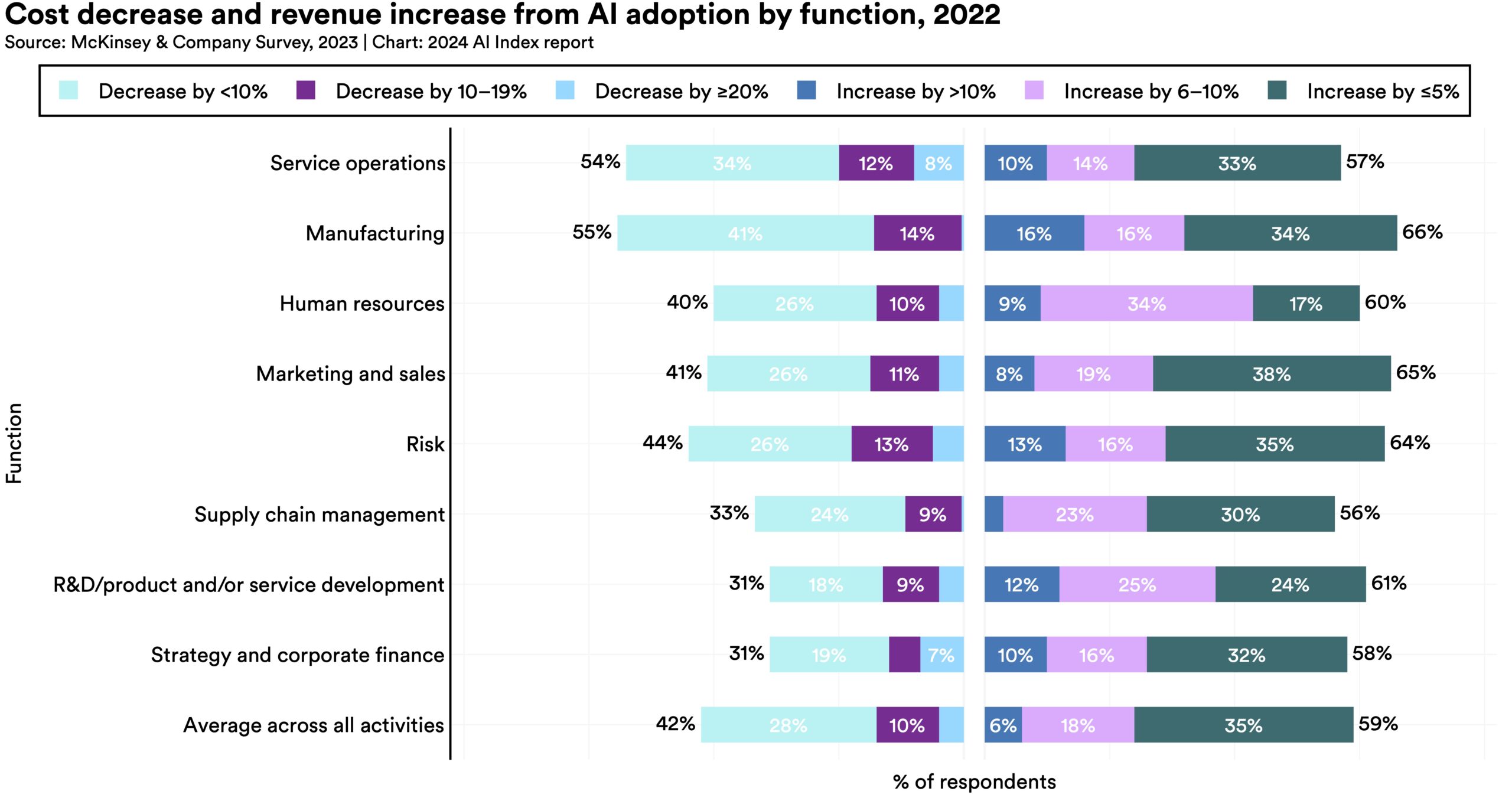
AI adoption offers significant benefits, including substantial cost reductions
(e.g., 55% in manufacturing and 54% in service operations) and high revenue
growth (up to 66% in manufacturing and marketing). Overall, AI drives
efficiency and strategic value across industries, averaging a 42% cost decrease
and a 59% revenue increase across all activities as shown in the picture below
[3].
9 Copyright© 2024. All rights reserved
Artificial intelligence is a valuable asset for businesses, enabling efficiency
improvements, data-driven decisions, and automation of routine tasks to save
time and costs. A survey reveals that 56% of companies use AI for customer
service, while 51% apply it to cybersecurity and fraud detection.
Generative AI, though in its early stages, is widely utilized, according to
McKinsey. 79% of respondents have some exposure to these tools, with 22%
using them daily. Adoption is particularly high in North America and the tech
sector.
AI adoption is expanding globally, with 35% of companies integrating AI into
their operations and 42% leveraging it for broader business applications.
McKinsey data shows that 77% of organizations either use or plan to adopt AI
technologies by 2024.
The global AI market, valued at $184.4 billion, is projected to reach $826.73
billion by 2030, demonstrating rapid growth and widespread adoption. [4]
Research by Valoir shows that AI automates 40% of the average workday,
significantly boosting productivity. Business leaders are increasingly relying on
AI for repetitive task automation and strategic decisions [5].
AI Adoption
Fig 3: Cost increase & Revenue increase due to AI adoption by function
Source

AI adoption is highest in China, where 58% of companies have implemented it
in their business processes. India follows closely with 57% adoption. The United
States has the lowest AI adoption rate, with only 25% of businesses utilizing the
technology [11].
Globally, 72% of organizations have integrated AI into at least one business
function [11].
1.5.2. AI Adoption Worldwide
10 Copyright© 2024. All rights reserved
AI Adoption
AI’s impact on employment is twofold. While the World Economic Forum
estimates that 75 million jobs may be displaced, AI is expected to create 133
million new roles by 2030, particularly in fields like Data Science and Natural
Language Processing [6].
AI is expected to contribute $15.7 trillion to the global economy by 2030,
highlighting its transformative economic potential [7].
IBM reports that Robotic Process Automation leads global AI adoption at 39%,
followed by Computer Vision at 34% and Natural Language Understanding at
33% [8].
As a report by UST Global, 93% of the companies surveyed think that AI is
essential for their success but 75% are facing talent shortages. [9]
IBM data highlights regional adoption trends, with 50% of companies in China
and 59% in India actively using AI, surpassing adoption rates in countries like
Spain, Australia, and France [10].
Fig 4: Global AI adoption by Region
Source

11 Copyright© 2024. All rights reserved
The top contributors to AI investments include the United States, China, India, and
Canada. Over the past five years, the US led with $328,548 million invested,
followed by China at $132,665 million and the UK at $25,541 million [12].
America and China are leading the global AI initiative. Baidu, a leading Chinese
firm, is in top 10 in the number of AI and Machine Learning patents, with 19,308
patent applications by the end of the year. Baidu also leads in patent quality and
grants [13].
ChatGPT achieved a record-breaking 1 million users within days of its launch,
becoming the fastest-growing consumer application. By January 2023, it reached
over 100 million users and is projected to hit 180.5 million by 2024 [14].
1. Scalability Issues: Difficulty transitioning AI pilot projects to full-scale
implementations. 74% of companies struggle to achieve scalable value in AI [C1].
2. Talent Shortages: Limited availability of qualified AI professionals. About 75% of
employers find it challenging to hire the right talent [C2].
3. Integration Difficulties: Fragmented systems complicate AI integration. Over 90%
of organizations face difficulties integrating AI with existing systems [C1]
4. Infrastructure Limitations: Lack of real-time data processing infrastructure.
5. Data Quality Issues: Poor-quality and untimely data impact AI outcomes.
6. Strategic Recommendations: Invest in upskilling, collaborate with educational
institutions, leverage remote talent, and improve retention strategies.
1.6. Challenges of AI Adoption
1.7. Conclusion
AI adoption is revolutionizing industries, boosting productivity, optimizing processes,
and fostering innovation. It enables automation, strategic decision-making, and
enhanced customer experiences. However, challenges such as talent shortages,
scalability, and ethical concerns persist. Addressing these issues requires investment
in workforce development and strong governance. As AI continues to evolve, it
promises deeper integration across sectors like healthcare and finance, driving
economic growth and improving lives. To fully leverage AI’s potential, organizations
must prioritize ethical practices and continuous learning.
AI Adoption

AI+ Network
2. Key Trends in AI Adoption
2.1. Leading Industries in AI Adoption
Copyright© 2024. All rights reserved
AI Adoption
12
The adoption of artificial intelligence (AI) is reshaping industries worldwide, with
significant advancements seen across various sectors. This section outlines the
leading industries in AI adoption, popular applications, and sector-specific
advancements, supported by examples and statistics.
2.1.1. Healthcare
AI is revolutionizing the healthcare sector by enhancing patient care through
personalized treatment and improving operational efficiency. For instance, IBM's
Watson Health utilizes advanced algorithms to analyze vast amounts of clinical data,
aiding healthcare professionals in recommending effective cancer treatments
tailored to individual patient profiles. This capability not only enhances treatment
accuracy but also accelerates the decision-making process, significantly impacting
patient outcomes [15].
In 2023, the healthcare sector invested approximately $6.1 billion in AI technologies,
driven by the urgent need for optimized workflows and effective remote patient
monitoring systems. AI tools are now capable of analyzing genetic predispositions
alongside environmental factors to identify individuals at higher risk for certain
diseases, allowing for early interventions [16]. The integration of AI in healthcare is
expected to lead to a 30% reduction in diagnostic errors, further improving patient
engagement and satisfaction [17].
Below figure shows the pace of AI adoption in US healthcare.
Fig 5: US AI in healthcare market
Source

AI+ Network
Copyright© 2024. All rights reserved
AI Adoption
13
Moreover, AI applications extend to administrative tasks, streamlining processes such
as scheduling and billing. This not only reduces the burden on healthcare providers
but also enhances the overall patient experience by ensuring timely care delivery [18].
As we move towards 2025, the potential for AI in healthcare continues to expand,
promising a more proactive approach to medicine that prioritizes patient well-being
through personalized care strategies [19].
The finance industry has embraced AI primarily for risk management, fraud detection,
and enhancing customer service. A notable example is JPMorgan Chase's COIN
program, which automates the analysis of commercial loan agreements. This
automation has saved thousands of legal hours, demonstrating how AI can
streamline complex processes and reduce operational costs [20].
The global AI market in business and finance was at USD 5.5 billion and is expected to
grow at a CAGR of 24.9% to reach USD 26.5 billion by 2027 [21]. Financial institutions
are increasingly leveraging machine learning algorithms to predict market trends
and assess risks more accurately.
The picture below shows the status of AI adoption in finance and the rate at which it
changed from 2022 to 2023.
These technologies enable firms to analyze customer data effectively, leading to
improved service delivery and customer satisfaction. Furthermore, AI-driven chatbots
are enhancing customer interactions by providing 24/7 support for inquiries and
transactions, thereby increasing engagement and operational efficiency.
2.1.2. Finance
Fig 6: AI adoption rate in financial business in 2022 and 2025
Source

AI+ Network
Copyright© 2024. All rights reserved
AI Adoption
14
AI applications in manufacturing focus on predictive maintenance and inventory
management, with companies like General Electric leading the charge. GE is using AI
in manufacturing not only to boost productivity and increase profitability but also
integrating sustainability goals with operational data and processes. Its new AI
application is developed to address their sustainability goals as well as optimize
operational processes. [22]
The picture below shows the size of AI in manufacturing over the years and how it is
going to change in future.
There are other use cases of AI such as by utilizing AI to predict equipment failures
before they occur, manufacturers can significantly reduce downtime and associated
costs. This proactive maintenance strategy not only enhances productivity but also
extends the lifespan of machinery.
As foundational AI capabilities mature within this sector, manufacturers are expected
to see substantial improvements in operational efficiency. The integration of AI into
supply chain management is also becoming prevalent, allowing for real-time tracking
of inventory levels and optimizing logistics processes.
This evolution is crucial as manufacturers strive to meet growing consumer demands
while maintaining cost-effectiveness.
2.1.3. Manufacturing
Fig 7: AI manufacturing market size
Source

AI+ Network
Copyright© 2024. All rights reserved
AI Adoption
15
In retail, AI is primarily used for supply chain optimization and creating personalized
shopping experiences. Amazon's recommendation engine is a prime example; it
analyzes customer behavior to suggest products tailored to individual preferences,
significantly boosting sales figures and profitability. Retailers are increasingly
investing in AI technologies to enhance customer engagement through personalized
marketing strategies that leverage data analytics. In 2023 alone, retail investments in
AI have surged as companies recognize the potential for these technologies to drive
sales and improve customer loyalty through targeted promotions and personalized
shopping experiences.
The energy sector utilizes AI for optimizing grid management and maximizing the
use of renewable energy sources. Google’s DeepMind has made significant strides by
employing predictive analytics to reduce energy consumption in data centers. This
initiative not only lowers operational costs but also contributes to sustainability efforts
by minimizing waste.
As energy demands continue to rise globally, AI technologies are expected to play a
critical role in managing resources more effectively. Innovations such as smart grids
powered by AI can enhance energy distribution efficiency while promoting the
integration of renewable energy sources into existing infrastructures. The continued
development of these technologies will be vital for achieving long-term sustainability
goals within the energy sector.
Deloitte did a survey with retail executives. AI is going to be the game-changer in
retail technology in the coming years. It is already being used in branding,
personalization, and customer service. It will lower the acquisition cost, increase
customer spend because of personalization, and improve customer satisfaction. [23]
2.1.4. Retail
2.1.5. Energy
Fig 8: AI in retail market
Source

AI+ Network
Copyright© 2024. All rights reserved
AI Adoption
16
The picture below shows the volume of AI market in energy.
Fig 9: AI in energy market share
Source
The power system is getting more complex as we focus on green sources of energy
and decarbonization of power production processes. The network of distributed
generators, grid-connected devices, solar and wind power installation, and hydrogen
energy are some of the sources that are going to be future energy suppliers.
Managing these disparate power sources require capabilities of AI. [24]
In summary, AI is reshaping industries by enhancing efficiencies, personalizing
services, and driving innovation across various sectors. As these technologies
continue to evolve, their impact on operational processes and customer experiences
will likely deepen, paving the way for a more interconnected and efficient future
across all domains.
Generative AI is rapidly gaining traction across multiple sectors, particularly in
marketing and product development. This technology enables organizations to
create content, designs, and even code through algorithms that they learn from
existing data. In 2024, 65% of organizations reported using generative AI regularly in
at least one business function, showcasing its widespread adoption and effectiveness
in enhancing creativity and productivity [2].
Use Cases: There are many use cases of GenAI and it is increasing as more
people use it for their requirements. Here are the 3 most important use
cases.
2.2. Popular Applications of AI
2.2.1. Generative AI

AI+ Network
Copyright© 2024. All rights reserved
AI Adoption
17
Content Creation: Companies like OpenAI and Jasper use generative AI to
produce marketing copy, blogs, and social media posts, significantly reducing the
time spent on content generation.
Design: Tools such as DALL-E allow designers to create unique images based on
textual descriptions, streamlining the creative process.
Sentiment analysis: AI can go through huge data and sense the sentiments
embedded in reviews, documents, writings, emails, and any communication.
Machine learning (ML) is extensively utilized for data analysis and pattern recognition
across various industries. By employing algorithms that learn from data, businesses
can make informed decisions based on insights derived from large datasets.
AI-powered automation tools are transforming processes in sectors such as finance
and manufacturing. These tools enhance efficiency by automating repetitive tasks,
allowing employees to focus on more strategic initiatives.
Use Cases: There are many use cases of machine learning in businesses,
institutions, and governments. Let’s take a look at 3 important use cases.
Use Cases: There are many use cases of automation. Manufacturing and
Finance are the big users of automation.
Predictive Analytics: Retailers like Walmart use ML to analyze customer
purchasing patterns, helping them optimize inventory management and
improve sales forecasts. Similarly, producers and sellers plan their inventory
based on the past data.
Risk Assessment: Financial institutions leverage ML algorithms to evaluate
credit risk by analyzing historical data and predicting future behaviors.
Association analysis: Retailers do association analysis of products which
are bought together. The association helps retailers to understand
customers’ habits and help sell more items.
Finance: Financial companies utilize AI for process automation such as
accounts payable, loan application, credit card offers, revenue forecasts, and
many such important operations.
2.2.2. Machine Learning
2.2.3. Automation

AI+ Network
Copyright© 2024. All rights reserved
AI Adoption
18
Manufacturing: Organizations implement AI-driven quality control
systems that automatically inspect products for defects during production.
This not only speeds up the process but also ensures higher quality
standards.
2.3. Additional Applications
Chatbots: Businesses deploy AI chatbots for customer service, providing instant
responses to inquiries and reducing the workload on human agents.
Sentiment Analysis: Companies use NLP to analyze customer feedback on social
media platforms, helping them gauge public sentiment about their products or
services.
Facial Recognition: Retailers employ facial recognition technology for enhanced
security and personalized customer experiences.
Autonomous Vehicles: Companies like Tesla utilize computer vision for
navigation and safety features in self-driving cars.
RPA tools automate routine tasks across various business functions, such as data
entry and report generation, leading to improved accuracy and efficiency.
The application of AI technologies is reshaping industries by enhancing operational
efficiencies, enabling better decision-making through data insights, and automating
mundane tasks. As organizations continue to adopt these technologies, the potential
for innovation and growth will expand significantly.
AI adoption is increasingly becoming a critical component across various industries,
reflecting a diverse landscape shaped by regulatory environments, technological
readiness, and market demands. Here’s a detailed examination of how different
sectors are advancing their AI capabilities:
2.4. Adoption Patterns and Sector-Specific
Advancements in AI
2.3.1. Natural Language Processing (NLP):
2.3.2. Computer Vision:
2.3.3. Robotics Process Automation (RPA):
Conclusion

AI+ Network
Copyright© 2024. All rights reserved
AI Adoption
19
The healthcare industry is rapidly adopting AI technologies, driven by the urgent
need to improve patient outcomes and operational efficiencies. With investments
exceeding $6.1 billion in 2022 [25], healthcare organizations are leveraging AI for
applications such as:
The COVID-19 pandemic has accelerated this trend, with many healthcare providers
integrating AI solutions to streamline processes and enhance patient services.
Financial services are witnessing a surge in compliance-related applications of AI as
regulations evolve. Key advancements include:
In 2023, the sector invested approximately $5.5 billion in AI technologies [25],
reflecting its commitment to leveraging AI for operational efficiency and regulatory
compliance.
The manufacturing sector is focusing on automation and predictive analytics to
enhance production efficiency. Notable applications include:
As of 2024, manufacturing firms are expected to increase their AI investments
significantly as they seek to optimize operations and reduce costs.
Predictive Maintenance: AI systems monitor equipment conditions to predict
failures before they occur, reducing downtime.
Quality Control: Automated inspection systems powered by AI ensure product
quality and consistency.
Risk Management: AI algorithms assess credit risk and detect fraudulent
activities, enhancing security.
Chatbots and Virtual Assistants: These tools provide 24/7 customer support,
improving client engagement.
Predictive Analytics: AI tools analyze patient data to predict health outcomes,
enabling early interventions.
Telemedicine: AI-powered platforms facilitate remote consultations, improving
access to care.
2.4.1.2. Financial Services
2.4.1.3. Manufacturing
2.4.1.1. Healthcare
2.4.1. Sector-Specific Advancements

AI+ Network
Copyright© 2024. All rights reserved
AI Adoption
20
Customer Insights: AI analyzes shopping patterns to tailor marketing efforts and
improve customer experience.
Supply Chain Optimization: Advanced algorithms forecast demand and manage
inventory more effectively.
With an expected growth in AI adoption rates in retail, companies aim to enhance
customer satisfaction and drive sales through targeted marketing initiatives.
Recent statistics [26] underscore the accelerating pace of AI adoption across
industries:
A McKinsey survey revealed that global AI adoption jumped from 50% to 72%
within a year, indicating a significant increase in interest across all regions.
Approximately 59% of early adopters plan to expand their investments in AI
technologies in 2024.
The global AI market is projected to reach $196 billion by 2030, growing at a
compound annual growth rate (CAGR) of 37.3% from 2023.
AI adoption patterns reveal a dynamic landscape where industries increasingly
recognize artificial intelligence's potential to drive innovation and efficiency. As
organizations continue to invest in these technologies, the impact on operational
processes and customer experiences will deepen, paving the way for future
advancements across all sectors.
2.4.2. Statistics Supporting AI Adoption Trends
2.5. Conclusion
Retailers are leveraging AI for personalized marketing strategies that cater to evolving
consumer behavior trends. Key areas of focus include:
2.4.1.4. Retail

AI+ Network
Data quality is a foundational issue, as AI systems rely heavily on clean,
comprehensive, and unbiased datasets. Poor-quality data can lead to ineffective
model training and unreliable outputs. Additionally, keeping datasets relevant
often requires frequent updates, which can be expensive and time-consuming,
especially in dynamically changing environments. For instance, data
augmentation or sourcing new datasets can mitigate these challenges, but both
require substantial effort and resources.
The lack of skilled professionals is another significant barrier. Building effective
AI systems requires a blend of domain knowledge, technical expertise in
machine learning, and familiarity with the latest tools and frameworks.
Organizations often struggle to assemble a team capable of handling the
complexities of AI development and deployment.
System transparency, or explainability, is crucial but often overlooked. Many AI
models, especially complex ones like deep learning, are treated as "black boxes."
Without clear insight into how these systems make decisions, diagnosing issues
or building stakeholder trust becomes challenging. This is particularly critical in
sectors like healthcare or finance, where regulatory requirements demand
transparency.
Scalability presents an additional hurdle. While many AI solutions show promise
during pilot phases, ensuring they perform consistently under real-world
conditions and at scale can be challenging. This requires a robust infrastructure
and continual optimization, which are resource intensive.
Copyright© 2024. All rights reserved
AI Adoption
21
3. Adoption challenges in AI
3.1. Major challenges
Fig 10: AI in energy market share

AI+ Network
Copyright© 2024. All rights reserved
AI Adoption
22
Start with Small Efforts: Organizations should begin with smaller, well-
defined projects to validate AI's feasibility and build internal confidence.
Identifying a Clear Business Value: AI implementations should align with
strategic goals like improving efficiency, reducing costs, or enhancing
customer experience.
Optimize AI by regular retraining: Regular retraining and fine-tuning of AI
models help maintain performance over time.
Leverage Existing Models: pre-trained models or third-party solutions can
accelerate deployment, but these must be carefully evaluated for security and
suitability.
Collaborate with domain experts and AI professionals: Fostering
collaboration between domain experts and AI professionals can ensure the
developed solutions are practical and impactful.
To support AI adoption effectively, companies must also manage associated risks.
Investing in a scalable, adaptable infrastructure, building cross-functional teams,
and continuously updating both models and data pipelines are key to
overcoming the complex challenges of AI integration into modern business
processes. The key to successful AI integration lies in addressing the primary
obstacles: scalability issues, talent shortages, ethical considerations, and
model biases.
Business should focus on developing robust AI infrastructures that can handle
increased data loads and processing requirements. This involves investing in
advanced cloud services and edge computing technologies that offer the necessary
flexibility and power.
It's also crucial to prioritize the seamless integration of AI with existing systems,
ensuring that AI solutions can operate efficiently within the company's current
technological framework.
For instance, UPS adopted ORION (On-Road Integrated Optimization and
Navigation), optimize delivery routes by analyzing routes, traffic, weather, and other
factors. ORION saved UPS an average of 6 to 8 miles per day per route, which cut
100 million miles per year off delivery miles, resulting in $300 to $400 million saved
annually. It also eliminated 100,000 metric tons of CO2 emissions.
The initial AI project has proven so successful that UPS has continued to invest in AI
by introducing UPSNav, with turn-by-turn directions, UPS MyChoice and
personalized customer services for delivery routing and notifications. [28]
Scalability Issues:
3.2. Suggestions to overcome challenges

AI+ Network
Copyright© 2024. All rights reserved
AI Adoption
23
Companies can create a pipeline of skilled professionals ready to join the workforce
by sponsoring AI-related courses and programs which require faceted approach.
Additionally, fostering partnerships with academic institutions and research
organizations can help bridge the talent gap. By sponsoring AI-related courses and
programs, companies can create a pipeline of skilled professionals ready to join the
workforce.
In a Skillsoft survey, IT professionals report that training improves work quality (62%),
engagement (47%), and job performance (47%), and 82% of IT professionals say a
lack of training is the primary reason they change jobs.[29] The shortage of AI-skilled
professionals results in demand outpacing supply, damaging AI adoptions.
Example: Over 70% of respondents holding back their deployment of generative AI
cite a lack of talent as an important hurdle, which BCG has agreed, due to fewer
employees being both aware of AI and having relevant expertise in relevant
domains.[21]
Establishing robust data privacy protocols and adhering to regulatory standards is
essential to maintain user trust and compliance. Companies should also implement
ethical AI guidelines and create dedicated ethics committees to oversee AI projects
and ensure they align with the organization's values and societal norms.
AI systems sometimes unconsciously perpetuate biases in their training data, which
creates ethical issues and/or discrimination. Thus, AI fairness and AI transparency
must be ensured in its decision-making processes.
Example: In 2014, Amazon's job application machine learning tool tended strongly
towards being male since the sources used to train it were primarily male CVs,
which poses dangers of misuse of AI tools.
Talent Shortages:
Ethical Considerations:
Fig 11: AI ethics [30]

AI+ Network
Copyright© 2024. All rights reserved
AI Adoption
24
It poses a significant threat to the fairness and accuracy of AI systems. To address
this, companies must adopt fairness-aware algorithms and conduct regular audits
of their AI models. This helps identify and mitigate any biases that may be present
in the data or the algorithm itself.
Incorporating diverse data sets and perspectives during the development phase
can also reduce the risk of bias. Additionally, creating a culture of continuous
improvement and feedback allows companies to adapt and refine their AI systems
over time, ensuring they remain equitable and effective.
In conclusion, overcoming the challenges of AI adoption requires a strategic and
comprehensive approach. By investing in scalable infrastructure, addressing talent
shortages, ensuring ethical considerations, and mitigating model biases, companies
can successfully integrate AI into their organizations.
Growth in the US manufacturing sector, for example, had languished at 1.4 percent
over the past two decades. More recently, AI, digital technologies, sustainable
features, and higher skill have reinvigorated the market: over the past five years, US
industrials companies have generated total shareholder returns about 400 basis
points higher than in the previous 15 years. [31]
According to a recent BCG report, a significant 74% of companies struggle to
achieve and scale value from their AI investments. Only a small fraction, 26%, have
successfully transitioned from proof-of-concept to tangible value generation.
Furthermore, a mere 4% have attained cutting-edge AI capabilities across various
functions and consistently reap substantial benefits. This indicates that while many
organizations are experimenting with AI, few have mastered the art of scaling AI
solutions to drive significant business impact. [32].
Another major hurdle in AI adoption is the acute shortage of AI-skilled talent. A
recent UST AI report reveals that a staggering 93% of large companies recognize AI
as a critical factor for success. However, a significant 76% of these companies
grapple with a severe shortage of AI-skilled professionals. This talent gap hinders
organizations' ability to effectively develop, deploy, and manage AI solutions,
limiting their potential to fully realize the benefits of AI [9].
Model biases:
3.3. Examples of AI Adoption challenges

AI+ Network
Copyright© 2024. All rights reserved
AI Adoption
25
3.4. Case Study on adoption challenges
3.4.2. ZILLOW: Flawed Pricing Algorithm
3.4.1. Amazon
In 2014, Amazon created an AI recruiting tool to take drudgery out of their hiring
process. However, the dataset from which it was trained was biased toward male
resumes; thus, it discriminated against male candidates who had "women's" or
female-oriented activities on their resumes. Amazon scrapped the tool, citing
"significant work still to be done regarding bias in the hiring tools."[33]
The iBuying business, Zillow Offers by Zillow, experienced critical failures because of
defects in its algorithm that used AI to price a home. The algorithm, which was to
aid in the estimation of home values, was worse at predicting prices while there was
rapid change in principles in market, hence mainly experiencing massive loss as
they purchased homes at highly inflated prices but sold them for any reasonable
price. This case further indicates that there is a danger of algorithmic reliance
without adequate human oversight, the importance of continuous model
validation, and the limitations of looking into the history of data regarding
predicting future market trends, especially amidst great volatility. As a result, Zillow
lost more than $500 million [34]
Fig 12: Zillow Bought Homes and It Failed Embarrassingly [35]

AI+ Network
Copyright© 2024. All rights reserved
AI Adoption
26
3.4.3. Uber: Regulatory and Ethical Concerns with Self-
Driving AI
3.4.4. Coca-Cola: To understand customer behavior and
brand effectiveness through its next-gen vending
machines
Uber's self-driving car project took a serious hit in 2018 when one of its vehicles
fatally struck a pedestrian in Arizona. Various questions, henceforth raised
regarding self-driving AI relate to the ethical dilemma over life-and-death decision,
gaps in regulation regarding governance of autonomous vehicles, and public
distrust towards self-driving technology. This case really puts the focus on rigorous
testing, adequate safety measures, and well-defined principles of ethics that would
drive autonomous technologies appropriately to be developed safely. [36]
Coca-Cola's innovative use of AI-powered vending machines has revolutionized the
way it engages with customers and manages its operations. By embedding smart
technologies into their vending machines, Coca-Cola gathers real-time data on
consumer behavior, allowing the company to predict which products will perform
best in specific locations.
For example, energy drinks are placed less frequently in hospital vending machines,
while lemonades are favored in sports stadiums. Additionally, the company uses AI
to optimize restocking schedules, reducing the frequency of visits by 18% and
increasing transactions by 15%.[26] Coca-Cola’s mobile app and AI systems also
enable the company to gather valuable consumer insights through app usage and
social media analysis.
This data helps in tailoring marketing strategies, offering personalized promotions,
and improving overall customer service. [37]

AI+ Network
Copyright© 2024. All rights reserved
AI Adoption
27
4. Case studies on AI Adoption and its impact
4.1. Amazon (E-Commerce): AI in Logistics Optimization
Warehouse Robotics:
Route Optimization:
Demand Forecasting:
Amazon has revolutionized its supply chain and logistics operations by integrating
advanced AI technologies. The company utilizes AI in areas like warehouse robotics,
route optimization, and demand forecasting to streamline operations, reduce costs,
and improve customer satisfaction. Here are a few of the use cases of AI on Amazon.
Amazon's acquisition of Kiva Systems in 2012 marked a significant shift in its
approach to warehouse operations. It led to the automation of key warehouse
functions, such as sorting, picking, and moving inventory. Robots now work
alongside human employees to improve productivity and reduce operational errors.
Machine learning models are employed to analyze a variety of data points, including
traffic conditions, weather patterns, and package volumes, to determine the most
efficient delivery routes. These models adjust in real-time, ensuring that Amazon
can meet its promises of fast, reliable delivery.
AI-driven predictive analytics forecast customer demand based on historical data,
seasonal trends, and regional preferences. This helps Amazon avoid stockouts and
overstocking, leading to a more efficient supply chain.
Impact: Accurate demand forecasting ensures that Amazon’s warehouses are
stocked with the right products at the right time, reducing operational disruptions
and maximizing sales opportunities. This helps prevent both excess inventory and
missed sales opportunities, improving overall supply chain efficiency. [40]
Impact: Route optimization has led to a significant reduction in delivery times,
decreased fuel consumption, and lower transportation costs. This not only increases
profitability for Amazon but also improves customer experience by ensuring on
time deliveries. [39]
Impact: Robots increase operational efficiency by reducing manual labor and
optimizing space usage, which leads to faster fulfillment times and improved
accuracy. This leads to faster delivery times and fewer errors, improving customer
satisfaction and reducing costs.
Reference: [38]

AI+ Network
Copyright© 2024. All rights reserved
AI Adoption
28
Measurable Outcomes:
Future Prospects:
AI-Powered Supply Chain Visibility:
Cost Reduction: By using route optimization, Amazon has reduced shipping costs
by 10% per package, resulting in significant savings in its logistics operations.
Increased Productivity: Warehouse robotics have led to up to a 20% increase in
productivity, allowing Amazon to process and ship more orders per unit of labor.
Faster Delivery: AI-driven demand forecasting and route optimization have helped
Amazon decrease delivery times by 15%, making it one of the leaders in the fast-
evolving e-commerce market.
Inventory Optimization: Demand forecasting powered by AI has helped Amazon
reduce stockouts by 30%, minimizing lost sales and enhancing customer
satisfaction while reducing excess inventory costs.
Amazon’s adoption of AI in logistics optimization has proven to be a game-changer,
improving efficiency, reducing operational costs, and enhancing customer
experience. With the continued evolution of AI technologies, Amazon is well-
positioned to maintain its leadership in e-commerce logistics, ensuring faster, more
reliable, and cost-effective services for customers worldwide.
IBM’s Watson AI platform, combined with blockchain technology, provides
businesses with end-to-end visibility into their supply chains. This integration allows
real-time tracking of goods from origin to destination, ensuring greater
transparency and reducing the likelihood of delays or miscommunications.
Impact: The real-time tracking and monitoring enabled by AI ensures that
businesses can quickly identify and respond to disruptions or inefficiencies in the
supply chain. This improves operational flow, enhances responsiveness, and
strengthens customer satisfaction by ensuring timely deliveries. [41]
IBM has been at the forefront of applying artificial intelligence (AI) to optimize
supply chain management. By integrating AI with blockchain and cloud
computing, IBM has enabled businesses to enhance supply chain visibility,
traceability, and overall efficiency, empowering them to make data-driven
decisions. Let’s look at a few of the use cases.
4.2. IBM (Technology): AI in Supply Chain Management
AI+ Network
Copyright© 2024. All rights reserved
AI Adoption
29
Predictive Analytics for Demand Forecasting:
Autonomous Procurement:
Measurable Outcomes:
Future Prospects:
IBM Watson uses historical data and machine learning models to forecast demand
fluctuations. By analyzing trends and patterns, Watson helps businesses predict
future demand with high accuracy, which aids inventory planning and resource
allocation.
IBM is exploring the use of AI in automating procurement processes. Through
machine learning algorithms and AI decision-making, the company is working on
systems that can autonomously identify the best suppliers, negotiate prices, and
place orders based on current needs and market conditions.
Impact: By automating procurement, businesses can reduce the time spent on
manual processes, cut costs, and optimize purchasing decisions. AI’s ability to
assess the market in real time ensures that companies are always getting the best
value from their suppliers. [43]
Improved Efficiency: By using AI-powered supply chain visibility, businesses have
reported a reduction in operational disruptions by up to 30%, enabling smoother
and timely deliveries.
Cost Savings: The use of predictive analytics for demand forecasting has led to a
20% reduction in inventory carrying costs, improving profitability while minimizing
the risk of overstocking.
Enhanced Responsiveness: AI-powered solutions in supply chain management
have enabled companies to respond to supply chain disruptions more quickly,
reducing the impact of delays and improving customer satisfaction.
IBM is focused on advancing AI-driven supply chain ecosystems. Future
developments include enhancing cognitive supply chain networks that can
autonomously adjust to disruptions, predictive maintenance for supply chain assets,
and the broader integration of AI in circular supply chains to promote sustainability.
As AI and blockchain technologies continue to evolve, IBM is positioning itself as a
leader in enabling smarter, more efficient supply chains globally.
Impact: Accurate demand forecasting allows companies to optimize inventory
levels, reducing both stockouts and overstocking. This leads to more efficient
operations and cost savings. IBM’s AI-powered predictive analytics has been shown
to reduce inventory carrying costs by up to 20%. [42]

AI+ Network
Copyright© 2024. All rights reserved
AI Adoption
30
4.3. Tesla (Automotive): AI in Manufacturing and
Logistics
Tesla has emerged as a leader in incorporating artificial intelligence (AI) and
machine learning into its manufacturing and logistics operations. By leveraging AI
technologies, Tesla enhances the efficiency, scalability, and speed of both its
production processes and supply chain logistics, all while maintaining high
standards of quality. The AI use cases in Tesla are as follows.
AI in Manufacturing Automation:
Logistics Optimization with AI:
Autonomous Vehicles for Supply Chain:
Tesla’s Gigafactories utilize AI-powered robots for critical tasks such as assembly,
painting, and quality control. These robots are designed to learn from real-time
production data, constantly improving their performance and efficiency over time.
The system’s ability to process data and adjust on the fly ensures that production
runs smoothly and continuously improves.
Tesla uses AI to optimize its logistics and supply chain operations, which include
inventory management, production scheduling, and parts procurement. Machine
learning models predict potential parts shortages, supply chain disruptions, and
production bottlenecks, enabling Tesla to take proactive measures to address these
challenges before they affect production timeline.
Tesla is exploring the potential of autonomous vehicles for internal logistics within
its manufacturing facilities. These self-driving vehicles are designed to transport raw
materials, components, and finished products between various stages of the
production line without the need for human intervention.
Impact: By leveraging AI for logistics optimization, Tesla has successfully reduced
lead times, minimized material shortages, and streamlined its supply chain. This
proactive approach to inventory management ensures that production continues
without significant delays, enhancing the overall efficiency of its manufacturing
operations. [45]
Impact: The use of AI in manufacturing automation helps Tesla reduce human
error, increase throughput, and scale production capacity efficiently. The rapid
learning and adaptation of AI systems contribute to faster production times,
ultimately lowering the cost of manufacturing and increasing the volume of
vehicles produced. [44]

AI+ Network
Copyright© 2024. All rights reserved
AI Adoption
31
Impact: By incorporating autonomous vehicles into its supply chain, Tesla can
reduce labor costs, improve safety, and increase the speed of material handling
within its Gigafactories. This innovation is also expected to help optimize internal
logistics, reduce traffic congestion in the plant, and enhance the overall efficiency of
the manufacturing process.
Future Outlook: As Tesla continues to develop and refine its autonomous vehicle
technologies, these innovations could be expanded beyond internal use to
streamline the movement of parts and finished products between manufacturing
plants, warehouses, and distribution centers, further improving supply chain
efficiency. [46]
Measurable Outcomes:
15% Improvement in Manufacturing Efficiency: AI-powered robots have improved
the efficiency of Tesla’s production lines, and increased output while reducing
defects.
20% Reduction in Logistics Costs: By using AI for logistics optimization, Tesla has
reduced transportation and inventory management costs by 20%.
15% Faster Production Times: Automation and AI-driven production scheduling
have led to a 15% reduction in manufacturing time, helping Tesla meet growing
demand.
Tesla’s integration of AI and machine learning into its manufacturing and logistics
operations has led to substantial improvements in production efficiency, cost
management, and supply chain optimization. By automating critical tasks,
enhancing real-time decision-making, and exploring innovative technologies like
autonomous vehicles, Tesla is positioning itself for long-term success in the highly
competitive automotive industry.
General Electric (GE) has been a global leader in driving innovation in
manufacturing, leveraging artificial intelligence (AI) to optimize operations and
maintain a competitive edge. GE employs AI to improve predictive maintenance,
ensure quality control, and streamline supply chain processes. By adopting these
technologies, GE enhances operational efficiency, reduces costs, minimizes waste,
and ensures consistent delivery of high-quality products. Let’s explore a few of the
use cases of GE.
4.4. GE (Manufacturing): AI in Predictive Maintenance
and Quality Control

AI+ Network
Copyright© 2024. All rights reserved
AI Adoption
32
Predictive Maintenance:
Quality Control:
Supply Chain Optimization:
Measurable Outcomes:
Predictive maintenance is one of the most transformative applications of AI at GE.
By integrating AI-powered sensors and machine learning algorithms into its
equipment, GE monitors machinery health in real-time, predicting potential failures
and optimizing maintenance schedules.
AI has transformed GE’s quality control processes by integrating advanced
technologies such as computer vision and anomaly detection. These systems
ensure defects are identified and corrected early in the production process,
reducing waste and improving product quality.
AI predicts supply chain disruptions by analyzing historical data, market conditions,
and real-time logistics. It optimizes inventory management and suggests
alternative suppliers when required.
15% Reduction in Supply Chain Costs: AI-driven efficiency improvements have
reduced expenses related to inventory management, transportation, and
procurement.
10% Improvement in Delivery Timelines: Optimized logistics ensure on-time
production schedules and better customer satisfaction.
Enhanced Resilience: AI has made GE’s supply chain more agile, allowing it to
adapt quickly to unforeseen challenges.
Impact: GE has reduced supply chain costs by 15% and improved delivery timelines
by 10%, ensuring timely production and customer satisfaction. [43]
Impact: AI-driven quality control has improved product quality by 20% and reduced
manufacturing waste by 25%, leading to cost savings and increased customer trust.
[48]
Impact: Predictive maintenance has reduced unplanned downtime by 30%,
minimized repair costs, and improved overall equipment reliability, leading to
smoother operations and reduced financial losses. [47]

AI+ Network
Copyright© 2024. All rights reserved
AI Adoption
34
Future Prospects:
GE plans to expand AI integration into sustainable manufacturing, focusing on
green energy solutions and carbon-efficient processes. By adopting AI-driven
innovations, GE is committed to leading the charge in environmentally responsible
industrial production.
GE’s integration of AI into predictive maintenance, quality control, and supply chain
optimization has redefined the manufacturing landscape. By delivering measurable
outcomes such as reduced downtime, improved product quality, and lower costs,
GE ensures operational excellence and customer satisfaction. As the company
advances its AI-driven initiatives, with a strong focus on sustainability and smart
manufacturing, it is poised to lead the industry into a future of innovation,
efficiency, and environmental responsibility.

AI+ Network
Copyright© 2024. All rights reserved
AI Adoption
35
4.5. Pfizer (Healthcare): AI in Drug Discovery and
Personalized Medicine
AI in Drug Discovery:
Personalized Medicine:
Clinical Trial Optimization:
Pfizer has embraced artificial intelligence (AI) to revolutionize drug discovery and
personalized medicine. By leveraging AI algorithms and machine learning models,
the company has significantly reduced the time and cost associated with
developing new drugs, while simultaneously improving patient outcomes through
tailored treatment plans. Some of the key use cases are given below.
Pfizer employs AI-powered platforms, such as IBM Watson for Drug Discovery, to
process vast datasets, including genomic information, chemical libraries, and
clinical trial data. By leveraging AI, Pfizer identifies potential drug candidates with
greater speed and precision compared to traditional methods.
Pfizer applies AI to analyze complex patient data, including genetic profiles, lifestyle
choices, and medical histories. This enables the creation of highly personalized
treatment plans that address individual patient needs.
Clinical trials are critical to bringing new drugs to market, but they are often lengthy
and expensive. Pfizer uses AI to design and manage trials more effectively by
analysing patient eligibility, geographical distribution, and historical trial data. AI-
powered models also predict potential bottlenecks, ensuring timely interventions.
Impact: AI has reduced the average time for trial completion by 20%, cutting costs
and accelerating regulatory approvals. This efficiency has been especially beneficial
during the development of vaccines and treatments for urgent health crises, such
as the COVID-19 pandemic. [50]
Impact: Personalized medicine has significantly improved treatment efficacy,
reducing adverse reactions and enhancing patient satisfaction. AI enables Pfizer to
stratify patients into subgroups, ensuring that they receive therapies tailored to
their unique conditions. [51]
Impact: AI has reduced the time required to identify viable drug candidates by
nearly 30%. By predicting the efficacy and safety profiles of compounds early in the
research phase, Pfizer can prioritize the most promising candidates, minimizing the
risks and costs associated with failed trials. [50]

AI+ Network
Copyright© 2024. All rights reserved
AI Adoption
36
Measurable Outcomes
Future Prospects
30% Reduction in Drug Development Time: AI accelerates candidate identification
and preclinical testing phases, ensuring faster delivery of life-saving treatments.
20% Improvement in Treatment Efficacy: Personalized medicine ensures patients
receive optimal therapies, improving recovery rates and satisfaction.
15% Cost Reduction in Clinical Trials: AI-driven trial optimization has reduced
recruitment time, operational expenses, and dropout rates.
Higher Success Rates for New Drugs: AI minimizes trial-and-error in the drug
discovery process, increasing the likelihood of successful outcomes.
Pfizer aims to expand its use of AI by integrating real-time patient data through IoT
devices, enabling continuous monitoring and adaptive treatments. The company is
also exploring AI’s potential to identify biomarkers for complex diseases, paving the
way for earlier detection and more effective interventions.

AI+ Network
Copyright© 2024. All rights reserved
AI Adoption
37
4.6. JPMorgan Chase (Finance): Transforming Fraud
Detection and Trading with AI
JPMorgan Chase has established itself as a leader in leveraging artificial intelligence
(AI) to revolutionize the financial industry. By adopting advanced AI solutions, the
bank enhances fraud detection, optimizes trading strategies, and improves credit
risk management. These AI-driven initiatives not only strengthen the bank's
operational efficiency but also enable it to provide more secure, innovative, and
personalized services to its clients.
Fraud Detection:
Algorithmic Trading:
Credit Scoring and Risk Assessment:
One of the most critical applications of AI at JPMorgan Chase is fraud detection. The
bank uses advanced machine learning algorithms to monitor millions of
transactions in real-time, identifying suspicious patterns and anomalies that may
indicate fraudulent activity.
JPMorgan Chase employs AI-driven algorithms to transform its trading operations.
These algorithms analyze vast amounts of market data, including historical price
trends, real-time market conditions, and global economic indicators, to predict
price movements and execute trades at optimal times.
In addition to fraud detection and trading, JPMorgan uses AI to enhance credit risk
assessment. Traditional credit scoring models rely on limited data, such as income
and credit history. AI, however, incorporates non-traditional data sources, such as
transaction histories, spending patterns, and even social media behavior, to provide
a more holistic view of customer creditworthiness.
Impact: AI-enhanced credit scoring has reduced loan default rates by 15%,
improving the bank’s portfolio quality and enabling it to offer more competitive
loan products. [53]
Impact: AI-powered trading systems have increased trade execution efficiency by
25%, delivering higher returns for clients and enabling the bank to stay competitive
in global markets. [53]
Impact: AI-powered fraud detection systems have reduced fraudulent transactions
by 40%, saving JPMorgan Chase billions of dollars annually and enhancing
customer trust. [52]

AI+ Network
Copyright© 2024. All rights reserved
AI Adoption
38
Measurable Outcomes
Future Prospects
40% Reduction in Fraudulent Transactions: Advanced fraud detection systems
significantly enhance security and minimize financial losses.
25% Increase in Trading Efficiency: AI algorithms optimize decision-making
and execution in trading operations.
15% Decline in Loan Defaults: AI-powered credit scoring ensures better risk
assessment and loan portfolio quality.
Improved Customer Satisfaction: AI-enabled chatbots enhance customer
experiences and reduce response times.
JPMorgan Chase plans to expand its AI capabilities to include real-time customer
sentiment analysis, enabling more personalized financial services. The bank is also
exploring AI’s use in blockchain-based smart contracts for more secure and efficient
transaction processing, solidifying its position as a leader in fintech innovation.

AI+ Network
Copyright© 2024. All rights reserved
AI Adoption
39
5. Future of AI Adoption: Emerging Technologies and
Predictions
5.1.1. Edge AI
5.1.2. Quantum AI
5.1. Emerging Technologies:
The evolution of artificial intelligence (AI) continues to drive innovation across
industries, enabling advanced solutions to complex challenges and fostering
unprecedented technological growth. Emerging technologies such as Edge AI,
Quantum AI, and Generative AI are poised to redefine the scope and impact of AI,
paving the way for transformative applications and groundbreaking advancements.
Edge AI refers to the local processing of AI algorithms directly on devices like
smartphones, wearables, and IoT systems, reducing reliance on cloud-based
infrastructure. By decentralizing data processing, Edge AI enhances real-time
decision-making, minimizes latency, and improves the privacy and security of AI
applications.
Quantum AI merges quantum computing with artificial intelligence to tackle
problems that are computationally challenging for classical computers. By utilizing
quantum principles such as superposition and entanglement, Quantum AI can
process vast datasets, solve complex optimization problems, and simulate intricate
systems with unmatched speed and accuracy.
Example: Wearable devices, such as Fitbit and Garmin, use Edge AI to track
vitals like heart rate, sleep patterns, and physical activity. By processing data
locally, these devices provide immediate feedback, offering real-time insights
without relying on cloud connectivity. Similarly, autonomous vehicles leverage
Edge AI for navigation, obstacle detection, and safety decisions, ensuring rapid
responses to dynamic environments.
Impact: By decentralizing data processing, Edge AI enables faster, more secure
AI applications, particularly in environments where instant decisions are critical,
such as healthcare monitoring and autonomous vehicles.
References: [54]

AI+ Network
Copyright© 2024. All rights reserved
AI Adoption
40
Example: IBM’s Qiskit framework is advancing AI in quantum computing, with
potential applications in complex problem-solving, such as portfolio
optimization in finance and drug molecule simulation in pharmaceuticals.
Impact: Quantum AI holds the promise of dramatically improving AI’s capability
to solve problems in fields like optimization, cryptography, and drug discovery,
which could lead to breakthroughs in areas that currently seem computationally
infeasible.
Reference: [55]
5.1.3. Generative AI
Generative AI involves the use of machine learning models to create entirely new
content, such as text, images, music, or code. Technology has already found
widespread adoption in creative industries, content generation, and automation,
pushing the boundaries of human creativity and productivity.
Generative AI is transforming industries such as entertainment, marketing, and
software development. For instance, ChatGPT is widely used for natural language
understanding tasks, while DALL-E generates creative visual art from text prompts.
Example: GenAI can be used for text generation (e.g.: ChatGPT), visual art (e.g.:
DALL-E) and software development (Codex)
Future Potential: In the coming years, generative AI will enable hyper-
personalized experiences, such as individualized marketing campaigns and real-
time customer interaction. It will also revolutionize content creation, from
personalized educational content to virtual assistants that generate human-like
responses based on contextual understanding.
The image below shows the adoption rate of AI adoption by industry.
Fig 12: Zillow Bought Homes and It Failed Embarrassingly [35]

AI+ Network
Copyright© 2024. All rights reserved
AI Adoption
41
5.2. AI in future (Next 5-10 Years)
5.2.1. AI Democratization:
As artificial intelligence (AI) continues to mature, its integration into various
industries is set to accelerate, leading to transformative changes in how businesses,
governments, and individuals operate. The following predictions provide insights
into the future of AI adoption and its far-reaching implications.
As AI tools become more user-friendly, companies and individuals without deep
technical expertise will be able to harness the power of AI. Platforms like Google
AutoML and OpenAI’s Codex are making it easier for small and medium-sized
businesses (SMBs) to integrate AI into their operations.
Impact: Democratized AI will allow smaller players in industries like retail,
finance, and healthcare to compete with larger corporations, fostering
innovation and competition. AI-powered solutions will no longer be limited to
tech giants. Instead, they will permeate even traditional and resource-
constrained industries, driving efficiency and growth.
Future Applications:
Local restaurants use AI to predict demand and optimize supply chain
logistics.
Small retail stores deploy AI chatbots for customer service and loyalty
programs.
Reference: [56]
5.2.2. Sectoral Growth
5.2.2.1. Healthcare
AI will drive transformative growth across various industries, reshaping their
operations, capabilities, and customer experiences.
AI will drive significant advancements in precision medicine, where treatments are
tailored to individual patients based on genetic and health data. Predictive analytics
will be used extensively to manage chronic diseases, predict outbreaks, and
monitor patient outcomes in real time.

AI+ Network
Copyright© 2024. All rights reserved
AI Adoption
42
Precision Medicine: AI will enable the development of treatments tailored to
individual patients based on genetics, lifestyle, and health data. For instance, AI-
driven tools will analyze genetic profiles to recommend personalized drug
therapies.
Predictive Analytics: Hospitals will deploy AI to predict disease outbreaks,
manage chronic illnesses, and improve patient outcomes.
Example: An AI system may flag early warning signs for diseases like diabetes or
heart failure, empowering doctors to intervene before critical conditions arise.
Reference: [57]
5.2.2.2. Retail
5.2.2.3. Manufacturing
AI will facilitate hyper-personalized shopping experiences by analyzing real-time
customer data, predicting preferences, and offering tailored recommendations.
Example: Retailers will use AI to predict a customer's next purchase and create
personalized promotions or offers, increasing conversion rates and customer loyalty.
AI-powered automation and predictive maintenance will become mainstream. AI
will help manufacturers optimize supply chains, reduce waste, and increase
production efficiency by anticipating equipment failures before they occur.
Example: Predictive maintenance using AI sensors will prevent costly downtime in
industrial machinery and ensure smoother production cycles.
Hyper-Personalized Experiences: AI will analyze real-time data to predict
customer preferences and create tailored recommendations.
Dynamic Pricing: AI will help retailers adjust prices based on demand,
competitor pricing, and customer behavior.
Example: Retailers like Amazon may use AI to predict a customer’s next
purchase and deliver targeted discounts or offers, increasing conversion rates
and loyalty.
Reference: [58]

AI+ Network
Copyright© 2024. All rights reserved
AI Adoption
43
AI-Powered Automation: Robotic systems will increasingly take over repetitive
tasks, improving productivity and reducing errors.
Predictive Maintenance: AI-powered sensors will monitor equipment,
predicting failures and preventing costly downtime.
Example: An AI-driven system could optimize supply chains by predicting
inventory needs and automating restocking processes.
Reference: [59]
5.2.2.4. AI in Education
AI will play a significant role in transforming education by providing personalized
learning experiences. Adaptive learning technologies will be able to assess students’
progress in real-time and offer tailored lessons that suit their individual needs.
Example: Platforms like Duolingo already use AI to adjust language lessons based
on a learner's pace, and this type of personalization will spread across more
subjects.
Personalized Learning: Adaptive AI tools will assess student progress in real-
time and deliver customized lessons that cater to individual learning styles and
paces.
Virtual Tutors: AI will act as personal tutors, providing instant feedback and
guiding students through complex concepts.
Example: Platforms like Duolingo already adapt lessons based on a learner’s
performance. This approach will expand to subjects like mathematics, science,
and coding.
Reference: [60]
5.2.3. Ethical and Responsible AI
As AI adoption accelerates, ethical considerations will become a priority, with
increasing efforts to address issues like bias, transparency, and accountability.
Governments and organizations will establish stricter regulations to ensure
AI systems operate fairly and responsibly.
Ethical AI frameworks will guide the development and deployment of
algorithms, with a focus on mitigating unintended consequences.
AI Governance:
Reference: [61]

AI+ Network
Copyright© 2024. All rights reserved
AI Adoption
44
AI tools will become more sophisticated in identifying and reducing bias,
ensuring equitable decision-making across domains like hiring, lending, and
law enforcement.
Example: A recruitment AI system will be designed to ensure gender-
neutral candidate screening, promoting workplace diversity
Data protection laws like GDPR will evolve to address the complexities of AI,
ensuring user data is used responsibly.
Organizations will invest in explainable AI (XAI), which provides insights into
how AI systems make decisions, fostering trust and transparency.
Self-driving cars will become safer and more reliable, with advancements in AI
algorithms enabling vehicles to navigate complex environments and adapt to
unpredictable scenarios.
Example: Companies like Tesla and Waymo will refine autonomous driving
technologies, pushing closer to fully self-driving cars by 2030.
AI-powered drones will be widely adopted for last-mile delivery, surveillance, and
disaster response.
Robotics will handle tasks ranging from warehouse management to elder care,
reducing human labor demands and enhancing service efficiency.
Example: Logistics companies like DHL and Amazon will use drones to deliver
packages faster and at lower costs, particularly in urban areas.
Reference: [65]
Industrial Applications: Robots equipped with AI will streamline manufacturing
processes, handle hazardous tasks, and optimize production lines
Reference: [62]
Privacy and Accountability:
Autonomous Vehicles:
Drones and Robotics:
AI Fairness Algorithms:
5.2.4. AI in Autonomous Systems:
Reference: [63]
Reference: [64]

AI+ Network
Copyright© 2024. All rights reserved
AI Adoption
45
The future of AI adoption promises significant advancements, with new
technologies like Edge AI, Quantum AI, and Generative AI transforming various
sectors. Over the next 5-10 years, AI will become more accessible to businesses of
all sizes, foster sectoral growth in fields like healthcare and retail, and lead to the
widespread automation of industries such as manufacturing and transportation.
However, as AI continues to evolve, addressing the ethical, regulatory, and
societal impacts of these technologies will be crucial to ensuring their
responsible use and maximizing their potential benefits. By 2030, AI could be as
integral to our daily lives as the internet, driving innovation, increasing efficiency,
and creating new possibilities across industries.
6. Final Words on AI Adoption
AI is a powerful and rapidly evolving technology with the potential to significantly
impact our lives. The impact is already seen in various walks of life, but this is just
the beginning. We scratched the surface only.
AI offers immense opportunities but also presents many challenges which are never
faced by mankind. Few of the opportunities and challenges are mentioned in the
report. However, there are many unknown opportunities and challenges that will
test our ability to use technology judiciously. As we take this exciting journey in
artificial intelligence, we will discover new ways, new paradigm, new opportunities,
and new hurdles. The journey will be complex but it sure will be extremely
rewarding.
Moving forward, it is crucial to define standards, prioritize ethical development,
ensure a fair and equitable opportunity for all, and foster collaboration among the
various stakeholders.

AI+ Network
Copyright© 2024. All rights reserved
AI Adoption
46
6. References
[1] Artificial Intelligence Market Size, share & Trends Analysis Report by solution, by
technology (Deep Learning, Machine Learning, NLP, Machine Vision, Generative AI),
by function, by end-use, by region, and segment Forecasts, 2024 - 2030. (n.d.).
https://www.grandviewresearch.com/industry-analysis/artificial-intelligence-ai-
market
[2] Singla, A., Sukharevsky, A., Yee, L., & Chui, M. (2024, May 30). The state of AI in early
2024: Gen AI adoption spikes and starts to generate value. McKinsey & Company.
https://www.mckinsey.com/capabilities/quantumblack/our-insights/the-state-of-ai
[3] Agarwal, V. (2024, December 2). Transforming Manufacturing: The impact of AI
on cost reduction and revenue growth.
https://www.linkedin.com/pulse/transforming-manufacturing-impact-ai-cost-
reduction-revenue-agarwal-sysoe
[4] Statista. (2024, November 28). AI market size worldwide from 2020-2030.
https://www.statista.com/forecasts/1474143/global-ai-market-size
[5] Wettemann, R. (2023, May 23). Assessing the value of AI and automation — Valoir.
Valoir. https://valoir.com/blog-1/assessing-the-value-of-ai-and-automation
[6] Chowdhry, A. (2018, September 18). Artificial intelligence to create 58 million new
jobs by 2022, says report. Forbes.
https://www.forbes.com/sites/amitchowdhry/2018/09/18/artificial-intelligence-to-
create-58-million-new-jobs-by-2022-says-report/
[7] PricewaterhouseCoopers. (n.d.). PwC’s Global Artificial Intelligence Study: Sizing
the prize. PwC. https://www.pwc.com/gx/en/issues/artificial-
intelligence/publications/artificial-intelligence-study.html
[8] Morning Consult. (2023). IBM GLOBAL AI ADOPTION INDEX – ENTERPRISE
REPORT.
https://filecache.mediaroom.com/mr5mr_ibmspgi/179414/download/IBM%20Global
%20AI%20Adoption%20Index%20Report%20Dec.%202023.pdf
[9] UST AI Report: 93% of large companies view AI as essential to success, but more
than three-quarters face a severe talent shortage. (2024, August 20). UST.
https://www.ust.com/en/who-we-are/ust-newsroom/ust-ai-report-93-percent-of-
large-companies-view-ai-as-essential-to-success-but-more-than-three-quarters-
face-a-severe-talent-shortage

AI+ Network
Copyright© 2024. All rights reserved
AI Adoption
47
[10] Data Suggests Growth in Enterprise Adoption of AI is Due to Widespread
Deployment by Early Adopters. (2024, January 10). IBM Newsroom.
https://newsroom.ibm.com/2024-01-10-Data-Suggests-Growth-in-Enterprise-
Adoption-of-AI-is-Due-to-Widespread-Deployment-by-Early-Adopters
[11] Cardillo, A. (2024, August 21). How many companies use AI? (New data).
Exploding Topics. https://explodingtopics.com/blog/companies-using-ai
[12] USA leading the charge on AI investment – Intelligent CIO North America. (2024,
August 8). https://www.intelligentcio.com/north-america/2024/08/08/usa-leading-
the-charge-on-ai-investment/
[13] 杨洋. (n.d.). Baidu ranks top 10 in AI patent applicants globally. Chinadaily.com.cn.
https://www.chinadaily.com.cn/a/202410/23/WS67189dbea310f1265a1c9263.html
[14] Milmo, D. (2023, February 3). ChatGPT reaches 100 million users two months
after launch. The Guardian.
https://www.theguardian.com/technology/2023/feb/02/chatgpt-100-million-users-
open-ai-fastest-growing-app
[15] Ramanandi, B. (2024, September 25). How AI is Shaping the Future of
Healthcare and Personalized Medicine. Agile Infoways.
https://www.agileinfoways.com/blogs/how-artificial-intelligence-is-shaping-the-
future-of-healthcare-and-medicine/
[16] Khan, A., & Khan, A. (2024, June 20). Future of AI in Healthcare: Revolutionizing
Diagnosis and treatment | European School of Data Science and Technology.
European School of Data Science and Technology | Study at Europe’s Only
Dedicated Data Science School. https://esdst.eu/future-of-ai-in-healthcare-
revolutionizing-diagnosis-and-treatment/
[17] Walker, L. (2024, February 16). AI transforms personalized care for better health
outcomes. Bounteous. https://www.bounteous.com/insights/2024/02/16/ai-
transforms-personalized-care-better-health-outcomes/
[18] Barth, S. (2023, April 14). AI in Healthcare. ForeSee Medical.
https://www.foreseemed.com/artificial-intelligence-in-healthcare
[19] Yu Hao Li, (2024), Innovation and challenges of AI technology in personalized
healthcare. https://www.nature.com/articles/s41598-024-70073-7

AI+ Network
Copyright© 2024. All rights reserved
AI Adoption
48
[20] DigitalDefynd, T. (2024, November 30). 5 ways JP Morgan is using AI - Case
Study [2025] - DigitalDefynd. DigitalDefynd. https://digitaldefynd.com/IQ/jp-
morgan-using-ai-case-study/
[21] Stratton, B. (2025, January 21). AI Industry Growth Statistics: Exploring Key
Metrics Driving Growth of AI (updated for 2025). Blue Tree Digital.
https://bluetree.digital/ai-industry-growth-metrics/
[22] GE Vernova unveils new AI-based software to advance industrial sustainability
and operations goals simultaneously | GE News. (n.d.).
https://www.ge.com/news/press-releases/ge-vernova-unveils-new-ai-based-
software-to-advance-industrial-sustainability-operations-goals
[23] Future of retail: Profitable growth through technology and AI. (n.d.). Deloitte
India. https://www2.deloitte.com/in/en/pages/consumer-business/articles/future-of-
retail-profitable-growth-through-technology-and-AI.html
[24] [24] Why AI and energy are the new power couple – Analysis - IEA. (2023,
November 2). IEA. https://www.iea.org/commentaries/why-ai-and-energy-are-the-
new-power-couple
[25] Artificial Intelligence Index Report 2023. (n.d.). Artificial Intelligence Index Report
2023. https://aiindex.stanford.edu/wp-content/uploads/2023/04/HAI_AI-Index-
Report-2023_CHAPTER_4.pdf
[26] Gen AI casts a wider net. (2024, July 3). McKinsey & Company.
https://www.mckinsey.com/featured-insights/sustainable-inclusive-
growth/charts/gen-ai-casts-a-wider-net
[27] Apriorit. (2024, September 19). Challenges in AI adoption and key strategies for
managing risks. https://www.apriorit.com/dev-blog/ai-adoption-challenges-and-
strategies
[28] Gow, G. (2024, September 23). How CEOs Can Overcome AI adoption
Challenges: Strategies for 2025. Forbes.
https://www.forbes.com/sites/glenngow/2024/09/22/how-ceos-can-overcome-ai-
adoption-challenges-strategies-for-2025/
[29] Skillsoft. (2023, December 12). AI skills and talent gaps widen as innovation
Accelerates: new SkillSoft report. https://www.skillsoft.com/press-releases/ai-skills-
and-talent-gaps-widen-as-innovation-accelerates-new-skillsoft-report

AI+ Network
Copyright© 2024. All rights reserved
AI Adoption
49
[30] Addressing ethics amid ascending AI adoption. (n.d.).
https://action.deloitte.com/insight/4161/addressing-ethics-amid-ascending-ai-
adoption
[31] Bristol, H., De Boer, E., De Kroon, D., Shahani, R., & Torti, F. (2024, February 21).
Adopting AI at speed and scale: The 4IR push to stay competitive. McKinsey &
Company. https://www.mckinsey.com/capabilities/operations/our-
insights/adopting-ai-at-speed-and-scale-the-4ir-push-to-stay-competitive
[32] [32] Bristol, H., De Boer, E., De Kroon, D., Shahani, R., & Torti, F. (2024, February
21). Adopting AI at speed and scale: The 4IR push to stay competitive. McKinsey &
Company. https://www.mckinsey.com/capabilities/operations/our-
insights/adopting-ai-at-speed-and-scale-the-4ir-push-to-stay-competitive
[33] Jeffrey Dastin, (October 11, 2018). Insight - Amazon scraps secret AI recruiting
tool that showed bias against women.
https://www.reuters.com/article/world/insight-amazon-scraps-secret-ai-recruiting-
tool-that-showed-bias-against-women-idUSKCN1MK0AG/
[34] Editorial Team. (2022, July 25). The $500mm+ Debacle at Zillow Offers – What
Went Wrong with the AI Models? - insideAI News. insideAI News.
https://insideainews.com/2021/12/13/the-500mm-debacle-at-zillow-offers-what-
went-wrong-with-the-ai-models/
[35] Jee, K. (2022, September 14). Zillow Bought Homes and It Failed Embarrassingly:
Algorithm Lessons from A $500 Million Money Pit. Medium.
https://medium.datadriveninvestor.com/zillow-bought-homes-and-it-failed-
embarrassingly-algorithm-lessons-from-a-500-million-money-pit-8f2ea5336479
[36] Filipsson, F., & Filipsson, F. (2024, August 18). Ethical issues in AI for autonomous
vehicles. Redress Compliance - Just another WordPress site.
https://redresscompliance.com/ethical-issues-in-ai-for-autonomous-vehicles/
[37] Prime, G. (2022, October 28). The Story of Coca-Cola and its AI-powered Vending
Machines. Geospatial World. https://geospatialworld.net/prime/case-study/the-
story-of-coca-cola-and-its-ai-powered-vending-machines/
[38] Dekhne, A., Hastings, G., Murnane, J., & Neuhaus, F. (2019, April 24). Automation
in logistics: Big opportunity, bigger uncertainty. McKinsey & Company.

AI+ Network
Copyright© 2024. All rights reserved
AI Adoption
50
https://www.mckinsey.com/industries/travel-logistics-and-infrastructure/our-
insights/automation-in-logistics-big-opportunity-bigger-uncertainty
[39] Sandler, R. (2021, February 5). Amazon is installing AI-Powered cameras to
monitor delivery drivers. Forbes.
https://www.forbes.com/sites/rachelsandler/2021/02/03/in-bid-for-road-safety-
amazon-is-rolling-out-ai-powered-cameras-to-monitor-delivery-drivers/
[40] Putha, S. (2021, January 2). AI-Driven Personalization in E-Commerce:
Enhancing Customer Experience and Sales through Advanced Data Analytics.
https://biotechjournal.org/index.php/jbai/article/view/87
[41] Verma, S. (2024, November 25). Blockchain for supply chain. Blog.
https://www.ibm.com/think/topics/blockchain-for-supply-chain
[42] Sean Galea-Pace (May 18, 2020). IBM Watson: how AI is transforming the supply
chain. https://supplychaindigital.com/technology/ibm-watson-how-ai-transforming-
supply-chain
[43] Global Data from IBM Shows Steady AI Adoption as Organizations Look to
Address Skills Shortages, Automate Processes and Encourage Sustainable
Operations. (2022, May 19). IBM Newsroom. https://newsroom.ibm.com/2022-05-19-
Global-Data-from-IBM-Shows-Steady-AI-Adoption-as-Organizations-Look-to-
Address-Skills-Shortages,-Automate-Processes-and-Encourage-Sustainable-
Operations
[44] Here, A. (2024, September 18). Tesla: Artificial Intelligence Manufacturing
Revolution. Supply Chain Today - Home Page.
https://www.supplychaintoday.com/tesla-artificial-intelligence-manufacturing-
revolution/
[45] Here, A. (2024b, December 5). Top 10 Reasons for Tesla’s Highly Effective Supply
Chain. Supply Chain Today - Home Page. https://www.supplychaintoday.com/top-
10-reasons-for-teslas-highly-effective-supply-chain/
[46] Bellan, R., & Korosec, K. (2022, April 20). Musk says Tesla aspires to mass produce
robotaxis by 2024. TechCrunch. https://techcrunch.com/2022/04/20/elon-musk-
mass-produce-robotaxi-by-2024/
[47] Predictive Analytics. (n.d.).
https://www.gevernova.com/software/products/predictive-analytics

AI+ Network
Copyright© 2024. All rights reserved
AI Adoption
51
[48] Schmelzer, R. (2024, November 18). From production to Precision: How AI is
reshaping manufacturing. Forbes.
https://www.forbes.com/sites/ronschmelzer/2024/11/14/from-production-to-
precision-how-ai-is-reshaping-manufacturing/
[49] GEP | AI-Powered Supply Chain and Procurement Software, Strategy &
Managed Services. (n.d.). GEP. https://www.gep.com/
[50] P. (n.d.). Artificial Intelligence: On a mission to Make Clinical Drug Development
Faster and Smarter | Pfizer.
https://www.pfizer.com/news/articles/artificial_intelligence_on_a_mission_to_make_
clinical_drug_development_faster_and_smarter
[51] Agarwal, S. (2024, July 2). AI personalizes healthcare, transforming delivery and
saving lives. Forbes. https://www.forbes.com/sites/shashankagarwal/2024/06/29/ai-
personalizes-healthcare-transforming-delivery-and-saving-lives/
[52] MIT Technology Review. (2023, September 15). How retail is using AI to prevent
fraud. MIT Technology Review.
https://www.technologyreview.com/2022/09/20/1059799/how-retail-is-using-ai-to-
prevent-fraud/
[53] Tulsi, K., Dutta, A., Singh, N., Jain, D., & Department Finance, Universal AI
University. (2024). Transforming Financial Services: The impact of AI on JP Morgan
Chase’s operational Efficiency and Decision-Making. In International Journal of
Scientific Research & Engineering Trends (Vol. 10, Issue 1). https://ijsret.com/wp-
content/uploads/2024/01/IJSRET_V10_issue1_138.pdf
[54] AI on the Edge: Generative AI technology impacts, insights and predictions.
(n.d.). Qualcomm. https://www.qualcomm.com/news/onq/2023/12/ai-on-the-edge-
generative-ai-technology-impacts-insights-and-predictions
[55] Jiang, W., Xiong, J., & Shi, Y. (2021). When Machine learning meets Quantum
Computers. Proceedings of the 28th Asia and South Pacific Design Automation
Conference, 593–598. https://doi.org/10.1145/3394885.3431629
[56] Mohamed, A. (2024, January 10). AutoML Advancements: Unleashing the power
of automated machine learning for optimal efficiency. Medium.
https://medium.com/@AMustafa4983/automl-advancements-unleashing-the-
power-of-automated-machine-learning-for-optimal-efficiency-3771f7777ce9

AI+ Network
Copyright© 2024. All rights reserved
AI Adoption
52
[57] 2024 Global Health Care Sector Outlook | Transforming health care with
artificial intelligence. (2024).
https://www2.deloitte.com/content/dam/Deloitte/global/Documents/gx-
transforming-health-care-with-artificial-intelligence.pdf
[58] AI tools for retailers. (2023, May 19). McKinsey & Company.
https://www.mckinsey.com/featured-insights/sustainable-inclusive-
growth/charts/ai-tools-for-retailers
[59] Schmelzer, R. (2024b, November 18). From production to Precision: How AI is
reshaping manufacturing. Forbes.
https://www.forbes.com/sites/ronschmelzer/2024/11/14/from-production-to-
precision-how-ai-is-reshaping-manufacturing/
[60] Khan, S. (2023, November 17). Harnessing GPT-4 so that all students benefit. A
nonprofit approach for equal access. Khan Academy Blog.
https://blog.khanacademy.org/harnessing-ai-so-that-all-students-benefit-a-
nonprofit-approach-for-equal-access/
[61] How to balance innovation and governance in the age of AI. (2024, November 1).
World Economic Forum. https://www.weforum.org/stories/2024/11/balancing-
innovation-and-governance-in-the-age-of-ai
[62] Ideas, W. (2023, February 8). Health care bias is dangerous. but so are ‘Fairness’
algorithms. WIRED. https://www.wired.com/story/bias-statistics-artificial-
intelligence-healthcare/
[63] Candelon, F. (2023, May 15). AI can be both accurate and transparent. Harvard
Business Review. https://hbr.org/2023/05/ai-can-be-both-accurate-and-transparent
[64] Bellan, R., & Korosec, K. (2022b, April 20). Musk says Tesla aspires to mass
produce robotaxis by 2024. TechCrunch. https://techcrunch.com/2022/04/20/elon-
musk-mass-produce-robotaxi-by-2024/
[65] Discover, (14 September 2023) AI in Logistics and Last-Mile Delivery.
https://www.dhl.com/discover/en-in/logistics-advice/logistics-insights/ai-in-logistics-
and-last-mile-delivery

AI+ Network
Copyright© 2024. All rights reserved
AI Adoption
53
[66] Shanavaz Mohammed, (n.d.). Adoption-rate-of-artificial-Intelligence-by-
industry. https://www.researchgate.net/figure/Adoption-rate-of-artificial-
Intelligence-by-industry-Low-2018_fig1_382886781
[C1] Overcome AI Integration Challenges: Complexity to Competitive Edge.
December 12, 2024. https://blog.getaura.ai/ai-integration-challenges
[C2] 75% of Companies are Struggling to Hire Al Talent. (n.d.).
https://www.a.team/mission/ai-skills-gap