CITY SCRIPTS: NARRATIVES OF POSTINDUSTRIAL URBAN FUTURES PDF Free Download
1 / 254/254
100%


CITY SCRIPTS

CITY SCRIPTS
NARRATIVES OF POSTINDUSTRIAL
URBAN FUTURES
Edited by Barbara Buchenau,
Jens Martin Gurr, and Maria Sulimma
THE OHIO STATE UNIVERSITY PRESS
COLUMBUS
Copyright © 2023 by e Ohio State University.
All rights reserved.
Funded by the Volkswagen Foundation (Project number Az 93500)
Library of Congress Cataloging-in-Publication Data
Names: Buchenau, Barbara, editor. | Gurr, Jens Martin, 1974– editor. | Sulimma, Maria,
1985– editor.
Title: City scripts : narratives of postindustrial urban futures / edited by Barbara Buchenau,
Jens Martin Gurr, and Maria Sulimma.
Description: Columbus : e Ohio State University Press, [2023] | Includes bibliographical
references and index. | Summary: “Analyzes the past, present, and future of
postindustrial cities in Germany and the US through assemblages of narrative, media,
performance, and urban matter”—Provided by publisher.
Identiers: LCCN 2023013586 | ISBN 9780814215524 (cloth) | ISBN 0814215521 (cloth) | ISBN
9780814283103 (ebook) | ISBN 0814283101 (ebook)
Subjects: LCSH: City planning. | Cities and towns in literature. | Cities and towns—History.
| Narration (Rhetoric)—Social aspects. | Urbanization—Social aspects—United States.
| Urbanization—Social aspects—Germany.
Classication: LCC PN56.C55 C55 2023 | DDC 307.76—dc23
LC record available at https://lccn.loc.gov/2023013586
Other identiers: ISBN 9780814258866 (paper) | ISBN 0814258867 (paper)
Cover design by Larry Nozik
Text composition by Stuart Rodriguez
Type set in Minion Pro
In memory of Josef Raab

CONTENTS
List of Illustrations ix
Acknowledgments xi
INTRODUCTION City Scripts in Urban Literary and Cultural Studies
MARIA SULIMMA, BARBARA BUCHENAU, AND
JENS MARTIN GURR
PART 1 • URBAN SPACES
CHAPTER Black Lives Matter Grati and Creative Forms of
Dissent: Two Sites of Counterscripting in Denver, Colorado
FLORIAN DECKERS AND RENEE M. MORENO
CHAPTER Walking Down Woodward: (Re)Telling a City’s Stories
through Urban Figures
JULIANE BOROSCH AND BARBARA BUCHENAU
CHAPTER Tiny Architecture and Narrative: Scripting Minimal
Urban Living Spaces
KATHARINA WOOD AND RANDI GUNZENHÄUSER
CHAPTER Narrative Path Dependencies in Sustainable and
Inclusive Urban Planning: Portland’s Albina Neighborhoods
ELISABETH HAEFS AND JENS MARTIN GURR
viii • CONTENTS
PART 2 • URBAN LITERATURE
CHAPTER Scripting the Inclusive City, Narrating the Self:
Contemporary Rust Belt Memoirs in Poetry and Prose
CHRIS KATZENBERG AND KORNELIA FREITAG
CHAPTER Whose Detroit? Fictions of Land Ownership and
Property in Postindustrial America
JULIA SATTLER
CHAPTER To the Bodega or the Café? Microscripts of
Gentrication in Contemporary Fiction
MARIA SULIMMA
CHAPTER Redemptive Scripts in the City Novel
LIEVEN AMEEL
PART 3 • URBAN HISTORIES OF IDEAS
CHAPTER Patterned Pasts and Scripted Futures: Cleveland’s
Waterfronts and Hopes of Changing the Narrative
JOHANNES MARIA KRICKL AND MICHAEL WALA
CHAPTER The Creative Democracy: A Critique of Concepts of
Creativity in Contemporary Urban Discourse
HANNA RODEWALD AND WALTER GRÜNZWEIG
CHAPTER Forms, Frames, and Possible Futures
BARBARA ECKSTEIN AND JAMES A. THROGMORTON
List of Contributors
Index

ix
ILLUSTRATIONS
FIGURE . Elijah McClain mural by artists Thomas “Detour” Evans,
Hiero Veiga, and “TukeOne”
FIGURE . Conrad Kickert’s map of the remnants of Augustus B.
Woodward’s design
FIGURE . Figural sculptures on Woodward Avenue, downtown Detroit
FIGURE . Hubert Massey’s Power to the People
FIGURE . Marshall Fredericks’s The Spirit of Detroit
FIGURE . Robert Graham’s Monument to Joe Louis, with David Barr
and Sergio De Giusti’s Transcending in the background
FIGURE . William Kieer and Ann Feeley’s Antoine de la Mothe Cadillac
FIGURE . Ed Dwight’s Gateway to Freedom: International Memorial to
the Underground Railroad
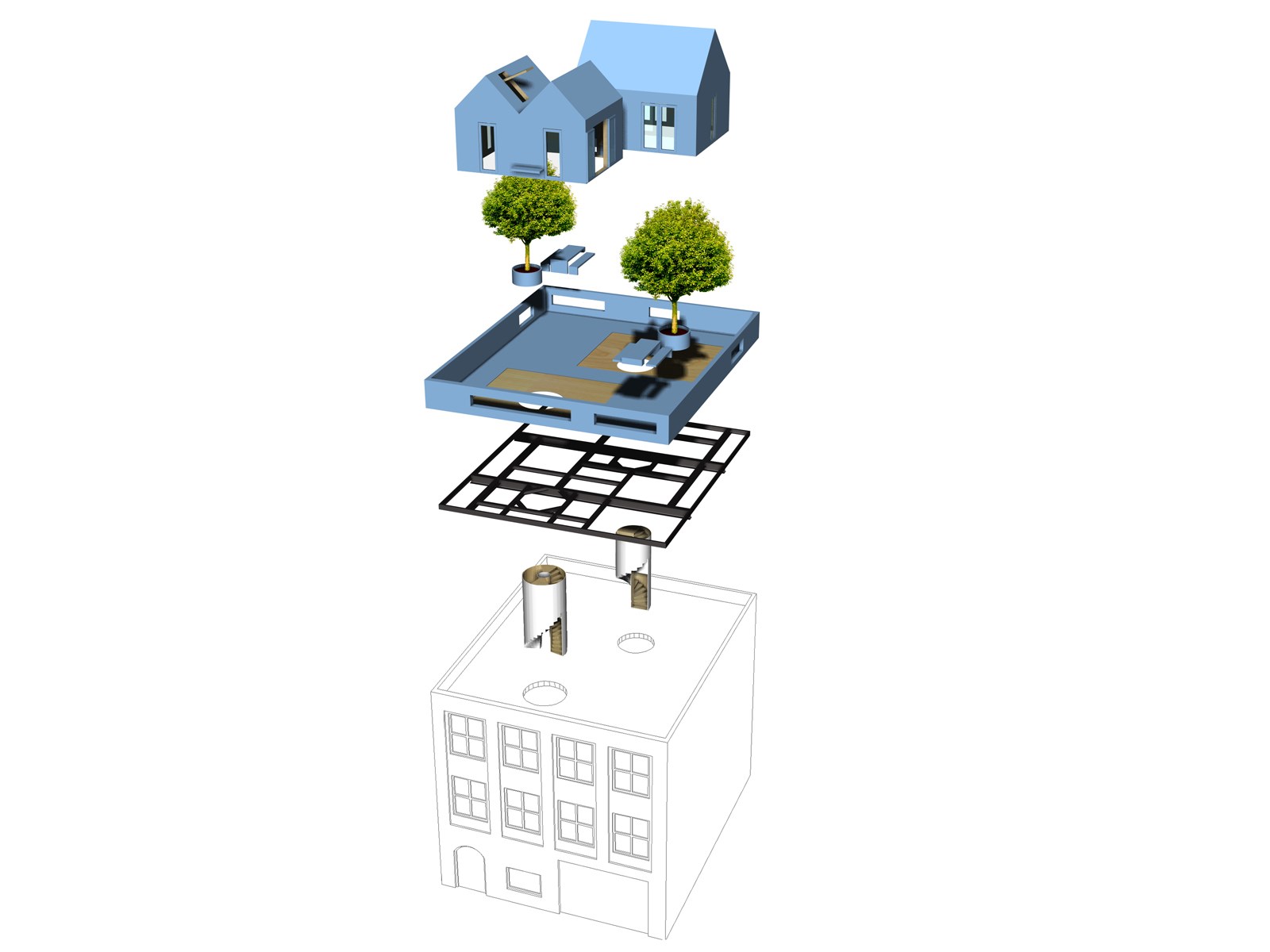
FIGURE . An explosion drawing of the Didden village
FIGURE . Logements à Poissy
FIGURE . A prototypical Wohnwagon
TABLE . Features of a redemptive plot
FIGURE . Blazing Paddles Paddlefest logo
FIGURE . Janna Banning’s “Art is only for the rich”

xi
ACKNOWLEDGMENTS
is book would have been unthinkable without the passionate input of our
critical interlocutors, who have shaped our argument at various stages. Special
thanks go to Stephanie Leigh Batiste, Michael Batty, Alex Blue V., Bocaoja,
Diane van Buren, Stefan Dierkes, Oliver Dörmann, Iris Dzudzek, Florian Frei-
tag, Sage Gerson, Julika Griem, Dieter Hassenpug, Jon Hegglund, Victoria
Hegner, omas Heise, Hanna Henryson, Stefan Höhne, Arun Jain, Norman
Klein, Kai Lipsius, Lena Mattheis, Dietmar Meinel, Courtney Moett-Bateau,
Paula M.L. Moya, Hajo Neis, Simone Raskob, omas Rühle, Ramón Saldívar,
Sebastian Schlecht, Heike Steinho, Ulrike Sommer, Boris Vormann, and
Ernest Zachary for their unwavering support and their expertise. Early on,
the nancial and institutional support of the Mercator Research Center Ruhr
for a research project directed by Walter Grünzweig and coordinated by Julia
Sattler allowed many of us to jointly venture into the eld of literary urban
studies. ree anonymous reviewers of an unsuccessful research initiative on
historical North American city scripts directed by Barbara Buchenau provided
useful feedback. is temporary failure sparked our interest in narrativity in
postindustrial cities in the US and Germany that are rescripting the pragmatic
functions of storytelling. e Volkswagen Foundation supported this collabor-
ative research extensively: It funded a sustained systematic exchange between
urban planning and American studies called Scripts for Postindustrial Urban
Futures: American Models, Transatlantic Interventions (2018–23, directed by
xii • ACKNOWLEDGMENTS
Barbara Buchenau, codirected by Jens Martin Gurr, coordinated by Maria
Sulimma). is research group has served as the intellectual hub or homebase
for the authors assembled here. We particularly thank the teams at Zachary &
Associates, Detroit; Ruhrfutur; the City of Essen; lala Ruhr; the world heritage
site Zeche Zollverein; Ökozentrum NRW; and the Dortmunder U—Zentrum
für Kunst und Kreativität for critical feedback and great opportunities to dis-
cuss our work with urban professionals. At the Volkswagen Foundation, Cor-
nelia Soetbeer, Pierre Schwidlinski, Barbara Neubauer, and Jeana illa have
been unwavering in their support of our endeavor. Christine Vennemann and
Phillip Grider oered time and critical acumen to assemble the argument in
its present form. Two anonymous readers provided extremely valuable feed-
back. It has been magic to experience the guidance of Ana Maria Jimenez-
Moreno, Elizabeth Zaleski, and everyone else at e Ohio State University
Press throughout the editorial process.

INTRODUCTION
City Scripts in Urban Literary
and Cultural Studies
MARIA SULIMMA, BARBARA BUCHENAU, AND
JENS MARTIN GURR
Have we come to a new era of narrating the city in Western democracies?
And is narration an appropriate technique to inuence powerful transfor-
mations? In a video statement announcing the United Nations Policy Brief
“Covid-19 in an Urban World” in July 2020, UN Secretary-General António
Guterres evoked stories of atomic wars and 9/11 alike when he described cit-
ies as “ground zero” of the global pandemic (United Nations). Like Guterres,
many politicians, activists, scientists, and journalists framed the COVID-19
pandemic as a decidedly urban phenomenon, challenging their listeners to
understand the spread of the virus as a fundamental threat to their cities.
Urban dwellers, infrastructures, and lifestyles were registered by the media as
the rst and foremost victims. Simultaneously, public discourse and the pro-
fessional elds of urban management and urban planning picked up on the
added sense of opportunity and futurity that emerged from this multiauthored
narrative documentation: e pandemic was seized as an incentive to rethink
and restructure urban communities. Between 2020 and 2022, several factual as
well as ctionalized narratives surrounding cities and pandemics surfaced in
newspapers, statements of politicians, or social media posts from around the
world. ese texts contributed to the recraing of the canonical and starkly
racialized scripts of urban ight and deserted cities.

2 • MARIA SULIMMA, BARBARA BUCHENAU, AND JENS MARTIN GURR
Urban ight, deserted cities: each a pas de deux that refers readers back
to a contingent, albeit conspicuous, assemblage of narrative techniques, per-
forming characters, medial frames, and gural interpretation. ey recall past
crises, sketch present urban isolation, and call for future urban action. ey
are especially familiar descriptors for transformational processes in so-called
“legacy cities” adapting to major global shis in the heavy industries (Mallach
and Brachman). Most importantly for the volume at hand, they are scripts—
consequential, but rather terse and stereotyping placemaking strategies at the
intersections between textuality, urban space, mediality, performativity, and
materiality. Drawing on mental schemata and conceptual models, scripts tend
to renew outdated explanations of social transformations to pitch story arcs
forward into the future. is new pandemic life given to two well-worn abbre-
viations of urban change is one example of city scripts (see Mahler) as highly
condensed, and yet expansive in scope, dynamic storytelling phenomena to
be methodically analyzed in this book.
As the example of the compressed yet complex storytelling sparked by
the rise of a pandemic demonstrates, factual and ctional stories aect how
we imagine our cities and life within them. Two contrapuntal elds of urban
practices equally depend on this ability to invent plausible stories of collective
action, partial cohesion, and selective connectedness: political activism and
urban planning. is volume suggests the city script as a methodological and
conceptual framework to better analyze and understand such future-oriented
storytelling. e conceptualization of scripts as much as the observation of
material practices of scripting and the performative dimension of “scriptivity”
permit innovative insights into the transgressive overlap and interdependence
of ctional, factual, and real-life modes of urban and anti-urban imaginaries.1
City Scripts responds to calls by literary theorists such as Rita Felski in
Hooked: Art and Attachment (2020) and Paula M. L. Moya in e Social
Imperative (2016) to develop methods for a new kind of narrative analysis
that recalibrates close reading and interpretation to the multiple ways in
which narratives “do things” (Felski 42) by, for instance, allowing their read-
ers to enter into emotionally and epistemically transformative “interracial
friendship[s]” (Moya 51) with literary characters and with the narrative pro-
gression that can and will “prompt a reader to question and then revise some
of her assumptions about structures of racial and economic inequality” (Moya
1. Within the eld of performance studies, “scriptivity” is dened as “the moment when
dramatic narrative and movement through space are in the act of becoming each other” (Bern-
stein 89). It blends word and action, doing and telling. See chapter 2 by Borosch and Buchenau
for a discussion of scriptivity.

CITY SCRIPTS IN URBAN LITERARY AND CULTURAL STUDIES • 3
58).2 We are particularly interested in how narratives take action in everyday
life. is book will analyze polysemic assemblages of narrative, media, and
poetics with their multiplying and contesting temporal, spatial, and material
groundings. We dene scripts as “artful combinations of narrative, medial as
well as gural acts of framing, inscription, description and prescription [that
...] establish contingent connective tissues between the past, the present and
the future” of cities and their frequently anti-urban constituents and contexts
(Buchenau and Gurr, “Urban Development” 142). is colloquial art of cra-
ing connective tissues between an emotionally charged past, a contentious
present, and an anticipated future is especially prominent in scenarios of mas-
sive deindustrialization and selective reindustrialization experienced in many
second cities across the United States and Germany, the regional foci of our
examination.3
In the US-American Northeast and Midwest, and in the German Ruhr
region, where many of our authors are based,4 stories past and passing by have
breathed new life into images of rust belts and transformation engines. On both
sides of the Northern Atlantic, the former heartlands of the steel, coal, and car
industries are producing countless stories—old and new—of (post)industrial
labor and exploitation. ese stories of a very special kind of urban setting
are “building character,” as architectural historian Charles L. Davis II would
call it (see 6–9), in the shape of divisive urban architecture, racialized social
orders, and regional, national as well as transatlantic interpretations of histori-
2. Rita Felski draws on Actor Network eory and criticizes the ideological exhaustion
of surface as well as strong readings, arguing that “our critical languages need to become more
attuned to their objects” (135). Paula Moya builds on the work of social and cultural psychol-
ogy to indicate how a revised employment of close reading techniques can enhance our under-
standing of narrative agency and help “to build racial literacy” (31). Moya also asks for a new
“conceptual vocabulary capable of registering [...] the linkages between [a wide variety of sche-
mas developed and employed by a large number of diverse readers,] institutional structures of
power and literary ‘value’” (27). See also Marie-Laure Ryan who moves forward from the most
prominent trends in postclassical narratology to emphasize the foundational sequence-building,
cross-medial, and material interactivity aorded and required by narrative (3, see also 183).
3. Ryberg-Webster and Tighe indicate the extent to which these cities appear to be
dened by a past forever lost and a future that is hard to bring into action: “Legacy cities,
also commonly referred to as shrinking, Rust Belt, or postindustrial cities, are places that have
experienced sustained population loss and economic contraction” (3). ey emphasize that “the
reality on the ground is a nuanced landscape of racial segregation, industrial decline, vacancy
and abandonment, revitalized neighborhoods, vibrant downtowns, and so forth” (6).
4. e volume presents chapters cowritten by members and collaborators of the research
group Scripts for Postindustrial Urban Futures: American Models, Transatlantic Interventions
(www.cityscripts.de; 2018–23), funded by the Volkswagen Foundation and based at three uni-
versities in the German metropolitan Ruhr region.

4 • MARIA SULIMMA, BARBARA BUCHENAU, AND JENS MARTIN GURR
cal meaning. In Remaking the Rust Belt (2016) Tracy Neumann has pointed
to the paradigmatic status of so-called rust belts: City-makers in deindustri-
alizing cities are craing an imaginary for their urban future that engages
“local variants of larger social, political, and economic processes that aect[]
many North American and Western European cities” (3). In the view of Neu-
mann, these spaces have been experiencing a “shi from manufacturing to
services” not because of global market forces, but because “growth coalitions
composed of local political and business elites [assisted by] international con-
sultants” envision and cra the transition to the lower-paying service industry
while seeking to attract members of the new middle class (3). is is a future-
oriented narrative at work in a quite literal sense.
City scripts such as these harness the powers of both story (as a sequen-
tialized ordering of events) and narrative (as past and potential lived
experiences).5 In doing so, they impact the social worlds of those who actively
read or unconsciously come into contact with them. ese scripts challenge
analysts and theoreticians of narrative to contribute to the development of a
transdisciplinary narratology that is commensurate to the centrality of nar-
rativity for factual, nonliterary sensemaking and world-building activities.6
Because colloquial storytelling and professional narrativization become the
touted and increasingly ritualized practices of politicians, businesspeople, and
city-makers, it is time for narrative theory to account for the growing impor-
tance of a new, fragmented kind of narrativity in the public and the private
sphere. Adopting terminology of the study of popular seriality, we want to
draw attention to the “proliferation” and “sprawl” of both terse and extended
forms of narrative in and for the conceptualization of urban space.7
is book uses our practice-oriented work at the intersection of litera-
ture, media, and urban development as a growing archive, which will need a
5. is distinction is roughly in line with Albrecht Koschorke’s discussion of the abun-
dance of storytelling and narration in everyday life. He understands “narrative” as “a multi-
storied construct” (10). Stories resemble the “events and actions with episodes”; they are “sub-
units of the narrative sequence” (10). Koschorke speaks of the “dynamization” inherent in story-
telling (11), emphasizing the “universality” of narrative as “a creative process of appropriation”
of the world (12).
6. One handbook and two edited collections sketch the emerging eld: Huber and
Schmid’s handbook (2018) points at the anthropological base of human narrativity; Strohmai-
er’s collection (2013) on transdisciplinary narratological research is particularly interested in the
generative capacities of storytelling. Finally, Gamper and Mayer’s collection is a media history
of short and terse everyday narrative in journalism, literature, and the public (and publicized
private) sphere (2017). Koschorke’s general theory of narrative lays a useful foundation.
7. In Serial Agencies (2014), Frank Kelleter uses these concepts to describe repetitive pat-
terns in televised popular urban seriality. Both terms are equally well established in the descrip-
tion of phenomena in urban infrastructure.

CITY SCRIPTS IN URBAN LITERARY AND CULTURAL STUDIES • 5
broader methodological toolkit if interdisciplinary scholarship on narrative is
to provide adequate and meaningful analyses of story-driven scripts.
URBAN ANALYSIS AS A CHALLENGE FOR
LITERARY AND CULTURAL STUDIES
In the past years, urban studies as a discipline has increasingly become aware
of how important narratives, cultural texts, and storytelling are in developing
cities, as well as in communicating these plans to a wider public. is new
awareness of narrative process is oen called the “story turn” of city planning,
even though it also aects the work of activists, politicians, and decision-
makers on all levels.8 Within academia, following the “narrative turn” in the
social sciences, and the “spatial turn” of the humanities, urban studies is fur-
ther diversifying toward a systematized interdisciplinarity, while the study of
cities to many still appears as the domain of architecture, geography, anthro-
pology, sociology, and the social sciences more generally.9 However, the eld
of Literary and Cultural Urban Studies has been gaining traction in recent
years. In its transdisciplinary translation of narratological, anthropological,
planning, and design methodologies, this new eld is able to provide impor-
tant contributions to urban and narrative analysis, methodology, and theory
alike. And it might help to address a methodological challenge that arises
from the persisting diculties to account for narrative’s stellar career in elds
and disciplines other than literature and literary studies.
e central venues for literary and cultural urban studies are the jour-
nal Literary Geographies, the Association for Literary Urban Studies, as well
as Palgrave’s book series “Literary Urban Studies.”10 Published since 2015, the
8. An early example of scholarship attuned to how stories and storytelling aect and even
compete for our interrelated understanding of cities, (urban) sustainability, and democracy is
the collection Story and Sustainability: Planning, Practice, and Possibility for American Cities
(2003), edited by Barbara Eckstein and James A. rogmorton. e growing awareness of the
importance of culture and narrative for the analysis of urban phenomena is also documented in
book series such as Architecture/Technology/Culture, edited by Klaus Benesch, Jerey Meikle,
David Nye, and Miles Orvell, published rst by Brill and more recently the University of Penn-
sylvania Press.
9. We describe the spatio-narrative conuence of the distinctive elds of urban, cultural,
and literary analysis in Buchenau and Gurr, “City Scripts.” In Buchenau and Gurr’s “Textuality,”
we explore disciplinary oppositions to more eective cross-disciplinary debates between urban
research, narratology, and cultural studies.
10. Founded in the same year, the formerly Scandinavia-based Association for Literary
Urban Studies by now possesses a thoroughly international membership and puts on frequent
meetings, workshops, and conferences. Its members are involved with and publish in Palgrave’s
new “Literary Urban Studies” book series.
6 • MARIA SULIMMA, BARBARA BUCHENAU, AND JENS MARTIN GURR
journal Literary Geographies accommodates the diversity of a eld in which
some are interested in “generating maps from quantitative data as a means of
correlating genre with geography or charting the lineaments of a narrative
trajectory,” whereas others are interested in “the nature of the relationship
between material and metaphorical spaces” (Alexander 5). Several compan-
ions seek to provide an overview of how this eld gradually developed into a
discipline in its own right, for instance, e Cambridge Companion to the City
in Literature (2014) edited by Kevin R. McNamara, e Palgrave Handbook of
Literature and the City (2016) edited by Jeremy Tambling, and e Routledge
Companion to Literary Urban Studies (2023) edited by Lieven Ameel. Further,
Lieven Ameel, Jens Martin Gurr, and Jason Finch have respectively published
monographs on literary urban studies.
As Ameel’s most recent edited collection highlights, the eld of liter-
ary urban studies can be subdivided into “classical” and “postclassical”
approaches. Classical literary urban studies originated in the second half of
the twentieth century. is subeld is dedicated mostly to the canonical texts
of urban realism, naturalism, and modernism. For their analysis, literary
scholars here turned to the formative thinkers of urban studies and (cultural)
geography, such as Henri Lefebvre, Michel de Certeau, Walter Benjamin, or
Georg Simmel. A compelling example of such an approach is Gerd Hurm’s
study Fragmented Urban Images (1991) with its chapters on authors such as
Stephen Crane, eodore Dreiser, Upton Sinclair, F. Scott Fitzgerald, John Dos
Passos, Richard Wright, Hubert Selby, and omas Pynchon.
Meanwhile, postclassical literary urban studies as the more recent section
of the eld draws on such previous studies and their theoretical concepts but
seeks to challenge its blind spots—the prevalence of mostly white and exclu-
sively male authors. Such recent approaches frequently employ postcolonial
and intersectional methodologies and are critical of canonicity and highbrow/
lowbrow distinctions of their materials, as well as the primacy of certain urban
centers over others. As one example, in e Black Skyscraper: Architecture and
the Perception of Race (2019), Adrienne Brown demonstrates how urban built
environments are central to the perception of race, specically that “the expe-
rience and reception of skyscrapers [...] mediate the experience and recep-
tion of race” (26). Moving from the invention of the skyscraper in the 1880s
to the erection of the Empire State Building in 1931, Brown reads canonical
texts by W.E.B. Du Bois, Henry James, F. Scott Fitzgerald, and Nella Larsen
alongside lesser-known works of pulp, romance, and science ction, as well as
labor histories of steelworkers and oce managerial manuals. us, Brown’s
study demonstrates the strengths of postclassical literary urban studies. A cul-
tural studies example for this kind of work is Kyle T. Mays’s City of Dispos-
CITY SCRIPTS IN URBAN LITERARY AND CULTURAL STUDIES • 7
sessions: Indigenous Peoples, African Americans, and the Creation of Modern
Detroit (2022).
Mays can be said to push postclassical approaches a little further in the
direction of urban narratology, since he gathers oral and family histories as
well as community documents and archival material for a groundbreaking
argument about the histories of race, colonialism, and sovereignty that have
shaped Detroit since its beginning. Further, the collection Literary Second Cit-
ies (2017), edited by Finch, Ameel, and Salmela, turns to literary and cultural
productions about previously neglected peripheral or “second cities.” is col-
lection targets the “blind spot, in which a small set of alpha cities [such as
New York, London, or Paris] with the strongest magnetic eect over whole
countries and global areas are oen taken to be the types for all cities” (Finch,
Ameel, and Salmela 5).
A nal important shi in recent literary urban studies is the broadening
of the corpus to include nonliterary pragmatic texts such as planning docu-
ments. Here, recent scholarship has shown the productivity of applying ana-
lytical methods developed in literary studies to nonliterary texts (see Ameel,
Narrative Turn; Buchenau and Gurr, “City Scripts,” “Textuality,” and “Urban
Development;” Gurr).
In addition to international literary and cultural urban studies, our vol-
ume positions itself in the eld of transnational American studies and urban
American studies. Recent edited collections are Urban Transformations in the
U.S.A.: Spaces, Communities, Representations (2016) edited by Julia Sattler and
e City in American Literature and Culture (2021) edited by Kevin R. McNa-
mara. In their introductions, both Sattler and McNamara respectively high-
light the city’s role in American studies and US-American national mythology.
Moreover, both quickly move on to the diversity of alternate visions of the US-
American city between modernization, urbanization, and immigration, which
include ethnic enclaves, dichotomies between the city and its suburbs, as well
as anti-urban dierentiations between the city and the country. Both volumes
call attention to the necessity for a transatlantic perspective in urban Ameri-
can studies. Sattler argues that “America, at least in the European imagination,
is a mostly urban nation, home to New York City or Los Angeles. ese cities
might in fact be exceptions to American urbanity at large, but they are cel-
ebrated in their iconicity” (13). Contributing to McNamara’s collection, John
Carlos Rowe states that “the transnational turn [...] is not just a phenom-
enon of literary studies: transnationalism is the dening social condition of
contemporary US urban life in cities across the nation” (137). Our collection
oers conceptualizations of how urban narratives “travel” (sensu Bal) or are
“translated” (sensu Tsing) not only between disciplines and professions but
8 • MARIA SULIMMA, BARBARA BUCHENAU, AND JENS MARTIN GURR
also countries, regions, and cities (for a discussion of traveling urban models,
see Gurr). Some contributions in our collection explicitly look at the ways in
which scripts for urban development and urban interaction emerge from con-
ceptual transfers and translations between the US and Germany, such as the
essay by Wood and Gunzenhäuser as well as the essay by Rodewald and Grün-
zweig. Some essays—Borosch and Buchenau as well as Deckers and Moreno—
build on the transatlantic placement and cooperation of their authors. Other
essays consider the ways that US-American cities such as Detroit, New York,
Chicago, Denver, Cleveland, Iowa City, or Oakland are impacted by increas-
ingly globalized scripts of urbanity. e ways that narration aects and deter-
mines these cities’ industrial pasts and postindustrial urban futures runs as a
common interest through all the contributions.
SUGGESTIONS FOR A TRANSDISCIPLINARY NARRATOLOGY:
CONCEPTUALIZING SCRIPTS AND SCRIPTINGS
For any inquiry into the impact of narratives on the construction and percep-
tion of actual real-world spaces, Marie-Laure Ryan, Kenneth Foote, and Maoz
Azaryahu’s Narrating Space / Spatializing Narrative (2016) was groundbreak-
ing in its explanation of how objects and things can challenge their observers
and users to engage in narrative. Moving forward from a particular urban
form that has narrativity (as Ryan, Foote, and Azaryahu argue for maps, for
example), there is a need to advance a transdisciplinary narratological meth-
odology that systematically develops notions of “script,” “scripting,” and
“scriptivity” (Bernstein 69, 89) in both narrative theory and literary analysis.
A “large conceptual leap” has already been made by the work of Ryan, Foote,
and Azaryahu. ey have moved forward from the traditional realm of liter-
ary narratology showing how “roadside markers, memorials, tourist signage,
and landscape are types of ‘media’ for storytelling” (163). From the perspective
of urban literary studies, as well as reecting the ways transdisciplinary nar-
ratology has evolved in recent years, this undertaking will necessarily lead to
much-needed methodological innovations regarding the materiality, spatiality,
and the social and emotional impact of narrativity. is book addresses the
“repertoire” of daily activities and impersonations of powerful texts as much
as the “archive” of stored texts, conceptual frames, and materials, reading the
oen-seamless assemblages of “written” and “embodied culture” through a
postindustrial urban lens (Taylor 20, 16; see Bernstein). Our use of the script’s
performative edge, we hope, will oer novel insights into pragmatic storytell-
ing phenomena.

CITY SCRIPTS IN URBAN LITERARY AND CULTURAL STUDIES • 9
e conceptualization of city scripts promoted here is a decisive step in
the direction of a transdisciplinary narratology, since these scripts possess
a unique relationship to materiality, mediality, time, space, and people. In
their audiences, city scripts seek to inspire an understanding about a specic
city itself, just as much as its inhabitants, their shared history, present, and
future. us, to analyze scripts is to engage with and understand a conten-
tious hermeneutics inscribed in such storytelling: As procedural knowledge,
scripts evaluate the past and construct (oen conicting) urban heritages. As
self-descriptions, scripts attempt to describe the present-day state of a city. As
blueprints, scripts regulate and prescribe possible visions of the future city
that can take on utopian but also dystopian qualities.11 At their best, scripts
“imagine viable paths into a better future. At their worst, they unleash anxiet-
ies and build scenarios that propel further segregation, conict and economic
disintegration” (Buchenau and Gurr, “Urban Development” 153).
e analysis of scripts as a method oers guidance for urban geographers
and urban studies scholars from the social sciences on how to approach both
pragmatic/real-world and literary storytelling as much more than alternative
forms of documenting and accompanying planning processes and as a means
to convince decision-makers or inhabitants of a proposed urban development.
But the script is an equally useful analytical category for narratological inqui-
ries in the humanities, since it allows for a context- and agency-sensitive study
of everyday and popular ctional and nonctional storytelling that involves
complex media and art environments, features fragmentation and standard-
ization, and develops stark condensations and abbreviations. e notion of the
script draws attention to distributed and communal forms of authorship, both
abstract and immensely concrete ambitions of mimetic eect and representa-
tion, strong forms of intertextuality, elements of serial narration, and generic
forms of temporal and spatial collocations.
Addressing scholars and students from literary studies, cultural studies,
media studies, (cultural) history, and narratology, the essays of this volume
all perceive the emerging eld of literary and cultural urban studies as a test
site to establish the analysis of scripts as a methodology genuine to this eld.
ere is an interdisciplinary multiplicity in the ways the term script is used.
ese range from the standardized, highly regulated, occasionally refurbished,
“tightly scripted” (Felski 122) forms of writing and thinking oen found in
academic or political arguments, to the theatrical script premeditating and
11. ere is also a strong line of research on scripts in cognitive narratology that is out-
side the scope of this volume. We found Albrecht Koschorke’s discussion of the “elementary
operations” of narration (15–85) and “sense and non-sense” particularly helpful in this regard
(117–20). For the mimetic/performative conuence of urban scripts and scapes, see Mahler.

10 • MARIA SULIMMA, BARBARA BUCHENAU, AND JENS MARTIN GURR
guiding a performance on stage, in a movie, or in carefully curated spaces.12
e script has a technological as well as material side to it, as in the scribal
and medial inventory used in documented, reusable language production and
reception or the technological script of algorithms and code. And, there is an
equally prominent psychological and epistemological dimension of the script:
is is the gendered, racialized, and class-driven “social script,” which favors
some ways of knowing over others (Moya 14), while it provides instructions
on what behavior is expected in certain situations. Finally, the script has an
emotional, relational, and spiritual dimension, ranging from the theological-
religious understanding of authoritative scripture (see Buchenau and Gurr,
“Urban Development” 146–49) to the “attachments” and “devotion” (Felski
7) called for by the compounds of narratives, media, and poetics that we call
scripts. Rita Felski’s sense of the liveliness of responses to art is worth quot-
ing here, since we believe that scripts do not dier from art in their depen-
dence on audience involvement: “Works of art [and their many mediations
by the literary and social elds in which they exist] invite and enlist us; they
draw us down certain perceptual or interpretive paths. ey have their own
distinctiveness and dignity [and] can aect us in ways we did not imagine or
anticipate. [...] Artworks must be activated to exist” (6–7). Historian Natalia
Molina foregrounds the psychological and epistemological as well as the mate-
rial dimension of the script when she develops the notion of “racial scripts” to
describe how the lives of diverse racialized Americans are connected across
time and space in the nexus of US-American immigration, racism, and his-
tory. She pulls “the lens back so that we can see dierent racial projects oper-
ating at the same time, aecting dierent groups simultaneously” (Molina 7).
Molina shares with our understanding the attention to the historical and nar-
rative contexts of scripts—as well as the alternative counterscripts put forth
as challenges by racialized groups themselves—as inseparable from the script
itself: “By seeing these processes as scripts that can occur over and over, we
expand our focus from just the representations to include the structural condi-
tions that produced them” (9).
e dimensions of emotion and relation, as well as reason and psyche,
play a crucial role for historians Keith Michael Baker and Dan Edelstein. eir
collection Scripting Revolution (2015) suggests that revolutions of dierent
12. Bernstein uses the terms “script,” “scripting” (68), “scriptive” (69), and “scriptivity” (89)
in a strictly performative, theatrical sense to argue that “agency, intention, and racial subjectiva-
tion co-emerge through everyday physical encounters with the material world” (69). For Bern-
stein, the term script applies to “an evocative primary substance from which actors, directors,
and designers build complex, variable performances that occupy real time” (69). Bernstein’s
emphasis on the conjunction between embodiment and material world is immensely useful for
our concern with the temporal dimension of scripting processes. We are grateful to Stephanie
Leigh Batiste for this suggestion.
CITY SCRIPTS IN URBAN LITERARY AND CULTURAL STUDIES • 11
countries and periods are guided by a revolutionary script when revolution-
aries interpret the unfolding of past revolutions “as frameworks for political
action. Whether they serve as models or counterexamples, they provide the
outlines on which revolutionary actors can improvise” (2). In our understand-
ing, scripts can prescribe sequences of events and suggest options for action,
precisely because they are frameworks through which social actors develop
intertextual modes of reading and interpretation. Conicts over authorship
and interpretation are central to scripts: “Competition to impose a script, or
to control a script that has been imposed, is a fundamental fact of politics,
though perhaps never more in evidence than in a situation that has been
declared revolutionary” (Baker and Edelstein 3). However, such competitions
over scripts also occur within the dramaturgy of urban developments.
As cultural imaginings of the city, regardless of whether they occur in
planning documents or ctional storytelling, scripts involve a broad set of
converging cultural practices. Scripts communicate and negotiate various
understandings of the city in close interaction with mass media aordances.
Elsewhere, we have argued that scripts may consist of media, gures, and nar-
ratives (Buchenau and Gurr, “Urban Development” 146). In other words, they
develop stories through dierent combinations of gural expressions (poetic
language and tropes, but also statistics and charts), narrative expositions
(related sequence, perspective, plot, or narration), and media aordances (in
audiovisual media: camera shots, angles, framing, soundscapes, digital media’s
options of commentary, art’s “distributed agency” [Felski 64], rewatchability,
etc.). Scripts mobilize the genre and media knowledge of their audiences, just
as much as factual representations and assumed common knowledge. Scripts
frequently evolve from collectives that share and contest authorship. ey
have much in common with popular seriality and its “dispersed” authorship
of “a work-net of agencies” that is involved in serial production, distribution,
and reception—writers, producers, actors, watchers as much as institutions
and technologies (Kelleter, Serial Agencies 5–6). Scripts thrive in social media
and online environments, and they “create ever more scripts” (Mahler 38).
Scripts are not synonymous with narratives since they rarely have iden-
tiable narrators and oen do not seem to be plot-driven. Neither are they
synonymous with stories: While sequentiality does matter, temporal and spa-
tial lines determine sequences in scripts. And yet, scripts quite reliably invite
broadly distributed, sprawling storytelling for the city.
Ryan, Foote, and Azaryahu establish that narratological explorations of
“landscape narratives,” or any kind of texts with narrative structure occurring
in a spatial environment, need to distinguish between such artifacts “being
a narrative” and “possessing narrativity” (139). In light of their argument, it
seems fair to say that scripts can be narratives; they may possess the sequen-
12 • MARIA SULIMMA, BARBARA BUCHENAU, AND JENS MARTIN GURR
tial structure, narrative discourse, and development of plots that we associate
with narratives in literature, poetry, or audiovisual media. But scripts do not
necessarily have to be narratives. However, scripts always do possess narra-
tivity, i.e., they “suggest[] stories to the mind” (Ryan, Foote, and Azaryahu
139). ey may also be described as having narrative potential. is narrativ-
ity is key, especially when it is connected with intertextual ties to texts that
explicate and esh out the script. Scripts additionally also have an inclination
for serial proliferation—the quality of “constantly bringing in new material
and integrating it into what came before” (Kelleter, Serial Agencies 29). is
co operation of narrativity, intertextuality, and seriality formally allows scripts
to inspire visions of a city’s past, present, and future.
For narratologists interested in the power of narrative to evoke “ctional
social worlds” and yet to aect and change “the real everyday social worlds”
of those who read (Moya 35), the script (along with the psychological concept
of the schema that plays a prominent role in Moya’s argument) has served
as a kind of container or framework for reader comprehension, as well as
expressions of agency and experience in texts. Monika Fludernik summarizes
that “one can construct basic ‘scripts’ for tellable stories, and these scripts can
be analyzed structurally as incorporating the central notions of intentional
action and incidence (extraneous occurrence)” (55). Such an understanding
of scripts borders on expressions of storytelling convention and narrative tra-
ditions, especially within “realistic” texts but also in fantastical genre ction:
“Our understanding of what is real derives precisely from well-worn clichés
of what should happen, has been known to happen, conventionally does hap-
pen, reecting an array of frames and scripts, conventionalized expectations,
moral attitudes and commonsense notions of the agentially and psychologi-
cally verisimilar” (Fludernik 121).
Indeed, scripts depend on plausibility, experience, and genre conventions.
is is not to say that scripts necessarily always contain predictable clichés.
Instead, in her work on storytelling in urban planning, literary scholar Bar-
bara Eckstein nds that surprise and the breaking of expectations are what
makes the best stories about cities: “Stories that defamiliarize can compel
audiences to shi their usual interpretative scale or spatial perspective” (29).
Hence, scripts depend on the evocation of conventional frames and story-
lines (oen harnessing a broad spectrum of intertextual and intermedial tech-
niques); they oer substantive repetition and serial storytelling, and yet they
also play a critical part in what Rita Felski calls popular and narrative art’s
“dynamic and agitated force eld of action and transformation” (63–64).
In their management of recognizability (Fludernik’s “cliché”) and surprise
(Eckstein’s “defamiliarized story”), urban continuity and innovation, scripts
in our understanding share important characteristics with the commercially
CITY SCRIPTS IN URBAN LITERARY AND CULTURAL STUDIES • 13
oriented serial narratives that the contributions to Media of Serial Narrative
(2017) describe as “popular series.” Scripts, like popular series, are evolving in
an overlap of their production and reception practices, which manifests in a
serialized feedback loop: “ey can register their reception and involve it in
the act of (dispersed) storytelling itself. Series observe their own eects—they
watch their audiences watching them” (Kelleter, “Ways” 14). Just like series
seeking to be continued, scripts need to incorporate viewer responses in
future renditions to be convincing to urban decision-makers and neighbors.
And not unlike popular series, city scripts, analytically speaking, are “moving
targets” (Kelleter, “Ways” 14) that pose signicant methodological challenges
to analysts, even if we tackle them with methods expanded in transdisci-
plinary training. As Frank Kelleter puts it, serialized cultural forms such as
these “exist, not so much as structures that can be programmatically designed,
but as structures whose designs keep shiing in perpetual interaction with
what they set in motion” (“Ways” 14). It is not only the exible design but also
the inclination to expand and sprawl with hardly any control that city scripts
share with popular serial narration.
Long-running and collaboratively produced serial narration as well as
conicts of authorization and narrative control can “feed into genre profu-
sion and genre diversication.” ese conicts “rende[r] the separating line
between producers and fans permeable” (Kelleter, “Ways” 19)—and they might
also weaken the dividing line between urban developers and urban dwellers.
Such a rapprochement would require both parties to involve themselves in a
form of “realistic storytelling [that] invites people not only to lose themselves
in the story but also—perhaps even more so—to nd themselves there” (Kel-
leter, Serial Agencies 74). But these potentially empowering dynamics of a rap-
prochement, described by Felski in terms of attunement-turned-attachment
and further dened by dialogue and interpretation in the work of Moya, do
not seem to work smoothly in commercially oriented serialized and scripted
narrative production and reception. As Maria Sulimma has shown in her
analy ses of “serial genders” and “gendered serialities” (Gender and Seriality 1),
there is a remarkable “capitalistic exibility to mix and match various ideolog-
ical positions in the interest of maintaining them” in and via serialized narra-
tion (Gender and Seriality 220). Additionally, serial narratives tend to develop
ctions of authorship that “oen express more about a cultural artifact’s recep-
tion than its actual production,” hence, there is little indication that the kind
of serialized narration found in urban scripts can oer enabling identication
to its urban recipients/audiences (Sulimma, Gender and Seriality 154).
In fact, the frequently absent authors of the urban stories evoked in urban
planning, Barbara Eckstein nds, create scepticism and a lack of trust among
audiences/urban dwellers: “As a citizen-reader, I too want to be able to iden-

14 • MARIA SULIMMA, BARBARA BUCHENAU, AND JENS MARTIN GURR
tify the authors of the stories planners use and tell so I can assess the bases
of their claims [... and] comprehend their place in systems of power” (17).
Scripts, too, obscure the collective storytelling of which they are the result and
may favor more or less convincing author ctions. “Who is the originator of a
story about the city that draws on multiple accounts, textual predecessors, and
embodied knowledges?” (Sulimma, “Scripting” 2). Hence, to employ scripts
as a method is to study “how scribal agency and modes of scripting and deci-
phering empower legal codes which regulate the underlying obligations and
rights of [both] the producers and the users of texts and images” (Buchenau
and Gurr, “Urban Development” 151).
While we do not want to oversimplify global urban developments, city
scripts oen respond to three larger social, economic, and environmental
challenges, transformations, or crises of cities in the twenty-rst century: (a)
the weakening of industries and labor markets, a crisis oen addressed in
pleas for creativity as a remedy enabling the replacement of previously lost
well-paying jobs; (b) the aggravation of social polarization, a crisis most fre-
quently addressed in searches for cultural practices of inclusion, equity, and
diversity as measures against the displacement of urban communities; and
(c) the deterioration of livability due to climate change and general environ-
mental degradation, a crisis addressed in proposals for resilient or sustainable
cities that equally have a strong cultural and literary component. Scripts for
these changes are particularly active in transformation cities that are of merely
peripheral importance to contemporary expert debates about urban as well as
economic growth. ese scripts thrive in second cities that have lost their life-
line industries in the second half of the twentieth century as part of structural
changes referred to as postindustrialism or deindustrialization.13
e rst urban challenge that motivates a standardized script of creativity
and originality is described by Andreas Reckwitz as the “structural breach”
between the modern logic of industrialization with its emphasis on standard-
ization and sameness and the postmodern logic of the “cultural capitalism
and the economy of singularities” with its stressing of creativity, culture, and
individuality (7). Reckwitz has argued that postindustrial regions are highly
unlikely, if not outright unable, to make it in the late modern race for narra-
tive distinction and “singularity.” As a sociologist, Reckwitz does not register
13. Sherry Lee Linkon proposes the term deindustrialization over postindustrialism or
postfordism because the latter terms suggest “that we have moved beyond earlier conditions.
e continuing economic and social eects of deindustrialization suggest that we are not yet
‘post’ anything” (5); instead, deindustrialization possesses a continued “half-life.” For the cultur-
alization of the debate about attractive urbanization, see Reckwitz 269–85. For the lessons to be
learned from North American legacy cities in the debates on global cities and global urbaniza-
tion, see Buchenau and Gurr, “Textuality” 138–40.
CITY SCRIPTS IN URBAN LITERARY AND CULTURAL STUDIES • 15
the distinctions between the broad spectrum of narrativity produced in this
scenario of massive transformation. e contributions in this volume, how-
ever, amply show that this pessimistic reading of the creative rescripting of
postindustrial cities might not be the only appropriate analysis. With their
diversifying, aging populations, former Western centers of industrial produc-
tion—including the coal, steel, and car industries—such as the US-American
so-called rust belt cities and the German greater Ruhr region engage in mul-
tifarious plans to bolster the urban art scenes and host creative industries as
sources of inspiration and new labor markets. Art and the creative industries
here are charged with the task of rewriting the past, while envisioning a radi-
cally dierent future. “Landscapes once drastically altered by industrialization
do not, as one popular story goes, return to the ‘rural,’ but rather transform
into something else altogether” (Sattler 12), creating a particular need for the
artices and the temporal dynamics of contending creativity scripts.
A second urban challenge that motivates city scripts is found in the pro-
cesses of economic, ethnic, racializing stratication, as well as polarization
and the dynamics of direct or indirect displacement of urban dwellers who
can no longer aord to live in their former neighborhoods. e resultant cul-
tural homogenization has come to be understood as gentrication, but the
dynamics involved might also be addressed as scripts of inclusive as well as
excluding neighborhoods (inclusivity / exclusivity scripts). Ever since urban
sociologist Ruth Glass coined the term gentrication in London: Aspects of
Change (1964), academia and activism have been struggling to understand
the host of socioeconomic phenomena associated with the term, including
privatization, neoliberal capitalism, and globalization of capital. e seem-
ing promises of gentrication attract those who hope for urban revitalization
or renaissance while worrying less about the strengthening of whiteness and
upper-middle-class status accompanying the renewal. Within literary urban
studies, there is a growing body of scholarship that explores the mutual impli-
cations of literature, visions of the inclusive city, and gentrication. So far,
omas Heise explores the “gentrication plot” of New York City’s crime c-
tion; James Peacock argues against the monolithic construction of a gentrica-
tion genre (105); and, for novels set in Berlin, Hanna Henryson demonstrates
how the competition of social groups over urban space is a central dimension
of gentrication in literary representations.
e third urban crisis or challenge that inspires city scripts is the current
ecological crisis: Global warming, loss of biodiversity, and the dramatic over-
stepping of ecological boundaries and excessive use of natural resources as
key issues have all been linked to—especially Western—metropolitan centers
and urban lifestyles. us, from manuals and handbooks instructing plan-
16 • MARIA SULIMMA, BARBARA BUCHENAU, AND JENS MARTIN GURR
ners in the prevention of urban heat islands all the way to the global role
of cities in climate change mitigation, from local “greener city” initiatives to
networks such as “ICLEI—Local Governments for Sustainability”—the sus-
tainability script (or “sustainability x,” see Jonas) in its numerous variations
and subscripts is central to current urban development worldwide. Its abun-
dant manifestations conrm the importance of narratives, medial imaginaries,
and gural condensations due to its global prevalence as a traveling concept
in the sense of Mieke Bal (Buchenau and Gurr, “Urban Development”; Gurr;
see also Wilson).
Responding to either one or several of these challenges for cities, the
contributions of this book engage with the dierent kinds of scripts pre-
dominant in the storytelling of and about the city, as well as with the entan-
glements of two or more of these scripts: socially inclusive scripts (Deckers
and Moreno; Sattler; Sulimma), sustainable scripts (Haefs and Gurr; Wood
and Gunzenhäuser; rogmorton and Eckstein), and creative scripts (Rode-
wald and Grünzweig; Deckers and Moreno; Borosch and Buchenau). As fur-
ther perspectives, several contributions seek to develop concrete aspects of
scripts to improve the conceptual grasp of the method. ese aspects range
from a historiographic grounding and teleological thrust of scripts (Krickl
and Wala), their “narrative path dependencies” (Haefs and Gurr), their trans-
historical and transregional dynamics of “gural interpretation” (Borosch
and Buchenau), their self-descriptive functions (Freitag and Katzenberg), to
counterscripts (Deckers and Moreno), redemptive scripts (Ameel), marginal
microscripts (Sulimma), and the political and moral “forms and frames” that
develop in conjunction with particularly consequential city scripts (rog-
morton and Eckstein).
ABOUT THIS VOLUME
Following this conceptual introduction, three larger sections discuss examples
of urban scripting as challenges for a transdisciplinary narratology and fur-
ther the conceptualization of city scripts. e sections are organized through
the kinds of materials under consideration: nonctional, pragmatic texts or
artifacts (Part 1: Urban Spaces); urban poetry and prose (Part 2: Urban Lit-
erature); and conceptual and intellectual debates (Part 3: Urban Histories of
Ideas). ese divisions are by no means absolute. All contributors to this col-
lection approach city scripts from the perspective of literary studies, cultural
studies, or urban history.
CITY SCRIPTS IN URBAN LITERARY AND CULTURAL STUDIES • 17
e rst section demonstrates the contribution of the humanities, and
especially literary studies and narratology, to previously more social sci-
ence-oriented, architecture- and geography-minded urban research. Moving
from the microscale of concrete urban artforms, facades, and houses to the
mesoscale of neighborhood designs, these essays investigate the narrativity
of nontextual urban artifacts, gures, plans, buildings, and spaces (and their
multimedia eects as well as paratexts). is section explicates the potential
of such spatial forms to inspire and direct storytelling.
In this vein, the rst chapter by Florian Deckers and Renee Moreno con-
siders artistic urban expressions of dissent and the Black Lives Matter (BLM)
movement. Combining the volume’s understanding of city scripts with Michel
de Certeau’s “tactic,” Deckers and Moreno approach BLM grati and street
art as counterscripts, that is, as “visual narrative artworks that inscribe them-
selves into urban space in order to rescribe local and translocal urban tales
of belonging, social cohesion, and political action” (28). at these artworks
are frequently criminalized examples of urban expression and urban dwell-
ing raises further questions about collective authorship and local as well as
transnational audiences of scripts, especially when such artworks are framed
as vandalism, illegal political action, or avant-garde beautication propelling
a neighborhood’s gentrication and desirability.
In the second chapter, Juliane Borosch and Barbara Buchenau also focus
on issues of in-/exclusivity, inequality, and place-making in prominent street
design, public sculptures, and monuments that rescript past events as proph-
ecies for future urban development. ey turn to Detroit’s main downtown
artery, Woodward Avenue, as a case study of such urban (re-)development and
(re-)writing. is chapter examines the original nineteenth-century design of
Woodward Avenue as well as today’s sculptures, street art, and monuments on
the walkable stretch of Woodward Avenue, showing how these objects pos-
sess “scriptivity” (Bernstein 89) and embodied forms of “gural narrativity”
(Ryan 378). Moving forward from a rereading of Erich Auerbach’s founda-
tional work of gural interpretation, this chapter shows how an assemblage of
urban gures projects and scripts a place’s (ocial) public story while, simul-
taneously, redirecting expressions of contested geographic memory. Raising
questions concerning the future orientation of public space, commemoration,
and representation, such gures are shown to be powerful engines in the cycli-
cal (re-)narration of a city’s past, present, and future. Urban gures “contrib-
ute to a naturalization of both narrativity and scriptivity. at is, they turn
the idea of temporal and spatial supersession, of future-oriented structure and
resistance, [...] into an everyday conict of the imagination at work” (66).
18 • MARIA SULIMMA, BARBARA BUCHENAU, AND JENS MARTIN GURR
If urban gures bear the weight of popular representation of the status
quo, new kinds of building styles supposedly represent their communities’
ambitions for a better, more sustainable future. e third chapter by Katharina
Wood and Randi Gunzenhäuser turns to increasingly popular discourses sur-
rounding tiny house living, minimal urban spaces, and economic “degrowth”
as well as “suciency” scenario building. e chapter shows how this trend
emerged in the US-American mid-nineteenth century, but scripts of sustain-
able living today feature most prominently in European tiny house settle-
ments. eir analysis of plans and advertisements developed by architectural
and engineering rms and taken up by private clients/future inhabitants in
e Netherlands, France, Austria, and Germany demonstrates how ecologi-
cal narration as well as American myths of self-reliance drive these collective
experiments in more sustainable urban planning. ese buildings function
as “cultural narratives that communicate with the outside world about them-
selves, alongside the larger story of the neighborhood or city that surrounds
and frames it” (70).
Current city scripts indeed do frequently take on issues related to sus-
tainability, climate change mitigation and adaptation, and environmentalism
generally. In chapter 4, Elisabeth Haefs and Jens Martin Gurr connect their
analysis of city scripts for the Albina district of Portland with the notion of
“narrative path dependencies” to describe how the combination of dierent
kinds of scripts in planning and administrative documents can create con-
icts due to the divergent narrative paths envisioned through a script’s spe-
cic genre, plot patterns, or tropes. For instance, the inated expectations that
urban planners and politicians place on green infrastructure (such as parks,
bike lanes, and urban gardens)—casting them as automatic builders of com-
munity—seem at odds with the narrative formatting that “create[s] [a] literary
equivalent of path dependencies, suggesting or even determining specic out-
comes, inclusions, and exclusions” (100) when a city is posited as a sustainable
green utopia.
Following these investigations of the scriptings that are associated with the
narrativity of planning documents, urban spaces, and built environments, the
second section applies the notion of city script to (ctional) literature set in
and engaging with cities. Collectively these chapters argue that ctional sto-
rytelling promotes individual scripts, which help readers navigate contending
stories about actual cities and the changes and challenges that they face. Gen-
trication looms large in these chapters that also demonstrate how literature
contributes to discussions surrounding its causes and eects, as well as the
individual and communal experience of living in gentrifying neighborhoods.
CITY SCRIPTS IN URBAN LITERARY AND CULTURAL STUDIES • 19
Introducing the scripted components in autobiographical prose and
poetry from Detroit, in chapter 5, Chris Katzenberg and Kornelia Freitag pro-
vide a transition from the rst section’s concern with the transhistorical and
transregional scriptings of and for postindustrial spaces to the second section’s
interest in translocal dwellings in literature proper. is section maintains the
volume’s shared attention to the role of storied scripts in urban design and
development by explicating the extra-literary powers of narrative agency that
postindustrial urban planners seek to harness. “In memoirs that focus on a
city [...] the presented ‘city script’ is based on personal experience that is
transposed into a stand-in for the community the memoirist lives in. ereby
it is much more provisional, more fragile, and less encompassing than” prag-
matic urban plans and spaces (109). Focussing on texts set in and engaging
with Detroit, the chapter discusses the Detroit-based “Rust Belt Memoirs” by
Jamaal May, Shaun Nethercott, and Marsha Music, showing how these texts
“reclaim agency over ‘self-narration’ as a key aspect of human identity forma-
tion” (119).
In the sixth chapter, Julia Sattler continues this interest in Detroit as a hub
for a new kind of regional narrative tradition that writes back to the accepted
metropolitan centers of literary innovation. is is an engaged kind of lit-
erature dedicated to the postindustrial crisis in the US and sensitive to the
responses of its urban dwellers, old-time inhabitants, as well as newcomers,
oentimes belligerently ghting with and against the script of postindustrial
decline. Sattler explores tensions regarding real estate ownership in You Don’t
Have to Live Like is (2015) by Benjamin Markovits and e Turner House
(2015) by Angela Flournoy. ese novels share the understanding that “any
script for the postindustrial city which is to be viable will have to engage
with questions of property, ownership, and truly redemptive strategies of land
use—beyond their economic dimension” (136). As Detroit-based ctions of
ownership demonstrate, due to the intertwined histories between land own-
ership, race, and class, urban renewal or redevelopment projects of all kinds
have become matters of open contestation.
e seventh chapter likewise focuses on current novels and gentrication:
Maria Sulimma studies contemporary ction that does not take the explicit
form of gentrication narratives—unlike the novels considered by Sattler—
and instead presents stories of gentrication in marginal passages. Drawing
on Gerald Prince’s notion of “disnarration” and Robyn Warhol’s “unnarration,”
Sulimma argues that such passages function as microscripts because, although
they appear marginal, they trigger their reader’s understanding of gentrica-
tion, consumerism, and positions of gentriers and victims of gentrication.
20 • MARIA SULIMMA, BARBARA BUCHENAU, AND JENS MARTIN GURR
She explores microscripts of gentrication through characters drinking coee
in distinct urban locations such as the upscale café or the bodega.
In chapter 8, Lieven Ameel draws attention to a core scriptural compo-
nent informing the history of American literature: the fear of declension
and the “promise of redemption, of past faults redeemed and of virtue in the
world restored” (156). is chapter examines redemptive scripts in city nov-
els. Drawing on a corpus of New York novels, Ameel argues that endeavors
toward personal, communal, and national redemption have provided a pow-
erful script over more than a century of writing New York City. ese texts
are driven forward by “a redemptive plot” and its “desire for the restoration
of balance” (158). e ction he discusses casts “doubts on the transforma-
tive benets of modernization and urbanization. Such ction expresses a pro-
found uneasiness about what technological, industrial, and social ‘elevation’
has wrought in terms of moral, spiritual, or societal forms of a fall from grace”
(166–67). Finally, the chapter explicates how these literary notions of redemp-
tion also inform modes of storytelling in urban planning. ese redemptive
scriptings are particularly apparent in New York City’s comprehensive water-
front plans.
e nal section expands the volume’s understanding of scripts and espe-
cially the notions of city scripts as standardized and serialized responses to
urban crises. It additionally brings the shared concern for a transdisciplinary
narratology into conversation with intellectual histories and interdisciplin-
ary debates. e chapters explore the relevance of scriptings and scripts in
and for broader public discourses and urban development initiatives, oer-
ing additional conceptual dimensions and integrating theoretical debates
surrounding, for instance, creativity, historicity, and futurity. In chapter 9,
Johannes Maria Krickl and Michael Wala move forward from the redemptive
scripts for waterfront development discussed by Lieven Ameel, as they analyze
the story craed by Cleveland city ocials and citizen stakeholders to move
beyond deindustrialization with its toxic 1960s legacy of the repeatedly burn-
ing Cuyahoga River. e authors productively use the connection between
philosophy of history, cognitive narratology, and semiotics of culture. Histori-
cal patterns and scripts fuse in processes of historical sensemaking; the reduc-
tion of historical complexities and contingencies aords the persuasiveness
of urban development visions. Krickl and Wala identify urban reinvention as
a prime eld of a strategic urban historiography that they develop from Jörn
Rüsen’s Historik and the semiotic theory of Juri Lotman. eir analysis of how
the “Blazing Paddles” initiative is reclaiming the Cuyahoga River shows the
usefulness of this new kind of historiographical narratology.
CITY SCRIPTS IN URBAN LITERARY AND CULTURAL STUDIES • 21
Just as the Cleveland example indicates the limits of sustainable city
scripts, proposing strategic irony as a better narrative path toward a post-
industrial redemption, there is also growing doubt about the role played by
creative city scripts. Although the notion of creativity has become an inte-
gral component of urban planning campaigns, there is a strong gentrifying
eect in the many initiatives that highlight a ubiquitous group of creatives as
a desirable demographic for which cities across the globe must compete. In
chapter 10, Hanna Rodewald and Walter Grünzweig interrogate this creative
city script within a wider theoretical history of culture and creativity. Moving
forward from a close reading of Janna Banning’s public art installation called
“Volunteering for Gentrication,” presented in the city of Dortmund in 2019,
the authors demonstrate how the creative city theorizing of urban economist
Richard Florida has reduced urban creativity to economic functionalism and
protability. Rodewald and Grünzweig situate the script advanced by Florida
in dialog with Ralph Waldo Emerson’s original understanding of the “creative
class” and philosopher John Dewey’s noncommodied notion of “creative
democracy.” e result is an overdue critical intervention into the current
discourse of postindustrial renewal and gentrication.
In the nal chapter, Barbara Eckstein and James A. rogmorton recon-
sider key concepts of their coedited volume Story and Sustainability (2003).
Attentive to what has changed on the ground as well as in scholarly litera-
ture about the interaction between narrative theory and city transformation,
they highlight the importance of narrative framing as one of the core func-
tions of city scripts. Following Caroline Levine’s work on literary forms, their
chapter suggests scripts as an “interpretive means to think dierently about
the interface of cities, stories, sustainability, and democracy” (217). Eckstein
and rogmorton provide two distinct frames close to their complementary
professional experiences: rogmorton explicates the public frame of city
governance and its limited access to long-term scriptings, drawing on his
experience of serving as a member of a city council for eight years, during
four years of which he was mayor. Eckstein nishes with what she calls “the
private frame of the human heart” (217) informed by political developments
such as the BLM movement just as much as her experiences as an academic
in the humanities and a narratologist who has worked with sustainability
researchers for decades.
ese personal and professional experiences draw to the forefront many
of the themes that earlier contributions of the volume understand as central
components of urban scripts: Katzenberg and Freitag’s readings of individ-
ual memoirs within a larger city, Deckers and Moreno’s attention to artistic
22 • MARIA SULIMMA, BARBARA BUCHENAU, AND JENS MARTIN GURR
dissent and communal interpretation, Krickl and Wala’s patterned histo-
riographies, just to name a few examples. Altogether, the volume seeks to
demonstrate how the future orientation of urban planning, urban activism,
urban literature, and urban histories invests in conicting, complex processes
of storytelling that seek to script and thus forge paths into a greener, more
inclusive, more creative future. Our readings esh out a new method for the
analysis of the growing importance of storytelling, scriptivity, and narrativity
for nonctional engagements with the agency of the human, nonhuman and
more-than-human world. is method respects the explicit redemptive bend
of much future-oriented pragmatic narration and opens it to critical analy-
sis. e eleven chapters provide dierent interpretative strategies to under-
stand the processes through which city scripts come into being, take action,
and do things for and toward a specic urban future. City Scripts showcases
the explanatory power of literary and cultural urban studies, inviting further
research on a transdisciplinary narratology of the urban.
WORKS CITED
Alexander, Neal. “On Literary Geography.” Literary Geographies, vol. 1, no. 1, 2015, pp. 3–6.
Ameel, Lieven. e Narrative Turn in Urban Planning: Plotting the Helsinki Waterfront. Rout-
ledge, 2021.
———, editor. e Routledge Companion to Literary Urban Studies. Routledge, 2023.
Baker, Keith Michael, and Dan Edelstein. “Introduction.” Scripting Revolution: A Historical
Approach to the Comparative Study of Revolutions. Stanford UP, 2015, pp. 1–21.
Bal, Mieke. Travelling Concepts in the Humanities: A Rough Guide, edited by Sherry Marx-
MacDonald. U of Toronto P, 2002.
Bernstein, Robin. “Dances with ings: Material Culture and the Performance of Race.” Social
Text, vol. 27, no. 4 (101), 2009, pp. 67–94.
Brown, Adrienne R. e Black Skyscraper: Architecture and the Perception of Race. Johns Hopkins
UP, 2017.
Buchenau, Barbara, and Jens Martin Gurr. “City Scripts: Urban American Studies and the Con-
junction of Textual Strategies and Spatial Processes.” Urban Transformations in the U.S.A.:
Spaces, Communities, Representations, edited by Julia Sattler, transcript, 2016, pp. 395–420.
———. “On the Textuality of American Cities and eir Others: A Disputation.” Projecting Amer-
ican Studies: Essays on eory, Method, and Practice, edited by Frank Kelleter and Alexander
Starre, Winter Universitätsverlag, 2018, pp. 135–52.
———. “‘Scripts’ in Urban Development: Procedural Knowledge, Self-Description, and Persua-
sive Blueprint for the Future.” Charting Literary Urban Studies: Texts as Models of and for the
City, by Jens Martin Gurr, Routledge, 2021, pp. 141–63.
Davis, Charles L., II. Building Character: e Racial Politics of Modern Architectural Style. U of
Pittsburgh P, 2019.
CITY SCRIPTS IN URBAN LITERARY AND CULTURAL STUDIES • 23
Eckstein, Barbara. “Making Space: Stories in the Practice of Planning.” Story and Sustainability:
Planning, Practice, and Possibility for American Cities, edited by Barbara Eckstein and James
A. rogmorton, MIT Press, 2003, pp. 13–36.
Felski, Rita. Hooked: Art and Attachment. U of Chicago P, 2020.
Finch, Jason. Literary Urban Studies and How to Practice It. Routledge, 2021.
Finch, Jason, Lieven Ameel, and Markku Salmela. “e Second City in Literary Urban Studies:
Methods, Approaches, Key ematics.” Literary Second Cities, edited by Jason Finch, Lieven
Ameel, and Markku Salmela, Palgrave, 2017, pp. 3–20.
Fludernik, Monika. Towards a ‘Natural’ Narratology. Routledge, 1996.
Gamper, Michael, and Ruth Mayer, editors. Kurz & knapp: Zur Mediengeschichte kleiner Formen
vom 17. Jahrhundert bis zur Gegenwart. Transcript, 2017.
Glass, Ruth. London: Aspects of Change. MacGibbon & Kee, 1964.
Gurr, Jens Martin. Charting Literary Urban Studies: Texts as Models of and for the City. Rout-
ledge, 2021.
Guterres, António. “Covid-19 in an Urban World.” United Nations, July 2020, https://www.
un.org/en/coronavirus/covid-19-urban-world.
Heise, omas. e Gentrication Plot: New York and the Postindustrial Crime Novel. Columbia
UP, 2021.
Henryson, Hanna. Gentriktionen: Zur Gentrizierung in deutschsprachigen Berlin-Romanen
nach 2000. Peter Lang, 2021.
Huber, Martin, and Wolf Schmid. Grundthemen der Literaturwissenscha: Erzählen. De Gruyter,
2018, https://doi.org/10.1515/9783110410747.
Hurm, Gerd. Fragmented Urban Images: e American City in Modern Fiction from Stephen
Crane to omas Pynchon. Peter Lang, 1991.
Jonas, Andrew E.G. “Beyond the Urban ‘Sustainability Fix’: Looking for New Spaces and Dis-
courses of Sustainability in the City.” e Politics of the Urban Sustainability Concept, edited
by David Wilson, Common Ground Publishing, 2015, pp. 117–35.
Kelleter, Frank. “Five Ways of Looking at Popular Seriality.” Media of Serial Narrative, edited by
Frank Kelleter, e Ohio State UP, 2017, pp. 7–34.
———. Serial Agencies: e Wire and Its Readers. Zero Books, 2014.
Koschorke, Albrecht. Fact and Fiction: Elements of a General eory of Narrative. 2012. Trans-
lated by Joel Golb, De Gruyter, 2018.
Linkon, Sherry Lee. e Half-Life of Deindustrialization: Working-Class Writing about Economic
Restructuring. U of Michigan P, 2018.
Mahler, Andreas. “City Scripts/City Scapes: On the Intertextuality of Urban Experience.” Explor-
ing the Spatiality of the City across Cultural Texts, edited by Martin Kindermann and
Rebekka Rohleder, Geocriticism and Spatial Literary Studies, Palgrave Macmillan, 2020, pp.
25–43.
Mallach, Alan, and Lavea Brachman. Regenerating America’s Legacy Cities. Lincoln Institute for
Land Policy, 2013.
Mays, Kyle T. City of Dispossessions: Indigenous Peoples, African Americans, and the Creation of
Modern Detroit. U of Pennsylvania P, 2022.
McNamara, Kevin R. “Introduction.” e City in American Literature and Culture, edited by
Kevin R. McNamara, Cambridge UP, 2021, pp. 1–20.
———, editor. e Cambridge Companion to the City in Literature. Cambridge UP, 2014.
24 • MARIA SULIMMA, BARBARA BUCHENAU, AND JENS MARTIN GURR
Molina, Natalia. How Race Is Made in America: Immigration, Citizenship, and the Historical
Power of Racial Scripts. U of California P, 2014.
Moya, Paula M.L. e Social Imperative: Race, Close Reading, and Contemporary Literary Criti-
cism. Stanford UP, 2016.
Neumann, Tracy. Remaking the Rust Belt: e Postindustrial Transformation of North America. U
of Pennsylvania P, 2016.
Peacock, James. “Gentrication.” e City in American Literature and Culture, edited by Kevin R.
McNamara, Cambridge UP, 2021, pp. 103–17.
Reckwitz, Andreas. e Society of Singularities, translated by Valentine A. Pakis, Polity Press,
2020.
Rowe, John Carlos. “Transnational American Cities: Camilo Mejía’s ar Ramadi, Iraq, and Jason
Hall’s Topeka, Kansas.” e City in American Literature and Culture, edited by Kevin R.
McNamara, Cambridge UP, 2021, pp. 136–50.
Ryan, Marie-Laure. A New Anatomy of Storyworlds: What Is, What If, As If. e Ohio State UP,
2022.
Ryan, Marie-Laure, Kenneth Foote, and Maoz Azaryahu. Narrating Space / Spatializing Narrative:
Where Narrative eory and Geography Meet. e Ohio State UP, 2016.
Ryberg-Webster, Stephanie, and J. Rosie Tighe. “e Legacies of Legacy Cities.” Legacy Cities:
Continuity and Change amid Decline and Revival, edited by J. Rosie Tighe and Stephanie
Ryberg-Webster, U of Pittsburgh P, 2019, pp. 3–19.
Sattler, Julia. “Narratives of Urban Transformation: Reading the Rust Belt in the Ruhr Valley.”
Urban Transformations in the U.S.A.: Spaces, Communities, Representations, edited by Julia
Sattler, transcript, 2016, pp. 11–26.
Strohmaier, Alexandra, editor. Kultur—Wissen—Narration. Perspektiven transdisziplinärer
Erzählforschung für die Kulturwissenschaen. Transcript, 2013.
Sulimma, Maria. Gender and Seriality: Practices and Politics of Contemporary US Television.
Edinburgh UP, 2021.
———. “Scripting Urbanity through Intertextuality and Consumerism in N.K. Jemisin’s e City
We Became: ‘I’m Really Going to Have to Watch Some Better Movies about New York.’” Cri-
tique: Studies in Contemporary Fiction, vol. 63, no. 5, 2022, pp. 1–16, https://doi.org/10.1080/0
0111619.2020.1865866.
Tambling, Jeremy, editor. e Palgrave Handbook of Literature and the City. Palgrave, 2016.
Taylor, Diana. e Archive and the Repertoire: Performing Cultural Memory in the Americas.
Duke UP, 2003.
Tsing, Anna Lowenhaupt. e Mushroom at the End of the World: On the Possibility of Life in
Capitalist Ruins. Princeton UP, 2015.
United Nations. “Coronavirus: Reshape the Urban World to Aid ‘Ground Zero’ Pandemic Cit-
ies.” UN News: Global Perspective Human Stories, 28 July 2020, https://news.un.org/en/
story/2020/07/1069041.
Wilson, David, editor. e Politics of the Urban Sustainability Concept. Common Ground Pub-
lishing, 2015.

PART 1
URBAN SPACES

CHAPTER 1
Black Lives Matter Grati and
Creative Forms of Dissent
Two Sites of Counterscripting in Denver, Colorado
FLORIAN DECKERS AND
RENEE M. MORENO
e summer of 2020 was a time of upheaval in the United States. From the
presidential campaign between incumbent president Donald Trump and his
Democratic opponent Joe Biden to the worldwide COVID-19 pandemic, 2020
was marked by uncertainty, fear, and possibility. e pandemic, the denial
of its impact by pivotal public as well as religious leaders, and the staggering
numbers of deaths only seemed to exacerbate existing economic, social, and
health inequities, bringing into even sharper relief systemic injustices that dis-
proportionately aect people of color (see Serwer). e death of George Floyd
in Minneapolis, Minnesota, remarkable because it was lmed for the world to
see, lasted for an excruciating eight minutes and forty-six seconds while Derek
Chauvin’s knee bore down on Floyd’s neck. Had his murder not been lmed
and transmitted globally, maybe 2020 would not have seen the resurgence of
the Black Lives Matter (BLM) movement, which garnered nation- and world-
wide support. e protest around Floyd’s death, however, coalesced into pro-
tests of other murders of African Americans throughout the US—Breonna
Taylor in Louisville, Kentucky; Ahmaud Arbery in Satilla Shores, Georgia;
Rayshard Brooks in Atlanta, Georgia; Elijah McClain in Aurora, Colorado, ad
innitum. For Robin D.G. Kelley the ensuing protests marked a critical junc-
ture: “Black Radical Tradition comes together at ‘the crossroads where Black
revolt and fascism meet’” (Cunningham n. pag.). In the summer of 2020, BLM

28 • FLORIAN DECKERS AND RENEE M. MORENO
successfully ignited massive protests, some of them going on for weeks and
months.1
Our goal in this contribution is to analyze a small part of the visual and
graphic narrative modes of protest that emerged in this context as forms of
counterscripting and “scriptivity” discussed in the introduction to this col-
lection. erefore, we are reading grati as visual narrative artworks that
inscribe themselves into urban space in order to rescribe local and translocal
urban tales of belonging, social cohesion, and political action. We will con-
sider the diverse visual/graphic approaches and aesthetics that are applied as
expressions of dissent. Focusing on practices that are essential parts of grati
and street art culture and their application in BLM protest, we interpret those
creative interventions as bottom-up renegotiations of US-American society
manifested in what Michel de Certeau describes as “the constructed, written,
and prefabricated space through which they move” (34). e illegality of some
of these writers’ expressions can be connected to de Certeau’s concept of the
“tactic” (36), which refers to marginalized residents’ various forms of interac-
tion with the city. is interaction is rooted in a space of otherness that it thus
“must play on and with a terrain imposed on it and organized by the law of a
foreign power” (37). Grati artists, who refer to themselves as writers since
their art is based on diverse forms of writing names and drawing letters in a
number of dierent styles, are experts in navigating and reshaping this terrain.
eir process of rewriting the city thus neatly ts the daily urban interaction
described by de Certeau. However, we do not only read their work as urban
practices. Instead, we interpret these grati as manifestations of a counter-
script—sharing the bottom-to-top directionality with the “tactic” (37)—that
criticizes and even tries to deconstruct police violence in the US. e lens of
the script allows us to also consider and meaningfully bring together the arti-
facts that are produced in this context, the paratexts that accompany them, as
well as the interplay of narratives, gures, and medium that they enter when
they are read as part of a city script.
e creativity of these artistic practices of BLM activists cannot generate
an interdisciplinary scholarly interpretation that is distant or removed from
1. e movement initially started in 2013 in the form of a social media hashtag aer the
acquittal of George Zimmermann, who shot seventeen-year-old Trayvon Martin in February
2012. In the early summer of 2020, however, and to a large degree inuenced by the openly
racist politics of the forty-h president of the United States that had further advanced the
divide between large groups of the US-American population, the anger at and frustration with
the government and society at large had reached a tipping point. People took to the streets in
protest across the US and around the globe. For a detailed history of the Black Lives Matter
movement and its roots in the continuous ght against racialized violence, see, among others,
Lebron.

BLACK LIVES MATTER GRAFFITI AND CREATIVE DISSENT • 29
the practices and artifacts generated in these tactical processes. e undeni-
able realities lived by African Americans and other people of color in the US
still entail systemic racism and the resulting threat to life and limb, creating
a situation that is like living under “the law of a foreign power” (de Certeau
37) for so many.2 Our theoretical work is therefore rooted within an activist
tradition in which research is not exclusively but also understood as politi-
cal action (on scholarly alliances with social movements, see, for example,
Sudbury and Okazawa-Rey; Clennon). By linking and dialoguing perspec-
tives, realized within and between both authors of this text—US-American
and European, cultural studies and literary studies, educational studies and
Latinx studies, scholarly and activist writing—we hope to establish a better
understanding of the diverse aesthetics and functionalities of the creative
forms of dissent and how they are applied in the process of counterscripting
the city of Denver, upon which we focus in this contribution. Our two varied
and yet adjuvant perspectives on this particular postindustrial urban setting
(Clarke 155–80)—one of intimate knowledge resulting from being born and
raised in Denver and the other coming from a dierent city, country, and even
continent—are only one reason why we decided to analyze creative counter-
cultural output in this region. e other lies in the city’s long tradition as an
important place for social rights movements in the US: Some even consider
Denver to be the birthplace of the Chicano Movement in the 1960s, and it is
the home of some of its inuential gures such as Rodolfo “Corky” Gonzales
or Guadalupe Villalobos Briseño.
FIRST SITE: THE ELIJAH McCLAIN MURAL
IN THE RIVER NORTH ART DISTRICT
On August 30, 2019, twenty-three-year-old Elijah McClain from Aurora, Colo-
rado, died aer an encounter he had with local police six days prior. Aer
being held in a carotid control hold, which has since been banned by Aurora
lawmakers, and being sedated with ketamine, he went into cardiac arrest in
the ambulance taking him to the hospital. His death found little to no rec-
ognition in US mainstream media at the time. Only aer the BLM move-
ment gained immense traction about one year later did Elijah McClain’s death
receive new and broader attention. Still, the death of a person of color at the
hands of police too oen goes unnoticed by national media or is only men-
tioned briey in local news coverage. In their work on grief and mourning,
2. For a detailed analysis of the systemic nature of racism, see Lipsitz.

30 • FLORIAN DECKERS AND RENEE M. MORENO
Judith Butler describes the dehumanization that takes place when the death
of a member of a marginalized group is excluded from public discourse as fol-
lows: “It is not just that a death is poorly marked, but that it is unmarkable.
Such a death vanishes, not into explicit discourse, but in the ellipses by which
public discourse proceeds” (35). Exactly in these “ellipses of public discourse,”
artists and activists can intervene with their art(-work). By creating artifacts
that memorize a lost loved one within a medium located outside of main-
stream media and within a public space, the death of that person is distinctly
marked as signicant. Ideally, the art can thus transform space into a place
of healing, a place that helps family and friends in their process of mourning
and that at the same time constitutes a social critique that aims to decon-
struct the dehumanizing practices at work. In their analysis of the narrativity
of places and in particular street names, Marie-Laure Ryan, Kenneth Foote,
and Maoz Azaryahu identify that “the use of place names for commemorative
purposes is intended to interweave remembrance into the everyday language
of the landscape. Underlying the cultural convention that invests the name
with mnemonic function is the premise that speaking or reading the name
actuates remembrance” (142). A similar process seems to be at the core of RIP
murals that present another form of space-bound commemoration. ey, too,
shape the urban landscape and facilitate repeated, if not daily, encounters and
thus remembrance of a person and their stories.
An example of such an intervention can be found in the mural that was
painted by artists omas “Detour” Evans, Hiero Veiga, and “TukeOne” in
Denver, Colorado, which has a colorful portrait of Elijah McClain as its cen-
terpiece (see g. 1.1; McCort). McClain is depicted wearing earbuds, listen-
ing to music, the same as when he was approached by the police on his way
home in the encounter that led to his untimely death. For the portrait the
artists used colors reminiscent of sunrise and sunset—yellow, orange, pink,
and purple and dark blue—to create contrast. e cherry blossoms that frame
Elijah McClain’s face on the le symbolize spring, which symbolizes his young
age at the time of his death. Further, the owers embody the eeting nature
of life, which is also emphasized through the depiction of petals being blown
away by the wind.3
e mural is rooted in the RIP grati tradition because it is an obitu-
ary that is adapted to the street. Cultural scholar Jack Santino refers to such
forms of dealing with loss as “spontaneous shrines” (10), for example, memo-
rial crosses placed on the side of roads where lethal trac accidents occurred.
3. e owers painted in the background are cherry blossoms as well as what appear to be
jasmine and hydrangea blossoms. e arrangement evokes the notion of funerals and shrines,
where people lay down owers for the dead.
<INSERT FIGURE
. HERE>

BLACK LIVES MATTER GRAFFITI AND CREATIVE DISSENT • 31
FIGURE .. Elijah McClain mural by artists Thomas “Detour” Evans, Hiero Veiga, and
“TukeOne” on the wall of a local brewery in the River North Art District in Denver.
This picture of the mural is used with kind permission of Thomas Evans.
Along these lines, this type of grati diers from other forms of grati, not
in regard to the techniques that are applied but concerning their function and
content. In the forms of grati that emerged in the context of hip hop culture
in New York City and Philadelphia in the 1970s and 1980s, the writers mainly
spray their own moniker in various forms (tags, bombings, larger produc-
tions) in numerous places across the city (see, among many, Cooper and Chal-
fant; Cervantes and Saldaña; George). e more a writer “hits” the walls or
trains of the city, the more “fame” he or she will acquire within the peer group
(see, for example, Bloch; Felisbret; Gottlieb). For RIP murals the situation is

32 • FLORIAN DECKERS AND RENEE M. MORENO
dierent, however: e writers do not promote their own names but create a
place of remembrance usually with a large-scale portrait—in many cases as
a monochromatic image—and the name of the deceased at a spot that was a
central place during the life of the deceased.
e Elijah McClain mural diers from other, more traditional RIP murals
in three key aspects. First, it is not a newly created place of remembrance for
friends, family, and the community of the deceased’s home neighborhood—
which lies in the neighboring city of Aurora and not in Denver’s River North
art district (short: RiNo) located twelve miles away. Second, RIP murals are
usually not painted over quickly or only against signicant resistance from
the community. Such murals produce a place that serves the function of an
altar or shrine for the community, where people can lay down bouquets, light
candles, and mourn the untimely death.4 Due to this, RIP murals are highly
revered within the community, and grati writers would usually not cross
them (paint over them). ose sites become spatial manifestations of the
community’s imaginary, and the community will usually go to great lengths
to protect these artworks. e Elijah McClain mural was removed aer only
about eight weeks, while other RIP murals are usually up for several years or
even decades. Apart from the spatial as well as temporal factors, the Elijah
McClain mural also diers aesthetically. e regularly applied monochromatic
color scheme of portraits in RIP murals appears to be connected to, on the
one hand, the usage of black-and-white imagery in printed obituaries and, on
the other hand, the insertion of monochrome footage in color lms and televi-
sion series to depict the past in ashbacks (see Turim 15–16).
Elijah McClain’s colorful portrait does not adhere to this tradition. Rather,
it ts the colorful trademark style of the artist omas “Detour” Evans, who
painted the mural along with fellow street artists Hiero Veiga and “TukeOne.”
Further, this aesthetic might be more suitable for the context of the art dis-
trict, where the Elijah McClain mural was located on the wall of a local cra-
beer brewery. e area north of downtown Denver and south of the South
Platte River is, according to the city’s website, “becoming a hotspot for the
artsy types in Denver.”5 Per the curative program of the brewery, the mural
was painted over in August of 2020 aer only two months.6 is stands in
stark contrast to other RIP murals that usually are painted in the neighbor-
hood, street, or even a specic spot where the mourned person used to live
4. For a detailed description of the role of early or untimely death in the community’s
construction of “spontaneous shrines,” see Santino.
5. Denver’s Art Districts. Visit Denver, https://www.denver.org/things-to-do/arts-culture/
art-districts/. Accessed 14 Jan. 2022.
6. On the destruction of the mural and repainting of the brewery wall, see Warwick.
BLACK LIVES MATTER GRAFFITI AND CREATIVE DISSENT • 33
and that, more than most forms of grati, have a comparably long half-life.
us, the mural seems to not fulll the place-bound function of community
building that usually presents an essential function of RIP murals. Due to
its specic location in the context of the art district, the mural should also
be seen within the logic of city and neighborhood planning as well as that
of the brewery’s marketing. Unintentionally, the artwork becomes a part of
the attempt to generate a space that attracts tourists and shoppers seeking
entertainment and leisure. In this vein, a colorful image such as this easily
ts into those spaces and does not irritate its recipients too much, despite the
more than grave occasion of its creation. It adds to a hip urban atmosphere,
within which the political message of Evans, Veiga, and “TukeOne” might
however recede into the background or even be lost altogether. In the context
of painting on a company’s wall with permission, their agenda should not be
underestimated. Indeed, there is a danger of losing the sociocritical potential
of the naturally political artform by eliminating the illegal appropriation of the
urban space that usually is an integral part of this art.
Along these lines, Dumar Brown aka Dumaar Freemaninov, author of Nov
York (2002), a stream-of-consciousness novel about the life of a young grati
writer, polemically describes the problem of co-optation and the undermining
of countercultural practices through consensual forms of grati. His critique
of the more mainstream-suitable formations of the artform appears to be too
fundamental, however. Brown/Freemaninov illustrates his stance on the tense
relationship between political art and marketability as follows:
the Consensual forms of grati, the ones that many can agree on, the pretty
stu, the ironic pieces that make the disillusioned masses giggle. e pretty
stencils and the posters and the re-appropriating of pop culture icons to
make a message, “Stop Racism!,” but in fact say nothing because of the inher-
ent consensuality. e so-called art that actually serves the capitalist captains
by prettying up the hood and raises rents and dislocates inhabitants. (Brown/
Freemaninov in Schacter xvi)
By dogmatically denying any political agency to the creators of these more
consensual varieties of public art, Brown/Freemaninov miss a substantial
amount of art that, on the one hand, might be more easily commodied, but
that, on the other hand, also reaches a larger audience and seems to evoke
fewer hostile reactions. In other words, those consensual forms of grati and
street art are eective as a part of a rewriting of the urban space that aims to
show dissent with the status quo—despite the high danger of being used for
commercial purposes.
34 • FLORIAN DECKERS AND RENEE M. MORENO
Still, the Elijah McClain mural constitutes a form of activism and social
critique. Directly underneath McClain’s name, written in large black and
blue letters with blossoms of various owers in the background, appears a
hashtag: #spraytheirnames. As the hashtag suggests, this mural contributes to
a larger counterscript that draws attention to police violence and the result-
ing deaths of people of color by inscribing their names into the city. e two
Denver-based artists omas ‘Detour’ Evans and Hiero Veiga, who started
the hashtag and the corresponding website, travel the country to collaborate
with “black, brown and supporting ally artists to paint murals focused on
black and brown victims of police brutality” (spraytheirname.com). ey do
so out of the urge to “give a voice to individuals who have been shut out,
oppressed, and silenced,” as they express it on their website. In an interview
for dailycamera.com, Evans states that for him, art and activism are always
intertwined, and the artists’ role is to “try to as much as they can [to] embed
truth about current times and what they are exploring.” Next to this docu-
menting or archiving task, which can be related to grati’s function as a soci-
etal metadiscourse (see Gottlieb 5), Evans describes his work as centered on
“remembering those that have been lost and using it as a healing tool and
a way where people can have some therapy” (dailycamera.com). Especially
in the context of the BLM movement, the traumatic events that make up its
origin, and the history of violence against ethnic minorities in the US, this
focus on healing from, with, and for the aected communities appears to be
one of the essential functions of this art. In the mural, the words “love” and
“respect” (g. 1) frame McClain’s portrait on both sides and reinforce the heal-
ing approach of the artists.
In addition to this collaborative initiative of two artists, spectators are also
unequivocally encouraged to take action themselves through the use of the
hashtag and thereby support the movement via donations that can be made
on their website. In this context, the artists’ use of the hashtag becomes an
urban “tactic” of contestation in de Certeau’s sense (36), as well as a means
of participating in public discourse from below. Similarly, the Elijah McClain
mural was—and its digital remnants still are—not only an RIP mural in the
conventional sense but a form of social activism. ey communicate agency,
and the hashtag constitutes an incentive to intervene in the urban social con-
struct through direct inscription into the city’s fabric by adding another layer
to the city’s text with a spray can. e hashtag asks people to participate in the
active construction of the city by creating visible signs of their anger, pain, and
frustration. Translated into the form of social media posts, the dissemination
of their art and message is reinforced in the digital space. In this remediated

BLACK LIVES MATTER GRAFFITI AND CREATIVE DISSENT • 35
form, the image lacks the aective immediacy of the mural itself, but it poten-
tially reaches millions of people all over the world.7
e multilayered complexity of the chosen example points to the
palimpsest- like structure of public art in general and grati in particular. e
example’s inherent ambiguity is not only evident with regard to its political
activism but also to the potential to commodify street art aesthetics and the
resulting multitude of possible interpretations and framings. Both resist xed
readings and invite viewers to proceed with a dierentiated examination of
the art, of her- or himself, and of society in general. As a form of inscription in
space, grati is characterized by its transience or removability. e process of
counterscripting, however, tends to never be complete and always leave traces
of what has been there before: While the Elijah McClain mural on the brew-
ery’s wall has long been removed, the photos of it and its political message live
on in the digital space of social media. is circumstance will become even
more apparent in the second example of BLM grati that will be analyzed in
the following paragraphs.
SECOND SITE: THE EXTENSIVELY TAGGED
COLORADO STATE CAPITOL
While the rst scrutinized site was closely connected to RIP murals, the sec-
ond example to be discussed here was painted in the context of BLM protests
at the Colorado State Capitol in Denver. is site is connected to a very dier-
ent subgenre within the art form of grati, namely tagging. is art is oen-
times considered to be “unaesthetic” or just plain “ugly” by many residents of
the city. Nonetheless, tagging tends to adhere to the same logic and aesthetics
of other forms of grati and is meant to enhance the aesthetic appearance of
their medium. Indeed tagging, or in other words, the writing of a moniker
with a marker or a spray can in subway cars or around the city, was the prede-
cessor of more elaborate forms of grati such as throw-ups, bombings, larger
productions, up to whole-cars or even whole-trains (see Felisbret). ose rst
tags were not as rened—they did not possess the almost calligraphic aes-
thetics that tagging would eventually acquire. Rather, the focus of these early
7. e usage of digital means such as websites and social media has been described for
female writers by Latinx Feminist Performance Studies scholar Jessica Nydia Pabón-Colón. She
labels those digital activities by artists “digital ups” (25). is term appears equally applicable
for the dissemination of art in other contexts, or, in other words, the “getting up” in the digital
spaces in general.

36 • FLORIAN DECKERS AND RENEE M. MORENO
artists was on visual representation through quantity, or in other words, get-
ting “up” in their neighborhood, borough, or even all parts of the city (see
Bloch). Out of this competition, however, more elaborate styles developed as
another way of getting recognition besides pure quantity.
Writing about the various styles and dierent modes of grati and street
art, from those widely considered to be aesthetically pleasing like murals or
poster-collages, to those oentimes categorized as vandalism such as tags or
throw-ups, anthropologist and curator Rafael Schacter claims that “these illicit
artefacts are both decorative and adjunctive[;] they are accessories to a pri-
mary surface, forms of embellishment upon an ancillary plane, and hence
objects with a fundamental ornamental status” (26). is analysis would apply
to the majority of grati created in cities around the globe. Although the aes-
thetics of tagging, for example, might not be understandable or pleasing for
every urban dweller, grati writers evaluate the mastery or lack thereof in tags
as in any other artistic style. Indeed, a good tagging style is understood as the
basis for a grati writer’s art by most practitioners.8
is ornamental function that Schacter describes, or in other words, a
beautication or adornment of the medium and thus of the urban space, is
not the intended eect of the BLM tags to be considered here. Neither is it
the advancement of the art as a modern form of urban calligraphy that is
at the core of these grati. In the case of the tagging of the Colorado State
Capitol in Denver by BLM supporters in the summer of 2020, the contrary is
the case, as we will show in the following paragraphs. e motivation is not
the promotion of an individual’s (alter-)ego and their art, but about visibility
in a political sense and a clearly dened political message. us, the few tags
of a writer’s name are by far outnumbered by political slogans and abbrevia-
tions thereof, as well as the names of victims of police violence such as Tray-
von Martin, Michael Brown, Freddie Gray, Corey Jones, Eric Garner, George
Floyd, Breonna Taylor, and local youth Elijah McClain, whose hometown of
Aurora lies only about ten miles away from the Colorado State Capitol. By
writing their names, activists carry out a counterscript that simultaneously
criticizes police violence, generates a community among people of color who
suer from this racialized brutality, and commemorates its victims. e writ-
ten names of the victims evoke the narratives of their deaths in the shortest
and thus quickest way possible. Ryan, Foote, and Azaryahu identify a similar
narrative condensation in commemorative street names as “a ‘title’ of a story
that stands for and encapsulates a life story of a person or an account of an
8. For a detailed description of the relevance of tagging in grati, see, for example, the
documentary Infamy (2005) directed by Doug Pray, which features great artists such as SABER,
CLAW, or EARSNOT.
BLACK LIVES MATTER GRAFFITI AND CREATIVE DISSENT • 37
event. In this capacity they weave history and memory into spatial and social
practices of everyday life” (143). What the tags accomplish is to achieve such
inscriptions without having to wait to be sanctioned by ocials. “A city-text
has many authors over time—such as successive municipal committees and
councils in charge of naming streets but also chiefs of police and national
authorities involved in approving names” (Ryan, Foote, and Azaryahu146).
Tagging the victims’ names, on the other hand, oers an immediate possibil-
ity to inscribe their narratives into the urban space and, in Ryan, Foote, and
Azaryahu’s terms, to become active as an author of the city-text.
Most of the additional tags painted on the Capitol are commonly known
abbreviations, such as BLM, ACAB, or FTP.9 Another tag that has been
painted frequently and might not be as easily decipherable is F12. e “12”
in this abbreviation plays with ambiguity; however, it is oen interpreted as a
code for either the police or the Drug Enforcement Administration. In other
interpretations, the “12” has been connected to a legal jury in a court case,
which in a so-called petit jury consists of twelve jurors. Regardless of the exact
reference, it is clearly a sign of the rejection of the government in its current
form, no matter if it is the executive or the jurisdictive branch of it. Next to
those abbreviations, there are also tagged political slogans calling to “Decolo-
nize Denver” or “Defund DPD”—to cut the budget of the local police depart-
ment—all tying into the overarching theme against police violence and racial
discrimination.
ose political tags should be understood as “social and political com-
mentary” (Gottlieb 5) in the historical context of police violence toward peo-
ple of color in the United States of America. Historian Robin D.G. Kelley
illuminates the history of the hostile relationship between the US and its pop-
ulation of Black and Indigenous People of Color (BIPOC), which was inten-
sied even further by the loss of jobs in postindustrial cities and the federal
government’s “war on drugs” that fed the prison-industrial-complex at the
cost of young Black and Brown men and their families. As a result of this war,
US police forces became more and more militarized, as Kelley states, includ-
ing “high-powered police helicopters, patrolmen in riot gear, and even small
tanks armed with battering rams [that] became part of the urban landscape in
the early 1980s” (48). Kelley goes further back in time by tracing the racialized
attacks of white hegemony against people of color to its origin that has “been
historically rooted in a colonial encounter” (24). With a detailed descrip-
tion of the seemingly endless violence toward African American, Latinx, and
Native American people throughout the last two and a half centuries, Kelley
9. ACAB is an acronym for All Cops Are Bastards, FTP for Fuck the Police.

38 • FLORIAN DECKERS AND RENEE M. MORENO
underlines the systemic nature of this oppression.10 Historian Khalil Gibran
Muhammad shines a light on yet another facet of systemic oppression. In e
Condemnation of Blackness: Race, Crime and the Making of Modern Urban
America (2011), he analyzes how “ideas of racial inferiority and crime became
fastened to African Americans by contrast to ideas of class and crime that
shaped views of European immigrants and working-class whites” (6). ose
hegemonic discourses construct Blackness as criminal by default, while crimi-
nal behavior of white people is justied by their economic circumstances.
Within this framework and history of racialized marginalization, the tags
of BLM supporters do not constitute a form of urban calligraphy but a clear
political message of dissent. A message that is underlined and enforced by its
specic aesthetic properties and in this functionality diers from other forms
of tagging. As we argue, their aesthetics consciously break with mainstream
conventions and try to disrupt hegemonic norms, not only but also on an
aesthetic level. eir destructive visual properties correspond with the suc-
cess of the counterscript of making society aware of the persistent racialized
systemic violence. Although this polarizing aesthetic also results in dismissive
reactions, the conscious breaking of aesthetic convention and property law
parallels the violent realities experienced by (parts of) the BIPOC community
and seems to oer an adequate means of expression. us, these tags are not
meant to ornament the Capitol building and by doing so support the order
that it represents. e contrary is the case; they pose a means of deconstruc-
tion of the monument and of the oppressive system that it embodies to many
people living in the US. Designed by Elijah E. Myers and built from white
granite in the 1890s, the Colorado State Capitol is situated slightly higher than
the rest of downtown Denver. Its elevated position underlines the representa-
tive and symbolic quality of the monument, and, as anthropologist Lisa Maya
Knauer and historian Daniel J. Walkowitz point out, the political stakes are
high in the ght over representation and what kind of history is told by monu-
ments such as the State Capitol in Colorado:
[is] can be seen in struggles over the representation of the nation in its
monuments, museums, and other public history sites where the various
interested parties cannot agree on what the proper tone or the overarching
narrative should be. (2)
e messages written in spray paint contrast with the white stone of the
monument and clearly communicate the group’s antagonism toward systemic
10. On discourses trying to naturalize systemic racism by disguising it as individual acts,
see Lipsitz.

BLACK LIVES MATTER GRAFFITI AND CREATIVE DISSENT • 39
racism and police violence. Like on a palimpsest, the words that have been
written on the Capitol can be removed—but the symbolic action along with
stains of the paint will probably remain not only in the porous stone of the
monumental building but also in the minds of the people in Denver.11
In accordance with the aforementioned, the extensive tagging of this mon-
ument can be read as a clear sign of the contestation of the system it repre-
sents and a claiming of the space for the group. e tags create a particular
aesthetic grounded in dissent by applying destructive force and ostensibly
unaesthetic creative production. However, this anti-aesthetic appearance is
neither the result of accident, coincidence, nor a lack of ability that results in
a design that many may consider ugly or even repulsive.12 Rather, we argue
that this particular style becomes a suitable vehicle for the deconstruction of
signs of coloniality and the manifestations of hegemonic power in the form of
monuments. rough being ostensibly ugly, the crude writing aectively con-
veys the pain and anger stirred by decades of experiencing violence and abuse.
On a textual level, these tags condense this anger into slogans and insults that,
on a physical level, deface the monument underneath and the hegemony it
represents. At the same time, the application of this style serves as an active
renegotiation of established aesthetics and thus a refusal of Eurocentric norms
passed down in, for example, art, architecture, education, and literary canons
in the US. e multiplicity of grati/tags with their palimpsestic layering of
dierent styles, colors, and words thus creates a new aesthetic that embodies
a visual canon of dierent and dissenting voices.
Following Michel de Certeau’s observation of bottom-up practices, the
tags on the Colorado state Capitol by BLM activists mark the temporal
(re-)appropriation of an urban space by its residents. Danish psychologist
Cecilia Schøler Nielsen describes tagging as a social practice that is “seen
almost everywhere and function[s] as a way of claiming a space, an object,
or an area” (304). In direct antagonism to this social function, numerous
11. Along these lines, the monument had already been an important site of protest dur-
ing the time of the Chicano Civil Rights Movement or El Movimiento. In 1969 a joined rally of
participants of a Chicano/a Youth Conference and activists connected to César Chávez’s United
Farm Workers Union demonstrated on the Capitol’s steps, took down the US-American ag,
and replaced it with a Mexican ag. A visually explicit form of protest and contestation that
can be compared to the monument’s tagging by BLM supporters in the summer of 2020.
12. e tagging of the State Capitol by BLM supporters can be read as an anti-aesthetic
approach to art: It presents a clear refusal of an articial separation of life and art in Nietzsche’s
sense, who argued against art that revolves around the aesthetic object and its consumption
in a state of disinterested pleasure and described art’s aective connection to life as its central
characteristic (see Wall 73). While for Nietzsche this aect automatically entails a beautication
of life, Heidegger stresses that art’s aect is not limited to beauty and the satisfaction it provides
but that art can also evoke feelings of dislike and rejection (Wall 81). Exactly this aective prop-
erty seems to be a crucial part of the polarizing tags on the State Capitol.
40 • FLORIAN DECKERS AND RENEE M. MORENO
attempts are made in public discourse to frame this sort of grati as vio-
lent and responsible for the decline of urban neighborhoods, as, for example,
in the broken windows theory by the social scientists James Q. Wilson and
George L. Kelling (1982)—developments that seem to correlate with disin-
vestment by the state and/or the municipality and not with some layers of
spray paint.13 Yet, the severe penalties that are still placed on painting grati
demonstrate the longevity with which even false theories can aect urban
planning, policing policies, and legislation. Moreover, they also highlight the
struggle for the sovereignty of interpretation over public space, as well as the
level of admission or prevention of dissenting voices in a society. is is not an
attempt to conceal the fact that grati can be a destructive practice as well, for
example, by scratching windows on busses, subway, and trains or by extensive
tagging, as in the case of the Colorado State Capitol. Nevertheless, it is not a
practice that is violent toward people or one that encourages criminal activi-
ties as has been collocated in the discourse on grati and tagging in the past.
Especially in the context of the BLM movement, it should be read as a form of
nonviolent protest. e only people who are at risk are the ones who risk their
own well-being by expressing their dissent through this medium (see Bloch).
CONCLUSION
Aer looking at two distinct sites of BLM grati in Denver, a wide range
of aesthetics as well as functionalities become apparent, which despite their
diversity seem to have the same goal of rewriting US-American society to
achieve equal rights for people of color and the end of race-based police vio-
lence. From consensual mural productions that adorn the walls of the city’s
art districts to the symbolic deconstruction of a state monument by means of
extensive tagging, the aesthetics applied in expressing dissent appear to be no
less ambiguous than other forms of art. As manifestations of activism and pro-
test, these dierent grati uctuate between poles of consensus and agonism,
beautication and destruction, as well as between being easily commodied
and being instantly rejected by the public for being too polarizing. Despite
this polarizing nature and the occasionally conscious breaking of not only
aesthetic norms but also property laws, their condemnation by parts of the
media as well as the general public seems to be a supercial and rash judg-
ment. Instead, it seems sensible to interpret them as creative tools with which
13. Wilson and Kelling’s debatable theory inspired New York’s “zero tolerance” approach
to policing. For the history of the broken windows theory, see Anseld. For a discussion of its
eects on debates in New York, see Heise (esp. 42–43).
BLACK LIVES MATTER GRAFFITI AND CREATIVE DISSENT • 41
dissent can be aectively communicated from a marginalized position—or, as
de Certeau describes it, from the “space of the other” (37).
is creative expression takes place in a medium that through its avail-
ability as well as its grounding in public space seems to be more democratic
than many others. e use of unsanctioned art in public space as a means of
community-building and placemaking is directly related to the inaccessibility
of other types of media for a large part of the inhabitants of urban spaces of
neglect. In the context of the construction of a hip company image situated
in a city’s ourishing art district, however, the commodication of the art by
city or company can result in a depoliticization of the residents’ “tactic” (De
Certeau 36) to (re)claim their neighborhood through grati. Companies try
to create a progressive image of themselves by claiming to be an ally of a par-
ticular social movement, such as the BLM movement, or just try to create a
“cool” and “authentic” place for their customers, thus hollowing out the prac-
tice of resistance while following a purely economic agenda.
Apart from the dangers of being co-opted by companies or through a city’s
plan to transform a neighborhood, the dierent varieties of grati that we vis-
ited at the two sites in Denver try to fulll dierent functions as well. While
omas “Detour” Evans and his colleagues beautify the city with their RIP
mural for Elijah McClain, the tagging of the state Capitol follows a much more
confrontational approach: It seems to be a direct inscription of frustration
and anger into the city that is emphasized by its aesthetical characteristics.
However, both instances present forms of grati, in the broadest sense of the
term, and they both are united in the same counterscript that is a critique of
systemic racism manifested in police violence—a function that they share,
unfazed by their aesthetic variance. is circumstance ts Michel de Certeau’s
description of the tactical practices produced by the residents of the city that
can be, as he states, “poetic as well as warlike” (xix). Along these lines, we read
the grati created by supporters of the BLM movement as simultaneously cre-
ative and disruptive as well as beautifying society and at war with parts of it.
WORKS CITED
Anseld, Bench. “e Broken Windows of the Bronx: Putting the eory in Its Place.” American
Quarterly, vol. 72, no. 1. March 2020, pp. 103–27.
Bloch, Stefano. Going All City: Struggle and Survival in LA’s Grati Subculture. U of Chicago P,
2019.
Brown, Dumar. Nov York. Xlibris, 2002.
Butler, Judith. Precarious Life: e Powers of Mourning and Violence. Verso, 2004.
42 • FLORIAN DECKERS AND RENEE M. MORENO
Cervantes, Marco Antonio, and Lilliana Patricia Saldaña. “Hip Hop and Nueva Canción as Deco-
lonial Pedagogies of Epistemic Justice.” Decolonization: Indigeneity, Education & Society, vol.
4, no. 1, 2015, pp. 84–108.
Clarke, Susan E. “e New Politics in a Postindustrial City: Intersecting Policies in Denver.”
Urban Neighborhoods in a New Era: Revitalization Politics in the Postindustrial City, edited
by Clarence N. Stone and Robert P. Stoker, U of Chicago P, 2015, pp. 155–80.
Clennon, Ornette D. Black Scholarly Activism between the Academy and Grassroots. Palgrave,
2018.
Cooper, Martha, and Henry Chalfant. Subway Art. Holt, Rinehart and Winston, 1984.
Cunningham, Vinson. “e Future of L.A. Is Here: Robin D.G. Kelley’s Radical Imagination
Shows Us the Way.” Los Angeles Times, 17 Mar. 2021, https://www.latimes.com/lifestyle/
image/story/2021-03-17/robin-dg-kelley-black-marxism-protests-la-politics.
De Certeau, Michel. e Practice of Everyday Life. Translated by Steven Randall, U of California
P, 1984.
Felisbret, Eric. Grati New York. Abrams, 2009.
George, Nelson. Hip Hop America. Penguin Books, 1998.
Gottlieb, Lisa. Grati Art Styles: A Classication System and eoretical Analysis. McFarland,
2008.
Heise, omas. e Gentrication Plot: New York and the Postindustrial Crime Novel. Columbia
UP, 2021.
Kelley, Robin D.G. “‘Slangin’ Rocks ... Palestinian Style’: Dispatches from the Occupied Zones
of North America.” Police Brutality: An Anthology, edited by Jill Nelson, Norton, 2000, pp.
21–59.
Knauer, Lisa Maya, and Daniel J. Walkowitz. “Introduction: Memory, Race, and the Nation in
Public Space.” Contested Histories in Public Space: Memory, Race, and Nation, edited by Dan-
iel. J. Walkowitz and Lisa Maya Knauer, Duke UP, 2009, pp. 1–27.
Lebron, Christopher J. e Making of Black Lives Matter: A Brief History of an Idea. Oxford UP,
2017.
Lipsitz, George. “e Logic of ‘Illogical’ Opposition: Tools and Tactics for Tough Times.” Anti-
racism Inc.: Why the Way We Talk about Racial Justice Matters, edited by Felice Blake, Paula
Ioanide, and Alison Reed, Punctum Books, 2019, pp. 273–93.
McCort, Kalene. “Muralist omas ‘Detour’ Evans Brings Activism, Emotionally Charged Art-
istry to New Heights.” Boulder Daily Camera, 29 Aug. 2020, https://thedairy.org/muralist-
thomas-detour-evans-brings-activism-emotionally-charged-artistry-to-new-heights/.
Muhammad, Khalil Gibran. e Condemnation of Blackness: Race, Crime, and the Making of
Modern Urban America. Harvard UP, 2010.
Nielsen, Cecilia Schøler. “e Democratic Potential of Artistic Expression in Public Space: Street
Art and Grati as Rebellious Acts.” Street Art of Resistance, edited by Sarah H. Awad and
Brady Wagoner, Palgrave, 2017, pp. 301–23.
Pabón-Colón, Jessica Nydia. Grati Grrlz: Performing Feminism in the Hip Hop Diaspora. New
York UP, 2018.
Pray, Doug, director. Infamy. https://www.youtube.com/watch?v=po_hM90TgD4. Accessed 1
Mar. 2021.
Ryan, Marie-Laure, Kenneth Foote, and Maoz Azaryahu. Narrating Space / Spatializing Narrative:
Where Narrative eory and Geography Meet. e Ohio State UP, 2016.
BLACK LIVES MATTER GRAFFITI AND CREATIVE DISSENT • 43
Santino, Jack. “Performative Commemoratives: Spontaneous Shrines and the Public Memorial-
ization of Death.” Spontaneous Shrines and the Public Memorialization of Death, edited by
Jack Santino, Palgrave, 2006, pp. 5–15.
Schacter, Rafael. Ornament and Order: Grati, Street Art and the Parergon. Ashgate, 2014.
Serwer, Adam. “e Coronavirus Was an Emergency until Trump Found Out Who Was
Dying.” e Atlantic, 8 May 2020, https://www.theatlantic.com/ideas/archive/2020/05/
americas-racial-contract-showing/611389/.
Spray eir Name. Arts Collective #spraytheirname. Behance, https://www.behance.net/gallery/
107401679/Spray-eir-Name.
Sudbury, Julia, and Margo Okazawa-Rey. Activist Scholarship: Antiracism, Feminism, and Social
Change. Routledge, 2009.
Turim, Maureen. Flashbacks in Film: Memory and History. 1989. Routledge, 2013.
Wall, Tobias. Das unmögliche Museum: Zum Verhältnis von Kunst und Kunstmuseen der Gegen-
wart. Transcript, 2015.
Warwick, Ben. “Epic Brewing’s Elijah McClain Mural Repainted as Part of Regular Art Rotation.”
CBSN Denver, 31 Aug. 2020, https://www.cbsnews.com/colorado/news/elijah-mcclain-
mural-epic-brewing-art-rotation/.
Wilson, James Q., and George L. Kelling. “Broken Windows: e Police and Neighborhood
Safety.” e Atlantic, March 1982, https://www.theatlantic.com/magazine/archive/1982/03/
broken-windows/304465/.

CHAPTER 2
Walking Down Woodward
(Re)Telling a City’s Stories through Urban Figures
JULIANE BOROSCH AND
BARBARA BUCHENAU
Etching out, renovating, revolutionizing, revolting, and recreating: Stories
told about Detroit’s Woodward Avenue are stories of radical spatial, temporal,
and social transformation. ese stories activate the makeover “narrativity”
(Ryan) and the “scriptive” materiality (Bernstein 69) that is the everyday fare
of any major city, whose inhabitants use structural elements of narrative as
well as scriptive props to project and generate “attachment” (Felski), “belong-
ing” (Bieger), and ethical engagement (Phelan) in contexts of complex socio-
historical, spatial, and economic change and displacement.1 Storytelling on
and about Woodward is an interesting example of community-based gural
1. For the narrativity of urban structures, see Ryan, Foote, and Azaryahu 139. For the
“scriptivity” (Bernstein 89) of a material object serving as prop that “forces a person into an
awareness of the self in material relation to the thing,” see Bernstein 69–70. Bernstein empha-
sizes how “scriptive things” encourage a merging of acts of writing/reading with performative
acts in space and physical matter. We are grateful to Stephanie Leigh Batiste for bringing Bern-
stein to our attention. For storytelling as a form of “attachment” driven by interpretation as a
means to cra relationships and to build connections otherwise missing, see Felski 121–63. e
agencies involved in storytelling as a technique of “belonging” are the subject of Bieger’s argu-
ment. e gural and rhetorical dimension of an ethical engagement of both the audience the
storyteller/artist has in mind and the narratees addressed are discussed by Phelan.
WALKING DOWN WOODWARD • 45
formation. is everyday narrativity and engagement with scriptive matter
diers from narrative ction in that it actively calls on its readers to intellectu-
ally, emotionally, and bodily respond to “the fact that the future is a space of
yet unrealized potentiality” (Bode and Dietrich 1). e power of narrativity in
textures such as poetry, historiography, philosophy, and, by implication, urban
infrastructure was theorized by Marie-Laure Ryan as early as 1992. When
Ryan dened “gural narrativity” as the process by which “the reader extracts
characters and events out of images through a process of individuation and
temporalization” (378), she circumscribes the specic (self-)explanatory activ-
ities of an urban walker. Ryan adds that “the gural plot must be subjected
to an allegorical reading in which characters and events become again bear-
ers of conceptual values” (378). is gural dimension of both storytelling
activities and urban walking are the topics of this chapter. It will explore very
concrete and eective acts of identication, interpretation, and formation
that revitalize a spatial and temporal hermeneutics of the gura that has not
been brought to rest with Erich Auerbach’s discussion of Christian mimetic
world-making.
We will put this hypothesis of scriptive urban gurae and gural narrativ-
ity to the test on downtown Detroit’s most prominent street. roughout its
history, Woodward Avenue has been read as a space of potentiality inviting
realization, especially by those who felt empowered by the prophetic thrust of
the urban gures of and on Woodward. e avenue today is the most impor-
tant one of the ve main roads segmenting the large downtown of Detroit.
Beyond its condensed pedestrian point of departure at the waterfront of the
Detroit River, it is a crucial part of Michigan State’s trunkline highway system
and a prominent witness to the massive transformations that occur along its
twenty-seven-mile north-to-south course. It is “one of America’s most iconic
roads,” as Michigan-based reporter Jessica Shepherd has said. As such it is not
only a sujet for serial remediation and a fabula for a broad array of stories. It
is also a persona in transcultural guration, most prominently known for its
role in abrogating the social, political, and economic functions of the Sagi-
naw Trail, an early modern road utilizing a precolonial Anishinaabe path (see
Pielack). Woodward Avenue also superseded several subsequent infrastruc-
tures for social interaction—trails and roads built by the many Indigenous,
French, British, Dutch, and other colonial actors in the region. Today, it is
held accountable for its gural promises of colonial, industrial, and neoindus-
trial expansion (see Kickert).

46 • JULIANE BOROSCH AND BARBARA BUCHENAU
ON THE PROMISES OF FIGURAL WALKING
is chapter takes seriously the idea that—for the urban walker—a street
has and produces narrativity.2 In order to contribute to the volume’s goal of
developing a methodology for the analysis of urban scripts—strategic forms
of placemaking that try to prompt, prescribe, and narrate possible futures
without abandoning popular concerns with the status quo—we here set out
to test the imaginative impact of gures. Figures, as we want to understand
them, are compounds that yank together, conjoin, and connect (a) a con-
crete urban instantiation—for example, an artwork, a map, or a sign; (b) a
persona—sometimes alive, mostly historical, but oen simply invented; and
(c) frequently also a gura. e gura recalls Erich Auerbach’s observations
concerning the interpretive bridging of unrelated people, events, and regimes
across time and space (see Auerbach in Auerbach, Porter, and Newman 96).
is futurity- driven bridging is enabled whenever comparative interpretations
understand one historical moment as a fulllment of an ostensible promise
made by an earlier historical moment, thus turning both events into ideas that
develop a life of their own beyond the framework of the original occurrence.
From a dual—close-up and long-distance—perspective we oer to take our
readers along on a gurative walk down the very short walkable section of
Woodward Avenue, a stretch of less than a quarter of a mile. One of us, Juliane
Borosch, has taken this walk innumerable times during her work as a visit-
ing scholar at Wayne State University in 2021 and 2022. Juliane’s literal urban
walking was part of her eldwork, which enabled the “observant participation”
(Wacquant 2) in several Detroit-based developments of climate-friendly his-
toric preservations directed by Diane van Buren and Ernest Zachary. Another
one of us, Barbara Buchenau, has taken these walks only via (pre)mediation
and textual exposure. Barbara’s armchair urban walking is part of her work on
literary, imaginative, and political gurations of historical, spatial, and social
conicts in colonial and present-day North America.
Readers will soon realize that walking as an urban practice takes less
eort and certainly less time than writing and reading about it. is temporal
2. For the topos and gure of the urban walker, the inuential accounts in Benjamin’s
Arcades Project (416–55, 516–26) or de Certeau’s chapter on “Walking in the City” (91–110) come
to mind. In his history of the postmodern displacement of walking as a daily necessity, regional
historian Joseph A. Amato addresses walking as “a language having its own vernacular, dialects
and idioms” (4); it is arguably a form of “talking” (4) that is particularly relevant in discussions
of urban transformations. “Walking has continued to be a focus in urban restoration. Increas-
ingly it is understood that the walker makes and becomes the city he or she walks. It is con-
ceded that walking plays an indispensable role in restoring neighborhoods, luring tourists and
shoppers, designing beautiful streets, and adding vitality to an entire city. It is also understood
that walking cannot be politically willed or conjured by planning” (Amato 273).
WALKING DOWN WOODWARD • 47
extension of a dense geographical space is another dimension of the collu-
sions between the xed and the temporary nature of the city that take shape
in urban gures—material and immaterial (see Autry and Walkowitz 1). In
his inuential chapter “Walking in the City,” Michel de Certeau states that
“pedestrian movements form one of these ‘real systems whose existence in
fact makes up the city’” (97). is transformative urban practice is heightened
when walking readers and scholarly analysts write about their experiences.
eir “operations of walking on can be traced on city maps in such a way as
to transcribe their paths (here well-trodden, there very faint)” (de Certeau 97).
Note, for instance, how Leslie Pielack’s description transcribes Indigenous into
national place, while also transcribing space into time:
e Saginaw Trail was the key to gaining access to Michigan’s wild country
and all it had to oer. It was so signicant to the settlement patterns and
economic foundation of our state that it could be said that the Saginaw Trail
built Michigan and was the most important reason that Detroit became the
Motor City and, ultimately, the global center of the auto industry. (17)
e trail-turned-street once was a convenient starting point for European-
American exploration. With the changed name and claim to the land, Wood-
ward Avenue turned into “the invisible parts of the ‘Indianized’ landscape
and the lingering legacies” (Jarzombek n. pag.). Soon enough new walkers
used this road as Detroit became a gateway to the West. Especially aer the
Erie Canal was opened in 1825, thousands came through Detroit and walked
along the Saginaw Trail/Woodward Avenue. e material conditions of and
on Woodward Avenue changed with the development and growth of the set-
tlement, and along the way, walking down Woodward rst became a choice,
then a peril in times of increased infrastructural focus on cars. Today, it is
turning back into a place of increasing walkability—at least for a quarter of
a mile.
Conrad Kickert’s study of Detroit’s planning history and his insights into
the present-day “rebirth” (269) of downtown Detroit inspire the key question
this chapter will explore: Why does walking on and talking about Woodward
so easily spark, even demand, a strong sense of futurity, of possibility and
indeterminacy? Oering to record and analyze our concrete, but certainly
not representative, transatlantic story-based urban experience, the argument
draws attention to the hermeneutic and interpretive process that allows walk-
ers to be readers, performers, and meaning-makers, who place urban gures
in ever new relation to each other and themselves. ese are gural interpreta-
tions produced by active readers and actors of and in the environment. Urban
meaning makers engage with this potentially “multi-linear” setting (Bode and
48 • JULIANE BOROSCH AND BARBARA BUCHENAU
Dietrich 17) as readers would do with Future Narratives (1). In walking, they
understand public sculptures, plazas, and artwork as gures, or “nodes” (xvii)
as literary theorist Christoph Bode and Rainer Dietrich would have it, that
“contain [stage, present, act out] situations that allow for more than one con-
tinuation” (2). As Bode might argue, how we “enter situations that fork into
dierent branches and actually experience that ‘what happens next’ may well
depend upon us, upon our decisions, our actions, our values and motivations”
(Bode and Dietrich 1). And yet walking, observing, and being “observant” (2)
in the sense of Loïc Wacquant’s immersive urban research must also be rooted
in the past and immersed in the present moment. Walking links the narra-
tive future to selectively activated senses of past stories. is interlinking is an
activity that draws attention to the walkers’ engagement with urban gures
that promise to redeem and deliver exemplary prophecies of the past. It is, in
fact, a politically consequential art of yanking together distinctive moments
in time and space, as Erich Auerbach might have seen it.
Writing “Figura” in Istanbul in 1938, Erich Auerbach was the rst to
describe the transhistorical and transcultural, interreligious powers of gural
interpretation. Although his concern was with late Antiquity and medieval
literature, his understanding of the image-word compounds described in the
hermeneutic procedure of the gura can improve our understanding of urban
guration and its visionary, future-oriented energies. What he identied as
the most basic interpretive activity of the ancient Church Fathers—an act of
visually and verbally interweaving historical personas to build a shared history
and establish viable connections between distinct sociopolitical settings—did
not stop once the mutual interdependence between Old and New Testament
that had been forged through gural interpretation became widely accepted.
Instead, the ancient tradition of preguration, fulllment, and reguration
described in Auerbach’s “gura,” also known as religious typology, proved to
have been vastly eective in colonial and early national North American writ-
ings as well. Especially colonial writers such as Mary Rowlandson, John Wil-
liams, and the Jesuit missionaries, but also Indigenous and African American
Enlightenment writers, as well as the writers of the American Renaissance
turned to gural interpretation in eorts to make sense of their own stand-
ing in a world undergoing radical transformations. In the old Northwest of
the continent, of which Detroit was one of the most important intercolonial,
interreligious centers, typological thinking and gural interpretation revital-
ized into religious readings and performances of the history of settler coloni-
zation (Bercovitch 147–67; Buchenau 179–81).
In Detroit’s public history, this heritage of gural interpretation is quickly
spotted in the very insistence that a major road such as Woodward Avenue
fullls the best promises of the local Indigenous societies of earlier centuries
WALKING DOWN WOODWARD • 49
(see Pielack). Located in Detroit’s downtown central business district, today’s
Woodward Avenue was planned as a replacement for the Saginaw Trail, a
heavily traveled road allowing travel inland through the wetlands from the
banks of the Detroit River. is gural etching out, overwriting, and coloniza-
tion of a major Indigenous route establishes Woodward Avenue as Saginaw’s
legal successor—despite the force employed in its displacement. Its designer
was Judge Augustus B. Woodward (1774–1827), the rst Chief Justice of the
Territory of Michigan (established in 1805), a man deeply involved in creating
and implementing the legal protocols for the wresting of power from the many
Indigenous, imperial, and early national competitors for the control over the
land west of the thirteen states that had ratied the Constitution. Woodward
arrived in Detroit right aer a re had destroyed the settlement in 1805, and it
was one of his rst tasks to develop the plan for rebuilding Detroit that would
suit his “astronomical interest and observations of star movements” (Pielack
33) but also more concrete ideas for city planning. His city plan was never
fully implemented but survived as a story of future possibilities. It features a
number of “interlocking hexagons that created angular lots of various sizes.
ese were intersected by wide streets that radiated outward from the river-
front and theoretically into the far distance” (Pielack 33–34). An instance of
European-style baroque town planning, it establishes a series of focal points
that emphasize the new powers of the republic, but equally recall the “highly
expressive sensibility” and “emotional theatricality” of eighteenth-century
European demonstrations of power (Cohen and Szabo 2).
Visible in Conrad Kickert’s map (see g. 2.1), the layout of the modern city
only partially includes this design. And yet, Leslie Pielack’s language choice
underscores an urgent sense of futurity: “In Woodward’s ambitious vision, all
roads led from Detroit as the center of the territorial universe” (36–37). e
future city to be developed from the plan was conceived as a center and nodal
point located at the intersection of at least three imperial peripheries: British
America, the expanding United States, and “Indian Country” or “Indian Ter-
ritory,” as it was called since the Royal Proclamation of 1763. Detroit’s growing
function as a gateway for people seeking liberation from countless shades of
nineteenth-century and twentieth-century bondage and slavery reverberates
only ever so vaguely in Pielack’s use of frontier imagery,
a wide street that led northwest away from the river and into the forest [...].
is major street [...] bisected the new city plan and was the center of activ-
ity. Its planned width—120 feet—befuddled many, who saw it as a waste
of perfectly good property lots. [...] [Its] predominance foreshadowed its
importance to come, and its outer reaches into the forest would lead to a
great future for Michigan. (34, emphasis added)
<INSERT FIGURE
. HERE>

50 • JULIANE BOROSCH AND BARBARA BUCHENAU
FIGURE .. Conrad Kickert’s map of the remnants of Augustus B. Woodward’s
design, adapted from gure . in Conrad Kickert, Dream City: Creation, Destruction
and Reinvention in Downtown Detroit. © The MIT Press, p. , with the
kind permission of the author and copyright holder and MIT Press.
Space and time are yanked together in this description of a plan never fully
realized and in its physical existence, if not its ideational content, lost to later
generations. Pielack’s language builds a bridge for a guration that Auerbach
would call “a historically real prophecy”: Woodward’s Detroit becomes the
shadow of later dispensations for its readers centuries aer the initial design
(78).3 Woodward did name the street that superseded the Saginaw Trail aer
3. e gura as a historically real prophecy observed by Auerbach interlinks two events
in history that are both real, yet unconnected to each other: “e prophetic gure is a material
historical fact and is fullled by material historical facts” (Auerbach in Auerbach, Porter, and
Newman 80). Yet the linkage between these events is usually rather imsy: “Shadowy similari-
ties in the structure of events or in the circumstances that accompany them are oen enough
to make the gura recognizable” (79).

WALKING DOWN WOODWARD • 51
himself, Woodward Avenue. e second main thoroughfare along the river
was named aer his idol and then president omas Jeerson.4 As Derek
Alderman points out, “place naming represents a means of claiming the land-
scape, materially and symbolically, and using its power to privilege one world
view over another” (“Place” 199). e place claimed was an important part
of the infrastructure built by Anishinaabe, Potowatomi, Ottawa, and other
Indigenous communities in the region. But aer the partial realization of the
plan, it was Woodward rather than any Native name that became the “sign of
a space and provide[d] symbolic reference to the underlying logic maintained
within it” (Hickey 1). Aer this rewriting by urban planning, there might be
much less of a chance to remember Detroit’s past as a commons for multiple
Indigenous and colonial interest groups. Woodward’s cartographic design for
Detroit’s future was barely put into action, and yet it endures in conversations
and cartographic images of downtown Detroit’s layout until today (Kickert
11–19, 74).
ON WALKING FOR PROPHECIES
Our walk starts where Woodward Avenue relates to the radial design once
envisioned: Walking away from Campus Martius toward Hart Plaza on the
riverfront will provide several encounters with urban gures (see g. 2.2).
ese gures are strategic embodiments of a place’s—ocial or autho-
rized—public story; simultaneously, they are expressions of contested geo-
graphic memory that invite further examinations of the layering, (re)writing,
and performing of urban scripts, symbolized and embodied by these gures.
Scripts, in this case, refer to strategic and embodied urban place-making
activities that interweave narrative—the meaning-making activity that brings
a variety of events and people into a coherent order—with matching medial
frames and gurative extensions. In other words, these gural components
of paradigmatic urban scripts invite the urban dwellers to attach their active
sense of a concrete place to an abstracted mode of temporal and spatial think-
ing about its past, present, and future. e gural dimension of the script thus
provides both material embodiment and ideational bridging of temporal and
spatial dierences and divides. Multifaceted urban gures, including statues,
4. “While belonging to master-narratives of national and local history, each commemora-
tive street name is also a ‘title’ of a story that stands for and encapsulates a life story of a person
or an account of an event. In this capacity they weave history and memory into spatial and
social practices of everyday life. e commemorative function assigned to street names pre-
dominates in the naming process, when eligibility for commemoration and the placing of the
commemoration in urban space reign supreme” (Ryan, Foote, and Azaryahu 143).
<INSERT FIGURE
. HERE>

52 • JULIANE BOROSCH AND BARBARA BUCHENAU
FIGURE .. Walking among gural sculptures
on Woodward Avenue, downtown Detroit, .
Map data © OpenStreetMap (ODbL).
monuments, streets, or squares, invite questions concerning the use of public
space. Finally, these urban gures are also key agents in processes of cyclical
(re)negotiation of narratives that ostensibly address a place’s past, even as they
are geared toward the future. e gures on Woodward invite the walker to
turn their locations into “storied places,” a move which, according to Virginia
Reinburg, “highlights the collaborative process of creating signicant places
by means of story [...] over time and across space” (1–2).
Campus Martius is one such “storied place”; it condenses time and space.
e nexus point of the Woodward Plan of 1805, the former militia gathering
ground later became a public square and was “envisioned to be the central
WALKING DOWN WOODWARD • 53
focus point of the city’s activities” (Poremba 12), thus revitalizing the core
ideas of baroque town planning. At the beginning of the Civil War, Michi-
gan troops gathered on Campus Martius before moving south. Aer the war,
Campus Martius was hence the location of a publicly funded war memo-
rial as a form of instant commemoration, inviting stories of attachment and
belonging. e Michigan Soldiers’ and Sailors’ Monument is one of the oldest
Detroit monuments with its unveiling dating back to a ceremony attended
by twenty-ve thousand people in 1872 (see Lees). e idea for a monument
had already taken shape during the war, thus seeking to render this moment
in time sacred via instant commemoration (see Assmann). As the Michigan
Historical Society points out,
support for the monument extended to the community at large. While the
war dragged on, community and fraternal organizations held pledge drives
and bake sales to nance the project. Rev. George Taylor, a Methodist min-
ister, organized an appeal to Michigan schoolchildren for contributions, with
each donor being given a certicate of appreciation. (Vachon 16)
e monument by Randolf Rogers, the neoclassical sculptor of the Columbus
Doors at the US Capitol (1855–61) and four prominent Civil War memorials,
consists of
a four-tiered, four-sided structure with gradual setbacks. On the rst level
are four bronze screaming eagles, a symbol of military strength and later,
during the 20th century, the insignia of the Army’s 101st Airborne Division.
e second level features four male gures, each representing a branch of
the 19th-century military: Infantry, Artillery, Calvary [sic], and Navy. Each
was instrumental in the Union victory. While the gures on the second tier
symbolize the agent of war, the third level depicts four female characters
[added in 1881] that personify its spoils: Victory, Union, Emancipation, and
History. On the monument’s pinnacle is a 10-foot-high female gure hold-
ing a shield and sword. She is modeled aer a Native-American woman and
metaphorically represents Michigan. Between the second and third tiers are
bas-relief gures of President Lincoln, Generals Sherman and Grant, and
Admiral Farragut. (Vachon 17)
Prominently displayed on Campus Martius, this landmark with its gurae for
“Victory, Union, Emancipation, and History” was at the center of many pub-
lic gatherings, political rallies, and events until the 1950s. At that time Detroit
had become a car-centric city, and Campus Martius lost its central role in civic
life when much of the space gave way to streets and many activities started
54 • JULIANE BOROSCH AND BARBARA BUCHENAU
to move closer to the riverfront or into the suburbs. e monument’s place-
ment on a small trac island on a major street led to a loss of status and
frequentation.
Campus Martius was the starting point of the current downtown revital-
ization eorts that led to Detroit’s frequently being dubbed “the comeback
city.” As political scientist Peter Eisinger explains,
[the] face of the downtown began to change in 2003 when Compuware, a
large soware company headquartered in a Detroit suburb, moved its main
oce and 4,000 employees to a newly constructed oce building in the
Campus Martius area of the central business district. Spurred by this devel-
opment, Detroit 300 Conservancy, a nonprot subsidiary of the business
organization Downtown Detroit Partnership, raised $20 million to create
a multiuse park and central gathering place at Compuware’s doorstep, and
then donated it to the city. (111)
Aer its degradation to a trac circle, Campus Martius is a pedestrian-
friendly public square once more today. Investments by wealthy individuals
such as Dan Gilbert, who “has been by far the dominant force in reshaping
the downtown” (Eisinger 111) rang in an era of downtown investment and revi-
talization initiatives. With the Q-Line, the streetcar is back, reintroduced as
part of Dan Gilbert’s downtown renewal eorts, seeking to reduce automo-
bility and thus to realize once more the potentialities of walkability within
the Woodward Avenue area. Yet, a car-centered city such as Detroit still puts
most pedestrians at high risk. e lack of pedestrian-friendly infrastructure is
matched by the searing question of who walks by choice and who has to walk
because they have no (nancial) access to other forms of mobility.
In 1963 the Walk to Freedom spoke to the complex nodes oered by the
multilinear gurae of the monument. Organized by the Detroit Council on
Human Rights (DCHR), the Walk to Freedom was the largest civil rights dem-
onstration in the US up to that day, with 125,000 people in attendance. Martin
Luther King Jr. addressed the crowd in words that foreshadowed his famous “I
Have a Dream” speech a few months later. A racially integrated coalition lead
the march. It included the mayor of Detroit and the president of the United
Automobile Workers, as well as prominent civil rights leaders such as the Rev-
erend C.L. Franklin, who was the main organizer of the march. is conse-
quential march is not materially memorialized on Woodward Avenue today,
even though the Walk to Freedom symbolizes a historic moment that opened
the possibility of Detroit “becoming the place where black America would
leave behind the legacy of slavery and Jim Crow and become full partners

WALKING DOWN WOODWARD • 55
in the prosperity of industrial America” (Fishman 34). A sense of unrealized
potentiality marked the Walk to Freedom, reminding its commemorators that
walking “assumes a powerful symbolic role as a means of protest and develops
an enhanced potential to evoke alternative worlds and experiences” (Amato
18). is symbolism addresses us in early 2022 as we walk further down
Woodward (see g. 2.3). As part of the Juneteenth celebrations in downtown
Detroit and as part of the racial justice ghts and campaigns of the summer
of 2020, a “microscript” of this struggle was painted onto the southbound side
of Woodward Avenue between Larned and Congress (see Sulimma in chapter
7 of this collection).
Commissioned by the city, designed by Detroit-based public artist Hubert
Massey, and painted onto the street by students and youth activists, the so-
called street mural reads “POWER TO THE PEOPLE” (Gray). “POWER” is
written in white except for the “O,” which is a black circle with a red st in it.
In the wake of protests against white abuse of power and police brutality, the
color of the word can stand as criticism of this prevailing system, while the
black “O” encircles and embraces the st of radical political activism used in
the Black Power movement and other civil rights protests around the world,
which can here serve as a challenge to these power structures. According to
<INSERT FIGURE
. HERE>
FIGURE .. Hubert Massey’s Power to the People (). Photo by Juliane Borosch, July , .
56 • JULIANE BOROSCH AND BARBARA BUCHENAU
Hubert Massey, the st, color-coded in red, represents the lives lost to police
violence (see Stitt). e words “TO THE” are written in black surrounded by
a white frame, leaving them with a background in the color of the pavement.
e framing of these two words underscores directionality: the transfer of
“power” to someone else (i.e., “people”) that allows for a change of the sta-
tus quo, signaling social movement.5 “PEOPLE” then is written in all white.
Aside from an eective contrast to the gray pavement, the color here can be
interpreted as an empty canvas, a unifying, inclusionary statement that signals
“power to all people,” just as the color white is created when mixing all the
colors of the rainbow. is message is highlighted by the slogan chosen for the
street mural: “Power to the People” is a social and racial justice chant used by
the Civil Rights Movement, the Black Panther Party, and South African anti-
Apartheid activism, but also labor activists in Britain and anti–Vietnam War
student activists, among others.
e street mural follows a general trend of the summer of 2020, when
activists as well as ocials took to the streets and created hundreds of Black
Lives Matter (BLM) pavement murals in cities across the US, most promi-
nently in downtown Washington, DC, leading up to the White House. is
practice was soon criticized by members of the BLM movement as merely
performative and happening instead of concrete judicial or governmental
action (possibly also as a co-optation of the movement; see Mask). “Perfor-
mative can also refer to words that,” as Deidre Mask writes with reference
to the philosopher J.L. Austin, “don’t just speak but act” (n. pag.). Indeed,
as we have seen with Woodward and the settler-colonialist appropriation of
the Saginaw Trail, naming a place is claiming a space. Although the durabil-
ity of this kind of public art is limited, its ability to claim space is immedi-
ate and visible—especially compared to a tedious, ocial renaming process.
Centrally located pavement murals proclaiming “POWER TO THE PEOPLE”
or “BLACK LIVES MATTER” support the “scaling of memory” (Alderman,
“Street Names” 163) to prioritize civil rights causes. Geographer Derek H.
Alderman denes the “scaling of memory” as “a socially contested process of
determining the geographic extent to which [something or someone] should
be memorialized” (“Street Names” 163). Since the transient street murals are
prominently placed in the hearts of cities, broad distribution in the media and
in public history—and thus regured survival even aer destruction—is guar-
anteed. Given the size and placement of Power to the People, this pavement
mural can only be experienced in its entirety from an aerial view. Ongoing
trac hides parts of the writing, and the direction of car trac means that the
5. For grati, murals, and street art in general, see chapter 1 by Deckers and Moreno in
this collection.

WALKING DOWN WOODWARD • 57
slogan can only be read backward, piece by piece from inside a vehicle. True to
the message, however, the street mural empowers the individual walkers who
can walk against the direction of trac and thus read the message. Walking is
an oppositional practice on Woodward in more than one sense: “Landscapes
are thus inscribed not just through physical marks [...] but through a social
engagement that serves to anchor people in place” (David and Wilson 6).
Walking down Woodward Avenue past Larned Street, we ttingly step
onto a temporary installation in urban space turned permanent through pub-
lic negotiation: Spirit Plaza. e plaza is named aer e Spirit of Detroit,
Michigan-based Marshall Fredericks’s emblematic formation of the iconic
statue, epigrammatic inscription, and seals serving as lemmata (see g. 2.4).
Cast in Oslo, Norway, and erected on Woodward Avenue in 1958, the statue is
a large bronze sculpture of a near-naked man sitting cross-legged and holding
up a stereotypical nuclear family in his right hand and a gilded globe radiat-
ing beams in his le. e plaque in front reveals this statue as a gura in the
sense of “‘shape’ and ‘form,’ which is now a praeguratio”—obscurely hinting
at “something that will happen in the future” (Auerbach in Auerbach, Porter,
and Newman 90). e plaque reads: “e artist expresses the concept that
God, through the spirit of man, is manifested in the family, the noblest human
relationship.” e sculpture’s globe cites the Woodward Plan as its own gura.
<INSERT FIGURE
. HERE>
FIGURE .. Marshall Fredericks’s The Spirit of Detroit (). Photo by Juliane Borosch, July , .
58 • JULIANE BOROSCH AND BARBARA BUCHENAU
e emblematic setting of the sculpture intensies this sequence of gurae:
Behind the sculpture, a wall holds as a lemma the seal of Wayne County, also
designed by Fredericks in the spirit of Christian gural interpretation.
Even though Wayne County was founded as the sixth county of the North-
west territory in 1796, it was still without a seal at the time of Fredericks’s work
on the emblematic ensemble. Fredericks designed the seal in 1955, guratively
representing “the signing of the peace treaty between Chief Pontiac (Ottawa)
and Brig. General Anthony Wayne in 1796. [...] e treaty opened the land to
be settled into what is now the city of Detroit. Included on the medallion are
the phrases ‘Seal of the County of Wayne Michigan 1796,’ ‘We Produce,’ ‘We
Defend,’ ‘Freedom of Man’ and ‘In God We Trust’” (Fredericks). Obliterated
is the immense death toll of the 1794 Ohio Battle of Fallen Timbers in which
the army led by General Wayne destroyed the Northwestern Indian Confed-
eracy / United Indian Nations, eectively ending Indigenous resistance to the
encroachment by British and American settlers in the Great Lakes region.
is seal visually and verbally reframes the colonial and imperial history of
the region by using post-Christian gural interpretation to signify a peaceful
transition of power in the spirit of liberty and military production.
e second seal or lemma on the wall guarding the sculpture is the seal
of Detroit. Its Latin inscriptions commemorate the Detroit re of 1805 (and
hence the Woodward Plan)—“Speramus Meliora / We hope for better things”
and “Resurget Cineribus / It will rise from the ashes.” ese words are attrib-
uted to Father Gabriel Richard, a contemporary of Augustus B. Woodward,
who was commissioned to missionize and serve as pastor in Detroit in 1798.
He later became the delegate of the Michigan Territory, sponsoring the rollout
of settler colonialism in and beyond the territory (1823–27). e wall nally
features a biblical quote as the epigram of the emblematic gural ensemble:
“Now the lord is that spirit and where the spirit of the lord is, there is liberty”
from 2 Corinthians 3:17. e ensemble calls on the walkers/readers to employ
gural interpretation throughout their attempts at engaging with the scene on
their very own terms. Iconic sculpture, lemmata, and epigram are “scriptive”
(Bernstein 69) in that they invite walkers to inscribe themselves into space
and time like the represented gurae, adopting the role and the legal author-
ity of those whose gural depiction promises an eective transfer of power.
Urban interpreters of the scene can project the threats as well as the promises
and prophecies of a set of unrelated historical events into the future, thereby
establishing a sequence of providential history in the making.
e gurative interpellations of the statue and its emblematic setting have
been embraced by generations of Detroiters until today. Numerous transient
and more permanent urban practices have produced a symbol of the city and
a symbol of community: Many city logos use adaptations and simulations of

WALKING DOWN WOODWARD • 59
the sculpture. e bronze man is frequently dressed up in the jerseys of local
sports teams or used in other occasions of community spirit. Most recently
the Spirit was masked up and dressed in colors honoring the essential work-
ers during the COVID-19 pandemic. A pop-up square, set up in front of the
statue on the last block of Woodward Avenue before the riverfront in the
summer of 2017, was “designed to serve as the ‘civic plaza’ of Detroit,” as the
space in front of the statue was understood to be a “natural gathering place”
(City of Detroit) for citizens. e newly pedestrianized piece of Woodward
Avenue turned it into a permanent xture to become “the rst public space
in the city designed for all citizens to get together, get involved, learn about
local initiatives and enjoy civic, culinary and cultural attractions that highlight
the many Detroit voices and a unique identity” (City of Detroit). Despite this
unifying message, the square is not an uncontested space with the city council
only narrowly and in a second attempt deciding to make the plaza permanent
amid protests by drivers for closing down one of the city’s main crossings.
e fact that Spirit Plaza now has a permanent status and that infrastructural
improvements have been made to this public square shows that placemaking
practices and unspectacular everyday popularity can produce material mani-
festations in urban space.
South of Spirit Plaza, at the intersection of Woodward Avenue and Jeer-
son Avenue, we pass the former site of a whipping post erected shortly aer
the Woodward Plan had been put into partial action. is post was removed
in 1831, the year of the arrival of the rst fugitive slaves in Detroit, six years
before the state constitution would ban slavery. e post is commemorated by
a 1926 plaque currently only available in the digital collections of the Detroit
Public Library.6 Right then and there we are “struck” by the “st” of Joe Louis
(2001), a piece by the Los Angeles–based Mexican American sculptor Robert
Graham (see g. 2.5).
e sculpture designed by Robert Graham in Venice, California, celebrates
the st of the prominent Black boxing champion Joe Louis (1914–81) who was
knocked out by German boxer Max Schmeling in 1936, but who won against
him in less than three minutes in 1938. ese two battles reect at least three
simultaneous struggles: the radically racialized status of African American
athletes in the transatlantic as well as the national public sphere in the 1930s,
the growing tension between the US and national-socialist Germany, and the
6. e inscription on this anonymous roaring-twenties plaque erases all traces of the local
struggle over bondage and slavery in Detroit. It reads: “is tablet marks the site of Detroit’s
only whipping post. Detroit’s rst and only whipping post was erected in Woodward Avenue
near this location in 1818 to rid the town of petty thieves and vagabonds. e last two culprits
to be punished were ogged by the sheri in 1830, and shortly aerward the whipping post
was removed, the law legalizing its use was repealed on March 4, 1831. Presented to the city of
Detroit in the month of September, 1926.”
<INSERT FIGURE
. HERE>

60 • JULIANE BOROSCH AND BARBARA BUCHENAU
weakening position of German immigrants in pre-WWII Detroit. e sculp-
ture itself looks back at this historical event and projects its energies forward
to ensuing decades of ghting against racial injustice in and beyond Detroit.
It can be read as a fulllment of the conicted potentialities oered by the
gurative (visual) language of the monument at Campus Martius, the street
mural, and the 1926 plaque commemorating the whipping post.
HOW TO REWRITE THE FUTURE
By now we have reached the riverfront, walking toward a xture at the end of
Woodward Avenue, Hart Plaza. It is named aer prominent Detroiter and late
Senator Philip A. Hart (1912–76) and located roughly on the rst landing spot
of colonial settlers in 1701. is concrete plaza designed by famous New York–
based Japanese American sculptor Isamu Noguchi was created during a 1970s
redesign of the riverfront, which saw the adding of land roughly the width of
the square to the bank of the Detroit River. As the plaza was built on one of the
rst and main contact zones between the city and the world and between the
FIGURE .. Robert Graham’s Monument to Joe Louis (), with David Barr and Sergio De
Giusti’s Transcending () in the background. Photo by Juliane Borosch, July , .
WALKING DOWN WOODWARD • 61
water and the land, building a civic center at the place had long been discussed.
Hart Plaza has room for about forty thousand people and is the site of dierent
festivals and public events. Next to amphitheaters and access to the river and a
cruise ship terminal, this square today hosts an array of urban gures.
Hart Plaza is the location of the Horace E. Dodge and Son Memorial
Fountain designed by Isamu Noguchi in 1978. e futuristic fountain con-
sists of two stainless steel beams that hold up a circle. It also includes water
and light features. Not unsurprisingly the Motor City that rose to power as
an industrial city pays tribute at this central location to the industrial mag-
nates that contributed to the city’s rapid rise and epic fall. While funded by
the Dodge family, the prominent placement on the square and within the city
expresses an ocial appreciation of Dodge’s work and a “scaling of memory”
by the city council that leaves little room for widely publicized performative
contestations (Alderman, “Street Names” 163). ere is also a Ford Motor
Company historical marker featured on Hart Plaza. In 2013, during the height
of Detroit’s postindustrial crisis, including the city’s ling for Chapter 9 bank-
ruptcy, the plaza and especially the fountain were vandalized conspicuously,
yet the central message still is that Dodge and Ford are Detroit’s foundational
gures much like Woodward and the abstract military gures on Campus
Martius that foreshadowed them.
A number of sculptures were added to Hart Plaza in the context of
Detroit’s tricentennial celebrations in 2001. is collocation of prominent
urban gures is in line with what Aleida Assmann calls the “canonization of
one’s own present” (21, our translation) and can ideally help to readjust the
representation of memory. Transcending, the largest gure on the plaza beside
the fountain, is a workers’ rights and achievements memorial. It was added to
the plaza in 2003, counterpoising the prominent memorials to the Dodge and
Ford industrial magnates.
“Transcending,” as [the Detroit-based sculptors David Barr and Sergio De
Giusti] named their plan, was to rise 63 feet above street level in the form
of two stainless steel arcs, geared on the inside to reect Detroit’s industrial
might, and open at the top to symbolize labor’s unnished work. At night,
the gap would be lit as a reminder of the energy of working people. A spiral
walkway at the base would lead visitors to seven granite boulders, split in
half with the polished inside faces holding bronze reliefs telling labor’s story.
Embedded in the walkway would be milestones telling labor’s achievements
for the public good. A raised dais, intended as a speaker’s stand, would
include quotations from prominent activists for labor rights and social
justice. Beneath the dais would be a time capsule holding letters, badges,

62 • JULIANE BOROSCH AND BARBARA BUCHENAU
newspapers, and other labor mementos of the rst years of the 21st Century.
(“Labor’s Legacy” 1)
Transcending complements and augments the ambition of the Soldiers’ and
Sailors’ Monument and especially e Spirit of Detroit to serve as an immer-
sive emblematic space in which the urban spectators/readers/walkers may
cast themselves into the providential shoes provided by the respective sculp-
tures and their visual and verbal imagery. It is much more reverenced than an
already overgrown statue on the plaza, unveiled as well as part of Detroit’s tri-
centennial jubilee. e Landing of Cadillac (see g. 2.6) includes a sculpture by
the California-based sculptor William Kieer of Antoine Laumet de la Mothe,
Sieur de Cadillac, the founder of Fort Pontchartrain du Détroit (1701), the ear-
liest colonial version of Detroit. is sculpture commissioned by the French
American Chamber of Commerce was unveiled in 2001, depicting Cadillac
stepping onto land and planting the French Fleur de Lys ag.7
Two decades later, it is poorly maintained, absent from remediations and
Detroit documentaries—clearly not a public gure sparking the realization of
potentialities. Hart Plaza lacks gures of Indigenous Detroit agents. As part
of 2020’s public reckoning of the colonizing messages that many monumental
urban gures are sending, a group of Indigenous female activists used media-
relayed performance to “[ght] the spirits” of the space of the colonial gures
by reclaiming the location of a removed bust of Christopher Columbus just o
Woodward Avenue (Allaire). On Independence Day a Blueberry Moon Cer-
emony in Campus Martius Park celebrated interconnectedness. e Cadillac
statue, however, does not seem to script comparable regurations because it
lacks the palimpsestic energies and the prophetic bend visible in many of the
sculptures discussed. Cadillac’s character and its design are presented in the
frame of timeless and contemporary French American interactions, avoiding
both memories of colonial destruction and promises of future fulllments.
As we reach the very end of Woodward Avenue, looking south, gazing at
the Canadian side of the Detroit riverfront, we encounter a nal gural mani-
festation of downtown Detroit’s powerful selective memory. At the water-
front, in full sight of its Canadian twin on the other side of the Detroit River,
7. A rather abstruse inscription on the plaque provides no historical background for
Cadillac’s role among Indigenous people, whereas his founding activities are sketched on a
bilingual historical marker. e monolingual inscription gives as much credit to Cadillac as to
a motley group of contemporary sponsors: “Antoine de la Mothe Cadillac, 1658–1730, Founder
of the City of Detroit, Dedicated July 24, 2001. In commemoration of the tricentennial of his
arrival. Sculptors William Kieer and Ann Feeley. A gi to the people of the French-American
Chamber of Commerce Auto Chassis International—Burelle Dessault Systemes—Delmia—
Faurecia Hutchinson Jean-Pierre Kemper—Bruno Marko—Sescoi Sofanou—Valeo Arcadis
Giels—; Barton Malo Detroit Recreation Department.”
<INSERT FIGURE
. HERE>

WALKING DOWN WOODWARD • 63
stands Gateway to Freedom: International Memorial to the Underground Rail-
road by Denver-based Ed Dwight (see g. 2.7), the rst African American
astronaut trainee.
is densely woven emblematic ensemble juxtaposes inscriptions, icons,
and sculpture in a manner not unlike e Spirit of Detroit. It depicts a sculp-
tural group of eight enslaved people and an Underground Railroad conduc-
tor pointing toward Canada, the place of potential liberation.8 Added to Hart
8. e inscription informs visitors that
until Emancipation, Detroit and the Detroit River community served as the gate-
way to freedom for thousands of African American people escaping enslavement.
Detroit was one of the largest terminals of the Underground Railroad, a network of
abolitionists aiding enslaved people seeking freedom. Detroit’s Underground Rail-
road code name was Midnight. At rst, Michigan was a destination for freedom
seekers, but Canada became a safer sanctuary aer slavery was abolished there
in 1834. With passage of the Fugitive Slave Act in 1850, many runaways le their
homes in Detroit and crossed the river to Canada to remain free. Some returned
aer Emancipation in 1863. [...] e successful operation of Detroit’s Underground
Railroad was due to the eort and cooperation of diverse groups of people, includ-
ing people of African descent, Whites, and North American Indians. is legacy of
freedom is a vital part of Detroit and its history. (“Contemporary Monuments”).
<INSERT FIGURE
. HERE>
FIGURE .. William Kieer and Ann Feeley’s Antoine de la Mothe
Cadillac (). Photo by Juliane Borosch, July , .

64 • JULIANE BOROSCH AND BARBARA BUCHENAU
Plaza in 2001, this ensemble memorializes Detroit as the endpoint of the
Underground Railroad and stepping stone to post-slavery life. is composite
urban gure at the limen between the water and the land as much as between
two settler-colonial states memorializes the history of hardship and persever-
ance of Black people in the US and in North America, recalling and reguring
the personication of “Emancipation” in the Soldiers’ and Sailors’ Monument
at Campus Martius. Gateway reframes the city’s role in this history in images
and words, thereby creating living ideas, best condensed in the plaque that
speaks of a “legacy of freedom as a vital part of Detroit and its history.”
e emblematic monument thus casts a providential light on the early
republic, which assumes a healing function for the economically increasingly
hard times of its own construction. When Detroit served as a frontier town
and during a transition phase to statehood, Detroit was home to slavehold-
ers. Many fugitives in Detroit could not be safe from being taken captive and
resold into slavery (“Mapping Slavery”). And even today, emancipation is
never real enough. While these stories (much like the history of Indigenous
Detroit) do not feature prominently in the artistic memorialization on the part
of Woodward Avenue we traversed as walkers, they can always come in by the
FIGURE .. Ed Dwight’s Gateway to Freedom: International Memorial to the
Underground Railroad (). Photo by Juliane Borosch, July , .
WALKING DOWN WOODWARD • 65
interpretive acts that are sparked by the urban gurations. e memorial to
the Underground Railroad in Detroit, for instance, presents a powerful rei-
magination of the history of civil rights in the light of the best hopes for a bet-
ter future. It is a regurative reckoning in Detroit’s civic square in the center
of the city. is monument has “scriptivity”—folding “dramatic narrative and
movement through space” into one another (Bernstein 89), oering attach-
ment, belonging, and ethical engagement to its readers/walkers. Gateway also
oers to hold its observers in the bonds of the prophetic, forward-looking
sway of the gurae of its individual characters.
CONCLUSION
e place now called Detroit has been many things in its long history: vital
access point to water, starting point for ventures into the peninsula, trading
post, utopian idea, fortied settlement, agrarian land, industrial boomtown,
site of the Fordist revolution, union town, place of racial conict and coopera-
tion, the arsenal of democracy, Motown, boiling point of racial injustice, the
city in ruins, “the comeback city,” “the city and the neighborhoods,” still the
most segregated city in the US—the list goes on. At the turn of the twentieth
century already, one Detroiter remarked that “every 25 years the city is entirely
built anew” (qtd. in Kickert 36). Downtown Detroit is not only the ground
where this material change takes place. It can be seen as a symbol of the city’s
transformation throughout time, revealing the city to be both a xed and a
transitory space, a product and a practice in time and place. e city changed
from small settlement to big city and downtown, from center of urban life to
place of representation, consumption, and experience at the cost of the sur-
rounding neighborhoods. roughout these transitions, it was Woodward
Avenue, the original main street of Detroit, that remained its central gura
and xture promising redemption.
Writing down our encounters with more-or-less permanent urban gures
and xtures on Woodward Avenue in these pages, we have immersed our-
selves as transient, even transmedial, walking and talking gures on Wood-
ward Avenue, becoming part of the compound of gures, narratives, and
media that script the ongoing reimagining of Detroit. In light of this spa-
tial and narrative immersion, we come to a set of tentative conclusions. First,
these gures have both narrativity and scriptivity in ways that challenge their
counterparts on and o the street to speak to them and to talk about them in
order to develop a sense of place, agency, and time. Second, because of this
possessive rather than active relationship to narrative and script, these gures
66 • JULIANE BOROSCH AND BARBARA BUCHENAU
just as the walkers looking at them, functionally speaking, are not so much
protagonists, but rather minor characters in the larger story of the city. e
gures on Woodward are sequentialized parts of a redemptive city script that
engages eclectic understandings of the past to spell out a persuasive blueprint
for the future. While they appear to be xtures, they might be replaced by
new gures over time. ird, precisely in this potential of being etched out,
these gures work and function as gurae in the sense described by Auerbach:
ey anticipate and promise future fulllment; and this fulllment includes
the replacement by some future gurae. e urban gures discussed in this
chapter script a future-oriented, forward thrust of urban development that
seeks replacement and deauthorization of past gureheads more than a fair
transition of power or a reckoning with the past. Because of their ability to
bridge time and space, these gures are the driving force behind the future
orientation of Detroit’s postindustrial script. Finally, these gures contribute
to a naturalization of both narrativity and scriptivity. at is, they turn the
idea of temporal and spatial supersession, of future-oriented structure and
resistance, of focalization, replacement, and delegitimization—core elements
of the narrative and scriptive reformulation of a speaker’s sense perceptions—
into an everyday conict of the imagination at work.
WORKS CITED
Alderman, Derek H. “Place, Naming and the Interpretation of Cultural Landscapes.” e Ashgate
Research Companion to Heritage and Identity, edited by Brian Graham and Peter Howard,
Ashgate, 2008, pp. 195–213.
———. “Street Names and the Scaling of Memory: e Politics of Commemorating Martin
Luther King, Jr. within the African American Community.” Area, vol. 35, no. 2, 2003, pp.
163–73.
Allaire, Christian. “Over the Fourth of July, ese Indigenous Women Healed Colonized Spaces.”
Vogue, 6 July 2020, https://www.vogue.com/article/indigenous-women- heal-colonized-
spaces-detroit.
Amato, Joseph A. On Foot: A History of Walking. New York UP, 2004.
Anonymous. “Plaque Marking Site of Detroit’s Only Whipping Post.” Resource ID bh009345.
Burton Historical Collection, Detroit Public Library, Digital Collections, https://
digitalcollections.detroitpubliclibrary.org/islandora/object/islandora%3A145178.
Accessed 7 Feb. 2022.
Assmann, Aleida. “Geschichte ndet Stadt.” Kommunikation—Gedächtnis—Raum, edited by
Moritz Csáky and Christoph Leitgeb, transcript, 2015, pp. 13–28.
Auerbach, Erich, James I. Porter, and Jane O. Newman. Time, History, and Literature: Selected
Essays of Erich Auerbach. Princeton UP, 2013.
Autry, Robyn, and Daniel J. Walkowitz. “Editors’ Introduction: Undoing the Flaneur.” Walkers,
Voyeurs, and the Politics of Urban Space, special issue of Radical History Review, vol. 114, Duke
UP, 2012, pp. 1–5.
WALKING DOWN WOODWARD • 67
Benjamin, Walter. e Arcades Project. Translated by Howard Eiland and Kevin McLaughlin,
Belknap Press, 2002.
Bercovitch, Sacvan. e Rites of Assent: Transformations in the Symbolic Construction of America.
Routledge, 1993.
Bernstein, Robin. “Dances with ings: Material Culture and the Performance of Race.” Social
Text, vol. 27, no. 4 (101), 2009, pp. 67–94.
Bieger, Laura. Belonging and Narrative: A eory of the American Novel. Transcript, 2018.
Bode, Christoph, and Rainer Dietrich. Future Narratives: eory, Poetics, and Media-Historical
Moment. De Gruyter, 2013.
Buchenau, Barbara. “Preguring CanAmerica? White Man’s Indians and Religious Typology in
New England and New France.” Transnational American Studies, edited by Udo J. Hebel,
Winter Universitätsverlag, 2012, pp. 165–82.
City of Detroit. “Spirit Plaza. e People’s Plaza!” https://detroitmi.gov/departments/parks-
recreation/spirit-plaza. Accessed 3 Sept. 2020.
Cohen, Gary B., and Franz A.J. Szabo. “Introduction. Embodiments of Power: Building Baroque
Cities in Austria and Europe.” Embodiments of Power: Building Baroque Cities in Europe,
edited by Gary B. Cohen and Franz A.J. Szabo, Berghahn Books, 2008, pp. 1–8, https://doi.
org/10.1515/9780857450500-004.
“Contemporary Monuments to the Slave Past,” https://www.slaverymonuments.org/items/show/
1170. Accessed 7 Feb. 2022.
David, Bruno, and Meredith Wilson. “Introduction.” Inscribed Landscapes: Marking and Making
Place, edited by Bruno David and Meredith Wilson, U of Hawaiʻi P, 2002, pp. 1–9.
De Certeau, Michel. e Practice of Everyday Life. Translated by Steven Rendall, U of California
P, 1984.
Eisinger, Peter. “Detroit Futures: Can the City Be Reimagined?” City & Community, vol. 14, no. 2,
2015, pp. 106–17.
Felski, Rita. Hooked: Art and Attachment. U of Chicago P, 2020.
Fishman, Robert. “Detroit and the Acceleration of History.” Log, no. 37, 2016, pp. 32–48, http://
www.jstor.org/stable/26324715.
Fredericks, Marshall M. “Sketch for ‘Seal of Wayne County, Michigan,’ c. 1955. Description.” Mar-
shall M. Fredericks Sculpture Museum, Digital Archives and Objects Collection, 1995, https://
omeka.svsu.edu/items/show/7605.
Gray, Kathleen. “‘Power to the People’: Detroit Students Preserve is Moment in Paint.” New
York Times, 18 June 2020, https://www.nytimes.com/2020/06/18/us/politics/detroit-protests-
mural.html.
Hickey, Andrew T. Cities of Signs: Learning the Logic of Urban Spaces. Peter Lang Publishing,
2012.
Jarzombek, Mark. “e ‘Indianized’ Landscape of Massachusetts.” Places Journal, February 2021,
https://placesjournal.org/article/the-indianized-landscape-of-massachusetts.
Kickert, Conrad. Dream City: Creation, Destruction, and Reinvention in Downtown Detroit. MIT
Press, 2019.
“Labor’s Legacy. A Landmark for Detroit.” e Michigan Labor Legacy Project, Inc., August 2005,
http://mlhs.wayne.edu/les/050821_LaborsLegacy.pdf.
Lees, James A. “e Soldiers’ and Sailors’ Monument.” Michigan History Magazine, September/
October 1999, pp. 7–14.
“Mapping Slavery in Detroit.” University of Michigan Undergraduate Research Opportunity Pro-
gram (UROP), 2014, http://mappingdetroitslavery.com/.
68 • JULIANE BOROSCH AND BARBARA BUCHENAU
Mask, Deirdre. “e Black Lives Matter Movement Is Being Written into the Streetscape.” e
Atlantic, 22 July 2020, https://www.theatlantic.com/ideas/archive/2020/07/street-naming-
more-performative-gesture/614416/.
Phelan, James. Living to Tell about It: A Rhetoric and Ethics of Character Narration. Cornell UP,
2005.
Pielack, Leslie K. e Saginaw Trail: From Native American Path to Woodward Avenue. History
Press, 2018.
Poremba, David Lee. “Detroit’s Field of Mars: Campus Martius.” Michigan History Magazine,
September/October 1999, pp. 12–13.
Reinburg, Virginia. Storied Places: Pilgrim Shrines, Nature, and History in Early Modern France.
Cambridge UP, 2019.
Ryan, Marie-Laure. “e Modes of Narrativity and eir Visual Metaphors.” Style, vol. 26, no. 3,
1992, pp. 368–87.
Ryan, Marie-Laure, Kenneth Foote, and Maoz Azaryahu. Narrating Space / Spatializing Narrative:
Where Narrative eory and Geography Meet. e Ohio State UP, 2016.
Shepherd, Jessica. “Detroit’s Woodward Avenue Is One of America’s Most Iconic Roads.” MLive,
6 Apr. 2018, https://www.mlive.com/entertainment/erry-2018/04/57da31c03d/woodward_
avenue_detroit.html.
Stitt, Chanel. “‘Power to the People’ Mural Painted on Woodward Avenue in Downtown
Detroit.” Detroit Free Press, 18 June 2020, https://eu.freep.com/story/news/local/michigan/
detroit/2020/06/18/power-to-the-people-detroit-woodward-mural/3212918001/.
Vachon, Paul. “Detroit’s Soldiers & Sailors Monument.” HSM Chronicle, 2012. Library of Con-
gress, LC-D4-7336, Historical Society of Michigan, pp. 16–18.
Wacquant, Loïc. “For a Sociology of Flesh and Blood.” Qualitative Sociology, vol. 38, no. 1, 2015,
pp. 1–11.

CHAPTER 3
Tiny Architecture and Narrative
Scripting Minimal Urban Living Spaces
KATHARINA WOOD AND
RANDI GUNZENHÄUSER
The reduction of living space per capita is one of the most urgent
tasks of our society in the struggle for a sustainable future. The reduc-
tion in living space contributes to the fact that a whole series of other
sufficiency aspects can come into play. A prerequisite for feasibility,
however, is that the potential user is able to recognize very concrete
advantages for himself despite the decision of spatial self-restraint.
—Arne Steffen, “Chance auf Umsetzbarkeit”
Tiny houses are trending in Europe and North America as one possible
answer to the challenge of building during the global increase of anthropo-
genic climate change.1 Tiny-building projects follow diverse city scripts or city
narratives, which we will analyze exemplarily with respect to four tiny-living
projects in Europe situated in Rotterdam (NL), Poissy (F), Gutenstein (A),
and Dortmund-Sölde (D). e narratives employed reect the aims and inter-
ests of dierent parties involved in their creation, such as engineers, archi-
tects, city planners, municipalities, politicians, and citizens. Our hypothesis is
that buildings are not only constructed physically but also narratively. We ask
what kinds of narratives or scripts of the sustainable and degrowth city can be
found in the context of our examples.
First, we will discuss the connection between architecture, narrative, and
narrativity. en we explore the narrative contexts of contemporary green-
1. All German texts were translated by the authors. For an English language discussion
of “material suciency” as a transition toward more frugal lifestyle habits and an endorsement
of degrowth as “a planned economic contraction” of overgrown economies on the path to a
steady-state or zero-growth economy, see Alexander and Gleeson (54). e architectural jour-
nalist Klaus Englert describes the historical context of small-scale approaches among others in
his monograph Wie wir wohnen werden: Die Entwicklung der Wohnung und die Architektur von
morgen (2020).
70 • KATHARINA WOOD AND RANDI GUNZENHÄUSER
building practices in Western Europe, concentrating on dierent aspects of
suciency such as minimized land use per capita, exible use of space across
time, serial and modular ways of construction, less resource consumption,
healthy and sustainable building material, ecient energy use, and others.
Lastly, we will compare the building projects’ narrative conceptualizations to
their practical construction and underlying scripts of sustainability.
ARCHITECTURE, LANGUAGE, AND NARRATIVE
e exploration of narratives surrounding the building of houses serves as a
starting point to outline how far buildings can be analyzed through the lens
of literary and cultural studies. How can architecture be related to concepts
and terminologies of cultural studies such as narrative, language, and media?
Every building bears cultural meanings specically related to its time and
place, functions, ownership, and many other aspects, including its sustain-
ability. Compared to literary texts, architectural texts oen less consciously
express meaning, as Frishman pointedly phrases it:
All human landscapes are embedded with cultural meaning. And since we
rarely consider our constructions as evidence of our priorities, beliefs and
behaviors, the testimonies our landscapes oer are more honest than many
of the things we intentionally present. Our built environment, in other
words, is a kind of societal autobiography, writ large. (Frishman, n. pag.)
Within this “societal autobiography,” buildings can be read as cultural narra-
tives that communicate with the outside world about themselves, alongside
the larger story of the neighborhood or city that surrounds and frames it.
Buildings also draw from their historical context, the history of their architec-
tural and technical makeup, their design history and technological history, as
well as the history of building laws, technical norms, and aesthetics.
In his introduction to the anthology e Routledge Companion on Archi-
tecture, Literature and the City (2018), Jonathan Charley describes these nar-
rative aspects of buildings themselves, as found in space, by comparing them
to the function of architecture in literature:
We can clearly talk about the construction and representation of architec-
ture in literary narratives. But we can also talk about the narrative content
of architecture. All buildings, whether a garden shed or a cathedral[,] have
functional and programmatic stories that are inscribed in plan, form and
TINY ARCHITECTURE AND NARRATIVE • 71
spatial organisation. [...] Read thoroughly from cover to cover and wall to
wall, architectural narratives, like their literary counterparts can speak of
many things—ideology and power, history and geography, order and con-
trol, discipline and punishment, love and desire, birth and death. (2–3)
From Charley’s perspective, architecture (as the manipulation of space and
materials) always possesses narrative content. He further writes that “both
architects and novelists in this sense are jugglers of space, time and narrative”
(3). For him, all texts are part of historical ideological developments in their
structures and patterns: “e modernist use of abstraction, collage, and narra-
tive fragmentation to represent the dynamic pulse and accelerated space-time
reality of the revolutionary modern city” is also represented in the city’s build-
ings and architecture (3). Parallel to this modernist context, we are examining
today’s architectural texts for postmodernist discourses about the space-time
reality of the sustainable and degrowth city.
In e Words between the Spaces: Buildings and Language (2002) architect
omas Markus and linguist Deborah Cameron depict a building’s design
process as communication-oriented: Architects are in constant dialogue with
engineers, contractors, and fellow architects (1). In their analysis, the authors
argue that “the language used to speak and write about the built environment
plays a signicant role in shaping that environment, and our responses to it”
(2). As researchers, Markus and Cameron “try to show that reecting system-
atically on language can yield insight into the buildings we have now, and the
ones we may create in [the] future” (2).
ey explain that “a productive metaphor compares architecture to gram-
mar rather than literature, suggesting that buildings, like sentences, are con-
structed by combining a set of formal elements according to a set of formal
rules” (4). Accordingly, Markus and Cameron raise the question “Do build-
ings communicate directly, in their own semiotic codes?” and come to the
conclusion:
Buildings, it seems, do not explain themselves. While something like the
contrast between light and dark in a Gothic cathedral may be apprehended
directly, the signicance of that contrast is not apprehended directly. Rather
it is apprehended with the assistance of language, in the primary and literal
sense of that term. (7)
Markus and Cameron describe the relationship between architecture and
language as interactive rather than analogous. For their analysis, they choose
to focus mainly on writing or speech about architecture as social practices:
72 • KATHARINA WOOD AND RANDI GUNZENHÄUSER
“Both buildings and language are irreducibly social phenomena, so that any
illuminating analysis of them must locate them in the larger social world” (9).
Our approach follows a similar logic, laying emphasis on the social, economic,
and ecological scripts of buildings.
In Architecture and Narrative (2009), Sophia Psarra additionally contem-
plates the relationship between architecture, narrative, and the larger con-
struction of space and cultural meaning:
Narrative enters architecture in many ways, from the conceptual “messages”
it is made to stand for to the illustration of a design through models, draw-
ings and other representational forms. is aspect of architectural expres-
sion, what the design speaks of, is relevant to narrative as representation. It
concerns the semantic meanings of buildings and places, and the contribu-
tion of architecture to the expression of social and cultural messages. (2)
Psarra stresses that buildings and places function as signs across diverse media
and are thus working on dierent cultural levels, from macro- to microlevels,
from large social discourses to individual identity building.
In line with Lieven Ameel, we argue that buildings do not present “fully-
edged narratives,” but contain narrativity (25) and thus should be dened
as opening up to larger medial contexts and connections, inspiring narrative
responses across space and time. Ameel bases his argument on the interdis-
ciplinary denition of narrativity by literary and geographic scholars in Nar-
rating Space/Spatializing Narrative (Ryan, Foote, and Azaryahu). Buildings do
not explain themselves to a general audience, who (in contrast to expert audi-
ences) is not familiar with their manifold architectural and historical codes,
but they can be explained through the use of oral or written text, through
large frame narratives as well as small, identity-building microscripts that are
told about them. Ameel writes that “a building, or a built environment, does
not tell a story, unless the term ‘story’ is used guratively” (25).
Besides their narrativity as seen in conjunction with words, buildings
contain aspects of scripts based on other media. Digital maps, oor plans,
and guidance systems, as well as tables of materials used to activate dierent
kinds of procedural knowledge, come together in a building. Each room, from
the entrance hall across the living room, bedrooms, and bathrooms to gyms
and storage spaces, activates knowledge about its functions. At the same time,
buildings are accompanied by media such as brochures, videos, photographs,
web pages, planning documents, or certication texts—microscripts that hap-
pen at the individual level of single-building projects in contrast to macrolevel
scripts that operate at a larger scale.
TINY ARCHITECTURE AND NARRATIVE • 73
Generally, an individual building participates in processes of prescription,
inscription, and description on a macro- and microlevel. Building codes act in
prescriptive ways, embedding specic standards into the building’s construc-
tion. Construction concepts such as the Passivhaus- Standard (“passive house
standard” resulting in ultra-low-energy buildings) or Niedrigstenergiehaus-
Standard (“nearly zero energy building” standard) are dened by highly
energy-ecient criteria. First, for certication, each building standard pre-
scribes a standard of construction and performance that must be achieved.
Second, a building inscribes itself into its urban context, within which it
serves specic cultural, social, and economic functions. Finally, a house
entails a self-description, which is always accompanied by medial frame nar-
ratives that reect on current ideas and values serving as blueprints for the
future.
LIVING SMALL: A HISTORICAL PERSPECTIVE
Living small has an extensive past reaching back to the beginning of human
history. In the past thousands of years, most people around the world used
to survive under cramped living conditions with little privacy. Geographer
Krista Evans traces North American forms of small housing back to the fron-
tier log cabin, bungalow, cottage, shotgun house, and camp (“Integrating” 35).
In German architectural history, there are many forms of more recent small-
living situations such as large Mietskasernen (tenement houses or rookeries)
with small apartments for large families who took on extra boarders, but also
Ledigenheime (homes for single workers) and boarding houses (see Schmid,
Eberle, and Hugentobler). In the Ruhr area, Zechensiedlungen (colliery settle-
ments) were built for miners and their families during the nineteenth and
twentieth centuries. Even today, public housing provides small apartments
for low-income residents—oen without providing communal green or social
spaces. Historically, living small stands for poor living conditions.
Small living has also been thriving among people who were mobile, such
as nomads or circus members but also immigrants and settlers who took their
families across continents. rough the popularization of the automobile and
the evolution of assembly-line production, a new type of housing emerged in
the United States and Europe: the mobile home, also referred to as “manufac-
tured housing” (Evans, “Integrating” 36). Culminating in times of depression,
mobile homes were inhabited by the poor, which led to a condescending view
of their homes by the middle class. Today, trailer parks tell the story of cheap
holidays at best, of poverty and squalor at worst.
74 • KATHARINA WOOD AND RANDI GUNZENHÄUSER
Small wonder that specications in German development plans (Bebau-
ungspläne) and zoning laws in the US make it dicult for small, tiny, and
mobile houses to nd room among existing permanent residences. Changing
this situation is one main concern of people in the tiny-house movement.
Tiny houses are becoming a trend among diverse groups of people in North
America and Europe and have been popularized through TV shows such as
Tiny House Nation (FYI/A&E/National Geographic, 2014–present) as well as
through social media platforms.
When the self-proclaimed tiny-house movement, which had originated
in the United States, came to Europe, it brought along many a story. e US-
American tiny-house movement has been inspired by, among other narratives,
the nineteenth-century works of Transcendentalists such as Henry David o-
reau and Ralph Waldo Emerson (see Anson). In Walden; or, Life in the Woods
(1854), oreau criticizes the auence and luxury of his time and tells the
story of his simple life in the cabin he built on Walden Pond. e tale about
his immersion into nature still inspires many tiny-house occupants and can
easily be integrated into more recent tales promoting minimalist lifestyles and
the credo that “less is more” (Ford and Gomez-Lanier 394).
People with limited nancial means view tiny houses as an opportunity
for homeownership. And owning one’s home remains an essential part not
only of the American Dream but also of European dreams. Today’s shortage
of aordable urban housing has increased the interest in small houses. Living
tiny, of course, is not always sustainable, although it generally has a smaller
carbon footprint than its larger counterparts. Yet, the free-standing tiny house
has many of the disadvantages all free-standing buildings for one or only a
few families share. How then, can tiny living become fully environmentally
friendly and follow the logics and narratives of suciency?
SUFFICIENCY: HOW TO MAKE IT FEASIBLE
Suciency narratives are inspired by ideas of the degrowth movement that
criticizes the neoliberal primacy of economic growth. Degrowth and su-
ciency have practical implications for spatial planning as Benedikt Schmid,
Christian Schulz, and Sabine Weck point out. Many eorts at suciency are
organized at the level of civil society by individuals and groups interested in
creating spaces of change and model projects that exist outside of the logics of
increasing capital accumulation. Schmid, Schulz, and Weck call these projects
Reallabore (living labs) and Möglichkeitsräume (spaces of possibility), spaces
for experimenting with new communal ways of life and thus helping to cre-
TINY ARCHITECTURE AND NARRATIVE • 75
ate communities for the future. e narratives of degrowth and suciency
can, for example, be connected to the concept of the sharing economy, where
resources such as tools or machines are shared and used communally. is
saves resources and is cheaper than individually owning objects. On a dier-
ent scale, tiny-house building projects can be turned into living labs in order
to test practices of suciency and do further research.
In their recommendations for the German Environmental Agency
(Umweltbundesamt) from 2018, Carina Zell-Ziegler and Hannah Förster from
the German Öko-Institut conrm that when developing governmental strate-
gies for suciency, the most important factor is to negotiate every step with
those who actually put suciency into action. In order to convince people,
new narratives—scripts—have to be found. e scripts aim to translate neces-
sary technical steps toward suciency into vivid images that help everybody
understand how one can eventually prot from them (5). e Öko-Institut
writes:
Communication in this context is not an end in itself, but serves to improve
understanding of suciency, reduce prevailing reservations and obstacles,
and create acceptance for suciency. e latter should be understood and
worked on as a design task. In addition, eorts should be made to com-
municate suciency strategies positively, for example with the help of their
co-benets. (Zell-Ziegler and Förster 35)
e authors insist on the necessity of translating the technical term suciency
into the contexts of everyday life and personal-identity categories. Like many
other researchers, they consider scripting—as a form of communication that
comes in many medial guises—as absolutely necessary for inducing changes
in planning and constructing the sucient buildings we urgently need today.
MODEL PROJECTS IN EUROPEAN CITIES
Our analysis of the following model projects focuses on their narrative
and practical construction and on how they are inuenced by scripts of
the degrowth and resilient city; on the other hand, we explore how they
themselves are supposed to act as potentially redemptive microscripts (see
Sulimma in chapter 7 and Ameel in chapter 8 of this volume). We concen-
trate on the project websites and the narratives brought forth by planners and
architects who translate their professional engagement into larger social terms
in stories told through and about the building. Planners frame the buildings

76 • KATHARINA WOOD AND RANDI GUNZENHÄUSER
with narratives that are in turn used by journalists, private builders, and gov-
ernment ocials.
Nowadays one can nd examples for many dierent combinations of sus-
tainable practices and their respective scripts and narratives. We will intro-
duce and analyze four recent projects illustrating dierent combinations of
small and sucient strategies contributing to greener cities. e rst exam-
ple will take us to the Netherlands, where avant-garde builders have been
thinking about small-housing solutions since de Stijl Modernism, which still
inspires architects today.
In 2006 Winy Maas and his team from the internationally active archi-
tectural rm MVRDV in Rotterdam constructed modular rooop tiny-house
extensions in their city. e three small buildings of “Didden Village” added
to the at roof of the Didden family’s house are painted a widely visible bright
blue (see g. 3.1). Both name and color already refer to small-town living in
nature, close to the blue sky. At the same time, the position on a historical, pri-
vately owned building in the middle of Rotterdam opens up the possibilities of
<INSERT FIGURE
. HERE>
FIGURE .. An explosion drawing of the Didden Village.
© MVRDV, used with the kind permission of MVRDV.
TINY ARCHITECTURE AND NARRATIVE • 77
privileged, comfortable urban living—all you have to do is go downstairs and
immerse yourself into city life. MVRDV’s homepage underlines these aspects:
Situated on top of an existing historical building and atelier, the bedrooms
are conceived as separate houses, optimizing the privacy of every member
of the family. e houses are distributed in such a way that a series of plazas,
streets and alleys appear as a mini-village on top of the building, a kind of
heaven for its inhabitants. (“Didden Village”)
e phrasing “heaven for its inhabitants” constructs Didden Village as an
upscale redemptive project for inhabitants who spatially and socially reside
on top of the city, apart from everybody else.
e architects’ webpage refers not so much to the economically privi-
leged circumstances of the Diddens who built a whole tiny-house village for
themselves; the architects don’t use images of futuristic skyscraper settings
with luxury penthouses. Rather they construct a socially romantic script that
reminds us of Jacques Tati’s comedy Mon Oncle (1958) whose old-fashioned,
poor title character lives on top of a very old house, overlooking the quaint
old part of town. e lm’s bicycling uncle, too, is a very private person but he
keeps aloof from the cool modernist bungalow his nephew lives in, a bunga-
low representing not only modernist aesthetics but also the car-centered post-
war spending economy that he doesn’t want to be part of. is reference to
small-town and artistic nineteenth-century living is strong in the comments
about Didden Village; it supports the story of a redemptive lifestyle of con-
vinced minimalists and individualists rather than capitalists.
e plan of Didden Village on MVRDV’s homepage, which is not a
detailed explosion drawing for professional architects but a simplied ver-
sion for laypeople, shows only the rough layers of the built as well as planted
elements of the construction (g. 3.1). It abstracts from the technical details
and stresses the simplicity of the extension. Maas, an internationally known
experimental architect, conceives of the small buildings as spaces for testing
how city roofs can be used for extensions without sealing up any additional
land: “e addition can be seen as a prototype for the further densication
of the existing city. It adds a roof life to the city. It explores the costs for the
beams, infrastructure, and extra nishes, and it ultimately aims to be lower
in cost than the equivalent ground price for the building” (MVRDV, “Did-
den Village”). For Maas, the project is part of a larger vision of building for
times of degrowth and climate change, a “living lab” and a “space of possibil-
ity” in the words of Schmid, Schulz, and Weck. ese real-life small buildings
serve as a research project, testing technical, economic, and ecological motifs
78 • KATHARINA WOOD AND RANDI GUNZENHÄUSER
and narratives. ey are not about future high-rise buildings, but about the
prolongation of an old building’s life span by adding one small story to the
existing rooine and thus adjusting it to its inhabitants’ twenty-rst-century
requirements. In this sense, a high-end project like Didden Village can open
up green possibilities for the future: “We planted trees and can install water
reservoirs,” the Dutch architect points out in an interview for Arte Magazine
(Idris and Schneider). e project thus extends the original urban family
house by three bedrooms which, along with two trees breaking up and green-
ing the formerly sealed roof space, not only add village charm to the city
surroundings but also oer the possibility for additional rainwater inltra-
tion. Hiring a famous architectural rm resulted in a rst-class densication
project: three small cubes with traditional gable roofs, made from extremely
light materials—mostly wood—to make the construction statically safe and to
show o modernist architectural principles in their typical simple forms and
primary colors, red (for the door frames), yellow (for the outdoor accessories),
and blue (Englert 119).
Klaus Englert sums up MVRDV’s accomplishments: “In this sense, the
blue village on the roofs of Rotterdam is a contribution to the housing policy
debates that could ease the housing shortage in our cities” and insists that this
solution is, in fact, cheaper than building an addition on extra ground, which
does not exist in this part of Rotterdam (119–20). He tells a story of redensi-
cation and its potential to lessen the urban-housing crisis. Just like the Did-
dens, wealthy builders all over the world are ready to invest in such a costly
individualistic green future. Roderick Rauert, managing director of LBBW
Immobilien Capital GmbH, foregrounds the willingness of private upper-
middle-class residents to even prot from “sharing” culture and “collabora-
tive consumption” (26). But as we will see next, nowadays, not only well-to-do
citizens prot from these suciency measures and sustainability scripts.
Like other industrialized countries including the Netherlands, France has
a history of apartment blocks with practically identical oor plans also result-
ing from avantgarde theories—some of them huge “machines for living,” a
term coined by Le Corbusier in the 1920s, when he synthesized prefabrica-
tion, exibility, and minimalism. In 2016 in the town of Poissy, the architects
Béatrice Vivien and Laurent Pillaud from the oce Virtuel Architecture in
Paris added more than extra stories to an existing apartment ensemble that
was erected in 1957 for workers of the Simca car factory. ey also combined
cost-saving modular construction of prefabricated concrete slabs with a new
aesthetic and new technologies in a densication project. us, they upgraded
the existing Plattenbauten (modularized apartment blocks) aesthetically as
well as technically by adding the comfort of healthy materials, insulation,
and balconies.
TINY ARCHITECTURE AND NARRATIVE • 79
By placing thirty-three additional tiny houses onto the previously block-
shaped slabs of concrete, the architects created additional space on existing
roofs (see g. 3.2). e modular construction shortened the time of production
and installation and allowed the residents of the original parts of the building
to remain in their apartments during construction (see Idris and Schneider).
is state-of-the-art, user-friendly approach to building is stressed in a video
on the rm’s webpage; it shows the positioning of the modules onto the roofs
in fast-forward mode, as if by magic. For this quick and easy solution, the
architects have further perfected the modernist idea of modular prefabrica-
tion: ey assembled each of the small extensions in the factory according
to its individual plan and measurements before cranes put each on top of the
original buildings and complimented them with the readymade roofs. us,
repetitive design is optimized with the highest modular exibility and indi-
vidual comfort. On its homepage, Virtuel Architecture describes its aims:
Our projects respond to strong social and environmental issues. e HQE
approach [Haute Qualité Environnementale, a standard for green building
in France] is a citizen’s one; it seems to us inescapable. e reection on the
high environmental quality [...] inuences the organization of the plan,
supposes innovative materials, implies intelligent techniques. e invest-
ment, particularly in time, which is linked to an environmentally friendly
approach is “protable.” (Idris and Schneider)
Virtuel Architecture thus sticks to the narrative of the three-pillar model of
sustainability that, rst, considers social aspects by putting human beings in
the center of their plans, second, follows the sustainable HQE standard while,
third, also actively pursuing an economic agenda.
Comparable to MVRDV, Virtuel Architecture answers to modernist build-
ing practices by adding today’s technology. “Innovative materials” and “intel-
ligent techniques” securing the static stability of the enlarged house as well
as the concern for the priorities of the inhabitants prove the oce’s ecient
approach. When the architects insist on “protability” and “quantiable sav-
ings,” they fulll a prerequisite for the feasibility of suciency practices exem-
plied in the above excerpt from Arne Steen’s criteria of suciency, namely
that everybody involved should be “able to recognize very concrete advantages
for themselves despite the decision of spatial self-restraint” (Steen 8). e
enlarged apartments gain extra space that is, for the rst time in the apart-
ment blocks’ history, insulated according to the French green-building stan-
dard. Consequently, the additions with their new technologies improve the
whole building. So, for the tenants of the enlarged apartments, for the other
residents, for the lessor, and, last but not least, for future generations, these
<INSERT FIGURE
. HERE>

80 • KATHARINA WOOD AND RANDI GUNZENHÄUSER
investments are “protable.” Above all, this script aspires to not be a story of
gentrication; the residents of the rental apartments stay the same before and
aer the extensions.
Moving forward from two static densication projects, we turn to
“Wohnwagon,” a modular, individual tiny-house structure that adds self-
suciency and the possibility of lower-income homeownership without seal-
ing up additional ground (see g. 3.3). In 2017 the architectural journalist
Claudia Siegele describes the Austrian mobile tiny-living entity:
Young start-up entrepreneurs have developed a mobile housing unit that is
completely self-sucient thanks to a [... photovoltaic] system, wood-burn-
ing stove, and water circulation system with green sewage treatment plant.
e “caravans” are joined from natural raw materials and regional materials.
Depending on their size and equipment, they can also be used as oces or
hotel rooms. (48)
e journalist narrates the caravan not as an architectural achievement,
but rather as a return to primeval living, an autonomous housing space with
<INSERT FIGURE
. HERE>
FIGURE .. Logements à Poissy. The extension of existing working-class apartment blocks with thirty-
three small-living spaces. © Virtuel architecture, used with kind permission of the copyright owners.

TINY ARCHITECTURE AND NARRATIVE • 81
state-of-the-art eciency and consistent solutions. One price to pay for this
self-suciency is the occupants’ constant awareness of limited energy reserves,
or, in other words, their awareness of suciency as a leading principle of their
lives. e start-up’s homepage promises buyers that they will “be natural, self-
determined, independent” and “inspired by nature” (“Wohnwagon”). Aer all,
the mobile home is built from all-natural materials such as wood and clay, its
insulation material is wool.
is wholesome impression is reinforced by pictures of the mobile home
standing alone on an open eld, under trees, or surrounded by mountains
(see g. 3.3). Headlines such as “Paths to Self-Suciency” on the Wohnwagon
website and its Autarkieblog discuss the tiny house in terms reminiscent of
oreau’s dream of the simple, independent life close to nature. Whereas the
individualized examples given here can be rather costly, the Wohnwagon can
also become a less expensive do-it-yourself project. Accordingly, the projects
range from pricey investments to cheaper do-it-yourself versions of indepen-
dent living, all under one small roof. And besides being used as a datcha, a
hotel, oce, or studio space, the Wohnwagon can be an inspiration for com-
munal projects among small-living fans of all ages, even providing solutions
FIGURE .. A prototypical Wohnwagon. © Wohnwagon GmbH,
used with kind permission of the copyright owners.

82 • KATHARINA WOOD AND RANDI GUNZENHÄUSER
for generational living. Generational living is part of the degrowth-city script;
it means exible building solutions with more rooms for growing family situ-
ations and fewer rooms for families becoming smaller. But let us look at a
dierent tiny-living project in Dortmund-Sölde, which adds even more com-
munal dimensions to tiny living.
e city campaign for tiny living in Dortmund-Sölde follows the sustain-
able-city script (Stadt Dortmund, nordwärts, and Bund Deutscher Baumeis-
ter). As this chapter is prepared for publication, the model project is still in
its planning stage and building will not start before 2023. A research proj-
ect accompanying the planning and building process of the tiny village was
wished for by many to gain experiences for the future. It would have been
another exemplary lab script as advertised by Schmid, Schulz, and Weck.
Dortmund’s model project stresses the relative aordability in comparison
to larger housing; the webpage argues that the “need for action on the housing
market is immense” and “new ideas for living that are quick and aordable are
necessary” (Stadt Dortmund, nordwärts, and Bund Deutscher Baumeister).
e model project promising redemption from the housing crisis does not
challenge the spatially nonsucient idea of the Einfamilienhaus (single-family
home), but the single tiny houses will be grouped in clusters that share spaces
such as tool and bike sheds or piazzas and thus participate in a narrative of
close communal living. At the same time, the Sölde project incorporates a
Wohnprojekt (multiparty housing project) with a modular structure that can
respond to generational changes.
Adding to the space-consuming logic that undermines the sustainability
of this model project, Sölde is set in a suburban area on the outskirts of the
city of Dortmund, which will increase the area’s sealed-o space. Neverthe-
less, one can argue that tiny houses consume less resources and especially less
concrete than regular houses—aer all, the production of concrete is highly
carbon-intensive and depends on the scarce resource of sand. Some prospec-
tive tiny-house builders in Sölde also emphasize their wish to build with wood
and use sustainable insulation materials such as straw or wood ber.2 e
Sölde website by the city of Dortmund and other collaborators builds on the
sustainability narrative that “small houses present an environmentally-friendly
alternative to regular houses,” although savings are relativized by the indi-
vidual houses’ large exterior surface (Stadt Dortmund, nordwärts, and Bund
Deutscher Baumeister).
2. Due to Katharina Wood’s privilege of interning with the Öko-Zentrum NRW, she was
able to participate and take notes in planning meetings for the tiny village with the prospective
building groups. In those organizational meetings, future builders presented their ideas and
aspirations.
TINY ARCHITECTURE AND NARRATIVE • 83
e narrative of the circular economy is also a popular argument within
the tiny-house movement in general and in Sölde in particular. Within the
circular economy, not only the production costs but the entire life cycle of a
product is evaluated, and all products used for building are supposed to be
reused, reusable, or recyclable. is suciency model of ecological circulation
is oen termed the “cradle-to-cradle” principle, which aspires to run against
capitalist principles (Cui 22). Tiny-house inhabitants in Sölde are inuenced
by diverse suciency narratives. For some, living small entails approaches to
conscious consumption and strategies of reducing waste. Since tiny houses
only have a limited capacity to store waste, there always is a pragmatic neces-
sity to reduce it. e website celebrates “Wasteland rebel” Shia Su, who lives
with her partner in a 30m2 at in Cologne and pursues a zero-waste lifestyle.
She is presented as an inspiration for tiny living in Sölde (Stadt Dortmund,
“Lebensqualität auf 30 qm”).
Narratively, the ocial campaign advertises the idea of “small house. large
life.” is tale resonates with sociologist Tracey Harris’s observation that tiny-
house occupants tend to spend less money and yet perceive their lives as more
“meaningful” and “fullling” (Harris; see Ingram 640)—a redemptive dream
of living small starts to replace economic aspects central to the former Ameri-
can Dream.
e reasons for moving into tiny houses vary widely, ranging from val-
ues like freedom and minimalism to the wish to be close to nature and live
more environmentally friendly to aordability or preventing homelessness
(see Evans, “Tackling Homelessness”). e minimal narrative insinuates that
small houses award their inhabitants with more free time, less cleaning, and
a larger quality of life. e Sölde website refers to overowing possessions as
“ballast” from which one should free oneself. It raises the questions: “How
much time and money do I really want to invest in a house on a day-to-day
basis?” or “How much space do I need to live?” ese are very urgent ques-
tions on a planet where especially Western lifestyles are depleting resources
at an unprecedented pace. ese limitations are also narratively packaged on
the website, which argues against the “massive consumption of resources and
land” despite its own adherence to single family homes and the suburb. e
project website includes environmentally friendly approaches to building,
including scripts of anticonsumerism, individual freedom, a future-oriented
community life, and aordability; builders show tendencies to organize them-
selves according to the triple-bottom-line of sustainability. Here, tiny living
has proved to be a very exible concept. e most diverse and sometimes
contradictory narratives are connected to any of the prospective builders’ per-
sonal and personalized tiny-house plans.
84 • KATHARINA WOOD AND RANDI GUNZENHÄUSER
CONCLUSION
is chapter shows that tiny architecture follows innumerous narratives,
among them ancient cultural discourses from dierent parts of the world,
romantic ideals of a self-sucient life close to nature, modernist and post-
modernist plans for redemptive city architecture, historical and recent scripts
of urban densication, the traditional dream of home ownership, stories testi-
fying to a contemporary awareness of living in times of climate change, plots
of sustainability and suciency, scripts of degrowth and the sustainable city,
as well as many others. e mix of stories across digital platforms proves to be
dense and so does a complex system like the three-pillar model of sustainabil-
ity, which is oen reiterated, emphasizing the ecological, social, and economic
benets of projects—but always dierently. For future research, it will remain
important to read the narrative texts alongside the scripts of architectural and
technical construction in order to assess this diversity, its congruencies, and
its discrepancies. An additional analysis of the narratives used across architec-
tural projects further illuminates the inescapable complexity of understand-
ing greenness and sustainability by the dierent parties involved in building
processes.
WORKS CITED
Alexander, Samuel, and Brendan Gleeson. “Collective Suciency: Degrowth as a Political Proj-
ect.” Post-Capitalist Futures: Paradigms, Politics, and Prospects, edited by Samuel Alexander,
Sangeetha Chandrashekeran, and Brandon Gleeson, Palgrave Macmillan, 2022, pp. 53–64,
https://doi.org/10.1007/978-981-16-6530-1_5.
Ameel, Lieven. e Narrative Turn in Urban Planning: Plotting the Helsinki Waterfront. Rout-
ledge, 2021.
Anson, April. “‘e World is My Backyard’: Romanticization, oreauvian Rhetoric, and Con-
structive Confrontation in the Tiny House Movement.” Research in Urban Sociology, vol. 14,
2014, pp. 289–314.
Charley, Jonathan, editor. e Routledge Companion on Architecture, Literature and the City.
Routledge, 2018.
Cui, Mengmeng. “Key Concepts and Terminology.” An Introduction to Circular Economy, edited
by Lerwen Liu and Seeram Ramakrishna, Springer, 2021, pp. 17–34.
Englert, Klaus. Wie wir wohnen werden. Die Entwicklung der Wohnung und die Architektur von
morgen. 2nd ed. Reclam, 2021.
Evans, Krista. “Integrating Tiny and Small Homes into the Urban Landscape: History, Land Use
Barriers and Potential Solutions.” Journal of Geography and Regional Planning, vol. 11, no. 3,
2018, pp. 34–45.
TINY ARCHITECTURE AND NARRATIVE • 85
———. “Tackling Homelessness with Tiny Houses: An Inventory of Tiny House Villages in the
United States.” e Professional Geographer, vol. 72, no. 3, 2020, pp. 360–70.
Ford, Jasmine, and Lilia Gomez-Lanier. “Are Tiny Homes Here to Stay? A Review of Literature
on the Tiny House Movement.” Family and Consumer Sciences Research Journal, vol. 45, no.
4, 2017, pp. 394–405.
Frishman, Richard. “Hidden in Plain Sight: e Ghosts of Segregation.” New York Times, 30 Nov.
2020.
Harris, Tracey. e Tiny House Movement: Challenging Our Consumer Culture. Lexington Books,
2018.
Idris, Jana, and Jamin Schneider. “Eins aufs Dach.” Arte Magazin, June 2020, https://www.arte-
magazin.de/eins-aufs-dach/.
Ingram, Daniel J. “Tracey Harris, e Tiny House Movement: Challenging Our Consumer Cul-
ture.” Human Ecology, vol. 48, no. 5, 2020, pp. 639–40.
Markus, omas A., and Deborah Cameron. e Words between the Spaces: Buildings and Lan-
guage. Routledge, 2002.
MVRDV [Architectural Oce]. “Didden Village.” MVRDV.nl, https://www.mvrdv.nl/projects/
132/didden-village. Accessed 18 Mar. 2021.
———. “Example House.” MVRDV.nl, https://api.mvrdv.boerdamdns.nl/media/uploads/project/
132/120.jpg?width=1920. Accessed 30 Nov. 2022.
Psarra, Sophia. Architecture and Narrative: e Formation of Space and Cultural Meaning. Rout-
ledge, 2009.
Rauert, Roderick. “Nach dem Prinzip des Teilens: Apartmenthaus ‘Friends’ in München.”
Deutsche Bauzeitung. Tagungsband zum 2. DB-Suzienz-Kongress 13. Oktober 2015, 2015, pp.
26–29.
Ryan, Marie-Laure, Kenneth Foote, and Maoz Azaryahu. Narrating Space / Spatializing Narrative:
Where Narrative eory and Geography Meet. e Ohio State UP, 2016.
Schmid, Benedikt, Christian Schulz, and Sabine Weck. “Keimzellen für die Transformation. Post-
wachstum und Raumentwicklung.” Politische Ökologie, vol. 38, no. 160, 2020, pp. 19–26.
Schmid, Susanne, Dietmar Eberle, and Margrit Hugentobler, editors. Eine Geschichte des gemein-
schalichen Wohnens: Modelle des Zusammenlebens. Birkhäuser, 2019.
Siegele, Claudia. “Autark und mobil. Der ‘Wohnwagon’: Mobile Kleinstwohneinheit.” Deutsche
Bauzeitung, vol. 6, 2017, pp. 48–51.
Stadt Dortmund. “Lebensqualität auf 30 qm.” https://www.kleinehaeuserdortmund.de/2019/08/
28/shia-su/. Accessed 17 Mar. 2021.
Stadt Dortmund, nordwärts, and Bund Deutscher Baumeister, Architekten. “Kleine Häuser
Dortmund Webpage.” https://www.kleinehaeuserdortmund.de/. Accessed 30 Mar. 2021.
Steen, Arne. “Chance auf Umsetzbarkeit: Zehn Kriterien der Suzienz im Wohnen.” Deutsche
Bauzeitung. Tagungsband zum 2. DB-Suzienz-Kongress 13. Oktober 2015, 2015, pp. 8–11.
Umweltbundesamt. “Energieverbrauch nach Energieträgern und Sektoren.” https://www.
umweltbundesamt.de/daten/energie/energieverbrauch-nach-energietraegern-sektoren.
Accessed 18 Mar. 2021.
Virtuel Architecture [Architectural Oce]. “Extension sur les toits de 33 logements et réhabilita-
tion de 216 logements à Poissy.” Virtuel.fr, http://www.virtuel.fr/extension-sur-les-toits-de-
33-logements. Accessed 18 Mar. 2021.
86 • KATHARINA WOOD AND RANDI GUNZENHÄUSER
———. Logements á Poissy. http://www.virtuel.fr/wp-content/uploads/1810_Villogia_Poissy_
Aero_Porcher_09-1295x863.jpeg. Accessed 30 Nov. 2022.
Wohnwagon GmbH. “Wohnwagon.” https://wohnwagon.at. Accessed 18 Mar. 2021.
Zell-Ziegler, Carina, and Hannah Förster. Mit Suzienz mehr Klimaschutz modellieren: Relevanz
von Suzienz in der Modellierung, Übersicht über die aktuelle Modellierungspraxis und Ablei-
tung methodischer Empfehlungen, edited by Umweltbundesamt, EVUPLAN des Bundesmi-
nisterium für Wirtscha und Energie, Texte 55, 2018.
CHAPTER 4
Narrative Path Dependencies in
Sustainable and Inclusive Urban Planning
Portland’s Albina Neighborhoods
ELISABETH HAEFS AND
JENS MARTIN GURR
is contribution examines narrative path dependencies in the context of urban
planning (for a tentative account, see Gurr 125–40): While path dependencies
in urban planning point to an irreversible planning decision with long-term
impacts on urban environment, narrative path dependencies are “activated”
when the narratives invariably contained in planning discourses (implicitly or
explicitly) rely heavily on specic genres, plot patterns, or tropes (see Ameel).
Depending on the context of the planning project, the genre or the tropes sug-
gested in the plan or in the discourses surrounding it thus invoke specic plot
trajectories and predetermine future developments. City scripts, as “assem-
blages of gural expression [...], of narrative exposition [...], and of media
presentation” (Buchenau and Gurr 6) frequently create path dependencies,
while the combination of dierent city scripts oen produces conicts and
contradictions. is essay highlights this phenomenon specically in urban
planning that seeks to combine sustainability and social inclusiveness: e
scripts of sustainability and inclusivity discussed here do not always function
harmoniously in combination and sometimes conjure up contradicting nar-
rative patterns.
e case study we use to illustrate this phenomenon is Portland, Ore-
gon—frequently hailed as a “world-renowned sustainability mecca” (Good-

88 • ELISABETH HAEFS AND JENS MARTIN GURR
ling, Green, and McClintock 4)1—and particularly its Albina district, a
collection of neighborhoods (see Gibson). Here, too, a central issue is the
extent to which sustainability and privilege are connected. More specically,
the conict in Albina revolves around the question to what extent strategies
of urban revitalization and urban renewal—in Portland, these are closely asso-
ciated with green amenities for a sustainability-minded clientele—inevitably
bring about processes of gentrication. Does sustainability for some inher-
ently mean exclusion for others—in other words, can one tell a story of urban
renewal without having to gloss over processes of gentrication? Aer the
Albina discussion, we draw on recent work in planning theory and literary
urban studies to propose the notion of narrative path dependencies and dis-
cuss the potentially conicting scripts of sustainable and of socially inclusive
urban development.
All in all, by discussing the interplay between urban development strate-
gies and their accompanying imaginaries and narratives—conceptually as well
as in our Portland case study—this contribution seeks to explore what nar-
ratology and urban planning can learn from each other.
THE SUSTAINABILITY SCRIPT, THE INCLUSIVE
SCRIPT, AND THE CLASH BETWEEN “URBAN
RENEWAL” AND “GENTRIFICATION”
In urban planning, green space is frequently posited as a good to be saved, or,
simultaneously, as a savior of declining and unhealthy cities, thus rendering
green or ecologically sustainable planning a morally imbued enterprise. As the
sociologist Hillary Angelo explains, the “‘green as good’ formula has become
ubiquitous in urban planning [...]. Today, urban greening is understood to
be a global policy trend, used by transportation planners, architects, locavores,
activists, and city governments to make urban environments more hospitable
and more sustainable” (646). Charged with such implications, the idea of the
sustainable city functions as a script to be followed by the actors tasked with
urban development. In this context, Jonas argues that sustainability is a trope
used for redevelopment: “Sustainability plays a part in representing urban
change as both desirable and necessary: it is a trope to be mobilised selec-
tively in the service of redevelopment—aer all, who would want to argue
that unsustainable urban development is a good thing?” (Jonas 120). e nar-
rative framework surrounding ecological sustainability oen conceals aspects
1. For Portland’s “green exceptionalism” (Goodling, Green, and McClintock 19) and its
long-standing role in pioneering innovative strategies of sustainable urban development since
the 1970s, see also Gottdiener and Budd 149.

NARRATIVE PATH DEPENDENCIES IN URBAN PLANNING • 89
of social sustainability, because “sustainability has also helped to script a lan-
guage of urban development from which the voices and everyday struggles
for survival on the part of poorer and minority communities are excluded”
(Jonas 121; for a compelling account of the intersections between narrative
and sustainability, see also Eckstein and rogmorton and the contributions
in James and Morel).2
ough many urban development projects gloss over the contradiction
between economic, ecological, and social dimensions of urban development,
these contradictions have more clearly come into focus in recent years. In
their discussion of one of these conicts, Wachsmuth, Cohen, and Angelo
describe the phenomenon of “environmental gentrication:”
As districts become greener, they become more desirable and expensive. e
premiums placed on neighborhood amenities—such as walkability, public
transport and the proximity of parks, farmers’ markets and “greenways” such
as hiking trails and bike paths—by residents who can aord to pursue them
raise the cost of living. (Wachsmuth, Cohen, and Angelo 392)
In contrast to the sustainability script, development in the name of the inclu-
sive city normally aims at spatial, social, and economic inclusion (see Arm-
endaris 13), as well as access and participation. Like sustainability, it can
induce similar eects of coating injustices, but given its focus, these eects are
less likely to occur than the greenwashing that oen accompanies sustainable
development eorts. e inclusive city script works with less corporate and
institutional support and is therefore a minor force in global urban develop-
ment compared to sustainable, creative, and smart city development.
e redevelopment of urban areas in the service of sustainability, hinted
at by Jonas (120), is of central concern for our study. e bulk of Portland’s
planning eorts appears to be directed at remaining a “standard bearer of
sustainability” (Goodling, Green, and McClintock 18). A policy that is cen-
tral to Portland’s reputation in this regard is the city’s Urban Growth Bound-
ary (UGB), installed in the late 1970s to curb urban sprawl and to enable
condensed urban development. e controversy central to our interest in the
potential conicts between sustainable and socially inclusive urban develop-
ment with their specic narratives and imaginaries also centers on the ques-
tion whether the UGB, by limiting space for development, leads to increased
2. Our analysis of the impact of planning narratives on the physical spaces and experi-
ences in Albina would at rst sight fall into the category of econarratological investigation (see
James). However, as our work closes in on urban planning texts rather than works of literature,
it is still dierent from what is commonly considered a subject of econarratology.

90 • ELISABETH HAEFS AND JENS MARTIN GURR
real estate prices inside the city. e answers are by no means as clear as one
might think.
By contributing to the city’s reputation, the UGB also plays a role in
attracting “investment capital and more auent residents” (Goodling, Green,
and McClintock 13). Moreover, the image of Portland as an ecologically
inclined, quirky hipster paradise has famously even entered popular culture,
as it is crucial to the TV series Portlandia (IFC, 2011–18), a series that has been
criticized for predominantly representing privileged, mostly white urbanites
and their health- and sustainability-oriented lifestyle while largely ignoring
the role of African Americans in Portland.
Portland’s overall “sustainability x” (Goodling, Green, and McClintock
3) forms the backbone of so-called urban renewal and revitalization eorts,
which are usually aimed at increasing urban “livability” with a strong focus
on economic growth. In the course of Portland’s urban development strate-
gies, the city has seen various waves of investment and disinvestment in dif-
ferent neighborhoods (see Goodling, Green, and McClintock), which have
frequently been accompanied by conicting accounts of revitalization and
gentrication. Generally, urban renewal can contribute “to sustainable devel-
opment through the recycling of derelict land and buildings, reducing demand
for peripheral development and facilitating the development of more compact
cities” (Couch and Dennemann 137–38). However, it seems that in the case of
Portland’s Albina district, the city’s reputation for sustainability was used as a
pretext to implement urban renewal for economic development. It is speci-
cally in Albina that sustainable planning in the name of “urban renewal” and
catering to ecologically minded, auent residents has been a major driver of
gentrication (see Goodling, Green, and McClintock 14, 19).
PLOTTING PORTLAND’S ALBINA NEIGHBORHOODS
Our discussion focuses on the 1993 “Albina Community Plan” (ACP), which
dramatically shaped developments in the Albina district for almost two
decades. e plan aimed at “beautifying the district’s streets and sidewalks,
developing several of its over 2,000 vacant lots, and providing loans for store-
front improvements along a handful of dilapidated historic business corridors”
(Goodling, Green, and McClintock 13).3 We argue that the “urban renewal”
3. It was only in 2017 that Prosper Portland, the former Development Commission,
released a plan that ocially addressed the toll that the displacement largely driven by the
Albina Community Plan (ACP) took on the Albina community. However, even the 2017 plan
does not properly acknowledge that the process that changed Albina could be described as gen-
trication, because the term only marginally appears in the glossary (Prosper Portland 4, 17).

NARRATIVE PATH DEPENDENCIES IN URBAN PLANNING • 91
proposed by the ACP signies gentrication. In the terminology established
in this collection, one might say that the ACP formulates a script for the
overall gentrication of Albina: “is current round of displacements was
very explicitly catalyzed and designed by the [ACP] [...] with a long lead-
up of public admonishments about the state of Albina and the requisite ag-
waving for ‘urban renewal’” (Hern 8–9). “Urban renewal,” “revitalization,” “liv-
ability,” and “prosperity” come to function as stand-in keywords that, from a
dierent perspective, signify gentrication and exclusion. We will contrast the
urban development scripts resulting in gentrication—by way of an ostensibly
“redemptive,” prosperous rebirth plot induced by the ACP—with the entirely
dierent story told by former Albina residents, which rather resembles the plot
of a tragedy (Ameel, chapter 8 in this volume). Elements of classical tragedy
are also expressed in the inevitable fate of the antigentrier’s dilemma, “the
problem that an awareness of one’s own privileged position and even activism
against gentrication may not be enough to avoid supporting the process by
one’s mere presence as someone able to pay higher rents” (Gurr 122).
While ecological sustainability is rather a sidenote in the ACP and not an
end in itself, it is invoked in the demand for an attractive “Pattern of Green”
(Bureau 22, see 85–87). e keywords “urban renewal” and “revitalization”
are central concepts of this plan, which has marked the beginning of the
“‘improvement’ in Albina” and “has spelled the dislocation of thousands of
African Americans” (Goodling, Green, and McClintock 19).4 Fittingly, in their
analysis of Portland’s uneven development, Goodling, Green, and McClintock
ask “why the urban core of this paragon of sustainability has become more
White and auent, while its outer eastside has become more diverse and
poor” (3). erefore, while in Portland’s overall planning, sustainability seems
to clash with social inclusion, the ACP—on a smaller scale—also appears to
have induced a clash between economically prosperous urban renewal, on the
one hand, and aordability and inclusion, on the other. e conict between
ecologically sustainable and inclusive development is vividly described by
John Washington of the North/Northeast Business Association (NNEBA): “I
knew Black people were fucked as soon as I saw the bike lanes. at’s when we
knew Black people weren’t welcome here anymore” (qtd. in Hern 10).
In some descriptions, the Albina community resembles a theater of gen-
trication, with displacement as a show: e treatment Albina received by
urban planners “set the stage for developers to protably inject Albina with
capital, and create the necessary conditions for the displacement of lower-
income households and residents of color from inner-core neighborhoods to
4. Census data prepared by Portland State University show that in 1990, roughly 23,724
African Americans lived in Albina. By 2020 this number had halved to 11,845. In the same time,
the overall population of Albina increased from 77,195 to 94,650 residents (Jaquiss).

92 • ELISABETH HAEFS AND JENS MARTIN GURR
East Portland” (Goodling, Green, and McClintock 19, emphasis added). Simi-
larly, Hern speaks of “the combination of historical segregation, community
trauma, and ongoing neighborhood disinvestment that set the stage for its gen-
trication” (Hern 6, emphasis added). Hence, gentrication, although it is a
highly complex process, can appear deliberate and scripted, therefore empha-
sizing the sense of a virtually deterministic development logic set in motion
by specic plot choices in urban planning. is notion of a scripted theater
of gentrication further suggests that scripts as conceptualized in this volume
not only have the potential to galvanize citizens into collective action for their
neighborhood or their city, but that scripts can also cause or at least reinforce
divisive, agonistic, and potentially violent development logics.
Revitalization and urban renewal, on the one hand, and gentrication,
on the other hand, though they may refer to the same phenomenon, tell very
dierent stories, actualize very dierent associations, and suggest very dif-
ferent plots. e familiar planning tales of urban renewal and revitalization
invoke a redemptive rebirth plot: is pattern seems to mirror what happens
in the ACP, as the plan’s opening statement by Portland’s then mayor, Vera
Katz, already outlines that the plan seeks to protect “what is unique to each of
these neighborhoods and provides a blueprint for revitalizing areas that have
suered decline” (Bureau n. pag.). e plan recounts this story of “decline”
and “disinvestment” (Bureau 2, 35, 65) and promises that the ACP will “com-
bat [...] disinvestment and dilapidation” (Bureau 1). e strong drive of this
familiar story creates an automatism that overshadows the negative eects
of renewal, which is also due to a primary identication with the ostensibly
heroic planning commission. Correspondingly, the sense of agency is situated
with the planning commission rather than with the neighborhoods and the
residents.
erefore, the rebirth plot of “urban renewal” induces sympathy with the
city itself as the protagonist,5 which becomes a savior of the Albina commu-
nity, while the district, in terms of character stereotypes, is a marginalized
outsider le behind by development elsewhere.6 is story partly coincides
5. For the pervasive understanding of the city as protagonist or character, see Ameel 39, 94.
6. While there is limited space for historical background in this chapter, it is important
to note that the state of Oregon has been founded “on the notion of creating a racist white
utopia” (Imarisha). e history of segregation and housing discrimination faced by African
Americans is particularly evident in Portland, where a racist “code of ethics” and redlining
prevented mortgage lending and homeownership for many Albina residents (Goodling, Green,
and McClintock 10); however, these dynamics are not exclusive to Portland, as they “followed a
script playing out in cities across the country” (10). As Karen Gibson puts it, in “Portland, the
Black community was destabilized by a systematic process of private sector disinvestment and
public sector neglect” (Gibson 6).

NARRATIVE PATH DEPENDENCIES IN URBAN PLANNING • 93
with what Ameel calls the Bildungsroman plot in urban planning: If urban
development narratives are formulated in terms of growth, agency, identity
formation, the nding of a proper voice, or attainment of potential, then
these are the generic terms of the Bildungsroman especially of the late eigh-
teenth and nineteenth centuries as the narrative of emergent self-condence,
self-realization, and agency.7 In the case of the ACP, Ameel’s observation of
the center being the character with agency who absorbs the peripheries (96)
seems tting, even though Albina is located close to the city’s core. More-
over, the “ideological baggage” (Ameel 5; see also White 1–42) that comes
with generic plots is evident in this case: e Bildungsroman “envisioned a
wholesome individual in harmony with a wholesome society, a vision that was
reected in enlightenment visions of a harmonious spatial environment that
could lead to a well-educated citizen able to maximize his or her contribution
to society” (Ameel 96). is approach would then imply that Albina needs to
be “educated” or even “tamed” in order for it to become a valuable member of
the city society, and following the rebirth plot of urban renewal, Albina would
then be reborn into the larger city fold.
With the prosperous redevelopment induced by the plan so strongly rep-
resented, concerns about aordability are relegated to the sidelines: “e
Planning Commission and City Council felt that further concentration of
low-income households in the Albina Community should be avoided, and
that aordability and density issues should be revisited as the area stabilizes”
(Bureau 9). is means that aordability is not as important as the welcome
gentrication of the area. e choice of the verb is revealing in this case: To
read that the council “felt” a certain way about this decision, which impacted
countless livelihoods, in hindsight seems condescending. e same applies
to the following task formulated in the plan: “Revisit the housing aordabil-
ity issue in the Albina Community neighborhoods in 10 to 15 years aer the
Albina Community neighborhoods have stabilized” (Bureau 54). Aordabil-
ity and social inclusion here again become a side note, implicitly turning the
people who depend on them (a large part of the former Albina community)
into secondary characters without agency. e direction the Planning Com-
mission wants to take becomes clear, as does the nature of the urban renewal
envisaged here: “Aggressively market the Albina Community to investors,
developers, business owners, workers, households, and tourists” (Bureau 39).
7. ese, however, clash with the more recent generic development of the Bildungsroman,
which frequently no longer follows such optimistic patterns but rather stages abortive attempts
at rising from poverty or tells stories of racism and glass ceilings preventing the attainment of
agency (for the clash between the Bildungsroman emplotment of urban plans with the develop-
ment of the Bildungsroman as a literary genre, see also Ameel 101).

94 • ELISABETH HAEFS AND JENS MARTIN GURR
e narrative path taken here suggests an unvarnished welcome to gentrica-
tion and the ensuing displacement of the people who will not be able to aord
the renewal of the area. Using the word “aggressively,” moreover, is unusual
in a planning document. While it is oen maintained that displacement
from Albina was not intentional (Swart, “NorthEast”; Goodling, Green, and
McClintock 16), the consequences of suggested plots in planning here appear
as inevitable. ere is no proof that the narrative trajectories invoked by the
ACP are to blame for Albina’s gentrication, but it is likely that they strongly
contributed to it. is is clearly implied, for instance, when the plan argues
that “Albina’s public image has improved as the area has been broadly recog-
nized for its historic importance. Its wealth of quality structures of historic
value has helped to attract interest” (Bureau 14). In urban development par-
lance from an investor’s perspective, “wealth of quality structures of historic
value” had, even by 1993, long been the globally comprehensible euphemism
for gentriable housing stock.
If displacement is the outcome of both the rebirth (renewal/revitalization)
and the tragedy (gentrication) plot, these two plots denote the same phe-
nomenon.8 e development logic invoked and set in motion by the ACP
therefore inevitably conjures displacement and posits it as a necessary side
eect to ensure renewal. In Cornelius Swart’s Albina documentary “North-
East Passage: e Inner City and the American Dream” (2017),9 Stan Amy,
entrepreneur and philanthropist, provocatively says: “Call it gentrication, call
it revitalization. Obviously, there’s an implicit point of view in both ways of
stating it” (Swart, “NorthEast”). is statement sums up how the same phe-
nomenon is emplotted in two very dierent narratives with dierent implied
protagonists. Fred Stewart, an African American Realtor also interviewed by
Swart states that it is “not too late to make the next gentrication cycle better”
(“Priced Out”). is statement is quite revealing because it is the rare excep-
tion: “Gentrication” is almost invariably used to talk about the problem of
pricing out, while “renewal” or “revitalization” is normally used as the positive
term. In this case, gentrication is directly addressed as what happened dur-
ing the renewal and what is likely to happen again.
e success story of Albina becomes a tragedy when it is told from a dier-
ent perspective: Swart’s two-part documentary follows an African American
8. For the question of whether gentrication without displacement is possible, see
National Low Income Housing Coalition. For an exploration of the “gentrication plot” in
crime ction, see Heise.
9. e rst part of the documentary was lmed when gentrication in Albina was already
happening, presumably enforced by the ACP. e second part of the documentary is called
“Priced Out: Gentrication in Portland.”
NARRATIVE PATH DEPENDENCIES IN URBAN PLANNING • 95
resident from Albina, Nikki Williams, and her struggle against the changes in
her neighborhood. At rst, she welcomes gentrication because the situation
in the disinvested Albina has become unbearable for her, but in the second
part of the documentary, she sees what urban renewal has brought to her
door, and she eventually leaves Portland: “And see, [...] when I hear the [...]
new folks moving in and ‘oh blah blah’ [...], it’s like, y’all here ’cause you get
beer every ten feet and [...] can go to New Seasons and buy a $15 organic
apple, but [...] this is real heartbreaking.” Moreover, Williams’s daughter adds
that she “did not think it would become so bad that [her] mom would be leav-
ing” (“Priced Out”). Apart from a tragedy, this reads like one of the urban nar-
ratives described by rogmorton, namely the “city of ghosts,” which contains
“a narrative of memory, of loss, [...] of neighborhoods being destroyed by
urban renewal” (rogmorton 143–44).
Although tragedy seems obviously encoded in the displacement of Albina
residents, the classical tragedy plot, which requires the inevitable downfall of
a awed character, also appears in the gentriers themselves: Swart describes
himself as a “gentrier,” as an involuntary agent in the process he critically
seeks to document. is antigentrier’s dilemma neatly ts the denition of
the awed tragic hero: Although in this case they do not experience their
own downfall, but contribute to someone else’s displacement and downfall,
both the privileged antigentrier and the tragic hero unwittingly contribute
to bringing about the catastrophe they are trying to prevent. Still, the appar-
ent inevitability and the seemingly abstract and virtually automatic process
of gentrication, depending on whether gentrication is seen as driven by
the demand of an incoming middle class, or by the supply through investors,
developers, and real estate agents (for an overview of the debate, see Zapatka
and Beck), lends itself to being emplotted as a tragedy.
As a result, the virtually inevitable development logic invoked by both the
rebirth plot and the tragedy plot seem powerful in their ability to natural-
ize processes in urban development and make them seem unavoidable, even
necessary. is dynamic within the ACP also corresponds with Koschorke’s
notion of narratives as “formatting templates”: In certain situations, reality
adapts to the narrative because such narratives strongly suggest certain out-
comes and preclude others. e “diagnosis” made by the plan can thus become
a “screenplay” (Koschorke 197) of the events that are supposed to unfold in
the neighborhoods: is is quite precisely what, in the terminology of our
research group, we call a script.
e general familiarity of people (planners, residents, incoming residents)
with such scripts and basic plots is certainly a factor that contributes to the
narrative drive of planning documents like the ACP. e desired trajectories
96 • ELISABETH HAEFS AND JENS MARTIN GURR
of development, as determined in the ACP, are therefore strongly inuenced
by narrative. is approach also demonstrates how the (narrative) closure pro-
vided by the ACP—a fully renewed district—creates new planning problems,
namely displacement and the concentration of low-income housing and resi-
dents in other parts of the city—in this case, in East Portland (see Goodling,
Green, and McClintock 3).
At present, developments in Albina continue, and it remains to be seen
whether the plan released by Prosper Portland in 2017 will result in long-term
changes that benet the already displaced community members. Additionally,
the successful community-led nonprot Albina Vision Trust, founded in 2017,
is a countermovement that challenges decades of disinvestment, subsequent
renewal, and gentrication, by “transforming what exists today into a socially
and economically inclusive community of residents, businesses, artists, mak-
ers, and visitors” (Albina Vision Trust). e accompanying “Albina Vision
Community Investment Plan” for Lower Albina will apparently be a key to
this endeavor. In the end, it remains to be seen whether the 2020 Black Lives
Matter protests that unfolded across the globe, but especially prominently in
Portland, will echo in the years to come and will positively impact future
inclusive urban development.
NARRATIVE PATH DEPENDENCIES
Building on our discussion of how the scripted revitalization of Albina set the
district on a path of gentrication, and drawing on path dependency research
in economics and planning research, on classic narratological research as well
as on recent narratological research on planning texts in literary urban studies
(for a compelling recent account, see Ameel), we advance the notion of narra-
tive path dependencies.10 ough here exemplied for planning texts, we none-
theless propose narrative path dependencies as a more widely relevant concept
in literary studies. Path dependencies in general are dened as developments
in which a situation or decision to a large extent predetermines the future
course of a system, so that decisions at one point in time might severely limit
the range of options for future decision-makers. Most research on path depen-
dencies has focused on technology management and standardization in mar-
kets with a need for a systemic t of dierent components, in which decisions
for one system or the other creates technological lock-ins. A widely debated
example is the QWERTY keyboard: Originally the result of technical limita-
10. Our sections titled “Narrative Path Dependencies” and “Conclusion” reuse a number
of formulations from Gurr 125–40.

NARRATIVE PATH DEPENDENCIES IN URBAN PLANNING • 97
tions in mechanical typewriters that no longer apply to modern keyboards,
where other arrangements of keys would be ergonomically superior and more
ecient, QWERTY has nonetheless remained the standard, not least because
of the time-consuming need to retrain billions of users for a new typing sys-
tem (see David, “Clio”). Another notorious example is the issue of rail track
gauges, arguably the clearest case of path dependency and technological lock-
in: Although wider gauges would be technically superior, it is easy to see that
the incompatibility of new tracks and trains with the already installed rail
system makes a switch to wider gauges practically impossible. More recently,
path dependencies have been more widely discussed in urban planning and
urban development (see Hein and Schubert), not least in the eld of urban
mobility. As a case in point, many postwar European cities as well as much
twentieth-century planning in North American cities planned cities around
individual automotive mobility at a time when environmental degradation,
climate change, or geopolitical considerations with regard to fossil fuel depen-
dencies were not an issue.
Arguing that the notion of path dependency is one that literary studies
and more specically narratology may adapt from urban planning in order to
better understand real-world consequences of plot patterns, tropes, interpre-
tive schemata, or scripts, we draw on a number of scholars who have proposed
a closer look at narratives and discourses in explaining path-dependencies
(see esp. Herrmann). To be sure, the concern in these discussions has pri-
marily been with how narrative accounts retrospectively make developments
appear path dependent.11 In this vein, David, as one of the scholars most con-
sistently engaged in path dependence research, has argued that “the tragic
form of narrative” that makes a course of action seem “foreordained” clashes
with “the stories that economic historians typically wish to tell” (“Path Depen-
dence” 94). In a related vein, Garud, Kumaraswamy, and Karnøe have engaged
with the way in which narrative accounts of (allegedly) path-dependent devel-
opments foreground the agency (or lack thereof) of key players in these pro-
cesses. However, the creation of de facto path dependencies through generic
choices, plot patterns, and narrative schemata in urban-planning discourses—
and hence the more narrowly narratological concerns central to our endeavor
here—have only recently begun to be studied (see Ameel in chapter 8 of this
volume for the most far-reaching account so far).12
11. For the related narratological concern with serial narration and its need to work within
the connes of previous narrative instalments, see Kelleter.
12. For the seemingly unchangeable notion of “past narratives” and the contrasting notion
of “future narratives,” which inherently suggest openness because they foreground “nodes” as
points of decision between alternative paths, see Bode and Dietrich, especially 1–3.

98 • ELISABETH HAEFS AND JENS MARTIN GURR
Given the importance of narrative perspective and the centrality of a pro-
tagonist to the perception of a story, which Alex Woloch has rightly drawn
attention to,13 a key question in understanding narrative path dependencies in
planning documents is to ask who—individual residents, the collective of a
neighborhood, the city as a whole, the city administration, a group of develop-
ers or planners, the gentriers, the victims of gentrication—is cast as the pro-
tagonist and thus receives the bulk of the “limited, and unevenly distributed
amount of narrative attention” (Woloch 177; see also 2, 14, and throughout).
Conversely, who—given the overwhelming identication with the protago-
nist—is relegated to the periphery of textual (and readerly) attention? With
whom are addressees of planning narratives not invited to identify? In order
to better understand the ideological implications of planning narratives, the
tradition of research following Hayden White’s classic Metahistory (1973) is
important: In producing narrative accounts of past developments—and this
surely also applies to narrative representations of anticipated futures—White
argues, there are only four basic plots available: comedy, tragedy, romance,
and satire. e choice of a plot structure, moreover, also implies the choice
of a gure of speech and thought—White analogizes them with the estab-
lished tropes of metaphor, metonymy, synecdoche, and irony—and carries an
implicit ideology, a way of seeing the world. One does not need to accept
fully White’s complex and sometimes quite schematic, though highly sugges-
tive account of the elective anities between these basic plots, key gures of
speech, and ideological implications to see just how loaded with meaning such
plot choices are. Research on narratives in urban planning and urban liter-
ary studies has similarly pointed out both the very limited number of basic
plots commonly encountered in planning texts and the way in which they fre-
quently function in profoundly literary ways, calling up epic, comedic, tragic,
or melodramatic plot patterns and narrative conventions (for a more detailed
discussion, see Ameel; Buchenau and Gurr). In this vein (but without explor-
ing their generic implications), rogmorton speaks of “at least ve broad
narratives [that] are commonly told about urban areas in America” (142) and
mentions (1) “the city as a site of opportunity and excitement”; (2) “the city
as a nightmare”; (3) “the city as a site of injustice, oppression, and exclusion
(but also hope)”; (4) “the environmentalists’ interpretation [in which] the city
is a site of activities that are rapidly eroding the ecological base upon which
those activities are founded”; and (5) “the city of ghosts. is oers a narra-
tive of memory, of loss, of small towns drying up and blowing away, [...] of
13. To be sure, Woloch has also shown—for narrative generally, though with a focus on
the realist novel—that attention is by no means focused on the protagonist only (40 passim).
NARRATIVE PATH DEPENDENCIES IN URBAN PLANNING • 99
neighborhoods being destroyed by urban renewal [or] being eviscerated by
deindustrialization” (143–44). ough this inventory of narratives is hardly
complete, it is clear that each of these patterns suggests dierent outcomes,
inclusions, and exclusions. Similarly, Ameel has pointed out that narratives
in planning
are structured according to a limited set of narrative forms and strategies
that are well established in literary ction and in narrative studies: meta-
phor (such as the city as body), genre (such as the Bildungsroman), and the
protagonist’s development within the broader outlines of a narrative plot. All
three of these narrative forms have implications for assessing the planning
narratives discussed here. Metaphorization may underscore the implied logi-
cal, “natural,” or necessary nature of a chosen course of action. (6)
As for genres, plot patterns, narrative templates, and metaphors in planning
narratives and their ideological implications, they “come with some ideologi-
cal baggage that is hard to cast aside” (Ameel 5). Finally, and in keeping with
our above discussion of how attributing the role of protagonist in planning
narratives serves to direct interest and, conversely, to deect attention or to
gloss over concomitant developments, Ameel argues that plans suggesting
“the integration of a marginalized character into the natural urban fold of the
city centre” (94) can helpfully be read as following a Bildungsroman pattern
and that, in such narratives, “agency does not belong to the peripheries, but,
rather, to the centre that absorbs them” (96).
In sum, and as exemplied in our case study from Portland, we suggest
that what literary studies, and more specically narratology, can learn from
urban planning is more systematically to think in terms of path dependencies
and, in taking seriously the notion of narrative path dependencies, to consider
more systematically the ideological implications of specic narrative patterns
and the inclusions, exclusions, and dénouements they imply, suggest, or even
predetermine.
CONCLUSION
For the type of contextual analysis of planning documents here exemplied for
the case of Portland’s Albina district, the notion of narrative path dependency
may be fruitful: While path dependency is a common concept in planning, it is
conceptually surprisingly close to the analysis of narrative templates in literary
studies, where the choice of specic plot patterns suggests or even predeter-
100 • ELISABETH HAEFS AND JENS MARTIN GURR
mines certain outcomes. Even if we eschew the simplistic version of linguistic
determinism now largely refuted as being untenable, the surprisingly limited
number of plot patterns, narrative templates, and cognitive models available
in, for instance, the formulation of urban development, should not be under-
estimated in their function as “formatting templates” (sensu Ko schorke) for
urban developments: Which dénouements, lock-ins, inclusions, and exclusions
are suggested or even imposed by the plot patterns associated with dierent
genres or by established patterns of narrative sense-making? How do they thus
create the literary equivalent of path dependencies, suggesting or even deter-
mining specic outcomes, inclusions, and exclusions? Here, an awareness of
the extent to which cognitive models and their emplotment open up or fore-
close, suggest, or deter from dierent possible developments may be condu-
cive to more sensitive or circumspect planning and planning communication.
Similarly, the notion of path dependencies as they are studied in urban plan-
ning and other elds may be helpful to literary scholars in thinking about the
functions and eects of narratives.
WORKS CITED
Albina Vision Trust. “About,” https://albinavision.org/about/. Accessed 24 Mar. 2021.
Ameel, Lieven. e Narrative Turn in Urban Planning: Plotting the Helsinki Waterfront. Rout-
ledge, 2021.
Angelo, Hillary. “e Greening Imaginary: Urbanized Nature in Germany’s Ruhr Region.” e-
ory and Society, vol. 48, no. 5, 2019, pp. 645–69.
Armendaris, Fernando. “World—Inclusive Cities Approach Paper (English).” 2015, http://
documents.worldbank.org/curated/en/402451468169453117/World-Inclusive-cities-
approach-paper.
Bode, Christoph, and Rainer Dietrich. Future Narratives: eory, Poetics, and Media-Historical
Moment. De Gruyter, 2013.
Buchenau, Barbara, and Jens Martin Gurr. “‘Scripts’ in Urban Development: Procedural Knowl-
edge, Self-Description and Persuasive Blueprint for the Future.” Charting Literary Urban
Studies: Texts as Models of and for the City, by Jens Martin Gurr, Routledge, 2021, pp. 141–63.
Bureau of Planning Portland, Oregon. “Adopted Albina Community Plan.” City of Portland,
Oregon, 1993, https://scholarsbank.uoregon.edu/xmlui/bitstream/handle/1794/6186/Albina_
Community_Plan.pdf.
Couch, Chris, and Annekatrin Dennemann. “Urban Regeneration and Sustainable Development
in Britain: e Example of the Liverpool Ropewalks Partnership.” Cities, vol. 17, no. 2, 2000,
pp. 137–47.
David, Paul A. “Clio and the Economics of QWERTY.” American Economic Review, vol. 75, no. 2,
1985, pp. 332–37.
———. “Path Dependence: A Foundational Concept for Historical Social Science.” Cliometrica:
Journal of Historical Economics and Econometric History, vol. 1, no. 2, 2007, pp. 91–114.
NARRATIVE PATH DEPENDENCIES IN URBAN PLANNING • 101
Eckstein, Barbara, and James A. rogmorton, editors. Story and Sustainability: Planning, Prac-
tice, and Possibility for American Cities. MIT Press, 2003.
Garud, Raghu, Arun Kumaraswamy, and Peter Karnøe. “Path Dependence or Path Creation?”
Journal of Management Studies, vol. 47, no. 4, 2010, pp. 760–74.
Gibson, Karen J. “Bleeding Albina: A History of Community Disinvestment, 1940–2000.” Trans-
forming Anthropology, vol. 15, no. 1, 2007, pp. 3–25.
Goodling, Erin, Jamaal Green, and Nathan McClintock. “Uneven Development of the Sustain-
able City: Shiing Capital in Portland, Oregon.” Urban Studies and Planning Faculty Pub-
lications and Presentations, paper 107, 2015, pp. 1–27, https://pdxscholar.library.pdx.edu/
usp_fac/107.
Gottdiener, Mark, and Leslie Budd. Key Concepts in Urban Studies. SAGE, 2005.
Gurr, Jens Martin. Charting Literary Urban Studies: Texts as Models of and for the City. Rout-
ledge, 2021.
Hein, Carola, and Dirk Schubert. “Resilience and Path Dependence: A Comparative Study of the
Port Cities of London, Hamburg, and Philadelphia.” Journal of Urban History, vol. 47, no. 2,
2021, pp. 389–419.
Heise, omas. e Gentrication Plot: New York and the Postindustrial Crime Novel. Columbia
UP, 2021.
Hern, Matt. What a City Is For: Remaking the Politics of Displacement. MIT Press, 2016.
Herrmann, Victoria. “e Birth of Petroleum Path Dependence: Oil Narratives and Develop-
ment in the North.” American Review of Canadian Studies, vol. 49, no. 2, 2019, pp. 301–31.
Imarisha, Walidah. “How Oregon’s Racist History Can Sharpen Our Sense of Justice Right Now.”
Portland Monthly Magazine, 25 Feb. 2020, https://www.pdxmonthly.com/news-and-city-
life/2020/02/how-oregon-s-racist-history-can-sharpen-our-sense-of-justice-right-
now.
James, Erin. e Storyworld Accord: Econarratology and Postcolonial Narratives. U of Nebraska P,
2015.
James, Erin, and Eric Morel, editors. Environment and Narrative: New Directions in Econarratol-
ogy. e Ohio State UP, 2020.
Jaquiss, Nigel. “e Black Population of Inner North and Northeast Portland Continues to
Shrink.” Willamette Week, 25 Aug. 2021, https://www.wweek.com/news/city/2021/08/25/
the-black-population-of-inner-north-and-northeast-portland-continues-to-shrink/.
Jonas, Andrew E.G. “Beyond the Urban ‘Sustainability Fix’: Looking for New Spaces and Dis-
courses of Sustainability in the City.” e Politics of the Urban Sustainability Concept, edited
by David Wilson, Common Ground Publishing, 2015, pp. 117–35.
Kelleter, Frank, editor. Media of Serial Narrative. e Ohio State UP, 2017.
Koschorke, Albrecht. Fact and Fiction: Elements of a General eory of Narrative. 2012. Trans-
lated by Joel Golb, De Gruyter, 2018.
National Low Income Housing Coalition. “Gentrication and Neighborhood Revitalization:
What’s the Dierence?” 5 Apr. 2019, https://nlihc.org/resource/gentrication-and-
neighborhood-revitalization-whats-dierence.
Prosper Portland. “North/Northeast Community Development Initiative Action Plan: Fostering
Economic Prosperity among African Americans and People of Color.” 2017, https://
prosperportland.us/wp-content/uploads/2016/08/NNECDI-Action-Plan-web.pdf.
Swart, Cornelius. “Priced Out: Portland’s History of Segregation and Redlining—Full Documen-
tary.” 2017. YouTube, uploaded by Priced Out: Tales of Gentrication, 23 Oct. 2020, https://
www.youtube.com/watch?v=vMZYiv_jf2U.
102 • ELISABETH HAEFS AND JENS MARTIN GURR
———. “[Remaster 2017] NorthEast Passage: e Inner City and the American Dream.”
2002. YouTube, uploaded by Cornelius Swart, 28 Mar. 2017, https://www.youtube.com/
watch?v=U83_LFs_q6o&t=18s.
rogmorton, James A. “Planning as Persuasive Storytelling in a Global-Scale Web of Relation-
ships.” Planning eory, vol. 2, no. 2, 2003, pp. 125–51.
Wachsmuth, David, Daniel Aldana Cohen, and Hillary Angelo. “Expand the Frontiers of Urban
Sustainability.” Nature, vol. 536, no. 7617, 2016, pp. 391–93.
White, Hayden. Metahistory: e Historical Imagination in Nineteenth-Century Europe. Johns
Hopkins UP, 1973.
Woloch, Alex. e One vs. the Many: Minor Characters and the Space of the Protagonist in the
Novel. Princeton: Princeton UP, 2003.
Zapatka, Kasey, and Brenden Beck. “Does Demand Lead Supply? Gentriers and Developers in
the Sequence of Gentrication, New York City 2009–2016.” Urban Studies, vol. 58, no. 11,
2021, pp. 2348–68, https://doi.org/10.1177/0042098020940596.

PART 2
URBAN LITERATURE
CHAPTER 5
Scripting the Inclusive City,
Narrating the Self
Contemporary Rust Belt Memoirs in
Poetry and Prose
CHRIS KATZENBERG AND
KORNELIA FREITAG
Much has been written about America’s “Rust Belt”—the term itself already
sets a pessimistic tone. Anne Trubek’s Voices from the Rust Belt (2018) revolts
against this rush to regional judgment. Her anthology intervenes in a dis-
cursive context that is oen dominated by misleading perspectives from the
outside.
We have created not only income inequality but also narrative inequality in
this nation: some stories are told over and over while others are passed over,
muted. So the writers in this book seek you and say: is is me and I am
here. But more, they say: Please pay attention. Please listen. Let us tell you
our story. We can tell it ourselves. (Trubek 5–6)
As its title already suggests, the anthology showcases voices from the margins
of the American national (and literary) discourse. It aims to present previ-
ously unrecognized narrative self-descriptions of the region. Trubek insists
that the anthology’s writers are Rust Belt insiders who collectively construct
a cumulative and shared regional self-narrative—and seek to present it to an
external audience.
Anna Clark’s A Detroit Anthology similarly collects “many voices” (9) that
make up the Rust Belt. It focuses on the city that has come to be synonymous
with the region’s supposed complete failure—Detroit. e book was published
106 • CHRIS KATZENBERG AND KORNELIA FREITAG
in 2014, in the aermath of the city’s bankruptcy in 2013. As Clark points
out in her introduction, much Detroit writing is, indeed, intended for read-
ers from outside of the city and its surroundings. Yet, she knows that there
is a second audience for her book: It presents “Detroit stories for Detroiters”
(9–10).
We may be lifelong residents, newcomers, or former Detroiters; we may
be activists, workers, teachers, artists, healers, or students. But a common
undercurrent alights the work that is collected here: ese stories are for us.
is is a city made of many voices, and so, too, is this book. (Clark 9)
Both anthologies start from the same premise: ey collect recent writings by
Rust Belt inhabitants who represent their life stories or histories, their experi-
ences and thoughts in relation to their city and their region. And by making
room for people’s individual stories, they also create a space to voice larger,
shared issues within the city region.
In this chapter, we will use memoir and cultural theory to study three texts
from the two anthologies that are all set in Detroit. We will show how Jamaal
May, Shaun Nethercott, and Marsha Music fashion self-descriptions of Detroit
and Rust Belt city life between individual and collective concerns and pres-
sures. We will inspect how each of their memoirs, as a specic form of “self-
narration” (Eakin), constructs an account of regional urban self-formation.
Moreover, we will start to demonstrate that the anthologies function in them-
selves as collectively authored (meta-)self-descriptions and self-narrations.
ey assemble numerous and oen incoherent local perspectives on Detroit
city life that ultimately exceed the narration of any single author.
In the next section of this chapter, we will briey situate our project in the
existing scholarship on memoir and autobiographical self-narration as well as
on urban self-description. Subsequently, we will analyze how the three texts
negotiate between self-narrations and self-descriptions, individual and collec-
tive views, internal and external points of reference, prescription, and agency.
Finally, we will embed our ndings into the wider eld of research on the self-
representations of big cities.
MEMOIRIST SELFWRITING:
FASHIONING SELVES IN LITERATURE
e terms autobiography and memoir are sometimes used interchangeably.
Christiane Lahusen, however, has recently developed a useful narratologi-
cal distinction between the two. Following inuential twentieth-century nar-
SCRIPTING THE INCLUSIVE CITY, NARRATING THE SELF • 107
ratologists like Bernd Neuman, Georg Misch, and Francis Russel Hart, she
denes autobiography as typically more focused on the “psychic and personal
development of the individual,” while memoir rather places “an individual life
story into a larger context of public or historic consequence,” depicting “par-
ticipation by an individual [. ..] in public life, in public events” (Lahusen
626). While memoirs do, of course, engage with a “subjective past,” they focus
mainly on “an event, an era, an institution, a class identity” (Hart 195 qtd. in
Lahusen 626). As a fundamentally experience- and memory-based text type,
they (re)present these events from an explicitly limited and unreliable per-
spective, with no claim to objectivity or completeness (Couser 19). Concern-
ing these characteristics, the three texts to be analyzed here fall squarely into
the category of memoir. Moreover, in all of them the roles of writer, narrator,
and protagonist overlap. In omas Couser’s terms, they are a form of “self-life
writing” representing “single-experience narratives” (Couser 22) and match the
broader trend in the memoir eld “away from comprehensive scope toward
narrower focus—either in time span or in ‘thickness’” (23). e very fact that
such texts from lesser represented, “literary second cities” (Finch, Ameel, and
Salmela) like Detroit are increasingly being published, seems a consequence
of the recent “memoir boom” in the US (Gilmore 2 qtd. in Lahusen 629; for a
detailed account, see Rak). Local memories and experiences, penned by pro-
fessional or amateur writers, have become bestsellers since the late twentieth
century. Memoir has grown into an immensely popular “democratic genre,
allowing for a diversity of voices, positions, styles, arguments, and subjects”
(Danielewicz 6). It also empowers “previously silent group[s]” to narrate their
lives publicly (Lahusen 630). e transformative potential of popular memoirs
is high, as they call widespread attention to underrepresented issues, poten-
tially swaying “public opinion” and even encouraging “collective action” (Dan-
ielewicz 6). As Clark’s and especially Trubek’s introductions indicate, their
anthologies have exactly such aims. ey want to shi the Rust Belt and its
inhabitants from the margins to the center of public attention. ey create the
stage to intervene collectively in the ways the region has been and continues
to be (mis)represented, poised to reduce the narrative inequality diagnosed
by Trubek.
SELFNARRATION IN MEMOIRS AND
SELFDESCRIPTION IN CITY WRITING
Danielewicz links memoirs’ great attraction to its ability to “gratify readers’ per-
petual curiosity” about the lives of their fellow humans (6). Drawing on Paul
John Eakin’s work, she argues that memoirs’ appeal is due to the genre’s “refer-
108 • CHRIS KATZENBERG AND KORNELIA FREITAG
ential (the author is a real person) and relational (the author’s relationships to
others are central)” qualities (6). eir referentiality situates memoirs, like any
other autobiographical text, between claims of nonctional grounding in “the
real world” and the necessarily only mediated access to it through narrative
(6). eir strong relationality anchors memoirists’ referential self-constructions
along the continuum between the individual and the social or collective life.
Eakin argues that by representing a process of self-fashioning in writing,
memoirs may not so much perform a separate, highly specialized literary
function than formalize a common human process, as one’s self-narration is
embedded in and foundational to aspects of a person’s ongoing identity for-
mation. is goes back to the cognitive psychologist Daniel Schacter’s theory
of “autobiographical memory” as a form of “episodic memory” that “allows
us explicitly to recall the personal incidents that uniquely dene our lives”
(Schacter 17, qtd. in Eakin 107–8). If “autobiographical memory” is the “endur-
ing chronologically sequenced memory for signicant events from one’s own
life” (Nelson 162, qtd. in Eakin 108), Eakin proposes, language is needed to
structure and order the events. He claims that an identity materializes in a
“lifelong trajectory of self-narration” (113, see also 67–68, 99–141). Language is
for Eakin the basis of an “extended self” (102, with reference to Ulric Neisser),
the “self of memory and anticipation, the self in time” (102).
Eakin’s understanding of self-narration as a process of referential and rela-
tional structuring of individual experiences via language is shared by Lahu-
sen: She conceives of memoir-writing as “an act of ordering, through which
the author directs herself towards a goal and presents her proposed identity.
In this way, she positions herself in relation to the existing range of identities
on oer, appropriates preexisting narratives, perpetuates them, or dispenses
with them” (Lahusen 633). is is an ordering in time and place that happens
within and toward a certain culture’s social relations. Hence, city memoirists’
self-narration may be understood as always both predened by preexisting
urban societal models and intervening in them. ey are generated in a pro-
cess of being inscribed, writing one’s self, and redening one’s self via one’s
city at the “border between the individual and social groups” living in the city
(Lahusen 634; see also Eakin 65–66).
is understanding of city memoirs suggests that they are an important
part of the urban cultural texts that Barbara Buchenau and Jens Martin Gurr
have dened as “city scripts”: “proscriptive and descriptive systems of reading
and writing” the North America city (“City” 396). And, given the interven-
tionist aim of the two Detroit anthologies, it seems clear that their authors
partake in but also consciously subvert “the normative ways of scripting the
city, of rewriting and adapting cityscapes for new purposes and dierent users
as well as audiences” (“City” 402).
SCRIPTING THE INCLUSIVE CITY, NARRATING THE SELF • 109
Buchenau and Gurr explain how city scripts can lead to “re-scriptions
of a city’s past in the construction of (alternative) urban heritages, descrip-
tions of its present in modes that look like ‘the plotting of the everyday,’ as
well as prescriptions for its future” (“City” 405). ey serve three “core func-
tions” as a city’s “self-description,” “blueprint,” and “procedural knowledge”
(Buchenau and Gurr, “Development” 142). In city planning, policy, and mar-
keting, city scripts are mostly geared toward an intended blueprint that, in
turn, targets clearly dened procedural knowledge. e script of the smart,
the green, the creative city is mostly not what the place in question is already;
it is what the city hopes to become, or at least, what its town hall hopes to
make it. ese ocial self-descriptions of the future city are oen everything
but original: ey are mostly invented somewhere else, and related blueprints
and procedural knowledges are frequently imported. e imagined collective
city disseminated on municipalities’ websites, billboards, and media ads is
streamlined to t this kind of townhall script. In memoirs that focus on a city,
the city’s self-description instead gains center stage via the memoirist’s self-
narration. Urban planning blueprints are far away. e presented city script is
based on personal experience that is transposed into a stand-in for the com-
munity in which the memoirist lives. ereby it is much more provisional,
more fragile, and less encompassing than a townhall script. “Self-narration” in
memoir centrally understands and represents the self as changing over time,
as Eakin makes clear (98). Hence, the city script in a memoir is circumscribed:
It is what we call an urban memoirist script, a script that can be traced back
to one individual and is based on that person’s experience. Closely tied to the
text type in which it emerges, it enacts very dierent generic conventions than
the script formulated in the townhall’s stable, (supposedly) all-encompassing
plan, policy, or marketing image. We will demonstrate three ways of how self-
narration in memoirs of city life addresses and turns into self-description in
urban memoirist scripts in the next three subsections.
NARRATING URBAN SELVES, SCRIPTING RUST
BELT CITIES: THREE CITY MEMOIRS
Jamaal May’s short free-verse soliloquy “ere Are Birds Here” captures the
battle for representing Detroit life as a life worth living. It is no memoir in the
usual sense, yet it undoubtedly places “an individual life story” of living in and
defending one’s hometown “into a larger context of public or historic conse-
quence” and shows “an individual” actively engaging “in public life, in public
events,” as Lahusen denes memoir (626). e rst-person speaker functions
as the persona of the poet, who grew up in the city. e brief colloquial poem
110 • CHRIS KATZENBERG AND KORNELIA FREITAG
condenses May’s positive experiences of contemporary Black life in Detroit
into a quotidian city moment: A smiling boy observes a girl who feeds bread-
crumbs to birds. e lively but peaceful scene is clearly meant to defy Detroit’s
stereotyped collective identity as a city of ruins and broken people. Yet the text
literally traces the obstruction of peaceful everyday life within the city from
the outside, by interrupting time and again the description of Detroit’s birds
and kids.
e poem’s dedication, “for Detroit,” does not so much establish the set-
ting but—as it turns out while reading—the arena of a battle about who gets
to dene the city. e speaker starts to declare “ere are birds here” (l.1),
underlining this with “so many birds here” (l.2), when, reacting to invisible
antagonists, he has to interrupt himself for the rst time in the poem to state
“is what I was trying to say / when they said those birds were metaphors / for
what is trapped / between buildings / and buildings” (ll. 3–7). With a strong
“No,” he returns to his original declaration and insists: “e birds are here
/ to root around for bread / the girl’s hands tear / and toss like confetti” (ll.
7–11). Another “No” is followed by a jarring line break as he interrupts himself
again to ward o the inappropriate interlocutor, then goes on to say: “I don’t
mean the bread is torn like cotton / [...] / not the confetti a tank can make of
a building” (ll. 12–15). While the speaker stubbornly insists on the normality
and livability of his hometown—with birds and happy kids—the interjections
call up not just real-life urban restrictions (“trapped”) and violence (“a tank”
making “confetti [...] of a building”), but they highlight urban blight’s con-
tinuation and aggravation by an overwhelming discourse that feeds on images
of inner-city poverty, connement, violence, and war.
e poem highlights the power of negative normative ways of scripting
Detroit, in a Rust-Belt-specic version of the script of the Black inner city,
a “racial script” in Natalia Molina’s sense.1 is city script, which May aims
to counter with his life-embracing memoirist city script, is the ipside of
one-dimensionally positive townhall scripts concocted by postindustrial cit-
ies’ planning, policy, and marketing departments. May does not pretend bad
things did not happen in Detroit or in Black history. In fact, he acknowledges
them with words like “trapped,” “cotton” (picking), and “tank” that allude to
the well-known history of Black victimization. ereby he gives his poem a
precise racial setting. May shows that victimization occurs (also and again)
due to debilitating city discourse, to a bleak racial [city] script that oen
seems inescapable for Black neighborhoods in its reductionism. He highlights
1. For “racial scripts,” see Molina; for Black inner-city imaginaries in the US, see Ander-
son; for the specic racial script of Rust Belt Black-majority cities as doomed to decline, see
Hackworth; Hamera.
SCRIPTING THE INCLUSIVE CITY, NARRATING THE SELF • 111
how racialization exacerbates the “narrative inequality” that aects all of the
Rust Belt.
Aer the speaker protests a last time the reversal of an utterance of life (the
smile of the boy) into a simile of death (“like a skeleton”) in lines 17 to 18, he
nally gives up. In the last four lines of the poem, he acknowledges that “they
won’t stop saying / how lovely the ruins / how ruined the lovely / children
must be in that birdless city” (ll. 28–31). e chiasm leads directly to the nal
sentence, literally sentencing the city to death. e racial city script of blighted
Detroit is condensed into the gure of a “birdless city.” It has nally drowned
out the hopeful urban script of “birds here, / so many birds,” an urban self-
description the speaker knows to be true but is still unable to uphold against
the onslaught of his imagined interlocutors. e vacuous last three lines are,
in fact, a dead giveaway of the eects and the beneciaries the “lovely [...]
ruins” and the “ruined [...] lovely / children” in the “birdless city” of Detroit
are meant to serve. e poem demonstrates the working of a powerful nega-
tive city script enacting symbolic violence: Line-by-line, a vivid scene of Black
urban life in Detroit is condensed into metaphor, simile, and chiasm. It is
inverted into dead people and deadly weapons. And it is newly assembled
to make a “lovely” spectacle for consumption by unconcerned outsiders. e
force of a negative, exclusionary city script is shown in (poetical) action.
e juxtaposition of external prejudice and insider experience is what the
poem highlights: As its speaker attempts to hold on to his observation of hap-
piness and hope, opposing negative scriptings of the city interject themselves.
e poem structures this back-and-forth like an actual argument, artfully con-
densing many similar confrontations into one. Talking back is presented as
an automatic habit for a (Black) citizen of Detroit. It is his interlocutors who
put the speaker into the position of a representative of his city. He is forced to
intervene, intercede, and speak for its collective self.
e speaker’s interlocutors remain invisible and nameless, an anonymous
collective of voices, the third-person plural pronoun “they.” May’s poem dees
“their” eagerness to (mis)read Detroit and the Rust Belt as a symbol of a failed
city rather than a real city with real people in it. is poem rejects both the
external negative prescription and the crude reduction of Detroit: It seeks
to set a local act of urban self-narration against the reductive constraints of
external overdetermination. It tells a city story on the locals’ own terms, to
audiences both within and beyond the Rust Belt’s borders.
Yet, the poem’s bleak conclusion hints at the power of stereotyping city
scripts that keep erasing Detroit’s self-experience by misreading as symbolic
what was meant to be literal and overwriting real-life events by rhetorical
sleight of hand. is is not a hopeful ending, and it calls into question the
112 • CHRIS KATZENBERG AND KORNELIA FREITAG
eectiveness of both anthologies studied here. However, the poem’s perfor-
mative analysis of the mechanism of discursive expropriation is certainly eye-
opening and empowering. It entertains no illusions regarding the ability of a
single speaker—or text—to “ip the script” of downtrodden (Black) Detroit.
Yet, it talks back deantly, and eectively. Its “counter-scripting” exposes
the clichés to raise the awareness of a tradition of exploitation and violence
(Buchenau and Gurr, “Development” 125).2 It shows how the denial of an ordi-
nary life and of this life’s presentation in simple stories victimizes Detroit’s
inhabitants. It performs the erasure of the memory that “there are birds here”
by the mediated image of “that birdless city,” replacing an (internal) memoir
city script with a stereotypical, latently racialized (external) city script.
e prose text “e Detroit Virus” by the white Detroit playwright and
activist Shaun Nethercott ts the category of “self-life writing” telling a “single-
experience narrativ[e]” (Couser 22), although it is special in its division into
two dierent sections with two distinct narrative voices. e rst section is
titled “Yes, But ...” (214–16) and tells in the rst-person singular about a
slightly too long bike ride through Detroit that Nethercott is seemingly only
able to nish because her husband Wes comes to her rescue. e second part,
which shares the text’s main title, “e Detroit Virus” (216–17), changes to the
rst-person plural and announces to a rhetorical “you,” next to the couple’s
plan to cycle through America, the up- and the downsides of living in Detroit.
is two-part structure seems to highlight Lahusen’s denition of memoir by
rst showing “an individual life story,” self-reexively told by the individual
itself, and then placing it “into a larger context of public or historic conse-
quence,” even addressing the public as “you.” Nethercott clearly depicts “par-
ticipation by an individual” (part 1) “in public life, in public events” (part
2, Lahusen 626). Yet, while this is undoubtedly her aim, a closer look at the
structure and the function of her text raises some questions.
On the surface, “e Detroit Virus” works toward the same goal as May’s
text. It sets a positive vision against the negative image of the city. By way of
her bike ride, the narrator aims to create a positive city script of an active and
changing city “teeming with people”:
people of all ages, all colors, women in hijab and men in hard hats [...],
youth with pants four sizes too big walking along hipsters with pants two
sizes too small [...] grandmas [...] grandbabies, white-suited sailors, [...]
even a few tourists having their pictures taken with [the] Underground Rail-
road monument. (214)
2. See Deckers and Moreno in chapter 1 of this volume on “scriptivity” and Black and
LatinX practices of “counterscripting” through urban murals.
SCRIPTING THE INCLUSIVE CITY, NARRATING THE SELF • 113
In this passage, the third paragraph of her text, she even manages to be much
more encompassing than May—“all ages, all colors” and the “Underground
Railroad monument.” And later, the rhetorical vehicle of the bike ride also
allows her to mention some less inviting parts of the city—a construction
site and a stretch of shore she calls the “party zone,” a “garbage zone” where
trash piles up because the city can no longer aord to pick it up (215). Finally,
exhausted, she summons her husband Wes and talks to him to catch her
breath and regain her condence, then bikes home safely. By way of the bike
ride through nice and not so nice parts of the city, Nethercott strives to pres-
ent the real, the full picture of the place.
Yet, instead of presenting herself in relation to her city and its people, she
rather presents herself in a hermetically self-centered narrative. is is in part
because she tells her ride as a quest narrative to meet a challenge: “I am going
to take a long loaded bike ride [...] just to see if I can” (214). And while this
challenge might have involved human interaction, it does not. It is herself
against herself with Detroit as the stage for her self-experiment.
In the rst two paragraphs, she tells how she sets out on a “blue spring day”
(214)—with the pronoun “I” appearing eight times in nine and a half lines.
e third paragraph describes the people and the city scenes quoted above—
seen literally in passing, from her fast-moving bike. e next paragraphs turn
back to the narrator, describing her feelings, her movements, her reactions—
starting: “I am a bit of a spectacle,” “I leave the waterfront,” “I curve back,” “I
am still feeling good,” and so forth (214–15). It seems that the narrator has no
connection to “the teeming people” she observes. Each one and everything
she sees somehow serves as a spectacle for her consumption—and, for the rst
part of her ride, serves to mirror her good mood. She describes the dierent
people and notable city features in the manner of a female âneuse—an aloof,
white, middle-class, (st)rolling observer of street life. Unlike the stereo typical
male âneur, she is not invisible, yet still appears beyond immediate social
censure (see D’Souza and McDonough; Nesci). Uninvolved, she enumerates
all she encounters, people included, as an almost quaint, pastoral procession
of sights. ey may defy potential readerly expectations of Detroit as a dan-
gerous ruinscape inimical to the white middle classes. Yet, the protagonist is
in no way part of the picturesque city through which she rides.
As in every quest, she has to overcome obstacles. When she leaves the nice
and acceptable part of the city, a “big mistake” (215), she rolls into a construc-
tion site that blocks the picturesque view of the Detroit River, and “workers
stare at” her. She traverses the ugly stretch of shore full of party garbage and is
exhausted, her “right leg is hurting.” She “stop[s] in the shade”—and calls her
husband for help. When she is on her way to meet him and waits at a red light,
her only interaction with another Detroiter occurs: “A friendly fellow tells me,
114 • CHRIS KATZENBERG AND KORNELIA FREITAG
‘You don’t need to wait for the light, there ain’t no trac.’ I wait anyway, glad
to be o my bike, even for a moment” (215–16). e advice is “friendly” but
obviously redundant. e narrator is familiar with her body’s needs, even if
her weakened state is not obvious to the stranger observing from the outside.
On her way home, at the end of part 1, the narrator complacently answers
the question she had posed to herself at the start: “‘Can I do twenty miles in
a shot?’ e answer is ‘yes, but ...’” (216). is nal statement recalls the title
and is clearly meant to be read as implying a larger lesson on the limits of
self-reliance and individual autonomy in the city of Detroit. Yet, the reading
of the text has made it clear that, most likely contrary to her intention, Neth-
ercott’s representation of Detroit here is a place to consume, not to interact
with. When, inadvertently, Detroit gets rough, what saves her are not just
any Detroiters, but specically her family—though she does identify herself
with the city collectively, it appears that actual support networks function at
a much smaller scale.
e surface message is that sticking with bold plans against all odds and
better judgment is what it means to be a Detroiter. e self-centered, not at
all relational or referential self-narration suggests a rather narrow idea of what
that means for the city and its inhabitants. e rst part translates into a full-
edged city script revolving around Nethercott, her husband, and people who
are just like them.
In the second section of the text, the tone changes. While the memoiristic
vignette of the bike ride is narrated in the rst-person singular, the text then
transforms into a narrative in the rst-person plural, which lays claim to a
larger Detroit identity. e new narrative “we” explains the titular “Detroit
Virus,” as a metaphor for the forces that drew the narrator and her husband
to the city: “We moved here in 1989, one of the rst to catch the Detroit virus.
We fell in love with it, with its potential, with its stark and beautiful contradic-
tions” (216). e gurative virus thus functions as both a self-description and
an embodiment of procedural knowledge, condensing what it means to be a
Detroiter. Yet this “we,” far from encompassing all Detroit citizens, refers to
the narrator-protagonist and her husband. It is also representative of “a num-
ber of people” that they “have transmitted the virus to” and who are said to do
“really important work here that makes a real dierence in people’s lives and
the shape of the city” (216). It is this group’s vision of the city that Nethercott’s
text advertises, without openly admitting to its partial view. ereby the activ-
ist newcomers are advertised as Detroit’s future while the city and the people
already living there are objectied, rendered as in need of shaping—or saving
from the “ugliness” mentioned later in the text (217).

SCRIPTING THE INCLUSIVE CITY, NARRATING THE SELF • 115
e rhetorical question “Is there a place that has more imminence, in
which the future is more present? Or the past more painfully marked?” (216)
is a perfect illustration of the workings of a hegemonic city script: In a single
minimal narrative, the city’s past is rescripted into “painfully marked” (alterna-
tive) urban heritages, its present is described as having “imminence,” and its
future is prescripted as “already present,” demonstrating all three normative
and temporal dimensions of city scripts.
Nethercott’s request, “Want to break away from mindless consumerism,
me-rst-ism, and deadening conformism? Come on down,” (217) displays an
astonishing failure of self-awareness. Her self-centered city-consuming quest
and the self-serving, streamlined city script in the two parts of “Yes, but” turn
out to be just another race- and class-privileged white savior narrative—the
claim that Detroit needs people like Nethercott to be saved. It is the ipside of
the city script of the blighted inner city that May’s poem dissected. Hence, it
is no coincidence that Nethercott’s text ends with a positive platitude that mir-
rors the negative false image of Detroit as the “lovely ruins [...] in that bird-
less city” that May portrayed: namely “the exasperating, endearing, delicious,
delightful wreck of a city” (217). Nethercott voices the attitude of relatively
new, mostly white and auent professionals and members of the “creative
class” (see chapter 10 by Rodewald and Grünzweig in this volume) who have
been coming to Detroit over the last two decades or so, looking for cheap
housing, an alternative lifestyle, or work in Detroit’s redeveloped downtown.
e bike ride illustrates unabashedly how gentrication and highly uneven
development bypass most Black and most poor Detroiters and the wide
swathes of the city they predominantly live in.
Direct critique of this attitude appears in several pieces in the antholo-
gies, for instance in Aaron Foley’s “Can Detroit Save White People?” (Trubek
115–18).3 e problematic relationship between the Black and the white Detroit
inhabitants is also addressed by Marsha Music, whose text is analyzed in the
next part of this essay. It is devoted to Detroit’s white ight as a historic coun-
terpart to current trends of white gentrication.
Marsha Music’s “e Kidnapped Children of Detroit” was anthologized in
both collections, bespeaking the importance of its subject and Music’s local
fame as an African American writer, cultural historian, and former labor
organizer. She is a Detroit native, assertively proclaiming herself a “primor-
3. e Detroit-based journalist Aaron Foley became Detroit’s rst ocial “chief story-
teller” since 2017. e city government tasked him and his media team with developing and
communicating new, alternative narratives for the city that break with its negative cliches
(Bloomberg Cities).
116 • CHRIS KATZENBERG AND KORNELIA FREITAG
dial Detroiter” on her website (Music “e Detroitist”). Her short, single-
themed text is closest to a traditional memoir of the three texts studied here.
It recounts the mid-twentieth-century “white ight” from the then racially
mixed, “solidly middle-class” area of Highland Park, a “city within a city” in
metropolitan Detroit (19), located in what is today the Black-majority area
south of Eight Mile Road.
e text starts in medias res: “It happened suddenly. One day we’d be out-
side with our friends, black, brown, and white. [...] e next day, our white
friends would be gone” (18). e beginning puts the phenomenon in a nut-
shell—from the perspective of “black and brown” kids who saw their white
friends and playmates suddenly disappear, seemingly, as Music’s title has it,
“kidnapped” overnight. Starting from her own and her nonwhite playmates’
childhood perspective, Music is able to highlight concrete consequences of
white ight that are too oen obliterated. White—together with the Black and
Brown—children were victimized by the white parents’ choice to leave the
city. A community of children was destroyed. Far from claiming total recall,
the narrator is quick to indicate the partiality, maybe even unreliability of
her recollections in the second paragraph. e narrative “I” characterizes her
reminiscences as fashioned from a “jumbled mishmash of childhood memo-
ries” (18).
Aer this unusual beginning, the text switches from the collective child-
hood “we” to an adult rst-person singular perspective as the narrator-
protagonist divulges her family background and upbringing (19). ereby the
dominant voice within the text is introduced. It will guide readers through the
following memoirist account of Detroit’s white ight, frequently commenting
on and evaluating this part of city history she reconstructs. In the latter half
of the text, the subject shis to Detroit’s present and its hoped-for future as it
has developed in the wake of the narrated events. Comparable to May’s poem,
the narrative proceeds to highlight that today, there are still pockets of highly
functioning neighborhoods and communities that have survived in Detroit
proper. Proud Detroiters have stayed, “committed” to the city (26), and the
protagonist-narrator’s current neighborhood of Lafayette Park is presented as
a “model of diverse urban living,” bearing similarities to how the prewhite-
ight Highland Park was described in the beginning (26).
Music intersperses personal and communal memories, seemingly supple-
menting them with insights from the scholarship on Detroit’s postwar devel-
opment. ereby she guards herself against self-centeredness and creates a
memoir that is at the same time, to use Danielewicz’s phrase, “referential (the
author is a real person) and relational (the author’s relationships to others are
central)” (6)—time and again bound back to the general historical context.
SCRIPTING THE INCLUSIVE CITY, NARRATING THE SELF • 117
She explicitly seeks to set up a counternarrative against the dominant dis-
course on white ight from the city, which holds that it was triggered by the
1967 Detroit Rebellion. Instead, she traces the exodus to white anti-Black sen-
timents, manipulative real estate proteering, and suburbanization trends in
the postwar era. In so doing, she plausibly shis the blame for Detroit’s sub-
sequent downturn from the Black population of Detroit, who stayed, to the
white Detroiters, who abandoned the city (Music 21, 18–25).
In the course of her self-narrative, Music does not simply narrate the white
ight as an unfortunate occurrence in her own life as a Black Detroiter. She
intersperses her text with a speculative account of the events from the col-
lective perspective of “the other,” the “kidnapped” white children and their
families. To do this, she relies in part on the personal testimonies of acquain-
tances from these groups and in part on her imagination. By writing about
these “proximate other[s],” she makes sure to include “relational lives” in her
memoir (Eakin 69, 176). is complicates the apparently clear-cut boundaries
between “me/us” and “them” that were erected in both May’s poetic condem-
nation of the stereotypical city script of the blighted inner city and Nether-
cott’s white urban savior script, based upon an ultimately awed âneurial
view of Detroit (which sharply contrasts with her collaborative artistic work
with marginalized Detroit communities as a playwright, see LISC Detroit).
Music does not stick at all with the rst, her childhood view that the
whites eeing the city simply lost their neighborhood-based collective iden-
tity as Detroiters and became “transgured into new souls called suburban-
ites” overnight (26). She recounts that many of those ex-Detroiters still feel a
sense of continued belonging and even ownership of their former city (27).
While this sort of lingering sense of rootedness is not uncommon in personal
memory, its introduction in the text muddles a unilateral view on the past and
the present of Detroit—of who is responsible for it and to whom it belongs
(see also Sattler in this volume).
Music relates that many Black Detroiters who stayed cannot “compre-
hend the sense of belonging or even entitlement that many whites feel toward
Detroit even decades and states removed from living within the city bound-
aries” (27). e incompatibility of the views of the (white) ones who le and
the (Black) ones who stayed is illustrated by “kidnapped children” who, upon
occasional return to their erstwhile neighborhoods, nd their parents’ deci-
sion to leave justied by the deterioration (27). Music asks the rhetorical ques-
tion of whether the returnees do not “sometimes [...] suspect that decision [to
leave the city] itself [...] was at least part of the cause of all the mess here now”
(27). Yet, far from just blaming “the other,” she briey envisions an alternate
history of shared Black and white responsibility for Detroit life:
118 • CHRIS KATZENBERG AND KORNELIA FREITAG
I wonder what might have happened in Detroit if there had never been this
ight—if whites had held on and resisted the racial manipulation; if blacks
had been able to push back the plague of unemployment, drugs, and crime;
if we had been able to live in Detroit, all at one time. (27)
If “we had been” responsible for the well-being of the whole community,
Music suggests, the “mass evacuation” could have been prevented (27). e
collective urban self not ruptured by white ight could have prevented the
attendant urban erosion. As it is, the “unprecedented transfer of community”
tore apart the collective urban self and created “Detroiters in exile” (27)—still
feeling a part of, but apart from Detroit.
e self-critical memoir closes with reections that anticipate a “redemp-
tive” collective Detroit identity in the future (see chapter 8 by Ameel in this
volume). Music discusses the inux of new generations of suburbanites to
Detroit proper, who are oen the descendants of those whites who ed the
city decades earlier (27–28) and asks the familiar question: “Will Detroit come
back?” (28). Yet, changing the interpretative context, she responds dryly that
“Detroit never le—but three generations did” (28). is well-founded obser-
vation helps her to continue the argument that the right to the city lies with
those who took and take responsibility for it. If “more and more of the chil-
dren and grandchildren of the Kidnapped Children are nding their way
home [...] they nd the city already occupied, and these strangers in a strange
yet familiar land must learn to share it with those who held on” (Music 27–28).
Based upon her critical historical re-vision of Detroit’s history of segrega-
tion, she concludes her memoir envisioning a cautiously optimistic city script
for the future (see Buchenau and Gurr, “Development” 142). It encompasses
a hopeful self-description as an ethnically “shared” place (Music 28), an opti-
mistic blueprint to become “the most exciting place in the world to live in
diversity” (29), and it unfolds procedural knowledge that goes deeper and is
more encompassing but also much more demanding than a quick image cam-
paign or the newest silver bullet x in urban planning:
ere is a need for atonement in Detroit and its suburbs. We need a restor-
ative movement to heal what has happened here, as the working people in
this town competed against themselves over the right to the good life. We
have to share stories about the experiences of the past era. As we move for-
ward in Detroit, there must be a mending of the human fabric that was rent
into municipal pieces with the divisions of city and suburbs. Small, continual
acts of reconciliation are called for here, as sections of the city rise again.
(29–30)
SCRIPTING THE INCLUSIVE CITY, NARRATING THE SELF • 119
is redemptive city script is Music’s answer to the Detroit white savior dis-
course that she debunks. However, she does not simply condemn the return
of white people to the city of Detroit it accompanies and prescripts. She rather
artfully inverts it, while doing away with its underlying false assumptions
about who took and takes responsibility for the city and who can and will save
it. As her closing statement about young white people coming to Detroit sug-
gests: “It is true that some say that they have come to save Detroit, but I say,
they come to Detroit to be saved” (Music 30).
CONCLUSION
e three anthologized memoirs from and about Detroit and the Rust Belt
analyzed here construct a complex, exible relation between collective urban
selves, in the sense of city- or neighborhood-level identities, and the indi-
vidual selves and identities of city people, as they are fashioned in processes
of self-narration. In so doing, the memoirs demonstrate the irreducible yet
necessarily conict-prone interplay between dierent levels of urban identi-
ties that are established in relation to each other, prescripted by various estab-
lished urban self-descriptions, but also continuously rescripted and subverted.
All three texts seek to defend Detroit and its meaning for its citizens
against more or less openly negative stereotypes from the outside. e anthol-
ogized memoirs show three dierent versions of what a narration of urban
selves on Detroiters’ own terms can look like. ey “write back” from the Rust
Belt as a metropolitan region too long either ignored or maligned in much US
national discourse. ey counterscript external narrative overdeterminations
of individual or collective city selves caused by clichéd prescriptions. ereby
these urban self-writings reclaim agency over “self-narration” as a key aspect
of human identity formation, in the postindustrial Rust Belt as elsewhere.
Yet, the analyses have also shown that none of the texts can simply bypass
stereotypical ascriptions from the outside, although all aim to use individual
self-narration to oppose such normative prescripting. While Jamaal May’s col-
loquial poem ultimately illustrates the overwhelming power of the hegemonic
Rust Belt script of the blighted inner city of Detroit, poetic condensation and
allusion allow him to present a case study of the discourse of Black victimiza-
tion, its history, and the tenacious Black opposition against it within sixteen
lines. While Shaun Nethercott uses her careful self-narration of a bicycle ride
through Detroit to call for joining in the progressive makeover of Detroit, her
ahistorical and self-centered performative script for herself and the city turns
out to be in many ways the well-meaning twin of the exclusive city script
120 • CHRIS KATZENBERG AND KORNELIA FREITAG
May deconstructs in his poem. Marsha Music, on the other hand, intertwines
individual and collective self-narration with local history in her account of
urban ight. rough a revisionary rescripting of the local past, she fashions
an inclusive city script of shared Black and white responsibility for Detroit’s
future. All in all, the analyses have shown how memoirist writing on a city
may work in poetry and prose. We have demonstrated how dierent self-
narrations, self-descriptions, and urban memoirist scripts may be produced in
texts that all share the same aim—to write against the stereotyping of Detroit.
WORKS CITED
Anderson, Elijah. “e Iconic Ghetto.” Bringing Fieldwork Back In: Contemporary Urban Ethno-
graphic Research, edited by Elijah Anderson, Dana Ashbury, Duke W. Austin, Esther C. Kim,
and Vani S. Kulkarni, e Annals of the American Academy of Political and Social Science,
vol. 642, 2012, pp. 8–24.
Bloomberg Cities. “How Detroit’s ‘Chief Storyteller’ Is Craing a New Narrative for His City.”
Bloomberg Cities, 25 Apr. 2018, bloombergcities.medium.com/how-detroits-chief-storyteller-
is-craing-a-new-narrative-for-his-city-3c14d0fa559c.
Buchenau, Barbara, and Jens Martin Gurr. “City Scripts: Urban American Studies and the Con-
junction of Textual Strategies and Spatial Processes.” Urban Transformations in the U.S.A.:
Spaces, Communities, Representations. Urban Studies, edited by Julia Sattler, transcript, 2016,
pp. 395–420.
———. “‘Scripts’ in Urban Development: Procedural Knowledge, Self-Description, and Persua-
sive Blueprint for the Future.” Charting Literary Urban Studies: Texts as Models of and for the
City, by Jens Martin Gurr, Routledge, 2021, pp. 141–63.
Clark, Anna. “Introduction.” A Detroit Anthology, edited by Anna Clark, Rust Belt Chic Press,
2014, pp. 9–10.
Couser, omas G. “What Memoir Is, and What It Is Not.” Memoir: An Introduction, Oxford UP,
2012, pp. 15–32, https://doi.org/10.1093/acprof:osobl/9780199826902.003.0002.
Danielewicz, Jane. Contemporary American Memoirs in Action: How to Do ings with Memoir.
Palgrave Macmillan, 2018.
D’Souza, Aruna, and Tom McDonough, editors. e Invisible Flâneuse? Gender, Public Space, and
Visual Culture in Nineteenth-Century Paris. Critical Perspectives in Art History, Manchester
UP, 2006.
Eakin, Paul John. How Our Lives Become Stories: Making Selves. Cornell UP, 1999.
Finch, Jason, Lieven Ameel, and Markku Salmela, editors. Literary Second Cities. Palgrave Mac-
millan, 2017.
Gilmore, Leigh. e Limits of Autobiography: Trauma and Testimony. Cornell UP, 2001.
Hackworth, Jason. Manufacturing Decline: How Racism and the Conservative Movement Crush
the American Rust Belt. Columbia UP, 2019.
Hamera, Judith. Unnished Business: Michael Jackson, Detroit, and the Figural Economy of Ameri-
can Deindustrialization. Oxford UP, 2017.
Hart, Francis Russell. “History Talking to Itself: Public Personality in Recent Memoir.” New Liter-
ary History, vol. 11, no. 1, 1979, pp. 193–210.
SCRIPTING THE INCLUSIVE CITY, NARRATING THE SELF • 121
Lahusen, Christiane. “Memoirs,” translated by Roisin Cronin. Handbook of Autobiography /
Autoction, edited by Martina Wagner-Egelhaaf, De Gruyter, 2019, pp. 626–35.
LISC Detroit. “A Tale of Commitment and Community.” Local Initiatives Support Corps Detroit, 6
Oct. 2019, https://www.lisc.org/detroit/regional-stories/tale-commitment-and-community/.
May, Jamaal. “ere Are Birds Here.” A Detroit Anthology, edited by Anna Clark, Rust Belt Chic
Press, 2014, p. 76.
Molina, Natalia. How Race Is Made in America: Immigration, Citizenship, and the Historical
Power of Racial Scripts. U of California P, 2014.
Music, Marsha. “e Kidnapped Children of Detroit.” Voices from the Rust Belt, edited by Anne
Trubek, Picador, 2018, pp. 18–31.
———. “Marsha Music—e Detroitist.” Marsha Music: e Detroitist, https://marshamusic.
wordpress.com/. Accessed 31 Mar. 2021.
Nelson, Katharine. Language in Cognitive Development: Emergence of the Mediated Mind. Cam-
bridge UP, 1996.
Nesci, Catherine. “Memory, Desire, Lyric: e Flâneur.” e Cambridge Companion to the City in
Literature, edited by Kevin R. McNamara, Cambridge UP, 2014, pp. 69–84.
Nethercott, Shaun S. “e Detroit Virus.” A Detroit Anthology, edited by Anna Clark, Rust Belt
Chic Press, 2014, pp. 214–17.
Rak, Julie. Boom! Manufacturing Memoir for the Popular Market. Wilfrid Laurier UP, 2013.
Schacter, Daniel L. Searching for Memory: e Brain, the Mind, and the Past. Basic Books, 1996.
Trubek, Anne. “Introduction: Why the Rust Belt Matters (And What It Is).” Voices from the Rust
Belt, edited by Anne Trubek, Picador, 2018, pp. 1–6.

CHAPTER 6
Whose Detroit?
Fictions of Land Ownership and
Property in Postindustrial America
JULIA SATTLER
Due to large-scale deindustrialization and its long-term consequences, includ-
ing the shrinkage of such cities as Gary, Indiana, or Detroit, Michigan, the US
Rust Belt has been in a process of reconceptualizing its plans for the future
since at least the turn of the millennium. Existing “in a liminal and contested
state of ownership” (Safransky 1080), postindustrial lands and the built struc-
tures upon them have become the subject of public debates relating to owner-
ship and responsibility as well as to possible redevelopment and the nancial
gains associated with this process. ese sites are “simultaneously iconic
reminders of the ongoing de-industrialisation, and locations to re-imagine,
reinvent and recover landscapes as agents for cultural, social, economic and
ecological change” (Langhorst, “Re-presenting” 69). In this context, and par-
allel to texts produced by city oces, city-owned agencies, foundations, the
media, individual investors, or activists, ctional works have contributed to
the discussion of a redemptive future. Postindustrial novels such as Philipp
Meyer’s American Rust (2009) or Christopher Barzak’s One for Sorrow (2007)
investigate the landscape that has been le behind by industrial companies
and enter into heretofore closed industrial spaces, mediating on the remains
of the past and the possible futures of the place. Other such novels, for exam-
ple Alyssa Cole’s When No One Is Watching (2020) or Lisa Braxton’s e Talk-
ing Drum (2020), speak to the ongoing contentions about gentrication and
ownership of the postindustrial city: What happens, for example, if a new
WHOSE DETROIT? • 123
population arrives that is unaware of the historical meanings of buildings
and other grown structures and takes them over for economic prot, without
considering their meaning to the locals? Entering into sites that have been
le behind by the industry and by the population, they take a stand in rela-
tion to gentrication and the future use of formerly industrial spaces. ey
also ask questions relating to the American economy and the consequences of
investor-led eorts at recovery on the ground level. ey spell out what these
processes of transformation in the Rust Belt mean for those who call these cit-
ies “home.” Narratives of this kind are especially critical in terms of scripting
Detroit’s future(s) in both planning and literature.
is location is of particular interest to me due to the sheer force of its loss
of capital and population and because of its complex positioning as “the cen-
tral locus of the anxiety of decline” (Apel 6). While there are several studies of
the Rust Belt’s representation across the media, including essays on the gentri-
cation novel and its specic literary form and the relationship of contempo-
rary Rust Belt writing to working class literature (e.g., Strangleman; Linkon,
Half-Life; Linkon, “Strukturwandel”; Strangleman, Rhodes, and Linkon; Pea-
cock), there is as of yet no comprehensive analysis of how Detroit novels speak
to urban transformation processes in the face of economic crisis and, speci-
cally, the topic of gentrication. is is a conspicuous absence. Gentrication
in Detroit plays out dierently compared to places such as Brooklyn or the San
Francisco Mission District because of the large-scale shrinkage of its popula-
tion following deindustrialization and white ight (see Katzenberg and Freitag
in chapter 5 in this volume). Further, the city and its declined spaces that lend
themselves to urban regeneration eorts have become internationally visible
due to coee table books staging their ruination (for example Marchand, Mef-
fre, Polidori, and Sugrue; Moore). John Patrick Leary even goes so far as to
speak of the “Detroit Utopia” as a “major subgenre of the popular Detroit
narrative” in the media and addresses how this particular kind of reporting
gives the impression of a place “where bohemians from expensive coastal cit-
ies can have the one-hundred-dollar house and community garden of their
dreams,” which sounds suspiciously like gentrication (Leary n. pag.). us, in
my discussion of two contemporary novels that were published aer Detroit’s
2013 bankruptcy and which speak to the contentions around ownership and
gentrication in this particular city, I seek to begin lling this research void.
e rst text I will discuss, Benjamin Markovits’s You Don’t Have to Live
Like is (2015), is an account of a Detroit rebuilt via gentrication, while
in the second one, Angela Flournoy’s e Turner House (2015), the mem-
bers of an African American family contemplate the fate of their home.
From their unique standpoints, both novels speak to the city’s present and
124 • JULIA SATTLER
potential future(s). Both recognize the role the past and its interpretation
play for Detroit’s future possibilities and explore how any intervention in the
city comes with multiple implications. In that sense, they each allude to the
idea of the “right to the city” as it is developed by alliances such as www.
righttothecity. org and make evident the destructive potential of neoliberal
urbanism and its associated policies.
REVISITING JAMESTOWN:
COLONIZATION AND GENTRIFICATION IN
YOU DON’T HAVE TO LIVE LIKE THIS 2015
You Don’t Have to Live Like is is set in a Detroit that has been heavily
aected by deindustrialization, white ight, and neighborhood abandonment
and imagines what were to happen if, indeed, a larger group of creatives or
gentriers were to arrive and build a new community in the city that keeps
mostly separate from the original inhabitants. Told from the perspective of a
young white man named Greg Marnier, or Marney, who is part of this group
of newcomers, the narrative plays with the idea of the city of Detroit as a con-
temporary frontier. e newly arriving group of gentriers follows the lead of
entrepreneur Robert James into a quasi-wilderness, an urban environment
in which some of the neighborhoods resemble “a war zone” (Markovits 17)
and where “the city has given up on certain blocks” (17). is analogy to the
frontier is not surprising in a novel about gentrication, since, as Neil Smith
already proposed in 1996, “the social meaning of gentrication is increasingly
constructed through the vocabulary of the frontier myth” (13), an idea with
which the reader of this novel is certainly also familiar. However, You Don’t
Have to Live Like is takes the frontier myth to a new level.
Since the story is being told from a rst-person perspective, and by a white
man who has no history with Detroit but ends up there due to his misplaced
sense of adventure—he comments that even in his childhood, he was fas-
cinated by the idea of “gold-rushing or homesteading” (Markovits 3)—the
reader participates in a situation in which outsiders try to understand Detroit,
and even more so, try to take possession of it and its abandoned neighbor-
hoods. At the same time, the narrator discredits his own authority over telling
the story in the rst lines: “When I was younger,” he introduces himself, “I was
never much good at telling stories [...]. I don’t know that I’ve gotten any better
at it” (1). is rst impression creates a distance between the narrator and the
reader and instills doubt about what they can learn from the protagonist, but
it also warns them that there will be other perspectives to think about, which
WHOSE DETROIT? • 125
are not explicitly mentioned in the novel. Here, said reader has no choice but
to engage with Marney’s perspective that is at times strangely detached from
what is happening on the ground, especially as Marney becomes more and
more of an outsider in the community as the story progresses.
Other voices, such as those of the African American inhabitants of the
neighborhood where Marney settles, only appear at the margins of the text—
as so oen, the story of Detroit’s gentrication in this novel is the one told
by the gentriers and not by the population that gets pushed out. is factor
contributes to the novel’s politics of storytelling and its strategy of critically
commenting on the ongoing processes of urban transformation—while it tells
a story of gentrication from the stance of the gentriers, You Don’t Have to
Live Like is overall looks at the process and its agents with skepticism and
thus not only oers the reader an inside angle of sorts but also points out the
problems of intervening in a city with which one is unfamiliar and taking
economic approaches to recovery to their extreme end.
Several times in the novel, the protagonist is confronted with how the
arrival of the group of gentriers is perceived by the long-term residents of
the city. One Detroiter explains the locals’ skepticism to the new arrivals in
the following way: “Because you’re trying to help and you haven’t got a clue.
In a place like Detroit that makes you one of the bad guys” (33). At least indi-
rectly, this statement contains the advice to get to know the city rst instead
of blindly trying to help and thus potentially worsening the situation. is is a
piece of advice the gentriers decidedly ignore in their attempt to get to know
each other instead, to set up their community, and to make use of the oppor-
tunity Detroit represents to them, either in terms of growing a business, or in
terms of living their lives as artists. Here, the novel directly picks up the idea
that Detroit is “hip and cheap [...] the new Berlin” (27)—open for reinvention
and with prot to be made.
As the main character, ironically an expert in colonial history and “a pretty
average nerd” (2) interested in historical military strategy from the Civil War
to the Africa campaign, explains to the reader, the newcomers refer to their
settlement as “New Jamestown” in a nod to their founder Robert James, but
also to the Jamestown colonial settlement, the rst permanent European set-
tlement on the American continent and the location that set the stage for
American slavery. e parallel that is drawn between America’s beginnings
and Detroit is in tune with Jerry Herron’s observation that Detroit is “probably
the most important design project ever undertaken by Americans (aer the
Founding itself)” (n. pag.). Detroit is attractive to the newcomers in the novel
because they perceive it as a canvas on which they are free to experiment:
“ere are still some beautiful, big houses standing empty. You could do what-
126 • JULIA SATTLER
ever you want with them, set up any kind of society” (Markovits 17). In this
context, Robert James is a kind of modern-day Great Gatsby, part of “a new
breed of rich man who turn[s] not to philanthropy but to mediagenic projects
designed to revitalize US society, while still making money” (Miller). He is not
just involved with the locals but also with large international companies and
foundations—the frontier that is Detroit is not simply a local space, but it is a
space of national if not international importance and interest.
New Jamestown represents a kind of utopia to Robert James and the group
at large. It is a city within a city, and the site of a steered gentrication eort
referred to as “a Groupon model of gentrication” (Markovits 17). Like in the
original Groupon voucher model where customers could sign up for an oer
and if a certain number of clients was reached, the oer became available to
everyone, Robert James suggests using social media to advertise homes in
sections of Detroit that have been bought up by investors and making them
available: “e consortium planned to rent out the houses, business units, and
land very cheaply, not just to individuals but also to groups of people who
would organize themselves over the Internet and put in bids” (57). In case the
project takes o, the inhabitants also get “a share of the prot” (57). Basically,
the model is one based on land speculation—if property values rise due to an
increased interest in living in Detroit, the model will work and make Robert
James a rich man, and Marney, who previously had unsuccessfully tried to
start an academic career, a recognized historian (53).
e business model depends on raising interest among people from out-
side the city to live in Detroit in spite of its rather negative reputation—and to
gain attraction, services have to be set up for them, and there need to be job
opportunities, for example. is is the work done by the rst “settlers” (126),
who work on the houses, but also—in the case of Robert—nd sponsors for
the model (48). e website the group has set up in the context of the settle-
ment is called “Starting-from-Scratch-in-America” (57), suggesting that there
is indeed free and empty land where people can just begin their lives or start
over again. In that sense, the project speaks to those Americans for whom liv-
ing in their own house or starting a new business does not seem feasible in a
place such as New York City, Chicago, or Los Angeles because of the money
needed in the rst place. e project gives them the opportunity to live in a
semblance of small-town America and free from economic hardships. Here,
the novel directly relates to the larger economic situation in the United States,
which has made attaining a middle-class life standard much more dicult
since the 1980s.
Gentrication in the novel is a business adventure—this is also how the
group understands America’s colonial foundations (53). e original taking
WHOSE DETROIT? • 127
of the land is linked to the ongoing project of rebuilding Detroit via a pro-
cess of reinvention (17). Apparently, the context of the postindustrial city of
Detroit or why it is in its current state does not matter here, but rather, what
matters is the “small experiment in regeneration” (56) the consortium con-
ducts. To expand and strengthen their apparent colony, the young-ish entre-
preneurs consistently need to buy up more property. It is part of their strategy
to directly address African Americans in transforming neighborhoods and
persuade them to sell their homes, an idea that is certainly not welcomed by
everyone alike (68). is is a process clearly reminiscent of land appropriation
during the settlement era. Here, the undertaking is supported by businesses
such as Goldman Sachs and several foundations as well as the city of Detroit
and the national government, including the Obama administration, lending
it much authority and ensuring media attention.
In a stance of bitter irony, the text even constructs a situation where Presi-
dent Obama comes to Detroit to applaud the “settlers’” eorts in the city (178)
and claims that their eorts in Detroit make clear that “‘the American experi-
ment ain’t over yet’” (179). e people coming to Detroit, he states, came there
“‘because there was a voice in [their] head saying, You don’t have to live like
this. ere’s a better way to live’” (179), with these lines ultimately lending the
novel its title. Something this ctionalized Obama does not even allude to is
the situation of Detroit’s Black community—it is not just the newcomers being
oblivious to them being le out of the experiment, but it is politics and all oth-
ers involved as well. Apparently, here, what is good for the economy is good
for the people, and not the other way around.
And apparently, there are certain people who are “better suited” for this
eort than others: e newcomers to the project join from across the United
States and Europe in a selective process (57) under the control of Robert James
and a few others he trusts. While it is not entirely clear what the selection
criteria are, those interested have to apply, and factually, are united by their
whiteness and middle-class social status and habitus. e group members
refer to themselves as “settlers” (126), and they evoke Crèvecœur’s concep-
tion of the European transplant replanted in American soil in Letters from
an American Farmer (1782). Here, it alludes to the idea of the postindustrial
American nation being redened and reinvented in Detroit—just like Detroit
once used to be a prime site of “the American Dream” in the rst half of the
twentieth century.
Over time, the New Jamestowners give themselves a charter for their set-
tlement to be more or less independent from the rest of the city and begin to
set up security services and childcare, among other services. ey conceive of
their settlement and its potentially positive impact on its environs as a test-
128 • JULIA SATTLER
ing ground for xing America’s urban problems at large (Markovits 56). ey
consider themselves agents of progress and intend to export this model to
other economically depressed cities. is is also why all advice by the locals
is lost on them. By contrast, most of the so-called settlers have a rather arro-
gant attitude toward the African American inhabitants of the neighborhoods
they perceive as “theirs”: “ere was a general feeling in the neighborhood,
which I [the narrator] didn’t totally share, that the old Detroit blacks should
be grateful to us, for pushing up their property prices and giving some of
them domestic employment” (151). e fact that Marney does not share the
sentiment and realizes that “most of the old residents kept to themselves” (151)
distances him from his fellow settlers and in the long run contributes to his
skepticism toward Robert James and the project.
In following their visions, most settlers of New Jamestown only stick to the
members of their own community and focus on the development and growth
of the settlement in relative ease; only at times are they confronted with the
perception that they are building their homes on “occupied territory” (139). By
contrast, the idea is that the original population either leaves or adjusts to the
new settlers. Marney, however, becomes more involved in Detroit because he
starts teaching at a local school and, for a short time, becomes a replacement
teacher in the Detroit school system. He begins to date one of the African
American teachers in the school, Gloria, who had at one point also applied
to become a member of the New Jamestown settlement but was rejected in
the competitive process. e explanation Marney oers to her makes evident
that Robert James’s project is indeed not inclusive of those Detroiters who
have been in the city for a long time but focuses on rebuilding the perceived
frontier city only with the help of an entirely new population: “We were look-
ing for people who wanted to change their lives. You have a life here already”
(120). e settlers are aiming for a new inscription, not one based on Detroit’s
complicated history, which includes racial discrimination and racialized vio-
lence. e assumption is that there are only specic people from outside
the city who are ready and able to change their lives. As becomes clear, even
Marney keeps a certain unease in his interactions with the community in
Detroit at large. He does not want to take sides, which is a point of contention
between the couple: In Detroit, not taking sides is also taking sides (309, 322).
As the novel makes clear, at rst, the settlers’ business undertaking appears
to go very well, as improvement work across the city is underway, and thus
their plans seem to turn into reality (138). But as it turns out, while the gentri-
cation eort is not nancially successful in the long run, it does cover up spec-
tacularly that the founder of the community, Robert James, is also involved
in an aluminum deal where the material is stored in abandoned structures in
WHOSE DETROIT? • 129
Detroit—the colony is “just the window dressing” (242), a fact that the gentri-
ers, however, do not know. Still, this points to the actual intentions of the
colony’s leader: to make money out of misery and to use Detroit’s “blight” for
nancial proteering. e supposed philanthropist is thus revealed to be a
dishonest businessman solely interested in his own gains.
In You Don’t Have to Live Like is, there is no resolution between the “set-
tlers” and those who have a history with the city of Detroit. Rather, and much
to the opposite, the situation escalates due to a number of misunderstandings
that go far beyond James’s aluminum deal and point to the racism-infused
fears of the white “settlers.” Riots take place between the “old” and “new” pop-
ulations of Detroit, and most of “New Jamestown” falls victim to this event.
In a sense, Detroit’s history repeats itself in this novel, and the twenty-rst-
century version of the colonial experiment goes just as terribly wrong as its
predecessor during urban renewal. e novel ends on a decidedly ambivalent
note: Some settlers leave, some stay. It appears that the predictions with which
the newcomers were confronted in the rst chapters were right: Learn about
Detroit or leave (33).
Whether Marney, the specialist of US colonial history and the composer
of New Jamestown’s newsletter as well as its historian and archivist driven by
the eort to script the postindustrial city as modern-day utopia, ever realizes
that the settlement of Detroit is akin to a second process of urban renewal in
Detroit complete with a riot is le open by the novel. He does feel discomfort
when a local African American resident explains to him aer he has already
been there for some time that Detroit’s urban renewal policy in the 1950s was
equivalent to “N***** removal” (143) but does not appear to understand the
connection of this explanation to his own actions, which is however evident
to the reader. Overall, the reader, here as in the novel at large, is in a situ-
ation to judge his behavior along with the other settlers as one that is not
culturally sensitive and shaped by a naïve trust in Robert James and belief in
economic upli.
rough the novel’s play with frontier terminology and references to colo-
nial history, it becomes undeniable to the reader that New Jamestown and
its inhabitants are colonizing postindustrial Detroit. Original Detroiters—all
those who are not “settlers”/“transplants”—in this equation are the “natives”
who will have to make way for the newcomers, who do not feel safe in Detroit
and do not rely on the existing structures. is does not serve the two com-
munities’ merging at all, but rather cements their separation. e “newcom-
ers” do not live up to their vision of rebuilding Detroit and turning it into a
better city and a model for others to follow—more to the contrary, they turn
it into a site of economic contention and racial violence. e text points to
130 • JULIA SATTLER
the tensions associated with urban redevelopment projects in a city that has
been harmed by urban renewal and in which the city’s structure is strongly
impacted by the vexed relationship between race, class, and property owner-
ship at large. is tension is not suciently addressed by the self-proclaimed
“transplants” to the city—and so, almost as if by force of nature, the transplant
is rejected, with the text essentially issuing a warning to those trying to gen-
trify Detroit or perceiving of it as an empty canvas without a history.
As Neil Smith expressed for Crocodile Dundee, the frontier myth in You
Don’t Have to Live Like is is also “so clichéd” (13) that one cannot but rec-
ognize the irony of the storyline and wonder why none of the supposedly
very educated and socially sensitive settlers wakes up at an earlier point in the
story. e novel certainly makes fun of contemporary discourses about gentri-
cation and economic processes of urban regeneration, but it does more than
that: rough sidelining the local and African American characters within the
text, it also points out exactly what is happening to these populations. Overall,
it presents an inside view into processes of gentrication via the protagonist
but leaves it to the reader to understand the destructions brought on by a neo-
liberal script for rebuilding Detroit.
THE HOUSES HOPE BUILT:
ANGELA FLOURNOY’S THE TURNER HOUSE 2015
Much in contrast to You Don’t Have to Live Like is, which focuses exten-
sively on a group of white newcomers trying to transform the Black city of
Detroit in a situation of uncertainty, in Angela Flournoy’s debut novel e
Turner House the reader encounters an African American family with a sig-
nicant history in the city. e story is told from a third-person perspective,
turning the reader into an outside witness—not a family member, but some-
one who has intimate insights into the dierent members’ lives due to the
omniscient narrator. e reader knows more about the family members than
they tell each other, leading to empathy for the dierent characters and their
struggles that partly emerge from the situation in the city in 2008 and also
partly stem from the past. In this novel, the reader understands that a situa-
tion may not be what it looks like from the outside—be it a family member’s
mental health or their economic position.
Having arrived in Detroit from rural Arkansas in the context of the Great
Migration, the Turner family—the name most likely a reference to Frederick
Jackson Turner, author of the frontier thesis—owns a home in one of Detroit’s
changing East Side neighborhoods, a neighborhood that is literally “turning,”
WHOSE DETROIT? • 131
which certainly also has an impact on the residents. While the allusion to
Turner and the frontier myth point to yet another novel constructing Detroit
as urban frontier, the novel also speaks to the equally familiar depiction of
Detroit as a ghost town. Still, the novel is not a traditional or conventional
ghost story. Rather, it is a family novel that includes a haunting. As James
Peacock has worked out in relation to Brooklyn gentrication novels, the idea
of haunting is characteristic of novels addressing processes of gentrication,
pointing to its “spectral realms” (131), “providing esoteric evidence of social
transformations” (131). In e Turner House, the “haint” has followed the fam-
ily to Detroit from the South and is a reminder of their origins. But it is also
tied to the Detroit home as the location that shaped the family, or turned it,
so to say, into what it is. erefore, the state of the house and the unclarities
relating to its future in 2008 necessitate a haunting.
e Turner family home on Yarrow Street is uninhabited at the time the
novel is set but still owned by the family. It is associated with memories relat-
ing to the family’s formation and growth. Upon their arrival in the city, the
family moved from one location to the next, from a shabby tenement in the
African American neighborhood Black Bottom to a house on Lemay and
Mack Avenues on the East Side, “on the edge of a white neighborhood whites
were quickly eeing” (Flournoy 337), and nally to the Yarrow Street home,
where they settled and gained more stability. e family’s moving houses
stands in relation to the improvement of their economic and social situation,
while the present state of the house indicates decline. e family is very aware
of their background in the South and of the progress they have made in the
North (82)—the grandparents had been sharecroppers, and from there Fran-
cis, the family father, had worked his way up and to Detroit. Still, there is not a
lot of open communication in the family, especially not about the past, which
Cha-Cha, the oldest son, criticizes: “It was frustrating, the way his siblings
worshipped their parents. What part of their worlds would crumble if they
took a good look at their parents’ aws? If there was no trauma, why not talk
about the everyday, human elements of their upbringing?” (83).
e novel shis between the 1940s, the present the novel is set in—2008—
and several other time periods in between. Here, the reader encounters a
Detroit before bankruptcy, and a place that is brimming with history: Detroit
“is the city with perhaps the most signicant homeownership and owner-
ship of property among people who have historically been denied property
rights. Many Detroit homes are black going multiple generations” (Pedroni
213), a factor the novel pays close attention to. It contextualizes the situation
in Detroit’s East Side by including urban renewal as well as instances of racial
unrest into its narrative. It describes how “by 1967 whites had already started
132 • JULIA SATTLER
their retreat to the suburbs” (Flournoy 91) and comments on the ongoing ten-
sions between Black and white people since the rst African Americans had
arrived in the city (151). It mentions the burning of Detroit homes (172), the
decline of the automobile industry (174), the discourses equating Detroit with
“post-zombie-fucking-apocalypse” (183), and ongoing eorts at “reviving” the
city (184), thus grounding the family story into a larger narrative of African
American and local Detroit history. Without explicitly stating who is at fault
for the present state of the city, the novel makes clear that the condition of
the family home is not a result of the family’s neglect. Rather, the text points
to the complexity of factors shaping Detroit’s property crisis, including social
class and race. It becomes clear to the reader that in Detroit, “contentious land
politics [...] follow socio-historical fault lines” (Safransky 1090).
By 2008, the problems of the neighborhood around the Turner family
home are evident, despite the perception that “streets with this much new life
could still have good in them”:
On both sides of the Turner house, vacant lots were stippled with new grass.
Soon ragweed, wood sorrel and violets would surround the crumbling foun-
dations, the houses long burned and rained away. e Turner house, origi-
nally three lots into the block, had become a corner house in recent years,
its slight mint and brick frame the most reliable landmark on the street.
(Flournoy 18)
e landscape described here sounds much like the postindustrial frontier
landscape—nature is taking over the city and the structures change due to
abandonment. Here, however, this development creates a feeling of threat
among the characters; the text makes clear that there is no safety anymore in
such an environment (Flournoy 252). is passage turns around the expecta-
tion that the supposed frontier landscape is inherently positive. At the same
time, the personication of the house points out that it is persistent, that it
has more endurance than many others, and that it is reliable—what is not, is
its future.
When the reader enters the story, it is up to the thirteen Turner children
to contemplate the fate of their house on Yarrow Street. is inheritance of
property is not only a typical feature of gentrication stories but also points to
the economic pressures under which the family lives. e year 2008 is a time
of economic crisis, and for several members of the Turner family, it is also a
time of personal crisis. e family matriarch, Viola, who had until recently
lived there, has become too ill to take care of it herself and has moved in with
her oldest child, Cha-Cha. Deciding what should happen next is not easy, as
WHOSE DETROIT? • 133
the siblings’ understanding of the past and present—both of the house and
the family—varies greatly, and they cannot agree on anything no matter how
many times they address the issue. e Turner House speaks to the declining
value of Detroit homes, which represents a problem for everyone wishing to
sell their home, but especially for the Turner family, since they are already in
debt (Flournoy 36).
For the members of the family, the house still holds value as it has been
the site where all the children have grown up. It is the carrier of secrets, and
the situation is further complicated because the house is haunted by the afore-
mentioned ghost—or at least that is what some family members claim. While
the deceased father, Francis, had always claimed that there “ain’t no haints in
Detroit” (Flournoy 3), pointing to the idea of a new start in the North follow-
ing the Great Migration, some of the siblings are convinced that a ghost has
followed the family from the South and remains a steady presence in Detroit.
is is especially true for Cha-Cha, who claims that he got into a car accident
because of the “haint,” an incident leading him to consider his family’s history
and his role in it with the help of a therapist.
Overall, the ghostly presence points to the complex legacy of the past with
which the African American Turner family members have to cope, and it will
not rest until this legacy has been worked through by Cha-Cha and by the
family at large. In his essay on haunting in Brooklyn gentrication ction,
James Peacock argues that hauntings provide “a means of exploring specic
historical, political and geographical contexts” (138), but they are also impor-
tant as they “mediate relations between the individual, the communities in
which the individual participates, and wider history” (139). In the ctions he
discusses, the spectral beings point to alternative paths, roads not taken and
the fact that the past cannot be entirely cut out even in a situation of intense
gentrication (Peacock 153). In contrast to this understanding of Brooklyn, the
ghost in e Turner House relates to the importance of the African American
history of Detroit that is about to be erased and to the long-term legacy of
the Great Migration. e “haint” comes to haunt Cha-Cha because he, as the
oldest son, is the carrier of family legacy. e ghostly presence calls for family
secrets to nally be addressed; it forces open communication about what the
house and the family mean to each of the members.
What the Turner children and the mother do not know or even suspect in
their debate around the house and its sale or potential demise is that one of
the siblings, Lelah, has been living in it since her eviction from her own home.
Lelah is addicted to gambling, and Detroit’s new casino—an eort at the city’s
recovery—is making this situation harder for her. She cannot share her addic-
tion or eviction with her family, neither with her siblings nor with her daugh-
134 • JULIA SATTLER
ter, because she wants to spare them from feeling obligated to help her or take
her in (Flournoy 21). us, she has to make her childhood home her tempo-
rary accommodation without anyone noticing—her secret squatting adds to
the other family members’ perception that something is indeed inhabiting the
home. Economic threat and the inability to speak openly about problems are
literally coming to haunt the house and by implication, the Turner family.
In the novel, it is not only Lelah who is busy gambling. e family at large
is very aware of the processes of speculation on land and gambling on prop-
erty that are typical of the neoliberal city, and this impacts their ideas about
what will happen to the family home in signicant ways. At the same time, and
in contrast to Markovits’s novel, there are no visible gentriers exploring the
neighborhood. Rather, gentrication is an invisible threat—another “haint”—
to the house, the family, the neighborhood, and Detroit. When debating the
future of the Turner house, the family members agree that “people are just
walking away from their houses, and the city is making it too hard for other
folks to buy them” (Flournoy 37). is is part of a process geared toward mak-
ing land available for larger investments, for “land grabs” and the like. ey
assume that if they sell it for the amount it is supposedly still worth, four
thousand dollars, “in ten years, Donald Trump or somebody will buy it, build
a townhouse, and sell it to some white folks for two hundred grand” (Flournoy
37). is knowledge leads to the siblings ruling out selling the Turner house to
anyone unrelated to the family. It would signify a betrayal of what they have
inherited from their parents, no matter how insignicant its nancial value. At
the same time, the reference to Donald Trump shows that those in economic
power might ultimately have the nancial means to determine what happens
to Detroit, without, of course, taking into account its complicated history, and
its “haunting” (see Peacock 138–39).
Troy, one of the Turner sons, hopes that his partner can purchase the
house—they are not married, and thus, she could appear as an interested
stranger and make sure that the house remains with the family. Since a friend
of his systematically purchases property in the city in the hope that this will
make him rich, thus participating in the neoliberal tactics of land speculation,
Troy knows about the dangers associated with such practices (Flournoy 183).
Still, the family members vote against this procedure, deeming Troy’s relation-
ship with his partner too unstable for an investment of this kind under the
given circumstances, but leading Troy to contemplate whether it may be worth
betraying his siblings and just still selling the house (66 .). What makes the
discussion about the house more dicult is that Viola, the mother, is still
convinced that she will get better and be able to move back to Yarrow Street
(40). e novel points to the decisive role of family loyalties and local histo-

WHOSE DETROIT? • 135
ries, as well as what it means to live in Detroit at the turn of the twenty-rst
century—how decline shapes and sometimes enforces processes of decision-
making, but also, what it means to stick together despite these diculties and
the threats of neoliberalism.
e novel has an open end, Viola accepts that she is dying from cancer,
some of the children host a vigil for the Turner House “haint,” and the family
gives a party for everyone to take leave of the matriarch. In these scenes, the
family members make peace with the past and with the present. It is only at
this point that the reader learns why the house is so crucial for the family: A
nal ashback to the Great Migration and the family’s arrival at Yarrow Street
reveals that it was the place where the father for the rst time since arriving
from the South “allowed himself to hope” (338). is ending makes it seem
impossible to simply leave the house behind or sell it. Pointing directly to the
motto of the city of Detroit, “We hope for better things—it will arise from
ashes” that is referenced throughout the novel, this ending alludes to the dev-
astating Detroit re of 1805, but more importantly to improvement and recov-
ery because of those who are loyal to Detroit and consider it their home.1 e
novel suggests that any plan for the future will rst have to deal with the past
and with nding new hope for the city and its homes. Reconciliation is not the
key to the future of Detroit, but attachment and atonement are.
LEARNING FROM FICTION
is paper explored how two recent novels set in Detroit enter into discus-
sions about the future of the city and position themselves in relation to the
developments at hand, such as the emergence of the “creative city script”
inspired by Richard Florida (see chapter 10 by Rodewald and Grünzweig in
this volume) that is oen used by planning and marketing agencies to attract
a new population to the Rust Belt, and to Detroit specically, and that is also
used in the eorts led by Robert James in You Don’t Have to Live Like is.
While it may be too early to speak of a new genre of Detroit-specic gentri-
cation novels, these texts denitely speak to gentrication and associated
processes from their own “Detroit” angle. What they are oering from quite
1. e novel thus speaks to the kind of postgrowth urban planning research that is found
in e City aer Abandonment (2013), an edited volume by Margaret Dewar and June Manning
omas that focuses on “places where large levels of population and household loss have led
to large amounts of property abandoned, manifested in a high percentage of vacant houses,
buildings, lots, and/or blocks, which jeopardize the quality of life for remaining residents and
businesses” (2–3).
136 • JULIA SATTLER
distinctive vantage points is an understanding of this subgenre’s need to speak
to the reputation of Detroit as an “un-city” in conict with both nonhuman
and infrastructural matter (Herron n. pag.).
Both novels deconstruct the idea that the city of Detroit can recover via
economic measures, and especially, via gentrication, which You Don’t Have
to Live Like is spells out to its extreme end. e Turner House explores how
the emotional, aective value of property plays into processes of urban devel-
opment and shows that an abandoned house may still be someone’s “home.”
is runs contrary to the notion that “unused” parts of the city can simply
be erased. In their investigation of the city and the neighborhood under con-
ditions of neoliberal capitalism, these novels also speak to the concern that
“nance has broken loose from its moorings in the so-called economy of man-
ufacturing” (Knight 347) and issue a warning for what that might mean for
individual people and individual places in the US.
Alluding to the period of urban renewal and the parallels to the pres-
ent situation, both novels speak to the complexities of race, social class, and
property ownership in Detroit and America at large, as well as to the dan-
ger of renewed erasure of an organically grown city and culture. Interestingly
enough, and while both texts in their own ways comment on the 1950s and
deal with the topic of colonization, neither speaks very explicitly to the origi-
nal frontier that was Detroit during the colonial era and that led to the erasure
of the Native population. Jamestown, aer all, was a very dierent settlement
as compared to Detroit with its French and English colonial settlers. What
both novels do call up, though, is the 2012 plan for Detroit called “Detroit
Future City,” dedicated to “rightsiz[ing]” the city—to “x the so-called spatial
mismatch between surplus land and a reduced population” (Safransky 1080).
Both novels discussed in this essay clarify that such city planning can never
oer a redemptive practice, since it cuts some people o from infrastruc-
tures, urging them to move elsewhere. Both make clear that any script for
the postindustrial city that is to be viable will have to engage with questions
of property, ownership, and truly redemptive strategies of land use—beyond
their economic dimension.
WORKS CITED
Apel, Dora. Beautiful Terrible Ruins: Detroit and the Anxiety of Decline. Rutgers UP, 2015.
Barzak, Christopher. One for Sorrow. Bantam Books, 2007.
Braxton, Lisa. e Talking Drum. Inanna Publications and Education, 2020.
Cole, Alyssa. When No One Is Watching. William Morrow Paperbacks, 2020.
WHOSE DETROIT? • 137
Crèvecœur, J. Hector St. John de. Letters from an American Farmer. 1782. CreateSpace Indepen-
dent Publishing Platform, 2012.
Dewar, Margaret, and June Manning omas. “Introduction: e City aer Abandonment.” e
City aer Abandonment, edited by Margaret Dewar and June Manning omas, U of Penn-
sylvania P, 2013, pp. 1–14.
Detroit Future City. 2012 Detroit Strategic Framework Plan. Inland Press, 2013, https://
detroitfuturecity.com/strategic-framework/.
Flournoy, Angela. e Turner House. Houghton Miin. 2015.
Herron, Jerry. “Motor City Breakdown: Detroit in Literature and Film.” Places Journal, April 2013,
https://doi.org/10.22269/130423.
Knight, Peter. “Economic Humanities: Literature, Culture, and Capitalism.” e Fictions of Amer-
ican Capitalism: Working Fictions and the Economic Novel, edited by Jacques-Henri Coste
and Vincent Dussol, Palgrave Macmillan, 2020, pp. 335–55.
Langhorst, Joern. “Re-presenting Transgressive Ecologies: Post-Industrial Sites as Contested Ter-
rains.” 2014. Post-Industrial Urban Greenspace: An Environmental Justice Perspective, edited
by Jennifer Foster and L. Anders Sandberg, Routledge, 2016, pp. 68–92.
Leary, John Patrick. “Detroitism: What Does ‘Ruin Porn’ Tell Us about the Motor City?” Guer-
nica, 15 Jan. 2011, https://www.guernicamag.com/leary_1_15_11/.
Linkon, Sherry Lee. e Half-Life of Deindustrialization: Working-Class Writing about Economic
Restructuring. U of Michigan P, 2018.
———. “Strukturwandel erzählen—Arbeiterliteratur nach der Deindustrialisierung.” Arbeit—
Bewegung—Geschichte: Zeitschri für historische Studien, vol. 19, no. 2, 2020, pp. 12–30.
Marchand, Yves, Romain Mere, Robert Polidori, and omas J. Sugrue. e Ruins of Detroit.
Steidl, 2010.
Markovits, Benjamin. You Don’t Have to Live Like is. Harper, 2015.
Meyer, Philipp. American Rust. 2009. Simon & Schuster, 2013.
Miller, Laura. “You Don’t Have to Live Like is by Benjamin Markovits Review—Utopianism
Meets Racial Distrust in Detroit.” e Guardian, 5 Aug. 2015, https://www.theguardian.com/
books/2015/aug/05/you-dont-have-to-live-like-this-benjamin-markovits-review.
Moore, Andrew. Detroit Disassembled. Damiani, 2010.
Peacock, James. “ose the Dead Le Behind: Gentrication and Haunting in Contemporary
Brooklyn Fictions.” Studies in American Fiction, vol. 46, no. 1, 2019, pp. 131–56.
Pedroni, omas C. “Urban Shrinkage as a Performance of Whiteness: Neoliberal Urban
Restructuring, Education, and Racial Containment in the Post-industrial, Global Niche
City.” Discourse: Studies in the Cultural Politics of Education, vol. 32, no. 2, 2011, pp. 203–15,
https://doi.org/10.1080/01596306.2011.562666.
Safransky, Sara. “Rethinking Land Struggle in the Postindustrial City.” Antipode, vol. 49, no. 4,
2017, pp. 1079–100.
Smith, Neil. e New Urban Frontier: Gentrication and the Revanchist City. Routledge, 1996.
Strangleman, Tim. “‘Smokestack Nostalgia,’ ‘Ruin Porn’ or Working-Class Obituary: e Role
and Meaning of Deindustrial Representation.” International Labor and Working-Class His-
tory, vol. 84, no. 1, 2013, pp. 23–37, https://doi.org/10.1017/S0147547913000239.
Strangleman, Tim, James Rhodes, and Sherry Linkon. “Introduction to Crumbling Cultures:
Deindustrialization, Class, and Memory.” International Labor and Working-Class History,
vol. 84, no. 1, 2013, pp. 7–22, https://doi.org/10.1017/S0147547913000227.

CHAPTER 7
To the Bodega or the Café?
Microscripts of Gentrication in
Contemporary Fiction
MARIA SULIMMA
According to a by now notorious expression, it has become easier to imagine
the end of the world than the end of capitalism. e catchy phrase is likely a
paraphrased version of Frederic Jameson’s quip: “It seems to be easier for us
today to imagine the thoroughgoing deterioration of the earth and of nature
than the breakdown of late capitalism; perhaps that is due to some weakness
in our imaginations” (xii). Gentrication is intimately related to capitalism—it
is arguably the most visible way in which (late neoliberal) capitalism plays out
in urban environments.1 Yet, unlike for capitalism generally, we can imagine
an end to gentrication. Several contributions of this collection investigate
alternatives to gentrication as they are conjured up by scripts to mitigate
or counter its devastating socioeconomic eects for low-income groups. An
abundance of stories craing alternatives to gentrication should not distract
from the issue that motivates this article: a lack of understanding of what it is
1. Ever since sociologist Ruth Glass coined the term in her 1964 study of a middle- and
upper-class “gentry” displacing London working classes (see xviii), academia and activism have
been struggling to pin it down. For some, it has become a “dirty word” (Smith 30, in reference
to a New York Times advertisement of 1985) that should be replaced with euphemisms such as
urban renewal, revitalization, or renaissance, though others argue that these terms cannot cap-
ture the ways gentrication destroys a city’s aordable housing stock (see Smith 30–47). Even
though gentrication is felt around the globe, it depends on national and local circumstances;
for example, (not only) in US-American cities, racial exclusion is nearly always an aspect of
gentrication that disproportionately aects communities of color.

TO THE BODEGA OR THE CAFÉ? • 139
that we mean by gentrication and how, consequently, contemporary ction
engages with the multifaceted phenomenon.
For decades, social studies have tended to follow either a macro or a micro
approach to explain the causes, breadth, or consequences of gentrication (see
Brown-Saracino). Depending on their approach, scholars (and activists) target
either sociostructural capitalist frames—such as privatization, corporatization,
real estate investment and speculation, capital mobility, and globalization—
or certain “gentrier” population segments and their behaviors, including
issues of consumption, taste, responsibility, and “authenticity.” In her review
of quantitative and qualitative scholarship, Japonica Brown-Saracino nds
that “driving these dierences is an anxiety that fuels (and goes beyond) the
gentrication debates: namely, an anxiety about broad economic and spatial
shis that are underway” in most global cities (517). Many scholars express
the need to overcome the stando between macro and micro approaches. As
the authors of the autoethnographic study Gentrier (2017) ask, “how can we
respect this structure while creating space for our agency within it? When
asking the question ‘where do we go from here?’ there are few satisfying
answers in the present dialogue” (Schlichtman, Patch, and Hill 173). e divi-
sion between macro and micro approaches is much more than a mere dier-
ence in methodology, scale, or research interest in the social sciences. Rather
it points to issues of the imagination—and the necessity to interrogate the
stories that circulate about gentrication and what these stories reveal about
the phenomenon itself.2
Further, the limits of imagination especially aect the practice of story-
telling, of that which can or should be told. In narratology, such concerns are
closely related to what Robyn Warhol—drawing on Gerald Prince’s notion
of disnarration—conceptualizes as the unnarratable. Warhol dierentiates
between Prince’s “disnarration,” “telling what did not happen,” and “unnarra-
tion,” her term to describe “what did happen [that] cannot be retold in words,
or explicitly indicating that what happened will not be narrated because nar-
rating it would be impossible” (222). She further classies dierent types of
unnarration: the “subnarratable,” the “supranarratable,” the “antinarratable,”
and the “paranarratable” (Warhol 222).
Of particular relevance for my purpose is the subnarratable, “that needn’t
be told because it’s ‘normal’” (Warhol 222) and thus absent from the text, and
the supranarratable, “what can’t be told because it’s ‘ineable’ [... and dees]
narrative, foregrounding the inadequacy of language or of visual image to
2. Within literary studies, there are sustained explorations into the ways contemporary
ction develops certain themes, characters, and narrative scenarios to depict gentrication (see
Peacock, Brooklyn Fictions; Henryson; Heise; Gurr).
140 • MARIA SULIMMA
achieve full representation, even of ctitious events” (223). We can understand
the lack of imagining an end to capitalism in theory and activism as result-
ing in the latter, in such a kind of unnarration. In other words, the struggle of
scholars, activists, or storytellers to represent gentrication is so hard because
their attempts scrape supranarratability.
Building upon Warhol’s conceptions, this contribution turns to contem-
porary ction and identies a narrative phenomenon related to storytelling
about and imaginings of gentrication: the evocation of seemingly trivial
activities or places tied to the consumption of characters as embodiments of
gentrication. Understanding such literary depictions as trivial further recalls
the criticisms leveled against the US-American literary tradition of realism in
the late nineteenth century. Naturalist writer Frank Norris expresses his con-
cerns toward realist ction in terms of not a coee but teacup: “It is the drama
of a broken teacup, the tragedy of a walk down the block, the excitement
of an aernoon call, the adventure of an invitation to dinner” (215). A few
years aer Norris, George Santayana coined the term “the genteel tradition”
and expressed similar skepticism toward the everydayness of such literary
scenes. Contemporary ction’s coee-drinking gentrier and realism’s “gen-
teel” tea-drinker both serve as literary explorations of status, class, and soci-
etal conict—in ways that are distinctly urban. ese representations appear
small-scale and invested in individual characters’ banal consumerism; hence,
they border on the subnarratable—because they appear to be inconsequential
or even boring statements of consumption.
Again, what Warhol calls “subnarratable” is so, because it is too unremark-
able, banal, “normal,” or uninteresting to be worthy of inclusion in a narrative,
and hence, is absent from the text (222). Paradoxically, in stories about gentri-
cation, such seemingly subnarratable moments become a means to represent
gentrication; that is, they are included solely on the basis of being a shortcut
to overcome the supranarratability of gentrication. Hence, instead of supra-
narratable, the nature of gentrication becomes understandable and knowable
in these passages. I will describe specic narrative passages as microscripts
because they oer depictions or lists of leisurely activities that are immensely
recognizable (possibly even boring) but also imply a deep sociopolitical
impact that is related to the imagination of gentrication.
Whereas city scripts seek to inspire grand visions of/for a city’s past, pres-
ent, or future, microscripts are short and condensed moments in a larger story
that in an o-hand and incidental manner transport an observation or insight
about life in a city. ey are invested with contested sociopolitical and eco-
nomical meanings for the reader to identify. What Ruth Mayer argues about
short literary formats applies to stand-alone passages inspiring microscripts

TO THE BODEGA OR THE CAFÉ? • 141
as well. For Mayer, smallness is not a feature of length or scope of a text but
should be conceived of in terms of style, gesture, and self-awareness: “eir
smallness is characterized by these texts’ ability to recongure established lit-
erary spaces or to open up new spaces for literary exploration” (Mayer 205)
because their forwardness and fragmentariness alert readers to the reduction
of complexity undertaken for the sake of brevity.3 ese marginal passages
exceed micro and macro frameworks of gentrication, serve characterization
or plot construction, and complicate narrative practices related to tellability
in Robyn Warhol’s sense.
Specically, this contribution turns to depictions of urban cafés and bode-
gas, as sites of buying and drinking coee. Contemporary ction oen relies
on the ominous “death by latte/cappuccino”-narrative popularized in jour-
nalistic discourse that targets how specialty cafés “have sprouted like mush-
rooms across cities in areas that are usually in the process of gentrication or
in existing gentried areas” (Felton 10). Passages surrounding the buying of
coee in contemporary ction oer striking condensations, or microscripts, of
how ction refers to discourses surrounding gentrication, individual respon-
sibility, and structural change. I demonstrate how four contemporary novels,
written and published before the COVID-19 pandemic and set either in New
York City or Oakland, evoke microscripts of drinking coee. e rst section
focuses on moments in which a narrating character’s feelings of inclusion or
exclusion from specic urban spaces, bodegas or cafés, serve as implicit char-
acterization and demonstrate belonging to or expulsion from the gentried
city. In the second part, I am interested in how such snapshot-like passages
relate to the plot of a novel, that is, what kind of plots such microscripts may
inspire. e article purposefully pairs novels with gentrier characters (see
Henryson and Sulimma) with works written from the perspective of charac-
ters who are displaced by gentrication.
CHARACTERS:
HAVING COFFEE WITH/AS GENTRIFIERS
In general, ction may present gentrication from the perspective of those
displaced by it, working-class populations struggling to remain in a changing
neighborhood, or from the perspective of gentrier characters, that is, charac-
ters who nd their needs accommodated for in a gentried neighborhood. To
3. “Die Kleinheit weist sich dadurch aus, dass die Texte einen literarisch erschlossenen
Kulturraum neu inszenieren oder unvertraute Raume erschließen” (Mayer 205).

142 • MARIA SULIMMA
think about ctional characters and gentrication recalls many interests of lit-
erary sociology, such as class, habitus, social-economic mobility, and interper-
sonal relationships. I contrast two recent novels, both of which were critical
and commercial bestsellers, Tommy Orange’s ere ere (2018) and Ottessa
Moshfegh’s My Year of Rest and Relaxation (2018), as examples of these dier-
ent concerns.
My Year of Rest and Relaxation is Ottessa Moshfegh’s third novel and con-
tinues her interest in exploring “unlikeable,” misanthropic protagonists and
their abject bodily realities. e novel’s unnamed narrator-protagonist is a
normatively beautiful, rich white woman in her mid-twenties whose trust
fund enables a comfortable life on Manhattan’s Upper East Side in the early
2000s—an urban setting already thoroughly gentried and culturally homog-
enous. e protagonist’s sardonic and nihilistic narrative voice betrays her to
be an insightful observer of her surroundings who, however, is either bored by
or hateful toward everyone in her life. is alienated “female Anti-American
Psycho” (Drügh 130) is only passionate about one thing, unconscious, dream-
less sleep—a state not typically depicted in ction. She seeks a pharmaceutical
drug–induced hibernation as a way to rebuild herself. is kind of recovery
is in turns eshed out as grotesque wellness treatment, self-induced coma,
abstract art project, or extreme body modication: “My hibernation was self-
preservational. I thought that it was going to save my life” (7). Set from June
2000 to September 2001, My Year of Rest and Relaxation recalls the promo-
tional hook of self-help books, guides, or memoirs that take a year as a stylis-
tic device to accomplish a feat, undertaking, or adventure. However, its title
should be approached with distanced irony (Greenberg 191), and, ultimately,
the novel dismisses any self-realization or self-optimization related to such a
“year”-structure as “hollow and commercial” (Greenberg 193; see also Drügh).
Cheyenne and Arapaho author Tommy Orange generated considerable
journalistic and scholarly buzz with his bestselling rst novel ere ere that
also rejects any form of nostalgia or sentimentality.4 Taking its title from Ger-
trude Stein’s remark about Oakland, “ere is no there there,” Orange’s novel
reframes the fact that “for Native people in this country, all over the Americas,
it has been developed over, buried ancestral land, glass and concrete and wire
and steel, unreturnable covered memory. ere is no there there” (39). Claim-
ing the city as a site of Native urbanity, Orange’s novel counters the erasure of
Indigenous people in US-American settler cities and highlights how gentri-
cation continues in the legacy of colonialism.
4. James Cox draws attention to the lineage of Native American ction and especially
urban Native ction that Tommy Orange stands in—and oen intertextually pays tribute to—in
his debut. For instance, its polyvocal structure recalls the multiple narrative voices of Louise
Erdrich’s novels Love Medicine (1984), Tracks (1988), and Four Souls (2004) (Cox 255).
TO THE BODEGA OR THE CAFÉ? • 143
e novel introduces readers to a group of twelve Indigenous Oakland
natives of dierent genders, ages, professions, and class backgrounds and
their more or less connected lives. ere ere has forty-two chapters nar-
rated from the perspective of these characters in either third person (thirty-
four chapters) or rst person (seven chapters). Only one chapter is narrated
in the second person, and therefore warrants particular attention: “You walk
outside your studio apartment to a hot Oakland summer day” (213). As with
any second-person narration, this style includes the reader but also focal-
izes the perspective of middle-aged drummer omas Frank. Unlike most of
the other characters whose (estranged) family relationships come into focus
as the book progresses, omas is the most socially isolated character. He
also struggles with addiction: To cope with a painful skin condition (eczema),
omas drinks excessively—and as a consequence loses his job as custodian
at the Indian Center.
e readers of both novels will realize mid-book that the plots are racing
toward a signicant diegetic event that will disrupt everything for the protago-
nists and will end the story in a moment of shock and surprise. In My Year,
the unnamed protagonist awakens in time to witness the impact of the terror-
ist attacks of 9/11 and sees a female gure whom she assumes to be her friend
Reva jump to her death from one of the burning twin towers. In ere ere, a
powwow held at the Oakland Coliseum turns into a mass shooting when some
characters rob it with 3D-printed guns—and omas is among those killed.
As a further connection, both novels undertake a study of urban charac-
ters struggling with addiction and, at the same time, a study of a gentried
city. To do this, these novels feature relevant passages in which characters real-
ize how their gender identity, race, class status, and professions impact how
they are able to belong to certain spaces and excluded from others—when
they seek to purchase and drink caeinated beverages.
I could have gone to any number of places for coee, but I liked the bodega.
It was close, and the coee was consistently bad, and I didn’t have to con-
front anyone ordering a brioche bun or no-foam latte. [.. .] e bodega
coee was working-class coee—coee for doormen and deliverymen and
handymen and busboys and housekeepers. e air in there was heavy with
the perfume of cheap cleaning detergents and mildew. [...] Nothing ever
changed. (Moshfegh 5–6)
You pass a coee shop you hate because it’s always hot and ies constantly
swarm the front of the show, where a big patch of sun seethes with some
invisible shit the ies love and where there’s always just that one seat le
in the heat with the ies, which is why you hate it, on top of the fact that
144 • MARIA SULIMMA
it doesn’t open until ten in the morning and closes at six in the evening to
cater to all the hipsters and artists who hover and buzz around Oakland
like ies, America’s white suburban vanilla youth, searching for some invis-
ible thing Oakland might give them, street cred or inner-city inspiration.
(Orange 214–15)
omas and the narrator of My Year are two drastically dierent charac-
ters with divergent experiences of the city. eir likes even implicitly feature
in each other’s passages. omas is the kind of working-class “handyman”
assumed by the narrator to frequent the bodega. Meanwhile, to omas, the
narrator of My Year easily would appear as a young white “hipster” new to the
city, a privileged gentrier through and through. Both passages unfold micro-
scripts through an aective reaction to urban space in a particularly gendered
fashion: omas explains why he “hates” the specialty café when immediately
confronted with it; the narrator describes why she “likes” the bodega as a
consequence of her personal consumer choices. ese reasons are surpris-
ingly compatible and complementary. Both react to issues of accessibility and
the patrons associated with a place, and both project anxieties surrounding a
class-based kind of coee tourism.
Here, access refers to an urban space being either closed in a moment of
need (such as the café with its working hours that are only convenient for
customers with a exible schedule) or reliably open (such as the bodega). In
his discussion of the novel, Jonathan Greenberg reads My Year’s bodega as
“seemingly immune from time” because it is “open twenty-four seven, it is a
small miracle of capitalism, unaected by the diurnal cycles of waking and
sleep” (189). e bodega may appear as an expression of a capitalistic impera-
tive of constant consumption and availability, yet it also curiously seems to
exist outside of capitalistic processes of gentrication, because of its resis-
tance to change. e bodega is a space that the narrator can shue into in
any physical state and at any time of day or night to buy large coees—before
countering the caeine with sedatives and antidepressants to return to sleep.
And yet, again, access also depends on intersectional factors relating to race,
class, and in this case, age. My Year’s narrator has a choice (“I could have gone
to any number of places”), whereas omas’s anger stems from not being the
intended clientele of the café and even possibly being fetishized as “authentic”
in the eyes of hipster newcomers to the neighborhood. Indeed, in her valoriza-
tion of working-class professions as fellow patrons of the bodega, the narrator
exhibits a similar fascination with “authenticity” that she in her self-chosen
unemployment can easily opt out of.
TO THE BODEGA OR THE CAFÉ? • 145
Both passages respectively highlight the perspective of their narrator pro-
tagonists and disregard that of the relatively invisible minor characters, such
as the sta and patrons of the bodega and café. ese minor characters are
present not as individuals but as an unnamed crowd characterized by their
profession as deliverymen, busboys, housekeepers, or hipsters and artists. Yet,
as Alex Woloch demonstrates in his readings of the asymmetrical relationship
between protagonists and minor characters in the nineteenth-century real-
ist novel, “real life is full of uneven matches, but ctional representation can
uniquely amplify such disparities within the narrative form itself” (8). Despite
the reductive exclusion of minor characters, these passages draw attention
to their relevance for the narrative and the inuence that they have on the
protagonists.
Because the narrator emphasizes her frustration with, disinterest in, or
hatred toward almost everyone and everything in her life, the confession of
“liking the bodega” is especially surprising. Heinz Drügh nds that the char-
acter’s preference of the bodega and “working-class” coee (similar to her
love for Whoopi Goldberg’s acting) should be understood as an aesthetic
appreciation bordering on parody, akin to Susan Sonntag’s notion of camp
as a “coarsest, commonest pleasure” (qtd. in Drügh 130–31). In addition to
her disassociation from her neighborhood, and the complete disregard of her
position as a wealthy newcomer to Manhattan, the narrator’s preference for
“working-class coee” (Moshfegh 6) over the coee served at a more upscale
café has little to do with morals or political behaviors (for example, to support
the bodega over the café, to avoid being labeled a gentrier or hipster), or the
coee on oer. Instead, whether described as aesthetic or conceptual, her pref-
erence amounts to a preference for the microscript of bodega coee over that
of upscale hipster coee. It is this understanding of convenient bodega coee
as something that can be chosen for the story it inspires that demonstrates the
privilege of My Year’s protagonist, especially when considering how omas
would never perceive bodega coee along such lines. Further, even the smells
of mildew and cleaning products in the bodega become an ingredient of this
script and serve to evoke authenticity.
By contrast, omas evokes an abject physical experience when he
describes the heat and the ies buzzing around the only available seat in the
café. Whereas in My Year’s bodega the mildew is present and perceivable,
omas cannot see or smell the “invisible shit the ies love” (Orange 214).
Symbolically, the bodega projects honesty, whereas the café’s repulsive aspects
are hidden and “invisible.” Further, omas links the ies and the hipster
patrons of the café, to be read as gentriers, who are similarly “buzz[ing]”
146 • MARIA SULIMMA
(Orange 215) around Downtown Oakland, drawn to some invisible appeal
that to him is similarly repulsive, “invisible shit.” is “street cred or inner-
city inspiration” (215), it is implied here, is something these newcomers may
associate with his Indigenous urban masculinity and seek to culturally appro-
priate. e term omas uses to describe the café-goers, “white suburban
vanilla youth,” is further relevant since it identies this antagonistic presence
as unrightfully there, a newcomer from the suburbs, as well as of a common,
bland, and uninteresting avor, “vanilla.” A stand-in for whiteness, the ref-
erence to vanilla matches the setting of the café. To sweeten his coee with
vanilla syrup could to omas seem unnecessary, indulgent, or even femi-
nine. And, the sticky-sweet vanilla syrup used in coee preparation would
be attractive to the café’s ies, another kind of “invisible shit” to which they
are drawn.
Stylistically, the second-person narration of omas’s passage invites read-
ers to assume his perspective, to put themselves in his shoes, and to under-
stand the exclusion and repulsion caused by the café. Whereas, the rst-person
narration of My Year reveals the omissions and partiality of its narrator and
the lack of thought that goes into her fetishization of “working-class coee”
(Moshfegh 6), the bodega, its sta, and its customers. Even though similar
preferences are articulated by both characters narrating these passages, they
dier signicantly when it comes to questions of access, inclusion, and exclu-
sion. As microscripts of gentrication, these passages trigger their reader’s
understanding of gentrication and consumerism, as well as the positions
of gentriers and victims of gentrication. Extending from such subnarrat-
able notions of gentrication for characterization purposes, the next section
expands on questions of plot as related to gentrication.
LOCALIZED PLOTS:
A BEFORE AND AFTER OF GENTRIFICATION?
Frequently, there is an implicit assumption that gentrication follows certain
inevitable stages or phases that are the same in dierent locations. Building
on geographer Sharon Zukin’s work on urban “authenticity,” literary scholar
James Peacock highlights how awed and inaccurate chronologies of gentri-
cation are: “Gentrication is not a simplistic matter of befores and aers,
of an authentic past supplanted by an inauthentic present. Rather, it is about
the interpenetration of competing discourses, a continual dialogue between
visions of authenticity rooted in economics and culture” (“ose the Dead
Le” 135). Similarly, sociologists Schlichtman, Patch, and Hill argue against
TO THE BODEGA OR THE CAFÉ? • 147
uniform temporalities: “Gentrication is not an event with a singular start
and nish. Gentrication is produced, reproduced, expanded, and sometimes
stalled” (85). How can the stand-alone, fragmentary nature of microscripts of
gentrication be related to the temporal and spatial concerns of ctional plots?
e question of how narratives translate the theme of gentrication into a
plot structure is an interest of urban literary studies and has tended to focus
on specic genres. e contemporary crime novel is at the forefront of such
analyses (see Heise; Peacock, Brooklyn Fictions 93–122), which explore how
crime ction turns gentrication into a particular kind of whodunit. omas
Heise nds that this “gentrication plot” is typical of contemporary crime
ction, which “tells stories of urban displacement, racial conict, class griev-
ance, community erosion, and cultural erasure, stories that are traceable in
one form or another to the socioeconomic transformations of the city” (8).
Aside from crime ction, it is interesting that gentrication is oen turned
into a plot in genre ction, like science ction or dystopian futuristic ction.
Such popular genres expand the singular, fragmentary observations of gen-
trication microscripts into larger plot structures and do not shy away from
playful and oen simplistic explorations of gentrication. is section will
look at a crime novel, Maggie Terry (2018), next to an urban science ction
novel, e City We Became (2018), both of which also feature passages that
develop microscripts of gentrication through coee from the bodega or the
café. My interest here is less in aspects of characterization or narration but in
how such passages can be related to the plot developments of the rest of the
novel, that is, what kinds of plots may be inspired by microscripts of urban
coee drinking.
Maggie Terry (2018) is the eleventh novel by activist and writer Sarah
Schulman. Even though they dier signicantly in narrative style, genre, and
themes, taken together Schulman’s novels serve as a chronicle of queer com-
munities in New York City’s East Village from the 1940s until today. In the
four days of July 2017 when Maggie Terry is set, its eponymous protagonist,
a white, cis female, and lesbian former NYPD detective, returns to New York
aer a stint in rehab for her decades-long alcohol and narcotics addiction.5
Back in Manhattan, she takes a job as a private investigator and is tasked with
the case of a murdered actress. Further, Maggie is preoccupied with a second
5. With the unnamed protagonist of My Year, self-proclaimed “WASP Queen” (14) Mag-
gie shares several biographical features: Both are normatively beautiful, white cis women
with a liberal arts education, and an upper-class background who are alienated from not only
their families, coworkers, friends, and former romantic partners but also their entire urban
surroundings.

148 • MARIA SULIMMA
murder years earlier: that of an innocent Black man shot by a police colleague
of hers, a murder she is complicit in covering up.6
Further, as a central theme running through all of her work, Schulman
draws attention to the lack of remembrance of HIV and AIDS as well as
the decades of activism it red up.7 In what is probably her most frequently
quoted work, the intellectual memoir e Gentrication of the Mind (2013),
Schulman describes how the AIDS-related deaths of thousands of gay men
contributed to gentrication when their deaths horrifyingly freed up physical
space in the form of subsidized apartments that went to market rate or were
converted into luxury condos. As a “spiritual gentrication” (Gentrication
14), the replacement of diverse populations with more homogenous groups for
Schulman leads to a homogenization of urban culture, including queer and
artistic subcultures: “With this comes the destruction of culture and relation-
ship, and this destruction has profound consequences for the future lives of
cities” (Gentrication 14). When Maggie walks through the city, she notices
the absence of signs to commemorate the people who have either died from
drug use or AIDS: “e oral history passed down by drug addicts told of days
before Maggie’s time. [...] No plaques saying ‘A person in this building died
of AIDS.’ No sign. It never happened at all” (187–88). As a queer woman, and
someone struggling with addiction, Maggie has not forgotten this queer his-
tory, but it also does not impact her life signicantly. By including the lack
of commemoration of the HIV/AIDS crisis and its forgotten relevance for
New York City, Schulman’s novel hints at the possibility of an alternative com-
memoration. About the narrativity of commemorative street names, signs,
and plaques, narratologists Ryan, Foote, and Azaryahu argue that “it is a func-
tion of their belonging to master narratives of history and, not less important,
to their capacity to evoke the stories of historical events or persons” (141). Pre-
sented from Maggie’s perspective, the above passage allows readers to reect
on how the city’s built environment makes the lives of some inhabitants visible
and erases the fate of others.
roughout her travels around gentried Manhattan, Maggie serves the
reader as a kind of neighborhood guide. Her narrative voice depicts the sub-
narratable and documents urban change in a snapshot-manner with indi-
vidual moments combining to create a panorama of gentrication. Returnee
Maggie had been physically absent from the city during her rehab and men-
6. rough the perspective of a white ocer, Schulman thus incorporates into the novel
an example of the racially motivated, corrupt police violence that catalyzed the Black Lives
Matter movement.
7. A long-time activist, Schulman has been involved with the New Yorker collective ACT
UP since the 1980s, coordinates the ACT UP Oral History Project, and published Let the Record
Show: A Political History of Act Up New York, 1987–1993 (2021).

TO THE BODEGA OR THE CAFÉ? • 149
tally absent for much longer. During her self-involved struggles with addic-
tion, she was too intoxicated to notice the demographic shis, the rebuilding
and upscaling of the city around her. Similar to My Year, Maggie’s personal
crisis occurred before the book’s plot, and it seeks to capture the diegetic pro-
cess of rebuilding a self. In Maggie Terry, the replacement of the city popula-
tion and closing of urban landmarks has already taken place, whereas in the
chronologically earlier My Year these developments are occurring, and our
narrator seeks to remove herself from these structural changes just as much
as from her personal trauma.
Maggie also frequents her local bodega as a lifeline or sole connection to
her neighborhood. Unlike My Year’s narrator, she does not perceive her rela-
tionship with the bodega’s owner, Nick, and his customers in purely aesthetic
terms. e minor story of Nick’s Deli frames the developments of Maggie’s
case and her journey of sobriety. She starts each day with a visit to the bodega.
ese visits begin each chapter and complement Maggie’s daily attendance
of Alcoholics Anonymous or Narcotics Anonymous meetings to stabilize
her sobriety. Rather than the healthier morning tea that she decides should
replace her coee, Maggie craves the ritualized daily encounter with Nick,
the only person in her life who knew her before rehab. However, the novel
does not depict their casual acquaintance in sentimental terms. Maggie cannot
delude herself about the transactional nature of their relationship. “Instead of
an old friend, she found a kind of looming clown. He was, aer all, a bored
person playing a role, trapped in service to people like her. e neighborhood
guy” (7). is awareness of her responsibility in “trapping” Nick counters the
romanticization that oen accompanies the bodega, specically in popular
culture or stories connected to New York City.8
e New York Times’ Willy Staley calls New Yorkers’ attachment to their
local convenience stores “bodega fetishism” and ties their appeal to the now
unique purpose they embody in gentried environments:
As the rest of the city’s character has been sanded away, bodegas have proved
surprisingly resilient and have become, in many ways, a portal to a New York
that no longer exists: unvarnished, idiosyncratic, sometimes illicit. [...] You
might get to know the proprietor a little bit, make small talk, maybe even
stash an extra house key there. A lot of businesses used to foster this sort of
low-stakes relationship, but now it’s just the bodegas, which must bear the
burden of a whole generation’s yearning for the very stu their presence in
New York has eliminated.
8. In Germany, similar discourses exist surrounding the Trinkhalle in the Metropolitan
Ruhr Region or the Spätkauf/Späti in Berlin.
150 • MARIA SULIMMA
Staley’s argument is exemplary of the ways that bodegas are perceived as pre-
gentried spaces or spaces immune to gentrication in popular urban dis-
course. As just one recent iteration, the highly anticipated lm adaptation
(2021) of Lin-Manuel Miranda’s Broadway musical In the Heights centers on
protagonist Usnavi de la Vega’s family business, a bodega in the gentrifying
Washington Heights neighborhood of Upper Manhattan. As such, bodegas are
diametrically opposite to specialty cafés as embodiments or motors of gentri-
cation. Both Maggie and My Year’s narrator would be examples of the kind
of gentriers who Staley nds to have eliminated the kind of local neighborly
interaction that bodegas continue to stand for. Nick’s presence connects Mag-
gie to her past life in a neighborhood that she has lived in for a long time and
that is now changing. Maggie shows some awareness of this change and her
privileged position of being able to remain living in the neighborhood. How-
ever, in this crime novel, despite her interest in understanding the whodunit
of New York’s gentrication, when it demands a victim close to her—Nick’s
bodega—Maggie cannot muster enough interest to respond.
At the end of the novel, she nds the bodega closed from one day to
another because Nick could not aord the rising rents. is violates one of the
appealing aspects of the bodega as constantly available and open, providing a
tragic turn as Maggie stands in front of the shut-down storefront. Instead of
a moment of neighborhood solidarity or activist coalition building, this loss
registers with her solely as a personal defeat:
Maggie let go of the last person who had known her before. e last caring,
intimate, friendly face. She crossed the street to the cold-pressed juice place,
and bought a cheddar scone, a soy latte, and a kale juice. [...] Maggie’s old
world was completely dissolved. (222)
Undertaking a subnarratable-turned-profound act of literary consumption,
Maggie quickly becomes a patron of the upscale café that Nick had com-
plained to her about at the beginning of the novel and even purchases the
exact items that le Nick puzzled:
You know what they got? Something called cold-pressed juice. Ten dollars.
ey have scones, made with cheese. Four dollars. Iced soy lattes. A pastry,
coee, and juice and you have to hand over a twenty. If you need soy, why
do you buy cheese? (6)
e speed with which Maggie moves on from Nick’s to this café is jarring
to the reader—and remains unquestioned by her narration—amounting to a
TO THE BODEGA OR THE CAFÉ? • 151
cynical, climactic punchline that ends Maggie’s relationship with Nick and
the narrative’s serialized opening passages in the bodega. e absurdity of
consuming a nondairy coee with a cheddar scone echoes My Year’s narrator’s
disdain for a “no-foam latte.” Again, the bodega is presented as a more hon-
est, cheaper, and consistent alternative to overthought and unnecessary indul-
gences oered by specialty cafés. While the whole novel presented Maggie’s
quest for understanding the changed city and remembering those displaced
by gentrication (such as the missing plaques for the victims of AIDS), in this
last scene, Maggie’s complicity as gentrier allows her to move on unscathed.
Her status as gentrier grants her the luxury of forgetting what she had been
so critical of before.
N.K. Jemisin’s urban science ction novel e City We Became (2020)
relies less on sarcasm and more on straightforward humor and exaggeration
to depict urban change.9 e novel’s New Yorker protagonists are aware of
gentrication, as well as the scholarship on it and activism against it, and do
not shy away from launching the term to describe threats to their hometown.
It is the somewhat demanding premise of the novel that cities can be “born”
into sentience through a complex symbiosis with one of their inhabitants as
their human embodiment. eir connection awards the city sentience and
the human magical superpowers. An antagonistic force seeks to prevent the
symbiosis of New York City by manifesting as a multitude of threats: tentacles,
horric monsters, racist police ocers, gentried storefronts, and, most prom-
inently, white femininity. I have analyzed elsewhere how e City employs
intertextuality to present “gentrication as a Lovecraian evil that makes the
ways that global neoliberal capitalism is gendered and racialized more under-
standable by connecting it to ctional horrors and the science ction genre’s
racist past as a literary institution” (Sulimma 13). e novel’s diverse superhero
characters face o against Woman in White, a supernatural conglomeration
of intersectional threats related to racism, sexism, or homophobia. e image
of gentrication in this novel by Jemisin is simplied, but it very eectively
communicates a shared evil that characters have to face not only in superhero
ght scenes but everyday experiences of discrimination, some of which take
place in a café.
e City begins with a prologue that is stylistically dierent from the rest
of the novel: In rst-person narration, it presents the perspective of a home-
less queer teenager of color who is treated to breakfast by an acquaintance
9. N.K. (Nora Keita) Jemisin is one of the most procient contemporary science ction
writers. Aside from the rst installment in a planned trilogy, the novel is an extension of a short
story (“e City Born Great”) that Jemisin rst published in 2016 and republished in her short
story collection How Long ’til Black Future Month? (2018).
152 • MARIA SULIMMA
in an upscale café. Very similar to the above-cited passage from Orange’s
ere ere, he describes how the other visitors of the café are “eyeballing
me because I’m denitively black, and because the holes in my clothes aren’t
the fashionable kind. I don’t stink, but these people can smell anybody with-
out a trust fund from a mile away” (2). Tellingly, in this café, neither Maggie
nor My Year’s narrator would catch a second glance (as white women with
trust funds), whereas both the unnamed teenager and ere ere’s omas
are acutely aware of being watched and judged. Unlike omas, the teenager
enjoys his visit to the café.
I sit there for as long as I can, making the sandwich last, sipping his leover
coee, savoring the fantasy of being normal. I people-watch, judge other
patrons’ appearances; on the y I make up a poem about being a rich white
girl who notices a poor black boy in her coee shop and has an existential
crisis (3).
Even though he expresses a desire for “being normal,” it is through artistic
creation, “making up a poem,” that the teenager seeks to establish his belong-
ing in this exclusive space and sarcastically targets the socioeconomic and
racial bias implicit in it. Similar to omas’s attack of “vanilla” youth frequent-
ing the café in Oakland, he imagines a “rich white girl” as the invented face
of the excluding atmosphere he feels in this space. Again, the actual visitors
and sta of the café remain an unmentioned crowd (“these people”) whose
microaggressive attention creates pressure for the protagonist (“eyeballing
me”). Despite their lack of actual interaction, through the overlap of the teen-
ager’s and the minor patrons’ respective “character spaces” (Woloch 14) in
the charged setting of the café, much is revealed about the unequal access to
resources and class-related separation of consumer spaces in gentried neigh-
borhoods. Tellingly, it is art that here is invoked as a potential to reect on
such inequality: e “existential crisis” of the teenager’s ctional poetic “rich
white girl” character is caused by the confrontation with her (white) privilege
and complicity as a gentrier.10
Later in the novel, a group of characters drives by bodegas in Harlem, and
the third-person narrator describes them as “sentinels of e City at Never
Sleeps And Occasionally Needs Milk At Two A.M.” (381). e next sentence
immediately contrasts the bodegas with upscale cafés:
10. Later in the novel, an exhibition of photographs taken of the teenager’s street art pro-
vides the chance for a less paralyzing realization and connectivity for those displaced by gen-
trication, not unlike the street art counterscripts described by Deckers and Moreno in chapter
1 of this volume.
TO THE BODEGA OR THE CAFÉ? • 153
Gentrication here has taken the form of endless coee shops. For the last
few blocks these have been indie places, proudly touting their locally roasted
pour-overs, all with dierent decor and sign fonts. en comes the proof
that it’s all over for the neighborhood’s original character: they pass a Star-
bucks on the corner. (381)
Again, bodegas as neighborhood lookouts and signposts of pregentrica-
tion are immediately contrasted with specialty cafés as embodiments of gen-
trication and culminate in global franchises as the ultimate indicator of the
kind of cultural homogeneity that Sarah Schulman refers to as “gentrica-
tion of the mind.” In an over-the-top spin, in e City, these coee franchises
become sentient, too. ey grow legs, scales, feathers, or wings and turn into
animalistic predators chasing the protagonists’ car through the city. Hence,
the novel’s manifestation of gentrication as concrete evils to be battled oers
comic relief. However, it does not absolve white femininity as the most domi-
nant personication of gentrication, since it is this shape that the antagonist
adopts to weaponize white privilege (see Sulimma 4).
Altogether, whether gentrication is unfolded within the genre conven-
tions of a whodunit for a detective character to investigate or as a superhero
quest in which a powerful evil must be battled by intrinsically good antigen-
triers, plots build upon marginal passages that I refer to as microscripts of
gentrication. Some novels expand such seemingly trivial moments beyond
characterization purposes and link them as narrative events that through their
serial repetition connect larger plot structures.
CONCLUSION
Because the urban changes subsumed under the label gentrication are not
solely economic, social, or even spatial, but also narrative processes, this con-
tribution has explored one of the strategies with which contemporary ction
takes up the imaginative issues surrounding gentrication.
By turning subnarratable—quotidian, trivial—developments into micro-
scripts, contemporary ction surpasses the supranarrative dilemma of gen-
trication (the notion that gentrication dees narrative), which exceeds
micro and macro frameworks of cause and eect (see Warhol for terminol-
ogy). Microscripts occur in marginalized descriptions of sites of consump-
tion. ese sites’ narrativity evokes readers’ understandings of sociopolitical
changes connected to gentrication. In their brief fragmentary nature, such
microscripts serve important purposes. I have explored how microscripts of
154 • MARIA SULIMMA
buying and drinking coee trigger questions of responsibility, complicity,
access, exclusion, and fetishization. e cultural imagining of the bodega and
the café as diametrically opposed urban spaces here stands in for the scriptive
materiality of urban spaces that function similarly: In the bodega and in the
café, the reader learns metonymically how urban infrastructure limits access
on economic and performative grounds, how it actively excludes or includes
specically marked urban dwellers. It is through this opposition imagined
by focalizing characters that readers are confronted with the everyday banal
practices of gentrication.
In three of the novels, characters battle with alcohol or narcotics addic-
tions, further complicating their consumer practices and capacity for self-
reection. In three of the discussed novels, white women are positioned as
dominant embodiments of gentrication. Meanwhile, in the two novels pre-
sented from the perspective of characters excluded from the benets of urban
change or displaced through gentrication, the polyvocal narrative structure
creates a representation of urban multiplicity under threat. Finally, marginal
microscripts of gentrication oer literary studies a means to understand lit-
erature’s contribution to the intense gentrication debates wielded in so many
areas of public life, as well as how to study small-scale representations with
large aspirations for readerly interpretation.
WORKS CITED
Brown-Saracino, Japonica. “Explicating Divided Approaches to Gentrication and Growing
Income Inequality.” Annual Review of Sociology, vol. 43, no. 1, 2017, pp. 515–39.
Cox, James H. “Tommy Orange Has Company.” PMLA, vol. 135, no. 3, 2020, pp. 565–71.
Drügh, Heinz. “Ästhetik der pulchritudo adhaerens: Zur Form der Warenwelt.” Formästhetiken
und Formen der Literatur: Materialität—Ornament—Codierung, edited by Torsten Hahn and
Nicolas Pethes, transcript, 2020, pp. 115–38.
Felton, Emma. Filtered: Coee, e Café, and the 21st-Century City. Routledge, 2019.
Glass, Ruth. “Aspects of Change.” London: Aspects of Change, edited by the Centre for Urban
Studies, 1964, xiii–xlii.
Greenberg, Jonathan. “Losing Track of Time.” Daedalus, vol. 150, no. 1, 2021, pp. 188–203.
Gurr, Jens Martin. Charting Literary Urban Studies: Texts as Models of and for the City. Rout-
ledge, 2021.
Heise, omas. e Gentrication Plot: New York and the Postindustrial Crime Novel. Columbia
UP, 2021.
Henryson, Hanna. Gentriktionen: Zur Gentrizierung in deutschsprachigen Berlin-Romanen
nach 2000. Peter Lang, 2021.
Henryson, Hanna, and Maria Sulimma. “‘Nothing Was Solved, Only Accelerated’: Gentrication
as Apocalypse in Contemporary Dystopian Berlin Novels” (in preparation).
TO THE BODEGA OR THE CAFÉ? • 155
Jameson, Fredric. e Seeds of Time. Columbia UP, 1994.
Jemisin, N.K. e City We Became. Orbit Books, 2020.
Mayer, Ruth. “Kleine Literaturen als globale Literatur.” Handbuch Transnationalität & Literatur,
edited by Doerte Bischo and Susanne Komfort-Hein, De Gruyter, 2019, pp. 203–14.
Moshfegh, Ottessa. My Year of Rest and Relaxation. Penguin Press, 2018.
Norris, Frank. e Responsibilities of the Novelist, and Other Literary Essays. Doubleday, 1903.
Orange, Tommy. ere, ere. Knopf, 2018.
Peacock, James. Brooklyn Fictions: e Contemporary Urban Community in a Global Age.
Bloomsbury, 2016.
———. “ose the Dead Le Behind: Gentrication and Haunting in Contemporary Brooklyn
Fictions.” Studies in American Fiction, vol. 46, no. 1, 2019, pp. 131–56.
Prince, Gerald. “e Disnarrated.” Style, vol. 22, no. 1, 1988, pp. 1–8.
Ryan, Marie-Laure, Kenneth Foote, and Maoz Azaryahu. Narrating Space / Spatializing Narrative:
Where Narrative eory and Geography Meet. e Ohio State UP, 2016.
Santayana, George. “e Genteel Tradition in American Philosophy.” e Genteel Tradition: Nine
Essays by George Santayana, edited by Douglas L. Wilson, Harvard UP, 1967, pp. 72–76.
Schlichtman, John Joe, Jason Patch, and Marc Lamont Hill. Gentrier. U of Toronto P, 2017.
Schulman, Sarah. e Gentrication of the Mind: Witness to a Lost Imagination. U of California
P, 2013.
———. Maggie Terry. Feminist Press, 2018.
Smith, Neil. e New Urban Frontier: Gentrication and the Revanchist City. Routledge, 1996.
Staley, Willy. “‘High Maintenance’ and the New TV Fantasy of New York.” New York Times, 30
Jan. 2020, https://www.nytimes.com/2020/01/30/magazine/new-york-tv.html.
Sulimma, Maria. “Scripting Urbanity through Intertextuality and Consumerism in N.K. Jemis-
in’s e City We Became: ‘I’m Really Going to Have to Watch Some Better Movies about New
York.’” Critique: Studies in Contemporary Fiction, vol. 63, no. 5, 2022, pp. 571–86, https://doi.
org/10.1080/00111619.2020.1865866.
Warhol, Robyn R. “Neonarrative; or, How to Render the Unnarratable in Realist Fiction and
Contemporary Film.” A Companion to Narrative eory, edited by James Phelan and Peter J.
Rabinowitz, Blackwell, 2005, pp. 220–31.
Woloch, Alex. e One vs. the Many: Minor Characters and the Space of the Protagonist in the
Novel. Princeton UP, 2003.

CHAPTER 8
Redemptive Scripts in the City Novel
LIEVEN AMEEL
e promise of redemption, of past faults redeemed and virtue in the world
restored, is one of the most prominent themes in the history of American
literature.1 In the literature of New York City, the promise of redemption is
developed in close dialogue with the forces of urbanity and modernity. Such
forces may elevate individuals or communities as well as corrupt them, all
within a spatial setting in which individual fate can be seen as symbolic of
the fate of ethnic or social communities of America or indeed all of West-
ern modernity. e redemptive narratives examined here—from Edith Whar-
ton’s short story “Autres Temps ...” (1911) to F. Scott Fitzgerald’s e Great
Gatsby (1925) and Colson Whitehead’s e Intuitionist (1999)—are treated as
providing persuasive scripts, formulaic narrative sequences that may be called
upon in particular circumstances. Scripts can be seen as serving three func-
tions: “ey activate procedural knowledge, they serve as self-description,
and they provide blueprints for the future” (Buchenau and Gurr 142). e
examples discussed are specically urban scripts, gesturing toward possibili-
ties of redemptive urban community or possible urban lives. In most of these
texts, the suggested possibility of redemption remains ultimately out of reach.
A measure of redemption, however, can be found in the very act of narrating
1. For an example of the dimension of individual and collective atonement, see chapter 1
by Deckers and Moreno; for the postindustrial and urban dimension of this promise, see chap-
ter 6 by Sattler.
REDEMPTIVE SCRIPTS IN THE CITY NOVEL • 157
and nding a voice. Redemptive scripts are also at work outside of literary c-
tion, and the nal part of this article briey examines redemptive scripts in
urban planning, contemporary music, and popular culture set in New York.
REDEMPTIVE NARRATIVES
While this article is most interested in redemptive narratives as they appear
in the context of American—and specically New York—literature, a redemp-
tive impulse is ingrained in all narrative structures. Narrative tends to be set
in motion by the introduction of an imbalance into a storyworld, and read-
erly interest is bound up with the desire to see such imbalance corrected. e
view of imbalance as central to narrative progression is well-established and
runs from formalist views of narrative structure to more recent rhetorical
approaches to narrative functions (see Todorov; Kafalenos). James Phelan, for
example, has pointed to the introduction of “unstable relationships” as gener-
ating the progression of the narrative and sees textual narrativity as bound up
with the “dynamics of instability-complication-resolution” (Phelan 16, 225). At
the background of such readings of narrative, of course, is Aristotle’s view of
classical tragedy’s development as moving through complication toward reso-
lution. All narrative can be seen as involving a progression (in innumerable
sequential and chronological varieties) from an imbalance (or revelation of
an imbalance) through complication toward the possibility of a restoration of
that imbalance. Readerly interest is bound up at least in part with an under-
standing of the importance of the imbalance within the storyworld: Readers
may be invested in seeing restoration brought about—or not. Closure, ide-
ally, brings resolution, although there have always been works that deliberately
deny the reader an image of balance restored.
e idea of resolution can be aligned with the notion of redemption, to the
extent that some critics have argued that, whereas “the introduction of plot
conict corresponds to the problem of evil, the movement toward resolution
corresponds to redemption” (Middleton and Walsh 64). But how can redemp-
tion (as an essential part of plot development) be dened in more precise
terms, and how does it complicate the notion of resolution? e Oxford Eng-
lish Dictionary gives a range of meanings for the term “redemption.” Among
these, three meanings stand out: rst, the notion of payment of some sort of
debt (specically to free a prisoner, captive or slave; OED 1.a), second, the
theological notion of “deliverance from sin and damnation, esp. by the atone-
ment of Christ; salvation” (OED 2.a), and third, “expiation or atonement for a
crime, sin, or oence; release from punishment” (OED 3.a). e understand-
158 • LIEVEN AMEEL
ing of the redemptive plot as it is developed here is based not exclusively on
the second, theological meaning but on all three meanings.
Drawing on this three-fold denition of redemption, the main features of
a redemptive plot can be outlined: e plot is set in motion by an imbalance
or the realization of an imbalance. is may also entail an experience of a
breach and/or loss, including the loss of freedom, loss of coherence, or loss of
stability in the storyworld. A debt is incurred, a sin committed, or an oense
perpetrated, or all three can occur. e action of the plot is driven in part by a
desire for the restoration of balance (and/or the desire to understand the roots
and repercussions of the imbalance), which may take the more specic form
of the redeeming of a debt, the deliverance from sin, atonement for past mis-
takes, or all three. In the course of these activities, the protagonist, narrator,
or central characters are led to understand some of the symbolical meanings
(communal/national/universal) of the foundational imbalance that set the plot
in motion. In the resolution, balance is restored, continued, or further com-
plicated. If balance is restored, this not only atones for an evildoer’s wrongs
but restores the protagonists and their community to a just and good world.
It should be noted that in the texts discussed here, redemption is present as
a possibility but rarely realized. But even if the resolution of the plot does
not oer a restoration of balance or a sense of deliverance or atonement, an
experience of redemption may be located on the level of the narrative voice:
A character or narrator who was lacking narrative agency at the outset may
gradually achieve the voice with which to recount the events experienced,
providing in narrative form the coherence, balance, and atonement that the
storyworld continues to lack. e narrative can be seen in this case not as a
description of events that aim at redemption, but rather as a description of
the gradual acquiring of voice. is is arguably the most powerful dimen-
sion of the redemptive scripts discussed here: the possibility for a narrative to
nd ways to give meaning, through the very act of narrating, to traumatic or
destabilizing experiences.
Redemption may also be located in the perspective of the actual reader
(see Bersani for a discussion of this notion) or in the perspective of the actual
author (for example in writing therapy). Both of these two last perspectives
entail a much more gurative understanding of the notion of redemption than
the one used here, and they largely fall outside of the scope of this article.
e notion of a loss of balance, a fall from grace, and the tentative possibil-
ity of redemption has particular resonances within the literature of modernity.
In the limited space of this chapter, only some general points may be noted
here. e processes of modernity can be described as a series of accelerat-
ing imbalances and experiences of loss: of authenticity, of enchantment, or

REDEMPTIVE SCRIPTS IN THE CITY NOVEL • 159
of perceived natural bonds with one’s environment. Developments in litera-
ture over the past two centuries can be seen as powerful engagements with
such experiences of loss, from romanticism’s investigation of increasingly
fraught relationships to the natural environment or the historical avantgarde’s
expression of a loss of cohesion to contemporary climate change literature
that searches for new literary forms to come to terms with the possibility of
life’s extinction. Following Lukács, the novel form, as it developed in the nine-
teenth and twentieth centuries in the shadows of modernity, can be seen as
an expression of “transcendental homelessness” (41). is modern experience
is not without a measure of guilt, a sense of being complicit in the processes
that have brought about the fateful rupture in the world. In consequence, the
literature of the modern city has been seen as dominated by the combined
fascination for, and sense of collective guilt about, modernity’s Promethean
achievements (see Pike). By addressing expressions of loss and guilt, it could
be argued, redemptive scripts draw on the ability of scripts to “assume the
role of scriptures in the old sense of the term: as declared foundational texts
of a shared faith,” which “might become canonical, authoritative, communally
binding, and prescriptive” (Buchenau and Gurr 146–47).
As recent studies by Fessenden and Ferraro have convincingly shown,
redemptive plots carry special meanings in the cultural narratives of the
United States. is may in part be related to the continued role of Christian
frames of meaning in public life in the US, as well as to the puritan roots of
the American republic and American founding myths. Early modern Puritan
views could see America as the place where earlier evils (le behind in the
Old World) could be atoned for; but America is also the place where new evils
TABLE 8.1. Features of a redemptive plot (compiled by the author)
PLOT Imbalance, breach,
or loss
Imbalance may involve
debt or loss of freedom,
a sin committed, or a
crime or oence
Development, driven
in part by urge for
the restoration of the
balance and specically
by redemption of debt,
deliverance, atonement,
or all three
Resolution, with balance
restored, continued, or
complicated
Redemption of
debt, deliverance, or
atonement—or lack
thereof
NARRATIVE
VOICE
Lack or loss of voice Development of voice Achievement of voice—
or failure to fully achieve
voice
READERLY
PERSPECTIVE
Reading/reception as redemptive experience
WRITERLY
PERSPECTIVE
Writing as redemptive experience (e.g., as part of writing therapy)
160 • LIEVEN AMEEL
were carried out, from the expulsions of Indigenous peoples to the historical
crime of slavery. In the American context, redemptive narratives can be seen
as central narrative resources outside of literary and cultural representations:
In everyday storytelling, redemptive scripts have been identied as the domi-
nant kind of scripts used by Americans in the telling of their own lives (see
McAdams).
REDEMPTION AND THE GREAT GATSBY
All of the key elements of the redemptive plot, as outlined above, can be found
in F. Scott Fitzgerald’s e Great Gatsby (1925), a novel that has repeatedly
been read as redemptive (although oen in terms of Gatsby’s love relationship
and Fitzgerald’s Catholicism; see Gindin 81 .; Fessenden 181 .; Ferraro 143
.). e instability that the plot of the novel aims to resolve can be located on
a number of dierent levels. With the gure of Gatsby, shiing class identi-
ties, as well as a threat to the institution of marriage are introduced in Long
Island, but he is also a gure who announces the disruptive experiences of
America’s participation in the Great War. e car trips back and forth to New
York City and the outings in the “Valley of Ashes” link the instability at the
heart of the novel to the disruptive eects of modernity and industrialization.
On the personal level of Gatsby, the desire for a new beginning, and for past
mistakes redeemed, centers on the gure of Daisy and his endeavors to regain
her favor against all odds. In the assertion of Gatsby: “‘I’m going to x every-
thing just the way it was before,’ he said, nodding determinedly. ‘She’ll see’”
(Fitzgerald 117).
is compulsive urge to dream of a new beginning in Gatsby’s personal
life is connected in the nal paragraphs of the novel to America’s self-image
of the continent and nation that will allow mankind (or at least its Western
sphere) a new beginning, a symbolical return to a lost Eden. In these nal
moments of the novel, the landscape of Gatsby’s mansion appears to the nar-
rator Nick Carraway as a vision of “the old island here that owered once for
Dutch sailors’ eyes—a fresh, green breast of the new world” (187). But this
vision remains elusive: By this time, Gatsby is dead, his house deserted, his
dream proven to be a dangerous and destructive illusion.
One could say that in the end, nothing in e Great Gatsby is redeemed:
No debts are paid (literally, since Gatsby’s debts to organized crime, it is sug-
gested, remain unpaid), no past mistakes set right. e destructive forces of
industrialization and modernity are unremittingly at work; the marriage of
the Buchanans is saved but proven to be hollow in the process; the returning
REDEMPTIVE SCRIPTS IN THE CITY NOVEL • 161
veteran is not reintegrated into society. If anything, the drive toward redemp-
tion, which the novel connects powerfully to America’s foundational narrative,
is revealed as both illusory and destructive.
But the instability and its resolution can also be located on the level of
the narrative voice, with the narrative as a gradual development of a voice to
describe what has happened. Nick Carraway, the narrator of e Great Gatsby,
gradually appears to the reader not only as an observer but as someone who
is actively trying to write down the events he has witnessed. By the end of
the novel, he has not only produced a coherent account of the events and of
the riddle that is Gatsby but has succeeded in transcending the aspirations of
Gatsby by casting Gatsby as the embodiment of the “American dream” itself.
In his nal utterance, Gatsby’s dream, nally, is connected by Carraway to
what is posited as the universal urge to beat on against the currents, includ-
ing the reader (through the sudden use of the personal pronoun we) in the
process: “So we beat on, boats against the current, borne back ceaselessly into
the past” (188).
In e Great Gatsby, redemption remains out of reach for Gatsby. For
America, Fitzgerald’s novel suggests, the promise of redemption, and the
dream of starting again from the beginning in a landscape untainted by past
mistakes, constitutes a dangerous illusion, complicit in bringing about new
violence. But in the novel, the perspective of Nick Carraway adds an important
dimension to the redemptive script: nding one’s own voice as a redemptive
experience that lends meaning to otherwise traumatic or enigmatic events.
FINDING A VOICE IN REDEMPTIVE SCRIPTS
In several New York novels of the twentieth century, redemption is not
achieved by coming to terms with past trauma or past mistakes or becom-
ing integrated into community, but rather in nding one’s voice, a language
with which to share and thereby transcend one’s experiences. A key novel in
this respect is Henry Roth’s Call It Sleep (1934), a novel that describes the
early twentieth-century Jewish immigrant experience in the coming-of-age
of young David in New York’s Brownsville. e climactic scene in the novel,
in which David tempts electrocution by touching an electried train rail and
experiences something akin to a mystical epiphany, has frequently been read
as indicative of the redemptive plot in the novel (for a critical overview of
this tradition, see Materassi). But the novel’s progression is also, and crucially,
about nding one’s language. Biblical David, as Hana Wirth-Nesher points
out, is also the writer of the psalms, and in the course of the novel, Roth’s
162 • LIEVEN AMEEL
protagonist is described as negotiating between dierent languages to reach a
mature voice of his own (98).
In the context of the American city novel, redemptive plots that include a
nding of voice and a maturing of language have particular importance. is
goes especially for what has been called the “ecological novel” by Blanche
Gelfant—a quintessentially New York subcategory of the city novel, which
focuses on unpacking a specic urban neighborhood, and in which redemp-
tive plots tend to oscillate around escaping the bounds of one’s social and
ethnic neighborhood. Betty Smith’s classic A Tree Grows in Brooklyn (1943),
which focuses on the coming-of-age of young Francie Nolan in an impov-
erished Williamsburg neighborhood, is a case in point. In the resolution of
the novel, hard work, perseverance, and education will eventually redeem
the painful generational transition from Old Continent to New Continent as
well as the imbalances at work both in the family and the social neighbor-
hood. As Llyod Michaels notes, the book—as well as the movie adaptation
by Elia Kazan—is a “synthesis of bildungsroman and kunstlerroman” (406),
with Francie nding her voice as a writer outside of the tenements. In the nal
pages of Smith’s novel, the tree that has again bloomed into life aer being
stumped and burned is also the symbol of Francie’s—and the working-class
block’s—ultimate redemption: “But this tree in the yard—this tree that men
chopped down [...] this tree that they built a bonre around, trying to burn
up its stump—this tree lived! It lived! And nothing could destroy it” (442–43).
LIMITS TO REDEMPTIVE SCRIPTS
If redemption in New York novels is about coming to terms with reintegrat-
ing into, or escaping from, the constraints of social and/or ethnic communi-
ties, New York novels also repeatedly oer tragic stories in which redemption
remains impossible or illusionary—e Great Gatsby a classical example. e
oeuvre of Edith Wharton can be seen as one set of literary works that oen
pivot around New York communities, and in which the possibility of redemp-
tion is held out only to be denied. I have elsewhere (with Markku Salmela)
examined Wharton’s short story “Autres Temps ...” (1911) from the perspec-
tive of the themes of self-transformation and rebirth (323). But the short story
could just as pertinently be described as one about redemption. Its opening
sees the elderly Mrs. Lidcote return by steamer to New York City from Italy,
where she has been in self-imposed exile, pondering the possibility of rein-
clusion into New York society years aer the events that have seen her ostra-
cized. Is it possible that times have changed—as the title suggests—and that
REDEMPTIVE SCRIPTS IN THE CITY NOVEL • 163
the moral landscape has changed as well? In part, the question is the same
as in e Great Gatsby: Is it possible to make a new start, to make up for the
mistakes of one’s youth, this time in a way that leads to integration and a pro-
cess of healing? To these questions are added the inections from the novel of
manners: Can Mrs. Lidcote be returned to New York’s fashionable society, and
will it turn out that that society has mended its ostracizing ways (especially
toward women)? For Mrs. Lidcote as well as for the reader, the interest of the
short story revolves around this question, which is resolved in the negative in
two separate instances on the nal pages. First, when Mrs. Lidcote expresses
her inability to escape—even when leaving the country—the constraints of
society. She recounts to the sympathetic Franklin Ide how “I thought I’d got
out of it once; but what really happened was that the other people went out,
and le me in the same little room. e only dierence was that I was there
alone” (Wharton 272). And the second, and more nal awareness of the con-
tinuing imbalance comes when Mrs. Lidcote realizes that Mr. Ide also con-
tinues to be afraid of being tainted by his acquaintance with her, a realization
described as “the veil of painted gauze [...] torn in tatters” aer which “she
was moving again among the grim edges of reality” (276). In Wharton’s short
story, the redemptive script attunes the reader to possible future forms of
urban community. If there is a possibility of redemption at the end of this
short story, it will be claimed by the generation following Mrs. Lidcote.
AFRICAN AMERICAN ELEVATION AND
REDEMPTION IN THE INTUITIONIST
In African American literature, redemptive plots have a particular, if fraught,
resonance, in part because of redemption’s signicance in African Ameri-
can historical slave narratives but also because of the way in which African
American texts question and complement cultural narratives of American
redemption. Can American redemptive scripts, as they have developed in
nineteenth-century and twentieth-century US literature and culture, be
squared with African American scripts of redemption (see Moses; Giggie)?
And conversely—to what extent can African American stories of redemp-
tion become part of American scripts, grounded as these are in experiences
of European settlers and puritan republicanism? Such questions continue to
be relevant in the twenty-rst century. One important starting point is the
meaning of redemption not only as a remittance (personal, communal, soci-
etal) of the sins of society but more specically as the making of a payment
to free a slave from bondage (see OED 1.a). Numerous African American
164 • LIEVEN AMEEL
authors have drawn on religious tropes to create personal and communal sto-
ries of redemption (see Brooks and Mabry 81). But powerful American scripts
of redemption have also historically functioned as ways to exclude certain
groups—African Americans among them—from American forms of storytell-
ing (see Fessenden).
Several of the most iconic African American novels of New York City, per-
haps most notably Ralph Ellison’s Invisible Man (1952) and James Baldwin’s Go
Tell It on the Mountain (1953), are structured around the possibility, and the
limits, of redemptive scripts. I want to focus here, however, on a more recent
American novel that examines the possibility of redemption: Colson White-
head’s e Intuitionist (1999). e novel is set in an alternative New York City
in the second half of the twentieth century, in a world in which elevators have
taken on special importance. e protagonist, Lila Mae, becomes embroiled
in the inghts between two elevator technician guilds with their own dis-
tinct philosophical approaches to elevator maintenance, the Intuitionists and
the Empiricists, and much of the plot revolves around her investigations into
the writings of legendary elevator inventor James Fulton. e redemptive plot
is set in motion in the opening pages, with the mention of something that
is ominously broken: elevator nr. 11 in the Fanny Briggs Memorial Building
(Whitehead 35). Elevators, in turn, are presented as the technological innova-
tions that have been designed to mend a broken world, or more precisely, the
fraught modern city. e dreamed-of-perfect elevator, according to Fulton,
“will deliver us from the cities we suer now, these stunted shacks” (61). e
urban environment and the elevators in Whitehead’s novel are deeply sym-
bolical of the broken promises of modernity, but also, as the location of the
original—and literal—breach in a building called “Fanny Briggs” (named aer
“a slave who taught herself how to read”; 12) indicates, of fraught American
race relations.
e elevator is what will li up, literally and symbolically, what will enable
modernity to run its triumphant course and mend its aws. But it is pro-
foundly uncertain in the novel whether this message of redemption is under-
stood to be universal, or how racialized minorities are to see their own role
in such universalist visions of redemption. A subtle passage in this respect is
the long quote, in the novel, from the US vice president’s speech at the 1853
Exhibition of the Industry of All Nations:
We are living in a period of most wonderful transition, which tends rapidly
to accomplish that great end to which all history points—the realization of
the unity of mankind. e distances which separated the dierent nations
are rapidly vanishing with the achievements of modern invention. (80–81)
REDEMPTIVE SCRIPTS IN THE CITY NOVEL • 165
e quote is an actual quote by Prince Albert, husband of Queen Victoria, and
pronounced at the opening of the Great Exhibition in London in 1851—the
rst of the World Exhibitions. e speech announced universalist ideas such
as that of a universal “brotherhood of man,” but was also a showcase of—
among others—imperialism, the triumphant advance of Western civilization,
and Christian ideals; and already in contemporary satire, Western advance-
ments at the exhibition were criticized for being built, as Tanya Agathocleous
points out, on “the debasement of black bodies” (48). In this light, the gradual
uncovering by Lila Mae of Fulton’s prophecy of a coming “second elevation”—
a better future that will be brought about by a new kind of elevator, a myste-
rious “black box” (61), with promises of a “new beginning,” a “renegotiation
of our relationship to objects” (62)—is fraught with uncertainties. A turning
point in the novel, and for Mae’s understanding of the nature of a possible
“second elevation,” is when she learns that James Fulton was “colored” and
passing as white (134). Redemption, in Lila Mae’s thoughts reecting on Ful-
ton’s fate, turns out to be impossible, because racial boundaries remain unsur-
passable: e idea of universal redemption is no more than a dangerous lie.
ere was no way he believed in transcendence. His [Fulton’s] race kept him
earthbound, like the stranded citizens before Otis invented his safety eleva-
tor. ere was no hope for him as colored man because the white world will
not let a colored man rise, and there was no hope for him as a white man
because it was a lie. [...] He knows the other world he describes does not
exist. ere will be no redemption because the men who run this place do
not want redemption. (240)
In its nal pages, the novel does not oer a clear resolution, no unequivocal
key to how the elevator allegory would have to be read.2 Lila Mae has become
the guardian of Fulton’s secret and is working on the advancement of his ideas,
the completion of the new elevator that will change and redeem the world at
last: “She returns to the work. She will make the necessary adjustments. It will
come. She is never wrong. It’s her intuition” (255).
It remains profoundly unclear whether Lila Mae’s hope is illusory, or how
the promised “second elevation” would be able to resolve the tensions at the
beginning of the novel—ingrained as they are in the “rst elevation” of mod-
ernization and urbanization as well as structural racialized inequality. In the
storyworld, redemption—on the level of community—remains out of reach,
but, crucially, a measure of redemption is reached in how Lila Mae nds her
2. For more on allegorical readings of the novel, see, for example, Huehls 115.
166 • LIEVEN AMEEL
voice and her agency in the course of the novel. I have argued above—in the
case of e Great Gatsby and Call It Sleep—that to nd one’s voice to narrate a
pathway informed by the promise of redemption can be seen as one important
aspect of redemptive scripts. In e Intuitionist, Lila Mae’s self-realization as
heir to Fulton’s work is described not as learning how to write, but as a way
of nding literacy, an ability that is explicitly—through the gure of Fanny
Briggs—related to transformative slave narratives:
In her room at the Friendly League Residence, she reads eoretical Eleva-
tors, Volume Two. Reads, e race sleeps in this hectic and disordered century.
Grim lids that will not open. Anxious retinas it to and fro beneath them. ey
are stirred by dreaming. In this dream of upli, they understand that they are
dreaming the contract of the hallowed verticality, and hope to remember the
terms on waking. e race never does, and that is our curse. e human race,
she thought formerly. Fulton has a fetish for the royal “we” throughout eo-
retical Elevators. But now—who’s “we”?
She is teaching herself how to read. (186)
Lila Mae teaches herself to read, and as the novel progresses, the reader, too,
is learning to read and learning to question universalist narratives of redemp-
tion. For both, this reading process is guided by a redemptive script that ges-
tures toward personal “upliing” but also toward possible urban futures in
which past and present societal wounds can be redeemed.
NEW YORK CITY PLANNING AS REDEMPTION
As these examples from a range of texts from twentieth-century literature of
New York show, the possibility of redemption provides a powerful script with
which to model a literary protagonist’s experiences of the city, their hopes and
aspirations, achievements, and disillusions, in ways that anticipate the urban
future of the location in which the texts are set. More oen than not in these
texts, redemption proves elusive or problematic, and redemptive plots are
actively critiqued and disrupted, for example, in the way characters experience
their own progress within a world that remains broken. e predominance of
texts that draw on the possibility of redemption while problematizing it can
be seen as in tune with the more general predominance of tragic and satiric
plots (in the terms of Frye) in the literature of modernity. Since the advent of
the realist novel (and with Honoré de Balzac’s Illusions perdues [1837–43] as
one example), literature tends to consistently cast doubts on the transforma-
tive benets of modernization and urbanization. Such ction expresses a pro-
REDEMPTIVE SCRIPTS IN THE CITY NOVEL • 167
found uneasiness about what technological, industrial, and social “elevation”
has wrought in terms of moral, spiritual, or societal forms of a fall from grace.
In this context, it is all the more striking that in urban planning and policy
visions, redemptive scripts have retained a peculiarly solid ground. Or rather,
that redemptive scripts have returned to urban planning and policy visions
toward the end of the twentieth century, aer having been out of favor in the
postwar years, when a systems approach and “rational planning” were argu-
ably preferred above far-reaching visions that aimed at an idealized end-state
(see Taylor 63). As many of the chapters in this book indicate, redemptive pat-
terns tend to be especially pronounced in the case of American postindustrial
urban revitalization plans. In the case of New York City planning, the promise
of new beginnings and redemption of past mistakes can be seen at work in
the consecutive New York comprehensive waterfront plans. e promise of
new beginnings is most explicit in the rst comprehensive waterfront plan
from 1992, which introduces the changes it proposes as a new beginning in
the preface: “Taken together, the land use changes, zoning text amendments,
public investment strategies and regulatory revisions recommended in this
plan signal a new beginning for the city’s waterfront” (xi). e very title of
the plan, Reclaiming the Edge, emplots the planned changes in terms of a past
loss that will be made good. e vision of a possible new beginning, enacted
within a landscape that has become a byword for the past mistakes of urban-
ization and industrialization (and of the short-sighted endeavors to maximize
prot), returns time and again throughout the planning document. And the
restoration of a balance “between commerce and recreation” that has been lost
is explicitly named as the aim of the plan, with the ultimate goal “to balance
these competing interests” (i; see Ameel, “Sixth Borough” 253–54).
In the second comprehensive waterfront plan, Vision 2020, a similar vision
of renewal and restitution appears. e plan emphasizes, for example, that
these new and benecial developments come aer “decades of turning our
back on the shoreline—allowing it to devolve into a no-man’s land of rot-
ting piers” (Vision 2020, 6). In the media representations of specic parts of
the waterfront development—notably the development of Willets Point—the
trope of a new beginning was explicitly cast as a redemption of past mistakes
and connected to metaphoric images from e Great Gatsby (see WNYC).
e reference to e Great Gatsby is no coincidence: In a century of planning
visions for New York, metaphors (“the Green Breast”; “the valley of ashes”)
from Fitzgerald’s novel have been used time and again to suggest the possibil-
ity of new beginnings at the waterfront (see Ameel, “‘Valley of Ashes’”).
To a degree, Vision 2020 goes some way toward an acknowledgment of the
continuing challenges that have to be contended with, even if all the plans it
proposes will be completed: “Building resilience to coastal storms and ooding

168 • LIEVEN AMEEL
anticipated in the future does not lend itself to quick or simple solutions. [...]
Because certain risks are unavoidable, a resilience strategy should not seek to
eliminate all risks” (106). e wording of Vision 2020—acknowledging the lack
of “quick or simple solutions,” pointing to the continuing presence of risks,
regardless of planned measures—explicitly evades closure and signposts to the
reader that a clean, new beginning at the waterfront is not achievable. e text
is an interesting showcase of a planning text that activates a redemptive script
while remaining open-ended, eluding the desire for closure.3
REDEMPTIVE SCRIPTS: SALVAGING MEANING
FROM THE WRECKAGE OF THE WORLD
In the rst decades of the twenty-rst century, experiences of loss have accu-
mulated in and around New York City, from 9/11 to Hurricane Sandy to the
events of the COVID-19 pandemic at the time of writing. Literature, repre-
sentational art, and audiovisual media have continued to draw on the pos-
sibility of redemptive scripts to come to terms with such real-world events.
Redemptive scripts may be drawn upon to come to terms with specic trau-
matic events and may be used to transform such experiences and to provide
them with meanings. is may involve a reactionary ethos that wants to pro-
vide the relief of closure rather than to explore, in narrative form, the ongo-
ing causes and eects of traumatic experiences. Guy Westwell points out how,
in the wake of 9/11, revenge lms “formed part of a broader ra of cultural
production that extended patriotic and nationalist discourses of rescue and
redemption” (56). But American cinema has always included the possibili-
ties of exploring themes of redemption in more subtle terms, from the 1954
lm On the Waterfront (oen read as an explicit Catholic redemption story,
see Fisher x) to Scorsese’s oeuvre, from Taxi Driver to Gangs of New York (see
Miliora 142 .).
Redemptive scripts in cultural representations of New York have come
in various guises, one notable example from contemporary music being the
album Landfall by Laurie Anderson and Kronos Quartet (2018). e album,
which documents the landfall and aermath of Hurricane Sandy (2012), is
structured as an eort to retrieve what is of worth in this catastrophe and to
nd a measure of redemption in the otsam and jetsam le by the experience.
One reviewer described the album as creative salvaging, “the sound of a quint-
essential New Yorker processing a New York tragedy, salvaging something
3. For planning without closure, see Ameel, Narrative Turn 118.
REDEMPTIVE SCRIPTS IN THE CITY NOVEL • 169
from the sad wreckage, internalizing the debris of a creative life, showing how
human memory can be stronger than catastrophe” (Pelly). In Landfall, too, the
redemptive progression is in part about gaining voice, with the album culmi-
nating in an almost ten-minute-long monologue by Anderson.
Redemptive plots, then, continue to be important narrative frames of
meaning in American lives and American cultural representations. Such plots
are hinged upon the desire to see balance restored, sins atoned for, freedom
gained. Redemptive plots are also about nding a voice to salvage something
meaningful from the broken world order. Some authors will hope that this
redeeming aspect will be replicated in their readers or audiences. Other texts
will engage with redemptive plots in ways that draw the readers’ attention
to the dangers of believing that order can be restored painlessly—e Great
Gatsby and, more recently, the planning document Vision 2020 gesture toward
the possibility of redemption while warning the reader not to be blinded by
the promise of new beginnings or easy solutions. In the American context,
redemptive scripts are also the arena for processes of exclusion and dieren-
tiation, and in a work such as Colson Whitehead’s e Intuitionist, the promise
of redemption is considered in light of its universalist pretenses and com-
plicated by connecting it to America’s history of racialized inequality. Mov-
ing into the present century, new challenges—such as catastrophic man-made
climate change—will undoubtedly further complicate how redemptive scripts
are drawn upon to deal with past traumas and future threats.
WORKS CITED
Agathocleous, Tanya. Urban Realism and the Cosmopolitan Imagination in the Nineteenth Cen-
tury: Visible City, Invisible World. Cambridge UP, 2011.
Ameel, Lieven. e Narrative Turn in Urban Planning: Plotting the Helsinki Waterfront. Rout-
ledge, 2020.
———. “e Sixth Borough: Metaphorizations of the Water in New York City’s Comprehensive
Waterfront Plan Vision 2020 and Foer’s ‘e Sixth Borough.’” Critique: Studies in Contempo-
rary Fiction, vol. 60, no. 3, 2019, pp. 251–62.
———. “e ‘Valley of Ashes’ and the ‘Fresh Green Breast’: Metaphors from e Great Gatsby in
Planning New York.” Planning Perspectives, vol. 34, no. 5, 2019, pp. 903–10.
Bersani, Leo. e Culture of Redemption. Harvard UP, 1990.
Brooks, Joanna, and Tyler Mabry. “Religion in Early African American Literature.” A Compan-
ion to African American Literature, edited by Gene Andrew Jarrett, Wiley Blackwell, 2013, p.
75–89.
Buchenau, Barbara, and Jens Martin Gurr. “‘Scripts’ in Urban Development: Procedural Knowl-
edge, Self-Description and Persuasive Blueprint for the Future.” Charting Literary Urban
Studies: Texts as Models of and for the City, by Jens Martin Gurr, Routledge, 2021, pp. 141–63.
170 • LIEVEN AMEEL
Ferraro, omas J. Transgression and Redemption in American Fiction. Oxford UP, 2020.
Fessenden, Tracy. Culture and Redemption: Religion, the Secular, and American Literature. Princ-
eton UP, 2007.
Fisher, James T. On the Irish Waterfront: e Crusader, the Movie, and the Soul of the Port of New
York. Cornell UP, 2009.
Fitzgerald, Scott F. e Great Gatsby. 1926. Penguin, 1950.
Gelfant, Blanche Housman. e American City Novel. U of Oklahoma P, 1954.
Giggie, John M. Aer Redemption: Jim Crow and the Transformation of African American Religion
in the Delta, 1875–1915. Oxford UP, 2007.
Gindin, James. “Gods and Fathers in F. Scott Fitzgerald’s Novels.” Sin and Redemption, edited by
Harold Bloom, Bloom’s Literary Criticism, 2010, pp. 81–104.
Huehls, Mitchum. Aer Critique: Twenty-First-Century Fiction in a Neoliberal Age. Oxford UP,
2016.
Kafalenos, Emma. Narrative Causalities. e Ohio State UP, 2006.
Lukács, Georg. e eory of the Novel: A Historico-Philosophical Essay on the Forms of Great
Epic Literature, translated by Anna Bostock. MIT Press, 1971.
Materassi, Mario. “Shiing Urbanscape: Roth’s ‘Private’ New York.” New Essays on Call It Sleep,
edited by Hana Wirth-Nesher, Cambridge UP, 1996, pp. 29–60.
McAdams, Dan P. e Redemptive Self: Stories Americans Live By. Revised and expanded ed.
Oxford UP, 2013.
Michaels, Lloyd. “A Tree Grows in Brooklyn.” QRFV, vol. 27, no. 5, 2010, pp. 406–7.
Middleton, J. Richard, and Brian J. Walsh. Truth Is Stranger an It Used to Be: Biblical Faith in a
Postmodern Age. InterVarsity Press, 1995.
Miliora, Maria T. e Scorsese Psyche on Screen: Roots of emes and Characters in the Films.
McFarland, 2004.
Moses, Wilson Jeremiah. Black Messiahs and Uncle Toms: Social and Literary Manipulations of a
Religious Myth. Pennsylvania State UP, 1994.
New York City. Reclaiming the City’s Edge: New York City Comprehensive Waterfront Plan.
Department of City Planning, 1992.
———. Vision 2020. Department of City Planning, 2011.
Pelly, Jenn. “Laurie Anderson—Kronos Quartet—Landfall.” Pitchfork, 27 Feb. 2018, https://
pitchfork.com/reviews/albums/laurie-anderson-kronos-quartet-landfall/.
Pike, Burton. e Image of the City in Modern Literature. Princeton UP, 1981.
Phelan, James. Experiencing Fiction: Judgments, Progressions, and the Rhetorical eory of Narra-
tive. e Ohio State UP, 2007.
“redemption.” Oxford English Dictionary Online, Oxford UP, December 2021, https://www.oed.
com/view/Entry/160259?redirectedFrom=redemption#eid. Accessed 13 Jan. 2022.
Roth, Henry. Call It Sleep. 1934. Penguin, 1977.
Salmela, Markku, and Lieven Ameel. “New York Fiction.” e Palgrave Handbook of Literature
and the City, edited by Jeremy Tambling, Palgrave, 2016, pp. 317–32.
Smith, Betty. A Tree Grows in Brooklyn. 1943. Popular Library, 1962.
Taylor, Nigel. Urban Planning eory since 1945. Sage, 1998.
Todorov, Tzvetan. Grammaire du Décaméron. Mouton, 1969.
Westwell, Guy. Parallel Lines: Post-9/11 American Cinema. Wallower Press, 2014.
REDEMPTIVE SCRIPTS IN THE CITY NOVEL • 171
Wharton, Edith. “Autres Temps ...” 1916. Roman Fever and Other Stories, Collier Books, 1993, pp.
235–72.
Whitehead, Colson. e Intuitionist. Anchor Books, 1999.
Wirth-Nesher, Hana. Call It English: e Languages of Jewish American Literature. Princeton UP,
2006.
WNYC. “Mayor: Valley of Ashes in ‘Great Gatsby’ Was Inspired by Willets Point.” WNYC News,
15 June 2012, https://www.wnyc.org/story/216534-blog-mayor-valley-ashes-great-gatsby-was-
inspired-willets-point/.
PART 3
URBAN HISTORIES OF IDEAS
CHAPTER 9
Patterned Pasts and Scripted Futures
Cleveland’s Waterfronts and Hopes
of Changing the Narrative
JOHANNES MARIA KRICKL AND
MICHAEL WALA
In 2019 the Cleveland-based organization Share the River proclaimed that
“a new narrative for Cleveland was blazed as 250 paddlers on kayaks, pad-
dleboards, and canoes took part in a historic celebration on the Cuyahoga
River, 50 years to the day since the 1969 re ignited the environmental move-
ment” (“2019 Blazing Paddles”). With its annual Blazing Paddles Paddlefest,
Share the River has been trying to shape a more positive image of Cleveland
as a waterfront city with an abundance of recreational and leisure activities
on oer for visitors and locals alike. Hinting at what this new narrative is or
could be, Share the River stylizes elements of Cleveland’s past to propose a
perceptible shi in what sociologist Martina Löw has described as the “intrin-
sic logic” of a city (40). In the past, the notoriety of the 1969 Cuyahoga River
re not only served as the punchline for corny jokes about Cleveland’s postin-
dustrial struggle, but also fed public perceptions about the Cuyahoga re’s
supposed role in kickstarting US environmentalism in the 1970s. If there is
a new narrative of Cleveland seeking to script a dierent, a better future as
a waterfront city, then this case of a symbolic recourse to the burning river
clearly contributes to it. Narrative—or with every oar stroke the embodiment
of narrative—not only represents the possibilities of change but seems to be
the very catalyst of change.
In addition to Share the River’s promotion of the Cuyahoga River as a
source of urban recreation, urban scholars Aritree Samanta and Wendy
176 • JOHANNES MARIA KRICKL AND MICHAEL WALA
Kellogg observe that the “intentional transformation of the narrative of loss to
an asset-based narrative was key” in transforming the river and the city (206).
Widening the scope of their study beyond the lower, industrial Cuyahoga Val-
ley to the whole watershed, Samanta and Kellogg state that “based on the
origin story and legacy of the river, the city, and the region, this narrative pro-
vided a novel and sustainable organizing policy and governance framework
for restoration and revitalization eorts” (206). ey argue that the strate-
gic placement of new narratives, in a profound entanglement with the river’s
urban, environmental, and regional history can prompt the policy-making
necessary for the river’s ecological comeback and shape the image of a more
livable city.
Narrative here emerges as a practical, hands-on method to identify, and at
the same time solve, postindustrial challenges. In the case of Cleveland, com-
plexities of urban depletion and environmental pollution that became appar-
ent in the wake of deindustrialization are schematized into a reductionist logic
of two oppositional narratives. Plainly put, a narrative of decline is followed by
a narrative of renaissance, without which prospects for urban revival remain
unarticulated and virtually inconceivable. ese narrative strategies appear
to be grounded in a desire to tame the consequences of deindustrialization,
cushion the rages of neoliberal market radicalism, and make contingencies
manageable by breaking them down into coherent narrative strands. Storytell-
ing provides order, sequence, and nal closure; narratives promise to ll an
otherwise overwhelming or incomprehensible void with meaning. Yet, narra-
tive strategies do have their blind spots and weaknesses. By conjuring a cau-
sality between narrative change and urban revival, the deliberate prescription
of new narratives not seldomly overrides the ambiguities and intricacies that
stem from an industrial past, which are undoubtedly representative of a city
caught in the tribulations of postindustrial transformation.
More than dwelling on narratives’ function as a strategic coping strategy,
this chapter proposes an understanding of narrative as open to complexities
and ambiguities. As ocial planning documents and feasibility studies oen
insist on a clean slate unencumbered by the city’s industrial past, these are
challenged by other proposals for Cleveland’s revival using that very past as
part of their legitimization. Any change of narrative ultimately rests on deci-
sions and selections of what is being narrated and promoted as a city’s new
identity. We argue that urban revival narratives are inevitably historicizations,
that these narrative identity constructions can hardly be radically cut loose
from the weight of an industrial past. Using Jörn Rüsen’s typology of histori-
cal narratives and his concept of “historical thinking,” we claim that hands-
on, local narratives employed by urban actors such as Share the River have a
PATTERNED PASTS AND SCRIPTED FUTURES • 177
universal cognitive as well as a cultural function, which transcends modes of
mere representation (Evidence 25–26). Setting Rüsen’s philosophy of history
in relation to Juri Lotman’s theory of cultural semiotics allows us to show that
historicizations always activate a moment of cultural semiosis, i.e., meaning-
generating processes through and beyond the account of a narrative. In syn-
thesis, we will delineate a conceptualization of patterned pasts and scripted
futures, understanding the pattern-script-interrelation as a basic operation in
how historical narratives shape cultural meaning. By way of bringing together
theory and exemplary application, this chapter looks at two phases of Cleve-
land waterfront recongurations: the promotional phase leading to the con-
struction of downtown’s North Coast Harbor (1980–89) and Share the River’s
Blazing Paddles Paddlefest as a combination of citizen grassroots and entre-
preneurial activism. We will analyze their respective historical recourses in
order to illustrate our theoretical approach to the role of historical narrative
in the discourse of urban planning.
USES OF THE PASTCULTURAL ORIENTATION
IN URBAN DEVELOPMENT
Although urban planning has a strong tradition in Cleveland, the city has
lacked the tenacity required for implementing a grand vision for repurpos-
ing its lakefront and riverfront. Ambitions, of which there have been many,
were always hampered by a sheer jumble of dissatisfactory “piecemeal devel-
opment” (Keating, Krumholz, and Wieland 145). Steven Litt, longtime art and
architecture critic of Cleveland’s only surviving daily newspaper, the Plain
Dealer, echoes this assessment. In a 2022 online article, he recaps Cleveland’s
history of waterfront planning as temporally situated in “decades when big
visions languished or went bust.” Other cities such as Baltimore, New York,
or Pittsburgh had long before capitalized on their waterfronts as planning tar-
gets, especially when the waning impact of heavy industries on the cities le
vast stretches of property vacant or dilapidating along their shorelines and
riverbanks. Lake Erie and the Cuyahoga River, however, presented very little
leverage in implementing the city’s urban revival. For decades, they had been
barred o by trac infrastructure, polluted by heavy industry, occupied by
warehousing, and thwarted by administrative inaction. Picking up on the pub-
lic mood of the time, when calls for an integrated river- and lakefront swelled
again, the Plain Dealer lamented in an article in March 1980: “ere is not one
bench on the lakefront from E. 9th Street to Gordon Park where a Clevelander
can sit and watch the lake” (Miller 30-A). is stretch of sixty-three blocks

178 • JOHANNES MARIA KRICKL AND MICHAEL WALA
on Cleveland’s eastside oered virtually no public access to the lake. Clearly,
Cleveland missed out on this planning trend for a while, a major setback to an
asset-based urban revival of the postindustrial city.
Nonetheless, the 1980s proved a pivotal decade in Cleveland city planning,
when missed chances and persistent neglect of the city’s waterfront could no
longer be tolerated. Firm in his belief that restoring Lake Erie’s shoreline was
indispensable for Cleveland’s reputational turnaround, Mayor George V. Voi-
novich vowed in late 1985 that his waterfront plan would be “not another pie-
in-the-sky eort that will fade in a few years” (“News Release, Lakefront” 1).
Voinovich was inaugurated in January 1980 and immediately had his admin-
istration join forces with the New Cleveland Campaign, a marketing associa-
tion launched by the Plain Dealer publisher and editor omas Vail two years
earlier to counter the city’s lingering bad reputation, upon which national
media had unrelentingly xated following the event of the 1969 Cuyahoga
River re (Souther, Believing 198). During Voinovich’s ten years in oce, the
New Cleveland Campaign and city hall meticulously avoided any reference to
the 1969 Cuyahoga re and the city’s legacy of water pollution. Rather, they
framed the restoration of the shoreline and downtown’s North Coast Harbor
in light of a dierent history.
Voinovich regarded waterfront reconstruction as a steppingstone into
Cleveland’s future. Severing the nostalgic ties to the glories of Cleveland’s
industrial heyday, the mayor conceded that “we can’t be the same city we
were in the 50s and 60s. We can’t plan backwards, attempting to duplicate the
past” (“Participation ’84” 20). Instead, the development of downtown’s North
Coast Harbor was supposed to guide Cleveland into the 1990s and 2000s, with
Voinovich proposing a grand city planning vision he regarded as sorely miss-
ing since World War II. Voinovich never promoted the new lakefront as an
antidote to Cleveland’s ongoing deindustrialization and urban depletion but
rather sought out dierent ways to embed redevelopments into a historical
grand scheme of the city.
With the groundbreaking of downtown’s North Coast Harbor in 1986, Voi-
novich cast a historical arc to Cleveland’s Great Lakes Exposition from 1936
and 1937.1 “At that time,” Voinovich said in a presentation to the Waterfront
Steering Committee, “the lakefront was a popular and exciting ‘people place’”
1. Echoing the Chicago World’s Fair three years earlier, the Great Lakes Exposition com-
memorated Cleveland’s centennial as an incorporated city in the summers of 1936/37. e Expo
sought to oer fair-style entertainment for Clevelanders and visitors and promote the city’s and
northeast Ohio’s industrial portfolio in the midst of the Great Depression. Held on a landll
shoreline stretching from East Ninth Street to East Twenty-Fourth Street, it was also conceptu-
alized to spur new lakefront and downtown rebuilding eorts.
PATTERNED PASTS AND SCRIPTED FUTURES • 179
(“News Release, Remarks” 1). is he wished to see restored. Alluding to the
symbolic power of jubilees (see also chapter 2 by Borosch and Buchenau in
this volume), Voinovich continued that “1986 would mark the beginning of
our waterfront development so that the city’s gi to itself in 1996, on its 200th
birthday, would be the completion of our waterfront development” (“News
Release, Remarks” 3). Cleveland’s new lakefront, at least according to the
mayor, fell in sync with the city’s origin, when Cleveland became the hub
of the Connecticut Western Reserve. On another occasion, at a lobby lun-
cheon of the Cleveland Mid-Day Club, Voinovich made this clear with a sol-
emn reminder: “Let us never forget that our roots are set here at the water’s
edge, and that our city’s founder, Moses Cleaveland, landed here because we
had a strong river owing into a large lake. Without those elements, Moses
would have went somewhere else” (“News Release, Lakefront” 3). In the late
eighteenth century, the surveying, indexing, and selling of land in the North-
west Territory was a measure to refurbish the United States treasury aer a
costly Revolutionary War. Cleveland’s founding and settling was part of this
US expansionist strategy when Moses Cleaveland, a large shareholder of the
Connecticut Land Company, landed with his band of surveyors at the mouth
of the Cuyahoga River on July 22, 1796. e decision to line up Cleveland’s
future with its preindustrial history suggests that in the 1980s the city’s recent
industrial past oered little identicatory currency on which to build an
urban revival. e wounds inicted by deindustrialization were still too fresh,
the damage done by plant closures and industrial ight too dismal to draw any
hope from this era. Cleveland’s renaissance—embodied in a new waterfront
and a downtown building boom—could not be built on an industrial legacy
conicted by processes of deindustrialization but trusted instead, partially and
symbolically, on the city’s founding myth.
In the context of city planning, the decision of whether the past is consid-
ered “an important resource for the future” or “a burden to be shed as much
as possible” is oen a political one (Berger and Wicke 16). If valued, the past
carries meaning; if shunned, it remains unarticulated and meaningless. Mayor
Voinovich’s decision to circumvent Cleveland’s recent past of industrialization
and deindustrialization presents a case that conrms that “cities and regions
enjoy a certain freedom to choose their historical legacies” (Berger and Wicke
10). In this sense, the New Cleveland Campaign painted a surprisingly self-
condent picture of Cleveland, contrary to the predominantly negative press
the city had been receiving, for years epitomized in the grave imagery of heavy
water pollution, a dying Lake Erie, and a burning Cuyahoga River (Souther,
“Best ings” 1105–10). Consequently, the narrative coupled with Cleveland’s
new lakefront was not one of ecological recovery and redemption—or only
180 • JOHANNES MARIA KRICKL AND MICHAEL WALA
implicitly so—and did not dwell on the struggles of overcoming postindus-
trial urban decline but rather pointed to the dormant potential of Lake Erie’s
shoreline for development, which up to that point apparently no one managed
to fully activate or even recognize. Like virgin land—recast in the hue of a
bucolic frontier land in the Connecticut Western Reserve—the lakefront was
to be discovered, appropriated, and cultivated yet again.
Voinovich’s historical recourse to Cleveland’s founding myth is a search
for the city’s old and new identity and an attempt to use it as a means of ori-
entation. Historian Jörn Rüsen describes this search for orientation as a uni-
versally cognitive process of “historical thinking,” where historical narrative
is the means of accessing and producing cultural meaningfulness (Evidence
168–89). Much more than ensuring a referential claim of historical truth, “his-
torical thinking” unfolds its cultural value only insofar as history becomes a
valuable resource for orientation in the present and for the future. is can
be a highly selective practice, as was the obvious case in Voinovich choosing
Cleveland’s preindustrial past over its industrial past in connection with the
city’s lakefront. Matters of historical truth—fact or ction—are not irrelevant.
But they do not necessarily inform, or dene, the cultural value and the means
of orientation we nd in historical narrative.
To equip our analysis with some terminological accuracy, we draw on Jörn
Rüsen’s typology, which identies four historical narratives. Although this
typology works with ideal types, which limits its applicability, it nevertheless
oers an analytical toolkit helpful for scaling the dierent purposes of histori-
cal narratives. Rüsen’s typology dierentiates whether the past reigns over the
present and the future, or whether the present elaborates on a particular past
to inform future development. e distinction thereby evoked is that of teleo-
logical versus constructivist dimensions and the respective historical narra-
tives they spawn. “In a teleological view,” Rüsen wrote, “the present is aligned
with an established and set principle of time based on long-term and future-
directed developments” (Evidence 72). erefore, past, present, and future
combined form a symmetry that becomes legible as temporal continuity.
e decision to choose Cleveland’s founding myth as the inception for
the lakefront’s repurposing, thus, creates this sense of temporal and meaning-
ful continuity. As a teleological narrative, it embeds present circumstances
in a temporal scheme with an origin that predenes a later course of action.
In this regard, Cleveland’s identity construction as a waterfront city attains
stability and legitimization, which it draws from the depths of the past. “e
further we reach back into the past,” says Rüsen with regard to teleological
constructions of meaning, “the more certain the foundations of our temporal
orientations in the here and now appear” (Evidence 74). is may explain the
PATTERNED PASTS AND SCRIPTED FUTURES • 181
mayor’s recourse to the city’s very beginnings: With the onset of deindustrial-
ization, Cleveland had experienced disruption rather than continuity; hence,
the restoration of the lakefront could be promoted as nothing less than the
continuation of Cleveland’s oldest legacy, as an encompassing pursuit endors-
ing the city’s entire history. According to Rüsen’s typology, this particular case
of teleological construction of meaning presents an exemplary type of histori-
cal narrative. It “opens up the horizon of experience in historical thinking and
turns all its accumulated experience and evidence into a pillar of orientation
in the present” (Evidence 159). “Experience” here is not to be understood in
the strict sense of subjective, empirical rsthand relatability. In the case of
Mayor Voinovich’s anecdotal recourse to Cleveland’s founding—which serves
as the exemplary template of the past—this would be absurd. Rather, experi-
ence needs to be seen as the communicative, dialogic context where
our view of history becomes open to everything that happened in the human
past. Historical thinking approaches these events as a plethora of events or
situations that, despite their spatial and temporal diversity, present con-
crete cases that demonstrate the general rules of action with timeless validity.
(Rüsen, Evidence 159)
Voinovich’s colloquial comment, that “Moses would have went somewhere
else” if the Cuyahoga River and Lake Erie had not made settlement attractive,
utilizes a rhetorical register that endows this exemplary historical narrative
with immediacy and intimacy despite the obvious temporal gap of almost two
hundred years. Casual and romanticized as Voinovich’s anecdote may sound,
it imparted Cleveland’s North Coast Harbor plans with the impression of a
historical obligation to continue a legacy of progress connected with the city’s
origin. e traditional historical narrative is one other type of teleological
construction of meaning according to Rüsen. It diers from the exemplary
narrative in that historical experientiality is exempt from processes of con-
structing meaning. Its primary purpose is to convey a sense of “continuity
through the ages” by trusting in a “continuously reproduced agreement about
the validity of universal origins” and “prompting us to accept the predened
world orders” (Rüsen, Evidence 159). Almost axiomatic, the traditional type
of historical narrative oers universal validity instead of a full-edged plot.
It becomes a narrative only as the perceived connection of the past with the
present establishes the sequence of events (Koschorke 43–45). e strength of
the traditional narrative type lies in its inviolability and its invariability. Yet,
this also marks its greatest weakness, namely that it only presents a rigid and
overblown scheme of historical sense-making.
182 • JOHANNES MARIA KRICKL AND MICHAEL WALA
Cleveland’s North Coast Harbor plans were undergirded by such teleologi-
cal narratives, which surfaced in promotional texts and the public relations
material rallying for citizen support. is is also the case with, for example, a
promotional brochure from the Cleveland Waterfront Coalition, a nonprot
citizen organization for the advancement of a comprehensive lake- and river-
front plan and part of Mayor Voinovich’s North Coast Development Corpora-
tion. Seeing the momentum of lakefront development grow in the mid-1980s,
the Coalition boasted that “Cleveland’s beginning to enjoy something that’s
been out there all along” (1). Reaching even further back in time, the Water-
front Coalition satised the need for orientation not in the preindustrial
era of eighteenth-century westward expansionism of the early republic, or
nineteenth- century industrialism, but in the depths of prehistory. “e lake,
of course, has been here all along,” the brochure reveals on the opening page.
“What is new, though, is Cleveland’s Inner Harbor” (Cleveland 2). Cleveland’s
North Coast Harbor here seems to converge with the long-cast trajectory of
Lake Erie’s ancient natural history.
e teleological reasoning behind this traditional narrative is neither very
compelling nor is it quite refutable as non-sense since it is borne on a tauto-
logical truth. However, lining up postindustrial lakefront redevelopment with
the precultural history of Lake Erie also obscures the conicted and contro-
versial histories of the Great Lakes cultural area as well as the tribulations of
postindustrial life. Rüsen notices that “these histories are relatively lacking in
evidence since they refer to information that is relevant for the human com-
munity and disregard all other possible ways of forming the human way of
life” (Evidence 159). Remarkably, Native American history nds little to no
voicing in the mnemonic discourse of legacy cities in the Great Lakes region,
even when these discourses explicitly reference the preindustrial past. Histori-
cal tributes to Native American culture and the recognition of displacement
practices of US expansionist imperialism are omitted as sources for identica-
tion. In the same fashion, the scenario drawn up by the Waterfront Coalition’s
historical narrative belies the reasons why Cleveland’s lakefront was hitherto
unenjoyable and neglects a recent past that continued to trouble Cleveland-
ers and their reality of an inaccessible lake. In this regard, a remark found
in a 1980 Plain Dealer article is dead-on with its assessment that “the public
has been denied downtown access to Lake Erie for so long that the people
have forgotten that they have a right to be there” (Miller 30-A). We can see
that public perception paints a diametrically dierent picture from what the
Waterfront Coalition’s brochure construes as the natural course of history and
its apparent culmination in the development of a new downtown with an inte-
grated lakefront: Access to Lake Erie was restricted and contested, something
that strenuously had to be regained and, in a way, learned again.
PATTERNED PASTS AND SCRIPTED FUTURES • 183
Obviously, the history of Cleveland, the Cuyahoga River, and Lake Erie
is much more complex than city hall and the planning corporations tried to
contrive it in their rather boosterish texts to advocate a downtown revival.
In the face of deindustrialization, the symbolism attached to Lake Erie and
the Cuyahoga River was incompatible with the city’s ambitious renaissance
endeavors. e symbolic dimensions not only indexed Cleveland’s unsettling
history of environmental pollution, but the burning Cuyahoga River con-
ated a host of ills into one apocalyptic image. e burning river became a
shorthand for everything that troubled a city hit hard by deindustrialization:
racial unrest in the late 1960s, few desegregated schools, poverty, inner-city
decay and population drain, suburbanization, vacancy, vast demolition for
the purpose of urban renewal, property-tax decits, and nally Cleveland’s
municipal default in 1978 (Souther, “Best ings” 1092). erefore, the Voi-
novich administration rolled out its comeback bid by countering and avoid-
ing this symbolism and by casting Cleveland’s waterfront redevelopment in a
light emphasizing the ancient pristine beauty of the city’s surrounding natural
environment. While showing some signs of success, this attempt at a symbolic
inversion of Lake Erie and Cleveland’s waterfronts had no long-lasting eect.
“Over the years, Cleveland’s economic deterioration continued, and the story
of a burning river somehow seemed explanatory. It echoed for decades, with
no competition from a similarly ammable river running through a simi-
larly deindustrialized landscape” (Stradling and Stradling 531). e broadly
spread optimism that grew with Voinovich’s mayoralty—the “Comeback City”
pride and the condence boosts of three All-America City Awards—dwindled
and turned into disenchantment.2 Urban historian J. Mark Souther notes that
Cleveland’s “1980s comeback ran out of steam in the 1990s,” and the image
of the burning Cuyahoga—despite eorts to mue this reputational harm—
resurged aer the Voinovich years with a new quality (“Best ings” 1092).
THE SEMIOSIS OF PATTERNSCRIPTINTERRELATIONS
e 1969 Cuyahoga River re, David and Richard Stradling write, “has
attracted considerable referencing but little research” (519). In their work,
2. In the late 1970s and throughout the 1980s, national media garnished Cleveland
with the moniker “Comeback City,” an epithet usually associated with Pittsburgh or Balti-
more (Souther, Believing 1–5, 197–204). e success of private-public partnerships in revital-
izing downtown and distressed neighborhoods as well as a catalogue of political and nan-
cial reforms were reasons for Mayor Voinovich to enter Cleveland in the competition for the
National Civic League’s All-America City Award, which it won it in 1982, ’84, and ’86 (Souther,
“Best ings” 1109).
184 • JOHANNES MARIA KRICKL AND MICHAEL WALA
they trace the evolution of the interpretation that this historical event has
experienced over the decades. When Cleveland was bustling and brimming
with industrial brawn, a burning river was primarily a threat to production
and trac infrastructure with high nancial liabilities. e reality of deindus-
trialization, however, shied the ecological damage done to the river to the
forefront and was, henceforth, regarded as most concerning. “In 1969 Cleve-
landers were not ready to think of a burning river as an apocalyptic symbol
of a rapidly developing ecological crisis,” comment David and Richard Stra-
dling, who continue, “this symbolism would be learned over time” (521). With
deindustrialization as a foil and hopes for an urban renaissance setting a new
pace, historical interpretations of the burning Cuyahoga River took on ever
new meanings: Over time the ’69 re evolved from a threat to heavy indus-
tries to an environmental catastrophe, then to the epitome of postindustrial
failure, and later to a glaring emblem of the need for ecological recovery, as
well as the strategic key asset of a sustainable waterfront city. In these dier-
ent shapes, the multitude of the Cuyahoga’s symbolic applications were always
anchored in the river’s ecological nadir, explicitly or implicitly—ex negativo—
evoking the image of the burning river but meaning much more than this
signier alone.
When the Cuyahoga River burned for approximately twenty minutes on
June 22, 1969, it could actually be interpreted as “a rather unexciting event,”
as David and Richard Stradling relate (518). ere had been bigger and more
destructive res on the Cuyahoga before, but the message formulated in the
aermath of the ’69 re was clear and has been repeated oen: “In the press,
and in popular conception, it wasn’t much more complicated than that; the
Cuyahoga re ignited a national movement to improve the nation’s water-
ways” (Stradling and Stradling 519). Cast in this light, the Cuyahoga became
an issue of national interest and at the same time an indicator of how bad
o Cleveland presumably must have been. e question of whether Cleve-
land was on a path to recovery or still caught in a downward spiral of urban
decline, or saw itself somewhere in between, was negotiated on many occa-
sions in a variety of narrative recourses to the burning Cuyahoga. While city
ocials steered clear of what they perceived as detrimental imagery—as did
the Voinovich administration—public and popular references were not con-
tained by such strategic obligations.
e multitude of historicizing stories told about the last Cuyahoga re do
not comply with one normative interpretation. Historical narratives springing
from Cleveland’s burning river are conceived under a constructivist mode of
historical thinking. Jörn Rüsen’s typology provides further narrative types that
explicate this mode of historical sense-making. Integrated in genetic narra-
PATTERNED PASTS AND SCRIPTED FUTURES • 185
tives, claims Rüsen, “events of the past in their temporal movement no longer
appear within the connes of xed practical principles of human ways of life.
Rather they establish a dynamic process of transformation that takes the edge
o change in the human world and shakes o the eternal value of accepted
norms” (Evidence 160). During the second half of the twentieth century, cit-
ies such as Cleveland were confronted with incisive shis; long-held reas-
surances found in industrial growth and prosperity faltered with a feeling of
uncertainty nourished by the onset of economic and urban crises. e ques-
tioning of old truths and dynamics of change became the modus operandi
of identity constructions in the era of deindustrialization. erefore, we see
the constellation of historical experience and expectations about the future
diverge in an asymmetrical fashion. In this sense, Rüsen’s antinormative type
of historical narrative is particularly interesting for a historiographic analysis
of Cleveland’s deindustrialization as it displays the greatest narrative freedoms
in the formulation of cultural meaning. e critical narrative “destroys and
deconstructs culturally predetermined [...] interpretive patterns. It focuses
on events that challenge established historical orientations” (Evidence 162).
e event of Cleveland’s burning river engendered the critical narratives that
drove the paradigmatic shi in cultural orientation. “A critical narrative of his-
tory,” Rüsen writes, “is about deviating points of view, dierentiation, rebut-
tals and the transformative power of ‘no’” (Evidence 162). e disruptions and
uncertainties of a liminal state dene Cleveland’s postindustrial identity gap
at a time when many critical narratives of the burning Cuyahoga River prolif-
erate. Over time these narratives sediment in the form of a cultural memory
from where they are occasionally revived.
“Memory and history are not the same thing. But we cannot think of his-
tory without memory,” postulates Rüsen (Evidence 175). Memory is a medium
through which historical experience inevitably becomes a means of cultural
orientation through narration. Memory, Rüsen continues, “charges historical
consciousness with the vitality of a past made present” (Evidence 176). Hence,
the historical inventory (res gestae) of the river re of 1969 is liberated from
its chronological isolation. As an epistemological incentive, it produces an
enhanced state of historical consciousness, which is made present in an array
of narrative manifestations (narratio rerum gestarum). As such, the material
and formal dimensions of historical thinking merge and thus elicit the cul-
tural meaning of the ’69 re, as it is set in relation to the present through the
narrative formulations and the interpretations they allow. Jörn Rüsen denes
this as the functional dimension of historical thinking, where the cultural sig-
nicance of history becomes apparent through the transcendence of the mere
mimetic principles of narrative; these are the constraints of referential content
186 • JOHANNES MARIA KRICKL AND MICHAEL WALA
and formal expression (Geschichte denken 103–4; 115). In its functional dimen-
sion, historical narrative is endowed with what narratologist Stephan Jaeger
described as a “poietic ability,” exacting the creative impulses life asks of us
when forming meaningful accounts of the past (30). Narrative constructions
in this sense widen the horizon beyond mimetic representations and allow
for creativity and new, that is, higher orders of experience. Jaeger indicates
that “one of the tasks of historiographic narrative is to construct or simulate
historical experience” (36). In doing so, historical experience is detached from
its time-bound origins, letting rst-order experiences diuse into the plethora
of cultural story-constructs with which the “recipient is led to experience his-
tory as if it happened presently, while being aware that this is a secondary
experience of a construct” (Jaeger 31). Memory, in this respect, is the cogni-
tive exchange market of historical narratives and their trade-ins in the form
of meaningful modications, add-ons, or reductions.
Concordant with the idea of an exchange market, cultural theorist Aleida
Assmann perceives memory as a medium where “mental images become
icons, and narratives become myths, whose most important property is their
persuasive power and aective impact. Such myths largely detach historical
experience from the concrete conditions of its origin and recast them as time-
removed stories” (2, our translation).3 e signicance of the lessening impact
of industrial wastewater on the Cuyahoga River and Lake Erie’s ecological
wellbeing congealed in the aective imagery of waterborne ames winding
through the Flats. David and Richard Stradling speak, with good reason, of
the 1969 Cuyahoga River re as a myth, as public perception bends the his-
torical account to align with expectations people foster in hopes for improved
water quality and a more sustainable life in the city of Cleveland. e more
impressive and graphic the imagery, it seems, the more eective, recognizable,
and reassuring becomes the power of its symbolism.
In outlining the possibilities of a postindustrial, sustainable, and recre-
ational life in Cleveland, the organization Share the River amply draws on the
potent symbolism of the burning Cuyahoga. Since 2018, stand-up paddlers,
kayakers, canoeists, and rowers gather annually on the river on June 22 (later
moved to Cleveland’s founding date, July 22). ey race away in the name of
environmental protection, sustainability, and improved public access to the
city’s recreational bodies of water. As Share the River’s founder Jim Ridge indi-
cates, the name of the event, Blazing Paddles Paddlefest, leans on Mel Brooks’s
3. e German source reads: “Im kollektiven Gedächtnis werden mentale Bilder zu Iko-
nen und Erzählungen zu Mythen, deren wichtigste Eigenscha ihre Überzeugungskra und
aektive Wirkmacht ist. Solche Mythen lösen die historische Erfahrung von den konkreten
Bedingungen ihres Entstehens weitgehend ab und formen sie zu zeitenthobenen Geschichten
um” (2).

PATTERNED PASTS AND SCRIPTED FUTURES • 187
1974 comedic Western, Blazing Saddles (Ridge). is pop cultural reference
echoes the ironic attitude many Clevelanders have adopted in embracing their
hometown’s ambiguous history of industrial decline. In proclaiming the last
re on the Cuyahoga as the moment spurring US environmentalism, the event
sports a logo (see g. 9.1) that depicts silhouettes of stand-up paddlers and
kayakers racing in front of a Cleveland skyline engulfed in licking ames.
While the design’s rendering of ames reverberates with an interpretative
pattern of Cleveland’s pollutive past, the pleasure rowers in the foreground
suggest the recreational possibilities, which become intelligible in narrative
spin-os. Mimetic and referential accounts of the past are enriched by an
instance of cultural semiosis. Symbols are of great importance in mnemonic
constellations like these. To use the terminology of cultural theorist Juri Lot-
man, “the symbol serves as a condensed programme for the creative process.
e subsequent development of a plot is merely the unfolding of a symbol’s
hidden possibilities. A symbol is a profound coding mechanism, a special kind
of ‘textual gene’” (101). Just as the Blazing Paddles logo references specic nar-
ratives of ecological catastrophe or industrial decline connected with the city
of Cleveland, the symbolic implementation of the burning river also oers
semiotic revolutions in the form of alternative imaginaries. Summarizing
<INSERT FIGURE
. HERE>
FIGURE .. Blazing Paddles Paddlefest logo, as sported on T-shirts, social
media, and the event’s website. Used with kind permission of Jim Ridge.
188 • JOHANNES MARIA KRICKL AND MICHAEL WALA
Lotman’s idea of a symbol as a “textual gene,” Batiashvili, Wertsch, and Inauri
explicate that
the symbol embodies the potential for a new semiosis and in this way
perform[s] as a hidden script for the unfolding of meaning. e idea of a
plot-gene concerns the ability of a symbol to organize consciousness and
thus to impose order or t the textual content in which it is used in some
kind of a structured schema. At the same time, it suggests that a symbolic
expression has the potential not just to hint at, or allude to[,] the volumi-
nous content hidden behind its expression, but to generate plot lines that are
expressive of the prexed meanings, while at the same time having variabil-
ity in the ways in which they recongure these prexed meanings. (386–87)
Lotman’s “textual gene” builds the focal point of semiosis, where patterned
perceptions of the past render the creative agency of scripting alternatives,
resumptions, amplications, or denials. It is an anthropological desire to come
to terms with the world by way of trusting in reproducible experiences and
structures of the familiar.4 Yet, in the sense of Rüsen’s idea of historical think-
ing and the functional dimension of historical meaning constructions, there
can hardly be a pattern without a script.5 As cultural beings, we need “the tem-
poral relationship that systematically connects the interpretation of the past to
an understanding of the present and the expectations of the future” (Evidence
50). True to Rüsen’s philosophy of history (Historik) and to Lotman’s theory of
cultural semiotics, we understand that patterned pasts transition into scripted
futures, with the present dening the creative agency necessary to do so; only
then does this interplay of patterns and scripts provide the cultural orientation
we seek in the formulation of historical narratives.
Dening a methodological nexus of cultural and literary studies with
postindustrial urban studies, Barbara Buchenau and Jens Martin Gurr propose
that scripts “activate procedural knowledge, they serve as self- description, and
they provide blueprints for the future:” Past events evoke patterned renditions
4. Literary scholar Daniel Fulda argues that “what is perceived is perceived because the
cognitive apparatus checks it against ‘internally stored’ schemata” (n. pag.). Analogously, Jörn
Rüsen points out Friedrich Schiller’s idea of Universalgeschichte and hints at an aphorism by
Gustav Droysen, which is helpful here: “Geschichte über den Geschichten,” translated as “His-
tory over the (hi-)stories” (Geschichte denken 46). Our understanding, however, is that Fulda’s
notion of schema falls short of including the creative agency and semiotic impulse transported
with—and inherent in—our conceptualization of the interrelation of patterns and scripts.
5. From the standpoint of cognitive narratology, Daniel Fulda notes that “it becomes
possible to describe history narratologically as both a pattern for reception and a product of
reception” (n. pag.).
PATTERNED PASTS AND SCRIPTED FUTURES • 189
and perceptions of their meaningfulness (“narrative, medial [and] gural acts
of framing”); thus, they provide a practical sense of cultural orientation and
present a means of identication (“self-description”) and align historical expe-
rience with expectations that design a serviceable future path (“blueprints for
the future”) (Buchenau and Gurr 142).
Put to the test, the 2019 Blazing Paddles event description oers a germane
example to demonstrate how cognitive pattern-script-interrelations render a
historical event, in its functional dimension, to serve as a means of cultural
orientation for the present and the future:
Blazing Paddles is a celebration of how the Cuyahoga River has risen like a
phoenix since the 1969 re ignited the environmental movement. [...] At
one time in American history, hundreds of rivers were used as sewers for
the byproducts of industrial processes. Yet the Cuyahoga River stands alone
as the symbol for the ravages of a bygone era. More rigorous environmental
regulations and engaged citizen stewardship have helped fuel the recovery
of tributaries that now support not only a widening array of sh and wildlife
species, but they also serve as a sustainable economic driver for their regions:
tourism and recreation. When you participate in Blazing Paddles and recre-
ate on the Cuyahoga River, you’ll be making a national statement about the
value of protecting our nation’s natural resources. (“Blazing Paddles”)
e historical exposition of industrial America as a “bygone era,” when con-
cerns about environmental protection took a back seat to economic growth
and industrial mass production, provides the groundwork for the metaphor
of the rising phoenix to take eect. In itself, the metaphor already stimulates
a plot, driven by the tension of utter destruction and subsequent, if not tran-
scendent restoration. Installed as a “symbol” then, the Cuyahoga transports a
mix of patterns that not only describe a past state of aairs but also signal a
relief of tension, as the river now stands in for environmental consciousness
and as a token of further responsibilities to be lived up to. Virtually redeemed
of collective, past irresponsibilities, today’s pleasure seekers—be it paddlers,
anglers, tourists—are the living manifestation of a river that has come a long
way. As they paddle and “recreate,” they perform and create a script that not
only strengthens a national memento but also serves as “a sustainable eco-
nomic driver” and a brand for a city that styles itself as a postindustrial water-
front city. Aer all, it seems that paddlers and kayakers are not just paddling
for paddling’s sake, but for the environment, for biodiversity, for boosting the
local economy, for public access to bodies of water, for a more just, more cre-
ative, more inclusive, more sustainable, and more livable city of Cleveland.
190 • JOHANNES MARIA KRICKL AND MICHAEL WALA
CONCLUSION
Has Blazing Paddles really blazed a new narrative for Cleveland? And could
Mayor Voinovich’s retelling of the city’s founding myth change perceptions, so
that people actually believe that Cleveland was nally making reasonable use
of its two waterfronts? e numbers, as the Plain Dealer recaps, speak a sober-
ing language in that regard: In 2022 “78% of the Lake Erie shoreline within
[Cuyahoga County], or 23.4 miles, are rendered inaccessible by private prop-
erty, rail lines, highways, and Burke Lakefront Airport” (Litt). But then again,
what story do bare numbers really tell? In search of orientation and grounded
legitimization for their visions of urban futures, we see planners, entrepreneurs,
and citizen stakeholders appropriate history and narrative as political and stra-
tegic instruments. However, Cleveland’s urban revitalization eorts teach us
that attempts to domesticate history for the purpose of technocratic and mea-
surable planning implementations can be somewhat shortsighted undertak-
ings. Changes to the narrative cannot be executed with surgical precision and
processed with denite predictability of its eects. When history attains mean-
ing through a narrative, the two are subject to the centripetal forces of cultural
semiosis. Targeted interventions will more likely be interferences; new means
of identication cannot be “planned” reliably. Nevertheless, historical narra-
tives unfold cultural meanings in messy settings: ey are stimulated by com-
peting narratives, ambiguities, and contradictions, as much as by long-lasting
reinforcing narrative traces in the cultural whole. When history is tapped as a
source of orientation, its meaning is always negotiated in a moment of semio-
sis, where patterns of the past overlap with scripts for the future. e joint
application of history and narrative as a collaborative strategic instrument in
the discourse of urban planning and development deserves a solid grounding
in both, the philosophy of history and the theory of cultural semiotics.
WORKS CITED
“e 2019 Blazing Paddles Paddlefest Blazes a New Cuyahoga River Narrative.” Share the River, 3
July 2019, https://sharetheriver.com/blog/2019/6/27/the-2nd-annual-blazing-paddles-
paddlefest-burns-a-new-cuyahoga-river-narrative.
Assmann, Aleida. “Soziales und kollektives Gedächtnis.” British and American Studies Universität
Konstanz, https://cms.uni-konstanz.de/leadmin/archive/litwiss-personen/leadmin/litwiss/
ang-ame/AA%20Download%20Aufsatz%20SozKultGed%C3%A4chtnis.pdf. Accessed 16
Apr. 2021.
Batiashvili, Nutsa, James V. Wertsch, and Tinatin Inauri. “Lotman and Memory Studies.” e
Companion to Juri Lotman: A Semiotic eory of Culture, edited by Marek Tamm and Peeter
Torop, Bloomsbury Academic, 2022, pp. 379–89.
PATTERNED PASTS AND SCRIPTED FUTURES • 191
Berger, Stefan, and Christian Wicke. “Deindustrialization, Heritage, and Representations of Iden-
t i t y.” e Public Historian, vol. 39, no. 4, 2017, pp. 10–20.
“Blazing Paddles Paddleboard, Kayak, & Canoe Paddlefest.” Share the River, http://sharetheriver.
com/blazing-paddles. Accessed 6 June 2019.
Buchenau, Barbara, and Jens Martin Gurr. “‘Scripts’ in Urban Development: Procedural Knowl-
edge, Self-Description, and Persuasive Blueprint for the Future.” Charting Literary Urban
Studies: Texts as Models of and for the City, by Jens Martin Gurr, Routledge, 2021, pp. 141–63.
Cleveland Waterfront Coalition. “Cleveland’s Beginning to Enjoy Something at’s Been Out
ere All Along, Brochure.” 1985/1986, Container 126, Folder 1, MS 5048 Records of the
Mayor of the City of Cleveland, George V. Voinovich. Western Reserve Historical Society,
Cleveland, OH, transcript, pp. 1–4.
Fulda, Daniel. “Historiographic Narration.” e Living Handbook of Narratology, 25 Mar. 2014,
https://www-archiv.fdm.uni-hamburg.de/lhn/node/123.html.
Jaeger, Stephan. “Poietic Worlds and Experientiality in Historiographic Narrative.” SPIEL, vol. 30,
no. 1, 2011, pp. 29–50.
Keating, Dennis, Norman Krumholz, and Ann Marie Wieland. “Cleveland’s Lakefront: Its Devel-
opment and Planning.” Journal of Planning History, vol. 4, no. 2, 2005, pp. 129–54.
Koschorke, Albrecht. Fact and Fiction: Elements of a General eory of Narrative. 2012. Trans-
lated by Joel Golb, De Gruyter, 2018.
Litt, Steven. “5 New Lakefront Projects Led by Cuyahoga County, Cleveland Metroparks Gain
Support, Accelerating Drive to Open Up Shoreline.” Cleveland.com, 28 Feb. 2022, https://
www.cleveland.com/news/2022/02/5-new-lakefront-projects-led-by-cuyahoga-county-
cleveland-metroparks-gain-support-accelerating-drive-to-open-up-shoreline.html.
Lotman, Yuri M. Universe of the Mind: A Semiotic eory of Culture. Translated by Ann Shuk-
man, Indiana UP, 1990.
Löw, Martina. “Eigenlogische Strukturen—Dierenzen zwischen Städten als konzeptuelle
Herausforderung.” Die Eigenlogik der Städte: Neue Wege für die Stadtforschung, edited by
Helmuth Berking and Martina Löw, Campus, 2008, pp. 33–54.
Miller, William F. “Development for Public Slow Here, Planner Says.” Plain Dealer, 2 Mar. 1980,
p. 30-A.
Ridge, Jim. “Blazing Paddles and Share the River.” Transatlantic Rust Belts—Scripting Urban
Futures, 10 Sep. 2021, online symposium, Detroit, MI. Presentation.
Rüsen, Jörn. Evidence and Meaning: A eory of Historical Studies. Translated by Diane Kerns
and Katie Digan, Berghahn, 2017.
———. Geschichte denken: Erläuterungen zur Historik. Springer, 2020.
Samanta, Aritree, and Wendy Kellogg. “Back to the Beginning: e Resurgence of the Cuyahoga
River and Cleveland.” Legacy Cities: Continuity and Change Amid Decline and Revival, edited
by J. Rosie Tighe and Stephanie Ryberg-Webster, U of Pittsburgh P, 2019, pp. 205–20.
Souther, J. Mark. Believing in Cleveland: Managing Decline in “e Best Location in the Nation.”
Temple UP, 2017.
———. “‘e Best ings in Life Are Here’ in ‘e Mistake on the Lake’: Narratives of Decline
and Renewal in Cleveland.” Journal of Urban History, vol. 41, no. 6, 2015, pp. 1091–17.
Stradling, David, and Richard Stradling. “Perceptions of the Burning River: Deindustrialization
and Cleveland’s Cuyahoga River.” Environmental History, vol. 13, no. 3, 2008, pp. 515–35.
Voinovich, George V. “News Release, Lakefront Development Funds, Remarks to the Mid-Day
Club.” 21 Oct. 1985. Container 126, Folder 1, MS 5048 Records of the Mayor of the City of
192 • JOHANNES MARIA KRICKL AND MICHAEL WALA
Cleveland, George V. Voinovich. Western Reserve Historical Society, Cleveland, OH, tran-
script, pp. 1–3.
———. “News Release, Remarks at the Waterfront Steering Committee.” 12 Mar. 1985. Container
126, Folder 1, MS 5048 Records of the Mayor of the City of Cleveland, George V. Voinovich.
Western Reserve Historical Society, Cleveland, OH, transcript, pp. 1–5.
———. “Participation ’84.” 16 Nov. 1984. Container 4, Folder 11, MS 5048 Records of the Mayor of
the City of Cleveland, George V. Voinovich. Western Reserve Historical Society, Cleveland,
OH, transcript, pp. 1–21.

CHAPTER 10
The Creative Democracy
A Critique of Concepts of Creativity in
Contemporary Urban Discourse
HANNA RODEWALD AND
WALTER GRÜNZWEIG
As long as art is the beauty parlor of civiliza-
tion, neither art nor civilization is secure.
—John Dewey, Art as Experience
THE ENIGMA OF THE CREATIVE CITY
In November 2019, Dortmund-based artist Janna Banning presented a large-
scale multimedia art project titled Wir arbeiten für Gentrizierung ehrenamt-
lich (We are volunteering for gentrication). At ten dierent locations along
the Rheinische Strasse, a part of the historically important European trade
route of the medieval Hellweg that runs westbound of Dortmund’s city cen-
ter, the artist installed various stations that addressed emerging processes of
creative development and gentrication in a rapidly changing neighborhood.
For one month, Banning’s installations raised questions about the role of art
in urban development and of artists as supposed initiators of gentrication.
With her oentimes sharply observant and pointedly sarcastic installations
such as a fake pop-up burger shop, a banner on a fence reminiscent of a real-
tor advertisement, and commentaries on vacant shop windows, Banning aims
to disrupt the perception of interested visitors as well as the neighborhood’s
residents. Keen to showcase and criticize processes of gentrication, she wants
to irritate her spectators and initiate conversations because she understands
art primarily as a form of conversation. In dialogue with the recipients, she
wants to nd answers to pressing issues of urban transformation. On the proj-
ect’s website, she asks: “Is the pattern of enhancing a neighborhood with the
help of creatives and the accompanying displacement of its original residents

194 • HANNA RODEWALD AND WALTER GRÜNZWEIG
a mandatory process? Or are there alternative approaches by intervening early
and interrupting or disrupting this process or cycle?” (Banning, “Art”; our
translation).1
What Banning describes as a distinctive “pattern” of creative urban
enhancement, which seems almost mandatory in its realization, and which
apparently imposes itself onto the neighborhood like a vicious “cycle” that
seems inescapable, represents the global phenomenon of an urban cre-
ative imperative also known under the less favorable term of gentrication.
Whereas mechanisms of gentrication have been proven to generate pro-
cesses of social exclusion and displacement due to rising rents and property
speculation, creative urban development seems to positively mystify the same
underlying processes. Wherever urban planners use the word “creative” in
their strategies to reinvigorate the postindustrial city, the term remains curi-
ously opaque. ey usually do not dene it, as if its meaning must be obvious
to everybody to whom it is presented. Oentimes readers of such planning
documents need to “unearth” (rogmorton 129) the larger story behind this
creative city script, as Jamie Peck (2007) and Dzudzek and Lindner (2013) have
labeled it, from other sources. If at all, city ocials address it indirectly, usu-
ally instrumentally, explaining what creativity should accomplish.
Today’s creativity mantra, as it is widely applied in cities around the world,
stems mostly from a self-proclaimed guru of this creative urbanism, the
American economist Richard Florida. From the mid-1990s onward the idea of
the creative city evolved into a replicable blueprint for cities needing to adapt
to a changing economic structure.2 In particular, Richard Florida’s books e
Rise of the Creative Class: And How It’s Transforming Work, Leisure, Commu-
nity and Everyday Life (2002), Cities and the Creative Class (2005), and e
Rise of the Creative Class, Revisited (2012) have had a decisive impact not only
on the discourse of a “creative” makeover of the city but also on actual city
development itself. It is hard to estimate the many billions of various curren-
cies that have been expended to turn Florida’s notions into a gentried reality.
e underlying story that is told around such development follows a
rather simplistic narrative. It is based on the claim that the new economy of
the twenty-rst century is no longer centered around mass production or the
1. “Muss das Muster, mit der Aufwertung eines Viertels durch Kreative und die o damit
einhergehende Verdrängung der ursprünglichen Bewohner, immer gleich sein? Oder kann man
es individuell gestalten, indem man frühzeitig eingrei und den Prozess oder Zyklus unter-
bricht oder stört?”
2. Focusing mainly on the United Kingdom and Europe at large, it was actually Charles
Landry who was the rst to promote creative city development with his publications on e
Creative City (cowritten with Franco Bianchini, 1995) and e Creative City: A Toolkit for Urban
Innovators (2000).
THE CREATIVE DEMOCRACY • 195
service sector but rather around the creative industries and the overall creative
capacity of cities’ inhabitants, which bring forth new technology and innova-
tion-rich growth.3 Cities need to attract the members of this “creative class”
and jobs will follow. In order to come out on top of the creative city ranking
and to ensure a ourishing economic prosperity, urban centers must attract as
much human capital as possible. is means that cities compete for the sup-
posedly highly exible and nicky members of the creative class, who move
wherever the urban atmosphere caters best to their lifestyle choices. Tailoring
entire neighborhoods around the three Ts (technology, talent, and tolerance,
as proposed by Florida), cities now try to provide all kinds of cultural ameni-
ties (e.g., art galleries, cafés, festivals, museums, music scene, cycling, etc.) to
increase the productivity of their creative dwellers.
is, however, is the fallacy in this future-oriented tale of creative trans-
formation. Rather than viewing creativity as an essential dimension of being
human, its economic functionality and its exclusivity are foregrounded. Its
narrative groundwork follows a logic of prot-oriented economic growth and
protability. Jamie Peck, one of Florida’s harshest critics, warns against such
an instrumentalization of creativity and its innovative force when he writes:
rather than “civilizing” urban economic development by “bringing in cul-
ture,” creativity strategies do the opposite: they commodify the arts and
cultural resources, even social tolerance itself, suturing them as putative eco-
nomic assets to evolving regimes of urban competition. (“Struggling” 763)
So just like Janna Banning, who asks for alternative approaches to creative city
development, we want to propose a dierent understanding of the creative city
script. In their analysis of creative rationalities at work in Frankfurt am Main,
Germany, Iris Dzudzek and Peter Lindner dene the creative-economy script
as “the result of an ongoing collective (re-)writing and performing endeav-
our, to which not only ‘partners in mind’ contribute but also sometimes erce
opponents” (392f.).
eir denition of a script falls in line with our denition of a cultural
narrative, which grounds itself in the theoretical thinking of Roger Betsworth.
It entails a model of complex narrative investigation of stories that dene the
core of a culture’s character. is denition equally implies the option to tell
a story dierently, indeed, even to disagree. Cultural texts and performances
3. e sociologist Andreas Reckwitz (2017) identies this societal regime of innova-
tion and newness as a distinct movement of the late modern age. His term creativity dispositif
describes an aesthetization of society that is now mostly interested in the production and recep-
tion of aesthetically new experiences.
196 • HANNA RODEWALD AND WALTER GRÜNZWEIG
therefore may work both ways, armatively or in critical subversion to its
cultural narrative (see Cortiel and Grünzweig 31). is text therefore reframes
the creative city script and historically grounds it in a tradition of American
cultural criticism by Ralph Waldo Emerson and John Dewey that Richard
Florida conveniently disregards. e following text starts out with an analysis
of the terminological origins of the “creative class,” which was already coined
by Emerson long before Richard Florida. It continues with a discussion on
the conceptual relation between art and creativity by both cultural critics and
ends on a political note while discussing the term of creative democracy intro-
duced by Dewey. Overall, this ultimately leads to a dierent understanding of
creativity in the city that is less standardized and more focused on the indi-
vidual human creative ability detached from any value other than the creative
process itself.
THE ORIGIN OF THE CREATIVE CLASS
In 2016, some een years aer e Creative Class’s initial publication, we pre-
sented a critique of Florida’s model based on his notion of class. In an article
entitled “Parasitic Simulacrum: Ralph Waldo Emerson, Richard Florida and
the Urban ‘Creative Class,’” we attempted to demonstrate that Florida’s proj-
ect was less concerned with creativity than with a “creative” simulacrum for
the hyper-commercialization of the postindustrial city—or rather, some post-
industrial cities—willing to undergo a transformation at the expense of its less
privileged inhabitants and, of course, at the expense of other, less privileged
cities (Grünzweig).
e starting point of this critique, which was part of a volume document-
ing the work of the predecessor project to City Scripts, funded by the German
Mercator Foundation, was the realization that the term “creative class” was
actually not coined by Florida. Rather, it was rst introduced, like so many
other innovative conceptions, by Ralph Waldo Emerson, the foremost cultural
critic of the United States in the nineteenth century. In his later text “Power,”
which became a part of a collection of lectures and essays in e Conduct
of Life (1860), Emerson wrote the following remarkable sentence: “In every
company, there is not only the active and passive sex, but, in both men and
women, a deeper and more important sex of the mind, namely the inventive
or creative class of both men and women, and the uninventive or accepting
class” (57f.). e surprising freshness of this sentence cannot be overestimated.
Breaking through the binary gender stereotype traditionally associated with
creativity, Emerson is, in fact, creating a third category: Beyond the funda-
THE CREATIVE DEMOCRACY • 197
mental, albeit since heavily criticized, dierentiation between biological sex
and social gender, he is dening a cultural or creative “sex of the mind,” which
naturally transcends the binary quality of the other two. Its polarity lies else-
where, namely between creative and uncreative.
Whereas Florida focuses on the emergence of a new urban environment
to attract his “creative class,” Emerson deals with the creatives themselves and
their creativeness. While the latter does not ignore the cultural value of an
urban environment, he makes fun of an articially designed “creative” bub-
ble—the personalities supposedly making up an urban creative core amount
to little: “New York is a sucked orange” (Emerson, Conduct 117).
In our previous study, the lack of a denition of creativity was our stron-
gest criticism of Florida’s narrative (Grünzweig 219). In his 2002 book, the
chapter that comes closest to addressing the topic is “e Creative Ethos,” a
section missing in the second edition, the only concrete cue he provides is that
“creativity involves the ability to synthesize” (Rise 31).
Einstein captured it nicely when he called his own work “combinatory play.”
It is a matter of siing through data, perceptions and materials to come up
with combinations that are new and useful. A creative synthesis is useful in
such varied ways as producing a practical device, or a theory or insight that
can be applied to solve a problem, or a work of art that can be appreciated.
(Florida, Rise 31)
Florida’s mention of “creative synthesis” recalls German polymath Wilhelm
Maximilian Wundt (1832–1920), oen referred to as the father of modern psy-
chology. Indeed, Wundt theorizes how the interaction of various perceptions,
ideas, and emotions can lead to a creative impulse. Immediately, however, we
see how Florida explains this creative impulse as a mechanical and functional
combination, primarily “useful” in “producing a practical device” (Rise 31). His
reference to a creative work of art that can be “appreciated” similarly shows a
limited level of aesthetic reection.
e nal chapter of the 2012 edition of his book then calls for a “Creative
Compact,” which will be “dedicated to the creatication of everyone” (Flor-
ida, Revisited 385). is neologism has not yet made it into Merriam-Webster,
but its very morphemic construction suggests it is not about agency. What at
rst deceptively sounds like the emergence of a universally creative society is
turned into its passive opposite. e creative potential of the human being is
commodied: “Every job can and must be creatied” (388).
e appendix then lists a series of professions making up a “Super-
Creative Core”: “Computer and mathematical occupations / Architecture
198 • HANNA RODEWALD AND WALTER GRÜNZWEIG
and engineering occupations / Life, physical and social science occupations
/ Education, training, and library occupations / Arts, design, entertainment,
sports and media occupations” (Florida, Revisited 401). ere is little that is
new about these professions. But by subsuming them into one “class” category,
creativity becomes associated with a privileged group in society. Emerson’s
“creative class,” on the other hand, is a deeply democratic and egalitarian con-
cept, which was further developed into a model of democratic creativity and
creative democracy by one of the most important Emersonians of the twenti-
eth century, John Dewey.
CREATIVITY AND ITS DISCONTENTS
For Emerson, creativity is antagonistic to dominant society and culture:
A true announcement of the law of creation, if a man were found worthy
to declare it, would carry art up into the kingdom of nature, and destroy its
separate and contrasted existence. e fountains of invention and beauty in
modern society are all but dried up. A popular novel, a theatre, or a ball-
room makes us feel that we are all paupers in the almshouse of this world,
without dignity, without skill, or industry. Art is poor and low. (Essays 208)
Emerson’s cultural criticism and that of the other Transcendentalists (includ-
ing, but not limited to, Margaret Fuller and Henry David oreau), even
though it was formulated at the beginning of the development of the capi-
talist-industrial complex, is amazingly accurate also for an evaluation of our
contemporary situation. Art, as Emerson observes it in his time, is “poor and
low” because it is commodied. It makes us “all paupers”: “As soon as beauty
is sought [...] for pleasure, it degrades the seeker” (Emerson, Essays 209).
Emerson’s essay titled “Art” (1841) is a veritable mission statement of
the meaning of creativity. He dierentiates between “Art” as a fundamental
human quality, and the practice of lowercase “arts” in the plural, which denies
this claim:
ere is higher work for Art than the arts. ey [the latter] are abortive
births [!] of an imperfect or vitiated instinct. Art is the need to create; but
in its essence, immense and universal, it is impatient of working with lame
or tied hands, and of making cripples and monsters, such as all pictures
and statues are. Nothing less than the creation of man and nature is its end.
(Emerson, Essays 207)
THE CREATIVE DEMOCRACY • 199
Art is dened as the human “need to create,” a process, rather, than a product.
e artistic products, compared to the “essence” of art, which is “immense and
universal,” are not only imperfect, but an expression of an artistic practice that
lacks agency and freedom (“lame and tied hands”). is is not a discrimina-
tory metaphor of the (failed) artist as a “cripple,” but of the products which
include, notice the radicality of the statement, even “all pictures and statues.”
To reduce “Art” to its products thus destroys its task of the “creation of man
and nature” (Emerson, Essays 207).
Art is thus equal to the creative drive and not its material results. Creativ-
ity in that sense is a means to fully realize human potential:
A man should nd in it an outlet for his whole energy. He may paint and
carve only as long as he can do that. Art should exhilarate, and throw down
the walls of circumstance on every side, awakening in the beholder the same
sense of universal relation and power which the work evinced in the artist,
and its highest eect is to make new artists. (Emerson, Essays 207)
Emerson’s essays, from the beginning to his later work, emphasize the impor-
tance to overcome human division, separation, and alienation. e point
here is that creativity is an expression of human beings’ whole energy. Art is
not something that can be added to “jazz up” a human, urban environment.
It is at the center of a fully realized human life. Artistic activities such as
painting and sculpture only meet these requirements if they liberate (provide
an outlet for) the creative impetus. e walls of circumstance, which here
we want to interpret as the gentried sector of a “creatively” worked-over
city, need to be overthrown so that the creative individuals can establish a
relationship to all parts of life and all people around them. In the end, the
purpose of art is not to end up in a museum, but to inspire creativity. at,
indeed, is not Florida’s “creatication” of the urban environment and urban
profession by imposing the label of art on “circumstance,” but instead present
a challenge through art.
rough “creatication” of the human environment, Florida promises a
merging of art and “circumstantial life,” but it is a subordination of art to
commercial interests, the total commodication of art in the public sphere.
Instead, Emerson argues for a dierent relationship between creativity and
everyday occupations at large: “Beauty must come back to the useful arts, and
the distinction between the ne and the useful arts be forgotten”:
[People] reject life as prosaic, and create a death which they call poetic. ey
dispatch the day’s weary chores, and y to voluptuous reveries. ey eat and
200 • HANNA RODEWALD AND WALTER GRÜNZWEIG
drink, that they may aerwards execute the ideal. us is art vilied; the
name conveys to the mind its secondary and bad senses; it stands in the
imagination as somewhat contrary to nature, and struck with death from
the rst. (Emerson, Essays 209)
Instead, a creative life must bring creativity into the “useful arts,” rather than
embellishing them in the format of a creative death. In that sense, in “nature”
(in the sense of a holistic life allowing human beings to come to their senses)
“all is useful, all is beautiful” (Emerson, Essays 210).
What is important for our context of creative urbanism is that Emerson
does not limit creativity to the traditional realm of high culture. e creative
impetus will not “reiterate its miracles in the old arts [...].” In the New World
(geographically as well as historically), it “will come, as always, unannounced,
and spring up between the feet of brave and earnest men” (Essays 210).
Proceeding from a religious heart it will raise to a divine use the railroad,
the insurance oce, the joint-stock company, our law, our primary assem-
blies, our commerce, the galvanic battery, the electric jar, the prism, and the
chemist’s retort, in which we seek now only an economical use. (Emerson,
Essays 210)
e contrast between “divine use” and “economical use” requires a bit of an
explanation. Emerson, who gave up his profession as a minister in Boston’s
tradition-laden Unitarian Second Church because of his inability to follow
established dogmas of institutional practice and theological belief, continues
to use religious terminology, but radically changes its semantics. According to
this shi, which becomes characteristic of the whole Transcendentalist move-
ment, divinity is now located inside the human individual rather than outside
and especially above it. is does not mean a disavowal of metaphysics, but its
grounding in the physicality of human life on earth. A “religious heart” will
recognize everyday life as part of a unied world where the objects of nature
“are not chaotic, and are not foreign, but have a law which is also a law of the
human mind” (Emerson, “American Scholar” 86). It is the “opposite of the
soul, answering to it part for part” (87).
Emerson and the Transcendentalists thus view their modern culture
(which, in the preceding quote, is very much located in an urban environ-
ment) as having a higher meaning. e religious vocabulary is a lexical vari-
able for a fullled, creative life, where human activities have a value for and
in themselves and for the people engaged in them. e mode of seeking “only
THE CREATIVE DEMOCRACY • 201
an economical use” of his modern culture then attens out this symbolism;
the activities in the world (in “Nature”) are reied; the creative actor becomes
an object. In his famous address “e American Scholar” he formulates this
in a prototypical way:
Man is thus metamorphosed into a thing, into many things. e planter,
who is Man sent out into the eld to gather food, is seldom cheered by any
idea of the true dignity of his ministry. He sees his bushel and his cart, and
nothing beyond, and sinks into the farmer, instead of Man on the farm. e
tradesman scarcely ever gives an ideal worth to his work, but is ridden by the
routine of his cra, and the soul is subject to dollars. e priest becomes a
form; the attorney, a statute-book; the mechanic a machine; the sailor a rope
of the ship. (Emerson, “American Scholar” 83f.)
is analysis of a commodied culture is very close to that of the early,
“young” Marx, especially in his Economic and Philosophic Manuscripts of 1844
before the establishment of the economic prerogative in classical Marxism.
Going beyond this “Marxist Humanism,” which concentrates on the decits in
human existence, Emerson then goes on to develop a positive vision, namely
that of human creativity, which interprets culture as constantly evolving. e
creative mind thus progressively changes with the developments in the cul-
ture—not in dependence from, but in dialogue with these “useful arts.” Trans-
lated into our contemporary situation, the creative mind would nd ways to
“throw down the walls” of a digital society that increasingly forces us to adapt
our lives to them.
Emerson’s essay “Circles” explains that the “key to every man is his
thought.” is thought is progressive, innovative, and inherently creative:
In the thought of to-morrow there is a power to upheave all thy creed, all the
creeds, all the literatures, of the nations, and marshal thee to a heaven which
no epic dream has yet depicted. Every man is not so much a workman in the
world, as he is a suggestion of that he should be. Men walk as prophecies of
the next age. (Emerson, Essays 175)
In contradistinction to Florida, the task of Emerson’s creative class is thus
not to devise ways to adapt (but ultimately conrm and stabilize) the system,
but to develop a progressive vision that will at rst be resisted. Eventually,
however, it will establish itself as a new paradigm, though not without a new
“prophecy of the next age.”
202 • HANNA RODEWALD AND WALTER GRÜNZWEIG
CREATIVE PARTICIPATION AND IMAGINATION
e pragmatist philosopher John Dewey brings Emerson, who strongly antici-
pated philosophers such as Charles Sanders Peirce, William James, and Dewey
himself, into the modernist age. Herwig Friedl insists that the works of both
Emerson and Dewey “have provided the most expansive and penetrating
response to the specic call of Being in America” (133). In Emerson, Dewey
saw a thinker and critic with a poetic vision that prepared the grounds for the
pragmatist belief in human experience. In his 1903 essay, “Emerson—e Phi-
losopher of Democracy,” he quotes Emerson’s conviction that “I am, [...] in
all my theories, ethics and politics, a poet.” Dewey adds that “we may, I think,
safely take his word for it that he meant to be a maker rather than a reector”
(406). With this claim, Dewey appropriates “Emerson as the ancestor of the
pragmatic turn from antecedents to consequences, as the initiator of a shi
from a conception of truth as representation to an idea of truth as strategies
of possible conduct” (Friedl 136). Dewey’s emphasis on the poetic quality of
Emerson’s cultural criticism shows that Dewey understood philosophy as an
act of creative practice.
John Dewey develops Emerson’s concept of creativity in signicant ways.
Both thinkers approach it as a phenomenon that entails all-pervasive aesthetic
expressions of human experience and future-oriented imaginative construc-
tions constantly questioning the status quo. Dewey equally sees creativity,
much in opposition to Richard Florida and the current “creative city” dis-
course, as a noncommodied, holistic approach to life. Critically anticipating
Florida’s version of the “creative class,” Dewey draws on Emerson when he says
against creed and system, convention and institution, Emerson stands for
restoring to the common man that which in the name of religion, of philoso-
phy, of art and of morality, has been embezzled from the common store and
appropriated to sectarian and class [!] use. (Dewey, “Emerson” 411)
Emerson’s division between a creative and an “uninventive” class emphasized
the importance for all human beings to develop their creativity and not the
emergence of a hegemonic group in society. In line with Emerson, Dewey
argues against a distinction between elitist notions of creativity since he
believed that aesthetic or creative activity is constitutive of common experi-
ences in everyday life.
In this vein, Dewey expresses the intrinsic connection of art and its cre-
ative practice to ordinary experience. To him, even the highest form of art
will always be linked to everyday human activity (see Negus and Pickering
THE CREATIVE DEMOCRACY • 203
45). In his refusal to separate art from experience, the philosopher saw the
“task to restore continuity between the rened and intensied forms of experi-
ence that are works of art and the everyday events, doings, and suerings that
are universally recognized to constitute experience” (Dewey, Art 3). Dewey’s
approach toward this restored continuity, Keith Negus and Michael Pickering
argue, “made a major contribution to the development of a democratic con-
ception of art” (43). is democratic assertion is grounded very much in the
Emersonian maxim of the “creative class.”
Dewey’s insistence on the democratic relationship between art and creativ-
ity leads to his call to make “art more accessible to the common man” (Friedl
134). As a consequence, he strictly opposes a concept of ne art “requiring a
highly cultivated disposition for its proper appreciation” or even worse “the
appropriation of art by those claiming social exclusivity and a ‘superior cul-
tural status’” (Negus and Pickering 41). So, against popular beliefs, Dewey
regarded “the museum concept of art” as outdated and false, amounting to a
place promoting the “separation of art from the objects and scenes of ordinary
experience” (Dewey, Art 6).
In a timely manner that anticipated contemporary cultural and urbanist
debates, Dewey’s antimuseum argument turns not only against the separation
of art from its original place of creation but also against predominantly com-
mercial motivations. Seemingly foreshadowing what has since become known
as the “Bilbao eect,”4 he remarks:
e contents of galleries and museums testify to the growth of economic
cosmopolitanism. e mobility of trade and of populations, due to the eco-
nomic system, has weakened or destroyed the connection between works
of art and the genius loci of which they were once the natural expression.
(Dewey, Art 9)
His critique of “the growth of economic cosmopolitanism” thus critically
anticipates Florida’s concept of the “creative class” and its goal of an economi-
cally protable “creatication.” As the local experience is the origin of any art-
work, the direct spatial localization of art in its original cultural background
seems to be of essence to Dewey. A globalized economic understanding of
art dilutes its purpose. For Dewey, art and aesthetic expression embody an
all-embracing approach to life as a whole. It is inspired by experience and, in
4. e Bilbao eect describes a strategy of purposefully enhancing places through sensa-
tional architecture to attract outside attention and draw in commercial interest. is phenom-
enon is named aer the outpost of the Guggenheim Museum in Bilbao, Spain, which was built
by Frank O. Gehry in 1997.
204 • HANNA RODEWALD AND WALTER GRÜNZWEIG
turn, inspires new experience. It is a fundamental expression of culture and
innovative thinking. Creativity is thus a decisive, and essential dimension of
human life in an existential sense. Cities as condensed spaces of human life
and culture very much depend on creative activity. Hence, Dewey’s idea of
creative urbanism anticipates and goes beyond the commercialized notion of
Florida. He sees creativity as having an impact on inclusive social develop-
ment, a concept he eventually characterizes as “creative democracy.”
Dewey struggled to nd an English word to fully capture the entirety of
the reciprocal meaning of art and its underlying creative processes as a whole:
We have no word in the English language that unambiguously includes
what is signied by the two words “artistic” and “esthetic.” Since “artistic”
refers primarily to the act of production and “esthetic” to that of perception
and enjoyment, the absence of a term designating the two processes taken
together is unfortunate. (Dewey, Art 46)
In fact, he notes that this language deciency results in a notion of art that
oentimes attributes all creative agency to the artist. is leads to the false
“assumption that, since art is a process of creation, perception and enjoyment
of it have nothing in common with the creative act” (46). However, the art-
work equally calls for the recipient to become creatively active. e creative
power of art therefore is not only channeled through the artist but also gener-
ated by the recipient. Like Emerson, who conceives the task of art to “make
new artists,” Dewey ascribes equal signicance to the participatory reception
of artistic work. Art, as an “active productive process, may thus be dened as
an esthetic perception together with an operative perception of the eciencies
of the esthetic object” (Dewey, Experience 375).
Beyond the active and creative process of artistic work, its reception is
equally productive, establishing creative participation and imagination for all
of society. For Dewey art is “a matter of communication and participation
in values of life by means of the imagination” (Dewey, Art 336). is interac-
tive understanding of creativity as a dialogical experience through mutual
acts of imagination and expression can also be found in the narrative con-
tract between author and reader. According to Negus and Pickering, the “cre-
ative act,” as Dewey calls it, “entails a communicative experience which is
cross-relational. It is an intersubjective and interactive dialogue bringing its
participants together in the activity of interpretation, exchange and under-
standing” (23).
What matters with regard to creativity is not the nal product but its
inherent stimulus to imagination and contemplation. e interaction with
THE CREATIVE DEMOCRACY • 205
the material artwork causes aesthetic experiences that evoke processes of self-
reection. Consequently, any such exchange is very personal and, according to
Dewey, “is not therefore twice alike for dierent persons even today” (Dewey,
Art 331). As matter of fact, it even “changes with the same person at dierent
times as he [or she] brings something dierent to a work” (331). So contrary
to functional products or machines, art does not serve any instrumental pur-
pose other than to challenge and question perceptions of the self and society
in general. In John Dewey’s words, “this fact constitutes the uniqueness of
esthetic experience and this uniqueness is in turn a challenge to thought”
(274). Or as Isobel Armstrong states in her book e Radical Aesthetic (2000),
the aesthetic experience “crosses the boundaries between maker, art object,
and response and recongures them” (162).
CREATIVE RECONFIGURATION
Art as Experience, a book based on a series of ten lectures on the thought of
William James that Dewey gave at Harvard University in 1931 and published
in 1934, develops the pragmatist view that society and culture are always uid
and never static. In this constant state of overcoming the given, creativity
becomes an essential human ability for innovation and future-oriented agency.
Dewey remarks that there is still a societal lack of exibility and fear of the
uncertainty of innovation since it leads to questioning prevailing principles.
He states that “creative intelligence is looked upon with distrust; the innova-
tions that are the essence of individuality are feared, and generous impulse is
put under bonds not to disturb the peace” (Art 348).
In fact, Dewey shares Emerson’s understanding that art represents one of
the most radical acts of creativity, which brings forth innovative approaches
that renegotiate existing structures and imagine alternative ideas. As indi-
cated in the initial quote on art as “the beauty parlor of civilization” (Art 344),
Dewey rejects the notion that art should serve merely aesthetic enjoyment, as
entertainment, or as an indicator of social status, all of which results in the
atrophy of Art. Dewey would strongly disagree with the mechanical concept of
“creative synthesis” in Florida’s meaning, which implies the creation of practi-
cal products and supercial, artistic entertainment. In opposition to Florida,
Dewey understands Art as the continuous act of reinventing a society’s sta-
tus quo. e unique challenge of creativity to human thought is, therefore,
all-embracing: “e act of creation involves grappling with the conventions,
traditions, media and institutional conditions through which any experience
can be given communicative form” (Negus and Pickering 4).
206 • HANNA RODEWALD AND WALTER GRÜNZWEIG
In the end, Emerson and Dewey understand creativity as an act of aban-
donment of and contradiction to the dominant social order. According to
Friedl, both thinkers advocate “concepts of a persistent removal and the
refusal to acknowledge ‘settling’ as an ultimate goal of human existence” (133).
is short statement by Dewey condenses his approach perfectly: “Where
everything is already complete, there is no fulllment” (Dewey, Art 17). Con-
sequently, creativity always constitutes an “opportunity for resolution” of exist-
ing structures and conventions (17). Creative acts of imagination therefore go
beyond one’s own horizon of experience.
In contrast to this subversive understanding of creativity, urban geogra-
pher Jamie Peck does not detect the same scrutinizing scope in the latter’s
approach to the concept. Quite to the contrary, he criticizes that Florida’s
deceptive sales pitch of “creative city”—development for economic revitaliza-
tion—merely “(re)produces the dominant market order” and is by no means
disruptive of the prevailing neoliberal imperative of market-driven competi-
tion (“Creativity Fix” 2). In his harsh critique of Florida’s “creative” urbanity,
he concludes that “entrenched problems like structural unemployment, resi-
dential inequality, working poverty, and racialized exclusion are barely even
addressed by this form of cappuccino urban politics” (10). is image has
become famous in the discussion of creative urbanism. Systematic plans to
make cities more creative have mostly resulted in the continuation of, and
oen increase in, “socioeconomic inequality” (11). Even though Florida him-
self detects the gentrication driven increase of social inequality and segrega-
tion in his recent book e New Urban Crisis (2017), he hardly acknowledges
his own role in contributing to these problems. His own economic interests
as founder of the still up and running consulting rm Creative Class Group
might be one reason for that.
e problem is that Florida’s label gives a bad name to urban creativity.
But the script of the “creative city” is not corrupt in itself. With the intro-
duction of the Emerson-inspired concept of “creative democracy” in 1939,
Dewey has proposed a creative concept that brings creative and innovative
paradigms to the urban framework under the premise of social inclusivity
and participation.
CREATIVE DEMOCRACY
For Dewey, Emerson was “the Philosopher of Democracy” (Dewey, “Emer-
son” 412). Both thinkers understand democracy as an experiment: “Always
erasing precedent, they think America as always new and unapproachable”
(Friedl 155). Dewey’s “creative democracy” is thus essentially future-oriented
THE CREATIVE DEMOCRACY • 207
and follows a progressive vision. He formulates this vision as follows: “Since it
is one that can have no end till experience itself comes to an end, the task of
democracy is forever that of creation of a freer and more humane experience
in which all share and to which all contribute” (Dewey, “Creative Democracy”
230).
Facing the imminent threat of fascist regimes throughout Europe and the
increasing aggressiveness of Nazi Germany, Dewey’s famous speech titled
“Creative Democracy—e Task Before Us,” delivered on October 2, 1939,
called for a passionate defense of democratic social structures and egalitar-
ian political participation that “can [only] be accomplished [...] by inventive
eort and creative activity” (225). His notion of creative activity is based on
social cooperation and embracing the continuous creative reimagination by
all members of society.
Especially with regard to future challenges, democracy, for Dewey, is
directly linked to human creativity and inventiveness. It is thus both “the
product and source of creative agency” (Breitenwischer 54). In short, human
creativity and inventiveness in a democratic life entail the ever-evolving task
to “[put] a new practical meaning in old ideas” (Dewey, “Creative Democracy”
226). e reciprocal relation of creative agency and democratic activity for
Dewey is manifested in an act of continuous renegotiation of the self, mak-
ing it everyone’s task to challenge political decision-making and to propose
better solutions.
Creative democracy is founded on the belief in the equality of the “Com-
mon Man,” on the “faith in the potentialities of human nature as that nature
is exhibited in every human being irrespective of race, color, sex, birth and
family, of material or cultural wealth” (Dewey, “Creative Democracy” 226).
In fact, for Dewey, creative potential exists in the people who inhabit cities
undergoing structural change and crisis. He describes those people as “unused
resources,” which can be found in the “waste of grown men and women who
are without the chance to work” (225). is view of the urban public can be
easily applied to struggling postindustrial cities with their high unemploy-
ment rates. John Dewey’s call for a creative democracy helps to constitute a
more holistic and noncommodied understanding of creativity in the city, one
that puts less emphasis on neoliberal intentions and understands creativity
as a societal task of ongoing cultural reevaluation and political participation.
CONCLUSION: INVOLUNTARY GENTRIFICATION
For the artist Janna Banning, the work “Art is only for the rich” embraces
her alternative proposition of creativity (see g. 10.1). In an Emersonian and
<INSERT FIGURE
. HERE>

208 • HANNA RODEWALD AND WALTER GRÜNZWEIG
Deweyan sense, she places her artwork not in a museum but outside in the
immediate context of public space: “out there, where the transformation is
happening,” as she notes (“Gentrizierung”; our translation).5 Originally the
installation consisted of the sentence “ART IS ONLY FOR THE RICH” in bold,
red, glow-in-the-dark letters hung between two trees on a former parking lot
that belongs to an abandoned administrative building. is deliberatively pro-
vocative statement points to and simultaneously questions a narrowly capi-
talistic and commercialized understanding of art. is is an understanding,
however, which Dewey also, almost a century earlier, denounces in Art as
Experience when he says:
e nouveaux riches, who are an important by-product of the capitalist sys-
tem, have felt especially bound to surround themselves with works of ne art
which, being rare, are also costly. Generally speaking, the typical collector is
5. “Die Arbeit ndet im öentlichen Raum statt—dort, wo der Wandel stattndet.”
FIGURE .. “Art is only for the rich.” © Janna Banning, with anonymous response. Photo
by Hanna Rodewald, December , . Used with kind permission of the artist.
THE CREATIVE DEMOCRACY • 209
the typical capitalist. For evidence of good standing in the realm of higher
culture, he amasses paintings, statuary, and artistic bijoux, as his stocks and
bonds certify to his standing in the economic world. (Dewey, Art 8)
With her work, Banning, therefore, invites the viewer to reect on this exclu-
sionary and socially rareed conception of art and to participate in an alterna-
tive, less commodied version.
Her provocation fell on fertile ground when a few weeks into its installa-
tion, an unknown person felt inspired to add another, though less idiomatic,
English-language line under the original sentence: “RICH OF IMAGINA-
TION.” While the artistic execution diered from the original, as it was writ-
ten on pieces of paper and hung up with a neon-yellow cord, the answer
expresses the inverted meaning behind the artwork. It reverses the literal,
exclusionary message to a purpose of art that is again open to everyone. e
installation now argues for the general human ability to think and to imagine.
Looking out on the ruins of a former industrial site of the Hoesch steelworks
(a company merged into the Krupp group in 1992), Banning’s work and the
contribution it has inspired propose a sense of future-oriented innovation and
creative agency in the framework of urban development that is in line with
Emerson’s and Dewey’s ideas about art. rough her art, she initiates a dialog
that aims to think outside of the usually gentrifying box of creative urbanism.
Evidently, Banning holds up a democratic understanding of art and creativ-
ity that is similar to the thought of Ralph Waldo Emerson and John Dewey.
Our reconstructions of subversive notions of creativity through Emerson’s
category of the creative class and Dewey’s democratic understanding of cre-
ativity have reconnected the creative city script with its historical roots in
American cultural criticism. An understanding of creativity in the city that is
less concerned with its functionality and protability than with the processes
of (self-)reection and innovative thinking. What counts with regard to cre-
ative acts is not the outcome but the ever-evolving process of creative work
and its aesthetic perception. We hope to have shown that the creative city
discourse therefore does not necessarily need to end in commodication and
gentrication. e previous conceptualization of creativity by Emerson and
Dewey has led to the conclusion that it needs to be recognized as the human
potential of imaginative and productive experience and expression. is real-
ization transforms the creative-city script into a more inclusive and ultimately
more democratic endeavor.
210 • HANNA RODEWALD AND WALTER GRÜNZWEIG
WORKS CITED
Armstrong, Isobel. e Radical Aesthetic. Blackwell, 2000.
Banning, Janna. “Art Is Only for the Rich.” Wir arbeiten für Gentrizierung ehrenamtlich. 2019,
https://gentrizierung.org/orte/art-only-rich/.
———. “Gentrizierung ehrenamtlich.” Wir arbeiten für Gentrizierung ehrenamtlich. 2019,
https://gentrizierung.org.
Betsworth, Roger G. Social Ethics: An Examination of American Moral Traditions. Westminster/
John Knox Press, 1990.
Breitenwischer, Dustin. “Creative Democracy and Aesthetic Freedom: Notes on John Dewey
and Frederick Douglass.” Democratic Cultures and Populist Imaginaries, edited by Donald
E. Pease, REAL Yearbook of Research in English and American Literature, vol. 34, 2018, pp.
47–63.
Creative Class Group. https://creativeclass.com/richard_orida/. Accessed 25 July 2021.
Cortiel, Jeanne, and Walter Grünzweig. “Das Erzählen in der Kultur: Narrativ, Religion und Kul-
turanalyse.” Kulturwissenschaliche Perspektiven in Der Nordamerika-Forschung, edited by
Friedrich Jaeger, Stauenburg, 2001, pp. 27–40.
Dewey, John. Art as Experience. 1934. Perigee Books, 1980.
———. “Creative Democracy—e Task Before Us.” 1939. e Later Works: 1925–1953, vol. 14,
1939–1941, edited by Jo Ann Boydston, Southern Illinois UP, 1988, pp. 224–30.
———. “Emerson—e Philosopher of Democracy.” International Journal of Ethics, vol. 13, no. 4,
1903, pp. 405–13.
———. Experience and Nature. 1925. Dover Publications, 1958.
Dzudzek, Iris, and Peter Lindner. “Performing the Creative-Economy Script: Contradicting
Urban Rationalities at Work.” Regional Studies, vol. 49, no. 3, 2015, pp. 388–403.
Emerson, Ralph Waldo. “e American Scholar.” 1837. Quoted from Emerson, e Complete
Works of Ralph Waldo Emerson. Vol. 1, Houghton Miin, 1903, pp. 81–115.
———. e Conduct of Life. 1860. Quoted from Emerson, e Complete Works of Ralph Waldo
Emerson. Vol. 6, Houghton Miin, 1904.
———. Essays: First Series. 1841. Quoted from Emerson, Essays: First and Second Series. Library of
America, 1991.
Florida, Richard L. Cities and the Creative Class. Routledge, 2005.
———. e New Urban Crisis: How Our Cities Are Increasing Inequality, Deepening Segregation,
and Failing the Middle Class—and What We Can Do About It. Oneworld Publications, 2017.
———. e Rise of the Creative Class: And How It’s Transforming Work, Leisure, Community and
Everyday Life. Basic Books, 2002.
———. e Rise of the Creative Class, Revisited. Basic Books, 2012.
Friedl, Herwig. “inking America: Emerson and Dewey.” Negotiations of America’s National
Identity, edited by Roland Hagenbüchle and Josef Raab, Stauenburg, 2000, pp. 131–57.
Grünzweig, Walter. “Parasitic Simulacrum: Ralph Waldo Emerson, Richard Florida, and the
Urban ‘Creative Class.’” Urban Transformations in the U.S.A.: Spaces, Communities, Represen-
tations, edited by Julia Sattler, transcript, 2016, pp. 81–97.
Landry, Charles. e Creative City: A Toolkit for Urban Innovators. Earthscan, 2000.
Landry, Charles, and Franco Bianchini. e Creative City. Demos, 1995.
THE CREATIVE DEMOCRACY • 211
Negus, Keith, and Michael Pickering. Creativity, Communication and Cultural Value. Sage Publi-
cations, 2004.
Peck, Jamie. “e Creativity Fix.” Fronesis, vol. 24, 2007, pp. 1–14, https://www.eurozine.com/
the-creativity-x/.
———. “Struggling with the Creative Class.” International Journal of Urban and Regional
Research, vol. 29, no. 4, 2005, pp. 740–70.
Reckwitz, Andreas. e Invention of Creativity: Modern Society and the Culture of the New. Polity,
2017.
rogmorton, James A. “Planning as Persuasive Storytelling in a Global-Scale Web of Relation-
ships.” Planning eory, vol. 2, no. 2, 2003, pp. 125–51.

CHAPTER 11
Forms, Frames, and Possible Futures
BARBARA ECKSTEIN AND
JAMES A. THROGMORTON
In 2003 we coedited a collection of stories and essays in a book titled Story
and Sustainability, bringing together then, as now, our elds of inquiry: lit-
erary scholarship and urban planning. In it, we sought to juxtapose diverse
essays by scholars and practitioners that addressed the interaction of story,
sustainability, the (US) city, and democracy. We advanced three specic argu-
ments concerning their interaction. First, sustainability is both necessary and
dicult to achieve. Second, dense urban environments raise the human stakes
of sustainability and make the balancing of environmental and public health,
social justice, and economic growth through democratic means both more
necessary and more dicult to achieve. And third, intensely privatized Amer-
ican cities that emphasize economic growth further heighten the importance
and diculty of pursuing sustainability. Storytelling, that is, an arrangement
of events situated in time and space whether conveyed via words, numbers,
images, or sounds by some interested party, is a central means of participating
in all three arguments, we assumed. In short, we argued, with the help of the
other contributors, “story, sustainability, and democracy are mutually consti-
tutive” (Eckstein and rogmorton 4).1 In this essay we reect on that 2003
1. Robert Beauregard’s essay in the collection distinguished between representative, par-
ticipatory, and discursive democracy and argued that discursive democracy would, in a perfect
world, produce sustainable cities. He dened a discursive democracy as “one in which people’s
interests are formed through talk and deliberation” (75).
FORMS, FRAMES, AND POSSIBLE FUTURES • 213
collection, what has changed, and the assertions about scripts put forth by the
editors of this volume.
We introduced Story and Sustainability in 2003 with a scene from the
classic American novel Invisible Man (1952) by Ralph Ellison. It is a scene in
which Ellison’s young protagonist, new to New York City, encounters a man
pushing discarded blueprints in a cart. We saw in the scene the numerous dis-
carded urban plans of “the man,” those many developments, improvements,
and designs to raze neighborhoods of low-income—which is to say, predomi-
nantly minority—residents and renew the real estate and revenue prospects
of residents of means—which is to say, predominantly white. ough when
newly arrived in the city, Ellison’s invisible man believes he can make and
enact a plan in the US and thereby manage his destiny, before long his story
nds him living underground literally o the grid, that is creatively siphon-
ing energy from the electric utility company. As a young African American
new to one of America’s most powerful urban spaces, he has learned quickly
that his identity as a man, a human, is invisible behind his color and his caste.
Recognition—not fame, but dignity—has been denied him. Without the fun-
damental agreement of mutual recognition, the invisible man feels no respon-
sibility to the rules that govern urban society at street level. Indeed, without
mutual recognition, no one feels responsibility for creating sustainable places
for everyone, all life.
Ellison’s view of American urban plans in 1952 that we reiterated in 2003
remains pertinent nearly a generation later. e fundamental national con-
tradiction that brings democratic principles and a racialized hierarchy of
residents head-to-head remains. Despite the expansion of legal rights over
centuries, each the result of painful and prolonged insistence, the temptation
for many residents—mostly white, more male than not—to evade the con-
tradiction of our foundation persists. Development, improvement, design—
these presumptions of urban, especially economic, progress—mostly follow
the paths of evasion that continue to lead to prot for some and generations
of disinheritance for others. ese paths and their attendant stories have taken
on and oen still retain the mantle of inevitability.
In “Imagining Sustainable Places,” rogmorton argued that imagining
a sustainable place requires becoming conscious of the ways in which city
users displace the social and environmental costs of their actions onto distant
places (39–61). City users displace those costs by importing consumer goods
and energy produced at the cost of unlivable wages and pollution in those
distant places via complex transportation networks. e electric power grid
and global-scale container-ship supply chains provide two important exam-
ples of such networks. Because those costs are displaced to distant locations—
214 • BARBARA ECKSTEIN AND JAMES A. THROGMORTON
whether across town or across the globe—and because those costs (negative
externalities) are typically not fully incorporated into the prices of energy and
consumer goods, city users typically do not alter their behavior in light of
those costs. In a localized sense, therefore, the people of a place might think
they are developing their city sustainably but, in fact, they may be displacing
many, if not most of the adverse social and environmental eects onto distant
places, only to have the most signicant of them (e.g., climate change) return
to harm city users along with everyone else on the planet.
rogmorton went on to argue that progress toward sustainability requires
making space within one’s own place for stories that draw attention to the
magnitude of the displaced costs, ways to reduce those costs throughout sup-
ply chains, and ways to develop more sustainable patterns of land develop-
ment at the regional scale (“Imagining” 58–61). Because the content of a city’s
story and the planning that contributes to it depend on who authors it, he
concluded by emphasizing the need for inclusive processes and places.
Reading references to Invisible Man in 2021, we cannot help but hear the
inclusive counternarrative: “Say their names.” Across the US, across the world,
the name and face of George Floyd have been made visible in these pan-
demic times. Not only he, and not only victims of police violence, but also
the names and gis of innumerable artists, scientists, writers, thinkers of color
have become more visible on more—not all—media. Across color lines, the
(willing) public has heard not just the stories but the interpretations by people
of color of public and private life necessary for honest-to-God recognition.
White Americans like us have been invited to recognize ourselves again in
the large and small violence and evasions that are the daily life of American
hierarchy and embrace our responsibility for untangling the contradiction at
the heart of our democracy. We cannot do this by plans for development,
improvement, and design that face some Americans’ desired future and turn
our backs on a history of racial scapegoating and usurpation of other people’s
towns and farms by Europeans in North America that precedes the republic
by centuries. It is liberating to look up from one’s feet following a path paved
for us and nd our eyes met by a history and a diverse citizenry with so much
to teach us.
In proposing scripts as a useful means to understand story and planning
together, our editors may be articulating a strategy for identifying alternative
paths that lead to rather than away from the contradictions of the US and its
cities. e main goal of the City Scripts: Narratives of Postindustrial Urban
Futures collection is both to theorize and substantiate the notion of scripts for
contemporary narrative and literary studies. is collection of essays is also
intended to highlight the importance of storytelling and narratological analy-
FORMS, FRAMES, AND POSSIBLE FUTURES • 215
sis for urban studies and urban planning and to enable a greater role for liter-
ary and cultural studies methodologies in urban studies and in postindustrial
urban futures. “Factual and ctional stories aect how we imagine our cities
and life within them,” our editors write in the introduction.
ey dene scripts as “a new conceptual framework for the study of the
art of persuasion in urban development. Scripts are artful combinations of
narratives” in a variety of media that, through “framing, inscription, descrip-
tion and prescription [.. .] establish contingent connective tissues between
the past, the present and the future” of cities (Buchenau and Gurr 142). e
words “artful combination of narratives” suggest one possible way out of the
concern that launched Eckstein’s essay in 2003, that is, the frequent deploy-
ment of story to defend boundaries and galvanize segregated communities.
e root script nevertheless carries within it writing and so cannot evade the
eort to formalize one’s desires for the purpose of inuencing others—that
prescription the editors speak of. In 2003 Eckstein wrote of the “elusiveness of
truth and complexity of desire” manifested in story (“Making Space” 14). at
said, combining narratives can, if artful enough, heighten a public’s awareness
of what is elusive and complex in storytelling, though not without risking the
truth about specic desires. All the more reason to share interpretive strate-
gies and not just the narratives or scripts themselves. Such sharing of interpre-
tive strategies is at the core of what transdisciplinary narratology has to oer
urban development.
Political psychologist Molly Andrews posits one interpretive strategy when
she helps us understand how diverse actor-storytellers imagine their cities and
their lives within them. She reports that tellers of urban narratives are inclined
to imagine futures that are consistent with their pasts, and they expect oth-
ers to act in the future as they think those others have acted before; they
assume “what has gone before, and what is about to follow, belong together”
(2). And yet we storytellers are “forever revisiting our pasts, in light of chang-
ing circumstances of the present, and in so doing, our vision for the future is
reconstituted” (3). Andrews argues that imagination enables us to construct
the “and then” of the stories we tell; it addresses not just the “if only” of our
pasts but also the “what if” and the “not-yet-real” of our futures, and thereby
“gives us the ability to contemplate a world that might have been, as well as
one which might still be” (4–5). e New York Times’ Michelle Alexander puts
a sharp cut on this when she asks, “What If We’re All Coming Back?” What
would each of us do now if we knew the odds were very high that we would
be reborn as a poor person in a world ravaged by climate change?
US Victorianist literary scholar Caroline Levine specically oers an inter-
pretive strategy that considers literary and urban forms together as a means to
216 • BARBARA ECKSTEIN AND JAMES A. THROGMORTON
get at how power works and that thereby enters conversations about scripts.
In Levine’s book Forms, she proposes that analysts of narrative and city attend
to “numerous overlapping social, [political, natural, and aesthetic] forms”
arguing it is in encountering one another that their “organizing power [is]
compromised, rerouted, or deected” (132). She identies four major forms:
wholes, rhythms, hierarchies, and networks. In addition, she borrows from
design theory the concept of aordance: “the potential uses or actions latent in
materials and designs” (18). For Levine, the usefulness of the concept of aor-
dance particularly lies in its “cross[ing] back and forth between materiality
and design” (18). at said, in her argument “literary forms are not analogies
of social forms. As transgeohistorical designs and as participants in specic
situated power relations, they exist in overlapping relation to social and politi-
cal forms” (Eckstein, “Formal Encounters” 91).
In her book, Levine employs her theory to especially good eect in the
reading of, for example, Charles Dickens’s Bleak House (1852–53) and its Vic-
torian London setting and in the reading of the US television series e Wire
(HBO, 2002–8) and the millennial Baltimore it addresses. In Eckstein’s essay
in e Routledge Companion to Urban Imaginaries, Levine’s new formalism
frames the reading of Indra Sinha’s novel Animal’s People (2007) and the Bho-
pal dened by the 1984 catastrophic toxic release there, as well as her read-
ing of Naomi Wallace’s drama e Hard Weather Boating Party (2014) and
Louisville (Kentucky) dened by its long history with the chemical industry.
Eckstein argues, in part, that while a single monumental chemical leak and
loss of life and health have made the very city of Bhopal and its name a whole
that city leaders and literary representations must address as such, the smaller
persistent chemical emissions of Louisville’s Rubbertown over time have pro-
duced a rhythm that has elicited a dierent city and dierent story of toxic
threat. Dominant forms, even stubborn ones, overlap with others in space
and time that tinker in big and small ways with the meanings of those diverse
forms, each with aordances particular to it.
Despite the considerable complexity Levine’s new formalism entails, one of
its values is the description and analysis of overlapping forms that are not all
vectors, human desires with arrows on their chests heading toward the fulll-
ment of those desires that, along the way, collide with other vectors. Yes, toxic
events in both cities have elicited strong human emotions and diverse ideas
about addressing the problems at hand, but the interpretive tool of diering
forms aords an understanding of events that is not just another participant
in a clash of values, wills, and goals.
Another interpretive strategy with a similar virtue is developed in the doc-
toral work of Christopher Dolle in environmental humanities at the University
FORMS, FRAMES, AND POSSIBLE FUTURES • 217
of Iowa. Dolle posits that all interpretive activity at this point in the twenty-
rst century should be conducted with the understanding that the Earth’s
humans are immersed in two framing environments: the material world of
the sixth extinction and the digital world of the internet 2.0, that internet gov-
erned by the machinations of social media. Dolle’s project specically attends
to the animal stories and animal memes that circulate in these environments
aside and through the lives of humans and their products. One inuence on
Dolle’s work especially pertinent to the theorizing of scripts is Australian envi-
ronmental philosopher and anthropologist om Van Dooren’s Flight Ways:
Life and Loss at the Edge of Extinction (2014). Van Dooren explains extinction
not as a cli but as an unfolding story for each species, each ock or herd, over
time. Animals—birds in this case—lead, he shows, storied lives connected to
particular places. Little Penguins, for example, have a relationship with a spe-
cic rocky shoreline in Sydney that is not “interchangeable, but deeply storied,
carrying the past experiences of individuals and the generations before them”
despite human construction of walls and upscale housing (64). Apprehend-
ing, in the environments of both mass extinction and human social media, the
storied lives of animals with their own scripts on their own terms enables an
understanding of sustainability and democracy dierent from the anthropo-
centric frames usually deployed.
In considering the ecacy of scripts and their relationship to stories,
we have pondered the signicance of overlapping narratives, artfully com-
bined narratives, as well as the persistence of prescription in the rhetoric of
storytelling that our editors oer by way of denition. We have also oered
new formalism and the interplay of aordances as well as the coexistence of
environments of accelerated extinction and accelerated electronic media as
interpretive means to think dierently about the interface of cities, stories,
sustainability, and democracy. To close our chapter, we turn to the signicance
of narrative framing in various media that, our editors propose, can “establish
contingent connective tissues between the past, the present and the future” of
cities (Buchenau and Gurr 142). We oer our own frames as examples. rog-
morton begins with the public frame of city governance. Eckstein nishes with
the private frame of the human heart. Together we recognize the sinews that
connect each script to the other.
rogmorton: It is one thing to imagine sustainable cities, but it is quite
another to transform any particular city into a sustainable place. Over the past
ten years, I have learned a great deal about those requirements by serving as a
member of my city’s city council from 2012 through 2019 and, simultaneously,
218 • BARBARA ECKSTEIN AND JAMES A. THROGMORTON
as mayor from 2016 through 2019. As mayor, I tried to lead my city toward
becoming a more inclusive, just, and sustainable place (rogmorton, Co-
Craing; “Planners”; “Storytelling”).
In my capacity as an elected council member/mayor, I saw many instances
of individuals, private businesses, nongovernmental organizations, elected
ocials, governmental entities, and others using stories and storytelling to
report their experiences, to strengthen their claims about what city govern-
ment should do in response to specic issues and to convey their visions for
the city’s future. My experience revealed a great deal about how, specically,
stories (and scripts more broadly) inuence what people advocated, what
city councils do, and what external constraints and incentives aected a city’s
actions.
In what follows, I draw upon my experience, recognizing that it was one
elected person’s experience in one city, yet emphasizing a few key points that
I think apply to all city governments in the US and to the relationship among
storytelling, democracy, and the ability of city governments to cra sustain-
able futures for their cities.
Oen when people use the words the city, they conate two dierent
understandings of what the city means. One refers to the city as a territorially
bounded municipal corporation, whereas the other understands the city to be
a complex multijurisdictional place in which people live, work, and play. As
a municipal corporation, the city has the legal right to take specic types of
action on behalf of the city’s residents and businesses. e formal structure
of city governments varies from place to place, but they usually have a chief
executive (e.g., a mayor), a legislative body of elected representatives (e.g., a
council), and other ocers having special functions.
e second use of the city manifests what urbanist Jane Jacobs called
“problems in organized complexity—organisms that are replete with unex-
amined, but obviously intricately interconnected, and surely understandable,
relationships” (438–39). In addition to this internal complexity, individual cit-
ies are typically enmeshed in urbanized regions with a complex array of mul-
tiple overlapping governmental jurisdictions. Moreover, cities depend upon
various networks (e.g., transport, energy, and nance) and ows (e.g., water,
consumer goods, and displaced environmental costs) to function. ese net-
works and ows typically extend far beyond the legal territorial limits of the
city, oen to the global scale. In this sense, cities can be thought of as nodes in
a global-scale web, a web that consists of a highly uid and constantly chang-
ing set of relationships.
In the United States, city governments vary in institutional structure pri-
marily because they are “creatures of the state”; that is, they derive all their
FORMS, FRAMES, AND POSSIBLE FUTURES • 219
powers from the individual states.2 In some states, local governments can do
only that which states explicitly permit them to do. In other states, some cities
are granted the authority to govern themselves within constraints established
by their state governments. is “Home Rule” status notwithstanding, states
can still preempt local governments’ authority to act on particular issues.
Moreover, in the US, the role of the mayor varies from city to city. Some cit-
ies have a “strong mayor” form of government in which the mayor has the
power to appoint and replace key department heads and to veto ordinances
passed by a majority of the city’s legislative body. ink Mayor Daley’s Chi-
cago. Other cities, mine included, have a council/manager form of govern-
ment in which the mayor’s powers are considerably less.
Beyond the formal structures of their governments, cities also vary consid-
erably in history, size, economic base, ethnic diversity, political leanings, envi-
ronmental conditions, and many other ways. Some are very large, whereas the
rest are considerably smaller. Some have been withering economically, others
have been booming. Some have relatively homogenous populations, whereas
others are quite diverse. Some are severely threatened by specic environmen-
tal risks and hazards (e.g., hurricanes) that are irrelevant to other places. Some
are red (Republican) cities in red states, whereas others are blue (Democratic)
in blue states, and still others are either blue in red or red in blue.
e elected leaders of a city cannot make their place more sustainable sim-
ply by proclaiming their support for the characteristics of an ideal sustainable
city. Making a turn toward sustainability requires working with a large and
diverse array of other people to transform the city’s policies, plans, budgets,
capital improvement plans, codes, and practices where necessary. is can be
arduous. To do it successfully, the city’s mayor and other elected leaders must
understand the contexts and constraints within which they operate, and they
must be skilled at craing the step-by-step actions required to move a city in
that more sustainable direction.
As they act (whether to promote sustainability or not), city leaders (may-
ors, council members, and professional sta) routinely tell themselves con-
tinually unfolding stories about what they have been doing with regard to the
key issues confronting their cities. ese stories consist of a mix of ordinances,
resolutions, plans, budgets, programs, and projects. Wanting to redevelop part
of their city, for example, they might hire a consultant to help the profes-
sional sta devise a plan, conduct public outreach and engagement, produce
a dra plan, have the local planning and zoning commission review the dra
2. Frug and Barron (2008) report that states shape city structures in three key ways:
regulations, laws, and nancing. By limiting or prohibiting more proactive or innovative ideas,
states can constrain cities’ actions considerably.
220 • BARBARA ECKSTEIN AND JAMES A. THROGMORTON
plan and propose amendments, and have the city council review and adopt
the plan. With the plan in hand, city sta would then use various tools (e.g.,
tax increment nancing, height and density bonuses, transfer of development
rights, and capital improvement programs) to enable and encourage private
investment in the area. Over time, investment would occur and ribbons would
be cut. All this, plus related action, would become part of the city leaders’ con-
tinually unfolding story. If one has not been tracking the unfolding, one will
have a very hard time inuencing the city leaders’ next steps.
In my experience, there can be a massive gap between the stories city
ocials tell themselves and the stories that other residents tell about the city
and their lives within it. Most members of the general public know very little
about the ow of action pertaining to specic topics or the background infor-
mation that city sta and council members draw upon when making deci-
sions in that ow. Standard ways of informing the public through the news
media about the complexities of this ow provide little help. Consequently,
the general public remains largely in the dark until some particular issue grabs
their attention. And when the general public becomes involved, they typically
frame their advocacy either in terms of testimonial storytelling based on their
own lives and those of their close relatives, friends, and neighbors or else in
terms of generalized opinion only loosely connected to the specic decisions
at hand. e sequence of actions elicits a familiar substantive and narrative
path dependency that can be very hard to change.3 But change is possible,
within constraints.
With that in mind, I want to highlight three stories that are currently
intersecting with and potentially inuencing such continually unfolding sto-
ries in US cities. One, surely the predominant one, derives from conventional
urban theory. Ever since political scientist Paul Peterson published City Limits
back in 1981, the conventional reasoning has been that cities inevitably must
compete with one another to attract private investment and highly educated
residents, and hence must adopt business- and development-friendly policies.
is reasoning limits democratic engagement within cities to relatively incon-
sequential matters, makes city politics mostly irrelevant, and goes a long way
toward explaining why, at least in my city, residents typically know more about
national than local politics and why only a very small percentage of registered
voters vote in city council elections. Enacting this story, city leaders defer to
the policy priorities of the local “growth machine” while city sta enacts a
neoliberal, entrepreneurial form of planning that is highly unlikely to lead
3. For detail about path dependency, see Pierson; Sorensen. See also Haef and Gurr’s
chapter 4 in this book for more detailed discussion of “narrative path dependency.”
FORMS, FRAMES, AND POSSIBLE FUTURES • 221
the city toward becoming a more equitable and sustainable place (Molotch
309–32).
e second story focuses on the need to eliminate racial inequities.
Although the underlying history of eorts to eliminate them is quite deep,
the most recent manifestations have been generated by the murders of Tray-
von Martin in 2012, Michael Brown in 2014, George Floyd in 2020, and many
others. In each case, the murders stimulated stories that circulated in social
media, sparked protests and demonstrations in cities throughout the US, and,
at least in my city, persuaded city leaders to make incremental changes in
local policies and practices. In my city, we created an “Ad Hoc Committee
on Diversity Issues”; began monitoring and reporting on disproportionality
in trac stops, searches, and arrests; required police ocers to wear and use
body cameras; required all city employees to participate in implicit bias train-
ing; mandated training for city sta in crisis intervention and de-escalation
techniques; hired more Black police ocers; instituted greater diversity on
the city’s boards and commissions; and more. City ocials, myself included,
renarrated these incremental steps as a story about how we had been making
important changes to reduce racial inequities.
Conversely, many (if not most) Black residents either thought we were
taking only “baby steps” and needed to do much more, or else were completely
unaware of the changes city government had been making. e 2020 demon-
strations following the killing of George Floyd by a Minneapolis police ocer
dramatically increased pressure on city leaders to make deeper changes in pol-
icies and practices. is pressure included calls for defunding the police and
shiing funding to programs that would help communities of color, especially
Black communities, overcome structural racism. In my city, just a few months
aer I had retired as mayor, large multiethnic crowds of protestors led by
Iowa Freedom Riders (IFR) peacefully but loudly marched for weeks through
dierent city neighborhoods every night (at times to city council members’
homes) while chanting “Say their names! George Floyd,” carrying signs, and
tagging buildings and streets with markers such as “BLM,” and “Fu*k 12.”4
At least twice protestors marched from downtown to (and onto) Interstate
80. IFR subsequently presented the city council with a set of twelve demands
for action, many of which displayed a lack of knowledge about what the city
had actually been doing or had the legal authority to do. e city council
responded by passing a seventeen-point resolution addressing systemic racism
and law enforcement policies, and by later establishing a Truth and Reconcili-
4. e latter is a slang term, a meme, which basically means “Fuck the Police.” Black
rappers and others began using it around 2014, and the subsequent deaths of Black men at the
hands of the police greatly increased its usage.

222 • BARBARA ECKSTEIN AND JAMES A. THROGMORTON
ation Commission. e story continues, the BLM story having disrupted and,
at least temporarily, transformed the city’s continually unfolding story.
e third story focuses on climate change. Empowered by scientic stud-
ies and stories that have circulated internationally, this story calls on local
governments to play their part in minimizing climate change by reducing
and eventually eliminating their reliance on fossil fuels. In many cases, cities
have responded by adopting climate action and adaptation plans. Our city
adopted such a plan in 2018 when I was still mayor. Craed with the help
of a consultant and a climate action advisory committee, it indicated a set
of actions to reduce citywide greenhouse gas emissions by the percentages
called for in the 2016 Paris Accord. Immediately aer we adopted that plan,
the International Panel on Climate Change (IPCC) released a new report that
indicated the situation had become worse than what had been expected just
a few years earlier and deeper cuts in emissions would be required. Over the
succeeding months, student climate strikers began pressuring city leaders to
ensure their cities (ours included) would do what the IPCC’s report said was
necessary. In our case, the pressure continued through the middle of 2020 as
the climate strikers who were acting as part of a global social media–based
movement held a couple of demonstrations, berated us for “doing nothing,”
and demanded that we take specic actions: Proclaim a “climate emergency,”
signicantly accelerate the amount and pace at which carbon emissions would
be decreased, and hire a new Climate Plan Action Coordinator charged with
developing community partnerships that would lead to net-zero carbon diox-
ide (CO2) emissions by 2050. e city manager and I met with a group of local
climate strikers, listened carefully to them, and made sure they knew what we
had been doing. I also tried to ensure they understood two key constraints we
operated under: First, state government had preempted local government’s
ability to adopt carbon emission standards for new buildings that were stricter
than the state’s standard, and second, we had no authority over MidAmerican
Energy and, though it is in our city limits, the University of Iowa.5 Even so,
aer three work session discussions in midsummer, and aer an inspiring visit
by sixteen-year-old Swedish climate activist Greta unberg, we approved a
resolution declaring a climate crisis, adopting the more demanding 45 percent
and 100 percent reduction goals, and directing the sta to recommend within
one hundred days actions we could take to achieve the 45 percent reduction
by 2030.
5. MidAmerican provides almost all of the electric power and natural gas used in Iowa
City and accounts for well over half of the city’s CO2 emissions. e university’s power plant
accounts for another 15 percent.
FORMS, FRAMES, AND POSSIBLE FUTURES • 223
Greta unberg’s visit early in October proved decisive. She had sailed
across the Atlantic Ocean, spoken to the US Congress, and driven halfway
across the country in an all-electric car prior to arriving in our city. I had
the opportunity to introduce her to a crowd of four to ve thousand people
at a key intersection in the heart of our city. Looking at the joyful, excited,
and hopeful faces of students, parents, and other adults in the crowd, and
hearing them react to Greta and what she said, I nally knew that we had a
strong constituency for climate action. Early in October, we created a new Cli-
mate Action Commission to help us accomplish our climate action goals. In
mid-November, the sta presented us with an outstanding report identifying
actions the city should consider taking to achieve our new goals.
Racial inequities and greenhouse gas emissions have accumulated over
generations, and bills have come due—overdue. It is up to us now to pick up
the tab.
Eckstein: In 2003 I turned to an Inuit denition of storyteller to help unravel
the question of who or what authorizes the author of a story.
e Inuits say that the storyteller is the one who makes space for the story
to be heard. As I see it, this denition of the traditional storyteller cum
author may be especially useful for planners, for it assumes that the stories
storytellers tell are not their own. It is their knowledge of traditional stories
and local conventions; it is their skill as narrators, as “hosts,” for stories they
hear and retell; it is their demeanor, their voice, their ordering, their shaping,
their ability—literally—to create an amiable narrative and physical space,
that allow their telling, retelling, and thus transformation of the community’s
stories to be heard. (Eckstein, “Making Space” 21)
On one hand, an ability to make space for stories to be heard is more important
than ever as, for example, US cities grapple with calls to defund the police. On
the other hand, amiability in narrative or in place is an insuciently urgent
aect in a transformative and necessary discussion such as this one. Neverthe-
less, the suspension of the planner’s ego and the cultivation of patience by all
players as they listen to as well as narrate the past remains important. Peace
negotiator John Paul Lederach writes of the generative energy to be found in
the past if decision-makers do not too quickly implement instrumental solu-
tions born of well-worn paths and long-established infrastructure perpetually
promising a dierent future that never arrives (147).
224 • BARBARA ECKSTEIN AND JAMES A. THROGMORTON
at generative energy may be sparked by disruptions in the usual expec-
tations of a story and indeed of the storyteller. In 2003, I pointed to literature
and literary theorists who use and analyze techniques of disruption and thus
can teach their readers or listeners how to read or hear dierently. In dis-
rupted habits may be found the will to change. A generation before the 2020
pandemic and the unfolding assaults on US democracy and environmental
stewardship during the Trump presidency, I wrote as though I knew what dis-
ruption of habits and will to change were. Maybe I did, then. But more recent
events have brought new opportunities for knowledge and understanding. e
life in suspension that the pandemic has required together with the witness of
repeated escalating injustice driven by powerful political will targeting espe-
cially people of color and crucial biomes created a space and time for old
understandings of familiar stories to be disrupted and new modes of think-
ing and even being to take their place. A professional life of studying African
American, American Indian, and Asian American literature and history as
well as environmental humanities; a public life of marching, chanting, writ-
ing, lobbying, organizing, and arguing were not enough for this white woman
to understand at heart what it would mean to live one’s life—one generation
among many—in a regime of violent injustice.
But the pause of the pandemic and the relentless violation of every politi-
cal and moral value I embrace completely turned the interpretive frame
around for me. As white friends and colleagues were bewailing every day the
violations I too saw, my frame of reference became not my own life but a long,
long life lived in the jurisdiction of a Bull Connor or a slaveholder before
him. My frame of reference became Mamie Till, the mother of Emmett Till,
who had the stunning emotional courage to insist her een-year-old son’s
body, mutilated by his murderers, be displayed in an open casket as witness
to centuries of terror—not terrorism dened by 9/11 but centuries of terror.
Strange to say, this shi in my interpretive frame that turned the horror I
knew into the horror I, as a fellow American, am, made me calmer than many
around me. e brevity of the disastrous use of power before us diminished
in comparison to the time endured and the alternatives presented by genera-
tions of African Americans, American Indians, Asian Americans, and others.
e disregard for other species has also, most oen, occurred alongside the
assaults on people of color. Externalities all. I don’t know that I can prescribe
conditions for this sort of reframing of how one sees, hears, feels—pandemics
and the abuse of the US presidency are not the answer—but I know that it is
necessary for everyone in the US who is white and some who are not.
If I try to imagine what scripts would produce this change of frame to a
frame of heart, I would begin with humility close to home, among intellec-
FORMS, FRAMES, AND POSSIBLE FUTURES • 225
tuals and academics. In 2003 I quoted the wonderful Italian scholar of oral
history Alessandro Portelli writing of the necessarily dicult encounter of
an academic researcher with a storyteller from the laboring class dierent
from himself: “Reopening a dialogue between two human worlds which long
ago ceased to speak to each other is a dicult enterprise, and it causes many
burning humiliations [for the researcher, for everyone]” (27). But there is no
turning away from these humiliations if we mean to shape improvements of a
genuinely just and sustainable kind. Portelli recommends dealing with power
openly. at’s a start.
But justice and sustainability, as elusive as they are, are insucient. e
future contingent upon this present reframing of the past is one that recog-
nizes justice is only “the minimal standard of love.” Making this claim in a
lecture, ethicist Scott Bader-Saye goes on to explain, “love itself exceeds jus-
tice in its mode of giving and forgiving.” In every council chamber, in every
chamber of our hearts, there is much reframing work to do. Luckily there are
scripts of love from every generation, every culture, every territory, even every
species to inform the work.
WORKS CITED
Alexander, Michelle. “What If We’re All Coming Back?” New York Times, 29 Oct. 2018, https://
www.nytimes.com/2018/10/29/opinion/climate-change-politics-john-rawls.html.
Andrews, Molly. Narrative Imagination and Everyday Life. Oxford UP, 2014.
Bader-Saye, Scott. Unreferenced lecture cited in Alan Scarfe. “Second Sunday in Lent. February
27, 2021.” e Episcopal Diocese of Iowa. https://www.iowaepiscopal.org/news-blog/second-
sunday-in-lent. Accessed 27 Feb. 2021.
Beauregard, Robert A. “Democracy, Storytelling, and the Sustainable City.” Story and Sustainabil-
ity: Planning, Practice, and Possibilities for American Cities, edited by Barbara Eckstein and
James A. rogmorton, MIT Press, 2003, pp. 65–77.
Buchenau, Barbara, and Jens Martin Gurr. “Scripts’ in Urban Development: Procedural Knowl-
edge, Self-Description, and Persuasive Blueprint for the Future.” Charting Literary Urban
Studies: Texts as Models of and for the City, by Jens Martin Gurr, Routledge, 2021, pp. 141–63.
Dolle, Christopher V. Inter / -Species / -Net / -Sect: Biology. Technology. Promise. Perversion. 2021.
U of Iowa, PhD dissertation.
Eckstein, Barbara. “Formal Encounters in Two Tales of Toxicity: Bhopal, Animal’s People, Lou-
isville, e Hard Weather Boating Party.” e Routledge Companion to Urban Imaginaries,
edited by Christoph Lindner and Miriam Meissner, Routledge, 2019, pp. 90–102.
———. “Making Space: Stories in the Practice of Planning,” Story and Sustainability: Planning,
Practice, and Possibilities for American Cities, edited by Barbara Eckstein and James A.
rogmorton, MIT Press, 2003, pp. 13–36.
Eckstein, Barbara, and James A. rogmorton. “Introduction Blueprint Blues.” Story and Sustain-
ability: Planning, Practice, and Possibilities for American Cities, edited by Barbara Eckstein
and James A. rogmorton, MIT Press, 2003, pp. 1–7.
226 • BARBARA ECKSTEIN AND JAMES A. THROGMORTON
Ellison, Ralph. Invisible Man. Random House 1952.
Frug, Gerald E., and David J. Barron. City Bound: How States Stie Urban Innovation. Cornell
UP, 2008.
IPCC—Intergovernmental Panel on Climate Change. “Summary for Policymakers.” Global
Warming of 1.5°C. An IPCC Special Report on the Impacts of Global Warming of 1.5°C above
Pre-Industrial Levels and Related Global Greenhouse Gas Emission Pathways, in the Context
of Strengthening the Global Response to the reat of Climate Change, Sustainable Develop-
ment, and Eorts to Eradicate Poverty, edited by Valérie Masson-Delmotte, Panmao Zhai,
Hans-Otto Pörtner, Debra Roberts, James Skea, Priyadarshi Shukla, Anna Pirani, Wilfran
Moufouma-Okia, C. Péan, Roz Pidcock, Sarah Connors, J.B. Robin Matthews, Yang Chen,
X. Zhou, M.I. Gomis, E. Lonnoy, T. Maycock, M. Tignor, and T. Watereld, Cambridge UP,
2018, https://www.ipcc.ch/sr15/chapter/spm.
Jacobs, Jane. e Death and Life of Great American Cities. Vintage, 1961.
Lederach, John Paul. e Moral Imagination: e Art and Soul of Building Peace. Oxford UP,
2005.
Levine, Caroline. Forms: Whole, Rhythm, Hierarchy, Network. Princeton UP, 2015.
Molotch, Harvey. “e City as a Growth Machine: Toward a Political Economy of Place.” Ameri-
can Journal of Sociology, vol. 82, no. 2, 1976, pp. 309–32.
Peterson, Paul E. City Limits. U of Chicago P, 1981.
Pierson Paul. Politics in Time: History, Institutions, and Social Analysis. Princeton UP, 2004.
Portelli, Alessandro. e Death of Luigi Trastulli and Other Stories: Form and Meaning in Oral
History. SUNY Press, 1991.
Sorensen, Andre. “Taking Path Dependence Seriously: An Historical Institutionalist Research
Agenda in Planning History.” Planning Perspectives, vol. 30, no. 1, 2015, pp. 17–38.
rogmorton, James A. Co-Craing the Just City: Tales from the Field by a Planning Scholar
Turned Mayor. Routledge, 2022.
———. “Imagining Sustainable Places.” Story and Sustainability: Planning, Practice, and Possibili-
ties for American Cities, edited by Barbara Eckstein and James A. rogmorton, MIT Press,
2003, pp. 39–61.
———. “Planners in Politics, Politicians in Planning.” Planning eory & Practice, vol. 22, no. 3,
2021, pp. 495–502.
———. “Storytelling and City Craing in a Contested Age: One Mayor’s Practice Story.” Planners
in Politics: Do ey Make a Dierence?, edited by Louis Albrechts, Edward Elgar Publishing,
2020, pp. 174–97.
Van Dooren, om. Flight Ways: Life and Loss at the Edge of Extinction. Columbia UP, 2014.
CONTRIBUTORS
LIEVEN AMEEL is university lecturer in comparative literature at Tampere Univer-
sity, Finland. He holds a PhD in Finnish literature and comparative literature from
the University of Helsinki and the Justus Liebig University Giessen. He has published
widely on literary experiences of the city, narrative planning, and urban futures. His
books include Helsinki in Early Twentieth-Century Literature (2014) and e Narrative
Turn in Urban Planning (2020) and the coedited volumes Literature and the Peripheral
City (2015), Literary Second Cities (2017), and e Materiality of Literary Narratives in
Urban History (2019).
JULIANE BOROSCH is a doctoral researcher in the Scripts for Postindustrial Urban
Futures: American Models, Transatlantic Interventions research group at the Depart-
ment of Anglophone Studies at the University Duisburg-Essen. Her dissertation proj-
ect investigates landmarks of the former industrial city in Detroit, Michigan, and the
Ruhr Area, Germany, at the conjunction of creative and sustainable development.
Her research combines literary, cultural, and media studies. Further research interests
include questions of seriality, television, and history of the nineteenth and twentieth
centuries.
BARBARA BUCHENAU is professor of North American literary and cultural stud-
ies at the University Duisburg-Essen and the speaker of the Scripts for Postindus-
trial Urban Futures: American Models, Transatlantic Interventions interinstitutional
research group, funded by the Volkswagen Foundation (2018–23). Her publications
address socio-spatial imaginaries in early modern and contemporary times, Atlantic
cultural transfer, as well as gurations of approximation in pragmatic texts and maps.
228 • CONTRIBUTORS
With Lieven Ameel and Jens Gurr, she is the author of Narrative in Urban Planning: A
Practical Field Guide (2023).
FLORIAN DECKERS is a doctoral researcher in the Scripts for Postindustrial Urban
Futures: American Models, Transatlantic Interventions research group at the Depart-
ment of Anglophone Studies at the University Duisburg-Essen. His research interests
include contemporary popular culture, literary urban studies, and transnational Amer-
ican studies. His dissertation project, “Raising Ethnic Voices,” explores contemporary
reimaginations of the city by Latinx artists and activists in New York.
BARBARA ECKSTEIN retired as a professor from the English Department and the
Center for Global and Regional Environmental Research at the University of Iowa (US)
in 2019. Her teaching and research were in environmental humanities with an empha-
sis on justice for humans and other species. Her work, such as the book Sustaining New
Orleans (2006), most oen attends to specic places and histories. A recent publication
is “Empires’ City-Building and the 1792 Intervention of Aupaumut’s Book,” Urban His-
tory (2021). In retirement, she retains these interests as she pursues action on climate
change.
KORNELIA FREITAG is the chair of American studies at Ruhr-University Bochum.
Her major areas of research are American poetry and cultural and literary theory. She
has published Cultural Criticism in Women’s Experimental Writing: e Poetry of Ros-
marie Waldrop, Lyn Hejinian and Susan Howe (2006), has coedited Another Language:
Poetic Experiments in Britain and North America (2008) and Modern American Poetry:
Points of Access (2013), and edited Recovery and Transgression: Memory in American
Poetry (2015). Currently she is serving as vice rector for academic aairs at her home
university.
WALTER GRÜNZWEIG is professor of American literature and culture at TU Dort-
mund University. A native of Austria, he received his BA in English at Ohio Univer-
sity and his subsequent degrees at Karl-Franzens-Universität Graz. He has taught at
universities in Austria, Germany, Hungary, Italy, Slovenia, and the United States. He
specializes in nineteenth-century American literature as well as transatlantic literary
and cultural relations and international student exchange. His interest in urban Ameri-
can studies is related to his years of work on Walt Whitman and his literary urbanism.
RANDI GUNZENHÄUSER is professor of American studies and the media at TU
Dortmund University. Her research interests and teaching range from literature, the
arts, and performative cultures since 1800 across the aesthetics of the aects in trans-
atlantic popular cultures to remediation in video games. She is author of Automaten—
Roboter—Cyborgs: Körperkonzepte im Wandel (2006) and Horror at Home: Genre,
Gender und das Gothic Sublime (1993). She takes a special interest in medial aspects of
city planning and building discourses, be they modes of narration, color schemes, or
the structures of web pages.
JENS MARTIN GURR is professor of British and Anglophone literature and culture
at the University of Duisburg-Essen, Germany. He is the cofounder and speaker of
CONTRIBUTORS • 229
the Metropolitan Research competence eld at the University Alliance Ruhr. Research
interests include literary urban studies, theories and methods of interdisciplinary
urban research, and the theory of models as well as literature and climate change. He is
the author of Charting Literary Urban Studies: Texts as Models of and for the City (2021)
and coeditor of Understanding Complex Urban Systems: Multidisciplinary Approaches
to Modeling (2014).
ELISABETH HAEFS is a postdoctoral researcher in the Scripts for Postindustrial
Urban Futures: American Models, Transatlantic Interventions research group at the
Department of Anglophone Studies at the University Duisburg-Essen. Her disserta-
tion engaged in a comparison between narratives of community-building gardening in
the former “European Green Capital”—Essen, Germany—and in the alleged ecological
model city of Portland, Oregon. Further research interests include the eld of literature
and science, specically the narrativity of scientic writing.
CHRIS KATZENBERG is a doctoral researcher in the Scripts for Postindustrial Urban
Futures: American Models, Transatlantic Interventions research group at the Depart-
ment of American Studies at Ruhr University Bochum. His PhD project traces the
transatlantic trajectories and transformations of “Collective Impact,” an inuential
American city script for inclusion at the intersection of urban education and social
reform. His research interests reach from contemporary US literature and (literary)
urban studies to transnationalism, globalization, race, and ethnicity.
JOHANNES MARIA KRICKL is a doctoral researcher in the Scripts for Postindustrial
Urban Futures: American Models, Transatlantic Interventions research group at the
Department of North American History at Ruhr University Bochum. His current work
investigates inland port cities and their logistics industry, river- and lakefront revital-
izations, as well as the cultural, environmental, and public urban history of postin-
dustrialism. His research also addresses the nexus between the US history of ideas
and transatlantic urbanism, covering matters of metahistory (Historik), semiotics, and
narrative theory.
RENEE M. MORENO is professor in the Chicano/a Studies Department at California
State University, Northridge (CSUN), where she teaches composition and literature
courses. She holds a joint PhD in English and education from the University of Michi-
gan and has held postdoctoral fellowships at the University of California, Los Angeles,
and the University of Notre Dame. Dr. Moreno directs the Chicano Studies Writing
Center and supervises part-time faculty teaching composition courses in the depart-
ment; she cochairs CSUN’s Writing Council. She is working on a book-length project
recovering an early history of Chicano artists in Denver and counternarratives docu-
menting gentrication in her home neighborhood of Swansea in Denver.
HANNA RODEWALD is a doctoral researcher in the Scripts for Postindustrial Urban
Futures: American Models, Transatlantic Interventions research group. She is currently
working on her PhD in American studies at TU Dortmund University, where she n-
ished her BA and MEd in English and American studies, ne arts, and educational
science. Looking into the implementations of the creative city script in postindustrial
230 • CONTRIBUTORS
cities from a transatlantic perspective, her dissertation combines three of her major
elds of interest: art, urban imaginaries, and transatlantic American relations.
JULIA SATTLER is assistant professor of American studies at TU Dortmund Uni-
versity. She studied English, American studies, and Protestant theology at TU Dort-
mund and Hamilton College, New York. She is the author of Mixed-Race Identity in
the American South: Roots, Memory, and Family Secrets (2021) and the editor of Urban
Transformations in the U.S.A.: Spaces, Communities, Representations (transcript, 2016).
Her ongoing research investigates the narration of urban transformation processes in
the German and American Rust Belts. Following this trajectory, Julia Sattler is cur-
rently studying the negotiation of radical urban change in American poetry.
MARIA SULIMMA is junior professor of North American literature and cultural stud-
ies at the University of Freiburg. Prior to this, she was the postdoctoral researcher of
the Scripts for Postindustrial Urban Futures: American Models, Transatlantic Interven-
tions research group at the University Duisburg-Essen. She is the author of Gender and
Seriality: Practices and Politics of Contemporary US Television (2021). Her recent work
is on storytelling and gentrication as well as the urban pastimes of nineteenth- and
twenty-rst-century ction.
JAMES A. THROGMORTON is emeritus professor, School of Planning and Pub-
lic Aairs, University of Iowa. He is the author of Planning as Persuasive Storytelling
(1996), Co-Craing the Just City (2022), and dozens of articles in scholarly journals
and edited books. In collaboration with Barbara Eckstein, he also coedited Story and
Sustainability (2003). As an active resident of Iowa City, Iowa, he served as an elected
member of its city council from late 1993 through 1995 and again from 2012 through
2019. During the last four years of his council term, he also served as mayor.
MICHAEL WALA teaches North American history at Ruhr-University Bochum. He
spent a year at Stanford University as visiting scholar and taught in Great Britain as
well as in the United States before coming to Bochum. His research focuses on various
aspects of American history, on international relations, and on the history of intel-
ligence services. He has written and edited a large number of books, most recently
Otto John, cowritten with Benjamin Carter Hett (CUNY) and published in 2019, and
he coauthored a comprehensive history of the United States, Geschichte der USA, pub-
lished in 2021 in an updated edition by Reclam.
KATHARINA WOOD is a doctoral researcher in the Scripts for Postindustrial Urban
Futures: American Models, Transatlantic Interventions research group at the Depart-
ment of Cultural Studies at TU Dortmund University. In her dissertation, she dissects
transatlantic green city scripts used to build a greener future as brought forth through
visionary approaches in green building standards and projects. Further research inter-
ests include green cultural studies, urban studies, and sustainability studies.

INDEX
addiction, 143, 147–48, 149
aordance, 216
African American communities: Albina
gentrication, Portland, Oregon, and,
90–96, 91n4; Ellison’s Invisible Man,
164, 213; Flournoy’s e Turner House,
130–35; Markovits’s You Don’t Have to
Live Like is, 127–30; May’s “ere Are
Birds Here,” 109–12; murders against, 27,
28n1, 214, 221, 224; redemptive scripts
and, 163–66; Underground Railroad,
63–65, 63n8; US hostile relationship
with BIPOC populations, 37–38. See also
Black Lives Matter grati in Denver;
Black Lives Matter (BLM) movement;
Civil Rights Movement; gentrication
Agathocleous, Tanya, 165
AIDS, 148
Alderman, Derek, 51, 56
Alexander, Michelle, 215
Amato, Joseph A., 46n2
Ameel, Lieven, 6, 7, 72, 93, 99
American Rust (Meyer), 122
American studies, 7–8
Amy, Stan, 94
Anderson, Laurie, 168–69
Andrews, Molly, 215
Angelo, Hillary, 88, 89
Animal’s People (Sinha), 216
architecture, 72, 73. See also tiny architecture
Aristotle, 157
Armstrong, Isobel, 205
art: Emerson on Art vs. “the arts,” 198–99 (see
also creativity scripts); Felski’s liveliness
of, 10
“Art is only for the rich” (Banning), 207–9,
208 g. 10.1
Assmann, Aleida, 61, 186
Association for Literary Urban Studies, 5
atonement. See redemptive scripts
attachment, 10, 13, 44, 44n1, 53
Auerbach, Erich, 45, 46, 48, 50, 50n3, 66
Austin, J.L., 56
authenticity, 41, 139, 144–45, 146, 158–59
authorship, 9, 11, 13–14, 17
“Autres Temps ...” (Wharton), 162–63
Azaryahu, Maoz, 8, 11–12, 30, 36–37, 148
232 • INDEX
Bader-Saye, Scott, 225
Baker, Keith Michael, 10–11
Baldwin, James, 164
Balzac, Honoré de, 166
Banning, Janna: “Art is only for the rich,”
207–9, 208 g. 10.1; Wir arbeiten für
Gentrizierung ehrenamtlich, 193–94
Barr, David, 60 g. 2.5, 61
Barron, David J., 219n2
Barzak, Christopher, 122
Batiashvili, Nutsa, 188
Beauregard, Robert, 212n1
Benjamin, Walter, 6, 46n2
Bernstein, Robin, 8, 10n12, 44n1, 65
Betsworth, Roger, 195
Bilbao eect, 203, 203n4
Bildungsroman plot, 93, 99, 162
Black and Indigenous People of Color
(BIPOC) populations, 37–38. See also
African American communities; Indig-
enous communities
Black Lives Matter grati in Denver: aesthet-
ics of, 35–36, 39, 39n12, 40; commodica-
tion and, 33, 35, 41; as counterscript, 28,
29, 34–35, 36, 38; Elijah McClain mural,
Aurora, 29–35; as “tactic,” 28–29, 34, 41;
tagging of the state capitol, 35–40
Black Lives Matter (BLM) movement, 27–29,
56, 148n6, 221–22
Black Skyscraper, e (Brown), 6
Blazing Paddles Paddlefest (Cleveland), 175,
186–90, 187 g. 9.1
Bleak House (Dickens), 216
Bode, Christoph, 48
bodegas. See gentrication microscripts in
ctional bodegas and cafés
Braxton, Lisa, 122
broken windows theory, 40
Brooklyn gentrication novels, 131, 133
Brown, Adrienne, 6
Brown, Michael, 221
Brown/Freemaninov, Dumar, 33
Brown-Saracino, Japonica, 139
Buchenau, Barbara, 108–9, 156, 159, 188–89,
215
Butler, Judith, 30
Cadillac, Antoine Laumet de la Mothe, Sieur
de, 62, 62n7, 63 g. 2.6
cafés. See gentrication microscripts in c-
tional bodegas and cafés
Call It Sleep (Roth), 161–62
Cameron, Deborah, 71–72
“Can Detroit Save White People?” (Foley), 115
capitalism. See gentrication; neoliberal capi-
talism; property ownership
Charley, Jonathan, 70–71
Chauvin, Derek, 27
Chicano Civil Rights Movement (El Mov-
imiento), 39n11
city, meaning of, 218
City aer Abandonment, e (Dewar and
omas), 135n1
City in American Literature and Culture, e
(McNamara), 7
City Limits (Peterson), 220
City of Dispossessions (Mays), 6–7
city scripts: conicts and contradictions
between, 87; denitions of, 2, 4, 46;
motivations or urban challenges for,
14–16; narrative and, 4; operations and
analysis of, 9–10; story and, 4; urban
memoirist scripts, 108–9. See also narra-
tives; scriptivity; scripts; and specic top-
ics, such as tiny architecture
City We Became, e (Jemisin), 147, 151–53
Civil Rights Movement, 54–55
Clark, Anna, 105–6
class: in Markovits’s You Don’t Have to Live
Like is, 126, 127, 130; memoirs and,
107, 115–16; mobile homes and, 73; in
Orange’s ere ere, 143–46; race in US
vs. class in Europe, 38. See also gentri-
cation; inclusion/exclusion scripts
Cleaveland, Moses, 179
Cleveland waterfronts: Blazing Paddles
Paddlefest, 175, 186–90, 187 g. 9.1;
Cleveland Waterfront Coalition, 182;
Cuyahoga River re (1969) as sym-
bol and myth, 175, 183–89; founding
myth and, 179–81; Great Lakes Exposi-
tion (1936–37), 178; historical thinking
and, 176–77, 180–82, 184–86; narratives
INDEX • 233
as catalyst of change, 175–76; Native
Americans, erasure of, 182; North Coast
Harbor promotion, 178–83; oppositional
narratives, 176; planning history, 177–78
climate change, 15–16, 222–23
Cohen, Daniel, 89
Cole, Alyssa, 122
colonialism: Detroit historical narratives and,
45–51, 56, 58, 62–64, 136; Detroit’s Sagi-
naw Trail and, 49; gurae and, 48–49;
Kelley on racialized attacks and, 37–38;
in Markovits’s You Don’t Have to Live
Like is, 125–30; in Orange’s ere
ere, 142; tagging as deconstruction
of, 39
Colorado State Capitol, tagging of, 35–40
Columbus, Christopher, 62
“comeback city” moniker, 54, 183, 183n2
commemoration. See memorialization and
commemoration
commodication: of art and creativity, 195,
197, 198–201, 209; Black Lives Matter
grati and, 33, 35, 41; as depoliticization
of “tactic,” 41
constructivist historical narratives, 184–86
counterscripting: Black Lives Matter grati
as, 28, 29, 34–35, 36, 38; in digital space,
34–35; as inseparable from scripts, 10; in
memoirs, 112, 119; memoirs and, 119; in
Orange’s ere ere, 152n10
Couser, omas, 107
COVID-19 pandemic, 1, 27, 59, 168
Cox, James, 142n4
cradle-to-cradle principle, 83
creativity scripts: Banning’s “Art is only
for the rich,” 207–9, 208 g. 10.1; Ban-
ning’s Wir arbeiten für Gentrizierung
ehrenamtlich, 193–94; commodication,
cultural criticism of, 198–201; “creatica-
tion,” 197, 199; creative class in Emerson
vs. Florida, 196–98; creative participa-
tion and imagination in Dewey, 202–5;
creative-economy script, dened, 195;
creativity dispositif, 195n3; cultural nar-
rative, dened, 195–96; democracy, cre-
ative, 206–7; enigma of the creative city,
193–96; in Markovits’s You Don’t Have to
Live Like is, 124; reconguration, cre-
ative, 205–6; as urban challenge, 14–15
Crèvecœur, J. Hector St. John de, 127
critical historical narratives, 185
cultural urban studies, 6–7
Cuyahoga River. See Cleveland waterfronts
Danielewicz, Jane, 107–8, 116
Davis, Charles L., II, 2
de Certeau, Michel, 6, 28, 34, 39, 41, 47
De Giusti, Sergio, 60 g. 2.5
degrowth script, 69, 69n1, 71, 74–75, 77, 82, 84
deindustrialization: Cleveland and, 176, 179–
81, 183, 184–85; dened, 14n13; Detroit
and, 123–24; future imaginaries and, 3, 4;
narratives and, 98–99. See also Rust Belt
democracy, creative, 206–7
Denver. See Black Lives Matter grati in
Denver
deserted cities script, 1–2
Detroit: as “comeback city,” 54; Detroit Future
City plan (2012), 136; Detroit Utopia nar-
rative, 123; Flournoy’s e Turner House,
130–35, 136; Foley’s “Can Detroit Save
White People?,” 115; historical transi-
tions, 65; Kickert map (1911), 49, 50 g.
2.1; Markovits’s You Don’t Have to Live
Like is, 124–30, 135–36; May’s “ere
Are Birds Here,” 109–12; Music’s “e
Kidnapped Children,” 115–19; Nether-
cott’s “e Detroit Virus,” 112–15; seals of
Detroit and Wayne County, 58; whipping
post site, 59; Woodward Plan (1805),
49–51, 52. See also gural walking on
Woodward Avenue, Detroit
Detroit 300 Conservancy, 54
Detroit Anthology, A (Clark), 105–6
“Detroit Virus, e” (Nethercott), 112–15
Dewar, Margaret, 135n1
Dewey, John, 193, 196, 202–9
Dickens, Charles, 216
Didden Village, Rotterdam, 76–78, 76 g. 3.1
Dietrich, Rainer, 48
“digital ups,” 35n7
disnarration, 139
Dodge, Horace E., 61
Dolle, Christopher, 216–17
Dortmund-Sölde, Germany, 82–83
Drügh, Heinz, 145
234 • INDEX
Dwight, Ed, 63
Dzudzek, Iris, 194, 195
Eakin, John, 107–9
Eckstein, Barbara, 12, 13–14
ecological scripts: city narrative of environ-
mentalists, 98; Cleveland waterfronts
and, 176, 179–80, 184, 186–87; climate
change, 15–16, 222–23; cradle-to-cradle
principle, 83; gentrication and, 88–91;
self-reliance in, 18; suciency script, 69,
69n1, 74–75, 79, 81, 83; tiny architecture
and, 77–78. See also sustainability scripts
economy: circular, 83; Cleveland and, 183, 185,
189–90; creativity and, 194–95, 203, 206;
degrowth script, 69, 69n1, 71, 74–75, 77,
82, 84; in Flournoy’s e Turner House,
132, 134, 136; gentrication and, 90,
96–97; legacy cities and, 3n3; in Mar-
kovits’s You Don’t Have to Live Like is,
125–30, 136; of singularities, 14. See also
creativity scripts; neoliberal capitalism;
property ownership; Rust Belt; sustain-
ability scripts
Edelstein, Dan, 10–11
Eisinger, Peter, 54
Elijah McClain RIP mural, 29–35, 31 g. 1.1
Ellison, Ralph, 164, 213
Emerson, Ralph Waldo, 74, 196–202, 204–6,
209
Englert, Klaus, 78
Erdrich, Louise, 142n4
Evans, Krista, 73
Evans, omas “Detour,” 30, 31 g. 1.1, 32–34,
41
exclusion. See inclusion/exclusion scripts
exemplary historical narratives, 181
Felski, Rita, 2, 3n2, 10, 12, 13
Ferraro, omas J., 159
Fessenden, Tracy, 159
gurae, 45–46, 48, 50n3, 57–58, 65–66
gural walking on Woodward Avenue,
Detroit: Auerbach’s gurae and, 45, 46,
48, 50n3, 57–58, 66; Campus Martius,
51–54, 62; Dodge and Son Memorial
Fountain, 61; Ford Motor Company
historical marker, 61; Gateway to Free-
dom: International Memorial to the
Underground Railroad (Dwight), 63–65,
64 g. 2.7; Hart Plaza, 60–65; Kickert
map (1911), 49, 50 g. 2.1; e Landing
of Cadillac (Kieer), 62, 63 g. 2.6; map,
52 g. 2.2; Michigan Soldiers’ and Sailors’
Monument (Rogers), 53–54, 64; Monu-
ment to Joe Louis (Graham), 59–60, 60
g. 2.5; Power to the People (Massey),
55–57, 55 g. 2.3; Saginaw Trail and, 47,
49, 56; e Spirit of Detroit (Fredericks),
57–59, 57 g. 2.4; Spirit Plaza, 57–59;
storytelling, narrativity, scriptivity, and,
44–46, 65, 66; street names, commemo-
rative, 51n4; Transcending (Barr and De
Giusti), 60 g. 2.5, 61–62; Walk to Free-
dom (1963), 54–55; walking as language,
46n2; walking as urban practice and
gural interpretation, 46–48; Woodward
Plan (1805), 49–51, 52
gures, urban, 46–48, 51–53, 61–62, 65–66.
See also gural walking on Woodward
Avenue, Detroit
Finch, Jason, 7
Fitzgerald, F. Scott, 160–61
Florida, Richard, 135, 194–99, 201–6
Flournoy, Angela, 123–24, 130–35
Floyd, George, 27, 214, 221
Fludernik, Monika, 12
Foley, Aaron, 115, 115n3
Foote, Kenneth, 8, 11–12, 30, 36–37, 148
Ford Motor Company, 61
formalism, new, 216
Förster, Hannah, 75
Four Souls (Erdrich), 142n4
framing, narrative: Dolle’s two framing envi-
ronments, 217; generative energy, dis-
rupted habits, and frame of the heart,
223–25; public frame of city governance,
217–23
Franklin, C.L., 54
Fredericks, Marshall, 57–58
Friedl, Herwig, 202, 206
Frishman, Richard, 70
frontier myth: in Flournoy’s e Turner
House, 130–32; in Markovits’s You Don’t
Have to Live Like is, 124–30
Frug, Gerald E., 219n2
INDEX • 235
Fugitive Slave Act, 63n8
Fuller, Margaret, 198
futures, 98, 123, 188, 190, 215
futures, urban. See specic topics, such as
gentrication
futurity and gurae, 46–49, 57–58, 66
Gamper, Michael, 4n6
Garud, Raghu, 97
Gateway to Freedom: International Memorial
to the Underground Railroad (Dwight),
63–65, 64 g. 2.7
Gelfant, Blanche, 162
generative energy, 223–24
genetic historical narratives, 184–85
gentrication: Albina District, Portland,
90–96; antigentrier’s dilemma, 95;
authenticity and, 146; Banning’s Wir
arbeiten für Gentrizierung ehrenamtlich,
193–94; Brooklyn gentrication novels,
131, 133; creative urban development and,
194; in Detroit, as unique, 123; environ-
mental, 89; in Flournoy’s e Turner
House, 130–35; genres, plot structures,
and, 147; macro and micro approaches
to, 139; in Markovits’s You Don’t Have
to Live Like is, 124–30; of the mind,
153; spiritual, 148; struggle to represent,
138–40; as term, 138n1
gentrication microscripts in ctional
bodegas and cafés: about microscripts,
140–41; Jemisin’s e City We Became,
147, 151–53; Moshfegh’s My Year of Rest
and Relaxation, 142–46, 149, 150, 151, 152;
Orange’s ere ere, 142–46, 152; Schul-
man’s Maggie Terry, 147–51; Staley on
bodega fetishism, 149–50; the subnarrat-
able and, 139–40
Gentrication of the Mind, e (Schulman),
148
ghost narratives, 131, 133–34
Gibson, Karen, 92n6
Gilbert, Dan, 54
Glass, Ruth, 15, 138n1
Go Tell It on the Mountain (Baldwin), 164
Goodling, Erin, 91
grati: aesthetics of, 35–36, 39, 39n12,
40; forms of, 31; memorial traditions
adapted to the street, 30–31; as rewriting
the city, 28; RIP murals, 30–35; tagging,
35–40
Graham, Robert, 59, 60 g. 2.5
Great Gatsby, e (Fitzgerald), 160–61, 162,
163, 167, 169
Green, Jamaal, 91
Greenberg, Jonathan, 144
greenwashing, 88–89
Gurr, Jens Martin, 108–9, 156, 159, 188–89, 215
Guterres, António, 1
Hard Weather Boating Party, e (Wallace),
216
Harris, Tracy, 83
Hart, Francis Russel, 107
Hart, Philip A., 60
haunting narratives, 131, 133–34
heart, frame of, 224–25
Heidegger, Martin, 39n12
Heise, omas, 15, 147
Henryson, Hanna, 15
Hern, Matt, 92
Herron, Jerry, 125
Hill, Lamont, 146–47
historical thinking, 176–77, 180–82, 184–86
historicizations, 176–77
homeownership. See property ownership
HQE approach (Haute Qualité Envi-
ronnementale), 79
Huber, Martin, 4n6
Hurm, Gerd, 6
Hurricane Sandy, 168–69
In the Heights (Miranda), 150
Inauri, Tinatin, 188
inclusion/exclusion scripts: art and, 209;
creativity and, 203–4, 206, 209; Detroit
memoirs and, 111, 119–20; in Ellison’s
Invisible Man, 213–14; gentrication
and, 91–96, 138n1, 194; microaggressive
attention, 152; in Moshfegh’s My Year
of Rest and Relaxation, 145–46; Nether-
cott’s “e Detroit Virus” and, 119–20; in
Orange’s ere ere, 143–46; redemptive
236 • INDEX
scripts and, 169; sustainability scripts vs.,
88–90; rogmorton’s ve city narratives
and, 98–99; as urban challenge, 15
Indigenous communities: Cadillac and, 62n7;
Cleveland waterfronts and, 182; Detroit’s
Woodward Avenue and, 47, 49, 51, 62; in
Orange’s ere ere, 142–44; US hostile
relationship with BIPOC populations,
37–38
inequality, narrative, 105, 111
International Panel on Climate Change
(IPCC), 222
Intuitionist, e (Whitehead), 164–66, 169
Invisible Man (Ellison), 164, 213, 214
Iowa Freedom Riders (IFR), 221–22
Jacobs, Jane, 218
Jaeger, Stephan, 186
James, William, 202, 205
Jameson, Frederic, 138
Jemisin, N.K., 151–53
Jonas, Andrew E.G., 88, 89
Karnøe, Peter, 97
Katz, Vera, 92
Kelleter, Frank, 4n7, 13
Kelley, Robin D.G., 27, 37–38
Kelling, George L., 40
Kellogg, Wendy, 175–76
Kickert, Conrad, 47, 49
“Kidnapped Children, e” (Music), 115–19
Kieer, William, 62
King, Martin Luther, Jr., 54
Knauer, Lisa Maya, 38
Koschorke, Albrecht, 4nn5–6, 9n11, 95, 100
Kronos Quartet, 168–69
Kumaraswamy, Arun, 97
Lahusen, Christiane, 106–7, 108, 109
Lake Erie. See Cleveland waterfronts
land speculation. See property ownership
Landfall (Anderson and Kronos Quartet),
168–69
Landing of Cadillac, e (Kieer and Feeley),
62, 63 g. 2.6
Landry, Charles, 194n2
Le Corbusier, 78
Leary, John Patrick, 123
Lederach, John Paul, 223
Lefebvre, Henri, 6
legacy cities, 2, 3n3, 182. See also Rust Belt
Levine, Caroline, 215–16
Lindner, Peter, 194, 195
Linkon, Sherry Lee, 14n13
Literary Geographies journal, 5–6
Literary Second Cities (Finch, Ameel, and
Salmela), 7
literary urban studies, 5–7
Litt, Steven, 177
living labs (Reallabore), 74–75, 77, 82
Logements à Poissy (Virtuel Architecture),
78–80, 80 g. 3.2
logos and seals of cities, 58–59
Lotman, Juri, 177, 187–88
Louis, Joe, 59–60
Love Medicine (Erdrich), 142n4
Löw, Martina, 175
Lukács, Georg, 159
Maggie Terry (Schulman), 147–51
Markovits, Benjamin, 124–30, 135–36
Markus, omas, 71–72
Martin, Trayvon, 28n1, 221
Marx, Karl, 201
Mask, Deidre, 56
Massey, Hubert, 55–56
May, Jamaal, 109–12, 119
Mayer, Ruth, 4n6, 140–41
Mays, Kyle T., 6–7
McClain, Elijah, 29–35, 36, 41
McClintock, Nathan, 91
McNamara, Kevin R., 7
memoirs in Detroit: about memoirs, 107–9;
the anthologies, 105–6; autobiography
vs. memoir, 106–7; Foley’s “Can Detroit
Save White People?,” 115; May’s “ere
Are Birds Here,” 109–12; Music’s “e
Kidnapped Children,” 115–19; Nether-
cott’s “e Detroit Virus,” 112–15
INDEX • 237
memorialization and commemoration:
Dodge and Son Memorial Fountain,
Detroit, 61; Gateway to Freedom: Inter-
national Memorial to the Underground
Railroad, Detroit (Dwight), 63–65, 64
g. 2.7; HIV/AIDS crisis and lack of,
148; Michigan Soldiers’ and Sailors’
Monument, Detroit (Rogers), 53–54,
64; removal of statues and busts, 62;
RIP murals and, 30; scaling of memory
and, 56; street names and, 51n4. See also
gural walking on Woodward Avenue,
Detroit
memory: autobiographical, 108; history vs.,
185–86; myth and, 186; scaling of, 56, 61;
selective, 62–63; symbols as mnemonic
constellations, 187
Metahistory (White), 98
Meyer, Philipp, 122
Michaels, Lloyd, 162
Michigan Soldiers’ and Sailors’ Monument
(Rogers), 53–54, 64
microscripts: about, 140–41; architecture
and, 72; ctional bodegas and cafés and,
145–47, 153–54; Power to the People street
mural (Massey) as, 55; tiny homes and,
75
minimalist narrative, 83
Misch, Georg, 107
modernity, 156, 158–61, 164, 166
Möglichkeitsräume (spaces of possibility),
74–75, 77
Molina, Natalia, 10, 110
Monument to Joe Louis (Graham), 59–60, 60
g. 2.5
Moshfegh, Ottessa, 142–46
Moya, Paula M.L., 2, 3n2, 12–14
Muhammad, Khalil Gibran, 38
murals, 30–35, 56–57
Music, Marsha, 115–19, 120
MVRDV, 76–78
My Year of Rest and Relaxation (Moshfegh),
142–46, 149, 150, 151, 152
Myers, Elijah E., 38
Narrating Space / Spatializing Narrative
(Ryan, Foote, and Azaryahu), 8
narrative framing. See framing, narrative
narrative inequality, 105, 111
narrative path dependencies, 87, 96–99
narratives: architecture, language, and, 70–73;
as catalysts of change, 175–76; city scripts
and, 4; cultural, dened, 195–96; deni-
tions of, 4n5; as formatting templates,
95; haunting, 131, 133–34; historical nar-
ratives, constructivist, 184–86; historical
narratives, teleological, 180–82; mini-
malist, 83; redemptive, 157–60; scripts
and, 11–14; serial, 13; rogmorton’s ve
urban narratives, 98–99; in urban plan-
ning, 89–90, 89n2, 95, 98–99
narrativity: anthropological base of, 4n6;
architecture, narrative, and, 70–73; archi-
tecture and, 72; Detroit’s Woodward
Avenue and, 44–45, 65–66; gural, 45,
66; naturalization of, 66; possessing,
11–12; transdisciplinary methodology
and, 8
narratology, transdisciplinary, 4, 8–16, 20, 215
Native Americans. See Indigenous
communities
Negus, Keith, 203, 204
neoliberal capitalism: creative city and, 206;
in ction, 134–35, 135n1; in Jemisin’s e
City We Became, 151; “right to the city”
and, 124; suciency narratives and,
74–75. See also gentrication
Nethercott, Shaun, 112–15, 119–20
Neuman, Bernd, 107
Neumann, Tracy, 4
New Cleveland Campaign, 178–79
New York City: Ellison’s Invisible Man, 164,
213, 214; Jemisin’s e City We Became,
147, 151–53; Moshfegh’s My Year of Rest
and Relaxation, 142–46, 149, 150, 151, 152;
planning, redemptive scripts in, 166–68;
Reclaiming the Edge waterfront plan, 167;
Vision 2020 waterfront plan, 167–68, 169
Nielsen, Cecilia Schøler, 39
Nietzsche, Friedrich, 39n12
Noguchi, Isamu, 60–61
Norris, Frank, 140
“North-East Passage: e Inner City and
the American Dream” (documentary;
Swart), 94–95
Oakland, CA, 142–46
238 • INDEX
Öko-Institut, 75
On the Waterfront (lm), 168
One for Sorrow (Barzak), 122
Orange, Tommy, 142–46
Pabón-Colón, Jessica Nydia, 35n7
Patch, Jason, 146–47
path dependencies, narrative, 87, 96–99
pattern-script-interrelations, 188–89
Peacock, James, 15, 131, 133, 146
Peck, Jamie, 194, 195, 206
Peirce, Charles Sanders, 202
performativity, 2, 8, 10n12, 44n1, 56, 119–20,
154
Peterson, Paul, 220
Phelan, James, 157
Pickering, Michael, 203, 204
Pielack, Leslie, 47, 49
Pillaud, Laurent, 78
Poissy, France, 78–80
Portelli, Alessandro, 225
Portland, Oregon: Albina Community Plan
(ACP) and gentrication, 90–96; Albina
Vision Community Investment Plan,
96; historical racism in, 92n6; narrative
path dependencies and, 99; sustain-
ability script and, 87–88; Urban Growth
Boundary (UGB), 89–90
Power to the People street mural (Massey),
55–57, 55 g. 2.3
praeguratio, 57
Prince, Gerald, 139
property ownership: in Flournoy’s e
Turner House, 130–35, 136; in Markov-
its’s You Don’t Have to Live Like is,
124–30, 135–36; postindustrial novels
and, 122–23; tiny homes and, 74. See also
gentrication
Psarra, Sophia, 72
queer communities, 147–48
“racial scripts,” 10, 110. See also African
American communities; Indigenous
communities
Rauert, Roderick, 78
realist ction, 140
Reallabore (living labs), 74–75, 77, 82
Reckwitz, Andreas, 14–15, 195n3
redemptive scripts: about, 156–57; African
American literature and, 163–64; in
lms, 168; Fitzgerald’s e Great Gatsby,
160–61, 162, 163, 167, 169; gentrication
and, 91–95; Landfall album (Anderson
and Kronos Quartet), 168–69; meanings
of redemption, 157–58; in Music’s “e
Kidnapped Children,” 118–19; narrative
structures and redemptive plots, 157–60,
159 table 8.1, 169; in New York City plan-
ning, 166–68; Roth’s Call It Sleep, 161–62;
Smith’s A Tree Grows in Brooklyn, 162;
tiny homes and, 75, 77, 83; Wharton’s
“Autres Temps ...,” 162–63; Whitehead’s
e Intuitionist, 164–66. See also urban
planning
Reinburg, Virginia, 52
Richard, Gabriel, 58
Ridge, Jim, 186–87
“right to the city,” 124
RIP murals, 30–35
Rogers, Randolf, 53
Roth, Henry, 161–62
Rotterdam, 76–78
Rowe, John Carlos, 7
Rowlandson, Mary, 48
Rüsen, Jörn, 176–77, 180–85, 188
Rust Belt: creativity scripts and, 15; memoirs
and, 105–6, 107, 111, 120; Neumann on,
4; ownership debates in, 122; storytell-
ing and, 2–3; transformation processes
in, 123. See also deindustrialization; and
specic cities
Ryan, Marie-Laure, 3n2, 8, 11–12, 30, 36–37,
45, 148
Ryberg-Webster, Stephanie, 3n3
Salmela, Markku, 7, 162
Samanta, Aritree, 175–76
Santayana, George, 140
Santino, Jack, 30
Sattler, Julia, 7
“Say their names” and #spraytheirnames,
34–35, 214, 221
Schacter, Daniel, 108
INDEX • 239
Schacter, Rafael, 36
Schlichtman, John Joe, 146–47
Schmid, Benedikt, 74–75, 77, 82
Schmid, Wolf, 4n6
Schulman, Sarah: on gentrication of the
mind, 153; e Gentrication of the Mind,
148; Maggie Terry, 147–51
Schulz, Christian, 74–75, 77, 82
Scripting Revolution (Baker and Edelstein),
10–11
scriptivity: dened, 2n1, 10n12; Detroit’s
Woodward Avenue and, 44–45, 44n1,
65–66; gural, 66; iconic sculptures,
lemmatas, and epigrams as, 58; natural-
ization of, 66
scripts: gural dimension of, 51–52; meanings
and denitions of, 2, 3, 9–10, 10n12, 215;
as method in social sciences and human-
ities, 9; narratives and, 11–14; storytelling
and, 9; three functions of, 156. See also
city scripts
scriptures, 159
semiotics, cultural, 188
serial narratives, 13
Share the River, 175, 186–87
Shepherd, Jessica, 45
Siegele, Claudia, 80
Simmel, Georg, 6
Sinha, Indra, 216
Smith, Betty, 162
Smith, Neil, 124, 130
Sölde, Germany (Dortmund), 82–83
Sonntag, Susan, 145
Souther, J. Mark, 183
“space of the other,” 41
spaces of possibility (Möglichkeitsräume),
74–75, 77
Spirit of Detroit, e (Fredericks), 57–59, 57
g. 2.4
#spraytheirnames, 34–35
Staley, Willy, 149–50
Steen, Arne, 69
Stein, Gertrude, 142
Stewart, Fred, 94
Story and Sustainability (Eckstein and rog-
morton), 212–14
storytelling: the “and then” of, 215; city scripts
and, 4; Detroit’s Woodward Avenue
and, 44–45; disnarration, unnarration,
and, 139; dynamization in, 4n5; frame of
city governance and, 220–23; interpre-
tive strategies, 215–17; Inuit denition of
storyteller, 223; rust belts and transfor-
mation engines, images of, 2–3; scripts
and, 9
Stradling, David, 183–84, 186
Stradling, Richard, 183–84, 186
street names, 51n4
Strohmaier, Alexandra, 4n6
Su, Shia, 83
subnarratability, 139–40, 153
suciency script: cradle-to-cradle principle,
83; tiny homes and, 69, 69n1, 74–75, 79,
81, 83
Sulimma, Maria, 13
supranarratability, 139–40
sustainability scripts: Eckstein and rog-
morton’s Story and Sustainability, 212–14;
Iowa City and frame of city governance,
217–23; three-pillar model of sustain-
ability, 79; tiny homes and, 78, 82, 83; as
urban challenge, 15–16; urban renewal
and inclusive script vs., 88–90
Swart, Cornelius, 94–95
symbols, semiotics of, 179, 183, 184, 186–89
“tactic,” 28–29, 34, 41
Talking Drum, e (Braxton), 122
Taylor, George, 53
teleological historical narratives, 180–82
“ere Are Birds Here” (May), 109–12
ere ere (Orange), 142–46, 152
omas, June Manning, 135n1
oreau, Henry David, 74, 81, 198
rogmorton, James A., 95, 98–99
unberg, Greta, 222–23
Tighe, J. Rosie, 3n3
Till, Mamie, 224
tiny architecture: about, 69; Didden Village,
Rotterdam, 76–78, 76 g. 3.1; Dortmund-
Sölde, Germany, 82–83; historical per-
spective, 73–74; Logements à Poissy
(Virtuel Architecture), 78–80, 80 g. 3.2;
240 • INDEX
narrative, language, and architecture,
70–73; redemptive scripts, 75–76, 83; suf-
ciency narratives, degrowth, and, 69,
69n1, 74–75; Wohnwagon caravans, Aus-
tria, 80–82, 81 g. 3.3
Tracks (Erdrich), 142n4
traditional historical narratives, 181
tragedy plot, 91–95, 97
Transcendentalism, 74, 198, 200
Transcending (Barr and De Giusti), 60 g.
2.5, 61–62
Tree Grows in Brooklyn, A (Smith), 162
Trubek, Anne, 105
“TukeOne,” 30, 31 g. 1.1, 32–33
Turner, Frederick Jackson, 130–31
Turner House, e (Flournoy), 123–24, 130–35
Underground Railroad, 63–65, 63n8
United Farm Workers, 39n11
unnarration, 139–40
urban (white) ight script, 1–2, 117–18
Urban Growth Boundary (UGB), 89–90
urban memoirist scripts. See memoirs in
Detroit
urban planning: Albina District, Portland,
Oregon, 87–88, 90–96; Bildungsroman
plot in, 93, 99; “green as good” formula,
88; narrative path dependencies and,
87, 96–99; narratives in, 89–90, 89n2,
95, 98–99; public frame of city gover-
nance and, 217–23; redemptive, in New
York City planning, 166–68; sustain-
ability/inclusive and renewal/gentrica-
tion scripts, 88–90. See also Cleveland
waterfronts
urban scripts. See city scripts
urban studies, literary and cultural, 5–7
Urban Transformations in the U.S.A. (Sat-
tler), 7
utopianism: Detroit Utopia narrative, 65, 123;
in Markovits’s You Don’t Have to Live
Like is, 126, 129; racist, in Oregon,
92n6; scripts, utopian and dystopian
qualities of, 9; urban planning, sustain-
ability, and, 18
Vail, omas, 178
van Buren, Diane, 46
Veiga, Hiero, 31 g. 1.1, 32–34
Virtuel Architecture, Poissy, France, 78–80,
80 g. 3.2
Vivien, Béatrice, 78
Voices from the Rust Belt (Trubek), 105–6
Voinovich, George V., 178–83, 190
Wachsmuth, David, 89
Wacquant, Loïc, 48
Walden; or, Life in the Woods (oreau), 74
Walk to Freedom (1963), 54–55
walking. See gural walking on Woodward
Avenue, Detroit
Walkowitz, Daniel J., 38
Wallace, Naomi, 216
Warhol, Robyn, 139–40
Washington, John, 91
Weck, Sabine, 74–75, 77, 82
Wertsch, James V., 188
Westwell, Guy, 168
Wharton, Edith, 162–63
When No One Is Watching (Cole), 122
White, Hayden, 98
white (urban) ight script, 1–2, 117–18
Whitehead, Colson, 164–66, 169
Williams, John, 48
Williams, Nikki, 95
Wilson, James Q., 40
Wir arbeiten für Gentrizierung ehrenamtlich
(Banning), 193–94
Wire, e (HBO), 216
Wirth-Nesher, Hana, 161–62
Wohnwagon caravans, 80–82, 81 g. 3.3
Woloch, Alex, 98, 145
Woodward, Augustus B., 49–51, 56
Wundt, Wilhelm Maximilian, 197
You Don’t Have to Live Like is (Markovits),
124–30, 135–36
Zachary, Ernest, 46
Zell-Ziegler, Carina, 75
Zimmermann, George, 28n1
Zukin, Sharon, 146