Introduction PDF Free Download
1 / 14/14
100%

Introduction
History of the Novella
he modern English word novella (French nouvelle, German Novelle,
Spanish novela) comes from the Italian novella, a term that derives
from the Latin novella, which is a diminutive form of the adjective novus.
A Latin-English dictionary defines novus as “fresh,” “novel,” “strange,”
“unusual,” “unheard-of.” In the sixth century the word gained an addi-
tional meaning and was also used to describe the laws that were added to
the Justinian Code as sections 528-35. In its literary application, novella
was first used in Italy to describe a short prose account of an unusual new
event. The Italian Renaissance author Giovanni Boccaccio labeled the
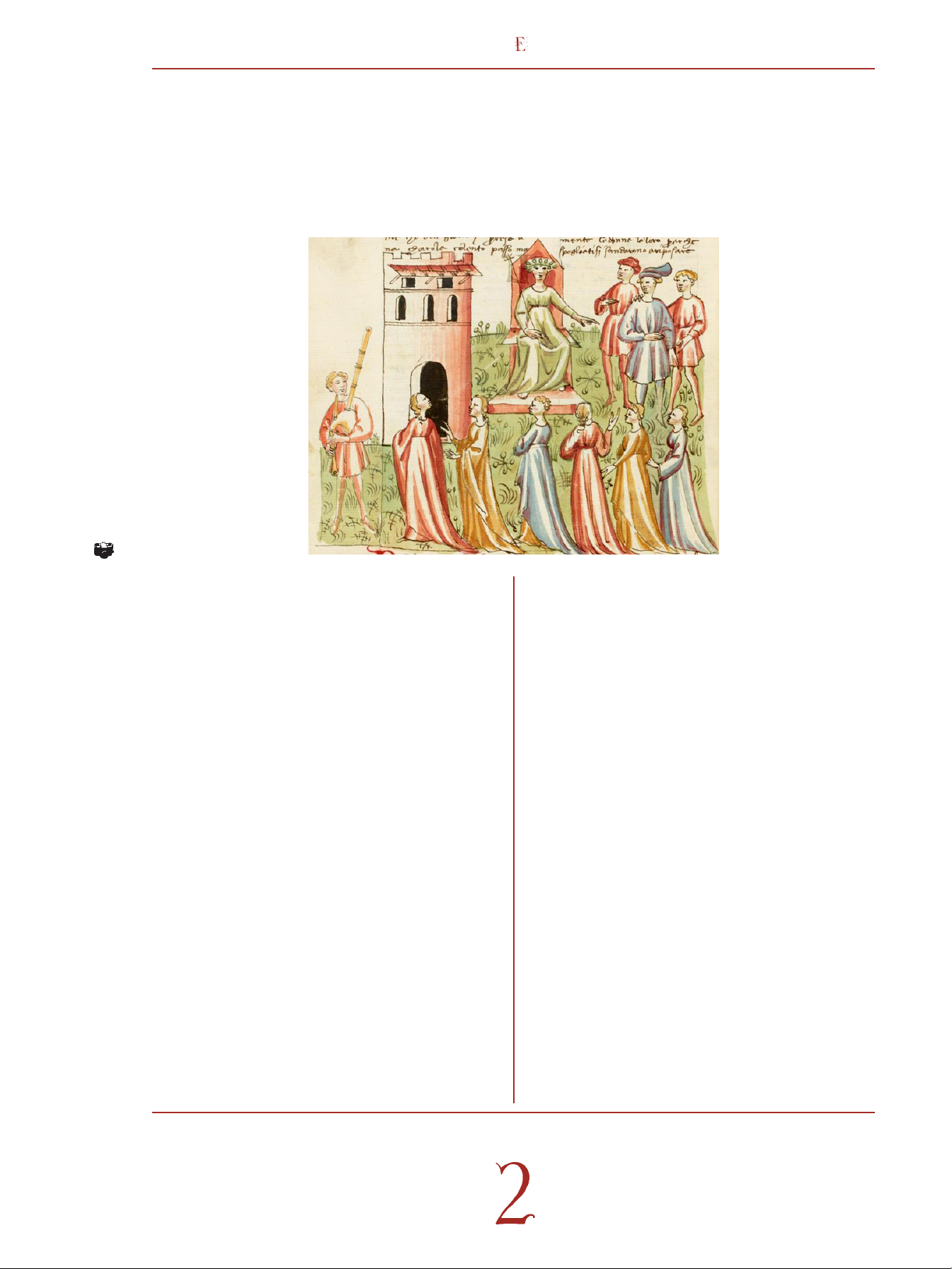
one hundred narratives of his Decameron (ca. 1350) variously as novellas,
fables, parables, or histories: “novelle o favole o parabole o istorie.”
Many scholars credit Boccaccio not only with inventing the genre, but
also with introducing a new theme (actual events from everyday life) and
a new medium (prose) into the mainstream of European letters (Auerbach
188-89).
The novella did not spring full-blown from Boccaccio’s pen, but had
several predecessors, among them the many medieval anecdotes, myths,
legends, fables, and tales that circulated orally throughout Europe and
that, when captured on paper, provided plot foundations for many no-
vellas. Another significant forebear, the exemplum, can be traced to Aris-
totle’s time. Originally a rhetorical device, the exemplum amounted to a
short anecdote or story that was used as an illustrative example. During
the Middle Ages the clergy wove such anecdotes into their sermons in
order to hold the interest of their parishioners and to simplify or illustrate
moral or theological points. Such anecdotes, believed to resemble
Christ’s parables, had the same dual purpose as did literature in general:
instruction and amusement (utilitas and delectatio), with utilitas being of
much greater importance than delectatio. Exempla became popular and
the clergy began to collect them in written form so they would be avail-
able for incorporation into sermons. The first such collection, Petrus Al-
fonsi’s Disciplina clericalis (ca. 1110), was soon followed by ones
assembled by Baudri of Bourgueil (d. 1130), John of Salisbury (d. 1180),
and others. Exempla also found their way into secular imaginative litera-
ture, such as Dante’s Divine Comedy and, of course, novellas.
Other antecedents of the novella include such Latin sources as Apu-
leius’s Satyricon and Petronius’s Metamorphoses. Written medieval
predecessors involve many folk tales (Volksbücher), Die Geschichte von den
sieben Weisen, and Gesta Romanorum. Oriental precursors of the genre
encompass such works as the Panchatantra and Arabian Nights — the
T

INTRODUCTION
x
former work, like the exemplum, exhibits moral overtones, whereas the
latter employs the frame or cyclical narrative structure that was utilized
by Boccaccio and for some time served as a hallmark of the novella.1 Yet
another set of forbears include the many biographies, lais, and fabliaux of
the medieval French troubadours.
With the advent of the Renaissance, the espoused functions of litera-
ture changed. The emphasis on religious and moral edification gradually
declined and, concomitantly, the emphasis on amusement and entertain-
ment increased. Many authors then reversed these two functions and of-
ten ignored the dictate of utilitas altogether. Boccaccio, after paying
perfunctory lip service to utilitas in the introduction of his Decameron,
stresses that he intends his stories to be read for pleasure. His narrative
stance — especially when telling overtly erotic or bawdy stories (and he
includes many such tales in his Decameron) — remains unabashedly
amoral.
Boccaccio and his work came under attack. One group of critics ac-
cused him of being a lecher who engaged in the inappropriate enterprise
of attempting to entertain women for his own immoral purposes. Other
critics noted that The Decameron contained stories that were silly or far-
cical and thus failed to conform to the serious, noble spirit of art. Another
group of critics condemned the collection because many tales were
bawdy — the criticism was directed not so much at Boccaccio’s emphasis
of the erotic, but at his refusal to draw morally exemplary conclusions.
And, to mention a last group, other critics attacked Boccaccio for casting
his stories in prose, a medium hitherto deemed inartistic. As a result of
such universal disapprobation, the collection eventually was placed on
the Index.
Despite (or, perhaps, because of) this censure, Boccaccio’s new genre
gained such immense popularity that over the course of the next three
centuries Romance Europe and England witnessed the publication of
more than a hundred novella collections. Notable Italian examples, in
addition to The Decameron, include such works as Giovanni Sercambi’s
Novelle (1374), Matteo Bandello’s Novelle (1573), and Giambattista
Basile’s Pentamerone (1636). Significant French collections comprise the
anonymous Les Cent nouvelles nouvelles (ca. 1460) and Marguerite de Na-
varre’s Heptameron (1558). Marguerite, it should be noted, departs from
the general trend since she covertly stresses utilitas in her work. Spanish
examples include Cervantes’s Novelas ejemplares (1613), Lope de Vega’s
Novelas (1624), and M. de Zayas y Sotomayor’s Novelas amorosas y exem-
plares (1649). English representatives involve such works as Chaucer’s
Canterbury Tales (ca. 1390), John Rastell’s One Hundred Merry Tales
(1526), and William Painter’s Palace of Pleasure (1567). Chaucer, it should
1In the frame of Arabian Nights Scheherazade tells an exciting story every
night and thereby stays alive to tell another story the following night. In The
Decameron ten young men and women flee from the plague ravaging Florence
and repair to a country villa, where they each tell one story per day for ten
days.
INTRODUCTION
xi
be noted, incorporates the framework often associated with the early no-
vella, but departs from the mainstream of novellistic tradition by casting
his work in verse rather than prose.
While novellas continued to be popular in the Romance countries and
England up to the middle of the seventeenth century, German-speaking
areas of Europe failed to produce such narratives until much later. Al-
though early German humanists such as Niklas von Wyle, Albrecht von
Eyb, and Heinrich von Schlüsselfelder exhibited much interest in the
genre during the second half of the fifteenth century, this interest mani-
fested itself not in the creation of novellas, but in the translation and ad-
aptation of Romance examples (most often from The Decameron). The first
half of the sixteenth century, dominated by the turmoil of the Protestant
Reformation, witnessed a loss of interest in the literary, as well as the
other arts.
With the Peace of Augsburg (1555), which temporarily ended the re-
ligious strife of the Reformation, a new literary era was initiated by Jörg
Wickram’s Rollwagen-Büchlein (1555), a work whose popularity led to
many imitations. This epoch was characterized by the Schwank, a short,
humorous, quite often vulgar story. Although many such tales revealed
Boccaccian influences, and although their avowed purpose was that of
entertainment, the moral and religious climate of the times was such that
many authors of Schwänke felt compelled to incorporate observations and
statements into their stories that comported with the dictates of utilitas.
While research into the short prose narratives of the next literary pe-
riod, the Baroque, remains relatively scant, scholars have identified
three successive stages: continuation of the Schwank literature, continued
adaptation of the Romance novellas (which at this time also included the
novellas of Cervantes), and incorporation of various novellistic narratives
into novels. Of interest, in addition to Hans Jakob Christoffel von
Grimmelshausen, who is often credited with writing three lengthy novel-
las, is Georg Philipp Harsdörffer, who in 1650 published nearly one thou-
sand relatively short stories in two separate volumes.
The short prose narratives of the eighteenth century can be classified
into three categories: moral tales, philosophical tales, and fairy tales.
The first phase, imitative of Joseph Addison and Richard Steele’s The
Tatler (1709) and The Spectator (1711), saw the establishment of periodi-
cals in Germany that published moralische Beispielerzählungen, tales that
adhered to the requirements of utilitas. Under the influence of Jean-
François Marmontel’s contes moraux (1761), these tales evolved into the
very popular moralische Erzählung, many examples of which suffered
from being hackneyed. A subgenre of such tales, the Kriminalgeschichte,
often described actual events and attempted to foster a humane, objective
sense of justice. Examples of such stories include Johann Michael Rein-
hold Lenz’s Zerbin (1776) and Schiller’s Verbrecher aus verlorener Ehre
(1786). The second phase, inspired by Voltaire’s Contes philosophiques
(especially Candide, 1759), led to narratives that attempted to wrap a phi-
losophical thesis in fictional form. Examples of such tales include Chris-
toph Martin Wieland’s Koxkox und Kikequetzel (1770) and several of
INTRODUCTION
xii
Anton Wall’s Bagatellen (1783). The final phase, that of the fairy tale, also
had its origins in France. Charles Perrault’s Mother Goose tales crossed
the Rhine and inspired such many-volume collections as Johann Karl
August Musäus’s Volksmärchen (1762-86) and Wieland’s Dschinnistan
(1786-89).
Although several critics classify a few of the above-mentioned narra-
tives as novellas — some even cite short medieval verse epics as exam-
ples of the genre — the preponderance of critical opinion declares that
the novella did not put on German garb until Goethe published his Unter-
haltungen deutscher Ausgewanderten in Schiller’s journal, Die Horen, in
1795. In this work Goethe follows the traditions of the Romance novella
not only by patterning his framework on the Decameron,1 but also by in-
corporating narratives from Romance sources: one novella comes from
Les Cent nouvelles nouvelles, one from the memoirs of a French actress, and
two from the memoirs of the French Marshal de Bassompierre. Although
both Goethe and Schiller were fully aware that the work followed the
traditions of the Romance novella — Schiller even referred to it as “eine
Suite von Erzählungen im Geschmack des Boccaz” — neither author used
any variants of the word novella in describing Unterhaltungen, but instead
employed the terms Geschichte and kleine Erzählung.
Shortly after the publication of Goethe’s narrative cycle, Ludwig
Tieck and Wilhelm Heinrich Wackenroder ushered in Romanticism, a
literary movement that stressed the fantastic and the wondrous. Critics
categorize the shorter prose tales of Romanticism as Kunstmärchen, Mär-
chennovellen, Novellenmärchen, and Novellen, and note that in their his-
torical unfolding these narratives exhibit both a departure from and a
return to realism (Rowley 97-99; Trainer 121-124). The fairy tale of early
Romanticism depicts a world of fantasy. This genre is replaced by one
that displays strong realistic traits, but is still dominated by fantasy. This
narrative is followed by one that emphasizes reality, but retains fantastic
elements. The latter narratives frequently exhibit a narrative technique
that allows for the incorporation of information on two levels. This tech-
nique, called the double narrative plane (“der doppelte Boden”), allows
for two interpretations — one realistic, the other fantastic (Erné 53-61).
Romanticism was supplanted by the Biedermeier period. In roughly
1820 Ludwig Tieck, who helped inaugurate Romanticism, abandoned the
fantastic themes associated with that literary approach and began to cul-
tivate the novella. The novella of this period, as several scholars note, re-
turned to realism, yet often retained traces of the Romantic wondrous. At
this time the term Novelle began to acquire popularity and, once it be-
came established, narratives with the label novella appeared in such
1In the frame Goethe describes how the upheavals of the French Revolution
force a German baroness and her family to flee from their home on the west
bank of the Rhine to an estate on the east bank. Once settled there, a heated
political argument erupts and the baroness attempts to restore harmony by
banning controversial topics. The family chaplain then volunteers to provide
entertainment by telling stories.
INTRODUCTION
xiii
large numbers that in 1834 Theodor Mundt felt justified in referring to
the genre as a German pet — “ein deutsches Haustier.” Since more than
500 authors were writing novellas between 1820 and 1848, many of these
narratives, much like the moralische Erzählungen a half century earlier,
suffered from being trite. Yet, despite the poor quality of many novellas
of this era, outstanding examples were written by such authors as Adal-
bert Stifter, Annette von Droste-Hülshoff, Jeremias Gotthelf, and Franz
Grillparzer (Schröder 53-73).
The political turmoil of 1848 brought an end to the Biedermeier era.
The next literary phase, Poetic Realism, was named after an essay by
Otto Ludwig. This literary approach attempted to depict everyday real-
ity, not with stark, photographic exactitude, but in conformity with such
artistic principles, among others, as aesthetic selectivity, symbolism,
and abstraction. While writers in other countries were devoting their ef-
forts to producing novels, their German counterparts were cultivating
the novella. Works by such German-speaking authors as Theodor Storm,
Gottfried Keller, Wilhelm Raabe, Conrad Ferdinand Meyer, Eduard
Mörike, Adalbert Stifter, Marie von Ebner-Eschenbach, and Paul Heyse,
to name only a few, dominated the literary scene and led to the conclu-
sion, drawn by artists and critics alike, that the novella in its modern
manifestation was primarily, if not exclusively, a German genre.
In the late 1880s, with the migration of Naturalism into Germany, the
novella became passé for many writers of the new generation who
seemed to prefer such genre labels as Skizze, Studie, Kurzgeschichte, and
Erzählung. Gerhart Hauptmann, for example, subtitled Bahnwärter Thiel a
“novellistische Studie.” Although many writers and critics were alarmed
at this development and attempted to sustain the popularity of the no-
vella, the battle for retaining its preeminence was lost by the end of the
century. The genre did not disappear — writers during the first half of
the twentieth century such as Robert Musil, Thomas Mann, Ernst
Wiechert, Paul Ernst, Stefan Zweig, and Stefan Andres, to name only a
few — continued to produce novellas. The popularity of the novella,
however, had declined to the point that it became only a rank and file
member of German genres. After World War II novella production con-
tinued, but on a reduced scale. Notable authors include Anna Seghers,
Stefan Zweig, Gertrud von Le Fort, Werner Bergengruen, and Christa
Wolf. In 1961 Günter Grass published Katz und Maus, perhaps the most
famous novella of the postwar era. For almost twenty years a hiatus in
novella writing in Germany prompted many critics to declare the genre
dead. This announcement proved premature, for in 1978 Martin Walser
published Ein fliehendes Pferd, a novella that for months stood first on the
German bestseller lists. The success of Walser’s work seems to have re-
vived the genre, for the current generation of German writers is, once
again, producing novellas.
INTRODUCTION
xiv
Theory of the Novella
In their study of the Renaissance novella, Robert Clements and Jo-
seph Gibaldi note that literary commentators of that period failed to de-
velop a theory for the genre. They attribute this failure to the
circumstance that classical aestheticians (Aristotle and Horace) had ig-
nored prose as an artistic medium.1 German writers, unlike their Renais-
sance colleagues, began almost immediately to speculate about the genre
and, as its popularity grew, developed a wide-ranging theory. Since the
scope and volume of the criticism, generated by authors and scholars, is
huge, an introductory essay such as this can only hope to deal briefly
with the most important facets of this theory.
Christoph Martin Wieland first introduced the German word Novelle
in 1764 by including it among a list of foreign narrative types. In 1772 he
provided the first, rudimentary definition: a novella is a type of narrative
that can be distinguished from the novel through the simplicity of the
plan and the small compass of the plot. Eight years later he characterized
the genre as a small, interesting narrative that describes only one main
“Situation” or one knot (“Knoten”). In the preface to his Novelle ohne Titel
(1804), Wieland noted that novellas describe events (“Begebenheiten”)
that, while not commonplace, could nevertheless have occurred in the
everyday world.
In the frame commentary of Unterhaltungen, Goethe, in 1795, has his
principal narrator, the chaplain, characterize his stories: they do not deal
with great historical events, but describe incidents or events (“Begeben-
heiten”) that come from the everyday world. These narratives involve
ingenious twists, reveal hidden aspects of human nature, or portray in-
stances of foolishness. Many of his stories deal with situations where
chance has an impact on human foibles. The chaplain also notes that his
tales exhibit such realism that his listeners will be unable to tell whether
they are invented or are accounts of real incidents. The aim of all his sto-
ries, the chaplain emphasizes, is that of entertainment (Unterhaltung). Af-
ter six narratives have been told, the chaplain’s listeners (the
Ausgewanderten of the frame) tire of realistic stories and request a fairy
tale. Before allowing the chaplain to tell such a tale, Goethe gives a clear
signal that there will be a change in genre by having a frame character
ask the chaplain to exclude from his tale things that actually happened
(“das, was wirklich geschehen ist”). He does so on the basis that if the
fairy tale were hitched to truth (“Wahrheit”), the resulting narrative
would be a monster (“ein Ungeheuer”). The chaplain allows for no other
criteria because, he insists, the fairy tale is a product of the imagination
that is uniquely endowed with its own set of aesthetic wings. The chap-
lain then narrates a fairy tale, entitled Das Märchen, and Unterhaltungen
ends at that point as a fragment.
1In a chapter devoted to analyzing the structure of the novella collection,
Clements and Gibaldi work out a seven-point theory of the Renaissance no-
vella (4-26).
INTRODUCTION
xv
Goethe’s collection proved to be significant because it introduced two
narrative types into the German genre repertoire, the artistically created
fairy tale (das Kunstmärchen) and the novella. Goethe apparently believed
that much potential grief lay in combining the two worlds of these genres
and called for strict separation. Twelve years later, when he published
the first narrative he himself labeled a novella, Die wunderlichen
Nachbarskinder, Goethe again stressed realism by describing the genre as
the narration of one strange event that actually took place. In 1827, upon
discussing a story that he paradigmatically entitled Novelle, Goethe de-
livered an epigrammatic definition: a novella is a novel event that took
place (“denn was ist eine Novelle anders als eine sich ereignete
unerhörte Begebenheit”). This characterization, Goethe insisted, cap-
tures the essence of the genre: “Dies ist der eigentliche Begriff.”
Shortly after the publication of Unterhaltungen, the brothers Schlegel,
the principal theoreticians of Romanticism, began to speculate about the
nature of the novella. Friedrich, in his various Fragmente, noted that a
novella consists of a well-told event (“Begebenheit”) that is true
(“wahr”), yet deals with a singular oddity (“Seltsamkeit”). In an essay on
Boccaccio published in 1801, Friedrich noted that the most remarkable
feature of the novella involves the author’s narrative stance, which is
both objective and subjective. Since the novella is based on a real event,
history provides accurate details (“das Lokale und Costum”), thereby in-
clining the author toward objective depiction. Such overt objectivity al-
lows the writer to superimpose his covert (“indirekte und verborgene”)
subjectivity. This dual narrative approach lends every novella unique-
ness and charm. The genre also displays an all-inclusive unity similar to
the one postulated by Aristotle for the tragedy. Friedrich then called
attention to the close relationship between the novella and the drama. Af-
ter observing that several of Shakespeare’s dramas are based on novellas,
he goes so far as to claim that the form of Shakespeare’s plays cannot be
understood without a familiarity with novellas: “ohne Novellen zu ken-
nen, kann man Shakespeares Stücke nicht verstehen der Form nach.”
August Wilhelm Schlegel noted that the driving force behind the no-
vella is action: “in der Novelle muß etwas geschehen.” Much like his
brother, who noticed a certain tension in the novella that arises from a
dual narrative approach, August Wilhelm also detected a tension, but at-
tributes it to the genre’s dual thematic content. The novella, he ob-
served, deals with real events (“wirklich geschehenen Dingen”) that are
extraordinary (“außerordentlich . . . einzig . . . Unwahrscheinlich . . .”).
The demands of these conflicting criteria not only lead to a tension
within the novella, but represent a dilemma for the author. August
Wilhelm advocated that the writer give short shrift to the commonplace
and emphasize the extraordinary. Much like Friedrich, August Wilhelm
also saw a kinship between the novella and the drama and postulates that
every novella may be convertible to a drama. The novella, moreover, re-
quires decisive turning points or reversals (“die Novelle bedarf
entscheidender Wendepunkte”), a need it shares with the drama: “dies
INTRODUCTION
xvi
Bedürfnis hat auch das Drama.” With this criterion Schlegel came close
to reproducing Aristotle’s notion of peripeteia.
During the Biedermeier period, just as during the Romantic era,
writers continued to speculate about the nature of the novella. Willibald
Alexis observed that the genre deals with only a few events and people
and that it exhibits brevity and unity. Theodor Mundt in 1828 theorized
that the novel portrays a macrocosm, as opposed to the novella, which
describes a microcosm. In form the novel is linear, whereas the novella is
circular and exhibits a midpoint (a “Centrum” or “Mittelpunkt”) that
serves as a hub from which all action radiates and that determines the
ending. In 1829, after having written roughly a dozen novellas, Ludwig
Tieck observed that the genre takes one event and places it under a spot-
light: “[stellt] einen . . . Vorfall ins hellste Licht.” This incident, while
originating in the real world, is wondrous or unique (“wunderbar,
vielleicht einzig”). Once the event’s singularity has manifested itself, the
story line takes a dramatic change of direction that leads to a logical, yet
unforeseen, ending. Tieck at first called this change the midpoint and a
few lines later the turning point (“Wendepunkt”). Tieck allowed the no-
vella much freedom with respect to form and content, but insisted that a
genuine novella (“eine echte Novelle”) will always have a
“Wendepunkt.”
The Revolutions of 1848 brought an end to the Biedermeier. The next
literary period, Poetic Realism, also saw its share of theoreticians. Frie-
drich Theodor Vischer observed that the novella is related to the novel as
a single ray of light is related to a broad beam (“wie ein Strahl zu einer
Lichtmasse”). The genre deals with a single incident — one crisis, one
human experience, one twist of fate. The novella, unlike the Schwank or
anecdote, affords an insight into the depths of life and leans toward the
tragic. Wilhelm Heinrich Riehl observed that action dominates in the
novella as it ties and unravels one knot. Paul Heyse, in the foreword of
Deutscher Novellenschatz (an anthology of novellas published in 1871),
noted that the novella deals with the deepest and most morally signifi-
cant questions of life. Heyse distinguished between the novel and the
novella by scope: the former portrays several human lives through a se-
ries of interlocking circles and attempts to depict a whole society; the lat-
ter is a concentrated portrayal of one such circle and attempts to depict
one human being in action. The basic plot of a novella should be unique
and should be such that it lends itself to a brief summary that stands out
in strong relief or silhouette. This characteristic is so important that it
can be used to determine whether a plot is suitable for a novella. As an
example, Heyse analyzed Boccaccio’s ninth novella of the fifth day, the
story of Federigo and his falcon. This story incorporates all the features of
a novella and portrays the lives of two people affected by a twist of fate.
The falcon, moreover, makes this tale unique so that it remains imprinted
in the memory of the reader. This portion of Heyse’s observations became
famous as “die Falkentheorie” and was interpreted to mean that a novella
should contain a concrete, unifying symbol. Four years after Heyse’s
pronouncements, Gottfried Keller remarked that the penchant for a priori
INTRODUCTION
xvii
speculation about the novella is unwarranted, especially since the genre
is still in its formative stages. Disdaining all theory, Keller simply ad-
vocated that writers do their best and, with their next effort, try to im-
prove. In 1876 Friedrich Spielhagen noted that the novella has a small
cast of fully-developed or fixed characters, that it deals with one event or
incident, and that it comes to a rapid conclusion so consistent with the
nature of the characters that the ending seems predetermined. Theodor
Storm, in 1881, observed that the novella no longer is just the brief ac-
count of a gripping event — it has become a serious art form that can
deal with the most profound questions of life. Like its sister, the drama,
the novella requires an organizing conflict at its midpoint and a tautness
of style that deals only with essentials.
The comments of the last two critics represent a turning point of sorts
in novella theory. The earlier commentators seem to have based their
theories on several sources: Aristotle’s Poetics, Renaissance and German
novellas, other critics, and original observations. Spielhagen and Storm
rely more on earlier findings than they do on the other bases. Theorizing
about the genre, instead of expanding it, seems to have come to stand-
still, if not an actual retreat. Speculation about the novella did not cease,
for older critics remained engaged with theory, and new ones like Paul
Ernst, Heinrich Hart, and Robert Musil also added their voices to the
critical forum. Yet their pronouncements, like those of Storm and Spiel-
hagen, seem more derivative than original.
The major tenets of German novella theory were essentially in place
by 1900. These tenets declare the novella to be an amalgam of the various
notions advanced by the individual commentators over the course of the
century. The primary characteristics of the genre are as follows:
1. It uses a frame structure,
2. It deals with a highly unusual, yet realistic or verisimilar event,
3. It exhibits a small cast of fixed characters,
4. It emphasizes, much like the drama as defined by Aristotle, event
over character,
5. It has a compact structure (which has led modern critics to cite
medium length as a criterion),
6. It incorporates one or more turning points or reversals
(“Wendepunkte”) that lead to sudden shifts or changes in the action of
the story,
7. It exhibits a central symbol (“Dingsymbol”) that in many ways re-
flects and informs the whole narrative (modern critics note that at times
symbolism takes the form of a leitmotif),
8. It typically uses a narrative stance of overt objectivity and covert
subjectivity,
9. It often portrays a twist of fate.
As several critics have pointed out (including the brothers Schlegel,
Tieck, Storm), the genre seems to be constructed according to dramatic,
rather than epic, principles. As a consequence, many criteria developed
by theoreticians for the novella can also be found in either direct or cog-
nate form in Aristotle’s discussion of the tragedy in The Poetics.
INTRODUCTION
xviii
After World War I, with the birth of a new academic discipline
called literary studies (Literaturwissenschaft), the identity of the theoreti-
cians underwent a change. Before the war, creative writers dominated
attempts to formulate theory. After the war, artists fell silent and scholars
monopolized the critical discourse. Initially these commentators at-
tempted to illuminate the theories of earlier artists. As the discipline ma-
tured, scholars also began to react to each other’s findings and to
formulate theories of their own. These approaches have led to a large
body of secondary literature that can be roughly classified into three
groups: the rigorists, the latitudinarians, and the moderates. The rigor-
ists (their numbers are in decline) declare that in order to qualify as a
novella, a narrative must exhibit many (if not all) of the above features.
The latitudinarians, highly skeptical of all theory, either postulate that
there is no such genre as the novella or, if we must cling to the term, that
the novella exhibits only one characteristic — that of medium length.
The moderates undogmatically note that there is such a genre and that it
tends to exhibit several common features that point toward family re-
semblance.
All three scholarly stances are open to criticism. The rigorist position
can be undermined by pointing out that very few, if any, of the works
usually classified as novellas exhibit all the features required by tradi-
tional novella theory. The viewpoint of the latitudinarians is also vulner-
able. If there is no such genre, what are we to make of the many
narratives that the authors themselves label as novellas? If, on the other
hand, the novella has only one distinguishing feature of medium length,
then many modern novellas and nearly every Renaissance example, in-
cluding most (if not all) of Boccaccio’s tales, would be excluded from the
genre. Logical extension would then dictate that if the novella exhibits
this one characteristic and no others, then the only difference among the
three basic prose narratives (the short story, the novella, and the novel)
is that of length. The notion of length, moreover, would have to be de-
fined in arbitrary terms. The moderate view, espousing the notion of
family resemblances, is as problematic as the other two: if one school of
scholars is unable to agree on the existence of even one criterion, then
arriving at an agreement on several characteristics, no matter how un-
dogmatic the stance may be, becomes, for all practical purposes, impos-
sible.
Despite the failure of scholarship to establish even a tentative defini-
tion of a very popular genre, empirical evidence seems to point at the
moderate stance as being the most tenable. An examination of nine-
teenth-century prose narratives reveals a relatively large number of sto-
ries that quite often exhibit such characteristics as a frame, medium
length, one unusual but realistic event, as well as other characteristics
associated with the genre by German critics. Although this is hardly the
place to attempt a sweeping survey of other literatures, it might be
pointed out that, in addition to many German examples, Joseph Conrad’s
Heart of Darkness, Herman Melville’s Benito Cereno, Prosper Mérimée’s
Carmen, and Leo Tolstoy’s The Death of Ivan Ilyich (to name only four rep-
INTRODUCTION
xix
resentative non-German examples) are all narratives of medium length
that may be said to deal with single, central events that are highly un-
usual yet realistic. The first three stories exhibit the frame often associ-
ated with the novella.
It may be worth noting, perhaps only parenthetically, that for dec-
ades scholars of English-language literature labored with such terms as
long short story, short novel, and novelette to describe narratives of me-
dium length. In 1967 Gerald Gillespie undertook a brief survey of German
novella theory and pointed to a “noticeable gap” in English genre termi-
nology because it employs only the terms short story and novel. After ana-
lyzing Hemingway’s The Old Man and the Sea, Gillespie observed that this
“short novel” exhibits such novellistic features as an unheard-of-event, a
turning point, a central symbol, and dramatic structure and tension. Af-
ter analyzing several other non-German narratives of medium length,
Gillespie calls for the adoption of the term novella. Other scholars have
echoed Gillespie’s call and, in the last two decades, the term has gained
currency in the United States.
A Word on Selections
It has become standard practice for editors to lament over how lack of
space has forced them to exclude many fine examples of the type of work
they are anthologizing. Such is the case here. Many outstanding novel-
las, especially those from the age of Poetic Realism, had to be excluded
for reasons of space. Faced with a choice of including a relatively large
number of short narratives or only a handful of long ones (many novellas
from the Age of Poetic Realism are more than a hundred pages long), the
editor chose the former course. This decision was driven mainly by the
principle of availability: many shorter works included in this collection
are available to the reader only in an expensive volume of an author’s
collected works. Long novellas by such authors as Jeremias Gotthelf,
Gottfried Keller, Conrad Ferdinand Meyer, Theodor Storm, and Wilhelm
Raabe, to name only the most outstanding ones, are readily available in
inexpensive, one-volume paperback editions.
INTRODUCTION
xx
Books for Further Reading
The following list of works has been compiled with the aim of provid-
ing the interested reader with a sampling of the history of the novella, of
genre theory, and of interpretations of individual narratives.
Auerbach, Erich. Mimesis: The Representation of Reality in Western Litera-
ture. Trans. Willard R. Trask. New York: Doubleday, 1957.
Aust, Hugo. Novelle. Stuttgart: Metzler, 1990. Provides an introduction
and excellent bibliography to the history and theory of the novella.
Bennett, E. K. and H. M. Waidson. A History of the German Novelle from
Goethe to Thomas Mann. 2nd ed. Cambridge: Cambridge UP, 1961. Il-
luminates standard novella theory and traces the history of the no-
vella.
Boccaccio, Giovanni. The Decameron. Trans. Mark Musa and Peter Bon-
danella. New York: W. W. Norton, 1982.
Clements, Robert J. and Joseph Gibaldi. Anatomy of the Novella: The
European Tale Collection from Boccaccio and Chaucer to Cervantes. New
York: New York UP, 1977. Provides an in-depth study of the Renais-
sance novella in the Romance countries and England.
Ellis, John M. Narration in the German Novelle: Theory and Interpretation.
Cambridge: Cambridge UP, 1974. A skeptic, Ellis analyzes standard
theory and offers interpretations of eight German novellas.
Erné, Nino. Kunst der Novelle. Wiesbaden: Limes, 1956.
Gillespie, Gerald. “Novella, Nouvelle, Novelle, Short Novel? — A Re-
view of Terms.” Neophilologus 51 (1967): 117-27, 225-30. Gillespie ini-
tiates the drive to adopt the English word novella.
Himmel, Hellmuth. Geschichte der deutschen Novelle. Bern: Francke, 1963.
Himmel provides an excellent history of the genre, a skeptical analy-
sis of novella theory, and an in-depth history of the German novella.
Hoffmeister, Werner. “Die deutsche Novelle und die amerikanische
‘Tale’: Ansätze zu einem gattungstypologischen Vergleich.” German
Quarterly 63 (1990): 32-49. Concludes that the early American tales of
Poe, Hawthorne, and Irving have much in common with the German
novella of the first half of the nineteenth century.
Klein, Johannes. Geschichte der deutschen Novelle von Goethe bis zur
Gegenwart. 4th ed. Wiesbaden: Steiner, 1960. A rigorist, Klein pro-
vides an introduction into novella theory and then traces the history of
the genre from its beginnings to the middle of the twentieth century.
INTRODUCTION
xxi
Kunz, Josef. Novelle. Darmstadt: Wissenschaftliche Buchgesellschaft,
1968. An invaluable collection of essays on the theory of the genre,
emphasizing the findings of scholars during the first half of the twen-
tieth century.
Paine, J. H. E. Theory and Criticism of the Novella. Bonn: Bouvier, 1979. A
comparative study that, after illuminating German novella theory,
applies this theory to the narratives of other countries. Paine devotes a
lengthy chapter to analyzing Heart of Darkness in terms of the novella.
Paulin, Roger. The Brief Compass: The Nineteenth-Century German
Novelle. New York: Oxford UP, 1985. Paulin provides an introduction
to novella theory from a moderate viewpoint.
Polheim, Karl Konrad, ed. Handbuch der deutschen Erzählung. Düsseldorf:
Bagel, 1981. A skeptic, Polheim calls for the eradication of the word
Novelle and advocates that, henceforth, all narratives of medium
length should be called Erzählungen. The text proper of this massive
volume contains thirty-five essays by leading scholars of German let-
ters that deal with various historical periods and individual authors.
———, ed. Theorie und Kritik der deutschen Novelle von Wieland bis
Musil. Tübingen: Niemeyer, 1970. An invaluable book in which Pol-
heim assembles reprints of statements germane to the theory of the
novella written between 1772 and 1914.
Remak, Henry H. H. “Wendepunkt und Pointe in der deutschen Novelle
von Keller bis Bergengruen.” Wert und Wort: Festschrift für Else Fleis-
chner. Ed. Marion Sonnenfeld, et. al. Aurora, New York: Wells Col-
lege, 1965. 45-56. Remak postulates that the novella quite often
contains two “Wendepunkte,” the first to initiate, the second to re-
solve the action.
Rowley, Brian. “The Novelle.” The Romantic Period in Germany. Ed. Sieg-
bert Prawer. New York: Schocken, 1970. 121-46.
Ryder, Frank. Die Novelle. New York: Holt, 1971. In the foreword of this
anthology Ryder presents the moderate view of novella theory that
espouses the notion of family resemblances.
Schröder, Rolf. Novelle und Novellentheorie der frühen Biedermeierzeit.
Tübingen: Niemeyer, 1970.
Silz, Walter. Realism and Reality: Studies in the German Novelle of Poetic
Realism. Chapel Hill: University of North Carolina Press, 1965. After
presenting a brief, undogmatic analysis of standard German novella
theory in the foreword, Silz interprets nine novellas.
Steinhauer, Harry. “Towards a Definition of the Novella.” Seminar 6
(1970): 154-74. After excoriating the results of German novella theory
as “contradictory,” “shallow,” and “absurd,” Steinhauer, a latitudi-
narian, observes that the novella tells “an exciting story.”
INTRODUCTION
xxii
Swales, Martin. The German Novelle. Princeton: Princeton Un. Press,
1977. A moderate, Swales provides an introduction to the theory of the
genre and then interprets seven novellas. Each interpretation focuses
upon the narrative voice and how this voice attempts to understand
and interpret the central novellistic event.
Trainer, James. “The Märchen.” The Romantic Period in Germany. Ed.
Siegbert Prawer. New York: Schocken, 1970. 97-120.
Weing, Siegfried. The German Novella: Two Centuries of Criticism. Co-
lumbia, S.C.: Camden House, 1994. After providing three chapters on
the history of the genre and the development of nineteenth-century
theory, Weing devotes five chapters to analyzing modern novella
scholarship between 1915 and 1991.
Wiese, Benno von. Die deutsche Novelle von Goethe bis Kafka:
Interpretationen. Düsseldorf: August Bagel, 1956. After analyzing
standard novella theory, Wiese interprets seventeen German novellas.
———. Novelle. Stuttgart: Metzler, 1963. Wiese provides a treatise on
the history and theory of the genre.