Jewish Review of Books PDF Free Download
1 / 48/48
100%

New Summer Fiction!
V , N S .
Daniel C. Matt
Before the
Big Bang
Michah Gottlieb
Are We All
Protestants
Now?
Allan Arkush
Jeremy Rabkin
Peace & War
Catherine
C. Bock-Weiss
Matisse's
Jewish Patrons
Ilan Stavans
Borges'
Jewish Writing
JEWISH REVIEW
OF BOOKS
Shlomo Avineri
Herzl's Great
Bad Novel

The Book
of Job
Harold S.
Kushner
When Bad
Things
Happened
To A Good
Person
SCHOCKEN
BY
E
Abraham Socher
S C E
Allan Arkush
A E
Philip Getz
A D
Betsy Klarfeld
A E
Amy Newman Smith
I
Baruch Blum
E B
Robert Alter Shlomo Avineri
Leora Batnitzky Ruth Gavison
Moshe Halbertal Hillel Halkin
Jon D. Levenson Anita Shapira
Michael Walzer J. H.H. Weiler
Leon Wieseltier Ruth R. Wisse
Steven J. Zipperstein
P
Eric Cohen
D M
David Fishman
B M
Lori Dorr
J
EWISH
R
EVIEW
OF BOOKS
e Jewish Review of Books (Print ISSN 2153-1978,
Online ISSN 2153-1994) is a quarterly publication
of ideas and criticism published in Spring, Summer,
Fall, and Winter, by Bee.Ideas, LLC.,
745 Fih Avenue, Suite 1400, New York, NY 10151.
For all subscriptions, please visit
www.jewishreviewoooks.com or send $19.95
($29.95 outside of the US) to: Jewish Review of Books,
PO Box 3000, Denville, NJ 07834. Please send noti-
cations of address changes to the same address or to
subscriptions@jewishreviewoooks.com.
For customer service and subscription-related
issues, please call (877) 753-0337 or write to
service@jewishreviewoooks.com.
Letters to the Editor should be emailed to letters@
jewishreviewoooks.com or to our editorial oce,
3091 Mayeld Road, Suite 412, Cleveland Heights,
OH 44118. Please send all unsolicited reviews
and manuscripts to the attention of the editors at
submissions@jewishreviewoooks.com, or to our
editorial oce. Advertising inquiries should be sent
to ads@jewishreviewoooks.com or call (212) 796-
1669. Review copies should be sent to the attention of
the Associate Editor at our editorial oce.

V , N S
JEWISH REVIEW
OF BOOKS
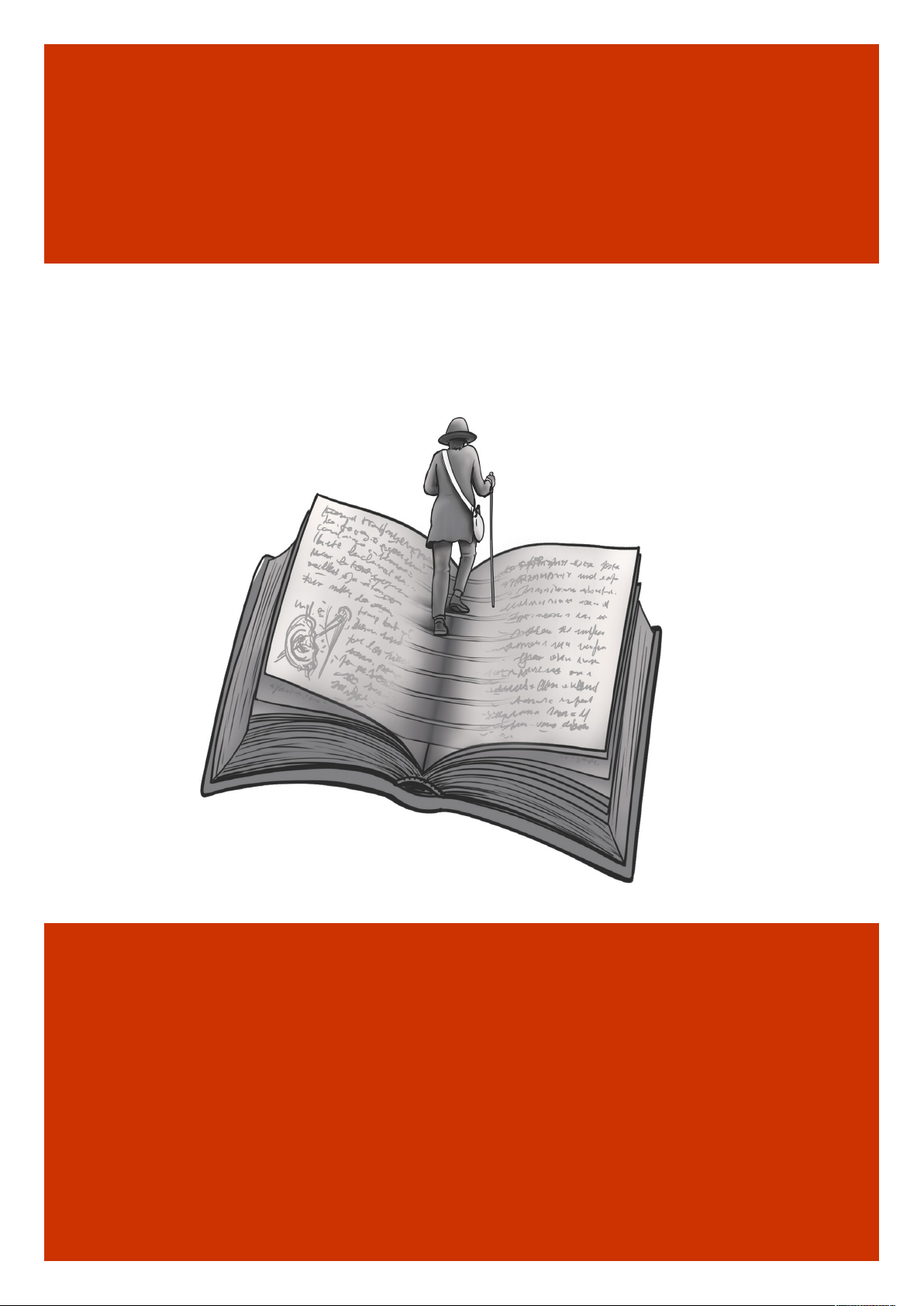
On the cover: “Matisse and the Big Bang” by Mark Anderson.
LETTERS
4 Too Much Chometz?
FEATURES
5 D C. M Before the Big Bang Cosmologist Lawrence Krauss thinks he knows how the universe began. Novelist Alan
Lightman takes a wild narrative guess.
7 A A War & Peace & Judaism Robert Eisen was walking to campus on 9/11 when he saw a dark cloud above the
Pentagon. Alick Isaacs was in Lebanon with the IDF when he began to think about peace and Judaism.
REVIEWS
11 A K The Mighty Jacobson Whatever It Is, I Don’t Like It: e Best Of Howard Jacobson by Howard Jacobson
e Finkler Question by Howard Jacobson • Kalooki Nights by Howard Jacobson • e Mighty Walzer
by Howard Jacobson • No More Mr. Nice Guy by Howard Jacobson
14 N A. SReorientation Jews, Christians, and the Abode of Islam: Modern Scholarship, Medieval Realities
by Jacob Lassner
15 M G Are We All Protestants Now? How Judaism Became a Religion: An Introduction to Modern Jewish ought
by Leora Batnitzky
19 J L. S Where Wisdom Begins Religion for Atheists: A Non-believer’s Guide to the Uses of Religion by Alain de Botton
20 G A. A Who Is Man? Demonic Desires: “Yetzer Hara” and the Problem of Evil in Late Antiquity by Ishay Rosen-Zvi
Sin: e Early History Of an Idea by Paula Fredriksen
23 P R Dust-to-Dust Song Nelly Sachs: Flight and Metamorphosis: An Illustrated Biography by Aris Fioretos,
translated by Tomas Tranæus
24 A M Israel's Arab Sholem Aleichem Second Person Singular by Sayed Kashua, translated by Mitch Ginsburg
26 N K A Neoplatonic Aair Melisande! What Are Dreams? by Hillel Halkin
28 A T Muddling Through e World Without You by Joshua Henkin
29 J R Lawfare Israel and the Struggle Over the International Laws of War by Peter Berkowitz
READINGS
33 I S Borges, the Jew
35 S A Rereading Herzl's Old-New Land
THE ARTS
39 C C. B- Matisse and His Jewish Patrons
W
42 A N S Homage to Mahj
LOST & FOUND
45 Y Y Berdyczewski, Blasphemy, and Belief
W
LAST WORD
47 A S Something Antigonus Said

4 JEWISH REVIEW OF BOOKS • Summer 2012
Too Much Chometz?
In Chronicles II 25:12, there is a horrifying image
of the sons of Judah throwing their captives o
a cli, dashing them to pieces on the rocks below.
is image came to mind as I was reading Leon
Wieseltier’s savaging of the New American Hagga-
dah (“Comes the Comer,” Spring 2012). In an age
when all sorts of abuse are being called out, this re-
view suggests a new species—the “abuse of scholar-
ship,” assuming one believes scholarship is meant to
enlighten, not to pummel an opponent who is un-
able to respond.
I write this letter not out of loyalty to the
author/translator. (I am a moderate fan of England-
er’s ctionand have never met him.) But, as a reader
of Jewish text, literature, and the Jewish Review of
Books,I feel ill served and even oended by Wiesel-
tier’s intemperate, condescending review.
Aer the rst half-dozen times that Wieseltier
challenges Englander’s translation/interpretation
of a word or phrase, I realized that he believes the
translation winnows out the intent and “mystery”
of the Haggadah and is not always melliuous. Wi-
eseltier bundles his criticisms in allusions to a suf-
cient number and diversity of sources to suggest
his own mastery of Jewish texts.But aer twenty-
ve to thirty such critical blows, prompting him
to characterize Englander’s work as “foolish,” “lu-
dicrous,” “clumsy,” and “ridiculous”—perhaps ar-
rogant charges leveled against a writer of serious
purpose—Wieseltier seems more like a man de-
termined to overwhelm us with his own scholar-
ship rather than to discredit the translator’s. Aer
a good 1,500 words of vitriol, Wieseltier seems to
realize his excess and oers us a witty one-word
paragraph as a salve. e word is dayenu. Unfortu-
nately, he is already many outstretched arms past
dayenu.
e problem that inspires this letter is that
aside from shamelessly dashing the defenseless
Englander to pieces on the rocks below, Wieseltier
demeans the reader of this journal as well.(I wish
the editorial wisdom of the Jewish Review of Books
had saved him from his relentlessness.) Even if the
New American Haggadah fails to meet Wieseltier’s
requirements for a “faithful” translation of the
Haggadah, his review implies through its excess
and invectives that anyone nding value or mean-
ing or an expanded kavana through Englander’s
take on the Pesach text is a muttonhead. Wieseltier
may have an axe to grind with Englander, or with
American Jews in general (he bemoans “the mag-
nitude of their illiteracy” in his rst paragraph),
but that doesn’t give him the right to subject us to
this hatchet job.
Len Lyons
Newton Highlands, MA
What Leon Wieseltier has given us is not a re-
view at all, but an editor’s mark-up of a man-
uscript, the sort of thing sent back to an author, who
might accept some of the points and argue down
others, sometimes changing the mind of the editor
along the way. ere’s a kind of role-play in such ex-
changes, in which the editor is obliged to assume an
almost prosecutorial stance, while the author plays
the defendant. For obvious reasons, such exchanges
are strictly private. Presented here, from one side
only, it becomes a slam, and a particularly cheap
one at that, in which the “reviewer” avails himself
of every opportunity to establish his nobility even
at the far edges of relevance. And yet, despite his
erudition, I believe that Mr. Wieseltier has failed to
grasp some important distinctions, and in doing so
missed the larger picture entirely.
To his rst complaint: e language of benedic-
tion is not prose, and it’s laden with meaning that is
not ordinary. (Is there anything ordinary about this
story?) It’s a formulation—a mantra, repeated again
and again throughout the service. So, to say “God-
of-Us” once may fall strangely on the ear, but repeat-
ed, as it is throughout the Seder, it becomes some-
thing else, and I, for one, feel we can only benet
from the particularity of treatment given to eloheinu
by Mr. Englander. “God-of-Us” implies a mutually
enveloping relationship, not a single-sided one. It’s
a stretch, perhaps, but one to which many of us as-
pire—it has kavana. I mention this because a Hag-
gadah, commentaries aside, is not a book to be read
as prose, and shouldn’t be criticized as such. Rather,
it’s a book to be experienced in a unique service in
our own homes, where we are free to vary and inter-
pret as we wish. Some might say the more halting,
the better, and let it rise above the picayune. What’s
more is that Mr. Safran Foer has given us some very
lively table company, a group of pesachdik ushpizin
(guests) with whom we can argue or agree as the
case may be.
But these are only trees, not the forest. In say-
ing nothing about the book’s quirky architecture or
what it feels like in use, and not a word about its
profuse illustrations (all of it the work of the out-
standing graphic artist Oded Ezer), Mr. Wieseltier
seems insensate to the experience of this Haggadah.
Would he look at the great Haggadahs of old, say
the Golden or Birds’ Head, and see only the mis-
spellings? And did he notice that there are no trans-
literations, ubiquitous in American Haggadahs? If
any book is greater than the sum of its parts, it’s the
Haggadah, and this one presents us with a very large
sum indeed.
Scott-Martin Kosofsky
Lexington, MA
I
am one of the many American Jews who has no
knowledge of Hebrew and can only sound out
the words without understanding the meaning of
more than a dozen of them. Of course, as a woman,
it would have been rare at any time in Jewish history
for me to have known much more than I do now.
And I question how many men whose religious
education began in the cheder (religious primary
school) and ended when they turned 13 would have
been much more uent. ere is a reason that the
Jews of Eastern Europe communicated in Yiddish,
not Hebrew.
My father, who had an Orthodox upbringing
and a good enough command of Hebrew to get by
in an Israeli kibbutz aer World War II, never at-
tempted to interpret the text of the Haggadah to us.
We either read the Maxwell House translation or lis-
tened to my father race through the Seder without
any comprehension. In my brief time as a supple-
mental school student, I learned to chant the four
questions without being able to understand them,
their function in the Seder, or their history.
Given that background, I am very grateful for Mr.
Englander’s new translation. I nd the “God-of-Us”
and other stretches of English usage refreshing and
thought-provoking. Even among those of us who do
not understand the Hebrew, the new translation has
inspired questions about what the text really means
and why. Even though I cannot really imagine that
I myself was a slave in Egypt or that God liberated
me personally, this translation and the commentar-
ies that accompany it encourage me to think about
the Seder as an expression of my cultural heritage
or Jewish identity and about how to present it to my
friends and family as something more than a shared
meal. Admittedly Judaism lite, but mine, such as it is.
Gilah Goldsmith
via jewishreviewoooks.com
Great review. In the Haggadah itself, I was im-
pressed by the carelessness regarding histori-
cal details and interpretations—also, the typos. Two
examples:
a) Mount Gezerim (for Gerizim). at might be re-
venge by Englander’s subconscious for his joke in
naming a ctional character something like Edgar
Gezer aer Etgar Keret (gezer being Hebrew for
carrot.)
b) In the hineni mukhan u-mezuman before some
cups of wine, he uses the word “besurat” instead of
the expected besorat (tidings of), for besora, tidings.
Perhaps besurat is the construct for the Spanish
basura (trash).
Gideon Weisz
via jewishreviewoooks.com
Leon Wieseltier Responds:
I
am sorry if I ruined anybody’s Pesach. e eight
days are hard enough without such polemical
nastiness, I know. I had hoped to welcome the New
American Haggadah to the world, not least because
its editor is (or perhaps was) my friend, and its trans-
lator, with whom I have enjoyed cordial relations,
seemed well equipped for his task. But I take these
things—Hebrew, English, my duty as a scholar, my
duty as a critic, my duty as a Jew—very seriously,
4 JEWISH REVIEW OF BOOKS •
LETTERS
(Continued on page 46)

Summer 2012 • JEWISH REVIEW OF BOOKS 5
FEATURES
Before the Big Bang
BY DANIEL C. MATT
Can we explain how the universe began
without invoking God? Certainly, an-
swers the noted cosmologist Lawrence
Krauss in A Universe from Nothing: Why
ere Is Something Rather an Nothing, because,
bizarre as it sounds, “nothingness” contains
energy. Near the beginning of time (approximately
13.72 billion years ago), through a process of
rapid expansion, this energy of empty space was
converted into the energy of something—particles
and radiation.
e modern scientic creation story goes like
this: Within a second or so aer the Big Bang,
the building blocks of atoms emerged—protons,
neutrons, and electrons. By the end of three
minutes, protons and neutrons joined, forming the
rst atomic nuclei. But roughly 300,000 years passed
before things cooled down enough for electrons to
combine with these nuclei to create full-edged
atoms. Over the next billion years, giant clouds of
such primordial atoms coalesced to form stars and
galaxies. Deep within these stars, nuclear reactions
gave birth to heavier elements such as carbon and
iron. When the stars grew old, they exploded, spew-
ing these elements into the universe. Eventually this
matter was recycled into solar systems such as ours.
Krauss writes, “One of the most poetic facts I
know about the universe is that essentially every
atom in your body was once inside a star that
exploded.” We, along with everything else, are
literally made of stardust.
Taken together with the elegant laws that govern
the universe, such facts evoke a sense of wonder.
As Krauss writes, “for Einstein, the existence of
order in the universe provided a sense of such
profound wonder that he felt a spiritual attachment
to it, which he labeled . . . ‘God.’” Although Krauss
knows that Einstein’s God was not the God of the
Bible, he stills wants none of it: “‘something’ can
arise out of nothing without the need for any divine
guidance.” Science, not religion, provides the path
to understanding, and a picture of reality that is
based on the work of tens of thousands of
dedicated minds over the past century, building
some of the most complex machines ever
devised and developing some of the most
beautiful and also the most complex ideas with
which humanity has ever had to grapple. It is
a picture whose creation emphasizes the best
about what it is to be human—our ability to
imagine the vast possibilities of existence and
the adventurousness to bravely explore them—
without passing the buck to a vague creative
force or to a creator who is, by denition,
forever unfathomable.
For Krauss, it’s either/or—the clear-eyed, ratio-
nal project of science or the outmoded, blinkered
bias of religion. “eology,” he writes, “has made no
contribution to knowledge in the past ve hundred
years, since the dawn of science.”
The God that Krauss dismisses is “some exter-
nal agency existing separate from space, time,
and indeed from physical reality itself.” How-
ever, this is far from the only denition of God.
Just as Krauss depends on a new conception of
“nothing”—“empty space endowed with energy”—
he might also expand his understanding of what
“God” could mean, or has meant over the last ve
hundred (or one thousand) years of theology.
Among other conceptions of the divine are sev-
eral that gure prominently in Kabbalah. One of
these is Ein Sof, Innity (literally, “there is no end”).
Ein Sof is the ultimate divine reality, or (to borrow
a phrase from the great Christian mystic, Meister
Eckhart) the “God beyond God.” Where, you might
ask, does Ein Sof appear in the Bible? Kabbalah ac-
knowledges that it is never mentioned explicitly, but
the author of the Zohar uncovers it in the very rst
words of Genesis.
Read hyperliterally, the rst words
of the Bible don’t mean, “In the begin-
ning God created . . .” but rather “With
Beginning (identied with Wisdom), It
created God.” e invisible subject “It”
refers to Ein Sof, while “God” designates
one of the emerging aspects (or serot)
of divine being, specically, in this case,
the Divine Mother, Binah (Understand-
ing). According to the kabbalists, the
divine personality or being that emerges
from Ein Sof is dynamic and continu-
ally unfolding, a God that includes both
male and female elements whose union
depends on virtuous human conduct.
One way to understand this radical
rereading is as a critique of
previous theology. Our notions of God
cannot encompass the true nature of
divinity; such imaginings are puny and
secondary compared with the vastness
of Ein Sof. At best we can imagine
the God of the serot, where Innity
manifests, as the personal God.
Sometimes the kabbalists use a more
radical name than Ein Sof. is is the
name Ayin, Nothingness. We encounter
this bizarre term among Christian mys-
tics too: Johannes Scotus Eriugena calls
God Nihil; Eckhart, Nichts; St. John of
the Cross, Nada. To call God “Nothing-
ness” does not mean that God does not
exist. Rather, it conveys the idea that
God is no thing. God animates all things
and cannot be contained by any of them. God is the
oneness that is no particular thing, “no thingness.”
is mystical nothingness is neither empty nor
barren; it is fertile and overowing, engendering
the myriad forms of life. e mystics teach that the
universe emanated from divine nothingness, a view
“Theology,” Krauss writes, “has made no contribution
to knowledge in the past ve hundred years, since the
dawn of science."
A Universe from nothing: Why there
is something rAther thAn nothing
by Lawrence M. Krauss
Free Press, 202 pp., $24.99
mr g: A novel AboUt the CreAtion
by Alan Lightman
Pantheon, 214 pp., $24.95
“Genesis” from the Bowyer Bible. (Bolton Museum, England.)

6 JEWISH REVIEW OF BOOKS • Summer 2012
that resonates surprisingly with Krauss’ description
of unstable nothingness, out of which something
is constantly liable to spring—or with the vacuum
state: “empty space endowed with energy.”
Yet, the mystical description of matter and en-
ergy is composed in a dierent key. Material exis-
tence emerges out of Ayin, the pool of divine energy.
Ultimately, the world is not other than God, for this
energy is concealed within all forms of being. Were
it not concealed, there could be no individual exis-
tence; everything would dissolve back into oneness,
or nothingness.
Leaving aside Krauss’ anti-religious bias (the
book contains a characteristically strident aerword
from arch-polemicist Richard Dawkins), his book
is a superb summary of the latest cosmological re-
search and speculation, in which Krauss himself has
played a signicant role.
Alan Lightman’s new novel Mr g: A Novel About
the Creation begins with a casual bang: “As I
remember, I had just woken up from a nap when I
decided to create the universe.”
A theoretical physicist by training, Lightman
burst onto the literary scene nearly twenty years
ago with Einstein’s Dreams. In Mr g, he approaches
Creation as a novelist imagining his way into the
divine perspective. is God has a simple, folksy,
lower-case personality, and Lightman’s tone is cor-
respondingly light, but before long he and Mr g are
delving into profound questions of existence.
Mr g begins by issuing certain basic organiza-
tional principles, for instance the principle of cau-
sality: “Every event should be necessarily caused by
a previous event.” But he ensures that humanity will
retain a sense of wonder.
Even if a very intelligent creature within this
universe could trace each event to a previous
event, and trace that event to a previous event,
and so on, back and back, the creature could
not penetrate earlier than the First Event. e
creature could never know where that First
Event came from because it came from outside
the universe, just as the creature could never
experience the Void. e origin of the First
Event would always remain unknowable, and
the creature would be le wondering, and
that wondering would leave a mystery. So my
universe would have logic and rationality and
organizational principles, but it would also have
spirituality and mystery.
If you’re writing a novel about God and Cre-
ation, how do you deal with the traditional account
in the Bible? At times, Lightman fashions a kind of
cosmological midrash. He ris, for example, on the
famous refrain in the opening lines of Genesis: God
saw . . . that it was good . . . ere was evening and
there was morning, one day. But, being scientically
accurate, he expands the cosmic zone:
At a certain moment of time, a particular planet
in the universe completed its rst rotation, before
any other planet, the end of its rst day. is was
the rst day in the universe. I noted when this
happened, and it was good (or at least satisfying),
and this was the end of the rst day on that
planet. en, in another galaxy . . . another
planet completed its rst rotation, its rst day,
and I noted when this happened, and it was also
good, and this was the end of the rst day on that
planet. en . . . another, and another . . . all with
dierent rates of rotation, completed their rst
days . . . ere were billions and trillions of rst
days, all of them good.
Mr g observes many planets, and sees bolts of
electricity slamming energy into their atmospheres,
forming complex new molecules. “I could hardly
wait to see what would happen.” Eventually, self-
replicating cells emerge, and then animate matter.
“As was now apparent to me, animate matter was
an inevitable consequence of a universe with mat-
ter and energy and a few initial parameters . . . If I
wanted, I could destroy life. But I was only a specta-
tor in its creation.”
Yet all is not blissful. Mr g has an antagonist—
or a shadow side—called Belhor (a variant of
Belial, the name of the Devil in some pseudepi-
graphic literature). is unsettling gure (“my dim
shadow . . . my antipodal companion”), demonic
yet wise, argues that Mr g should relinquish some
of his omnipotence and allow intelligent beings to
act on their own. “Let the creatures act without
your foreknowledge.”
Mr g hesitates; he is concerned that they will suf-
fer and come to harm. But this, it seems, is unavoid-
able. As Belhor explains to Mr g:
You have created a universe with minds. It is
the nature of mortal minds to suer, just as it
is the nature of esh to expire. e higher the
intelligence, the greater the capacity for suering.
ere is no turning back, and humans must learn
to live with chance, free will, and vulnerability. Yet,
their intelligence also enables these feeble mortals to
discover music, mathematics, and the laws of nature,
to realize how they are connected to the galaxies and
the stars.
ey begin to speculate, too, about Mr g him-
self. “e creatures have made up their own ideas
about me . . . ey have religions.” Mr g understands
that humans need to believe in something, to give
meaning to their lives, and he
admires them for that. Since
they cannot be immortal,
“they want something to be
immortal. ey come and go
so quickly. ey want some-
thing to last.”
Mr g realizes that humans
are just guessing, that they
are missing the true reality of
God, which is basically Inn-
ity and the Void. But he con-
cludes that “guessing is not so
bad.” Humans “feel a mystery
about it all,” which yields in-
spiration. He hopes to give
them at least a glimpse of the
Void, so that they may un-
derstand that their brief lives
partake of an endless stream.
To some extent like the
God of the kabbalists, Light-
man’s Mr g is a God who
evolves, who is enriched by his
Creation. As galaxies and stars
form, he feels “as if new things
had been created within Me.”
His imagination is amplied,
and he discovers things he
hadn’t known before. As inde-
pendent creatures chart their
own course, Mr g learns that
not everything can be con-
trolled. “Events spill out and
slide and defeat attempts to
explain . . . is I have learned
from the new universe.” He
learns, too, that he can take chances, that he can act,
even with doubts.
Lawrence Krauss is sure that he can explain how
the world came into existence. Alan Lightman dares
to take a wild guess. If you go along for the ride, you
won’t stop wondering for a long while aerward.
Daniel C. Matt, author of God & the Big Bang:
Discovering Harmony Between Science & Spirituality
(Jewish Lights), taught at the Graduate eological
Union in Berkeley, California for more than twenty
years. e seventh volume of his ongoing translation and
commentary, e Zohar: Pritzker Edition (Stanford
University Press), will appear this fall.
First page of Sefer Yetzirah (Book of Creation), 15th century. (© Gianni
Dagli Orti/e Art Archive at Art Resource, NY.)
We along with everything else
are literally made of stardust.

Summer 2012 • JEWISH REVIEW OF BOOKS 7
Robert Eisen was walking to his oce at
George Washington University on Septem-
ber 11, 2001 when he caught sight of an omi-
nous dark cloud in the vicinity of the Pentagon. is
moment marked the beginning of a great change in
his life. Once he had absorbed the impact of what
had occurred, he reports in e Peace and Violence
of Judaism,he came to realize that he could “no lon-
ger remain aloof from broad global concerns.” He
had to “come out of the ivory tower” of medieval
Jewish philosophy and “work on global issues in-
volving religious conict.”
Religious violence, according to Eisen, “has be-
come one of the most—if not the most pressing is-
sue of our time,” and the Jewish religion itself con-
stitutes no small part of the problem—not in the
Diaspora, of course, but in and around Israel.
e conict between Israelis and Palestinians
is at the center of the tensions between the
Western and Islamic worlds, and it is no
exaggeration to say that the well-being of our
world in the long term may depend on its
outcome.
Eisen believes that he can help to mitigate the
threat that this conict poses by clarifying the extent
to which Judaism has helped to heat it up, as well as
the ways in which it could help to cool it down. In ad-
dition to providing his readers with an inventory of
both the violent and the peaceful strains of Judaism,
he ventures in his epilogue to oer some tentative
suggestions as to how peace-seeking Jews might con-
strue what is admittedly an ambiguous tradition in
such a way as to make the Middle East a safer place.
Eisen freely acknowledges the worst things about
the Bible. Above all, it authorized God’s chosen peo-
ple to commit genocide against the inhabitants of
the land that He had promised to them. And even
if the modern scholars who consider the account of
the extermination of the Canaanites to be altogether
ctional are correct, this doesn’t eliminate the prob-
lem. “e biblical text is still reprehensible for de-
picting genocide as a good thing; aer all, it is com-
manded by God and carried out at His behest.” In
other ways, too, “the Bible encourages its adherents
to act violently against outsiders.” ere are, for one
thing, the passages in the prophetic literature “that
predict violence against the Gentile nations during
the messianic era.” On the other hand, the “vast ma-
jority of non-Israelites” who appear in the Bible “are
not the object of scorn, much less genocide.” In many
respects, in fact, the Bible “promotes peace between
Israelite and non-Israelite.” Most notably, there are
the prophetic passages that “describe the messianic
period as an idyllic era in which the Gentile nations
will acknowledge God’s sovereignty, humanity will
be unied, and universal peace will reign.”
Despite his clear preferences, Eisen doesn’t rush
to make the kind of pronouncements one might
expect. Instead, he asks, among other things, “Why
should we choose the peaceful passages in the
Prophets over the bellicose ones?” e answer, Eisen
makes clear, cannot be found through recourse to
the rabbis. “Jewish scholars and ethicists,” he tells
us, “commonly see rabbinic Judaism as a school that
rejected much of the violence in the Bible and in
its stead favored a more peaceful understanding of
Judaism.” ey’re right. But as Eisen takes pains to
demonstrate, “another reading of rabbinic Judaism is
possible, according to which the rabbis preserved the
violence of the Bible.” And this reading is right too!
Nor can any subsequent school of Jewish
thought tell us which of these readings is really the
correct one. Among the rationalists and the mystics,
and among the Zionists, religious and secular alike,
the two divergent viewpoints he has located in the
Bible are amply represented. Maimonides, for in-
stance, the greatest of the medieval Jewish philoso-
phers, seems to have interpreted the Bible’s standing
order to annihilate the Amalekites as a command-
ment that “is focused on the eradication of incorrect
philosophical conceptions and is therefore not con-
cerned with physical violence.” At the same time,
however, he “justies the war against the Canaanites
on the basis of philosophical considerations, leav-
ing the violence of the biblical narrative in place.”
Kabbalah is intolerant toward non-Jews and “its
doctrines, therefore, indirectly promote violence
against them.” But popular Kabbalah in our own
day has a universalistic orientation. “Both religious
and secular Zionism have exhibited violent strains
throughout their history,” but both have also dis-
played more pacic tendencies.
Unfortunately, history can’t solve the problem
created by our tradition’s duality by teaching us how
progress makes it possible for“violent Jewish sourc-
es” to “be defanged through interpretation.” For “one
has to be prepared for the possibility that in our pe-
riod interpretation might yield views that are more
violent than their predecessors.” Indeed, that has al-
ready happened in the case of the “readings of Juda-
ism espoused by Meir Kahane and Zvi Yehuda Kook,
which have promoted exceptionally militant forms
of Zionism.” And who’s to say that their interpreta-
tions are illegitimate? Not Eisen, anyhow, much as he
deplores their violence-prone theologies.
Eisen concludes the main part of his book on a
War & Peace & Judaism
BY ALLAN ARKUSH
the PeACe AnD violenCe of JUDAism:
from the bible to moDern Zionism
by Robert Eisen
Oxford University Press, 280 pp., $29.95
A ProPhetiC PeACe: JUDAism, religion,
AnD PolitiCs
by Alick Isaacs
Indiana University Press, 224 pp., $27.95
e Pentagon, Arlington, VA, September 11, 2001. (© Alex Wong/Getty Images.)
Eisen decided that he had to come out of the ivory tower
of medieval Jewish philosophy to work on global issues.

8 JEWISH REVIEW OF BOOKS • Summer 2012
modest note of hope that his analysis of his religion’s
dual nature will inspire scholars who belong to oth-
er Abrahamic communities “to examine their own
traditions and engage in the same kind of reec-
tion.” From the language that Eisen employs here,
one might suspect that he views Christian religious
extremism as just as much a threat to the world as
Muslim extremism. It is more likely, however, that
his even-handedness stems from his irenic outlook.
He doesn’t seem to want to say anything that might
smack of Islamophobia. In any case, his main focus
is on the Jewish world, to which he nally speaks,
in his book’s epilogue, in ways meant not merely to
inform it but to shi it in the right direction.
Eisen is not someone who is prepared to “declare
in postmodern fashion that both readings of Juda-
ism in our study are legitimate and we should leave
the decision about which view is correct to the indi-
vidual conscience.” But if, indeed, we want help in
making our own decisions, he tells us, “our only al-
ternative is to go outside the texts and engage the real
world. We must focus on the realm of the empiri-
cal. More specically, we must ask which viewpoint
makes more sense on the basis of pragmatic and
practical concerns.” e reader who arrives at these
statements on page 220 (of 280) can be forgiven for
regretting the amount of time he or she invested
in sorting through and keeping straight the multi-
tude of sources Eisen assembles. What’s the point
of learning about them, one might ask, if they just
cancel each other out? True, Eisen hastens to identify
strains of pragmatic thinking in the writings of the
rabbis themselves. But he doesn’t pretend that they
are of decisive importance, for, as he acknowledges,
he might with comparable ease have collected rab-
binic sources that militated against pragmatism.
What, in any case, does Eisen think would be
the truly pragmatic course of action for Is-
rael to pursue in its conict with the Palestinians,
a conict on which, as he puts it, the “well-being of
our world” may ultimately depend? It’s not exactly
the same as that recommended by the ancient rab-
bis in the aermath of the destruction of the Second
Temple. “ey encouraged their followers to give
up their political independence, eschew violence
against their enemies, and accommodate them-
selves to gentile rule. ey valued the preservation
of the Jewish community over independence.”
Eisen, for his part, “does not deny that Israel
should have a strong army and that it should use
force in some circumstances.” Where he does follow
the rabbis, however, is in making survival his central
concern. And Israel, he asserts,
has the best chance of surviving if it adopts
a strategy that involves shrewd diplomacy
designed to separate radical Palestinians, Arabs,
and Muslims from moderates by oering
incentives to them to live in peace with Israel
while at the same time isolating the radicals.
Creating a Palestinian state would be part of
that strategy because it would pull the rug out
from under the radical elements in the Arab
world, who have used the Palestinian issue to
drum up support for their cause.
I know Jews who agree with Eisen’s policy recom-
mendations, and I know others who don’t. But I’m
not going to tell any of them that the epilogue to e
Peace and Violence of Judaism is required reading.
e former will learn nothing new from Eisen’s cur-
sory tour of the present situation, and the latter will
be unlikely to nd his policy recommendations very
persuasive. For they generally think that they are be-
ing pragmatic, too, in opposing the creation of a Pal-
estinian state precisely because they feel that it would
constitute an unacceptable threat to Israel’s survival.
is is good evidence of what Eisen himself recog-
nizes, i.e., “[w]hat is considered pragmatic will vary
considerably from person to person,” and it demon-
strates the insuciency of the guidelines he oers us.
Eisen has every right, of course, to emerge from
his ivory tower to help resolve the world’s problems,
but he doesn’t seem to have brought with him any-
thing that will be particularly useful in accomplishing
his goals within the Jewish world, nor does he have
anything new to say. If he succeeds, however, in his
announced goal of inspiring Abrahamic imitators, his
labors will not have been in vain—especially if there
turn out to be some Ishmaelites among them. For it
is the Muslims of the world, far more than the likely
Jewish readers of a book like his, who need to get in
touch with the peaceful side of their own religion.
In the context of the interfaith peace work in
which he has been extensively engaged, Eisen has
encountered over the years many Palestinians,
Arabs, and Muslims who have little knowledge of
Judaism and many prejudices against it. He once sat,
he tells us, “with an Iranian ayatollah at an interfaith
conference in Italy who asked me whether it was
true that all Jews believed that their messianic king-
dom would stretch from the Nile to the Euphrates.”
People who share this cleric’s misconceptions could
learn otherwise and much else from e Peace and
Violence of Judaism. I hope that Eisen can get them
to read it.
Like Robert Eisen, Alick Isaacs traces his own
book back to a moment of violence. In the early
1980s, when he was walking home from a Talmud
class in Birmingham, England at the age of 14, a
gang of teenage skinheads spotted his kippa and
beat him up badly. While they were still hitting
him, he made three vows: “to settle in the land of
Israel and to enlist and to serve in an Israeli mili-
tary combat unit.”
By the time the rst intifada erupted, in 1987,
Isaacs, who had fullled his vows, occupied a post
in the real world that forced him to use a truncheon
against Palestinian demonstrators. He did so with
misgivings that he had failed to face the challenge
“of behaving humanely in the face of adversity.” But
it was only his service as a reservist in the Second
Lebanon War in 2006 that spurred him, two de-
cades later, to write A Prophetic Peace.
While Eisen tells us only that there was a time in
his life when he was drawn to the viewpoint from
which Judaism is “supportive of violence,” Isaacs re-
ports—with some shame—how whole-heartedly he
once adhered to it. “I prayed hard at war” in Leba-
non, Isaacs tells us.
“Battle of Joshua against the Amalekites,” 1625, by Nicolas Poussin. (© Erich Lessing/Art Resource, NY.)
Isaacs follows in the footsteps of other Israeli thinkers who
have tried, like him, to drive a wedge between religious
aspirations and politics.

Summer 2012 • JEWISH REVIEW OF BOOKS 9
I wielded “the God of Israel, who gives strength
and power unto His people. Blessed be God”
like a sword. I prayed to God “with a two-edged
sword in my hand; to execute vengeance upon
the nations, and punishments upon the peoples;
to bind their kings in chains and their nobles
with fetters of iron.”
Aer having prayed so avidly in the course of the
ghting, however, Isaacs faces a predicament.
I cannot strive in my daily practice to
emulate my greatest prayers. My most urgent
supplications to God and most complete
experiences of communion with the words of
the siddur are of no use to me. ey are no use
because I am ashamed of them.
But rather than renounce them in horror, Isaacs
has written a book devoted to defanging these parts
of the prayer book as well as the rest of the bellicose
language found in other layers of the Jewish tradi-
tion and forging “a theologically disarmed religion.”
Isaacs agrees with Eisen that one cannot simply
bypass the unappealing texts by identifying a contrary
tendency within the tradition. He understood from
the start of his new enterprise that “dismantling the
connection between violence and religion would take
more than a dovishly selective reading of the Bible or
the Talmud or a prayer book.” Unlike Eisen, however,
Isaacs doesn’t see the peace-promoting dimension of
Jewish literature, taken by itself, as the best point of
departure for further ruminations. What he seeks to
supply instead are “theological readings of biblical,
rabbinic, and prayer texts in an attempt to make good
on both biblical and rabbinic statements that present
the entire Torah as a path to peace.”
To do this, one has to go beneath the surface and
uncover “the implicit imaginative understanding of
faith that courses through the veins of religious ex-
perience, animating it from within.” Isaacs therefore
proceeds to walk his readers along his “post-Witt-
gensteinian, post-Derridean path to the implicit
side of Judaism.” Yet as he himself acknowledges at
the end of A Prophetic Peace, his arguments and in-
terpretations don’t “make for light reading.” In truth,
this is an understatement. I will conne myself to
stringing together some of his more accessible state-
ments in an eort to clarify, to some degree, the goal
at which he nally arrives.
“Despite explicit appearances,” Isaacs tells us,
“God—and, by way of extension, everything in the
Bible (and, as we learned from the story of Babel,
everything in language)—dees absolute or specic
translation into human politics.” “Isaiah’s vision of
peace,” for instance, “is an impossible one for human
hands to mold,” since its accomplishment would
require the unimaginable elimination of human
baseness. “Peace,” therefore, “is part of an implicit
prophetic vision that cannot become political with
anything less than the greatest caution. By framing
prophecies of peace in messianic time, the prophets
leave Jewish history with the legacy of anticipating
the impossible.” Consequently, the “messianic vi-
sion, rather than fueling our ight toward the end
of history, quenches or weakens our impulse to drive
history toward any kind of ultimate end.”
ese remarks reect what might be considered
to be the main thrust of Isaacs’ book: his rejection of
the path of the “disciples of Rabbi Kook,” whom he
describes as having “demystied the messianic age,
concretizing it in their brand of Religious Zionism,
dragging Judaism with them into erce ideological
conict.” Isaacs’ treatment of rabbinic literature has
a rather dierent polemical edge to it. e under-
standing of the rabbis that he is combating is not that
of Religious Zionists as such but one that generally
characterizes Orthodoxy as a whole. It is one that is
shared, he notes, even by the liberal pluralists with
whom he respectfully disagrees, such as Avi Sagi
and Menachem Fisch, who maintain that “the hal-
akha seeks—through interpretation or the assump-
tion of rabbinic authority—to determine either the
‘original’ or the ‘current’ intentions of revelation in
denitive terms.”
Isaacs declines to participate in this search for
certainty because he believes that everyone who en-
gages in such an enterprise runs the risk of engaging
in “religious tyranny” through the imposition of his
or her own view on others. A better way to under-
stand the halakha is to conceive of it as something
vastly more open-ended.
When viewed in terms of the implicit religious
purpose of halakhic argumentation, the
manipulation of logic and language produces
a body of literature that is perpetually
deconstructive and puzzling. Ultimately, it
oers an apophatic—backward—path away
from singular claims about law, ethics, and
justice. e implicit rabbinic voice confounds
arrogant delusions about the scholarly
acquisition of immutable or divine truth,
undermines the scholar’s sense of his power
as a legislator of divine law, and leads him to
display his fallibility before God. It disarms the
potential zealotry that emerges when legislators
of religious law believe that they are the
executors of his will.
Deprived of any sense that they are in sole pos-
session of the truth, rabbinic scholars can be ex-
emplars of genuine religious humility, which then
“becomes a crucial aspect of the irenic quality of
rabbinic law and its capacity to serve as a model
for negotiating peace.” If this model were to be gen-
erally followed, Isaacs appears to believe, people
would cease to ght over the divine will in public
and “search for God in private.”
In his treatment of both biblical and rabbinic
literature, Isaacs follows in the footsteps of other Is-
raeli thinkers who have tried, like him, to drive “a
wedge between religious aspirations and politics.”
While he thinks that he has improved on them, he
does not pretend that his book constitutes the last
word on the subject. “Indeed,” he says, “I have de-
veloped only one of several possible Jewish paths to
peace.”
I’m not sure how good a path it is. If it leads
away from a politics infused with messianism and
toward greater moderation, it is one that I would
be content to see other Israelis pursue. But where
does it end? It is Isaacs’ goal, he says, to soen “Is-
rael’s ambitions and convictions” and utilize “the
religious tradition to undermine the state’s moral
certitude.” He does not neglect to ask whether this
can be done “within a context that continues to af-
rm both the validity of state power and the Jew-
ishness of the state.” In fact, he believes that it can,
but says little more.
It would have been reassuring to read in this
book, so deeply soaked in the kind of postmodern-
ism that looks askance at the modern state as an
instrument of oppression, something like Robert
Eisen’s unequivocal armation “that Israel should
have a strong army and that it should use force in
some circumstances.”
Eisen and Isaacs’ books both owe their origins to
the violent turmoil of the rst decade of the 21st
century. Eisen traces his back to a horrifying terror-
ist attack on America; Isaacs wrote in the aermath
of his participation in Israel’s retaliation against a
terrorist attack on its armed forces. But both of these
authors are preoccupied much less with the threat
posed by enemy terrorism than with counteract-
ing the late 20th-century political theology upheld
by some of their own co-religionists, the “disciples
of Rabbi Kook.” Both seem to have adhered to it
in the past, and both want to replace it now with a
tradition-based approach to politics that could claim
at least as much legitimacy. Finally, both men have
sought to advance this purpose by spelling out their
ideas in books published by university presses. But
isn’t this, on some level, rather strange?
For virtually all of the readers of such mono-
graphs, the high value of peace is a given, as is the
compatibility of Judaism with such a priority. Most of
the people who hold the beliefs that Eisen and Isaacs
are challenging live in Israel and don’t read academic
studies of Jewish thought published by American and
British university presses—as both of our authors no
doubt know. It seems, in the end, that their books
“Let Us Beat Our Swords into Ploughshares”
by Evgeniy Vuchetich, United Nations, NY.
Is it really time for what
Issacs calls "theological
disarmament"?

10 JEWISH REVIEW OF BOOKS • Summer 2012
constitute not so much attempts to exert inuence in
places where it might be eective as they do public
battles with their own private demons.
But if this is true, it is only insofar as the Jew-
ish world is concerned. Eisen, we know, is already
very much involved in interfaith peace work, in
which e Peace and Violence of Judaism might be
of some assistance. Isaacs, for his part, describes A
Prophetic Peace as his own Jewish contribution to a
future dialogue in which he would like to see “Jews
and Muslims—separately and together—oer each
other their version of peace’s meaning for careful
and thoughtful consideration.” It is hard for me to
imagine an argument as dense as Isaacs’ receiving
much attention in such a setting, but if his presenta-
tion of his thoughts could help to diminish anyone’s
antagonism toward Israel that could only be a wel-
come development.
In the end, however, the books under review
here provide at least as much grounds for con-
cern as for satisfaction. Is it really time for what
Isaacs calls “theological disarmament”? Would one
want to see his arguments, or perhaps even Eisen’s,
couched in more accessible language, put into He-
brew, and widely consulted in the circles that are,
in their opinion, in greatest need of them?
Even those of us who share some of these au-
thors’ qualms about the ideology currently animat-
ing the national religious camp in Israel have to
acknowledge that it has been singularly eective in
inspiring young people to do what is necessary to
keep their country secure. As has been widely pub-
licized, in recent years representatives of this camp
have come to constitute a very largely dispropor-
tionate and steadily growing percentage of the IDF
ocer corps and combat units. If they are theologi-
cally disarmed, will they still show up for this kind
of duty? If one is to be truly pragmatic, such ques-
tions cannot be brushed aside.
Allan Arkush is professor of Judaic studies at Binghamton
University and senior contributing editor of the Jewish
Review of Books.
Israeli soldiers wait on the Israel-Lebanon border August 14, 2006. (© Denis Sinyakov/AFP/
Getty Images.)
VISIT US ONLINE FOR MISHKAN T’FILAH, BACK-IN-PRINT CLASSICS, E-BOOKS, AND MORE
For more information and to order, go to: www.ccarpress.org or call 212-972-3636 x243 | CCAR | 355 Lexington Avenue | New York, NY 10017
Food for ought from CCAR Press
Sacred Table: Creating a Jewish
Food Ethic
E M L. Z
is groundbreaking volume explores
a diversity of approaches to intentional
eating. Finalist, National Jewish Book Award.
Beyond
Breaking
the glass
A SPIRITUAL GUIDE TO YOUR JEWISH WEDDING
Second Edition
Rabbi Nancy H. Wiener, D. Min.
Mishkan T’ lah
for Travelers
Small paperback
edition for students
and travelers.
The
Mishkan
T’ lah App
for iPad
Available through iTunes.
NEW! Beyond
Breaking the
Glass, Revised
Edition
N H.
W
Completely updated and
revised. e wedding book for
all of today’s couples.
NEW! Birkon
Artzi: Blessings
and Meditations
for Travelers to
Israel
Voices of Torah: A Treasury
of Rabbinic Gleanings on the
Weekly Portions, Holidays,
and Special Shabbatot
Discover multiple perspectives on
every parashah in this rich collection of diverse
commentary. Makes a great gift.
of Rabbinic Gleanings on the
and Special Shabbatot
Discover multiple perspectives on
parashah
Artzi
for Travelers to
C C A R
BIRKON ARTZI
Blessings and Meditations
for Travelers to Israel
R S L,
with Preface by Rabbi Rick Jacobs, President, Union for Reform Judaism
and Introduction by Bruce Feiler, author of Walking the Bible
יצרא ןוכרב
CENTRAL CONFERENCE OF AMERICAN RABBIS
Since
1889

Summer 2012 • JEWISH REVIEW OF BOOKS 11
The Mighty Jacobson
BY ADAM KIRSCH
WhAtever it is, i Don't liKe it: the best
of hoWArD JACobson
by Howard Jacobson
Bloomsbury USA, 352 pp., $18
the finKler QUestion
by Howard Jacobson
Bloomsbury USA, 320 pp., $15
KAlooKi nights
by Howard Jacobson
Simon and Schuster, 464 pp., $15
the mighty WAlZer
by Howard Jacobson
Bloomsbury USA, 400 pp., $16
no more mr. niCe gUy
by Howard Jacobson
Bloomsbury USA, 272 pp., $16
“Christendom,” one of the contrast-
ing histories imagined for Nathan
Zuckerman in Philip Roth’s e
Counterlife, nds Zuckerman vis-
iting his wife Maria’s family in England. In the cli-
mactic scene, the American Jew and his English
wife are at dinner in a restaurant when an elderly
woman at another table stares at them and loudly
tells the waiter, “You must open a window immedi-
ately—there’s a terrible smell in here.” Zuckerman,
convinced that this is anti-Semitic jibe—“She is hy-
persensitive to Jewish emanations”—stands up for
himself and confronts the woman, to the dismay of
Maria, who thinks he is “being absurd.” What makes
the scene so exquisitely uncomfortable is that it’s
impossible to be certain whether the insult Zucker-
man hears really is an insult. Is the consciousness of
Jewish dierence more acute among the English or
among the Jews themselves? Is anti-Semitism real
or a gment of the imagination—and which is more
destructive of Jewish self-condence, a real threat or
a threat one can never be sure is real?
Imagine this uncertainty prolonged from a
dinner to a lifetime, and you begin to enter the
psychological world of Howard Jacobson, who is
both a magnicently funny writer and one of the
most serious Jewish novelists at work today. For an
American Jew to read Jacobson is to understand
just how dierent the situation of English Jews is
from our own. It has been several generations since
most American Jews would profess themselves un-
comfortable in America—alienated, self-conscious,
knowing themselves to be here on suerance—the
way Jacobson claims to be in England:
What’s sacrosanct about ease? Nothing about
this country has ever put me at ease. I didn’t feel
at ease when processions of weeping Catholics
passed my house carrying plaster saints. Didn’t
feel at ease at school when they sang hymns in
assembly about famous men I’d never heard
of, or accused ‘some boy’ of stealing toilet
rolls. Didn’t feel at ease at university where . . .
moral tutors called me Abrahamson, Isaacson,
Greenberg, and Cohen. Don’t feel at ease in the
Atheneum, or Glyndebourne, or the Courts of
Justice, or any police station, racetrack, garden
fete, rap concert, or pole-dancing establishment.
Many are the ways a person whose family hasn’t
owned land on these islands for a thousand years
might feel frightened, discomted, embarrassed,
or just not one hundred per cent at home.
is tirade comes from Whatever It Is, I Don’t
Like It, a collection of the columns Jacobson writes
for e Independent newspaper. But the sentiment
Jacobson avows here can be found again and again
in his ction, where it is the spur for some of his
most frantic comedy. Take the scene in his rst
novel, the campus comedy Coming from Behind,
published in 1983. Seon Goldberg, the thwarted
professorial anti-hero, is “used to Gentiles making
him uncomfortable. One way or another they all
did.” When Goldberg gets into a stando with his
colleagues over a parking space, he defuses his fear
of anti-Semitism by wildly inviting it:
He would have loved them to say something
about Jews. In his present responsive and
vibrating state he could have picked up an anti-
Semitic remark delivered in a guilty whisper a
hundred miles away. In an attempt to elicit one
a little closer to hand he shrugged his shoulders
in an exaggerated manner like Topol, ddled
with his nose like Jonathan Miller, squinted
like Menachem Begin, mopped the sweat from
his neck like Itzhak Perlman, and in that voice
which ancient money-lenders employed to
deny they had just devoured a pair of Protestant
babies in their soup he repeated, smacking his
rubbery lips, ‘Me?’
It is as if Nathan Zuckerman, instead of con-
fronting the woman who said he smelled bad, re-
sponded by setting o a stink bomb. “But I was an
English Jew—that was my dysfunction—and some-
how English Jews have had all the rudery squeezed
out of them,” complains Max Glickman, the protag-
onist of Kalooki Nights (2006), Jacobson’s best novel.
Jacobson squeezes the rudeness back in, replying
to the English pressure to be respectable by writing
about Jewishness in terms that are deliberately un-
respectable, even oensive.
Oensive it is, of course, potentially more so to
Jews even than to Gentiles, as Jacobson knows well.
His alter ego Max is a cartoonist whose graphic
novel about Jewish history, Five ousand Years of
Bitterness, earns him the reproach of Jewish read-
ers. “But a cartoonist isn’t there to help,” he protests,
in terms that unmistakably apply to Jacobson’s own
brand of comedy. “Not in the conventional sense,
at any rate. A cartoonist is there to make the com-
placent quake and the uncomfortable more uncom-
fortable still.”
Kalooki Nights is certainly calculated to make
readers uncomfortable by the relentlessness with
which it excavates the strata of Anglo-Jewish iden-
tity, both conscious and subconscious. e novel is
set in postwar Manchester, the scene of Jacobson’s
own childhood: “us did I grow up in Crumpsall
Park in the 1950s, somewhere between the ghettoes
and the greenery of North Manchester, with ‘exter-
mination’ in my vocabulary and the Nazis in my
living room.” e recent memory of the Holocaust,
the immigrant clannishness of the Jewish commu-
nity, their envy and fear of the surrounding Gentile
world, combine to make Jewishness a burden that
drives the Jews a little crazy: “Why, why, why, as
my father asked . . . does everything always have to
come back to Jew, Jew, Jew?”
In the case of Max’s friend Manny Washinsky,
the burden makes him more than a little crazy.
Manny, we learn early on, murdered his parents by
gassing them in their sleep, and the novel takes the
form of the adult Max’s inquest into the reason for
the crime. As this unfolds, Jacobson lays bare the
intense resentment and shame felt by modernizing,
assimilating Jews like the Glickmans for Orthodox
and traditional Jews like the Washinskys. Max is
ashamed of his friendship with the feeble, unath-
letic, unworldly Manny, and actively repelled by
Manny’s father, Selick, who is a tailor:
Indulge my genius for racial stereotypy. See
him bent, airless, avid, not a light shining
behind or above him, saving money—better to
ruin his eyes than pay an electricity bill—his
body wrapped in shawls . . . a stunted growth
of perturbations not a man, the ruination of
his sons to whom he bequeathed not a single
grace, a blot on the clean sheet my father
imagined for us . . .
When Manny kills his parents, then, the crime
seems to implicate all the secret ambivalences of
Max’s own Jewishness. Did Manny nally rebel
against everything his parents represented? Did
he come to hate the religion that forbade his older
brother Asher from marrying the Gentile girl he
loved? Was his use of gas to commit murder a twist-
ed reminiscence of the Holocaust, which forms the
REVIEWS
Jacobson’s work feels
like a visit from a wild,
disreputable uncle.

12 JEWISH REVIEW OF BOOKS • Summer 2012
secret subject of all the boys’ fantasy lives (includ-
ing, shockingly, their erotic fantasies)? And what
about Max himself, with his history of marrying
women who turn out to be anti-Semites: has his fa-
ther’s ideal of “muscular” normality turned out to
be any better a guide to Jewish life?
e explosive comedy of Kalooki Nights—the
title comes from the name of a card game played by
Max’s mother—is in direct proportion to the explo-
siveness of the psychic material it handles. “Colorful
language did never yet proceed from condence,”
Jacobson writes. “e condent are languid in their
contempt; what fuels the vivacity of our mistrust is
fear.”
If so, it makes a kind of sense that it is Jacobson’s
most fearful book, e Finkler Question, that -
nally won him the prestigious Man Booker Prize, in
2010. (Several of Jacobson’s earlier novels were not
published in America and, in the wake of the prize,
they began to appear in the United States for the
rst time, in a series of Bloomsbury paperbacks.)
What makes this book angrier and narrower than
Kalooki Nights is the fact that the fears it confronts
are no longer historical and inward, but political
and immediate. Written in the aermath of Israel’s
invasion of Gaza in 2008, e Finkler Question re-
ects a climate of opinion in which English and Eu-
ropean anti-Zionism have begun to turn into a new
anti-Semitism. In this unsettling moment—which
also produced the columns on Israel and British
anti-Zionism collected in Whatever It Is, I Don’t
Like It—Jacobson composed a novel focused on
the strange dialectic of philo-Semitism, anti-
Semitism, and Jewish self-hatred.
Sam Finkler, the novel’s Jewish protago-
nist, is a middlebrow writer who achieves
a new level of fame when he becomes
the public face of an anti-Zionist group
called “ASHamed Jews.” (e capitalized
“ASH” is an allusion to the Holocaust,
a blackly comic touch.) Jacobson de-
ploys all his malicious wit in laying
bare the psychology of Jews “who
only assumed the mantle of Jew-
ishness so they could throw it
o.” (Several well-known ex-
amples are caricatured in e
Finkler Question, including
Jacqueline Rose, literary critic
and author of e Question
of Zion.) “It’s not peculiar to
Jews to dislike what some
Jews do,” Finkler tells a Jew-
ish friend, who replies, “No,
but it’s peculiar to Jews to be
ashamed of it. It’s our shtick.
Nobody does it better. We
know the weak spots.”
At the same time that Fin-
kler is trying to escape his
Jewish identity, his non-Jewish
friend Julian Treslove is grow-
ing obsessed with Jews and
Jewishness. Aer he is the victim of what may or
may not be an anti-Semitic attack, Treslove happily
decides that he could be Jewish aer all. Eventually
he falls in love with a Jewish woman, Hephzibah
Weizenbaum, who tutors him in Jewishness while
fullling his fantasy of the exotic Jewess. (“It’s the
ess that does it,” Jacobson writes in his 1999 novel
e Mighty Walzer. “It’s the ess that gives it the juice.
Jewess. Ess. Ess for Sarah. Ess for Sahara. Ess for So
Who Needs a Shikse. Ess for Slut.”)
Jacobson shows how Jews, philo-Semites, and
anti-Semites in England are involved in a folie a
trois, each projecting their fantasies about what
Jews are and should be onto ordinary awed indi-
viduals like Sam Finkler (whose name in the title
becomes a synonym for “e Jewish Question”). Yet
the comedy in this novel is eventually outweighed
by Jacobson’s earnest fear of what the future has in
store for English Jews. As anti-Israel cant evolves
into indulgence of anti-Semitism, the novel shows
us a Jewish museum being vandalized and an Or-
thodox schoolboy being menaced by a gang of chil-
dren. Finkler himself reaps what he has sown, to his
horror, when his own son attacks an Orthodox Jew
at an anti-Israel demonstration:
He wasn’t sure . . . whether it was any longer
defensible even to use the word Jew in a public
place. Aer everything that had happened,
wasn’t it a word for private consumption only?
Out there in the raging public world it was a
goad to every sort of violence and extremism. It
was a password to madness. Jew. One little word
with no hiding place for reason in it. Say ‘Jew’
and it was like throwing a bomb.
If Jewishness and politics is a formula for in-
creasing anxiety in Jacobson’s work, the intersec-
tion of Jewishness and sex oers a compensating
liberation. It is unfair to Jacobson that so many
American discussions of his work, like this one,
begin by invoking Philip Roth. (He has joked that
when he is called an English Philip Roth, he likes
to counter that he is actually a Jewish Jane Austen.)
But the comparison with Roth, and also with the
Canadian Mordecai Richler, is inevitable. Jacobson
clearly belongs to the same genus as those crazily
sex-obsessed comedians. As he writes, “Sex, surely,
once we’ve put the animal state behind us, is an ab-
erration, and therefore, for it to be sex at all, must
thrive on imbalance and reversal, on usurpation
of the decencies, on disregard for what is usually
owing.”
e kinship between Jacobson and mid-period
Roth is all the more notable because this style of
manic transgression has largely disappeared from
contemporary American Jewish ction. e rising
Jacobson clings to a serious world because it is only when
taboos are weighty that their violation is exhilarating.
Howard Jacobson. (Illustration by Mark Anderson.)

Summer 2012 • JEWISH REVIEW OF BOOKS 13
or risen generation of American Jewish novelists—
the group that includes Michael Chabon, Jonathan
Safran Foer, Nicole Krauss, and their contempo-
raries—is two or three generations removed from
the golden age of Bellow, Roth, and Malamud. Such
writers are no longer wrestling with the temptations
of and obstacles to assimilation; they confront as-
similation as a fait accompli and try to imagine their
way back into the Jewishness they feel themselves
to have lost. (ey are, notably, much more respect-
ful of and interested in Judaism as a religion than
their elders were.) Against this background, the ap-
pearance of Jacobson’s work feels like a visit from a
wild, disreputable uncle. How long has it been since
an American Jewish novelist sounded the note we
hear in Jacobson’s 1998 novel No More Mister Nice
Guy: “When all else was said and done, he consid-
ered himself to be a Rabelaisian man. He drank, he
fornicated, he pigged out, he belched, he farted, he
slept, he rose on the arched dolphin back of his dick,
ready to breast the wild waves of existence all over
again. He was a force of nature, wasn’t he.” Or, again:
“But he’s a man; the only truly passionate pursuit of
his life has been fucking. ere’s a mathematical ne-
cessity involved in this. M.A.N.=F.U.C.K. If he’s now
to believe that a man his age isn’t for fucking, then
what the fuck is a man of his age for?”
What separates Jacobson from Roth, and makes
him a more genuinely comic writer, is the note of
self-skepticism we hear in these reections. For
Roth, sex has something metaphysical about it; it
is an assertion of individuality in the face of death,
which is why it must be performed again and again,
ever more agrantly and auntingly, in an almost
Sisyphean spirit. For Jacobson, on the other hand,
sex is sad because it is a scene of self-delusion, and
it is funny for exactly the same reason. In No More
Mr. Nice Guy, we follow Frank Ritz, another of Ja-
cobson’s horny, lonely, sentimental protagonists, as
he drives around England visiting the scenes of ear-
lier erotic disasters. In one town he seduced his best
friend’s wife; in another he solicited grim, unenthu-
siastic prostitutes; he spent a week in a third town
with his wife and another woman.
Yet the graphic descriptions of passion are all
suused with a sense of melancholy, and the ques-
tion that lingers—“what the fuck is a man of his age
for?”—grows more and more urgent. In the novel’s
last section, Frank, defeated by his memories and
appetites, decides to take refuge in a Catholic mon-
astery. But the novel’s crowning joke is that Frank,
in his unhappiness, is spiritually more advanced
than the monks, who beneath their cowls are entire-
ly conventional. When he seeks counsel from Father
Lawrence, it is Frank who quotes Saint Benedict
and invokes “that term you Christian philosophers
employ: hesychia. Tranquility, I think it means.” To
which Father Lawrence responds, “I had a wonder-
ful holiday in Israel last year. I went for about six
weeks. In a group.” e scene drives home the es-
sential point about Jacobson’s comedy, which is that,
to him as to so many modern comedians, transgres-
sion is more serious than obedience: “Slowly, Frank
is coming to realize that he is far more censorious of
the world than they are. He’s the real monk. ey’re
not in ight, he is . . . ey could never understand
what he nds in [the world] that makes him so vio-
lently angry.”
In sexual matters as in Jewish ones, the secret
twinship of seriousness and outrageousness is the
key to Jacobson’s comedy. is theme makes its ap-
pearance from the very rst scene of his rst novel,
Coming from Behind (a title whose entendre can
barely be called double). As we meet Seon Gold-
berg, a faculty member at a third-rate English col-
lege, he remembers the time he was having sex with
a student on the oor of his oce, when the campus
postman barged in and, with perfect aplomb, le a
letter “between the now motionless, frozen cheeks
of Seon Goldberg’s buttocks.” But this genial slap-
stick becomes truly Jacobsonian when we learn that
the letter so delivered was a bill from a bookstore for
F.R. Leavis’ Nor Shall My Sword.
To get the full avor of the joke, and of Jacobson’s
comic persona, it’s useful to know that F.R. Leavis
was the superego of mid-century English literary
criticism, a ercely earnest and moralistic critic
who looked to literature for the same kind of spiri-
tual nourishment that, centuries before, a dissenting
preacher might have found in the King James Bible.
Jacobson himself began his career at Cambridge as
a disciple of Leavis and went on to a series of minor
academic jobs before becoming a full-time writer.
In this Chaucerian scene, then, Jacobson is satiriz-
ing the very Leavisite seriousness that le an inerad-
icable mark on his own mind and work.
Any doubts about whether Jacobson has le
Leavisite seriousness behind disappear aer
reading Whatever It Is, I Don’t Like It. In his ob-
servations on contemporary British life, Jacobson
oen sounds like a moralist and a conservative,
inveighing against political correctness, multi-
culturalism, pop-culture trash, and the spread of
technology. at last bugbear comes up when Ja-
cobson writes about a case in which a Welsh librar-
ian evicted a man who was watching pornography
on the library’s computer. As the author of many
pages that are very like pornography, Jacobson is
hardly in a position to condemn lth. What en-
rages him is not what the man was using the com-
puter for, but the fact that there was a computer in
a library at all. “Call me a pedant, but I think of
a library as a place that houses books,” Jacobson
writes; let the book be the Marquis de Sade’s, as
long as it’s a book. A grown-up book, that is: “All
that I hope now is that [the librarian] keeps her job
and starts evicting any adult she catches reading
Harry Potter.” (e theme of the decline of literacy
will also be canvassed in Jacobson’s next novel, Zoo
Time, which is due this fall.)
As this piece suggests, Jacobson clings to a
serious world because it is only when taboos are
weighty that their violation can give the sensation
of exhilarating weightlessness. Sade is transgres-
sive, whereas Internet porn is merely utilitarian.
at’s why Frank Ritz is as appalled as anyone at
the carefree promiscuity of today’s young: “How is
he going to make it in a world where people wear
what they mean and mean what they say; where
the genitals are not a sort of joke about genitals;
where there’s no dissonance, no counterpoint, no
dramatic irony?” Jacobson remains, in the words
Philip Larkin used to describe himself, “one of
those old-time natural fouled-up guys,” and so do
his best characters.
Naturally, it is impossible to separate the sexual
anxieties in Jacobson’s ction from the Jewish anxi-
eties. Writing so graphically about sex is itself a vio-
lation of English literary decorum that is especially
fraught for a Jewish writer. (“ere had been a time
when his race, too, had occasioned phallic terror in
the minds of English Gentiles. It would be nice to
bring a bit of that back,” muses Seon Goldberg.)
More profoundly, however, Jacobson sees sexual
taboos and their violation as a constitutive experi-
ence for English Jews. In e Mighty Walzer, draw-
ing on his own Manchester childhood, he writes of
how Jewish teenagers of both genders conne their
sexual explorations to non-Jews, because “you can
only be mad for what’s dierent from yourself.”
In another column in Whatever It Is, I Don’t Like
It, Jacobson formulates his personal credo by re-
turning once again to Leavis:
According to his wife, the great critic F.R.
Leavis took Othello and that other great work
of sexual jealousy, e Kreutzer Sonata, away
on their honeymoon. We laughed, we students
of Leavis, when we heard that. But we laughed
with a sneaking regard. It was an example to us
all. Stay serious. Serious is more fun than not
serious. And if you want a holiday from serious,
try being more serious still.
Finally, Jewishness functions in Jacobson’s work
as the supreme expression and enforcer of serious-
ness. is kind of seriousness is what he describes
in e Mighty Walzer as a hybrid of “self-respect
and metaphysics—what you owe your soul. Your
neshome, as we used to call it in the days when we
talked metaphysics.” It is clear that, for him, this
metaphysics has nothing necessarily to do with Ju-
daism as a religion. Indeed, like many modern Jews,
he nds in his rejection of Jewish religion the ulti-
mate expression of Jewish earnestness: “Honoring
God isn’t compulsory, you know, even if He exists.
You may choose not to. at was our big contribu-
tion however many years ago. We discriminated.
We chose.” Yet inevitably, when it comes to nding
a symbol of this kind of intellectual discrimination,
Jacobson turns back to the Judaism he has rejected,
to the concept of havdalah (separation): “e older
I get, the more enamored I grow of the principle of
havdalah. Keep the meat from the milk, keep the
holy from the profane, keep the living from the
dead. And the goyim from the Jews? As an incor-
rigible mixer, with the bruises to show for it, I am
still thinking about that.”
Adam Kirsch is senior editor at e New Republic, a
columnist for Tablet, and the author of Why Trilling
Matters (Yale University Press).
Jacobson has joked that when he is called an
English Philip Roth, he likes to counter that he is
actually a Jewish Jane Austen.

14 JEWISH REVIEW OF BOOKS • Summer 2012
Reorientation
BY NORMAN A. STILLMAN
“Middle Eastern studies in this
country is dominated by the
Saidians,” complained the doy-
en of traditional Middle East
historians Bernard Lewis in a recent interview in
e Chronicle of Higher Education. “e situation
is very bad. Saidianism has become an orthodoxy
that is enforced with a rigor unknown in the West-
ern world since the Middle Ages. If you buck the
Saidian orthodoxy, you’re making life very dicult
for yourself.”
If this is indeed the rule in American academia,
Jacob Lassner is undoubtedly one of a small, but by
no means insignicant cohort of notable exceptions
to it. Although he devotes only a few pages of his
new book to direct combat with Edward Said, its
rst half constitutes in many respects an extended
and unabashed defense of what the late professor of
English at Columbia so successfully stigmatized as
“Orientalism,”a clever but misleading conation of
the name of a 19th-century romantic movement in
art and belles lettres and the academic discipline of
Oriental studies. In the second half, Lassner prac-
tices what he preaches with respect to his main area
of expertise, the history of the Jews and Christians
in the medieval Muslim world.
Despite Lassner’s claim that it is “modestly con-
ceived,” this book is a very substantial undertak-
ing, tightly packed with both detail and analysis.
Sketching the history of Oriental studies, Lassner
devotes special attention to the pivotal contribution
of European Jewish scholars in the 19th and 20th
centuries to the development of modern Islamic
studies. is began in Germany with Abraham
Geiger, better known today as one of the founding
fathers of Reform Judaism, whose doctoral disser-
tation was entitled “What Did Muhammad Bor-
row from Judaism?” “Geiger brought to bear his
vast knowledge of post-biblical Jewish texts, that
is, the rabbinic permutations of biblical narratives
that made their way into Muslim scripture.” He was
the rst Westerner to view Muhammad as a sincere
religious individual and not a cynical charlatan, as
Europeans had maintained since the Middle Ages.
Among his many successors was Ignaz Goldziher,
the Hungarian Jew who is to this day widely re-
garded as the father of Islamology. e role of all
of these scholars “in advancing our knowledge of
Islam and the Muslims,” Lassner tells us, “was sub-
stantial if not indeed central to the larger orientalist
project.” What really dened this project, however,
was not the ethnic origin of some of the scholars
involved in it but the broad range of its aims and
accomplishments.
Apart from exploring the origins of Islam and its
relation to its monotheistic predecessors, the orien-
talists reawakened interest in “disciplines of a dis-
tinctly Islamic character that had become underval-
ued by their Muslim contemporaries, for example,
Arabic historical writing.” ey produced, among
many other things, outstanding critical editions of
long-neglected Muslim classics like the writings of
the great medieval historian Ibn Khaldun. Far from
conning themselves to written texts, they took an
“active interest in cataloging and studying Islamic
painting, pottery, metalwork, carpets, and the like,
not simply as collectable objects of treasure but as
signicant markers of Islamic cultural production.”
Scholars, like the late S. D. Goitein, have already
opened new vistas into the daily life of the medieval
Islamic world, and as they continue to comb through
the “neglected trove of more than 100,000” Arabic
papyri, and many thousands of Judeo-Arabic docu-
ments from the Cairo Geniza, they may yet succeed
in “reconstructing the fabric of economic and social
life to which other Arabic literary sources pay inade-
quate attention.” Instead of “colonizing Islamic schol-
arship,” as the people Bernard Lewis labels Saidians
have contended, “orientalists and their successors lib-
erated it for the benet of worldly Arab Muslims and
Christians” and indeed for all humanity.
Unfortunately, however, “worldly” Arabs who
might be receptive to the teachings of the ori-
entalists are in short supply. is is not the fault of
Said and his disciples, unhelpful as they have been.
Lassner dismisses their work, but appears to disagree
with Lewis (whom he admires) about the damage
they have done. Most “philologically grounded spe-
cialists in Near Eastern history and religious institu-
tions” never fell under their inuence, he maintains,
and today Said is increasingly subject to criticism,
even in Arabic-language scholarship.
If the orientalists’ inuence has failed to pen-
etrate very deeply into the contemporary Arab
world, it is not because the post-colonialists have
stood in their way but because of the opposition
stemming from the local guardians of Muslim tra-
dition. ey reject out of hand “the challenge pre-
sented by orientalists and their historical methods
to Muslim self-understanding and behavior.” It is
Lassner’s impression, however, that they are no
longer very much disposed to rail against it. “Over
time,” it seems to him, “they have become more
condent of their ability to insulate the believers
from the depraved views of the Western academy
and its intellectual camp followers.” is, at any
rate, is Lassner’s assessment of the situation in the
Arab heartland of the Muslim world. More “inter-
esting reactions of Muslims to Oriental studies and
the challenges of modern culture are taking place,”
he informs us, in Southeast Asia, Turkey, and Iran.
But Lassner leaves discussion of these develop-
ments to others.
One thing Lassner is fully prepared to review,
however, is the overall situation of Jews and Chris-
tians in the medieval Muslim world. In treating
this subject, it is not his intention to make (what
would be for him) yet another contribution to the
scholarship but to provide an informative and foot-
note-free, yet reliable and up-to-date survey for the
benet primarily of “intellectually curious readers
outside the academy.” What such readers should not
be led by this announcement to expect, however, is
simple and denitive answers to all of the complex
questions he raises.
Lassner is extremely reluctant, for example, to
arrive at rm conclusions with regard to what actu-
ally happened during Muhammad’s hostile—and in
one famous instance bloody—encounters with the
Jews of Arabia. e traditional Muslim accounts
of these events were set down in writing at least a
century aer they occurred and, for reasons that
Lassner skillfully elucidates, cannot be taken at face
value.
Lassner generally deals with these sources with
great respect, but sometimes allows a little humor
to peek through his review of them. He mentions,
for instance, the story of the Jewish woman from the
oasis of Khaybar who gave Muhammed poisoned
donkey meat aer his slaughter of the Jewish forces
there.
For all of his inuence, Said is increasingly criticized
today, even in Arabic-language scholarship.
Jews, Christians, and the abode
of islam: modern sCholarship,
medieval realities
by Jacob Lassner
The University of Chicago Press, 336 pp., $45
Portrait of Abraham Geiger by Lesser Ury, ca. 1905.

Summer 2012 • JEWISH REVIEW OF BOOKS 15
One could readily understand, given
tribal sensibilities, why she would have
chosen to avenge her murdered kinfolk.
However, in this case, the meat would
appear more seasoned with irony than
any deadly substance. So delicate was
the poison applied, the Prophet only
succumbed to the tainted meat some
four years later.
Unfortunately, this tale and other less
laughable reports laid the lasting founda-
tions for popular and scholarly perceptions
of Jews that were generally more negative
than those that Muslims held of Christians.
Of the many subjects that Lassner discuss-
es, the one that is likely to be of most interest
to his target audience is the question of “toler-
ance and coercion in medieval Islam.” While
acknowledging that apart from the rough
treatment accorded to the Jews by Muham-
mad himself, “there was little in the Jewish
experience under medieval Islamic rule to
compare with the likes of the periodic Jew-
ish persecution in Europe,” Lassner does not
leap to unwarrantedly sunny conclusions. He
neither celebrates a “Golden Age” of Jewish-
Muslim coexistence, nor advocates the “neo-
lachrymose” vision of unmitigated Jewish
subjection and suering under Islamic rule.
Despite the best eorts of some mod-
ern Muslim scholars to locate in their tra-
ditional texts something like the “kind of
tolerance trumpeted by liberal forces in the
democratic societies of the West,” medi-
eval Muslims were quite far from oering
“a blanket acceptance of others and their religious
views and behavior.” But even as he demonstrates
the vast dierences between the situation in the
medieval Muslim world and the most enlightened
modern societies, Lassner rightly notes that “in the
best of times during the formative period of medi-
eval Islam, the three monotheistic faiths interacting
with each other produced a vibrant civilization to
which the entire world remains deeply indebted un-
til this very day.”
Aer observing that the Islamic world ultimate-
ly failed to capitalize on its own medieval scientic
and philosophical heritage, Lassner concludes with
the hope that it will once again be able to draw cre-
ative inspiration from outside and nd a synthesis
between Islamic belief and modern science and in-
novation. He even entertains the hope that perhaps
Jews—this time the Jews of the technologically dy-
namic state of Israel—will once again play a part in
this project. Aer all, “some early Zionist and cur-
rent Israeli visionaries saw and continue to see the
Jews as playing a central role in the transfer of valued
knowledge. In this idealized vision, the intellectual
trac will ow once more over a Jewish bridge that
connects the Muslim East and the Christian West.”
While he ends his thought-provoking book with
these optimistic musings, Lassner knows all too well
what obstacles stand in the way of their realization.
“e recent Islamic revival has created internal issues
still to be settled within the Abode of Islam,” he writes
at the end of his book, in characteristic understatement.
Norman A. Stillman is the Schusterman/Josey Professor
of Judaic History at the University of Oklahoma. He is
the executive editor of Encyclopedia of the Jews in the
Islamic World (Brill).
Fragment of a Judeo-Arabic
grammar of Classical Arabic from the
Cairo Geniza. Cambridge University
Library, T-S Ar. 31.254. (Courtesy of
Syndics of Cambridge University
Library.)
Are We All Protestants Now?
BY MICHAH GOTTLIEB
hoW JUDAism beCAme A religion:
An introDUCtion to moDern JeWish
thoUght
by Leora Batnitzky
Princeton University Press, 224 pp., $27.95
Leora Batnitzky’s How Judaism Became a
Religion is a bold new interpretation of
modern Jewish thought by one of the lead-
ing scholars in the eld. e fruit of an
undergraduate course that she has been teaching at
Princeton for over a decade, it provides a panoramic
view of Jewish eorts to come to terms with mo-
dernity. Unlike Julius Guttmann, whose chapters
on modern Jewish thought in his 1933 classic e
Philosophy of Judaism are conned almost entirely
to German-Jewish philosophers, Batnitzky rang-
es widely. Although she covers the German high
philosophical tradition from Moses Mendelssohn
forward, she also discusses German-Jewish theolo-
gians and historians like Abraham Geiger, Samson
Raphael Hirsch, and Heinrich Graetz; Eastern Eu-
ropean Yiddishists, Zionists, and ultra-Orthodox
thinkers, and Americans from Mordecai Kaplan
to Leo Strauss. is is not to say that Batnitzky
has been entirely comprehensive. Italians and Sep-
hardim, modern mystics, and feminist theologians
are largely absent from her account. But it would
scarcely have been possible for her to deal with ev-
ery important group of modern Jewish thinkers in a
thematic study of roughly two hundred pages.
Batnitzky anchors these thinkers in their social
and political context. Historians of Jewish thought
have all too oen taken a “history of ideas” approach,
in which later writers are described as solving philo-
sophical problems that they uncover in earlier writers
only to generate new problems to be solved by the
next generation. Batnitzky shows that Jewish thought
is a historical phenomenon that cannot be separated
from the political fate of the Jewish people. is gives
her book a sense of real intellectual urgency.
Her unifying thesis is that modern Jewish think-
ers invented the notion that Judaism is a religion in
response to the distinctive challenges of European
modernity. In the pre-modern period, “it simply
was not possible . . . to conceive Jewish religion, na-
tionality, and what we call culture as distinct from
one another.” is was because Jewish communities
were corporate entities whose authority over their
members was recognized by the state. e com-
munity collected taxes, adjudicated civil disputes
through rabbinic courts, and enforced halakhic
norms by punishing religious deviants through
nes, corporal punishments, or excommunication.
When enlightened thinkers proposed that the
Jews be incorporated into European states as fully
equal citizens, their opponents argued against eman-
cipation on the grounds that the Jews formed a sepa-
rate and inherently disloyal nation. In response to
this accusation, Batnitzky claims, Western European
Jewish thinkers began to conceive of Judaism as a re-
ligion in the Protestant sense. Since religion in this
sense “denotes a sphere of life separate and distinct

16 JEWISH REVIEW OF BOOKS • Summer 2012
from all others,” a sphere that is “largely private and
not public, voluntary and not compulsory,” people
who were Jews solely by religion ought to be con-
sidered just as eligible for citizenship as anyone else.
Elsewhere, the situation was dierent. By the end
of the 18th century, Batnitzky notes, “the Habsburg,
Ottoman, and Russian Empires had absorbed all
of the previously independent countries of Eastern
and Central Europe,” and retained corporate struc-
tures composed of estates. ese states continued to
dene Jews “legally, politically, and theologically” as
members of the Jewish community. Consequently,
the notion of Judaism as a religion “was largely irrel-
evant” to 19th-century Eastern European Jews, who
proceeded, as they encountered modernity, to de-
velop notions of Jewish aliation that highlighted
national and cultural distinctiveness.
Batnitzky begins her account with the great
18th-century philosopher Moses Mendelssohn,
whom she credits with being, or whom she identi-
es as the inventor of “the modern idea that Juda-
ism is a religion.” Rejecting the arguments of the
opponents of Jewish Emancipation in Prussia, Men-
delssohn maintained that adherence to Judaism did
not conict with the demands of citizenship since
Judaism was an apolitical religion centered around
voluntary commitment to halakha. According to
Batnitzky, Mendelssohn acknowledged that the
Jews remained a theological community, but he de-
nied that they shared a national Jewish identity.
Batnitzky argues that both Reform Judaism and
Modern Orthodoxy followed Mendelssohn in de-
ning Judaism as a religion, although, of course,
they did so in dierent ways. Abraham Geiger, the
ideological father of 19th-century Reform Judaism,
described Judaism as the voluntary acceptance of a
set of theological beliefs that were both rational and
moral. Hermann Cohen, the most distinguished
philosopher associated with Reform, dened the
“genuine Jew” as an ethical monotheist. e Ortho-
dox thinker Samson Raphael Hirsch, a contempo-
rary of Geiger’s, argued that “genuine Judaism” was
constituted by a community of individuals united by
their voluntary commitment to halakha as the im-
mutable word of God. In 1876, Hirsch led his com-
munity in Frankfurt to secede from the mainstream
Jewish community, which was then controlled by
Reformers, by invoking the right to freedom of
conscience. Hirsch, no less than Geiger, invoked a
distinctly Protestant and distinctively modern and
notion of religion to frame and defend his position.
In the 20th century, the preeminent Modern Or-
thodox thinker, Joseph Soloveitchik described Juda-
ism as a halakhic system, which “is not political but
instead concerns the intellectual and spiritual di-
mensions of human experience.” is highlights the
way in which, the primacy of halakha notwithstand-
ing, Soloveitchik is part of the same discourse as the
great early 20th-century “philosophers of Jewish ex-
perience,” Martin Buber and Franz Rosenzweig.
e Orthodox identication of Judaism with
halakhic observance received its most extreme ex-
pression in the thought of Yeshayahu Leibowitz
who disconnected halakhic observance so com-
pletely from scientic truth, ethics, and politics that
he labeled any attempt to link it with these spheres
as idolatrous. In a characteristically penetrating ob-
servation, Batnitzky notes that “Leibowitz’s notion
of Judaism is . . . more Protestant than either So-
loveitchik or Cohen’s conceptions.”
Batnitzky’s analytic focus allows her to group
thinkers in unconventional ways throughout the
book. us, she concludes her discussion of “Juda-
ism as a Religion,” with the Religious Zionists think-
ers Abraham Isaac Kook, his son Zvi Yehuda Kook,
and the French phenomenologist Emmanuel Levi-
nas. She frankly acknowledges that her thesis is less
than completely applicable to the younger Kook and
Levinas, since they both “reject the promise of mo-
dernity as expressed in the modern nation-state as
well as the privatization of religion.” Rather than be-
lieving that religion required legitimation from the
nation-state, Kook and Levinas claim that, “only the
Jewish religion . . . can justify and give meaning to
the state.” Still, these thinkers belong in the part of
her book entitled “Judaism as a Religion,” since they
continue to “view modern Judaism in terms of the
relation between religion on one side and politics
of sovereign national states on other.” While invert-
ing the relationship between the two, they “do not
change the terms of the conversation.”
Batnitzky begins the second part of her book,
“Detaching Judaism from Religion” by group-
ing three trends together: Eastern European Ha-
sidism as exemplied by the movement’s 18th-cen-
tury founder Israel Ba’al Shem Tov; Jewish free-
thinking as exemplied by the Lithuanian-Jewish
philosopher and skeptic Solomon Maimon; and
highly creative Talmud study as exemplied by the
19th-century Lithuanian Volozhin yeshiva under
the leadership of R. Hayyim of Volozhin. Batnitz-
ky claims that what unites these three seemingly
divergent approaches to Judaism is their common
stress on individuality, whether through commu-
nion with God (Ba’al Shem Tov), the freedom to
reason (Maimon), or Torah study for its own sake
(R. Hayyim of Volozhin). She does not, however,
go so far as to claim that these three gures adopt-
ed a Protestant view of religion, since all of them
were engaged in spiritual quests that took place
“against the backdrop of a Jewish communal life
that however weakened, shares common forms of
public practice and speculation, otherwise known
as religious law and tradition.”
At the heart of Batnitzky’s argument is her multi-
dimensional account of the Protestant conception
of religion:
(a)“Religion denotes a sphere of life separate
and distinct from all others” such as “politics,
morality, science and economics.”
(b) Religion is a “largely private aair, not public.”
(c) Religion is “voluntary and not compulsory.”
(d) Religion is about “personal belief or faith,”
which she contrasts with the view that
religion is primarily about ritual practice or
“performance.”
e problem with this is that no gure that Bat-
nitzky discusses in the “Judaism as a Religion” sec-
tion (Part I) of the book actually denes Judaism
as possessing all four of these characteristics. Fur-
ther, some of the gures Batnitzky describes in Part
II (“Detaching Judaism from Religion”) possess at
least some of them.
Mendelssohn, the seminal gure in Part I, stress-
es that Judaism must be based on rational convic-
tion and rejects religious coercion. In this sense, he
seems to accept (a) and (c). But Mendelssohn’s af-
rmation that halakhic observance is voluntary in a
Batnitzky argues that both Reform Judaism and
Modern Orthodoxy followed Mendelssohn in dening
Judaism as a religion.
Rabbi Abraham I. Kook, April 1924. (Courtesy of the
Library of Congress Prints and Photographs Division.)
Emmanuel Levinas, Paris, 1991. (Courtesy of Bracha
L. Ettinger.)

Summer 2012 • JEWISH REVIEW OF BOOKS 17
political sense does not prevent him from also hold-
ing that from a theological perspective such obser-
vance is binding on all Jews. “No sophistry of ours
can free us,” he writes, “from the strict obedience we
owe to the law.”
Moreover, to say that for Mendelssohn Judaism is
“individual and private” is not fully accurate. While
he does place individual conviction at the center of
Judaism, Mendelssohn also stresses that Jews consti-
tute a nation. Near the end of his Jerusalem, Men-
delssohn writes that one function of biblical narra-
tive is to recount the history of Israel that “contains
the foundation for national cohesion (National-
verbindung).” In his nal work, To Lessing’s Friends,
Mendelssohn explicitly
rejects the idea that Ju-
daism is a religion in the
Protestant sense. Pointing
to the fact that revealed
belief is at the heart of
the Protestant notion of
religion, while Judaism
consists essentially of re-
vealed law, Mendelssohn
observes that “e He-
brew language has no ac-
tual word for what we call
‘religion.’”
In her discussion of
Samson Raphael Hirsch,
Batnitzky correctly notes
that he armed the vol-
untary nature of the Jew-
ish religious community,
which must be based on
the convictions of its in-
dividual members. But in other ways Hirsch, too,
departed from the Protestant model. For Hirsch, Ju-
daism was primarily about practice rather than be-
lief, although he recognized the necessity of having
certain beliefs in order to ground the authority of
practice. In creating a separate religious community
based on halakhic observance, Hirsch sought to re-
establish a vision of Judaism that was clearly at odds
with the prevailing Protestant concept of religion
that conceives of religion as one sphere of life sepa-
rate from all others. “Judaism is not a religion, the
synagogue is not a church,” Hirsch writes. “Judaism
is not a mere adjunct to life: it comprises all of life.”
Batnitzky is aware of this feature of Hirsch’s thought
and indeed she quotes this very passage. She does
not believe that it militates against her overall argu-
ment, however, since Hirsch’s “claim for the endur-
ing authority of Jewish law” was predicated on the
premise “that Judaism, and in particular Jewish law,
is by denition not political.” Still, by highlighting
certain elements of Hirsch’s thought that can be
characterized as, in some sense, Protestant, she ar-
rives at the rather extreme conclusion that “Hirsch’s
orthodoxy is not only modern but rather in a cer-
tain sense the most modern of modern Judaisms in
molding itself as a religion on the German Protes-
tant model.”
At times, Batnitzky seems to acknowledge the
problematic character of her division of Jewish
thinkers into those who dene Judaism as religion
and those who do not. “Mendelssohn’s attempt to
dene Judaism within the Protestant category of
religion,” she writes, “brings with it no-so-subtle
criticisms of this very category.” Likewise, she notes
that the 19th-century historian Heinrich Graetz “in-
dicates that Judaism does not quite t the category
of religion.”
At the conclusion of her book, Batnitzky dis-
cusses the legal battles of the ultra-Orthodox
Satmar community of Kiryas Joel, in upstate New
York. She describes such ultra-Orthodoxy as “a
wholesale rejection of all the modern attempts
to divide human life into dierent spheres and
thereby a refusal to engage the question whether
or not Judaism is a religion.” According to Bat-
nitzky, the primary architect of this rejection was
the 19th-century Hungarian rabbi Moses Sofer
(known at the Hatam Sofer), who sought to pre-
serve the pre-modern integrity of Jewish life by
segregating Judaism as much as possible from the
broader culture. He therefore famously ruled that
Jews should distinguish themselves from Gen-
tiles through their dress, names, and language
(Yiddish). Members of his community were also
required to bring civil disputes to Jewish courts.
e ultra-Orthodox justify such separatism by ap-
pealing to religious conscience. us, as Batnitzky
wittily remarks, the “ultra-Orthodox wholeness is
wholly dependent on the nation-state’s protection
of religious freedom.” is creates a paradox, or at
least exposes an ambiguity in the right to religious
freedom.
Much of ultra-Orthodoxy today seeks to re-
establish not only the fusion of religion, culture,
and nationality that was characteristic of the pre-
modern community, but also its ability to coerce
its members into conformity. While the modern
nation-state stripped Jewish leaders of the author-
ity to enforce religious norms through threats and
punishments, ultra-Orthodoxy has turned to social
pressure and disapproval. Non-conformists in ultra-
Orthodox communities know that they will nd it
dicult to arrange their children’s marriages. ey
are also conned to their communities by their poor
command of English and lack of secular education.
ey know how dicult it would be to try to make
their way in the alien, outside world. ese barri-
ers to leaving the community constitute a powerful
de facto form of religious coercion. e paradox is
that while the ultra-Orthodox justify their separat-
ism by appealing to religious freedom, they use that
freedom to restrict the freedom of their individual
members.
Batnitzky’s account shows that the tension be-
tween accepting and rejecting Protestant notions
of religion is to some extent characteristic of all the
forms of modern Judaism. is should not surprise
us for the struggle over Protestantism is inherent in
modernity itself. As moderns, we are all, to some
extent, conicted Protestants who struggle with
the choice between individualism and community,
between autonomy and authority. is creative ten-
sion is a source of much of the vitality of modern
Western civilization. It is also the secret of Jewish
survival in modernity. Near the end of her book,
Batnitzky writes, “it is, among other things, the dif-
culty of answering the question of what Judaism
is in the modern world that makes modern Jewish
thought so interesting. [It] lives because there are
questions that are dicult to answer.”
Michah Gottlieb is assistant professor of Hebrew and
Judaic studies at NYU. His book Faith, Reason, and
Politics: Essays on the History of Jewish ought
(Academic Studies Press) will appear later this summer.
Title page of Haggadah with commentary by Rabbi
Samson Raphael Hirsch.
The ultra-Orthodox justify their separatism by appealing
to religious freedom but restrict the freedom of their
individual members.
Sign at the entrance to Kiryas Joel.

18 JEWISH REVIEW OF BOOKS • Summer 2012
Go to JewishLives.org to discover more about Jewish lives in this remarkable
series of interpretive biography. Current titles include Robert Gottlieb on Sarah Bernhardt,
Vivian Gornick on Emma Goldman, Mark Kurlansky on Hank Greenberg, Joshua Rubenstein on Leon Trotsky,
Steven Weitzman on Solomon, and Shmuel Feiner on Moses Mendelssohn. Forthcoming titles include
Rachel Cohen on Bernard Berenson, Yehuda Mirsky on Rav Kook, and Saul Friedlander on Franz Kafka.
NEW IN THE JEWISH LIVES SERIES
An intimate view of one of Israel’s most
complex and fascinating figures.
Mordechai Bar-On,
Dayan’s bureau chief
during the Sinai War
and eminent historian
of Israel, explores
Dayan’s private life,
public career, and
political controversies,
set against a highly
perceptive and original
analysis of Israel’s
political environment
from pre-Mandate
Palestine through
the 1980s.
“Well-written and absorbing . . .
Doing justice to the complex and intriguing persona of Dayan, Bar-On writes for a wide audience,
both general readers and students of Israel and the Middle East. I read it with great interest and profit.”
— Itamar Rabinovich, former Israeli ambassador to the U.S.
Available wherever books and ebooks are sold
Find us on Facebook at
facebook.com/JewishLives

Summer 2012 • JEWISH REVIEW OF BOOKS 19
Where Wisdom Begins
BY JONATHAN L. SILVER
During the charmed years between the
end of the Cold War and the onset of
the War on Terror, a great many po-
litical scientists believed that as citizens
and states marched into modern times they would
shed one religious atavism aer another until the
secular, freedom-loving nations of the world came
to trade with each other in perpetual peace. Few
sober thinkers still believe this. “It is by a sort of in-
tellectual aberration,” Tocqueville writes, “and in a
way, by doing moral violence to their own nature,
that men detach themselves from religious beliefs;
an invincible inclination draws them back. Incredu-
lity is an accident; faith is the only permanent state
of mankind.”
But the religion that has returned to our public
debates has been coarsened by an unconscious al-
liance between the New Atheists and their literalist
counterparts. When the New Atheists read Genesis,
they are scandalized that so many people still be-
lieve in myths from the Bronze Age. But the real
scandal is that biblical literalists have rushed to de-
fend scripture by accepting the categories and con-
ceptions of their opponents. God either did or did
not create the world in six days. ere either is the
creation of Genesis or there is an ongoing contest
of adaption and survival without inherent moral
meaning. Both the New Atheists and biblical literal-
ists agree on these alternatives and, in so agreeing,
are united in their opposition to traditional modes
of monotheistic theology. Such thinking does not
attend to the conceptual power of Augustine or the
exegetical subtlety of Rashi, and it cannot compre-
hend the traditional forms of religious life passed on
as an inheritance from father to son since Abraham
passed monotheism to Isaac.
Enter Alain de Botton’s Religion for Atheists: A
Non-believer’s Guide to the Uses of Religion, which
begins with this extraordinary sentence. “e most
boring and unproductive question one can ask of
any religion is whether or not it is true—in terms
of being handed down from heaven to the sound of
trumpets and supernaturally governed by prophets
and celestial beings.” De Botton, a Swiss essayist and
intellectual entrepreneur living in London, “hopes
to rescue some of what is beautiful, touching, and
wise from all that no longer seems true.” e de-
scendant of Abraham de Boton, a 16th-century
Talmudist and author of the classic Sephardic com-
mentary on Maimonides’ Mishneh Torah, de Bot-
ton responds to the atheist-literalist debates of our
day not from the perspective of traditional religion
but as Plato responded to the Presocratics and as
Levinas responded to Heidegger: the good is higher
than the truth.
e premise of Religion for Atheists is that reli-
gions were
invented to serve two central needs which
continue to this day and which secular society
has not been able to solve with any particular
skill: the need to live together in communities
in harmony, despite our deeply rooted selsh
and violent impulses. And second, the need to
cope with terrifying degrees of pain which arise
from our vulnerability to professional failure,
to troubled relationships, to the death of loved
ones and to our decay and demise.
Although he examines Christian, Jewish, and
Buddhist practices, de Botton does not interpret,
and certainly does not endorse these traditions. For
“they have their own apologists.” Instead, de Botton
writes for atheists like himself who have overlooked
“how many aspects of the faiths remain relevant
even aer their central tenets have been dismissed.”
Secularism itself is not wrong, but “we have too of-
ten secularized badly—inasmuch as, in the course
of ridding ourselves of unfeasible ideas, we have
unnecessarily surrendered some of the most use-
ful and attractive parts of the faiths.” Unlike secular
institutions, religions have succeeded in combining
theories about ethics and metaphysics with a practi-
cal involvement in education, fashion, politics, travel,
hostelry, initiation ceremonies, publishing, art, and
architecture—a range of interests that puts to shame
the scope of the achievements of even the greatest
and most inuential secular movements and indi-
viduals in history.
Rather than denigrate religions, atheists should
steal from them.
In chapters on community, kindness, educa-
tion, tenderness, pessimism, perspective, art,
architecture, and institutions, de Botton critically
analyzes shortcomings of secular society, explains
how religions have avoided those shortcomings,
and suggests a secular adaptation of the religious
strategy. e chapter on community showcases his
approach. For de Botton as for Tocqueville, our
problem is loneliness and alienation:
Whereas the Bedouin whose tent surveys a
hundred kilometers of desolate sand has the
psychological wherewithal to oer each stranger a
warm welcome, his urban contemporaries . . . — in
order to preserve a modicum of inner serenity—
give no sign of even noticing the millions of
humans who are eating, sleeping, arguing,
copulating, and dying only centimeters away from
them on all sides.
But religion knows of our loneliness, and al-
though a “Catholic Mass is not, to be sure, the ideal
habitat for an atheist,” even so, “the ceremony is re-
plete with elements which subtly strengthen congre-
gants’ bonds of aection, and which atheists would
do well to study.” To begin with, Catholicism realizes
the power of setting. e physical space of the church
gives attendees “rare permission to lean over and
say hello to a stranger without any danger of being
thought predatory or insane.” rough its “enormous
prestige, accrued through age, learning, and architec-
tural grandeur” the Catholic Mass permits “our shy
desire to open ourselves to someone new.”
It is now too easy to customize our lives and
avoid citizens unlike ourselves, but walking into
a Catholic Mass, one sees “a random sampling of
souls united only by their shared commitment to
certain values.” Attending a church service “breaks
down the economic and status subgroups within
which we normally operate, casting us into a wider
sea of humanity.” Being cast into the wider sea of
humanity might seem to be the opposite of commu-
nal, but de Botton’s point is that the homogeneous
relationships inspired by secular values and enabled
Top: Moses receives the Tablets of the Law; Bottom:
Moses shows the tablets to the Jews; from the Moutier-
Grandval Bible, Add. 10546, Folio No: 25v, British
Library, London. (© HIP/Art Resource, NY.)
religion for Atheists: A non-
believer’s gUiDe to the Uses of
religion
by Alain de Botton
Pantheon, 320 pp., $26.95 Rather than denigrate
religions, atheists should
steal from them.

20 JEWISH REVIEW OF BOOKS • Summer 2012
by technology allow us to blind ourselves to the
naturally circumscribed community of our physi-
cal space. ough we all have digital friends around
the world who are essentially like us, walking into
a church forces us to confront the wider sea of hu-
manity, even and especially in its poverty and frailty.
In one remarkable passage, de Botton writes that
the Church knows “we strive to be powerful chiey
because we are afraid of . . . being stripped of digni-
ty, being patronized, lacking friends, and having to
spend our days in coarse and dispiriting surround-
ings.” omas Hobbes proposed that mankind
naturally suers these exact problems—excessive
sensitivity to wounded pride, solitude, the ugliness
of existence—and on account of these problems we
are possessed by a “perpetual and restless desire for
power aer power, that ceaseth only in death.” e
Catholic Church and Hobbes are not oen thought
to agree on much, but de Botton reminds us that
they share a common diagnosis of our troubles.
Religions are simply better at helping us manage
these troubles than secular society is. For instance,
the liturgical design of the Catholic Mass takes our
sensitivity to pride (or fear of embarrassment) and
our longing to be with others (or fear of solitude) into
account by “taking people into a distinct venue which
ought itself to be attractive enough to evoke the en-
thusiasm for the notion of a group” and allowing
individuals “to suspend their customary frightened
egoism in favor of a joyful immersion in a collective
spirit.” e Mass demonstrates “the importance of
putting forward rules to direct people in their inter-
actions with one another.” e missal, as the siddur,
“compels the congregants to look up, stand, kneel,
sing, pray, drink, and eat at given points.”
In perceptive interpretations of religious cere-
monies, de Botton notes how they tend to preserve a
note of sobriety beneath the celebration. Weddings
mark “the entombment of sexual liberty and indi-
vidual curiosity for the sake of children and social
stability.” e custom of Bar Mitzvah is designed
“to assuage [the] inner tensions” that parents feel
as they both welcome the maturation of their child
while harboring “complex regrets that the nurturing
period which began with their son’s birth is drawing
to a close and—especially in the case of the father—
that they will soon have to grapple with their own
decline.” ough de Botton believes that religions
are wise in not expecting us to deal with such mat-
ters on our own, he is careful to warn against the
temptation to fetishize the community.
Religions understand that to belong to a
community is both very desirable and not
very easy. In this respect, they are greatly
more sophisticated than those secular political
theorists who write lyrically about the loss
of a sense of community, while refusing to
acknowledge the inherently dark aspects of
social life.
Throughout Religion for Atheists, there are photo-
graphs and architectural renderings, some with
aphoristic descriptions that illustrate a religious in-
sight. ese images help de Botton describe the per-
sonal and social benets of religious life exquisitely,
with the eect of chastening the materialist and so-
lipsistic excesses of secular liberalism. Liberals yearn
for liberty, but de Botton contends that
A lack of freedom is no longer, in most
developed societies, the problem. Our downfall
lies in our inability to make the most of the
freedom that our ancestors painfully secured
for us over three centuries. We have grown
sick from being le to do as we please without
sucient wisdom to exploit our liberty.
Now that we are free we are le to cast about with-
out knowing where to go; that is the great problem
for which religions are, if not answers, then social re-
sources. We need patterns, forms, rituals, and habits
to equip our souls for moral and humane action. We
need these things because, though our reason may
tell us what is right, we undermine our own resolu-
tions to live with integrity. On the basis of this psy-
chological truth, that each of us is at war with our-
selves, atheists should appropriate religion’s strategy
of nding consistent and even structural ways to for-
tify our better selves. “We continue to need exhorta-
tions to be sympathetic and just, even if we do not
believe that there is a God who has a hand in wishing
to make us so,” de Botton writes. Religion is the most
impressive library of strategies for the delivery of the
very wisdom we need to avoid becoming enslaved to
our worst selves in the pursuit of ever more freedom.
In attempting to marshal the resources of reli-
gious life for utilitarian and public purposes, de Bot-
ton stands at the end of a long and distinguished line.
Civil religion is at the core of the republican visions
of Machiavelli and Rousseau and was central in the
debates of the American framers. Like the theorists
of civil religion before him, de Botton’s work occupies
an intermediary moral position. On the one hand,
though de Botton does not specify the content of mo-
rality, he does insist that we have public and private
moral needs. But in jettisoning God, de Botton runs
into the philosophical challenge that must be posed
to all the philosophers of civil religion. How does
the atheist looking to adapt religious insights decide
which religious insights to adapt?
De Botton draws from Judaism, Christianity,
and Buddhism, each presenting dierent and, at
times, divergent ethical visions. On what basis can
the atheist arbitrate between these competing tradi-
tions? Indeed, de Botton’s work invites Nietzsche’s
great challenge: If revelation is untrue, if God is the
projection of a wounded animal or a willful found-
er, if morality is freely chosen and not commanded,
then why is kindness better than cruelty, or good
better than evil? What is the value of values? From
this critical perspective, Religion For Atheists can
encourage us to have nice ethics and fullling lives.
But are nice ethics sustainable if they are arbitrary?
Is self-fulllment all there is?
I can hazard a guess as to what de Botton’s re-
sponse might be. Suering cultures and souls need
triage, not treatise. Do as Rome did. Appropri-
ate whatever is of value from wherever you nd it,
building eclectically and putting everything beauti-
ful and good into a central system that can be trans-
mitted, if not by the civilization of empire, then by
apostolic succession.
Religion for Atheists will frustrate orthodox be-
lievers who will be oended at de Botton’s smor-
gasbord approach to extracting religious practices
from whole religions, and it will frustrate orthodox
atheists who believe each individual truly is a ratio-
nally autonomous sovereign. But, in this hour, when
religion has returned to public life, de Botton chal-
lenges religious people to think critically about how
they can improve rather than accommodate secular
liberalism, and he challenges atheists to retain the
wisdom, beauty, and goodness of religious life.
Jonathan L. Silver studies and teaches in the Department
of Government at Georgetown University.
Who Is Man?
BY GARY A. ANDERSON
DemoniC Desires: “yetZer hArA”
AnD the Problem of evil in lAte
AntiQUity
by Ishay Rosen-Zvi
University of Pennsylvania Press, 264 pp., $69.95
sin: the eArly history of An iDeA
by Paula Fredriksen
Princeton University Press, 208 pp, $24.95
Saint Augustine believed that human beings
constantly rebelled against God as a result
of the sin of Adam and Eve. e ill-eects of
that sin, Augustine famously contended, are
symbolized by the male member—it rises on occa-
sions when not desired and fails at moments when
desire burns most intensely. In short, we cannot ac-
complish the good that we will while we nd our-
selves committing the evil we fear.
e rabbinic picture, we are frequently told, op-
poses such pessimism. In support of this a famous
midrash commenting on Genesis 2:7 (“en God
formed man from the dust of the ground”) is oen
cited. e verb for formed (vayyitzar) is spelled here
with two yuds, according to this interpretation, be-
cause God created humans with two inclinations
(yetzarim): one for good and one for evil, and each
person has the capacity to choose between the two.
In his groundbreaking book, Ishay Rosen-Zvi ar-
gues that the rabbinic picture is optimistic, but also
that it is actually far more complex than this citation
would suggest. is idea of two warring inclinations

Summer 2012 • JEWISH REVIEW OF BOOKS 21
did not really crystallize until the 3rd century, and it
had a complex, literally demonic genealogy.
As a noun, the word yetzer appears in Genesis 6:5
in reference to the evil tendency of man’s thoughts,
and in Genesis 8:2 God reects that the yetzer of man’s
heart is evil (ra) from his youth. But as Ishay Rosen-
Zvi makes clear, neither of these verses nor any others
in the Bible presents the yetzer as an independent en-
tity, let alone an evil one. For that, we have to wait for
the rabbis. But where did they get the notion? And at
what point did they oppose it to a good yetzer?
Rosen-Zvi’s answer to the rst of these questions
takes us back before the rabbinic era, to Qumran,
the community that produced the Dead Sea Scrolls.
“My claim is that at Qumran yetzer occupies a mid-
dle ground between the biblical ‘thought’ and the re-
ied rabbinic being.” e biblical understanding of
yetzer, he shows, remained more or less unchanged
as late as the early 2nd century BCE, when the Wis-
dom of Sirach appeared. But the sect at Qumran
held to a cosmological dualism. ose on the side
of good were believed to be elected by God and gov-
erned by the power of light, while the wicked were
seen as the lot of Belial and constrained to do evil.
is could “account for the election of the sect, but
not for the depravity and sinfulness of its members.”
e answer to the latter was that the yetzer tempted
even the sons of light to do evil.
At Qumran, the yetzer hara t into a demonologi-
cal context, “as a counterpart of Satan, Belial, and the
spirit of impurity—and in an anthropological one—as
a component of human depravity.” e rabbis, for their
part, refused “to accept grand cosmological models
subjecting humans to external superhuman forces”
and “le the yetzer alone to account for their sinful-
ness, thus making it the center of their anthropology.”
In early rabbinic literature, Rabbi Akiva pre-
served the biblical concept of the yetzer, while
Rabbi Ishmael adopted a version with some
simiarities to the Qumranic one. In Akiva’s
usage, the yetzer was never qualied as “evil.” R.
Ishmael, on the other hand, cast the yetzer in a dark-
er light and frequently identied its power with the
domain of the demonic. As proof of this, Rosen-Zvi
cites a midrash from Sifre Numbers that describes
the evil yetzer tormenting Boaz during the night that
Ruth slept at his feet on the threshing oor. “Strong,
sophisticated, and demonic as the yetzer may be,”
Rosen-Zvi concludes, “it is still external . . . Boaz does
not need a good yetzer to best his evil one; he strug-
gles with it and defeats it himself.”
It is not Rosen-Zvi’s claim that fully developed de-
monic gures are at play in these texts. Satan is no-
where invoked as the one who orchestrates tempta-
tion. Rather, Rosen-Zvi uses the term in an extended
sense to refer to a power that is “fully internalized”
within the person. is is a subtle but crucial point.
e yetzer is demonic but internal to the domain of
the “self.” Unlike the pessimists at Qumran, the rab-
bis believed that it could be overcome with divine
help. One was not at the mercy of nefarious cosmic
forces operating outside the domain of one’s free will.
It is only in later stages of rabbinic literature that
the notion of a good yetzer is regularly opposed to
an evil one. In all of the earlier tannaitic literature
there is only one text that speaks of such a compe-
tition in the sense of the midrash with which we
began. In Mishnah Berakhot 9:5, we are told of the
famous verse in Shema, “And you shall love the
Lord your God, with all your heart and all your
soul . . . ” (Deut. 6:5) that “with all your heart” means
the two yetzarim, the one for good and the one for evil.
Some scholars have sought an external impetus
for this innovation, but neither Qumran nor any oth-
er postbiblical source has ever been located. Others
have suggested that the idea actually arose from close
midrashic readings of the Bible. But these interpreta-
tions are found only much later, in amoraic sources
and appear to be justifying a pre-existing idea. More-
over, such a fundamental claim about the nature of
the human person is likely to have its origin in some-
thing other than intensive exegesis.
e two yetzarim of the Mishnah have to be con-
sidered in their literary context. e goal of chapter
9 as a whole is to counter any sort of dualistic cos-
mology. e second mishnah, for example, exhorts
the reader to say a blessing for both good and bad
tidings; the third mishnah rules that a benediction
must be said for good and bad fortune, while the h
mishnah provides the biblical source for these very
obligations. It is within this h mishnah that we nd
our sole tannaitic reference to a two-fold yetzer. “is
context makes polemic with dualistic doctrines quite
tting,” Rosen-Zvi concludes, saying:
A dual yetzer structure internalizes dualism and
submits it to the free will of the person hosting
the yetzarim. In this polemical, anti-dualistic
context, it is quite understandable that the same
homily that presents a rare dualistic model also
present an exceptionally dialectic one. e evil
yetzer is not necessarily an enemy, for it too can
be enlisted in God’s service.”
roughout this study, Rosen-Zvi argues against
any particular linkage of the yetzer with sex, the
early midrash concerning Boaz notwithstanding.
Ultimately, however, in the Babylonian Talmud, es-
pecially in its latest editorial layer, the yetzer does
become sexualized.
Eight out of nine narratives that mention the evil
yetzer in the Bavli discuss sexual issues. Despite
their variegated topics, they all present an image
that is fundamentally similar: the yetzer appears
as sexual desire, with which men, usually sages,
are in constant struggle, and that demands
external assistance or supervision in order to
win.
“Adam and Eve” from the Falnama (Book of
Omens), Ja´far al-Sadiq, ca. 1550.
“Boaz and Ruth” by Charles Lock Eastlake, ca. 1853. (Shipley Art Gallery, Gateshead, Tyne & Wear,
UK/ © Tyne & Wear Archives & Museums/e Bridgeman Art Library.)
Unlike the pessimists at Qumran, the rabbis believed
that the yetzer could be overcome with divine help.

22 JEWISH REVIEW OF BOOKS • Summer 2012
Conrmation of the late nature of this devel-
opment can be gathered from Syriac sources. As
scholars have long noted, several Syriac Christian
writers, who were rough contemporaries with
the amoraim, utilize the rabbinic idea of an “evil
yetzer.” Yet these Christian sources never iden-
tify the yetzer as having a particular role in sexual
temptation, which is the domain of Satan alone.
“Had the Jewish idiom any sexual connotation [in
the early amoraic period],” Rosen-Zvi concludes,
“it would be reasonable to expect it to [have le]
traces in Syriac literature as well.” e conclusion
seems inescapable—the linkage of the yetzer to
sexual desire was an innovation of the nal redac-
tors of the Talmud.
Rosen-Zvi’s learned book opens up new vistas
for the discussion of Jewish theological anthropol-
ogy. His careful philological work traces the nu-
merous connections between rabbinic and early
Christian conceptions of human nature and sin.
Ultimately, Rosen-Zvi emphatically endorses the
view that the rabbinic conception of the human per-
son is fundamentally optimistic.
Paula Fredriksen’s latest book is not a learned
monograph like that of Rosen-Zvi. Rather, it
is a concise and elegantly written history of how
the early church understood the sinful character of
humanity and the solutions it provided. Beginning
with the New Testament, Fredricksen claims that
Jesus is to be located securely within the Judaism
of his day. His interests were focused on the resto-
ration of Israel and its current plight as an occu-
pied nation awaiting the fulllment of its destiny.
Paul of Tarsus radically expanded the picture by
putting emphasis on the plight of the Gentiles and
their inclusion in the salvation oered to Israel. In
order to accomplish this, Paul developed a con-
cept of sin and redemption that encompassed both
Israel and the nations. In Fredriksen’s account—
which would be contested by many—Paul preached
a universalism in which all would be saved.
Everything changed dramatically in the 2nd
century when the church fully entered the Greco-
Roman world and began to shape its teaching
around the philosophical categories of Middle
Platonism. e key players here were Valentinus,
a gnostic theologian; Marcion of Sinope, an early
Christian bishop whose teachings were ultimate-
ly denounced as heretical; and Justin Martyr, a
“Church Father” and early defender of the Chris-
tian faith. Fredriksen’s nal chapter engages two of
the most brilliant thinkers of the early church, Ori-
gen and St. Augustine, who transformed this early
discourse.
For Origen, humanity was created with an ethereal
body that was subject to change. Before the creation of
the material world, these spiritual creatures were sated
with the goodness of God and yet momentarily turned
from him, each in his own fashion. In order to rectify
this error, God created the material world as a site for
repentance and restoration. is explanation allowed
Origen to explain why each person is so dierent de-
spite having common origins:
Now since the present world is so varied and
comprises so great a diversity of beings, what
else can we assign to the cause of its existence
except the diversity in the fall of those who
declined from unity in dissimilar ways?
Our human bodies were not evil as the gnostics
like Valentinus had asserted, they were the means
through which our return to God would be won.
Origen also claimed that God intended every soul
he had fashioned to be saved. But how could this be
squared with free will? Clearly some persons will pre-
fer rebellion over obedience. Origen countered that
each soul was created by God and naturally tended
toward the good. If that soul was re-incarnated a suf-
cient number of times, it would eventually come
around and choose the path toward salvation. is
doctrine found few followers and was eventually con-
demned by the Church. For this reason Origen never
enjoyed the honor that his brilliance deserved.
Augustine is certainly the most important and
inuential gure that Fredriksen treats. What
interested Augustine was the fact that human be-
ings could know the good and yet be unable to
choose it. e human will is damaged and easily
conquered by the desires of the body, a condition
we all inherit from Adam and Eve. (e fact that 90
percent of all diets and exercise programs go un-
heeded in spite of their obvious benets would not
have been a mystery to him.)
e answer to this problem, according to Augus-
tine, was to be found in the “grace” of God. Drawing
on God’s arbitrary preference of Jacob over Esau in
Genesis, a choice made on the basis of no human
action, Augustine argued that salvation was totally
dependent on God. Humanity as a whole, he rea-
soned, was a “lump of perdition” and not deserving
of eternal life. When God exercises his wrath, for in-
stance in the hardening of Pharaoh’s heart, it is not
so much that God makes persons do evil as that he
simply leaves them on their own. eir fallen nature
will inevitably generate the sins.
As Fredriksen wisely observes, the question for
Augustine is not how is God just in condemning the
sinner, but how is God just in redeeming the elect?
If both were equally culpable prior to the infusion
of grace, what criteria did God use to justify Jacob
but condemn Esau? Augustine’s answer is that it is a
mystery known only to God.
Gary A. Anderson is the Hesburgh Professor of Catholic
eology at the University of Notre Dame and the author,
most recently, of Sin: A History (Yale University Press).
On the Origins
of Jewish
Self-Hatred
Paul Reitter
Winner of the 2010
National Jewish Book
Award in American
Jewish Studies, Jewish
Book Council
The Rebbe
The Life and Afterlife
of Menachem
Mendel Schneerson
Samuel Heilman
& Menachem
Friedman
A Short
History of
the Jews
Michael Brenner
Translated by
Jeremiah Riemer
See our E-Books at press.princeton.edu
“On the Origins of Jewish Self-Hatred is an impressively
fluent, deeply learned, and morally responsible
treatment of what can be an incendiary label. Reitter’s
major revelation is that the concept of Jewish self-
hatred emerged as part of an affirmative discourse
rather than as a label of denunciation. This stylish essay
should have a wide impact.”
—Samuel Moyn, Columbia University
Cloth $26.95 978-0-691-11922-9
“[A]n outstanding biography. . . . This well-written
presentation, based on exhaustive scholarship, will stand
as the definitive statement.”
—Publishers Weekly
“[A]n important biography. . . . [A]s full and reliable an
account of the life of this towering spiritual leader as we
are likely to get.”
—Saul Rosenberg, New York Sun
Paper $19.95 978-0-691-15442-8
“In this concise but all-encompassing account of the
Jews, Brenner . . . does a remarkable job of escorting
readers from the biblical narrative of Abraham’s
journey from Ur and idolatry through the treacherous,
monotheistic course of Jewish history, concluding with
modern-day Israeli society.”
—Publishers Weekly Religion Book Line
Paper $24.95 978-0-691-15497-8
Origen, Christian theologian.

Summer 2012 • JEWISH REVIEW OF BOOKS 23
In 1940, when Nelly Sachs and her mother
arrived in Sweden, having escaped the ird
Reich only a week before they would have
gone to a concentration camp, the idea that
she would one day win the Nobel Prize for Litera-
ture would have seemed absurd. Pushing 50, Sachs
was lightly published, and her poems to that point
rarely, if ever, anticipated the force or inventiveness
of her post-Holocaust work. Sachs was, to be sure,
always a de writer, but she was not yet a deeply
original one.
Legenden und Erzählungen (Legends and Tales),
Sachs’ debut, captured the style of Selma Lagerlöf
so exactly that it elicited wry praise from her liter-
ary idol: I couldn’t, Lagerlöf more or less said, have
done it better myself. Sachs’ poetry of the 1920s and
1930s is more original, but hardly unconventional.
Her poems from this period appeared in the presti-
gious Berliner Tageblatt and oen featured the motif
of the threatened idyll. But they also dealt in neat
rhymes, familiar metrics, and a tender handling of
animals. When Sachs tried out freer forms, the re-
sult was, in the words of her most recent biographer,
“epigonal exercises in sentimentality.”
It was only with the publication of her rst col-
lection of poems, In den Wohnungen des Todes
(In the Dwellings of Death), which Sachs wrote in
Swedish exile and dedicated to her “dead brothers
and sisters,” that she established herself as an im-
portant poetic voice. “Death,” she said, “was my
teacher.” e title Aris Fioretos has chosen for his
biography is taken from the title of a later collection
of poems, but it also describes her literary career.
Fioretos’ elegantly written biography is the rst
of Sachs to appear in English. Another tting title
from Sachs might have been even more apt: Glüh-
ende Rätsel (Glowing Enigmas). Fioretos sees the
late work that bears this name as the “high point” of
Sachs’ career. Moreover, as much as Fioretos plays
up the extent of Sachs’ remarkable transformation
in middle age, he seems uneasy with his own con-
ceit. Indeed, he devotes most of his interpretive en-
ergy to puzzling over the possible connections be-
tween Sachs’ early sensibilities and the poetry that
made her famous, to the extent that Sachs became
famous. She is well known in Sweden and Germa-
ny, but mainly as a gure; her writings aren’t widely
read in either country.
Fioretos spends more than half of the book
chronicling the three decades that Sachs, who
died in 1970, spent in Stockholm. As bets “an il-
lustrated biography” (it accompanied a traveling
museum exhibition and looks like an exhibition
catalog), he also lingers here on the material cir-
cumstances of Sachs’ life. ere are, for example,
long descriptions of the tiny apartment where
Sachs lived and worked and in which S. Y. Agnon
visited her aer they were jointly awarded the No-
bel Prize in 1966. But Fioretos is also skillful in
his discussion of the inuences on Sachs’ poetry,
and their relationship to the many developments
in her Sweden years. ese included the death of
her beloved mother in 1950, which precipitated
a breakdown, and her friendship and correspon-
dence with her “brother poet,” Paul Celan. In ad-
dition, Sachs was close to many younger Swedish
poets whom she translated into German in order
to make ends meet, including Tomas Tranströmer,
the current Nobel laureate.
During these years she developed an interest in
Jewish mysticism. Toward the end of her life she
also underwent bouts of paranoia; at one point in
the 1960s, she became consumed by the belief that
a neo-Nazi terrorist group was responsible for the
random noises in her home. Fioretos suggests,
imaginatively and not implausibly, that the en-
gagement with mysticism and mental illness were,
for Sachs, related. Certainly, the idea that another
world inhabits our everyday reality is a crucial motif
in Sachs’ late work.
Fioretos’ reections on what endured from
ight through metamorphosis are
sometimes less successful. Sachs’
father was an entrepreneur and in-
ventor who created, among other
things, “the expander,” a tness de-
vice that worked very much like the
strengthening bands of today. (e
book contains several reproduc-
tions from the expander’s marketing
materials.) Having doubted that the
contraption helped William Sachs’
nervous daughter, Fioretos specu-
lates that nonetheless “stretching
survived as a poetic principle. Lines
and cords appear repeatedly in her
texts, just as do the expansive veins
and arteries of language.” Were it
not an unpardonable pun, it would
be tempting to call this a stretch.
Aer all, where exactly is the taut-
ness in the illustration Fioretos of-
fers? Fioretos may be succumbing
to a hazard of his genre experiment.
A biographer who lls the margins
of his biography with catalog-style
images will naturally want them to
play a narrative role.
More oen, however, Fioretos
is thoughtful and careful in simul-
taneously reinforcing and compli-
cating the idea of Sachs’ metamor-
phosis. Perhaps the key event in this
eort is the romantic trauma that
Sachs experienced in 1908, when
she was 17. What exactly happened
is unclear; in fact, Sachs refused to
disclose the identity of the unattainable object of
her adoration, an episode she would repeat twice
more. In this rst instance, the emotional dam-
age was such that Sachs refused to eat and had to
spend more than a year residing in a kind of psy-
chiatric halfway house.
Picking up on Sachs’ cryptic reference to the epi-
sode as the “source of my endeavor to take on po-
etically our people’s greatest tragedy,” Fioretos tries
to ll in the space that she le blank—the space
Dust-to-Dust Song
BY PAUL REITTER
nelly sAChs: flight AnD
metAmorPhosis, An illUstrAteD
biogrAPhy
by Aris Fioretos, translated by Tomas Tranæus
Stanford University Press, 320 pp., $90
Nelly Sachs and her mother, Margarete, shortly aer their arrival in
Sweden, 1940. (© Deutsches Literaturarchiv, Marbach am Neckar.)
Fioretos tries to ll in the space that Sachs left blank—
the space between personal woe and collective destiny.

24 JEWISH REVIEW OF BOOKS • Summer 2012
between personal woe and collec-
tive destiny—exploring at length
the loneliness of Sachs’ life as an
only child in the well-to-do Ber-
lin home of her assimilated Jewish
parents. ere were cousins and a
couple of dear friends around, and
Sachs was extraordinarily close to
both her parents, but she also felt
a pronounced feeling of “dier-
ence” at school, which was exac-
erbated by the isolation caused by
her mental illness. Around 1930,
when Sachs was no longer young,
she had her second romantic
trauma. It was this long-standing
loneliness, according to Fioretos,
that allowed for Sachs’ intense
identication with the Jews, as
well as for her poetic project of
the 1940s. He stresses that Sachs
herself observed aer the war, “It
is my fate to be alone, as it is the
fate of my people.” And without
saying when exactly this began to be the case, Fio-
retos asserts, “Loneliness became the distinguish-
ing mark of [Sachs’] poetry. Without it, no poems.”
From there he proceeds to suggest that the “most
intimate texts” in the “Prayers for a Dead Bride-
groom” cycle, which has been seen as emblematic
of Sachs’ metamorphosis, “may actually have been
written before the ight.”
To its credit, Fioretos’ lucid, well-researched
book never feels hagiographic, despite its
abundant expressions of admiration for its subject.
About Sachs’ most famous poem, “O the Chim-
neys,” written in 1947, Fioretos soberly admits “if a
poet were to use such imagery today, he would risk
counteracting its purpose. e diagnosis would be
evident: Holocaust kitsch.” (O the chimneys / On
the cleverly designed dwellings of death / When Is-
rael’s body dispersed in smoke.)
If this poem was part of the project for which
“Sachs wished to be remembered,” its aesthetic val-
ue, in Fioretos’ view, lies in its preparing “the tone
for what was to come”—namely, the enigmatic, lap-
idary late work whose light comes from luminous
images:
Mankind, delivered up for so short a time
Who in this case can speak of love
e sea has longer words
and the crystal-spectered earth
with its prophetic form
is suering paper
already ill with the dust-to-dust song
abducting the blessed word
back perhaps to its magnetic point
which is God-porous
Of course, not everyone will share Fioretos’ liter-
ary enthusiasm. For some readers, Sachs’ poetry will
go from being too obvious to too obscure.
Her life, with its heartbreak and literary perse-
verance, is a dierent story, and it is more likely to
resonate in the English-speaking world, where it is
newly available.
Paul Reitter is a professor in the German department at
e Ohio State University and the author, most recently,
of On the Origins of Jewish Self-Hatred (Princeton
University Press).
Nelly Sachs with S. Y. Agnon before the ceremony where they shared the
Nobel Prize for Literature, 1966. (Courtesy of the Nobel Foundation.)
Israel's Arab Sholem Aleichem
BY ALAN MINTZ
seConD Person singUlAr
by Sayed Kashua, translated by Mitch Ginsburg
Grove Press, 352 pp., $25
For some years now the 37-year-old Arab
Israeli Hebrew writer Sayed Kashua has
been contributing a column to the week-
end magazine of Ha’aretz that is a min-
iature marvel of self-presentation. Kashua writes
rst-person vignettes in an easy, every-guy voice as
if he were just another working sti, married with
kids, who is trying to make his way in the world.
If that were all, his little tales would still have a lot
going for them. But that is not all. He is an Israeli
Arab who writes in Hebrew and has made it within
the world of Israeli Jewish journalism and popular
culture while remaining proud of his Arab identity
and illusionless about the civil disabilities of Israel’s
Arab citizens. Prized by Hebrew readers for the
uniqueness of his voice, Kashua has been vilied
in the Arab press for being a cultural collaborator.
Kashua has turned the dilemmas of living entangled
in these two identities into an opportunity for antic
observation rather than portentous agonizing. He
has a gi for taking the small absurdities of every-
day existence and the comic humiliations of family
life, themselves served up with self-eacing dead-
pan humor, and making them comment on the big-
ger, and oen darker, contradictions of his life and
the two cultures in which he lives.
Take, for example, the confusions in a column
from March 2012 entitled “A Clean Getaway.” (Hap-
pily, Kashua’s columns can be read online in the
English edition of Ha’aretz.) In this sketch, Kashua,
or someone very much like him, works among Is-
raeli Jews on a TV series in an oce building in
West Jerusalem, whose cleaning sta, unsurpris-
ingly, is comprised of Arabs. Kashua is embarrassed
by sitting in an oce with an air conditioner and
a computer while other Arabs are lugging around
mops and pails. His improvised solution is to lock
his oce and, without explanation, refuse to have
it cleaned; when the grime gets too much for him,
he does it himself. He can’t start up a chatty con-
versation in Arabic with the cleaners because he is
self-conscious about how they will view his mixing
equally among the Jewish writers and producers. So
he contrives to get up before dawn, bring a ra of
cleaning equipment from home to work, scour his
oce, and hide the equipment behind the couch.
Hoping to make his getaway aer dark, Kashua is
importuned by a cleaner, who addresses him in He-
brew because he does not realize that Kashua is an
Arab. e column concludes with this exchange:
“Why” he asked in Hebrew. “Why do you have
this?”
“What do you mean?” I answered in Hebrew.
ere was absolutely no chance I could hide the
mop and the bucket.
“Because of people like you they said they would
re me, sir,” he said.
Kashua (or his persona) gulps
down a cocktail made of equal
parts of self-importance,
scruple, and embarrassment.

Summer 2012 • JEWISH REVIEW OF BOOKS 25
“What?” I sputtered. “Why? I’m not even . . .”
“But why are you doing this to us?” he persisted,
still speaking in Hebrew. Now all I wanted to do
was ee, run away and never come back to this
place. “Is it because we are Arabs?”
Kashua (or his persona) gulps down a cocktail
made of equal parts of self-importance, scruple, and
embarrassment. He is clearly satised with himself
for working on an equal footing with his Jewish co-
workers; but his pleasure is undercut by his aware-
ness that he is doing so in the presence of Arabs per-
forming “Arab labor”—the name of the successful
TV show he writes—even though they have no clue
he is one of them. And his eorts to remain morally
spotless end up endangering the livelihood of these
real Arab laborers.
ese smart little performances, so ingenuously
economical in their telling, depend for their suc-
cess on the garrulous persona of a speaker, a kind of
Arab schlemiel, who is always inadvertently reveal-
ing more about his foibles than he intends. It is all
so chatty and home-cooked that it seems to resist
literariness; but the fact is that Kashua’s writing in
these columns is the lineal descendent of the Rus-
sian skaz and the European feuilleton, as well as the
monologues of Yiddish literature. It is a nice irony
to consider that the Hebrew writer today whose
way with the monologue is closest to that of Sholem
Aleichem’s is an Arab.
But it is a long way from the syncopated pre-
cision of a weekly column to the expansive
polyphony of a novel. One opens Kashua’s new
Second Person Singular wondering whether he
can shi gears and adapt his gis to a very dier-
ent genre. e good news is that, although he may
not be a novelist of elegance and depth, Kashua has
a solid grasp of three key opportunities aorded
by the novel that cannot be realized in his weekly
performances. e rst is the chance to present a
systematic and sustained account of the Arab Is-
raeli professional elite to which he belongs. e
second is the availability of plot as a means of trac-
ing the conict and entanglement among dierent
versions of Israeli Arab identity. Finally, the novel
oers Kashua relief from the burden of continually
having to write in the rst person singular.
e novel contains two separate narratives told in
alternating sections. e protagonist of one is a suc-
cessful criminal lawyer living in East Jerusalem and
practicing in the West. e protagonist of the other
narrative, also an Israeli Arab, is an introverted for-
mer social worker who works as caretaker for a young
Israeli Jewish man his age who is severely ill. e two
are ignorant of each other’s existence until the nal
pages of the novel, although the reader is privy to the
slight but consequential connection between them.
e lawyer has plenty of his own tics, but remains
nameless, apparently because he is meant to repre-
sent a whole class of Israeli Arabs who have gradu-
ated from Israeli universities and make their living
representing the interests of Arabs in Israeli courts
and elsewhere. e lawyer grew up the son of un-
educated parents in one of the Arab villages in the
Triangle (along the eastern Sharon Plain among the
Samarian foothills), excelled in school, took a law
degree at the Hebrew University, and then made the
crucial decision to stay in Jerusalem rather than re-
turn to his village. In doing so, the lawyer joined a
colony of well-to-do and high-achieving profession-
als (accountants, doctors, and other lawyers) who
occupy a self-ascribed social status superior to the
villagers they le behind, as well as the locals among
whom they live in East Jerusalem.
Kashua is at his mordant best in describing the ob-
session with status that rules the lawyer’s life. For ex-
ample, the lawyer envies his Jewish friends their fuel-
ecient Japanese cars they can keep for years on end.
He, alas, can do no such thing. “He knew that if he did
not upgrade his car to a model that surpassed what the
competition was driving, it would be seen as a retreat
. . . If one of his competitors bought a BMW with a V6
and three hundred horsepower, then he had to get the
Benz with the V8 and a few hundred more horses un-
der the hood.” In dress, he has to know the dierence
between Ralph Lauren and Versace because his respect
as an Arab depends on his appearance and will make
the dierence in whether or not he is stopped at a cross-
ing by the Border Police. He married early because he
knew his Arab clients would not trust a bachelor. His
wife is beautiful, educated, and a good mother, but he
demeans her work as a therapist-social worker because
of its insignicant income compared to his, and he has
in fact never truly fallen in love with her.
What he most envies in his Jewish friends is
their easy familiarity with Western cul-
ture, the fruit of several generations of adaption to
modernity. He compulsively puts together lists of
the books recommended in Ha’aretz and makes a
weekly visit to a bookstore to load up on works in
hopes of remediating his cultural decit. And it is
one of these visits that turns out to be his down-
fall. From the pages of a second-hand volume of
Tolstoy’s e Kreutzer Sonata—itself a story about
jealous rage—falls a note in his wife’s Arabic hand
that hints at the existence of a romantic liaison.
e lawyer becomes unhinged as he wildly—and
of course, mistakenly—imagines the most agrant
sorts of marital betrayal or, even worse, the possi-
bility that his wife slept with another man before
marriage. In one stroke, the entire complex of pro-
fessional achievement and social ascendance and
enlightened attitudes the lawyer has labored so www.cup.columbia.edu · cupblog.org
Parting Ways
Jewishness and the Critique of Zionism
Judith Butler
“This book is the product of a deep ethical urge, a com-
plex political sensibility, and a rigorous philosophical
mind. It is also a work of extraordinary courage and
personal urgency ... I think it is, perhaps even without
our knowing it, the book on this subject that we have
all been waiting for.”
— Akeel Bilgrami, Columbia University
Sinning in the Hebrew Bible
How The Worst Stories Speak for Its Truth
Alan F. Segal
“Segal’s posthumous book displays in abundance his
life-long reputation as a superb teacher. Using the
lens of doublets — parallel stories scattered through-
out the biblical narrative — Segal guides the reader
through the thickets of biblical history and a century
of biblical scholarship. This book is an excellent
guide for all students who wish to penetrate beneath
the surface of the biblical text to discover the events
and narratives that shaped our sacred Scriptures.”
— Rabbi Burton L. Visotzky, Jewish Theological
Seminary, author of Sage Tales: Wisdom and Wonder
from the Rabbis of the Talmud
Sayed Kashua. (Photo by Dan Porges,
courtesy of Grove Press.)

26 JEWISH REVIEW OF BOOKS • Summer 2012
A Neoplatonic Aair
BY NADIA KALMAN
“A
seventy-something debutant” is how
the back cover of this rst novel de-
scribes its author, the translator, bi-
ographer, and essayist Hillel Halkin.
Perhaps bettingly, then, Melisande! What Are
Dreams? reinvents the classic story of boy (or clas-
sicist) meets girl.
e title comes from a line in a Heinrich Heine
poem, “Georoy Rudèl und Melisande von Tripo-
li.” e titular lovers, who only met for a few mo-
ments while they were alive, meet again within one
of Melisande’s tapestries, and take a ghostly moonlit
stroll. Melisande speaks with gratitude of the loving
God who has worked this wonder. Georoy replies:
Melisande! What are dreams?
What is death? A vain to-do.
e truth belongs to love alone
And, always fair one, I love you.
Mellie, the wife of this novel’s narrator, was
named aer the poem’s Countess Melisande. She
meets and nicknames the narrator, “Hoo,” while
editing a high-school literary magazine with a third
friend, Ricky. Ricky is adventurous, Hoo is studious,
and, at dierent times, Mellie is drawn to each of
them, rst dating Hoo, and then sleeping with Ricky
the summer aer graduation.
While Hoo and Mellie attend college, Ricky
takes a dierent path, traveling east and studying
Buddhism. e three reunite in New York City, but
Ricky’s boldness is slipping into madness—he hears
voices and seems to be suering from schizophre-
nia. Eventually, Mellie chooses Hoo.
Hoo becomes a classics professor; Mellie becomes
a weaver; Ricky eventually commits suicide. Hoo and
Mellie are happy for a time, and then unhappy for a
time. Aer a betrayal, she leaves him. e novel is his
attempt to understand what went wrong and to win
her back. It is, in fact, a love letter.
Yet, to summarize Melisande! What Are Dreams?
as the story of a love triangle fails to do justice to its
intricate and satisfying design, its careful arrange-
ment of “signs and wonders,” as the narrator calls
them, echoing the biblical phrase. Although their
placement may seem casual at rst glance, as the tap-
estry unfurls, we see how perfectly each part ts into
the larger pattern. Names—of the literary magazine,
of a restaurant, of a dog—carry meaning without
bending under the strain. e novel alludes not only
to Heine’s poem but also to Maurice Maeterlinck’s
Pelléas and Mélisande, Neoplatonic philosophy, Bud-
dhism, Catullus, and Christian scriptures—and each
allusion enriches and elucidates the story.
e book moves forward and backward in time,
interweaving politics and history with the characters’
lives. Ricky and Hoo meet while arguing over the
Korean War in the high school cafeteria. At a party
in the 1960s, a man bursts in, wired and proud—he’s
just thrown a bomb through the window of a police
station. Aer leaving the party, Hoo and Mellie real-
ize who the man was: “My friend Peter Spatz, who
passed me clever notes in Caroline Ames’ writing
class.” In the 1970s, during a time of decline (the cou-
ple’s “Cimmerian years,”) Hoo dreams about telling
Nixon something that will help him avoid impeach-
ment: of nding the words to stave o the inevitable.
hard to erect begins to unravel. e distance he has
endeavored to place between himself and the tribal
codes that legitimate honor killings is swept away
by homicidal rage against his wife.
e investigations the lawyer undertakes to probe
his wife’s supposed indelities eventually bring him
in contact with the young Israeli Arab, a doppelgän-
ger of sorts, who is the protagonist of the contrapun-
tal sections of the novel. (His sections are told in the
rst person, the lawyer’s in the third.) Amir Lahab is
the son of an Arab who was murdered aer working
with the Israelis; he grows up as an outsider in a vil-
lage not his own and uses his good grades to escape
to Jerusalem and obtain a university degree. He is
shy and uncouth and shares little with other young
Israeli Arab men in Jerusalem who chain smoke, are
obsessed with girls, and are marking time in their
bureaucratic jobs until they can return with their
degrees to their home villages. He becomes fasci-
nated instead with the cultural world of Yonatan,
the young man in a vegetative state for whom he
cares in the evenings. Yonatan had been a preco-
cious student in the elite circles of professors’ chil-
dren, and it is among his books and CDs during the
long nights of caring for him that Amir discovers
an engrossing new cultural universe. Availing him-
self of Yonatan’s sophisticated camera, he discovers
a passion for photography and, with the approval
of Yonatan’s mother, he applies and is accepted to
the Bezalel Academy using Yonatan’s name rather
than his own. (Ironically, Bezalel rolls out the red
carpet for Arab applicants, but Amir does not want
to be taken on the basis of armative action.) Upon
the young man’s death, his caretaker assumes his
identity in name and in spirit. Amir Lahab becomes
Yonatan Forschmidt and continues to pass as an
Israeli Jew who is embarking on a promising career
as a photographic artist.
Why does Kashua divide Second Person Singu-
lar into two narratives with two protagonists? What
connects the two, beyond the note that indicates
that Amir and the lawyer’s wife once met? Kashua
appears to have taken the bumbling but grounded
persona of his newspaper columns and split it into
its two more extreme and unstable components.
e grandiose lawyer is a send-up of the Israeli
Arab who is obsessed with status and the accou-
trements of Western culture and denes himself
in contrast to his more “primitive” brethren. e
withdrawn and reticent Amir/Yonatan grows up
in an atmosphere of emotional and cultural depri-
vation and sees little in the new or the old Arab
culture worth emulating. e fact that both gures
lack a core sense of self explains why their char-
acterization is supercial. Because he is writing a
novel about the construction and performance of
identity, Kashua’s characters by denition cannot
be deep or given to self-reection. is is prob-
ably not, in any case, Kashua’s temperament as a
novelist. He has a sharper eye for the absurdities
of self-presentation and intra-group discrimina-
tion than he does for what goes on inside the soul.
is absence at the center suggests a provocative
skepticism about whether the Palestinian narrative
possesses enough cultural substance to nurture the
roots of Israeli Arab identity.
ere is a lot in Kashua’s novel that reminds
one of the early Philip Roth, the Roth who scan-
dalized the American Jewish community by ex-
posing the unruly appetites and ambitions behind
the decorous march of acculturation. One imag-
ines Israeli Arab readers being discomforted in
the same way, and like American Jews, one hopes,
becoming less anxious over time about such c-
tional acts of truth telling. Not so oddly perhaps,
Kashua’s voice is the closest thing in Israeli litera-
ture to the quandaries of identity that absorb di-
aspora Jewish literature. His writing, both in his
columns and his novels, probes a common ques-
tion about assimilation: not whether it is good or
bad but whether it is possible.
Alan Mintz is the Chana Kekst Professor of Hebrew
Literature at the Jewish eological Seminary of
America and the author, most recently, of Sanctuary in
the Wilderness: A Critical Introduction to American
Hebrew Poetry (Stanford University Press).
There is a lot in Kashua’s
novel that reminds one of the
early Philip Roth, the Roth
who scandalized the American
Jewish community.
melisAnDe! WhAt Are DreAms?
by Hillel Halkin
Granta, 224 pp., £14.99

Summer 2012 • JEWISH REVIEW OF BOOKS 27
If this novel is like a tapestry, then, thus far, we
have examined its design from several feet away. But
when one steps closer, some of stitching is uneven.
e description of Ricky’s nose aer an operation—
“It looked as if the surgeon had forgotten to sand it
when he was done”—is accurate and concise. So is
the passage about Hoo’s failure to greet Ricky’s fa-
ther on the street:
ere are big things one regrets and there are
little things. e little things can seem less
forgivable, because it would have been easier
to do them dierently. I don’t know whether it
would have given Ralph pleasure had I gone over
and said something about Ricky or whether it
would have caused him pain by reminding him
of what—perhaps only for a minute, perhaps an
hour or a day—he had managed to forget. I only
know I should have done it.
e writing here is wise, honest, spare, and true,
as it is in many other places in the book. However,
there are also sections that lack these qualities.
Hoo writes about love in the grand style. He goes
swimming with Mellie: “I saw the pond tremble at
your splendor.” He watches her sleep, and notices,
“your bare shoulder, from which the blanket had
slipped as if the dawn had begun to undress you and
stopped to stare in enchantment.” Later in life, and
less than gallantly, he speculates about her future ap-
pearance— “I can’t bear to think I might look at you
one day and not nd you beautiful,”—and exclaims:
“O my love! When did our love become a cage in
which we tear and tear at each other?” Mellie seems
to enjoy such outpourings, even the last two, which
she nds in a letter in his study. However, to a reader
who is not also the narrator’s wife, they might seem
a little theatrical.
Some of the sex scenes also have a conventional
romanticism to them: “Wondrous, we lay thrown
together on the shore,” is a typical post-coital obser-
vation. Other passages are less conventional:
e thrusts of his loins were erce, famished.
She met each with one of her own. He, she, he,
she: they were wielding a two-handled saw. It
took the tree a long time to topple. Who would
believe how long it held out, even as it groaned
for deliverance?
is sex-as-forestry analogy, though novel, is
somewhat alarming and less than evocative. One
can imagine Hoo writing these lines, but why are
we reading them?
It is oen said that every professor has a novel
lying in his desk drawer. Halkin is a disintinguished
man of letters, not a professor, but there are times
in Melisande! What Are Dreams? when he seems
to have opened that drawer. Just as, in Netherland,
Joseph O’Neill wrote the novel a brilliant banker
might produce; so, here, Halkin writes with the eru-
dition, care, and, at times, with the stilted sentimen-
tality of his professor-narrator.
Who, then, is Hoo? He is the kind of man who
skips a date to catch up on his reading, the
kind of man who, contemplating an aair, won-
ders whether to ee to the library instead, the kind
of man who observes a woman’s physique and cau-
tiously hypothesizes, “She had what appeared to be
nice breasts.” His approach to love and sex is schol-
arly, as well as deeply idealistic. (He has chosen the
Neoplatonist philosophers as an area of academic
focus, possibly to his personal detriment.)
Sex is holy, he believes. us, fantasies about
Jane Russell are sins crying out for retribution:
Aerwards, I prayed you wouldn’t conceive.
In the Middle Ages men believed in succubi,
beautiful demons who came to them in their
dreams and bore them children from their seed.
I was afraid we might have a demon child.
When the couple does, indeed, have trouble con-
ceiving, he puts forth similarly rigid (so to speak)
ideas about articial insemination: “I want to sow
my seed in you.”
Mellie replies, “at’s very biblical. But you
might not have enough seed or my mucus might
not agree with it.”
“I’d have to think about it,” Hoo says. “No!” this
reader wanted to tell him. “No more thinking for
you!”—though this is likely an intended eect on
Halkin’s part.
As in the novels of Saul Bellow, romantic intel-
lectualism collides with earthy pragmatism. An in-
terlude in which Hoo and Mellie make love like ti-
gers, slugs, and a menagerie of other creatures ends
in an argument about the sink. Some years later,
when they are discussing the possibility of adopt-
ing a child, Hoo suggests, “Life could be telling us,
‘Here’s your chance,’” to be childless. Mellie says,
“We could tell life, ‘anks for nothing.’” Still, in the
end, she gives in to Hoo’s perspective and gives up
on adopting a child. “I wanted a child to grow in-
side me . . . I’m like you. If we didn’t make it, I don’t
want it.” Childless, they become isolated, dependent
upon routines, buried in work. Eventually, Hoo has
an aair. (He does not ee to the library, aer all.)
Mellie nds out and leaves him. Hoo retires from
the academy and moves to a Greek island, as the two
of them had talked about doing together someday.
On the last pages of the book, he renounces his
Neoplatonists and the central conceit of Heine’s poem:
What good would it do us to be ghosts? What
good would it do to be Georoy and Melisande,
holding hands that never touch, kissing with
lips that never meet? . . . ey were wrong,
Mellie . . . Ammonius, Plotinus, Porphyry . . .
ey thought the soul, the wise soul, would be
glad to lay down its burden. ey didn’t know
it would be inconsolable, that it would always
grieve for the legs that had carried it, the arms
that did its work, the mouth that fed it, the
cheeks that felt the wind.
is passage ends in an imagined shower of
sperm, which restores the lovers to their child-
hood selves. (Al-Ghazali wrote of such things, Hoo
notes—you can take the classics professor out of
the university library, but you can’t. . .) e image
is both ridiculous—and not. He imagines a return
to Martha’s Vineyard, where they both vacationed
as children, without ever meeting. Now, he nds a
bicycle and rides o to her.
Perhaps there’s hope for Hoo yet.
Nadia Kalman is the author of e Cosmopolitans
(Livingston Press) and an NEA Literature Fellow.
A clear, concise introduction to some
of the major confrontations in Jewish
history, often leaving us thinking ‘both
sides are right.’ Perfect for adult or teen
study groups.”—Rabbi Harold Kushner, author of
When Bad Things Happen to Good People
-- • www.jpsbooks.com
The Jewish Publication Society
For complete descriptions and
to order, visit www.jpsbooks.com
FO R T HCOM I NG FA L L
From Gods to God
How the Bible
Debunked,
Suppressed, or
Changed Ancient
Myths and Legends
$27.95 paperback
Seasons of
Our Joy
A Modern Guide to
the Jewish Holidays
$18.95 paperback
The Life of
Glückel of Hameln
A Memoir
$18.00 paperback
We Are Children
Just the Same
Vedem, the Secret
Magazine by the
Boys of Terezín
$34.95 paperback
Judaism’s Great Debates
Timeless Controversies from Abraham
to Herzl
Rabbi Barry L. Schwartz
In this important survey, Rabbi Barry L.
Schwartz presents the provocative and vibrant
thesis that debate and disputation are not
only encouraged within Judaism but reside at
the very heart of Jewish history and theology.
In graceful, engaging, and creative prose,
Schwartz presents an introduction to an
intellectual history of Judaism through the art
of argumentation.
$15.95 paperback

28 JEWISH REVIEW OF BOOKS • Summer 2012
Muddling Through
BY ANNE TRUBEK
the WorlD WithoUt yoU
by Joshua Henkin
Pantheon, 336 pp., $29.95
Near the beginning of Joshua Henkin’s
new novel e World Without You, a
couple in their late 30s agonize over an
ovulation test.
She hands the stick to Nathaniel. “What do you
think?”
“e control is darker.” “Are you sure?” He
nods. She breaks the stick in half and throws it
against the wall. “Clarissa . . .”
“Please,” she says, “don’t patronize me.” “I
haven’t even said anything.” She returns with
another ovulation test and shreds the wrapper.
“Here,” she says, “you pee on it.” “What?” It’s a
waste of a good pee stick, she understands, but
she’s been wasting these sticks for months now,
and she wants him to feel what it’s like.
And what will she do if Nathaniel tests positive?
Sue the company?” Nathaniel pees on the stick.
“You’re not ovulating, “she says. “No, I’m not.”
She starts to cry.
A century ago the naturalist American writer
Frank Norris described realism as “tragedy in a
tea cup,” and the movingly rendered scene of this
upper-middle class New York couple might be de-
scribed as tragedy in a pee cup. But Henkin is actu-
ally up to something more than another procient
domestic novel.
e 4th of July weekend is coming up and Clar-
issa and Nathaniel are on their way to her parents’
summer home in Lenox, Massachusetts for the
memorial of her younger brother, Leo. Leo was the
golden boy of the Frankel family and a reporter in
Iraq who was captured and killed in a very public
Daniel Pearl-esque tragedy.
Clarissa and Nathaniel are fantastically talented.
She could have been a world-class cellist but took
up a career in international aid instead, and he is a
neuroscientist whose name comes up frequently in
Nobel Prize discussions—and the rest of the Fran-
kel family is similarly impressive. Clarissa’s mother,
Marilyn, is a septuagenarian doctor whose tennis
game is tournament-ready, and her father, David, is
a menschy, even saintly man. e other two chil-
dren are Lily, who clerked on the Supreme Court
and lives with a gourmet chef, and Noelle, who was
an underachiever academically, but drop-dead gor-
geous. isbe, Leo’s young widow, is a graduate stu-
dent in anthropology at Berkeley. Finally, the ma-
triarch, David’s mother, married three CEOs and is
a billionaire. (One is reminded a little of Rebecca
Goldstein’s recent novel 36 Arguments for the Exis-
tence of God, in which every character seemed to be
a genius or at least Harold Bloom.) Yet the achieve-
ments of the Frankels are simply assumed:of course
this group of upper-west side Jews would be so ac-
complished—now let’s get on with their problems.
e problem is, of course, the hole that Leo has le
in their world.
During her year of mourning, Marilyn has
decided to leave David, her husband of forty
years. e breaking point may have been when,
asked how many kids they have, he said “three”
and she said “four.” Marilyn is shattered—Leo
was everybody’s favorite, the irrepressible trouble-
maker. Marilyn has grieved by publishing twenty-
four newspaper op-eds against the Iraq War. (One
does wonder how she found so many newspapers
accepting editorials.) David is grieving too, but he
has withdrawn by taken up running and reading
opera librettos at night.
e characters’ grief is crosshatched by their
individual woes. Clarissa, who decided aer Leo’s
death that she wanted children, nds that she can-
not conceive. isbe, mother to their 3-year-old
son, is wracked with guilt by how she le things
with Leo and for falling too quickly in love with an-
other man. Lily, the childless, unmarried one of the
group, whose work sustains her, is plagued mainly
by her annoyance with Noelle, who is the most in-
teresting Frankel, though she received the the few-
est A’s in school.
Noelle has become an Orthodox Jew and lives
in Jerusalem with her husband and four Hebrew-
speaking children. Beautiful and insecure, she was
the girl available to every boy in high school. “Only
in a boy’s arms: that was the one time she felt she
belonged.” She was “self-punishing” as a baby, and
as a teenager pulled out clumps of her hair.
Her move to Israel and religious turn is another
form of rebellion against her secular, progressive
Jewish family, although not entirely. One of her ear-
liest memories is Entebbe. On another July 4th in
Lenox, she remembers sitting with her sisters
eating roast beef sandwiches while in the
background the TV played. She recalls
footage of the boats tracking up the Hudson,
then the news reports breaking in, her
parents cheering at the announcement that
Israeli commandos had stormed the airport
and saved the hostages . . . Noelle can’t
explain it, but she felt pride watching TV
that day . . . Even now, when she wants to irk
her mother, she’ll say “I’m in Israel because
of you, Mom. I saw you cheering that day in
front of the TV, and I got inspired.”
For the other Frankels, Israel is something they
“read about in the Times,” as the 94-year matriarch
who shows up at the end of the weekend, puts it.
Although her husband Amram is unemployed
and unimpressive (singularly so in this family), No-
elle is happy with her choices when the novel opens.
She is comfortable in her kerchief and long skirts,
though her sisters and the narrator comment upon
them throughout. eir disapprovalworks: By the
end of the weekend at home, she begins to question
why she is obeying Amram and her religion’s rules.
Although the novel ends with a satisfyingly cathar-
tic memorial service and a good novelistic sorting
out of dilemmas, the character whose life one con-
tinues to think about is Noelle.
Henkin is a skillful writer, alternately witty and
moving, but there are some oddly unrealistic mo-
ments in this realist novel, many of them involving
children. In general, the ve children under age 8
who are spending one weekend together are far too
well-behaved, and their mothers a bit too relaxed
about parenting. isbe blithely leaves her toddler
for three hours to go rollerblading with Noelle. In
this closely rendered scene, neither mother seems
to even delegate taking care of the children to the
grandparents.
ere are also some striking inconsistencies at the
end of the novel. Looking at Noelle, isbe thinks,
“despite the kerchief and the dress, despite having
given birth only three months earlier, Noelle was
anything but dowdy . . . she was still lovely.” No doubt,
but her youngest son who they le back at the house
is 3 years old. Although it could easily have been
xed (and someone at Pantheon ought to have xed
it), this is more than a typo. A toddler is not a new-
born and three years is not post-partum. A little later,
Amram wears jeans and a rumpled button-down and
then nds himself in a t-shirt and dungaree cutos,
without any narrative downtime for a change.
Still, e World Without You entertains, and
politics serve as a backdrop against which to prop
questions about family bonds. Even aer great loss,
the everyday ruins of dicult marriages, sibling ri-
valries, and blended families remain. e Frankels
muddle through.
Anne Trubek is a professor of Rhetoric and English at
Oberlin College and the author of A Skeptic’s Guide To
Writers’ Houses (University of Pennsylvania Press)
The achievements of the Frankels are simply assumed:
of course this group of upper-west side Jews would be so
accomplished—now let’s get on with their problems.

Summer 2012 • JEWISH REVIEW OF BOOKS 29
Lawfare
BY JEREMY RABKIN
isrAel AnD the strUggle over the
internAtionAl lAWs of WAr
by Peter Berkowitz
Hoover Institution Press, 112 pp., $19.95
In this brisk survey of recent disputes, Peter
Berkowitz defends Israel against some of the
more outrageous accusations leveled against
it. He makes a quite compelling case that Israel
was not guilty of violating generally accepted laws of
war in 2008, when it sent its army into Gaza to sup-
press terrorist attacks on civilians in Israel. He also
demonstrates that Israel acted consistently with in-
ternational law in 2010 when it sent its navy to stop
the Mavi Marmara and other ships from breaking
its blockade of Gaza.
e UN Human Rights Council commissioned
the Goldstone Report to investigate “war crimes” by
the IDF in “Operation Cast Lead,” Israel’s military
campaign against Hamas strongholds in Gaza in the
winter of 2008-2009. South African judge Richard
Goldstone, who had helped launch the international
criminal tribunal for Yugoslavia in the 1990s, lent his
name to the inquiry. As Berkowitz recounts, the deck
was stacked against Israel from the outset. e com-
mittee relied, for the most part, on one-sided accounts
supplied by Hamas sympathizers in Gaza and always
put the worst construction on Israel’s actual motives.
e report accuses the Israeli armed forces, for
instance, of relying on a concept of “supporting
infrastructure” that transforms “civilians and civil-
ian objects into legitimate targets.” But as Berkow-
itz rightly protests, this is a “perverse inversion.” In
fact, in Gaza, “the unlawful transformation of civil-
ians and civilian objects into supporting infrastruc-
ture for violent jihad against Israel was not a result
of Israel’s framing but rather an essential feature
of Hamas’ strategy.” Despite Hamas’ worst eorts,
Berkowitz shows, Israel did as much as was possible
in its 2008 incursion into Gaza to attack legitimate
military targets without harming civilians.
In another revealing example, the Goldstone Re-
port contends that Israel’s response to Hamas prov-
ocations caused disproportionate harm to innocent
civilians in Gaza and was therefore unlawful—in-
deed, that Israel’s actions reached the level of “war
crimes.” But, as Berkowitz argues, it arrived at this
conclusion without the required recourse to “fac-
tual ndings about what commanders and soldiers
knew and intended, on complex calculations about
tactics and strategy, on the care with which deci-
sions were made, on the prudential steps and pre-
cautions taken, and on the propriety of sometimes
instant judgments in life and death situations.” e
ndings of a report that routinely ignored such “le-
gally essential considerations,” Berkowitz correctly
concludes, are of no value whatever.
e conclusions of the Goldstone Report were
foreordained. Goldstone’s commission from the UN
Human Rights Council was framed from the outset
as an inquiry into “Israeli war crimes,” with no men-
tion of what Hamas might have done. Goldstone’s
investigators were in no position to make factual
ndings from an inquiry that did not have access
to Israeli military records or personnel and could
not provide security to Gaza civilians it did inter-
view, who might otherwise have challenged ocial
Hamas claims.
is one-sidedness was entirely consistent with
the general orientation of the UN Human Rights
Council, as Berkowitz notes.
A majority of its members appear to take a
cynical view of international law, conceiving of
it as a tool for punishing enemies and rewarding
friends, and regarding Israel as the most
odious of enemies and the principal threat to
international order.
No wonder the Council has refused to reconsider
its endorsement of the Goldstone Report, even aer
Goldstone himself publicly retracted its most extreme
charge, that Israel deliberately targeted civilians.
While Berkowitz concentrates most of his at-
tention on the aws in the Goldstone Report, he
also devotes a chapter to the dispute about Israel’s
interception of the Turkish otilla. As he explains,
frequent denunciations of the Gaza blockade as “il-
legal” depict it as a violation of humanitarian safe-
guards in the 1949 Fourth Geneva Convention on
the treatment of civilians in occupied territory. is
argument presumes, however, that Gaza is still a ter-
ritory “occupied” by Israel—a premise contrary to
recent history, common sense, and indeed to legal
usage in other conict zones.
Berkowitz does an admirable job of getting Isra-
el o the hook on which its enemies have tried
to place it—but only up to a point. He doesn’t do
very much to enlighten his readers about the ori-
gins and design of this hook—the contemporary
understanding of the “laws of war.” Early on, he
refers to the “master concepts of the international
laws of war governing combat operations.” One
of these, he says, is “the principle of distinction,”
which “requires parties to a conict to distinguish
between civilians and civilian objects, and com-
batants and military objects, and prohibits target-
ing the former.” e other main principle, accord-
ing to Berkowitz, is that of proportionality, which
“requires that the force used in the pursuit of legit-
imate military objectives be reasonably expected
not to cause harm to civilians or to civilian objects
that would be excessive in relation to the anticipat-
ed military advantage.” How and when did these
restrictions come to undergird the laws of war?
Only in the very last paragraph of the book does
Berkowitz acknowledge that these “master con-
cepts” have not always been treated as absolute obli-
gations through the long history of war or even the
history of modern war. “In the aermath of World
War II,” he writes, “a great revolution in military af-
fairs brought the conduct of war under vastly great-
er legal supervision. e revolution has accelerated
over the last several decades and continues apace.”
Nothing in this book helps readers to understand
this claim. Is he referring here to the Nuremberg
and Tokyo War Crimes Trials in 1945 and 1946? Is
he thinking of the 1949 Geneva Conventions? Is that
where we get these basic principles? But in the fol-
lowing decade, the United States began accumulat-
ing an arsenal of intercontinental ballistic missiles
with thermonuclear warheads, eventually stockpil-
ing thousands of such missiles. Were we only going
to use them on “military objectives”? Did we think
that, in the event of an actual nuclear exchange with
the Soviet Union, the tens of millions of anticipated
civilian casualties would not be “excessive”?
If the “revolution” was a reaction to World War
II, it was a long time in coming. Not one of the ac-
cused at Nuremberg or Tokyo was prosecuted for
bombing civilians, since the Allies were not will-
ing to brand their own tactics as criminal. Nor did
the 1949 Geneva Conventions say anything about
the principles of distinction and proportionality.
e postwar conventions dealt with protections for
wounded combatants, shipwrecked combatants,
prisoners of war, and civilians in occupied terri-
tories. Apart from ambulances and hospital ships,
they put no restrictions on targeting in war zones.
Richard Goldstone (Courtesy of United Nations
Information Service, Geneva.)
Goldstone’s report has retained
its authority, even after his
belated repudiation of it.

30 JEWISH REVIEW OF BOOKS • Summer 2012
ese principles do have some roots in humani-
tarian admonitions expressed in older treaties, start-
ing with the convention on the “law and custom of
war” adopted at e Hague Peace Conference in
1899. But the resulting convention described its re-
strictions as aiming to “diminish the evils of war, as
far as military requirements permit”—and was quite
clear that many restrictions were therefore condi-
tional on the circumstances of particular conicts. It
was not until 1977 that Berkowitz’s master concepts
were set down as universal, absolute obligations, in
Additional Protocol I to the Geneva Conventions,
known as AP I. at treaty had many innovations
that have generated continuing controversy.
Additional Protocol I was the rst treaty on war
to confer prisoner of war protections on gue-
rilla ghters who disguised themselves as civilians.
All previous treaties had assumed that combatants
who hid among civilians would inevitably force
the opposing ghters to re on actual civilians.
But by 1977, the additional protocols approved this
concession to the demands of “national liberation”
movements, which relied on previously prohibited
guerilla tactics. While accommodating guerillas,
AP I also sought to restrain the power of more ad-
vanced states that might be ghting against them;
it set down far more detailed and constraining
limits on permissible targets for bombing or artil-
lery attacks than any previous treaty.
AP I also launched another controversial innova-
tion. It was the rst treaty to insist that its restrictions
remain binding, even against an enemy that did not
adhere to them. Previous treaties spoke about obli-
gations of the “contracting parties,” acknowledging
that non-adherents could not expect the same pro-
tections as those who accepted the agreed restraints.
us, to cite the textbook example, when Germany
used poison gas and attacked neutral shipping early
in World War I, Britain and France asserted they
would now be under no obligation to heed prewar
restrictions on such tactics. Bombing of cities in
World War II was justied in the same way—the
Germans (and Japanese) started it.
By eliminating traditional notions of reciprocity
(and permissible reprisal when reciprocity breaks
down), AP I invited precisely the situation that Is-
rael faced in Gaza. Hamas denied any obligation
to the restraints set down in AP I, notably those
against attacking civilians, who were the main tar-
gets of its rocket attacks on Israel, and deliberately
placed its weapons, ghters, and command centers
in civilian neighborhoods. When Israel tried to de-
molish Hamas military sites in its incursion into
Gaza in December of 2008, Hamas—and much of
the world—put all the blame on Israel for the ensu-
ing civilian casualties.
is result was entirely foreseeable. It is one
reason why the United States has never ratied AP
I—nor, for that matter, has Israel. Britain, France,
Germany, Canada, Australia, and a number of other
western states have ratied it but only with reserva-
tions stipulating that they will not be bound by all
the restrictions against an enemy that dees them.
Instead of acknowledging these complica-
tions, Berkowitz oers, as grounding for his “mas-
ter concepts,” the study published by the Inter-
national Committee for the Red Cross (ICRC) in
2005, Customary International Humanitarian Law.
e point of this multi-volume study was to get
around awkward gaps in the ratication of AP I by
claiming that all its provisions had become bind-
ing on all nations as a matter of customary interna-
tional law. Historically, much international law has
been grounded in custom, for instance, rules about
the treatment of ambassadors or of neutral ships
in wartime. But “customary law” was supposed to
emerge from the actual practice of states. Instead,
the ICRC grounded its conclusions on mere verbal
pronouncements, which it assiduously collected
with mindless disregard for context.
To demonstrate the customary status of restric-
tions on targeting civilians, the ICRC study repeat-
edly cites statements of Amnesty International and
Human Rights Watch, as if they could vouch for the
conduct of armies. It also cites statements from Sad-
dam Hussein and Hafez al-Assad. It even reports a
statement from Neville Chamberlain in 1940, af-
rming that it would be wrong to bomb “civilian ob-
jects” in Germany. e study never bothers to con-
sider whether these edifying pronouncements corre-
sponded to the actual practice of these governments.
e ICRC study is at best a compendium of inter-
national rhetoric relating to the conduct of war. e
United States government formally repudiated it as
any sort of authoritative guide to actual state practice.
Focusing on recent conicts involving Israel,
Berkowitz’s book does not alert readers that
there are serious, ongoing disputes about what the
law of war is and where it applies. U.S. military
manuals, for example, insist it is legitimate to tar-
get anything that contributes to an enemy’s “war
ghting capacity.” Prominent European commen-
tators protest that this standard could be extended
to justify attacks on almost any civilian target,
since disruptions in the civilian economy could af-
fect “war ghting capacity.”
ere were, in fact, many disputes between U.S.
commanders and NATO allies about proper tar-
geting in the air war against Serbia in 1999. Some
American commanders acknowledged that they
hoped that bombing, which “incidentally” hit civil-
ian infrastructure, would undermine civilian sup-
port for Slobodan Milosevic. Today, the Obama
administration insists that its drone strikes are
perfectly consistent with international law—even
when directed at clerics or propagandists who seem
to play no direct role in military operations—while
UN-sponsored studies and many European com-
mentators urge the opposite.
Israel itself takes issue with various restrictions
in AP I. During the second intifada, for example, the
Observing the Turkish ship, Mavi Marmara, from the coast of Ashdod, May 31, 2010.
(© David Buimovitch/AFP/Getty Images.)
Hague Peace Conference, 1899. (Wood engraving from the Illustrated London News.)

Summer 2012 • JEWISH REVIEW OF BOOKS 31
What Berkowitz calls the “laws of war” often function as a set
of “gotcha” clauses to be invoked against Israel without regard
to what other countries do.
IDF (with the approval of Israel’s Supreme Court)
deliberately knocked down the family homes of sui-
cide bombers. e point was to show future bomb-
ers that their families would still pay a price for their
attacks. Prominent Israeli legal commentators have
argued that states remain within their rights to en-
gage in reprisals—at least against “inanimate civil-
ian objects”—to punish violations of the laws of war
with retaliatory strikes. Professor Yoram Dinstein of
Tel Aviv University argues in his classic treatise e
Conduct of Hostilities Under the Law of International
Armed Conict that the Additional Protocol “is pre-
mised on the unreasonable expectation that” when
a state is attacked in ways that violate international
law, it should “turn the other cheek” to its attackers:
“at sounds more like an exercise in theology than
in the laws of war.”
It is hardly a coincidence that Additional Proto-
col I is so oen invoked against Israel. e political
momentum for this convention actually began with
a conference in Iran a few months aer Israel’s vic-
tory in 1967. e ird World majority there insisted
that international human rights had to embrace the
laws of war. In 1975, delegates from more than a hun-
dred countries, the majority of them from the ird
World, assembled in Geneva to dra additions to the
earlier Geneva conventions. Only a few months later,
the same ird World majority endorsed the infa-
mous resolution equating Zionism with racism at the
UN General Assembly. Among the invited guests at
the Geneva draing conference were representatives
of the Palestine Liberation Organization, who ex-
pressed full satisfaction with the results.
For centuries, commentators on the laws of
war—basing their opinions on actual practice—in-
sisted that the rules governing the conduct of war
(jus in bello) must be insulated from disputes about
the justice of the cause on either side (jus ad bellum).
AP I discarded this formula to give special claims to
“people ghting against racist regimes.” Meanwhile,
ordinary domestic rebels still could be crushed by
almost any tactics that non-“racist” regimes might
choose. By 1998, the international conference dra-
ing the treaty for the International Criminal Court
(ICC) agreed to language classifying among “war
crimes” the policy of allowing civilians to settle in
“occupied territory”—a provision aimed directly
and seemingly exclusively at Israeli practice in the
disputed Palestinian territories.
A dozen years later, as Berkowitz notes, at the
very same session of the Human Rights Council
that commissioned Goldstone’s inquiry, the Council
rejected a proposal to investigate war crimes in Sri
Lanka. In the last months of the civil war there, the
Sri Lankan government bombed civilian refugees
to get at insurgent guerrillas, killing somewhere
between 20,000 and 30,000 civilians. is display
of indierence was hardly unique. Berkowitz could
have mentioned half a dozen other episodes in
which civilian casualties in war zones have far ex-
ceeded the losses in Gaza (as with Russian bombing
in Chechnya) but received scant attention from the
UN or the international community.
In practice, what Berkowitz calls the “laws of
war” oen function as a set of “gotcha” clauses
to be invoked against Israel without regard to what
other countries do (let alone what Israel’s immedi-
ate enemies do in provoking its actions). e gov-
ernment of Israel has, in fact, quietly asserted its
right to depart from the ICRC version of the laws
of war. But in Berkowitz’s account, the laws of war
are essentially sound and the Red Cross a reliable
exponent of their requirements.
In this, Berkowitz follows the lead of Israeli
government’s rebuttals to the Goldstone Report.
e IDF does seem to have gone to great lengths
to minimize loss of life and physical injury to ci-
vilians, by sending helicopters, for instance, over
buildings that were going to be attacked to give an
advance “knock”—a warning to civilians to leave.
But Berkowitz expresses indignation at claims in
the Goldstone Report that Israel intended to cause
harm to civilian infrastructure to “demoralize ci-
vilians.” at would not, in fact, be at odds with
past IDF practice. It would be consistent with a
blockade that—while always allowing food and
medical supplies to reach civilians—did try to im-
pose economic hardship evidently with the aim of
undermining support for Hamas among the civil
population in Gaza. But since the Israeli govern-
ment insists that it does respect the laws of war,
Berkowitz presents it as complying even with the
Red Cross version.
Why don’t defenders of Israeli policies—why
doesn’t the government of Israel itself—oer more
forthright challenges to the unreasonable expec-
tations now associated with the laws of war? One
reason, surely, is that Israel wants to present itself
as always acting lawfully. It wouldn’t help its case to
advertise its objections to the law. Even the United
States government began by insisting that deten-
tion of suspected terrorists at Guantanamo was en-
tirely lawful, then wound up promising (as early as
George Bush’s second term) to work toward closing
down that facility. Israel has more reason to be sen-
sitive to criticism, particularly in Europe.
ese issues are not just a matter of public rela-
tions. A number of European countries still have
legal provisions authorizing national prosecutors
to exercise “universal jurisdiction” against the
most serious crimes—war crimes or crimes against
humanity—if they cannot be addressed elsewhere.
Earlier this year, the ICC rejected a long-standing
Palestinian eort to have the court’s prosecutor in-
vestigate Israeli tactics in the Gaza campaign on
the grounds that Palestine is not a state. In 2009,
a UK magistrate issued a warrant for the arrest
of Tzipi Livni, forcing her to cancel a diplomatic
trip to London for fear she would actually be put
on trial while there. e possibility remains, how-
ever, that the ICC will decide that it does, aer
all, have jurisdiction over Israeli attacks on the
Palestinians or a neighboring state. But the ICC,
too, is supposed to defer to national authorities
when they are investigating in good faith. If Israel
were to highlight its disagreements with particular
500,000 Jewish school students
10,000 Jewish school teachers
2000 Jewish schools
100s of principals
1 Lookstein Center
The Lookstein Center for Jewish Education
Bar-Ilan University, School of Education
Ramat Gan, Israel 52900
info@lookstein.org
Through its programs and professional resources,
The Lookstein
Center
nurtures and supports formal and informal Jewish educators
and educational leadership from the broad range of the Jewish
community in North America and worldwide.
For more information, visit www.lookstein.org
NETWORK * LEARN * GROW

32 JEWISH REVIEW OF BOOKS • Summer 2012
Enhance what you read.
Enhance what you know.
Commentary
Magazine.
Enhanced.
Commentary
Magazine.
Now on the iPad.
Get enhanced, interactive
issues of America’s most
infl uential monthly plus
bonus content such as
slideshows, video, audio
and more. Share articles
with friends and book-
mark your favorites.
Annual or monthly sub-
scriptions now available.
Features:
• Easy-to-use navigation that
puts every article just a touch away.
• Download issues to your devise
to read without an internet
connection.
• Store and access back issues
all in one place.
• Share all your favorite
Commentary articles.
• Purchase your subscription
or buy individual issues.
Commentary Magazine on the iPad. Go Deeper.
#3
Commentary
international standards, it would not help its claim
that it can be trusted to investigate its own military
actions.
But there’s more to it than legal strategy. At a
deeper level, the IDF clearly seeks to reassure itself
that it is acting properly, decently, lawfully—main-
taining the “purity” of its “weapons,” by not engag-
ing in unrestrained violence. I have met quite a few
American military specialists who concede (at least
in private) that international legal standards are
sometimes just a nuisance to get around. By con-
trast, I’ve never met an Israeli analyst who does not
express serious concern about establishing prop-
er limits on force. e IDF submits to lawsuits in
which the Israeli Supreme Court weighs the legality
of particular targeting decisions, sometimes even in
the midst of ongoing military operations.
e Israeli Supreme Court says, in turn, that de-
mocracies must ght with restraint but it does not,
in fact, defer to the actual practice of other democ-
racies. It sets its own standard, oen more restrictive
than that displayed in American combat operations
(if more permissive than those found in European
military manuals). I am not sure how many Israe-
lis accept such restraints as a matter of democratic
theory, but there does seem to be widespread accep-
tance that a Jewish state cannot sink to the barba-
rism of its enemies.
Nonetheless, war imposes harsh discipline.
When enemies attack, the defense must adapt to the
nature of the attack rather than the ideals of third
parties. Israel can’t simply conduct its wars as Red
Cross lawyers in Geneva might think most proper.
Israel has much reason to sco at international law,
which so oen seems to amount to edifying admo-
nitions with little claim on anyone—except when
Israel’s enemies invoke it with determined malice
and its fair-weather friends invoke it with utopian
fantasy. It is entitled to sco at the advice it receives
from nations that do not face constant serious secu-
rity threats and probably could not deal with them
if they did.
It is, in a way, a tribute to Israel that its defend-
ers don’t sco. ey want to see Israel—as it wants
to see itself—as struggling to conform to lawful re-
straints in its conduct of war. Israel gropes for a law
that it can actually treat as law, even if it turns out
to be its own law rather than an impractical set of
ideals, universally lauded in speech and routinely
disregarded in practice. is attitude towards law
is much older than Zionism. Israel’s friends should
be prepared to view the resulting strains with some
patience and respect. e story does not need to be
sugarcoated.
Jeremy Rabkin is professor of law at George Mason
University and the author, most recently, of Law
Without Nations? Why Constitutional Government
Requires Sovereign States (Princeton University Press).
In 2009, a UK magistrate
issued a warrant for the
arrest of Tzipi Livni, forcing
her to cancel a diplomatic
trip to London.

Summer 2012 • JEWISH REVIEW OF BOOKS 33
Borges, the Jew
BY ILAN STAVANS
In 1934 an Argentinian fascist magazine ac-
cused Jorge Luis Borges of being a Jew. Borges,
35 at the time, responded in a brave and witty
little essay he titled “I, a Jew.”
Who has not, at one point or another, played
with thoughts of his ancestors, with the
prehistory of his esh and blood? I have done
so many times, and many times it has not
displeased me, to think of myself as Jewish. It
is an idle hypothesis, a frugal and sedentary
adventure that harms no one, not even the
name of Israel, as my Judaism is wordless,
like the songs of Mendelssohn. e magazine
Crisol [“Crucible”], in its issue of January 30,
has decided to gratify this retrospective hope;
it speaks of my “Jewish ancestry, maliciously
hidden” (the participle and the adverb amaze
and delight me).
Unfortunately, he goes on to say, it turns out that
the ancestor most likely to have been Jewish, Don
Pedro de Azevedo, whose surname suggests “Judeo-
Portuguese stock,” was “irreparably Spanish.”
Nonetheless, Borges wrote, “I am grateful for
the stimulus provided by Crisol, though hope
is dimming that I will ever be able to discover
my link to the Table of the Breads and the Sea of
Bronze; to Heine, Gleizer, and the ten Sephiroth; to
Ecclesiastes and Chaplin.” A few years later, dur-
ing World War II, when Borges oended both the
local Germanophiles and Argentina’s dictator Juan
Domingo Perón by siding with the Allies against
Hitler, he was subjected to a campaign of intimida-
tion that culminated in his demotion from librar-
ian to inspector of poultry and rabbits in a munici-
pal market.
But the idiosyncrasy of Borges’ short, seemingly
extemporaneous list of Jewish touchstones, shows
that his philo-semitism—if that is a strong enough
word—was not merely, or even primarily, a matter
of anti-fascist politics or a romantic embrace of the
cultural outsider. He associated Judaism not only
with his friend Manuel Gleizer (an avant-garde
publisher and bookseller) Heinrich Heine, and
Charlie Chaplin (who was, in fact, no more Jewish
than Borges), but with biblical wisdom, the myster-
ies of the Temple, and the doctrines of Kabbalah, by
which Borges remained fascinated all of his life. Nor
is this all.
One of Borges’ early literary mentors was Al-
berto Gerchuno, a Russian-Jewish immigrant
who, inspired by Don Quixote, switched from Yid-
dish to Spanish and wrote e Jewish Gauchos of
the Pampas, a series of vignettes about Argentinian
Jewish cowboys that owed something to Sholem
Aleichem. By the time Borges met Gerchuno he
had been obsessively reading books by and about
Jews since childhood. He rst discovered Kabbalah
in an appendix to Longfellow’s translation of the
Divine Comedy, which discusses the mystical val-
ues of the Hebrew alphabet. As an aspiring young
writer, Borges read Spinoza, Gustav Meyrink’s fan-
tasy Der Golem, Buber’s Hasidic tales, a translation
of the Zohar, and almost anything else of Jewish
interest he could get his hands on. (He discovered
Isaac Babel before Trilling and was scandalized
by Toynbee’s pseudo-historical discussion of Ju-
daism.) Perhaps most signicantly, the stories of
Kaa were among his deepest literary inuences.
He wrote a perceptive essay on Kaa’s precursors
and even translated “Before the Law,” the famous
parable from e Trial.
Borges’ life-long passion for lo Judío, Jewish
themes, has been noted, but it has yet to be fully
reckoned with in the ever-expanding world of Borg-
es commentary. It is almost invisible, for instance,
in Borges: A Life, the standard English biography by
Oxford scholar Edwin Williamson.
A
few years ago, Penguin, Borges’ American
publisher, released ve small thematic collec-
tions of his writings. One was about the art of writ-
ing, another gathered many of Borges’ sonnets, a
third comprised poems about darkness and blind-
ness. (Borges became progressively blind until, in
his later years, he was only able to see vaguely two
or three colors and no silhouettes.) A fourth was
on mysticism, and the h was On Argentina. is
was, to some extent, a publisher’s
gimmick. Borges’ genius is, perhaps,
better served by eclectic juxtaposi-
tion than thematic unity. Nonethe-
less, it might have been interesting
had the publisher decided to collect
Borges’ Jewish writing, which would
have included some of his very best
stories, written in his literary prime.
Such a volume might begin with
“e Aleph.” e story is indebted to
Dante, but, as I have noted, Borges
connected kabbalistic letter-mysti-
cism with the Divine Comedy. e
plot, which is partly autobiographical,
follows the narrator’s love aair with a
woman named Beatriz. But it is also
inspired by H.G. Wells’ story “e
Crystal Egg,” in which the item of the
title turns out to provide a window
onto Mars. In Borges’ more metaphys-
ical vision, the Aleph is “one of the
points in space that contain all points,”
turns out to be in a cellar, and it en-
ables whoever possesses it to see the
world from a God’s-eye point of view.
It is, says the excited poet who dis-
covered it, “the place where, without
admixture or confusion, all the world,
seen from every angle, coexists.”
Why did Borges choose that let-
ter? He never gave a denitive an-
swer, but in his writing, Hebrew plays
an important role. It is used in dier-
ent places to announce, perhaps playfully, that God
communicates with humans in that language, and
not in Latin or any other. It is the ur-language, the
natural language of the universe.
“Emma Zunz,” which was rst collected along-
side “e Aleph,” is a memorable story of revenge
set entirely among Jews. Although the story is per-
haps the least bookish that Borges ever conceived
(the plot was given to him by a female friend), the
protagonist’s last name might be a literary allusion—
READINGS
Jorge Luis Borges. (Illustration by Hadley Hooper.)
He discovered Isaac Babel before Trilling and was
scandalized by Toynbee’s pseudo-historical discussion
of Judaism.

34 JEWISH REVIEW OF BOOKS • Summer 2012
a tribute by Argentina’s great librarian-writer to the
19th-century scholar, and preeminent bibliographer,
Leopold Zunz, who helped found the 19th-century
movement for the academic study of Judaism (Wis-
senscha des Judentums). When Emma avenges the
death of her father, at great cost to herself, the narra-
tive ends with a characteristic Borgesian ourish: “e
story was unbelievable, yes—and yet it convinced
everyone, because in substance it was true . . . all that
was false were the circumstances, the time, and or
two proper names.”
Emma Zunz may or may not have been based
on a real person. But she is almost unique among
Borges’ creations in not being interested in litera-
ture. Jaromir Hladik, the protagonist of “e Secret
Miracle” is more typical. Hladik is a Czech writer in
Prague, whom the Nazis imprison in 1939 for the
crime of being a Jew. He is a writer of a metaphysical
bent, who has written on “Boehme, Ibn Ezra, and
Fludd,” and translated the mysterious kabbalistic
text Sefer Yetzirah, which purports to show how the
world was created from permutations of the He-
brew alphabet. Hladik, Borges writes, “like every
other writer, measured other men’s virtues by what
they had accomplished, yet asked that other men
measure him by what he someday planned to do.”
None of his works strike him as enduring—with
the exception of an unnished play, e Enemies. In
desperation, Hladik asks God for a miracle.
“If,” he prayed, “I do somehow exist, if I am not
one of y repetitions or errata, then I exist as
the author of e Enemies. In order to complete
that play, which can justify me, and justify ee
as well, I need one more year. Grant me the days,
ou who art the centuries and time itself.”
Borges’ story is remarkable in that the miracle
does take place, though secretly: “the German bullet
would kill him at the determined hour, in Hladik’s
mind a year would pass between the order to re
and the discharge of the ries.” e external clock
stops ticking but internally he has an entire year to
nish writing the play.
e plot, which turns on notions of time, inn-
ity, and a kind of message (the bullet that destroys
European Jewry in something like slow motion) is a
tribute to Kaa. In fact, Hladik’s residence on Zel-
tregasse is a direct homage, since it’s where Kaa
himself lived. e mysteries of the divine, a theme
in Kaa’s oeuvre, are also Borges’ concern here.
Another story that would have to be in any col-
lection of Borges’ Jewish stories is “Death and
the Compass.” It is a mystery that begins with a
murder at the “ird Talmudic Congress ” and
whose solution lies in the Tetragrammaton, the
ineable name of God. Spinoza also makes an ap-
pearance. e protagonist is detective Erik Lönnrot,
a Gentile with a Borgesian interest in Jewish texts.
His task is to solve a series of deaths committed in
a mysteriously geometrical order: at the points of
an equilateral triangle (North, East, and West) and
numerically on the same day of consecutive months
(December 3, January 3, February 3).
e rst victim is Dr. Marcelo Yarmolinsky, a
scholar at the conference whose interests would
seem to overlap with those of the condemned
Prague writer Jaromir Hladik. He is the author of
“A Vindication of the Kabbalah; A Study of the Phi-
losophy of Robert Fludd; a literal translation of the
Sefer Yetzirah; . . . A History the Hasidim; a mono-
graph in German on the Tetragrammaton.”
In a typewriter in the hotel room where his body
is found is a note: “e rst letter of the Name has
been written.” Likewise, a note is found near the
body of the next victim, another Jew named Daniel
Simon Azevado: “e second letter of the Name has
been written.”
Is it signicant that this Jewish victim has virtu-
ally the same surname as that of Borges’ possibly-
putative-would-be-Jewish forebears? No doubt, as it
showcases his empathy with Jews, and his desire to
see himself as part of the persecuted. e story was
collected in Ficciones in 1944, at the height of the
Nazi annihilation of European Jews.
e pattern continues with an apparent third
victim. Realizing that only the fourth letter of the
divine name is missing, Lönnrot deduces where a
fourth and last murder is likely to take place. He
goes there only to nd out he himself is the fourth
and nal victim.
Borges’ is a famously cerebral writer and there is
certainly something cold in “Death and the Com-
pass,” including the literary games he plays with
Jewish motifs and characters. But this is true of all of
his work. His Jewish characters are a bit bloodless,
not so much because of his failure to get beyond ste-
reotypes, but because he was a writer of metaphysi-
cal ction and philosophical and theological poems.
Borges visited Israel twice near the end of his life
in 1969 and 1971, the second time to collect the Je-
rusalem Prize. On both of his visits, he made sure
to meet the great scholar of Jewish mysticism Ger-
shom Scholem, a real-life counterpart of Borgesian
Jewish scholar-heroes like Hladik and Yarmolinsky.
(Scholem had already appeared, in rhyming trib-
ute, in Borges’ gorgeous poem “El Golem” in 1958.)
While in Israel, he wrote three poems. ey are not
his best work, but they do impart a vivid sense of
his loyalty—it is not too strong a word—to the peo-
ple of Israel and some of his characteristic Jewish
themes. In “Israel,” he apostrophizes:
a man who in spite of humankind
is Spinoza and the Baal Shem and the kabbalists,
a man that is a Book,
a mouth praising heaven’s justice
from the abyss,
an attorney or a dentist
who talked with God in a mountain,
a man condemned to ridicule and abomination,
a Jew,
an ancient man, burnt and drowned in lethal
chambers,
an obstinate man who is immortal
and now has returned to battle,
to the violent light of victory,
beautiful like a lion at noon.
A few years earlier, Borges had spoken, per-
haps more subtly, on the Israeli Nobel Laureate S.Y.
Agnon at the Instituto Cultural Argentino-Israelí in
Buenos Aires. Near the beginning of that talk, he
posed a “simple yet complex question”:
What is a nation? My rst reaction is to
oer a geographical answer, but it would be
insucient. Instead, let us envision a nation as
the series of memories stored at the heart of a
people . . . To me there isn’t a clearer example of
a nation than Israel, whose origins are almost
confused with the world entire . . . Memory
is oen approached … as [either] a barren
collection of dates [or] a catalog of curiosities.
But there’s another approach, neither endorsed
by historians, nor by students of folklore:
memory as experience incarnated in a people.
is, precisely, is what I nd in Agnon.
Borges envied Agnon, Scholem, Spinoza, Kaa,
and Gerchuno for having what he didn’t: an insid-
er’s understanding of Judaism. Maybe it wasn’t envy
per se but sheer adulation. In any case, a sentence of
his essay “I, the Jew” resonates loudly: “I have done
so many times, and many times it has not displeased
me, to think of myself as Jewish.” He spent his whole
life wishing, or at least imagining through his c-
tion, that he was Jewish, or was privy to the gnostic
wisdom of the Kabbalah, although, in the end, he
understood quite well that he lacked that “experi-
ence incarnated in a people.”
Ilan Stavans is Lewis-Sebring Professor in Latin American
and Latino Culture at Amherst College. His illustrated
memoir Return to Centro Histórico: A Mexican Jew
Looks for His Roots (Rutgers University Press) was just
published in January. e FSG Book of Twentieth-
Century Latin American Poetry (Farrar, Straus and
Giroux), which he edited, has recently appeared in
paperback. He is currently at work on a biography of
Isaac Bashevis Singer.
First edition of e Aleph by Jorge Luis Borges,
Buenos Aires, 1949.
The mysteries of the divine,
a theme in Kafka’s oeuvre,
are also Borges’ concern.

Summer 2012 • JEWISH REVIEW OF BOOKS 35
Theodor Herzl’s Altneuland (Old-New Land)
is a bad novel, but an important and pre-
scient book. It addresses three issues that
are today at the core of Israel’s politics and
public discourse: the question of equal citizenship,
the social and economic structure of the country, and
the relations between state and religion.
When the novel was published exactly one hun-
dred and ten years ago in 1902, Herzl was already
the leader of the Zionist movement. But this move-
ment, which he had more or less called into being at
the First Zionist Congress in Basel in 1897, was still
a edgling creature, criticized by both Orthodox
and Reform rabbis as well as by secular Jewish lib-
erals and socialists. According to its opponents, the
idea of a Jewish political entity in the Land of Israel
was either blasphemous, outlandish, outmoded,
outrageously dangerous, if not outright crazy—or
all of the above.
Despite his repeated failure to enlist any of the
many statesmen he met to further the Zionist cause,
he had made real institutional progress. By 1902,
the permanent structures of the Zionist movement
were already in place: an annual congress, elected
by the organization’s dues-paying members in more
than two dozen countries; an executive commit-
tee, elected by the congress and accountable to it; a
central newspaper (Die Welt), with many local and
regional papers; and the rudiments of a nancial
structure, selling shares and bonds to sympathiz-
ers of the movement all over the world, mainly to
buy land in Palestine. Together, these constituted
the infrastructure of what would be later called in
Zionist jargon ha-medina ba-derekh—“the state-in-
the-making.”
When Herzl published his novel he could rightly
claim—as he did in his preface—that this was not a
mere utopian dream, but a projection into the fu-
ture of a historical enterprise that had already be-
gun to be realized. Unlike other social utopias of the
time such as Edward Bellamy’s Looking Backwards
(which featured a similarly creaky Rip Van Winkle
plot device), Old-New Land extended an existing
reality.
Within a few years, the novel was translated into
English, Russian, French, Polish, Hebrew, Yiddish,
and, eventually, Ladino. ough its characters were
at and its dialogue mostly wooden, it was the most
popular and widely circulated articulation of the Zi-
onist vision. e Hebrew translation was the work
of the Warsaw-based journalist Nahum Sokolov, lat-
er to become president of the Zionist Organization,
who chose the inspired title Tel Aviv (Hill of Spring
or, to Anglo-Americanize, Springhill). In 1909, the
founders of a new garden suburb north of Jaa ad-
opted it as the name for their embryonic city. Vision
and reality were thus intertwined in the very history
of the novel’s publication.
It is this interface between literary creativity and
historical agency that continues to give the novel its
topicality even today. Zionism is the rare national
movement that produced not only manifestos,
programs, and declarations about its cause, but a
document describing in detail what its ultimate goal
would look like.
Herzl was not a great, or even a good, novelist
but he was a sophisticated and practical political
thinker who had been a correspondent and editor of
Vienna’s Neue Freie Presse, one of Europe’s leading
newspapers. If one overcomes the novel’s outmoded
narrative, replete with lengthy speeches and framed
within an incongruous, even kitschy, romantic plot,
Old-New Land is a still-useful standard by which
contemporary Israel can look at itself and judge its
achievements—and failures.
The Jewish commonwealth of Old-New Land
is based on universal surage, which in Her-
zl’s day did not exist in any Western democracy,
save New Zealand. Yet despite what is sometimes
claimed by critics of Zionism, Herzl was well aware
of the existence of a sizeable Arab population in the
country and dreamed that they would possess not
only political equality, but would also share fully in
the new polity’s social and economic achievements.
Reshid Bey, an Arab engineer from Haifa, is one
of the new country’s leaders and a central gure in
the novel. In fact, the issue of equal rights for the
non-Jewish population is central to the novel’s plot.
In 1923, the New Society of the Old-New Land
is in the midst of a heated electoral campaign. A re-
cently arrived immigrant has just established a new
political party, which calls for the disenfranchise-
ment of its non-Jewish inhabitants. e leader of
this racist party is a certain Rabbi Dr. Geyer. (Geyer
means vulture in German; Herzl was not subtle.)
Geyer maintains that citizenship and voting rights
should be restricted to Jews in a Jewish state. Arabs
and other non-Jews should not be expelled, but they
should not be part of the body politic either.
e campaign becomes a battle for the country’s
soul. At the core of the novel are dramatic accounts
of election rallies, in which the country’s liberal
establishment ghts the racist challenges of Geyer
and his followers. Herzl’s dramatic rendering of the
speeches of both the liberal and the racist protago-
nists clearly reect his journalistic experience as a
parliamentary correspondent in France and else-
where. Eventually, Geyer’s party is beaten, the liber-
als win, and the defeated candidate is reported to be
leaving the country in ignominy.
Anyone familiar with Herzl’s biography and n
de siècle European history will immediately recog-
nize that Rabbi Dr. Geyer is the mirror image of the
Viennese politician Dr. Karl Lueger, who emerged
in the 1890s as the leader of the anti-Semitic Chris-
tian Social Party and whose election as mayor of
Vienna helped to convince Herzl of the necessity
of Zionism. When he sat down to write the novel,
Herzl put some of Lueger’s anti-Semitic statements
in Geyer’s mouth, changing only the name of the
vilied group. e liberals in Old-New Land , on the
other hand, use two kinds of arguments: the uni-
versalistic armations of equal civil rights of the
European tradition, and principles drawn from Ju-
daism: “Remember that you have been a stranger in
the land of Egypt” and “You should have one law for
you and the stranger within your gates.” e mes-
sage of the Geyer episode in Old-New Land is plain
and powerful: What failed in Europe—liberalism
and equal rights—will triumph in Zion. In contem-
porary language, what Herzl advocated was that the
Old-New Land should be both Jewish and demo-
cratic—a Jewish nation-state, but one that would
preserve equal rights for its non-Jewish population,
not half-heartedly, but as a major tenet of its politi-
cal and moral credo.
While Herzl envisaged equal rights for the
Arab population and its participation in the
political process, he did not foresee the emergence
of a Palestinian national movement that would
draw much of its ideological energy from oppos-
ing the Zionist project itself. While one might fault
him for this, it is important to note that when he
was writing, there was no Arab national movement
in existence—neither in Palestine, nor anywhere
else. Arab nationalism’s emergence as a political
force dates to World War I, when the British fos-
tered it in order to undermine Ottoman rule in the
Rereading Herzl’s Old-New Land
BY SHLOMO AVINERI
eodor Herzl. (Illustration by Mark Anderson.)

36 JEWISH REVIEW OF BOOKS • Summer 2012
region. Herzl was, in this respect, far from being
the only person who failed to transcend the limita-
tions of his age. No liberal or socialist thinker in
Europe thought about the possibility or legitimacy
of national movements in their colonies. Nor, for
that matter, did the French in Algeria or the British
in India grant the local inhabitants equal citizen-
ship or voting rights.
e Zionist movement and the emerging State of
Israel followed the path marked out by Herzl, which
was obviously neither self-evident nor easy, not least
because of Arab opposition. e complex situation
of Israel’s Arab citizens today—determined to a
large extent by the history of Arab-Israeli wars—is
admittedly less than ideal. e fact remains, howev-
er, that upon declaring independence Israel granted
citizenship and voting rights to those Palestinians
who remained within its borders, maintained Ara-
bic as its second ocial language, and allowed Arab
citizens to send their children to state schools where
the instruction was in Arabic and within a frame-
work of a curriculum respecting—albeit perhaps
insuciently—Arab culture and history. One does
not have to compare this with the way the United
States treated its own citizens of Japanese ancestry
aer Pearl Harbor, or how Germany and France
deal today with their mostly Muslim minorities, to
realize that Israel measures up as far from the worst
of democratic nations that have been confronted
with serious minority problems. Herzl’s legacy, and
his novel, have been crucial in forging and main-
taining this liberal approach.
Recent political developments in Israel have,
however, cast a pall on this legacy. Some legislative
proposals now coming from some of the right-wing
parties in the Knesset are more reminiscent of the
imaginary Rabbi Dr. Geyer than of Herzl. While
most of these obnoxious and racist dra laws will
not be passed by the Knesset or will be annulled by
the Supreme Court, some have been adopted, and
the very fact that the others were raised and debated
has had a poisonous eect on the political and moral
climate of the country. at they play into the hands
of Israel’s enemies is also obvious. ese steps are
not only anti-democratic; they are also anti-Zionist
and undermine the vision of the Jewish nation-state
as a member of the family of nations. e fact that
Herzl himself was aware of such a racist potential
reminds us both of his remarkable stature and the
need for Israel to be true to his legacy.
Herzl was no socialist—he was a typical bour-
geois liberal with a conservative bent, and he
shied away from socialism, especially in its revo-
lutionary variety, fearing its potential for violence
and chaos. Yet his 1898 play Das Neue Ghetto (e
New Ghetto) includes a scathing critique of the sit-
uation of miners in a stockbroker-owned mine, and
Old-New Land reects the same social awareness.
Herzl presents the social and economic structure of
the new Jewish society as a synthesis of capitalism
and socialism. e society’s imaginary founders
have learned the lessons of European social history
and instituted a system aimed at avoiding both the
extremes of free market capitalism and the dangers
of socialism. ey embrace the virtues inherent
in both systems—learning freedom and initiative
from capitalism and equality and justice from so-
cialism. is intermediate solution, which Herzl
(following some utopian socialists) called “mutual-
ism,” looks something like what would later come
to be called a welfare state, “a third way” between
capitalism and socialism.
In Herzl’s New Society, the land is publicly
owned, as are natural resources (especially electric-
ity works, which play a central role in Herzl’s fu-
turistic vision); major industries are co-operatively
owned by their employees, as are agricultural settle-
ments, but retail trade is in private hands. Members
of the society enjoy a wide range of social services:
free universal education, free medical care, retire-
ment pensions, and old-age homes—all revolution-
ary for 1902.
While Herzl did not envisage any need for mili-
tary service—Old-New Land would be established
through an international agreement, ratied by the
Ottoman sovereign—there is national service. At
age 18, all young men and women undertake two
years of national service, in which they serve as
teachers, instructors, sanitation workers, hospital
nurses, and caregivers for seniors, thus giving back
to society what it has already invested in their edu-
cation, and reciprocating in advance for what they
will receive when they themselves are sick, feeble,
or old.
Interestingly, and in tune with his criticism
of the stock market as an institution in which too
many Jews found employment in late-19th-century
Europe, there was to be no stock exchange in the
New Zion. Herzl believed that a transformative
project like the establishment of a Jewish polity in
the Land of Israel could not be achieved through
the competitive methods of an unbridled capitalist
market economy, which would undermine social
solidarity and mutual responsibility.
e Jewish community in Palestine, and later
the State of Israel, in fact developed along the gen-
eral lines of Herzl’s vision. is was, admittedly,
due far less to any attachment to a Herzlian mas-
ter plan than to trial and error and the exigen-
cies of the times. e need to buy land from local
Arab landowners called for concentrated eorts
on a large scale, rather than individual purchases.
Likewise, the need for credit called for cooperative
rather than individual eorts. e mixed, social-
democratic economy of the pre-state Jewish com-
munity, with its emphasis on social solidarity and
a more or less egalitarian wage system, was a con-
sequence not only out of the ideology and infra-
structure of “the state-in-the-making,” but because
a state could not be constructed from a small and
weak Jewish enclave in Ottoman (and later British)
Palestine on the basis of the prot motive.
is trial-and-error welfare state was the lode-
star of Israel’s early years, when the embattled coun-
try was faced with the mass immigration of desti-
tute Holocaust survivors and equally impoverished
refugees from the Middle East. It also made Israel
into something of a model for many socially con-
scious movements in the West, inspiring Israelis
and many Diaspora Jews with pride that the Jewish
state was becoming “a light unto the nations.”
Over the past two decades, much of this system
of social solidarity has been dismantled and replaced
by an uncritical adoration of a highly competitive
market economy, characterized by an at times over-
heated stock exchange. Many publicly held indus-
tries (either state-owned or Histadrut-controlled)
have been privatized, sometimes at rock-bottom
prices; public land has been turned over to private
entrepreneurs and speculators; much of the egali-
tarian medical insurance and public hospital sys-
tem has been supplanted by private medicine; wage
and salary dierentials have grown to unheard-of
dimensions. e Histadrut has ceased to represent
the weaker sectors of the working population. Kib-
butzim and moshavim have abandoned their collec-
tive structures and have ceased to be role models for
society at large. Some of this has been due to neo-
capitalist trends in a globalized economy; some is
the outcome of local forces, reected in the political
structure of the country.
With the dismantling of much of its welfare
state, Israel is today not only rather similar to West-
ern capitalist market societies, but miles away from
Herzl’s vision of a “mutualist” society. Last sum-
mer’s massive social protests expressed the frustra-
tions of many young Israelis, regardless of political
aliation or ideology, with the way Israeli society
has evolved. In calling for a more just distribution
of the country’s wealth, they were, consciously or
unconsciously, reviving the Zionist vision of Herzl’s
Old -New Land.
In Der Judenstaat (e Jewish State), Herzl’s
rst Zionist manifesto, he famously stated that,
“while we respect our rabbis, we will keep them to
their synagogues, just as the army will be kept to
its barracks.” Secular Israelis oen cite this adage
Ladino version of Altneuland, 1913-1914,
Salonica.
Herzl was clearly able to distinguish between personal
devotion (or lack of it) and the symbolic meaning of
respect for religion in the public sphere.

Summer 2012 • JEWISH REVIEW OF BOOKS 37
to reinforce the idea that Herzl advocated a clear
separation of state and religion. In reality, his po-
sition on this question was more complex. When
Herzl made arrangements for the convening of
the First Zionist Congress in Basel, he directed his
assistants to make sure there was a kosher restau-
rant in town. On the Saturday preceding the open-
ing of the congress, Herzl—not exactly a regular
synagogue-goer—visited the local synagogue,
where he was honored with an aliyah. He admit-
ted to his diary that he was more deeply moved on
this occasion than by his opening speech the next
day. Upon visiting Palestine in 1898 with a Zionist
delegation, Herzl made sure to demonstrate pub-
lic respect for religious sensitivities. When their
train from Jaa was delayed and arrived in Jerusa-
lem aer the setting of the sun on Friday evening,
he and his entourage proceeded on foot from the
train station to their hotel near Jerusalem’s Jaa
gate—a considerable distance. Although he was
running a fever and had diculty walking, Herzl
found it unacceptable for a Zionist delegation to
enter Jerusalem riding in carriages on the Sabbath.
A few days later, visiting the Western Wall (where
he found the atmosphere of neglect and the pres-
ence of beggars repugnant) he decided not to visit
the mosques on the Temple Mount, “as there is a
rabbinical interdict” against this. Although he had
led a basically non-religious life, Herzl was clearly
able to distinguish between personal devotion (or
lack of it) and the symbolic meaning of respect for
religion in the public sphere.
is is equally manifest in Old-New Land. De-
spite being a modern, highly technological, and ba-
sically secular project, the New Society is marked
by many features that attest to a spiritual link to the
Jewish religious tradition. Indeed the very idea of
Zionism is rst introduced in Old-New Land by “Dr.
Weiss, a simple rabbi from Moravia”—to the deri-
sion of the n de siècle Jewish sophisticates amongst
whom he nds himself. One of the central events
described in the novel is a Passover Seder, held in
Tiberias, presided over by the president of the New
Society, at which non-Jewish dignitaries, residents,
and tourists, are present. e traditional Hagaddah
is read, but it is followed by a detailed rendition of
what is called the New Exodus—the story of the
mass immigration of Jews from all over the world to
the Old New Land.
is same two-tiered approach is reected in
the description of the New Jerusalem. While Haifa
is the commercial hub, Jerusalem is the capital, the
seat of the country’s legislature, its academy, and
other institutions. Herzl describes how the bustling,
now modern city, slowly prepares for the Sabbath—
shops close, people rush home for family meals or
to synagogue: “the Sabbath is evidently dwelling in
people’s hearts.”
Not only that: e Temple is being built, though
not on the site of the mosques, whose silhouette
continues to characterize Jerusalem’s skyline. Yet,
Herzl insists, the Temple is built “because the time
has come.” Its entrance is adorned by the two col-
umns, Yachin and Boaz, and in its vestibule, the
“Sea of Copper” has been constructed “as in olden
days, when King Solomon ruled the land.” Yet this
is obviously a dierent, modern institution. ere
are no animal sacrices and no priestly ceremonies.
e Friday night prayer service is a modernized
version of the traditional Kabbalat Shabbat.
is is a mixed message, whose basic wisdom
the pre-state Jewish community and the nascent
State of Israel tried more or less to uphold. Lacking a
constitution, Israel possesses an implied social con-
tract, with roots in the Mandate period, colloquially
known as the Status Quo. is unsystematic hodge-
podge tries to combine respect for religion in the
public sphere —with the preservation of individual
freedom not only of religion but also from religion.
Hence, there is no public transportation on Satur-
day, while at the same time hundreds of thousands
of Israelis ock to beaches and picnic areas in their
private cars. ere is no civil marriage, but there is
an acceptance by state authorities and the courts of
cohabitation and a form of common law marriage
as well as of pre-nuptial agreements. It is an uneasy
balance, which keeps both the Orthodox and the
secularists unhappy.
It is also a dynamic social contract, open to the
vagaries of democratic electoral politics, coali-
tion haggling, political blackmail, and sometimes
unsavory horse-trading. e process is obviously
unpleasant, but it has given the country a modus
vivendi based on compromise. Despite all its internal
contradictions, this approach has guaranteed rela-
tive political stability based on minimal solidarity. It
sounds perhaps ippant, but it is a fact that because
Israel does not have a constitution, it has never expe-
rienced a constitutional crisis; coalition crises—yes,
but a fundamental structural, constitutional crisis—
no. Yeshayahu Leibowitz once lambasted Israel for
being “a secular state living in concubinage with reli-
gion” (medina chilonit ha-yedu’a ba-tzbibur ke-datit).
I take that as a compliment, as would Herzl.
In recent years, this delicate balance that was in
tune with Herzl’s vision appears to be unraveling.
Because the religious parties are now much stron-
ger than in the rst decades aer 1948, religious
demands on the state are increasing; because of de-
mographic changes, central spheres of Israeli life,
including the army, are now under pressure to fol-
low religious precepts much more thoroughly than
ever before. Within the religious community itself,
the more radical elements are feeling stronger and
more empowered, and have made unprecedented
radical demands—like separation between men and
women on public transport.
is haredization of the religious community
has contributed to a radical, extremely secular-
ist reaction on the part of certain segments of the
Yeshayahu Leibowitz once lambasted Israel for being
“a secular public living in concubinage with religion.”
I take that as a compliment, as would Herzl.

38 JEWISH REVIEW OF BOOKS • Summer 2012
non-religious population. Some groups have lately
moved from a tolerant liberalism to a sometimes
violent anti-clericalism that appears to be totally
alienated from Judaism as such. Both develop-
ments, by undermining the wishy-washy historical
compromises that enabled the Zionist project to
thrive, are fundamentally destructive. ey bring
into the Jewish state the historical cleavages of the
Diaspora, where there was no Jewish public sphere,
no single authority speaking on behalf of the Jewish
people. It was precisely this lack of a Jewish central
authority and public sphere that led to Haredi self-
ghettoization on the one hand, and radical anti-
clericalism and atheism on the other. When there
is a Jewish public authority, it can only survive on
compromises and halfway measures, which cannot
possibly satisfy either side. Here, too, it would be
helpful to take a leaf out of Herzl’s Old-New Land.
The idea of writing a futuristic novel rst oc-
curred to Herzl in Paris in 1895, when he was
as yet unsure how to convey his Zionist ideas to
the general public. One of his acquaintances, the
French author Alphonse Daudet, urged that he
write a novel, arguing that Harriet Beecher Stowe’s
Uncle Tom’s Cabin did more for abolition than did
many learned tomes. At rst, Herzl considered
but chose not to follow this path and instead ap-
proached Jewish magnates like Baron Hirsch and
the Rothschilds, with his plans instead. When this
failed, he opted for publishing his programmatic
e Jewish State, which led to the convening of the
First Zionist Congress in Basel in 1897. But the idea
of a novel never le him.
He returned to the idea in 1901, by which time
his Zionist ideas had already been embodied in
institutions and activities emerging from the an-
nual Zionist congresses. So when he claimed, in his
preface, that Old-New Land was not a mere utopian
novel, but an ideal extension of an already existing
reality, he was not being completely unrealistic.
e famous motto Herzl chose for his novel—“If
you will it, it is no dream”—has a clear implication.
No historical determinism decides the fate of nations.
e crucial ingredient is human agency, not “objec-
tive” conditions. Ask any schoolchild in Israel who
said im tirzu ein zo agadda, and they will immediat-
edly recognize it as Herzl’s saying. is insistence on
the creative and transformative power of human will
is as relevant today relevant as it was one hundred
and ten years ago, when it was inscribed by Herzl on
the front page of his great non-utopian novel.
Shlomo Avineri teaches political science at the Hebrew
University of Jerusalem and the author of Herzl: An
Intellectual Biography (Shazar). He also wrote the
historical introduction to the Hebrew edition of Herzl’s
diaries Inyan Ha-Yehudim: Sifrei Yoman (Histadrut).
JEWISH
IDEAS
DAILY
The Moral Costs of Jewish
Day School
There is a lot of hand-wringing these days about whether the rising costs
of Jewish day schools are sustainable. The discussion has been about
money: How can we get more? How can we spend less? These questions
miss the point: The largest costs of high day school tuition are not nancial
but moral, and the key to solving the nancial dilemma is to address the
moral problem.
jidaily.com/moralcosts
By Aryeh Klapper
The Baron-Cohens and
the Problem of Evil
The pervasiveness of evil and the suffering of innocents have
confounded religious believers throughout history. Jews, with their
history marked by abundant evidence of evil and their faith in an
omnipotent and benevolent God, have unsurprisingly produced a
vast Jewish literature that attempts to reconcile God’s justice with
evil’s apparent dominion, in works ranging from the book of Job to
Harold Kushner’s best-selling When Bad Things Happen to Good
People.
www.jidaily.com/baroncohens
By Allan Nadler
The best of Jewish thought.
The Tenth Commandment
and Thoughtcrime
The Ten Commandments lay out a blueprint for relations, rst, between God
and Israel and then, between God and humanity; the Shabbat serves as the
hinge between the two. The prohibitions on murder, theft, and adultery, and
the principle of the inviolability of words, emerge as human society’s funda-
mental building blocks. Then comes one more commandment, which seeks
to implant social boundaries within us: “You shall not covet your fellow’s
house; you shall not covet your fellow’s wife, or his male servant, or female
www.jidaily.com/jidaily.com/tenthcommandment
By Yehudah Mirsky
Join the most
provocative conversation
on the web at
www.jewishideasdaily.com
A Jewish state can only
survive on compromises
and halfway measures,
which cannot possibly
satisfy either side.

Summer 2012 • JEWISH REVIEW OF BOOKS 39
Only four still life paintings by Henri
Matisse include books with legible
titles. e most surprising of them
anchors the objects in e Philadel-
phia Museum’s large “Still Life: Histoires Juives.”
Histoires Juives is a volume in the Gallimard series
Les Documents Bleus. e book’s editor, Raymond
Geiger, described it as a collection of “stories with
a moral, and narratives that belong to that treasure
of popular Jewish folklore transmitted by oral tra-
dition.” is might be a bit high-own for the con-
tents, which consisted of Yiddish jokes in French
translation. For instance:
Two Jews had a rough crossing. A terrible storm
sank their boat. An hour later, however, the two
were on the shore, safe and sound. People were
astonished:
“How did you swim ashore so successfully?”
“We didn’t swim.”
“en how . . .?”
Gesticulating with their hands, they said: “We
simply conversed.”
Or:
e old rabbi Mordechai is in heaven. Unfor-
tunately, he never stops his disputations with
everyone he meets. He harasses with questions
Abraham, Moses, and even God himself. One
day he said to the latter:
“Lord, tell me what a million years is to you.”
“To me? As one minute.”
“And a million pounds sterling?”
“A million pounds sterling? As one penny.”
“en Lord, make me the gi of a penny.”
“Certainly. Wait . . . a minute.”
e fact that Matisse had this book—full of
shtetl stereotypes—probably testies to the fact
that the artist was trusted by Jewish friends to en-
joy the book’s crude humor without prejudice. An
excellent mimic and raconteur himself, Matisse
could be counted on to enjoy these stories about
matchmakers; credulous or wily peasants; and dis-
putatious, gesticulating merchants. It may have
been a gi from one of Matisse’s Jewish dealers,
who included Bernheim-Jeune, Léonce and Paul
Rosenberg, Georges Petit, and Valentine Dudens-
ing. But his relations with these men were never
much more than cordial and occasionally conten-
tious. It seems more likely that Matisse received
the book from one of his early collectors, many of
whom were also Jewish. In his rst years of pub-
lic ridicule, from 1904 to 1911, he forged lasting
and intimate friendships with his earliest and most
loyal patrons, the Stein family and, later, the Cone
sisters of Baltimore. Two recent exhibitions and
their accompanying catalogs tell the story—e
Steins Collect: Matisse, Picasso, and the Parisian
Avant-Garde, which opened at the San Francisco
Museum of Modern Art and recently closed at
e Metropolitan Museum of Art, and Collecting
Matisse and Modern Masters: e Cone Sisters of
Baltimore, which opened at the Jewish Museum in
New York and will be at the Vancouver Art Gallery
through this summer.
As his earliest patrons, the four Steins—sib-
lings Leo, Gertrude, and Michael, and Mi-
chael’s wife Sarah—witnessed his eorts, listened
to his professorial explanations, absorbed his ex-
periments, and suered with him when his work
provoked derision. ey bought “Woman with
a Hat,” “e Joy of Life,” and “Blue Nude” at the
very moment gallery-goers were mocking them.
Matisse frequently dined with them, attended
their soireés, and even vacationed with them.
As Americans and Jews the Steins were doubly
outsiders to French society. rough their early
purchases, the Steins themselves became noto-
rious in Paris art circles and used this notori-
ety to create the avant-garde audience that made
Matisse’s name.
Gertrude Stein, of course, wrote herself into the
center of the group’s choices in her book e Autobi-
Matisse and His Jewish Patrons
BY CATHERINE C. BOCKWEISS
ARTS
Gertrude Stein wrote herself into the center of her
family’s patronage of Matisse. In fact, she was the
visual illiterate of the family.
“Still Life: Histoires Juives” by Henri Matisse, 1924. (Philadelphia Museum of Art: e Samuel
S. White 3rd and Vera White Collection. (© Succession H. Matisse/Artists Rights Society
ARS, New York.)
the steins ColleCt: mAtisse, PiCAsso,
AnD the PArisiAn AvAnt-gArDe
edited by Janet Bishop, Cécile Debray, and Rebecca Rabinow
San Francisco Museum of Modern Art and Yale University
Press, 492 pp., $75
ColleCting mAtisse AnD moDern
mAsters: the Cone sisters of bAltimore
by Karen Levitov
The Jewish Museum of New York and Yale University Press,
80 pp., $112

40 JEWISH REVIEW OF BOOKS • Summer 2012
ography of Alice B. Toklas. In fact, she was the visual
illiterate of the family. e ambitious and informa-
tive catalog for e Steins Collect, however, sets the
record straight in two excellent essays on Leo Stein
by Gary Tinterow and Martha Lucy. Gertrude had
no pictorial sensitivity whatsoever when she arrived
in Paris to live with her elder brother Leo, but she
quickly absorbed both his interest in painting and
most of his opinions. It was Leo who had labored
the previous ve years at “the work of seeing,” as he
put it.
An aspiring painter himself, Leo was interested
in art theory and the psychology of perception. He
was, as Tinterow shows, a friend and intellectual
peer of Bernard Berenson, the great art historian,
with whom he oen argued. e concepts of “tac-
tile sensations” and “plastic values” were being ex-
plored in Leo’s Florentine circle, and he was able to
apply them in his evaluation of Cézanne and later
of the new work of Matisse and Picasso. He already
understood the tension in Cézanne’s work between
“the shiing planes and the resolute masses, spatial
illusionism and the atness of the picture plane.”
In Paris, Leo was the acknowledged connoisseur of
the new art.
But the person Matisse called “the really intel-
ligently sensitive member of the family” was Mi-
chael Stein’s wife, Sarah (Sally) Stein, née Samu-
els. He had the deepest respect and most tender
regard for this married, matronly contemporary
with her plain, alert, kindly face, rimless glasses,
and halo of frizzy hair. If Matisse was her “reli-
gion” as Claudine Grammont’s catalog essay has
it, then Sarah Stein was his patron saint. Shortly
before the artist’s death, Matisse sent her a book
by way of an American visitor with the inscrip-
tion: “To Mme. Sarah Stein, who so oen aided
me in my weaknesses.”
Before coming to Paris, Sarah drew and painted,
studied psychology and art criticism, collected art,
and presided over something of a salon in her native
San Francisco. She and her husband brought their
ne collection of Japanese and Chinese prints with
them to Paris. Michael was interested in architec-
ture, commissioning an Arts and Cras-oriented
architect to design his innovative rental ats in San
Francisco. When they arrived in Paris in January
1903, Leo guided them through the city’s museums
and galleries.
At their apartment on the rue Madame, Sarah
assumed Leo’s role in explaining the work to visi-
tors. It was also Sarah who initiated and managed
the school that Matisse opened in 1908, the Acadé-
mie Matisse. Sarah took careful notes on Matisse’s
instructions to his pupils, which were later pub-
lished by Alfred A. Barr in 1951, aer her death.
Sarah and Michael also lent their paintings freely
to exhibitions in order to enhance Matisse’s reputa-
tion, especially in the United States, where she pros-
elytized for new believers.
Matisse responded eagerly to this unconditional
homage. He brought his paintings to Sarah, asked
for her opinions, and discussed his aspirations and
his doubts with her. As a young eyewitness, eresa
Ehrman, recalled:
She was the one who fascinated him with
her sense of appreciation of values among
all who came to see his paintings . . . Sarah
would tell him what she thought of things,
sometimes rather bluntly. He’d seem to always
listen and always argue about it, and I must
say, I was sometimes quite bored because the
conversations were very lengthy and very
philosophical and sort of beyond me.
Ehrman wasn’t exaggerating. Aer she had seen
a version of his 1911 painting, “e Artist’s Fam-
ily,” Sarah wrote the artist a characteristically candid
and penetrating letter.
As for the family portrait . . . for me, there
are contradictions in the treatment—which
take away from its sincerity of expression; it’s
neither family portrait nor pure decoration. e
profusion and dominance of the ornamentation
undermine its status as portrait, while a certain
intensity in some of the gures undermines its
status as decoration—but I see by your letter
that we’ll speak of all this.
is is a precise diagnosis of the artistic problem
Matisse confronted. He was struggling to reconcile
painting as a decoration, colored and at, as is done
in the Orient, with painting of a populated world,
substantial and volumetric, as is done in post-
Renaissance Western painting. Aer his experimen-
tal Fauve period (1904-1908), Matisse had branched
into two modes of “decorative” painting—the mu-
ral-like gurative work he was doing for his Russian
patron, Sergei Shchukin, (“Music,” “Dance,” “Game
of Bowls”) and the highly patterned, tapestry-like
paintings such as “La Dessert” and “Interior with
Eggplants.” It was then, around 1910, that both Leo
and Gertrude withdrew their support from Matisse.
Leo turned to Renoir, Gertrude to Cezanne and
Picasso.
Although Gertrude rst described “ree Lives”
as having been written under the inuence of “Swi
and Matisse,” she later eliminated Matisse and
claimed that it was really looking at Cézanne’s “Ma-
dame Cézanne with a Fan” that stimulated her writ-
ing. e catalog essays on Gertrude Stein empha-
size her relationship with Picasso, whose outing of
pictorial tradition gave Gertrude the permission to
write Tender Buttons, the work that kicked away the
scaolding of 19th-century genres. Along with that
scaolding, she rejected Matisse, and sold all of his
paintings.
Sarah and Michael Stein remained faithful to
Matisse. In August 1914, most of their collection of
Matisse paintings was on exhibition at a gallery in
Berlin, when it was threatened with seizure by the
German government, which was now at war with
France. ey hastily managed to sell the works to
Swedish collectors, but were devastated at the loss.
Matisse’s double portraits of Sarah and Michael in
1915 were a kind of compensatory gesture to them
for this loss. (Gertrude resented the fact that Matisse
never oered to paint her portrait.) e likeness of
Sarah was transformed from a simple, descriptive
likeness to a kind of icon in a gold frame, where her
aura expands upward in an inverted triangle. Her
round face is idealized in a gentle, ethereal visage
dominated by far-seeing eyes. It is entirely possible
“Portrait of Michael Stein” and “Portrait of Sarah Stein” by Henri Matisse, 1916. (San Francisco
Museum of Modern Art, Sarah and Michael Stein Memorial Collection, gi of Nathan Cummings,
le, and Elise S. Haas, right. © Succession H. Matisse/Artists Rights Society (ARS), New York.)
But the person Matisse called "the really intelligently
sensitive member of the family" was Michael Stein's
wife Sarah.

Summer 2012 • JEWISH REVIEW OF BOOKS 41
that, as Sarah experienced a rush of clarity and ener-
gy, a “profane state of grace” in the presence of Ma-
tisse’s work, so the artist experienced inner certainty
and calming reassurance in the presence of Sarah’s
vibrant belief in him.
In 1926 Michael and Sarah commissioned a pri-
vate villa from Le Corbusier, who was given a
free hand to demonstrate the theories of his ideal
of a house as a machine for living. “e house is
clean and pure, far beyond anything we have done:
a kind of obvious, indisputable manifesto,” he
wrote to his mother about the villa. Carrie Pilto’s
essay on the villa does justice to Michael Steins’
continued patronage of modern art. Once more,
they were hosts to visitors who came to investigate
and admire, including Matisse. Among the rst
visitors to the new villa were the Cone Sisters, Dr.
Claribel and Etta, for whom the Steins oen acted
as European agents.
e Cones, whom Matisse called “my two Bal-
timore ladies,” had been collectors of the rst hour.
ey attended the Salon d’Automne of 1905 when
“Woman with a Hat” was purchased by Gertrude
and Leo. Soon aer, Sarah Stein brought Etta to
Matisse’s studio, where she promptly bought two
drawings and a painting. e sisters were to pur-
chase some of the artist’s most important works
in the next two decades. Aer Claribel’s death in
1929, Etta went on to amass more than ve hun-
dred works by Matisse, which are now housed per-
manently at the Baltimore Museum of Art. eir
wealth derived from their family’s textile mills,
which sold denim and corduroy cloth to compa-
nies like Levi Strauss.
Like Sarah Stein, the Cones were cultivated
upper-class Jewish women who educated them-
selves in the arts, enjoyed surrounding them-
selves with beautiful objects, and traveled yearly
to see and to buy. Claribel had a distinguished
career as a physician, pathologist, and teacher.
She spent extended periods in Germany doing re-
search, while Etta, the younger sister, maintained
the Baltimore household. e Baltimore salon of
the Cone sisters at the turn of the century was
the model for that of the Steins in Paris. Close to
Sarah and Gertrude, Etta also became an intimate
of Matisse’s wife, Amélie, and his daughter, Mar-
guerite. e latter’s son (and Matisse’s grandson),
Claude Duthuit, remembered that “even as a little
boy, I felt that my mother, aer seeing Miss Cone,
was regenerated.” He added: “She had extraordi-
narily good, strong taste. e best of Matisse she
bought, really.”
It is sometimes charged that Etta’s later pur-
chases were unadventurous. As a single woman
with strong female friendships, she was especial-
ly receptive to paintings of the female gure in a
decorative interior, of two women together, or a
single woman in the role of dancer, reader, paint-
er, thinker. Nevertheless, when Matisse was bold,
she boldly acquired. Etta’s purchase of the daring
“Large Reclining Nude (Pink Nude)” of 1935 hung
in her apartment facing her sister’s acquisition of
the notorious “Blue Nude” of 1908. Her last pur-
chase, “Two Girls, Red and Green Background,”
was in 1949, the year of her death.
Matisse was especially responsive to the sym-
pathy of these capable, independent-minded
women who, like his mother, “loved everything
he did.” e respectable tweedy Matisse found
kindred souls in these upholstered Victorian
ladies of his generation who departed from the
conventional expectations of their times, as he
himself did, only when they ventured into the
uncharted territory of vanguard art. Like Matisse,
their spirit of iconoclasm and their radical choic-
es were grounded in the bourgeois respectability
of traditional cultural values. e religion of art,
with its ability to sublimate the baser instincts
and provide a “disinterested” spiritual joy, was a
vital aspect of the aesthetic movement of the pe-
riod, and Matisse was as much a true believer in it
as his acculturated Jewish patrons. Susceptible to
the most modern fads and fashions of their day,
they collected Eastern art and bibelots (the Cones
by the trunks-full), vegetarian diets and self-help
therapies, aesthetic theories and popular psychol-
ogy, and, with the same rm faith in progress,
they embraced the new in art.
Matisse worked alone. He belonged to no group,
no school, no collective progressive endeavor. is
made him a lonely gure who relied on his patrons
for their appreciation and approval as much as for
their nancial support. Claude Duthuit remem-
bered him saying, “If it hadn’t been for the Rus-
sians and the Americans, I would have starved.”
Catherine C. Bock-Weiss is professor emerita at the
School of e Art Institute of Chicago and the author,
most recently, of Henri Matisse: Modernist Against the
Grain (Penn State University Press).
e Steins in the courtyard of 27 rue de Fleurus, ca. 1905. From le: Leo Stein, Allan Stein (son of
Michael and Sarah), Gertrude Stein, eresa Ehrman (family friend), Sarah Stein, Michael Stein.
(e Bancro Library, University of California, Berkeley.)
It is sometimes charged that
Etta's later purchases were
unadventurous, but, when
Matisse was bold, she boldly
acquired.
• Plot summaries of 135 stories from a wide
range of Yiddish writers, including short bios
• Organized by topic: holidays, ethics, social
injusce moral choices, women, family, an-
Semism
• English and original Yiddish sources
• Essay on history of the translaon project
“Benne Muraskin has created a resource that
makes Yiddish stories (in translaon) accessible.
Any instuon with an interest in Jewish culture
ought to nd this book very helpful.”
—Dr. Sheva Zucker, Yiddish scholar
The Associaon of Jewish Libraries
Guide to Yiddish Short Stories
By Benne Muraskin
$14.95 from Ben Yehuda Press
www.benyehudapress.com

42 JEWISH REVIEW OF BOOKS • Summer 2012
“Any Miami Jewess worth her salt has
a poolside mah jongg game once a
week,” the designer Isaac Mizrahi de-
clares in his contribution to Project
Mah Jongg, which debuted at the Museum of Jewish
Heritage in New York. e show is now travelling the
Jewish museum circuit introducing the rummy-like
tile game to those who have never seen the craks,
bams, and dots—the Chinese characters, bamboo
sticks, and circles that decorate the game pieces.
Aer an appearance at the Maltz Museum of
Jewish Heritage in Cleveland, the show is now at
the Skirball Cultural Center in Los Angeles, with a
planned engagement at the Jewish Museum of Flor-
ida running into 2013. e exhibit, which is under-
written by the National Mah Jongg League, lays out
the game’s Jewish yichus in a visually appealing dis-
play designed to attract a new generation of players
in the current era of resurgent poker and retro-chic.
But mah jongg is not poker, and the Jewish en-
claves that nurtured it—mid-century Jewish sub-
urbs, Jewish country clubs, Catskill resorts—have
either disappeared or changed. Most importantly, of
course, Jewish women, like other American women,
have entered the workforce, which leaves little time
for long aernoons at the mahj table.
Still, mah jongg maintains its appeal. e tiles are
beautiful, feel pleasing in the hand, and swish and
click satisfyingly as the game moves along. Project
Mah Jongg successfully echoes the game’s aesthetic
power, with tall freestanding display cases that imi-
tate the shape and colors of mah jongg’s iconic tiles
intersected by glass boxes that evoke a game table.
e exhibit walks visitors through a quick history of
the game: It originated in China—by legend Confu-
cius was its creator—and grew from being a pastime
of the upper-class who could aord the hand-made
tiles to a recreation of the nation. It was banned in
the Cultural Revolution but (like Confucius) has
had a post-Mao resurgence. An American oil exec-
utive discovered the game while working in China
a century ago. He published the rst set of rules in
English and trademarked the game’s English name,
touching o a full-edged craze in the 1920s. All-
American rms such as Abercrombie & Fitch and
Parker Brothers started selling the game with Chi-
nese character tiles that was to become so closely
associated with American Jewish women.
At Project Mah Jongg, nostalgic photographs
of televised game lessons, players around a oating
game board, and smiling women playing mahj in
their bathing suits in a Catskills resort dominate the
gallery walls, memorializing a disappeared world
(or a postwar movie come to life) that seems simpler
and yet somehow hipper than the one we inhabit to-
day, a world we would want to step into, if we could.
e exhibit doesn’t ignore the aural component of
the game; CDs mounted on the gallery walls invite
visitors to pull a cord to hear the sound of the game
in play, with coee being served as the tiles click
and conversation bubbles up before one player ad-
monishes, “just play, don’t talk.” At the center of the
room stands a mah jongg table, set, insisting that
mah jongg is to be played, not contemplated.
Interspersed throughout are newly commissioned
works of mah-jongg-inspired art by famed fash-
ion designer Isaac Mizrahi, New Yorker illustrator
Bruce McCall, designer Christoph Niemann, and
Israeli-American writer and artist Maira Kalman.
Fully three feet tall and ve and a half feet long,
these creations capture the eye, providing balance
for the freestanding displays.
e Skirball Cultural Center, which is hosting
the show in Los Angeles through early September,
has planned a night of mah-jongg inspired com-
edy, featuring actors, writers, and producers from
Homage to Mahj
BY AMY NEWMAN SMITH
ProJeCt mAh Jongg
Curated by Melissa Martens, Museum of Jewish Heritage
Skirball Cultural Center through September 2, 2012
Jewish Museum of Florida in Miami Beach,
October 16, 2012 until March 17, 2013
mAh Jongg: CrAK, bAm, Dot
(Exhibit Companion Guide)
edited by Abbot Miller, Patsy Tarr
2wiceBooks, 84 pp., $40
“Project Mah Jongg” exhibit. (Courtesy of Maltz Museum of Jewish Heritage.)
Playing a oating game of mah jongg, 1924. (Courtesy of the Library of
Congress, Prints and Photographs Division.)

Summer 2012 • JEWISH REVIEW OF BOOKS 43
television shows including Dexter, Late Night with
Jimmy Fallon, and Seinfeld, as well as children’s
game-playing sessions and mah jongg lessons for
adults, all attempts to get visitors to experience mah
jongg not as a quaint cultural artifact, but a living
part of Jewish America.
As beautiful as is it is physically, and with the pa-
nache of celebrity and interactive bells and whistles,
the exhibit fails to satisfy. If there is anything illu-
minating about the game’s role in American Jewish
culture or the Jewish role in the game’s history, one
won’t nd it here. e exhibit is also poorly labeled.
One example: a large archival photo is labeled “Dor-
othy S. Meyerson teaching mah jongg on television,
1951.” Missing from the label is the information that
Meyerson was the author of one of the rst guides
to mah jongg, aimed at Jews, a book that was in its
fourth printing barely a year and a half aer it was
issued. (In its additions to the core exhibit, the Maltz
Museum in Cleveland included a stunning tableau
of models dressed in vintage fashion, labeled, as one
expects in a museum exhibit, with maker, date, and
description; the kind of information missing from
the rest of the exhibit’s artifacts).
Aer its introduction in the United States, mah
jongg took o like a rocket, with game sup-
pliers at times unable to keep up with demand. As
is true of any craze, mah jongg had its detractors
from the start. It was regarded as a dangerous gam-
bling game, tainted by its “heathen” origins, fuel
for rebellious appers, and the scourge of happy
homes, as wives and mothers ignored their family
in the quest for the next winning hand.
Mah jongg was also part of a larger interest in
things Chinese. One case of the exhibit is devoted
to Chinese-inspired objects, including a doll and
teacup. ey are exquisite, but like virtually every-
thing in the display cases, are not individually la-
beled, and no dating or provenance is given. Nor
does the exhibit dwell on the fact that at the height
of the mah jongg craze with all its attendant Chinese
décor and clothing, the US Congress was enacting
the Johnson-Reed Act, which excluded virtually
all immigration from an “Asiatic Barred Zone” (it
also tightened quotas on Eastern European immi-
gration). Popular singers of the 20s sang the lyrics
to “Since Ma Is Playing Mah Jongg,” in which Pa
“wants all ‘Chinks’ hung.” Chinese tsotchkes yes, ac-
tual Chinese, no.
e exhibit briey explores mah jongg’s use as
a fundraiser by groups as large as Hadassah and as
small as individual synagogue sisterhoods. Here,
again, however, Project Mah Jongg tells the truth
without being entirely truthful. While it comfortably
informs visitors that proceeds from mah jongg events
sent humanitarian aid to China during World War II,
donated a mobile kitchen to England under the Blitz,
and raised money for Jewish refugees in Palestine “and
Fabricating Palestinian History
Individual rate: $50/yr.
1-717-632-3535 (Ext. 8188) • E-mail: Pubsvc@tsp.sheridan.com
Web: www.MEQuarterly.org
Middle East Quarterly
Edited by Efraim Karsh,
published by Daniel Pipes,
reveals how the Palestinians invent history
to delegitimize the Jewish state.
$12
SUMMER 2012 VOLUME 19, NUMBER 3
Palestinian Myths
Debunked
Alex Joffe
The Rhetoric of Nonsense
David Bukay
Usurping Jewish History
Shaul Bartal
Denying a Jewish Jerusalem
Havatzelet Yahel,
Ruth Kark,
and
Seth J. Frantzman
The Negev Bedouin
Are Not Indigenous
Models for Arab
Democracy?
Ilan Berman
Iran’s Beachhead
in Latin America
Bruce
Maddy-Weitzman
The Arab League’s
New Relevance
Hilal Khashan
Lebanon’s
Shiite-Maronite
Alliance
Phyllis Chesler
and Nathan Bloom
Hindu vs. Muslim
Honor Killings
Ofra Bengio
Iraq and Turkey as
• •
• •
• Alex Joffe explores why Palestinian
nonsensical rhetoric resonates
in the West.
• •
• •
• David Bukay exposes how the
Palestinians have appropriated Jewish
history to create their own fake past.
• •
• •
• Shaul Bartal challenges the attempt
to erase the historical Jewish connection
to Jerusalem.
• •
• •
• Havatzelet Yahel, Ruth Kark, and
Seth J. Frantzman debunk Bedouin claims
to be indigenous to Israel’s Negev desert.
An American oil executive
discovered the game while
working in China a century
ago, and turned it into a full-
edged craze in the 1920s.

44 JEWISH REVIEW OF BOOKS • Summer 2012
beyond,” the exhibit shies away from specifying that
the “beyond” included Jews trapped under the shad-
ow of the Holocaust. “Jewish federations asked wom-
en to give up their weekly allowances for items such
as millinery and mah jongg during the war years,”
but fails to specify that cigarettes were also on the list
and, more importantly, where the money raised was
headed. An appeal of the time, quoted in Mah Jongg:
Crak, Bam, Dot, was not so squeamish: “One hat, two
pus, three bam / ey’re in a concentration camp /
And here I am.”
But of course, such a somber reminder of Jew-
ish history and American acculturation has no real
place next to a “ctional ‘mah jongg collection’” from
Isaac Mizrahi, with its beaded evening gown, cock-
tail dress, outt for daytime and swimsuit. Mizrahi’s
contribution—along with that of Maira Kalman, who
writes that “Women in my family did not play mah
jongg,” and German-born illustrator Christoph Nie-
mann, who reshapes the dots and bamboo sticks of
mahj tiles into kitschy Jewish symbols, including a
star of David and a bowl of matzah ball soup—is not
much more than a paid celebrity endorsement.
Like the four sides of the mah jongg table, Proj-
ect Mah Jongg rounds out its quartet of celebrity
contributions with a painting by Bruce McCall. Mc-
Call’s witty, clean-lined “Miami Mah Jongg” imag-
ines a world in which ancient Confucian sages hand
down the tradition to a group of American Jewish
women in a condo high above Miami Beach. is is
a good joke; but one wonders whether the curators
fully appreciate the irony.
e Catskills are mountains of course, but tiles
aren’t tablets. e world of American mah jongg was
largely Jewish without preserving any substantive
Jewishness. Is it worthwhile for Jewish museums to
expend limited resources to try to create a new gen-
eration of mah jongg players, or to moon over the
days when American Jewish women swished and
clicked as they kvetched and kvelled?
Amy Newman Smith is assistant editor at the Jewish
Review of Books.
North America’s largest independent Jewish magazine transcends the divides of the Jewish world. Fresh, engaging and always intelligent,
Moment offers readers of all ages beautifully written articles, reviews and fiction. Our thoughtful profiles include fascinating people such
as Albert Einstein, Jon Stewart and Google’s Sergey Brin. Each issue is packed with diverse opinions, providing depth and perspective.
SIGN UP FOR SIX BIG ISSUES FOR ONLY $17.97 PLUS OUR FREE E-NEWSLETTER AT MOMENTMAG.COM
CELEBRATING 3 7 YEARS
“I’m always amazed how Moment continues to be so good”
— Elie Wiesel, Nobel Laureate and Co-Founder of Moment Magazine
“There’s a dynamic sense to the magazine. It’s a living, breathing, evolving organism”
— Jerome Groopman, chair of Medicine, Harvard Medical School, and New Yorker writer
“Moment is the indispensable read for those seeking informed commentary on Jewish life”
— Geraldine Brooks, author and former Wall Street Journal reporter
SUBSCRIBE AND
RECEIVE 6
ILLUMINATING
ISSUES PER YEAR.
“Miami Mah Jongg,” by Bruce McCall for Mah Jongg: Crak, Bam, Dot. (Courtesy of the publisher.)
McCall’s witty painting has
ancient Confucian sages
handing down the tradition
to Jewish women in a Miami
condo.

Summer 2012 • JEWISH REVIEW OF BOOKS 45
LOST & FOUND
Berdyczewski, Blasphemy, and Belief
BY YECHIEL YAAKOV WEINBERG, TRANSLATED BY MARC B. SHAPIRO
Micha Josef Berdyczewski (1865-1921),
the son of a rabbi in the insular Ha-
sidic community of Medzibezh, wast-
ed no time in expanding his horizons.
Already in his adolescence he dipped into such suspi-
cious modern works as Nathan Krochmal’s Guide to
the Perplexed of the Time. For that, at the age of 17,
he paid a high price—the wreckage of his marriage
prospects. But it was not until eight years later, af-
ter a period of study at the famous Volozhin yeshiva,
that he broke with the world of orthodoxy altogeth-
er. Aer studying in Germany and Switzerland, he
earned a Ph.D. in philosophy, but his enduring fame
is due the novels and essays that he wrote mostly in
the Hebrew language.
While other Hebrew writers of his generation
sought either to modernize the Jewish religion or to
translate its values into acceptably secular terms,
Berdyczewski wanted to make a fresh start. He
urged his generation to be not the “last of the Jews”
but “the rst of the Hebrews.” is would entail,
in the Nietzschean language that he employed, a
“transvaluation of values,” a departure of the Jews
from the desiccated world of “the scroll” to the vi-
tal world of “the sword.” Propagating this message,
Berdyczewski incurred the wrath of any number of
contemporary rabbis—but not all of them.
In the excerpt below, we nd a surprisingly sym-
pathetic portrayal of Berdyczewski by one of the tow-
ering gures of the rabbinical establishment, Rabbi
Yechiel Yaakov Weinberg (1884-1966). A promi-
nent Torah scholar who would eventually head the
famous Rabbinical Seminary of Berlin, Weinberg
achieved recognition in the years following World
War II as one of the world’s leading halakhic au-
thorities. He was also an avid reader of modern He-
brew literature. Writing in Jeschurun, the journal
of Berlin’s intellectual Orthodox, in 1921, Weinberg
maintained that Berdyczewski’s strident opposition
to traditional Judaism was at bottom more deeply
religious than many people’s unreecting adherence
to it. Orthodox Jews could in fact learn something
from him about the nature of religious faith and the
struggle that characterizes its highest form. Wein-
berg presents what is not only an unusual example
of Orthodox appreciation of Berdyczewski, but also
a sophisticated portrayal of belief, one far removed
from the popular presentation of religion as helpful
in bringing about “peace of mind.”
He is a unique writer. One cannot nd another
who provokes so much bitterness and protest
in the hearts of the pious. Before him, no one dared
express such shocking heresy (apikorsut) as that
which is sprung from his pen. His heresy strikes at
the heart of the believer, leaving him dumbfound-
ed. Such blasphemy no Jew has yet heard, and his
impudence towards Heaven crosses all boundaries.
Yet at the same time, no other writer is so close to a
pure religious soul. He has no equal when it comes
to penetrating the heart of the believer, touch-
ing its most delicate cords. Here you are angered
at him, and there you follow aer him. At times
his rebellion against Heaven causes you pain, pro-
vokes your anger, and desecrates the Holy of Holies
in your heart. You want to stamp your feet, grind
your teeth, and scream at him: “Desecrator of that
which is holy, Troubler of Israel!” Yet at the same
time you feel yourself captivated by his charms.
e pain and anger are sunk deep in your soul
without you being able to express them verbally.
You must hate him, but you cannot debase him;
you want to place him under a ban, but you do not
want to push him away.
Despite his poisonous pronouncements direct-
ed towards Heaven, you remain attached to him.
With shame you are forced to admit: We have a
spiritual connection and a closeness of hearts.
What is the reason? It is because of a shared origin.
e heresy of Berdyczewski is Jewish at its roots
and branches. It arises from the same spiritual
source from which the [Jewish] religion is nour-
ished and supported—from the depth of spiritual
yearnings and desires.
Belief and denial do not always oppose one an-
other. ere is belief that is itself denial—a man’s de-
nial of himself, his negation of his essence, and his
surrender of who he is. ere is also denial that has
in it an element of belief, and has nothing to do with
arrogant abandon. For the latter is nothing more
than throwing o the yoke of the Law.
Belief that is tranquil and satised testies to an
inner emptiness and lack of thought. Shrinking in
the face of powerful impressions for which one is
not spiritually prepared drains one’s essence of its
strength. A man is swept away, trapped by the ex-
ternal ow, which inuences his senses. His will is
broken and he cannot rise up or protest. He believes
because he no longer has the strength to deny.
Belief such as this is not worthy of its name; it
is merely a lack of disbelief. It cannot be a source
Belief that is tranquil and
satised testies to an
inner emptiness and lack
of thought.
Micha Josef Berdyczewski and Rabbi Yechiel Yaakov Weinberg. (Illustration by Val Bochkov,
© e Bochkov Studio.)

46 JEWISH REVIEW OF BOOKS • Summer 2012
LETTERS continued from page 4)
and in my view the fault for any unpleasantness lies
not in my insistence upon demonstrating the inad-
equacies of this Haggadah but in the inadequacies
themselves. Presenting a new version of a central
text of Judaism, and making large claims for its su-
periority to previous versions, is not a triing matter,
and the standard by which it must be judged is not
Maxwell House, unless of course everything Jewish
is to be prized mainly for its ethnic cuteness. Nathan
Englander is no more “defenseless” than any writer or
translator who puts a book before the public. Indeed,
too many American Jewish readers are defenseless
against his mistakes and misrepresentations.
I did not imply, not for a moment, that “anyone
nding value or meaning or an expanded kavana
through Englander’s take on the Pesach text is a
muttonhead.” It’s a free country, and dierent peo-
ple attain spiritual enlargement in dierent ways.
Souls come in many varieties, and for the soul it is
always catch as catch can. If e Prince of Egypt lis
you up, then be uplied! But e Prince of Egypt is
not Abravanel or the Maharal, and it is just a shab-
by internecine relativism to pretend otherwise. We
are indeed “free to vary and interpret as we wish,”
but the freedom to interpret does not vouch for
the quality of the interpretation. Kavana, at least
in its traditional conception, is not whatever gets
you through the night. e integrity of its deriva-
tion is a part of what makes it powerful. e soul
operates, or should, in some relationship to the
mind, which makes distinctions between spiritual
opportunities. In the Jewish tradition even mys-
tics are intellectuals. Why would anybody want to
soar on wings of error? So it was important to me
to expose the errors of translation and interpreta-
tion—and the error of mistaking translation for
interpretation—that I found in a book that would
be used by many Jews at many tables. I thought I
was being helpful. (Since Stuart-Martin Kosofsky
lectures me about “trees” and “forests,” I should
point out to him that there are indeed translitera-
tions in the New American Haggadah. ere are no
forests without trees.)
Gilah Goldsmith’s letter includes two sentences
that take my breath away and make me tremble for
my brethren. e rst is this: “Of course, as a wom-
an, it would have been rare at any time in Jewish
history for me to have known much more than I do
now.” is, aer she has admitted to “no knowledge
of Hebrew.” But she is not living then, she is living
now. If, now, aer the re-establishment of Hebrew
as a living language, and in a Jewish community in
which Hebrew instruction is not too hard to nd,
a Jewish woman, a woman who takes pride in her
Jewishness, knows no Hebrew, then she has only
herself to blame. It can only be because she does not
wish to know Hebrew, and believes that as a Jew she
can do without it. Misogyny, religious or secular, is
no longer what stands in her way. Goldsmith now
excludes herself with the memory of exclusion. is
is a chosen exclusion.
Like many American Jews, Goldsmith is very
charitable about her Jewish shortcomings. And so
she writes, in her second unforgettable sentence:
“Admittedly Judaism lite, but mine such as it is.” I
wonder if she is so blithe and self-forgiving about
her other passions and obligations. Against such
relaxation, I would remind her of the following.
is deep and beautiful tradition of ours has made
it all the way to us aer a journey of over two thou-
sand years. It was not inevitable that this would be
so. It was an agonizing journey. Many forces tried
to prevent the tradition from surviving this far, or
at all. But the persecutions of the Jews did not pre-
vail against the preservationist genius of the Jews.
ey preserved their tradition because they prized
it, not because they were persecuted. We are the
custodians of what they, our ancestors, recent and
ancient, preserved. We hold it in trust for those
who will come aer us. We claim to revere it, and
to be its beneciaries. So by what right, by what
arrogance and ingratitude, do we condemn large
portions of it, with our ignorance and our indier-
ence, to oblivion? e Jewish tradition, the Jewish
God too, is not owed blind obedience, even ac-
cording to some canonical accounts of Jewish faith:
Over the centuries many elements of the tradition
have been rejected, or made obsolete by internally
justied reform. But you cannot reject or reform
what you do not know. Dissent must be literate
for it to have a strong claim on the inherited ways.
Otherwise it is just glibness or scorn. e stubborn
historical truth is that the primary instrument of
Jewish preservation and Jewish development has
been Jewish knowledge, attended (but not always)
by Jewish practice. So “Judaism lite” is Judaism
weightless, and losing gravity; Judaism attenuated
and abandoned; our very own race to the bottom.
I would not boast about it.
Lost and Misplaced
e University of Chicago library that holds the
two-volume album (“e Lost Textual Treasures of
a Hasidic Community,” Spring 2012) is the Regen-
stein, not the Regensburg, Library.
Rachelle Gold
Chicago, IL
for creativity. Perfect belief, worthy of the term, is
both religious and creative, and it is by nature tem-
pestuous. It comes from an abundance of strength
and moral power. is type of belief is not a pas-
sive spirituality, but a forceful expression of spiri-
tual activism that creates and conquers. It is not
one that surrenders and is disciplined, but one that
decrees and determines, demands and overcomes.
Such belief does not arrive aer denial has ceased in
the heart of man and lost its vitality. Rather, it pre-
cedes denial, or arrives together with it, arising and
sprouting from within it . . .
e Sages set forth a principle: ere is no
belief without denial, and there is no positive
without negation. A true believer is also a partial
denier (kofer). He bows to God and destroys the
idol. With one hand he builds an altar and in the
other he tears down a high place of idolatry. From
this you learn that the great distance between the
believer and the heretic looms large to the na-
ked eye, which sees their outward form, but not
to one who examines the matter closely, looking
into the folds of their souls and the source from
which they have been hewn. e Sages spoke of
a true heretic, not one who simply throws o the
yoke of the Law.
Berdyczewski is a religious heretic. His heresy
was acquired not through casual reading of hereti-
cal literature, but through spiritual torments and
great sacrices. When we examine his oeuvre,
we sense the dicult inner struggle, the convul-
sions of a grieving soul. Every one of his words is
soaked in the essence of his blood. is is a true
heretic, one who used to believe and now denies,
who once had faith but has just seen it die before
his eyes, and has witnessed its death-throes. is is
an ethical heretic, a Jewish heretic, whose heresy is
suused with the spirit, which enlivens faith. He
still stands at the well of religion, stirring it with
his feet and muddying its water. At times he bows
his head, drawing with his mouth, and quenching
his thirst.
e unique pathos of Berdyczewski makes an
impression on the pious reader. One senses im-
mediately that this man has not assumed his place
on the literary stage in order to “say his piece,” but
has been powerfully prompted to do so by an in-
ner force. e re found in his bones ejects from his
mouth sharp words that sting one’s soul. One senses
that it is not from irresponsibility or arrogance that
he says what he says.
Berdyczewski is not one of those writers who
carefully measures all of his words. When he
speaks he closes his eyes and sends down re and
brimstone. He does not concern himself with his
listener and or with the latter’s most exalted reli-
gious feelings. What is he like at such a moment? A
boiling kettle, bubbling over until its heat weakens.
Berdyczewski, whose opinions are so far removed
from religious Jewry, has a style and pathos that
leaves the impression of a religious castigator, who
stands at the gate and urges service to the Creator.
It sometimes appears that even in his battle against
religion there is a great deal of religiosity in him. It
is not religion that is defective in his eyes, but the
apathy of its adherents that repels him. Religion,
whose rst appearance in the world was marked by
strength and courage, has become a sign of weak-
ness, a place where old women can distinguish
themselves.
Marc B. Shapiro holds the Weinberg Chair in Judaic
Studies at the University of Scranton and is the author of
e Limits of Orthodox eology (Littman Library).
The Sages set forth a principle: There is no belief without
denial, and there is no positive without negation.

Summer 2012 • JEWISH REVIEW OF BOOKS 47
LAST WORD
Something Antigonus Said
BY ABRAHAM SOCHER
It is a custom to read a chapter of the Mishnah
Pirkei Avot, “Ethics of the Fathers,” on each of
the six Sabbaths that fall between Passover and
Shavuot. e traditional reason given for this
is that derekh eretz kadma le-torah, that is that ethics
are prior to, or a necessary prerequisite for, receiv-
ing the Torah, which is what the summer festival of
Shavuot (at least in rabbinic tradition) celebrates.
is is a nice thought but it isn’t entirely satisfy-
ing, since Pirkei Avot everywhere presumes revela-
tion and extolls the life lived in its strong light. As
the great literary critic Lionel Trilling once noted,
Pirkei Avot views the Torah in something like the
way Wordsworth viewed Nature, as “a great object
which is from God and might be said to represent
Him as a sort of a surrogate, a divine object to which
one can be in an … active relationship.”
Trilling was no kind of rabbinic scholar—he was
familiar with Avot from idly ipping to the back of
his prayerbook as a bored, bookish child in syna-
gogue—but his remark is characteristically insight-
ful. Pirkei Avot famously begins:
Moses received the Torah from Sinai and gave it
over to Joshua. Joshua gave it over to the Elders,
the Elders to the Prophets, and the Prophets
gave it over to the Men of the Great Assembly.
ey said three things: Be cautious in judgment.
Establish many pupils. And make a fence
around the Torah.
Aer this chain of tradition is established, the
Mishnah proceeds to quote the sayings of individu-
als, the rst of whom, Simon the Righteous, was a
High Priest and “among the survivors of the Great
Assembly” sometime in the early Second Temple
period, who said that “the world stands on three
things: Torah, service [in the Temple], and acts of
kindness.”
e next mishnah is the rst to invoke a “father”
who is not a prophet or a priest or—in the case of
the Great Assembly—an amorphous body shroud-
ed in myth.
Antigonus of Sokho received the tradition
from Simon the Righteous. He said: Do not
be as servants, who serve their master on the
condition of receiving a peras (remuneration).
Rather, be as servants who serve their master
not for the sake of peras. And let the fear of
heaven be upon you.
What is the teaching of this proto-Rabbi? An-
tigonus’ saying does not deny that we are servants
and God is the master. is is, in fact, a metaphor
that the rabbinic tradition, and perhaps all of an-
cient Judaism, lives by. Nor would the plain sense
of Antigonus’ saying seem to be denying that there
might indeed be a peras, whatever sort of payment
or reward that is. But such remuneration is, or
ought to be, irrelevant to this service. On the other
hand, if carrots are irrelevant, perhaps sticks are
not: “let the fear of heaven be upon you.”
It is a severe teaching, and one, moreover, that
seems to contradict the general tenor of Pirkei Avot,
each chapter of which is traditionally prefaced with
the otherworldly (and somewhat implausible) rab-
binic interpretation of a verse in Isaiah, which, on the
face of it, makes a promise of land to the people of
Israel rather than immortality to individual Israelites.
All Israel has a share in the World to Come, as
it is said: “And your people are all righteous,
they shall inherit the land forever; they are the
branch of My planting, My handiwork, in which
to take pride.”
Or, to take a characteristic teaching within Pirkei
Avot, consider Rabbi Yaakov’s famous saying that
“is world is comparable to the antechamber be-
fore the World to Come. Prepare yourself in the
antechamber so that you may enter the banquet
hall.” Isn’t this precisely what Antigonus would have
called serving the master for the sake of a reward?
(One manuscript tradition is so uncomfortable with
Antigonus that it adds a blatantly implausible last
clause to his saying: “… and let the fear of heaven be
upon you, so that your reward in the world to come
will be doubled.”)
Do the ethical teachings of the rabbinic tradi-
tion more or less begin, then, with a denial
of the prospect of rewards for good deeds in either
this life or the aerlife—or at least of the relevance
of any such reward?
e answer of the later tradition would seem to
be not really, but almost. Avot de-Rabi Natan, an
early talmudic commentary on Pirkei Avot, tells the
following story:
Antigonus of Sokho had two disciples [Zadok
and Boethius] who used to study his words.
ey taught them to their disciples, and their
disciples to their disciples. ese proceeded
to examine the words closely and demanded:
“Why did our ancestors see t to say this thing?
Is it possible that a laborer should do his work
all day and not take his peras in the evening?
. . .” So they arose and withdrew from the
Torah and split into two, the Sadducees and the
Boethusians … and they used silver vessels and
gold vessels all their lives … the Sadducees said
“it is a tradition amongst the Pharisees to aict
themselves in the world, but in the world to
come they will have nothing.”
It is oen pointed out that Antigonus is a Greek
name and the seize-the-day ethos of his latter-day
students, at least according to their rabbinic oppo-
nents, sounds like a caricature of Epicureanism (if
we drop the fear of heaven bit). But if this was a mis-
understanding, how should Antigonus have been
understood?
Moses Maimonides’ answer was that the peras
that Antigonus says a good servant ought not pre-
sume was not payment for services rendered. It was,
instead, a gi given out of generosity or even grace.
Rather than expect such kindness, a servant ought
to serve his master out of love, a love that is precisely
constituted by regarding the service as its own re-
ward. Just as a student studies at rst for the reward
of grades, honors, degrees, but (eventually, ideally)
he studies Torah for the sake of Torah itself.
If this divine-service-for-divine-service’s sake
constitutes love, why did Antigonus end his teach-
ing with the fear of heaven? Because, says Mai-
monides, the tradition understands that love is,
practically speaking, not always enough. It must
be paired with fear or awe. e pairing of love and
fear is certainly a rabbinic teaching, but was it An-
tigonus’? In truth we have only this handful of He-
brew words from Antigonus to go on, but none of
them mentions love.
In 1951, Elias Bickerman asked Maimonides a
good question: “What is the merit of a slave who
works without hoping for a tip?” His answer was
that Antigonus’ saying was far more radical than
Maimonides had imagined. Peras was not a tip at
all. It was the basic daily living allowance due a
slave. What Antigonus was saying was that there
was no payment for good actions, at least none
one could count on. Nonetheless, says Bickerman,
Judaism taught “absolute obedience to the divine
will,” without any promise of a nal reckoning in
the aerlife.
Bickerman, who had escaped the Holocaust, hy-
pothesized that Antigonus lived “shortly before or
during the persecution of Antiochus Epiphanes,”
the Hellenist tyrant whose vicious repression led
the Maccabees to revolt. But even if Bickerman’s
historical hypothesis is true, would Antigonus’ say-
ing have been preserved in Pirkei Avot, if this was
all there was to it, if it was only a dark teaching in a
dark time?
Vladimir Nabokov had a character whose proof
of eternity was based on a misprint. According to
the rabbis, their opponents the Sadducees did some-
thing like the opposite: ey lost eternity based on a
misreading of Antigonus. But why, in any case, did
the rabbinic tradition preserve his saying? It seems
to me that Antigonus’ teaching stands at or near
the very beginning of a tradition that views humble
obedience to an external law as a virtue, as, in fact, a
central feature of a life well-lived. Antigonus’ teach-
ing, on this reading, is not a statement of pessimism,
it’s a description of moral life: this is what it feels like
to be commanded.
Kant, who put our modern moral sentiments
into words before we felt them, once said that
“kneeling down or groveling on the ground, even
to express your reverence for heavenly things, is
contrary to human dignity.” Is this what Antigonus
requires of us? I would like to think not.
Abraham Socher is the editor of the Jewish Review of
Books.

A Publication of Bee.Ideas, LLC.
745 Fih Avenue, Suite 1400
New York, NY 10151
JEWISH REVIEW
OF BOOKS
Fertility and Jewish Law
Feminist Perspectives on Orthodox Responsa Literature
Ronit Irshai
Religion and Jewish Identity in
the Soviet Union 1941–1964
Mordechai Altshuler
For more information, please visit us at www.upne.com/brandeis or call 800-421-1561
Jewhooing the Sixties
American Celebrity and Jewish Identity
David E. Kaufman
Israel, Jordan, & Palestine
The Two-State Imperative
Asher Susser
Asher Susser analyzes the
evolution of the one- and two-
state options and explores why
a two-state solution has failed
to materialize. Susser argues
that Israelis, Palestinians,
and Jordanians have cohesive
collective identities that violently
collide with each other. Because
of these entrenched differences,
a single-state solution cannot be
achieved.
“This book is a rst-class pioneering
effort in what may eventually
become a critical area of research
for students of Jewish law—
uncovering the extent to which
unstated gender assumptions have
informed halakhic process over the
generations. In her application of
feminist legal theory to a masterly
grasp and analysis of the relevant
halakhic sources, this study also
converges with a broader need
currently felt by several Anglo-
American theoreticians to articulate
a post-positivist vision of law.”
—Tamar Ross,
Bar-Ilan University
Sandy Koufax, Lenny Bruce, Bob
Dylan, and Barbra Streisand.
All four achieved extraordinary
success in their respective elds
and became celebrities within
an American context, while at
the same time they were clearly
identiable as Jews. Kaufman
argues that these four early 1960s
gures represent a turning point
between celebrity Jews of the
past—such as Hank Greenberg,
Groucho Marx, Irving Berlin,
and Fanny Brice—and those of
the present, such as Jon Stewart,
Matisyahu, and Natalie Portman.
This illuminating study explores
the role of religious institutions in
the makeup of Jewish identity in
the former Soviet Union, against
the backdrop of the government’s
antireligion policies from the
1940s to the 1960s. Foregrounding
instances of Jewish public and
private activities centered on
synagogues and prayer groups,
Altshuler dispels the commonly held
perception of Soviet Jewry as “The
Jews of Silence” and reveals the
earliest stirrings of Jewish national
sentiment that anticipated the
liberation movement of the 1960s
and 1970s.
Available November 2012
New from Brandeis University PressNew from Brandeis University Press
Brandeis University Press Publisher of compelling and innovative scholarly studies
of the Jewish experience