An American Slave: Frederick Douglass and the Importance of His Narratives PDF Free Download
1 / 37/37
100%

J.J. Strossmayer University of Osijek
Faculty of Humanities and Social Sciences
Study Programme: Double Major MA Study Programme in English Language
and Literature –Teaching English as a Foreign Language and German Language
and Literature –Teaching German as a Foreign Language
Andrea Pavić
An American Slave: Frederick Douglass and the Importance
of His Narratives
Master's Thesis
Supervisor: Dr. Jadranka Zlomislić, Assistant Professor
Osijek, 2018
J.J. Strossmayer University of Osijek
Faculty of Humanities and Social Sciences
Department of English
Study Programme: Double Major MA Study Programme in English Language
and Literature –Teaching English as a Foreign Language and German Language
and Literature –Teaching German as a Foreign Language
Andrea Pavić
An American Slave: Frederick Douglass and the Importance
of His Narratives
Master's Thesis
Scientific area: humanities
Scientific field: philology
Scientific branch: English studies
Supervisor: Dr. Jadranka Zlomislić, Assistant Professor
Osijek, 2018

Sveučilište J.J. Strossmayera u Osijeku
Filozofski fakultet Osijek
Studij: Dvopredmetni sveučilišni diplomski studij engleskog jezika i
književnosti – nastavnički smjer i njemačkog jezika i književnosti – nastavnički
smjer
Andrea Pavić
Američki rob: Frederick Douglass i važnost njegovih pripovijesti
Diplomski rad
Mentor: doc. dr. sc. Jadranka Zlomislić
Osijek, 2018.
Sveučilište J.J. Strossmayera u Osijeku
Filozofski fakultet Osijek
Odsjek za engleski jezik i književnost
Studij: Dvopredmetni sveučilišni diplomski studij engleskog jezika i
književnosti – nastavnički smjer i njemačkog jezika i književnosti – nastavnički
smjer
Andrea Pavić
Američki rob: Frederick Douglass i važnost njegovih pripovijesti
Diplomski rad
Znanstveno područje: humanističke znanosti
Znanstveno polje: filologija
Znanstvena grana: anglistika
Mentor: doc. dr. sc. Jadranka Zlomislić
Osijek, 2018.

Table of Contents
Abstract 1
Introduction 2
1. Douglass's Background 4
1.1 Women in the Life of Douglass 6
1.1.1 Douglass's Mother and Grandmother 6
1.1.2 Mrs. Sophia Auld 8
1.1.3 Anna Murray-Douglass 10
1.2 Douglass's Beliefs 13
2. Douglass's Notable Works 15
2.1 Right is of no Sex 16
2.2 Truth is of no Color 17
2.2.1 Race vs. Ethnicity 17
2.2.2 Africa: Values and Views on Race 18
3.2.3 Slavery in the USA 19
2.2.4 Abolitionism 20
2.3 God is the Father of us all 21
2.4 We are all Brethren. Or are we? 23
3. Douglass's Transformations 24
3.1 Literacy and Education 25
3.2 Identity 26
Conclusion 29
Works Cited 31

Pavić 1
Abstract
The importance of Frederick Douglass’s narratives lies in the mere necessity of their existence, as
they were instruments which proved the importance of education and served as reminders that
history should not repeat itself. For a slave, literacy and education were close to impossible, which
is why Douglass is so significant. He came from an enslaved family, and, against all odds, not only
learned how to read and write, but made himself the biggest African American Hero of his century.
This paper explores Douglass's background and his autobiographies and breaks down three major
influences on his persona and literacy: the women around him, his faith in God, and his racial
background. Additionally, the paper mentions some of his other significant works besides his three
autobiographies which this thesis revolves around, in order to present his beliefs and views. Lastly,
this thesis displays some instances of the problematics of race in the modern society vastly covered
by the (social) media. This paper examines the various influences on Douglass's persona and
argues that the biggest influence on him was exercised by women from his early life as a spiritual
slave to his adulthood as a hero striving for equality. Women enabled Douglass's literacy and,
therefore, moulded his identity which he further developed once he became free.
Keywords: African American history, racism, literacy, education, slavery, Frederick Douglass.

Pavić 2
Introduction
This thesis revolves around Frederick Douglass and how he changed in the course of years. The
reader gets familiar with Douglass's background and the circumstances that made him a free black
man. Also, it defines the people and events who helped him develop his identity later in life. This
paper's aim is to show that the major contributors of Douglass's growth as an individual were the
women around him, his mixed-race heritage and his strong convictions about equal rights.
The first section introduces Douglass's life and his enslaved background with the help of Roy
Finkenbine's biography, which provides an excellent overview of Douglass's upbringing and life
as an adult. There is a particular focus on the conditions Douglass grew up in, as they were crucial
to his development. One of the key elements of Douglass's upbringing, but also development later
in life, were the women. Statements describing Douglass's relationship with women were backed
up using Douglass's autobiographies and Leigh Fought's Women in the World of Frederick
Douglass that give detailed accounts of all the women in Douglass's world, before and after his
life as a slave. The first section also compares and examines instances in the upbringing of
Douglass as opposed to white children and ends with an overview of his core values and beliefs as
a spiritual and family man who believed in equality for all.
The second section of this thesis briefly reflects on some of his works connected to civil rights.
The emphasis here lies in his (slave) narratives, especially the first one, but also covers Douglass's
most important speech for Independence Day. In addition, it introduces his newspaper The North
Star, which had the famous motto “Right is of no Sex - Truth is of no Color - God is the Father of
us all, and we are all brethren” (Petruzzello). The subsection Truth is of no Color contains
primarily entries from Richard T. Schaefer's Encyclopedia of Race, Ethnicity, and Society, in order
to define the difference between race and ethnicity, investigate the African continent and its values,
how the slave system worked in the U.S., and who was opposed to it. This section highlights the
motifs of Douglass´s autobiographies and other works, as they all revolved around the life of a
former slave striving for freedom and equality for all.
Last but not least, the paper reflects on his transmutation from an illiterate slave to the most
important African American of the 19th century. The fact that literacy rounded up his
metamorphosis into a full persona is supported with excerpts from his narratives, and Robert
Levine's Identity in the Autobiographies.
His narratives were important as they were evidence on how things were in the American South
in the 19th century. Douglass exposed the hypocrite Christians and demanded rights for African
Americans and women through his autobiographies. Thus, he was an important figure for human
Pavić 3
rights in his time, but also serves as an example for generations to come, as we are still facing
racial prejudice in the modern society.
Pavić 4
1. Douglass's Background
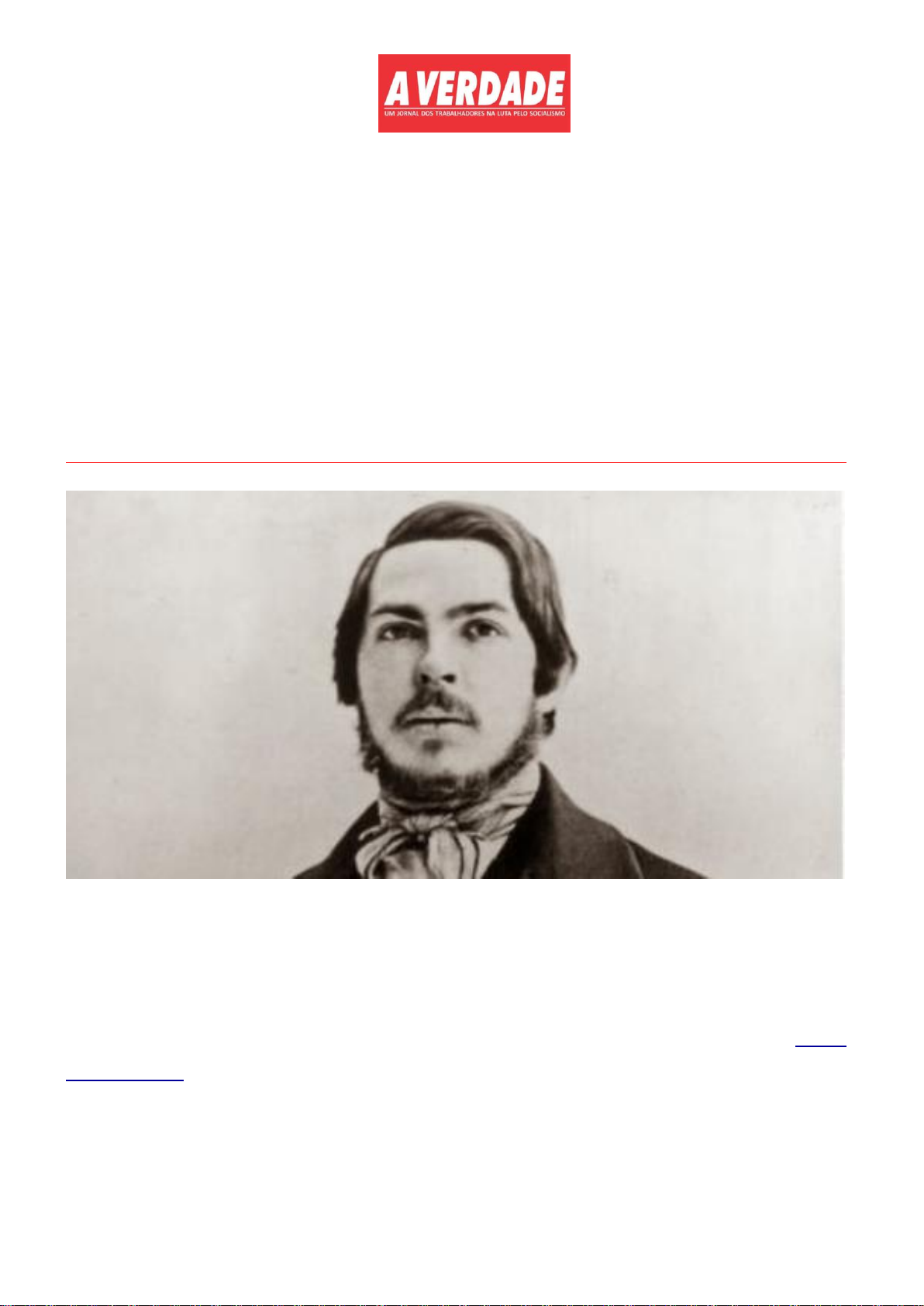
Frederick Augustus Washington Bailey was born on an unknown day in February 1818 in
Tuckahoe, Maryland. Later in life he changed his name to Frederick Douglass. He was “the son of
Harriet Bailey, a slave, and an unidentified white man” (Finkenbine). This unidentified white man
was presumed to be his master Anthony Auld. His maternal grandparents brought him up because
he was separated from his mother during his infancy. For the rare and brief nighttime visits the
mother had to walk a great distance to see her son.
In 1824, at the age of seven, Douglass was moved to another plantation, the one of Colonel
Edward Lloyd where he stayed for two years. After the two years he was sent with Col. Lloyd
Douglass to Baltimore to work for Hugh and Sophia Auld. Mrs. Auld taught him the basics of
reading that would forever change Douglass and the course of his life. He was determined to teach
himself how to read and write, “in spite of laws against slave literacy” and he later “organized a
secret school for slaves, but it was discovered and broken up by a mob of local whites”
(Finkenbine). His master then sent Douglass to another man, who was known as the slave breaker.
This was supposed to discipline Douglass, but instead he “became increasingly defiant and refused
to allow himself to be whipped” (Finkenbine). This was another major victory of a slave: he fought
back and won.
Douglass organized a second school for slaves where he and his pupils made plans on how to
escape to Pennsylvania, which was a free state. Their plan was discovered, and Douglass was
returned to Baltimore in 1836. There he was hired out to a shipyard where he learned how to caulk
and also joined “a self-improvement society of free black caulkers that regularly debated the major
social and intellectual questions of the day” (Finkenbine).
As he was unable to buy his freedom, he made his second attempt at escaping; this time he was
successful. Douglass “dressed as a sailor and carrying the free papers of a black seaman he had
met on the streets of Baltimore, he travelled by train and steamboat to New York” (Finkenbine),
where he got married to the free African American woman named Anna Murray. The newlyweds
settled in New Bedford, Massachusetts, where Douglass started working as a caulker and settled
into a family life with five children, two daughters and three sons.
After moving to New Bedford, Douglass was actively involved at the local African Methodist
Episcopal Zion church. His new home, New Bedford, was where he “began to read the Liberator,
a leading abolitionist journal edited by William Lloyd Garrison, and to attend antislavery meetings
in local African American churches, occasionally speaking out about his slave experiences”
(Finkenbine). Douglass reached a turning point in August 1841 at a convention of the
Pavić 5
Massachusetts Anti-Slavery Society where his eloquence and imposing presence was discovered
by Garrison and other Abolitionists, who then hired him as lecturer on antislavery.
Although a fugitive slave, in 1845 Douglass published his first autobiography Narrative of the
Life of Frederick Douglass, Written by Himself, which in five years had sales over 30,000 copies
in the United States and Britain and brought Douglass increased credibility and popularity, but
also threatened his liberty (Finkenbine). To avoid being caught he was advised to go to Britain
where he could use his popularity to “mobilize British abolitionists to bring international pressure
against American slavery” (Finkenbine).
For almost two years Douglass delivered lectures to eager audiences in England, Scotland, and
Ireland and as a result gained confidence to pursue an active role as a reformer. These fellow
antislavery friends in England purchased his freedom from his Master and “collected monies to
allow him to begin his own antislavery newspaper in the United States” (Finkenbine). Douglass
and his family moved to Rochester, where he “launched the weekly reform journal North Star,
which promoted abolitionism, African-American rights, temperance, women’s rights, and a host
of related reforms” (Finkenbine).
With the onset of the Civil War Douglass made it his goal to promote the acceptance of African
American men in the Union Army which would also be a way for them to “demonstrate their
patriotism and manhood” (Finkenbine). Thereby they would gain equality and consequently
slavery would be abolished. Finally, he was appointed as the U.S. marshal for the District of
Columbia (1877-1881), and as U.S. minister to Haiti (1889-1891) (Finkenbine). Whereas this was
a fundamental professional and personal success, his family life became troubled. His wife Anna
fell ill and died in 1882. Douglass married his former secretary Helen Pitts two years later.
Anna’s status as a free slave provided Douglass with the gates to Freedom, confirming that she
was one of the main factors in his life after slavery. Moreover, Anna always supported her husband
by taking care of the household and their children, due to Douglass's countless travels.
Anna was just one of the women who had a beneficial impact on Douglass. Women played a
major role in both his upbringing and mental development. His enslaved mother gave him life and
a heritage to be proud of. In her absence, his grandmother took his mother's place, strengthening
his affiliation with his mother's side of the family. Even his literacy would not have been possible
if it had not been for his master’s wife, who “accidentally” taught him to read. Therefore, the next
chapter's main aim is to show exactly how these women shaped Douglass's persona in the long
run.
Pavić 6
1.1 Women in the Life of Douglass
Fought argues that all of his life Douglass was influenced by women, both black and white, and
he “gravitated toward those who offered any hint of kindness, which meant food and intellectual
stimulation” (40). This presumption will be examined through Douglass's relationship with his
mother, his grandmother, his master's wife, and his (first) wife. These women not only showed
him kindness, but, more importantly, made him a sensitive man, able to empathize:
“I belong to the women”, declared Frederick Douglass at the mid-point of his life. More so
for him than for any other prominent man of his time, this was true. His race, his enslaved
status, his ability to read, his self-emancipation, his success as a speaker and newspaper
editor, the way he lived every aspect of his life in opposition to racism, his understanding of
equality between the sexes, his intellectual development, and even the very documents that
later generations use to reconstruct his life – like this book itself – all emerged from the
world of women. (Fought 1)
In Douglass's time, being African American was being punished in the most horrible ways.
Being a woman was also not something that would bring you much benefit. And then, all the way
down, even below the lowest point of the chain of rights, was the African American woman. Being
unfavoured to say the least based on race and sex is why Douglass had to fight for the equality of
both.
This was him returning a favour to his mother and beloved grandma, from whom he was
separated when Douglass was sent away when the grandmother was left in the woods to die
because she was not of much use being an elder (Douglass, Narrative 47-49). Douglass was driven
to take those rights (back) in the name of all the women. As a feminist, he had his mother and his
grandmother as role-models, but also as an inspiration for the long overdue changes he was trying
to implement in order to create a slave-free system.
1.1.1 Douglass's Mother and Grandmother
Douglass's mother, Harriet Bailey, was a slave. Thus, Douglass was born a slave, a “non-
person” striving for racial and cultural identity in order to rebuild himself as a free, educated and
high-ranked man. In order to fight for human rights and against the injustice brought upon him
and countless other “non-persons,” a realization of the problem must occur when it comes to white
and black children being treated differently. First of all, because white children were surrounded
Pavić 7
by all of their family members, unlike young Frederick who had been constantly separated from
his. Separating children from their mothers was common practice among the slaves in order to
destroy the family relations (Douglass, My Bondage and My Freedom 37-38). Douglass describes
how his mother had been taken from him at a very young age:
My mother and I were separated when I was but an infant—before I knew her as my mother.
It is a common custom, in the part of Maryland from which I ran away, to part children from
their mothers at a very early age. Frequently, before the child has reached its twelfth month,
its mother is taken from it, and hired out on some farm a considerable distance off, and the
child is placed under the care of an old woman, too old for field labor. For what this
separation is done, I do not know, unless it be to hinder the development of the child's
affection toward its mother, and to blunt and destroy the natural affection of the mother for
the child. This is the inevitable result. (Douglass, The Narrative of the life of Frederick
Douglass, An American Slave, Written by Himself 17-18)
Being aware of his own disadvantage of barely ever seeing his mother Harriet, apart from a few
night visits where she would walk for twelve miles to put him to sleep, and then, before the sun
came out, she went straight back to work on the plantation where she was residing. His mother's
efforts to be at least a memory in his later life was very important for him.
This was one of the things he had to live through in order to become the determined freedom-
fighter he later on became. He could feel his mother's love just before she came to never return
again, and it made him proud to find out that she was, indeed, special:
To me it has ever been a grief that I knew my mother so little and, have so few of her words
treasured in my remembrance. I have since learned that she was the only one of all the
colored people of Tuckahoe who could read. How she acquired this knowledge I know not,
for Tuckahoe was the last place in the world where she would have been likely to find
facilities for learning. I can therefore fondly and proudly ascribe to her, an earnest love of
knowledge. (Douglass, Life and Times of Frederick Douglass 24)
This is an instance showing that Douglass took pride in his mother's heritage; he identified with
her, with her troubles and efforts, blackness and will-power, especially when it comes to being
literate, i.e. educated, which was practically impossible for a slave during that time.
The void that ensued by the unwilling disappearance of his mother from his life was filled by
his grandmother Betsy Bailey, who brought him up in a setting that appeared idyllic to a little
child. As Douglass described it in Life and Times, “Living thus with my grandmother, whose
kindness and love stood in place of my mother's, it was some time before I knew myself to be a
slave” (17).
Pavić 8
It was not long until he would have to go through another, even more painful separation.
Douglass reported the event of being separated from his grandmother as follows: “These were
distressing revelations indeed. My grandmother was all the world to me, and the thought of being
separated from her was a most unwelcome suggestion to my affections and hopes” (Douglass, Life
and Times 18). This separation hit young Douglass even harder, because he got to spend more time
with his grandmother than his mother, and she brought him up in his mother´s absence.
In conclusion, for young Douglass the differences between white and black children became
obvious early on. For him it was not possible to have any kind of relationship, as the slave system
had the goal of separating children from their mothers, and other family members, such as brothers
and sisters, as well. As Douglass put it in My Bondage and My Freedom: “We were brothers and
sisters, but what of that? Why should they be attached to me, or I to them? Brothers and sisters we
were by blood; but slavery had made us strangers” (48), adding that his mother Harriet, just like
many other enslaved women, “had many children, but NO FAMILY” (48).
Unlike the non-existent relationship Douglass had had with his siblings, his relationship to his
mother and grandmother are different, as he acknowledged his mother's background and accepted
it as his own. And his grandmother was his true family, and “[his] heart clave[d] for [his]
grandmother” (Douglass, My Bondage and My Freedom 48).
Lastly, Douglass was able to learn a few things from his family, despite all the hate around
them and directed towards them. His mother risked her life to see him only a few times, showing
him that family, indeed, is important. His grandmother, on the other hand, equipped him with
optimism and a goal of achieving the idyllic setting and freedom he enjoyed in his childhood. Also,
upon finding out that his mother was one of the few slaves in the area that could read, it made him
proud and drove him even more towards his own goal of education. This would not have been
possible without his master's wife Sophia, who “accidentally” taught him how to read.
1.1.2 Mrs. Sophia Auld
Unlike the men in his life fuelled by anger and aggression, or, like his father, even failing to be
present, the women in Frederick Douglass's life never failed him; even in absence, or in a drastic
change in kindness, as was the case with Mrs. Auld, who would later on become an angry and
mean lady after becoming a victim of the slavery system herself. Initially Douglass accepted her
as a mother-figure and was moved by her tenderness:
Pavić 9
My new mistress proved to be all she appeared when I first met her at the door, —a woman
of the kindest heart and finest feelings. She had never had a slave under her control
previously to myself, and prior to her marriage she had been dependent upon her own
industry for a living. She was by trade a weaver; and by constant application to her business,
she had been in a good degree preserved from the blighting and dehumanizing effects of
slavery. I was utterly astonished at her goodness. I scarcely knew how to behave towards
her. She was entirely unlike any other white woman I had ever seen. I could not approach
her as I was accustomed to approach other white ladies. My early instruction was all out of
place. The crouching servility, usually so acceptable a quality in a slave, did not answer
when manifested toward her. Her favor was not gained by it; she seemed to be disturbed by
it. She did not deem it impudent or unmannerly for a slave to look her in the face. The
meanest slave was put fully at ease in her presence, and none left without feeling better for
having seen her. Her face was made of heavenly smiles, and her voice of tranquil music.
(Douglass, Narrative 36)
As Douglass elaborates in My Bondage My Freedom, “Mrs. Auld was not only a kind-hearted
woman, but she was remarkably pious; frequent in her attendance of public worship, much given
to reading the bible, and to chanting hymns of praise, when alone” (91), and as such a kind and
pious woman she was the opposite of her sour husband, who did not care for religion too much.
Unfortunately, Mr. Auld was furious that his wife had been teaching little Frederick how to
read by helping him to master the alphabet and to learn to spell simple words. After being scolded
by her husband, she begins to accept more and more his views that if slaves are not treated as such
they will revolt and enslave their masters. The fear started her perverting transformation, where it
“took several years to change the natural sweetness of her temper into fretful bitterness” (Douglass,
My Bondage and my Freedom, 92). In his Narrative Douglass describes the change as follows:
But, alas! this kind heart had but a short time to remain such. The fatal poison of irresponsible
power was already in her hands, and soon commenced its infernal work. That cheerful eye,
under the influence of slavery, soon became red with rage; that voice, made all of sweet
accord, changed to one of harsh and horrid discord; and that angelic face gave place to that
of a demon. (40)
Needless to say the terrifying transformation of Mrs. Auld caught young Douglass off guard
and left him in disbelief: “It was no easy matter to induce her to think and to feel that the curly-
headed boy, who stood by her side, and even leaned on her lap; who was loved by little Tommy,
and who loved little Tommy in turn; sustained to her only the relation of a chattel. I was more than
that, and she felt me to be more than that. I could talk and sing; I could laugh and weep; I could
Pavić 10
reason and remember; I could love and hate. I was human, and she, dear lady, knew and felt me to
be so” (Douglass, My Bondage and my Freedom 98). Confused, Douglass continued in disbelief:
“How could she, then, treat me as a brute, without a mighty struggle with all the noble powers of
her own soul. That struggle came, and the will and power of the husband was victorious. Her noble
soul was overthrown; but, he that overthrew it did not, himself, escape the consequences. He, not
less than the other parties, was injured in his domestic peace by the fall” (My Bondage and my
Freedom 98).
Mrs. Auld's transformation showed that not only the slaves were punished by the slave system
and its dehumanizing impacts, but it also changed the nature and habits of slaveholders, especially
ones who had not been witnessing the gore for a longer period of time. Mrs. Sophia Auld changed
from a kind mother-figure to an unrecognizable brute. Nevertheless, it was Mrs. Auld who taught
Douglass the A, B, C and, unaware, she enabled his literacy.
1.1.3 Anna Murray-Douglass
The last woman from Douglass´s narratives and life that made an enormous impact on him was
Anna Murray, Douglass's first wife. Anna was born in Maryland, “on an unknown day in an
unknown year” (Fought, Women in the World of Frederick Douglass 41). Fought explained how
“unknown” described much about Anna’s life” (Women in the World of Frederick Douglass 41).
What (most of) the people did know is the fact that Anna was illiterate. She was looked upon as a
woman whose identity merged into that of the husband. Mysterious Anna Murray and Douglass
had been married for forty years and “her husband’s biographers have puzzled over the attraction
of a man with intellectual aspirations to a woman who appeared to have little desire to read”
(Fought, Women in the World of Frederick Douglass 41). Though Anna was illiterate, she was
somewhat educated, and believed and pushed her children's education.
She was a very hard-working woman, doing laundry and housekeeping works. Apart from that,
her status was free; she was a free African American woman. And even though she could not know
how to read like her husband had taught himself to do, Fought argues that two of her children
remembered her as the banker of the family. This fact “suggests that she acquired knowledge with
the same agility as her husband and that her employer entrusted her with a degree of financial
responsibility” (Fought, Women in the World of Frederick Douglass 44).
Additionally, Anna was an exceptional employee. As a domestic service she possessed skills
and ability to “project an image of order and social standing” and she “maintained her position by
Pavić 11
absorbing and adopting middle-class norms of presentation and deportment” (Fought, Women in
the World of Frederick Douglass 44). This is where Anna’s and Douglass’s similarities in
character/personalities/personal identities come to overlap: both come from enslaved families,
they were both sensitive to hypocrisy and they were both striving for a working class African
American family, and a world with equal rights. Through their marriage she made him a Free
African American man. Their marriage resulted in five children who were all free due to their
mother’s status. This means that she was the matriarch: she not only gave Douglass the long due
and rightful freedom, but she provided security for their children as well. One of their children,
Anna, died when she was only ten years old which took a toll on Douglass and his wellbeing from
that point on.
The newlyweds moved to New Bedford, an event which Douglass explained as following: “We
now began to feel a degree of safety, and to prepare ourselves for the duties and responsibilities of
a life in freedom” (Douglass, Narrative 111). This was accompanied with an immediate, and last
change of his last name to Douglass.
While in his last narrative Life and Times, Douglass mentions the word “wife” 41 times; but
only once does he mention “[his] intended wife” (206), i.e. Anna. In the second narrative My
Bondage and my Freedom in “Letter To My Old Master” is where he described to his old master
Thomas Auld about his new life with Anna: “I married soon after leaving you; in fact, I was
engaged to be married before I left you; and instead of finding my companion a burden, she was
truly a helpmate.” (Douglass, My Bondage and my Freedom 425) This might be the best word to
describe Anna – a helpmate, with whom, as Douglass explained, he “never lived more happily”
(Douglass, My Bondage and my Freedom 425).
Other women in his life also entered his story but mainly as supporting characters with only a
vague influence on Douglass's progress, making it seem like he “occupied an almost entirely
masculine world” (Fought, Women in the World of Frederick Douglass 71) which in reality was
definitely not the case.
Women undoubtedly made the biggest impact on him while still young. Through his first, and
then second wife, the impact continued to grow; in different, but similar ways. “Douglass grew
into one of those leaders, but he emerged from a world in which women delineated many borders.
Because fathers were all but erased by through his mother, grandmother, and great-grandmother-
Harriet, Betsey and Jenny.” (Fought, Women in the World of Frederick Douglass 40) Lastly, his
mistress Mrs. Auld not only taught him how to read, but also taught him about just how a person
can change under certain circumstances until she becomes almost unrecognizable.
Pavić 12
So all of his life Douglass was influenced by women, both black and white, and he “gravitated
toward those who offered any hint of kindness, which meant food and intellectual stimulation”
(Fought, Women in the World of Frederick Douglass 40). As he gained those benefits from the
women around him, Douglass grew more and more and eventually became a man. With him
growing into a man, his needs changed as well:
As he grew he found himself more often among his peers, both male and female, almost all
African American, and he assumed the role of a man in his community, even as his masters
considered him a boy. He no longer needed a mother figure, he needed a partner. He found
that partner among those free African American women who were hidden from his audience,
a place where she preferred to stay. (Fought, Women in the World of Frederick Douglass 40)
As per above, his wife Anna was no different from these women staying in the background.
Anna, however, “saw her partnership with Frederick and, by extension, their family life, as
originating in the mutual efforts of preparing for Frederick's escape and their life together”
(Fought, Women in the World of Frederick Douglass 51), even though Douglass only briefly
mentions her towards the end of his first book. She was making a home for her family and doing
a great job housekeeping, while Douglass, who was more absent than not for work, was fulfilling
his service duties and “portrayed himself as the epitome of black, masculine, self-reliance, but that
self-reliance included the ability to support his family, and the self-reliance of the family depended
upon both his and Anna's work” (Fought, Women in the World of Frederick Douglass 56).
Therefore, Anna was a reliable woman, taking care of their household and children. This helped
Douglass focus on his work more, which also included him being absent.
Anna had died of a stroke in 1882. After about a year of depression Douglass married his
secretary Helen Pitts Douglass in 1884. Helen was 20 years younger than Douglass and was a
white suffragist, coming from a family of abolitionist who did not agree to her marriage to a
African American. This paper will not focus on Douglass's marriage to Helen Pitts, as she was not
a part of his narratives.
Fought claims that, “at key points in his life women ensured that he realized his ambitions; and,
in some instances, no man could have played the same type of roles in his resistance to racism.
Nevertheless, aside from platitudes, they have not found their way into the telling of his life in any
way that would reflect their influence” (Women in the World of Frederick Douglass 1). This is
why Fought´s book on the women in Douglass's life was significant, as well as the few instances
Douglass mentioned in his autobiographies- with some information being only read between the
lines and assumed by the reader.
Pavić 13
Fought also observed, that, although Douglass “acknowledged individual women at key
moments, he also obscured the degree to which they, at every turn, proved integral to his
advancement and protest against racism” (Women in the World of Frederick Douglass 2). This is
why it is important to understand that Douglass was not only “involved in the woman's rights
movement, but little of the rich body of scholarship about the importance of women to the
antislavery crusade, the woman's rights movement, African American families in slavery and
freedom, and about gender had penetrated later treatments in his life” (Fought, Women in the World
of Frederick Douglass 3).
1.2 Douglass's Beliefs
Douglass was a Christian by religion, but first and foremost he was a spiritual man. This
spirituality of his and his strong faith in God are one of the main factors that led him to freedom,
as he believed in justice and equality. Accordingly, he despised the Christians in the South as he
had witnessed the brutality of those 'pious' men.
Douglass was convinced that living at Baltimore laid the foundation to all of his subsequent
prosperity, and that he was chosen among all of those slaves, young and old, stating “I regarded
the selection of myself as being somewhat remarkable” (Douglass, Narrative 31). He promised to
stay true to himself claiming God's responsibility for his fortune:
From my earliest recollection, I date the entertainment of a deep conviction that slavery
would not always be able to hold me within its foul embrace; and in the darkest hours of my
career in slavery, this living word of faith and spirit of hope departed not from me, but
remained like ministering angels to cheer me through the gloom. This good spirit was from
God, and to him I offer thanksgiving and praise. (Douglass, Narrative 31)
Besides demanding emancipation of slaves and his wish to see African Americans vote as a
part of African American citizenship, he was also pro-recruitment (and inclusion) of African
American soldiers during the Civil War era. Douglass believed that this was another way to prove
patriotism and demand freedom in return.
As Fought puts it, “family was of paramount importance to Douglass and a necessary
component of his politics. His first autobiography, Narrative of the Life of Frederick Douglass,
began with a family shattered by slavery and ended with the fountain of a new one in freedom”
(4). His compromised family life and background was something Douglass could not change.
What he could change, and what he did change, is the stereotype of African Americans, who were
also portrayed as “incapable of forming and maintaining the emotional bonds of marriage and
Pavić 14
parenthood” (Fought 5). To debunk these beliefs of slaveholders and “seizing the right to marry,
have children, protect integrity of a family, and raise the next generation to lead a better life was
both a personal desire and a political statement in opposition to racism” (Fought 5). Together with
Anna he achieved this goal of his and showed how he, too, can have a normal life when not
enslaved.
Douglass is a hero not just for Americans or African Americans, but for all who support equality
and human rights, and condemn the dehumanization of a whole race and/or ethnicity. Douglass
was one of the first people to fiercely defend women and their rights and help them fight for the
same outcome that he wanted to achieve with his own battles: for everyone to be equal.

Pavić 15
2. Douglass's Notable Works
The civil rights movement and anti-slavery ideas were also the main aspects of his newspaper
called The North Star. Its motto was “Right is of no Sex – Truth is of no Color – God is the Father
of us all, and we are all brethren” (Petruzzello), which sums up Douglass's essential goal. The
paper was later merged with the Liberty Party Paper in order to form The Frederick Douglass'
Paper.
The North Star's motto sums up all of Douglass's strongest convictions which is why they were
used to highlight the two parts of the second section. Once again, the three biggest influences can
be seen in this motto, as well as read in his books: he fought for African Americans, for women,
black and white; and gave enough examples to expose the hypocritical South that used religion as
an excuse to harm others.
Douglass's recollection of his life was recorded in the three aforementioned narratives. The
most important was the first one, his Narrative of the Life of Frederick Douglass, An American
Slave, Written by Himself published in 1845. The two subsequent autobiographies, published in
1855 and 1881/1882 respectively, were expanded versions of the Narrative, adding more details
regarding his life and escape. In particular his escape was described in the second and third
narrative, as he still was a fugitive slave when the first book got published. These autobiographies
presented the metamorphosis from an enslaved child and young man into “the foremost Negro
American of the nineteenth century” (Martin 9). Apart from being a self-taught and self-made man
and writer, Douglass was a “former slave turned abolitionist orator, newspaper editor, social
reformer, race leader, and Republican party advocate” who “personified intellectual activism: a
sincere concern for the uses and consequences of ideas” (Martin 9) Besides these autobiographies,
Douglass also wrote a short fictional work The Heroic Slave.
Apart from his written works, Douglass was known for his activism accompanied by powerful
speeches and celebrated as an exceptional orator. He delivered his most famous speech the day
after Independence Day in 1852, exposing the wretchedness of slavery.
Douglass’s Papers on the Fourth of July look far less isolated and his argument less exceptional
if What to the Slave Is the Fourth of July? is read alongside his newspapers. Long before
Douglass’s Rochester speech, the Fourth of July was a frequent topic in The North Star and
Frederick Douglass’ Paper. Here we glimpse other, more antagonistic audiences that help explain
Douglass’s confrontational stance in his speech, but we also see that his position was less lonely
than he suggested. Indeed, some writers took Douglass’s argument further, claiming that as well
as slavery, Jim Crow laws (racial segregation) tarnished the celebration. Like Douglass, they
Pavić 16
expressed ambivalence about American institutions and recognized both the liberating possibilities
and the lies gathered up in the idea of the Fourth of July. Douglass was already calling the Fourth
an “anniversary of American hypocrisy” in 1848 (“theirs is a white liberty”), but many other
contributors to his papers reflected on the holiday. They denounced “Clap-trap” oratory on the
Fourth, lamented America’s neglect of African American Revolutionaries, and reprinted a speech
declaring America would not be free until it had abolished the evils of slavery, alcohol, “bondage”
to party or sect, and the “prejudices of complexion, of class and of sex”. (Meer 54)
Douglass's Narrative made people pay attention to him, which led to him being a successful
orator – which then again influenced his latter two narratives; they were more detailed and showed
how he made progress in rhetoric as well. Therefore, with his Narrative he paved his way as the
most important African American of the 19th century.
Douglass's work, both written and spoken, displayed his strongest convictions and gave the
reader not only insights to his own story, but rather shared an experience not too different from
the other slaves in the system. Douglass provided the reader with the happenings on the farms and
various instances of torture and (sexual) abuse and condemned every form of mistreatment based
on race or gender.
2.1 Right is of no Sex
Slavery as an (invisible) institution for Douglass was just one form of racism; and racism and
sexism “represented twin aspects of a larger evil: the refusal to embrace and act upon the
immutable principle of human equality” (Martin 138). As he could identify with women when it
came to struggles and unfair treatment, along with his love for women and enriched by an empathy
he could have only learned from a woman, Douglass always praised the feminist abolitionists. His
feminism “represented his awareness of his immeasurable personal debt to them and illustrated his
growing awareness that sexism circumscribed and degraded their lives as well as those of all men
and women” (Martin 138).
Consequently, it came as no real surprise when Douglass, who had attended the 1848 Seneca
Falls Convention on behalf of women’s suffrage, argued that: “Slavery is not abolished until the
black man has the ballot” (New Yok Times 2). If so, slavery ended not with the 13th Amendment
of 1865 but with the Voting Rights Act of 1965.
By this logic (and countless pieces of evidence that forced work in the American South ended
as late as 1960s), slavery was abolished one hundred years later; a time that Douglass did not live
Pavić 17
long enough to witness. The United States finally began allowing women to vote in 1920, after the
ratification of the 19th Amendment to the Constitution.
2.2 Truth is of no Color
Douglass was seeking freedom for everyone. The most evident demand for freedom apparent
in his narratives was the one he was fighting himself from an early age: the White Man and the
institution of slavery, excused by White Supremacy. In order to inspect this idea, we need to first
examine how such a system, based on a super- and subordinate race, came to life in the US in the
first place.
2.2.1 Race vs. Ethnicity
First, in order to clarify the problematics of slavery and racism, the terms race and ethnicity
need to be defined, as they are often used interchangeably and incorrectly:
Race and ethnicity typically refer to long-established groups with a common culture and
geographic origin, often sharing a common language and religious tradition. Although the terms
are used interchangeably, race tends to be associated with groups whose physical appearance is
defined as distinctive, whereas people's ethnicity rests on cultural differences alone. Even this
separation of race and ethnicity is abandoned as ethnic groups become racialized- as in the
British viewing the Irish as a race apart from themselves or the Bosnian Serbs and Bosnian
Muslims racializing each other. … At one point, diversity in the United States was cast in
biracial, almost caste-like terms as a Black-White issue with American Indians and Asian
immigrants virtually ignored. By the end of the 20th century, observers were beginning to talk
about the triracial nature of the United Stated or the Latinization of America, while also noting
that dozens of other socially defined groups such as Pacific Islanders and hundreds of tribal
groups were ignored or received less attention even though they were a significant part of
society. (Schaefer 47)
To conclude, race is being used to describe the physical/biological characteristics of humans,
i.e. their skin color, and is visible. Ethnicity on the other hand is something that deals with the
sociological i.e. cultural characteristics, such as religion, country/region, language, but also race;
Pavić 18
it is not always visible (Kate). Therefore, you might be able to tell the race of a person, and not
guess the ethnicity, as it is a much broader term.
The slaves were deprived of any information about their ethnicity, and only characterized by
their race. As Douglas explains: “The reader must not expect me to say much of my family.
Genealogical trees did not flourish among slaves. A person of some consequence in civilized
society, sometimes designated as father, was literally unknown to slave law and slave practice. I
never met with a slave in that part of the country who could tell me with any certainty how old he
was” (Life and Times of Frederick Douglass 14).
Even today this misconception of a subordinate race exists, even though race is seen as
something completely different in the US compared to the continent of Africa, as it is presented in
the following chapter.
2.2.2 Africa: Values and Views on Race
Africa is the second largest continent, being second in terms of population as well. The African
continent currently has over 1.2 billion people.
Slavery and various forms of it existed long before the Transatlantic Slave Trade, which formed
in the 16th century. However, in terms of the scale along the strict racial division, this was
considered (one of) the biggest Homicide(s) of human history. The Transatlantic Slave Trade was
not the only horrifying and dehumanizing slave trade on African soil, if one considers the century
long Arab Slave Trade and the reason for millions of Africans no longer residing on their own
continent. Nevertheless, Africa is a continent with several thousand languages and dialects, where
each country had different historical and cultural backgrounds, and it was not until Slavery in the
Americas that all of the ethnological aspects got erased, and the people became merely “Blacks.”
The reason was, along with the spread of religion, that “European colonialism imposed a new
way of looking at race,” and therefore Africans were forced to see Europeans as a superior race,
which was, and still is, incomprehensible to Africans (Schaefer 39). Prior to these twisted views,
most Africans did not think of skin, or its color, as something other than an organ that covers your
body. Therefore it was not something connected to the individual itself, like his individual
characteristics or personality, but rather a variant in shades of skin color and it was “to be
appreciated as an asset and not as a deficiency or a social problem” and “people of different skin
colors [were] viewed as just another example of nature exercising creativity”, “a part of nature,”
Pavić 19
or “a continuum of hues.” rather than something used “as a measure of an individual's worth”
(Schaefer 39).
Contrary to popular belief (or the belief of the less educated) Africa was not just a pile of
savages who the White Man had to “enlighten” or “modernize.” There had been empires dating
from 300 BC (e.g. Ghana) to the early 1600s, where there were efficient governments, great
wealth, commitment to education and scholarship, international trade, and strong armies. Also,
today, African people “who come to the United States bring with them a rich cultural heritage, a
strong work ethic, and a wide array of skills that they are enthusiastic to share, and America has
been enriched by their literature, music and dance” (Schaefer 38-39). Other African values are “a
strong commitment to education, a sense of hospitality, a long and rich history of many cultures
and traditions, a facility with languages (some Africans speak five or more languages), and a strong
sense of community” (Schaefer 39).
3.2.3 Slavery in the USA
According to the Encyclopedia of Race, Ethnicity and Society, the U.S. slave system:
was defined first by its physical, psychological, and sexual brutality. Physically, it was a
violent domination by various forms of punishment and terror, including whipping,
mutilation, torture, murder, and deprivation. Psychologically, it involved daily humiliation,
coerced protocols of submission, religious and social doctrines of White superiority and
Black inferiority, and processes to deculturalize and dehumanize the enslaved Africans.
Sexual brutality was imposed mostly on women but also on children and men; it involved
both forced breeding and rape. These practices and the system itself were further enforced
by law, armed bodies of various official and unofficial kinds, and other institutions.
(Schaefer 21)
Instances of all of the above are found in Douglass's narratives, either with him being the
mistreated one, or him observing and reporting on the events.
The Ideology of white supremacy or white racism in Douglass's time – like today-
encompassed attitudes, beliefs, values, ideals, behaviour, and thought on individual, group,
and institutional levels. It subsumed antiblack prejudice and Negrophobia. In addition, it
represented a deep-seated philosophy of black dehumanization. Predicated upon the
assumptions of black cultural inferiority, black biological inferiority, or both, the ideology
of white supremacy matured and gained intellectual respectability during the nineteenth
Pavić 20
century. It signified a rationale and a justification for white oppression of blacks” (Martin
109)
The White Man did cause slavery to happen, and since the Black Man was worthless and his
opinions and struggles did not matter in the White Man's eyes, it was necessary for the Other White
Man, who shared Douglass's vision of equality, to join forces in order to finally put an end to
slavery. The Abolitionists were a biracial effort to not only abolish slavery but also “attempted to
make the ideals of equality and the unity of humankind a reality” (Schaefer 1).
2.2.4 Abolitionism
Early Abolitionism started in Pennsylvania late 17th century, but it reached its peak in 1777
after the first Antislavery Society was formed and ordered its slaveholding members to emancipate
their bondspersons or leave the church. This also led to the U.S. Congress to declare “that it was
illegal to import slaves into the country” in 1808 (Schaefer 1). After further accomplishments and
newspapers on abolitionism, which included The Liberator by Douglass's friend, ally and mentor
William Lloyd Garrison, led to Garrison's Anti-slavery society being founded in 1833, and split in
1840 after he had broadened his reform movement from the single issue of slavery to universal
reform, adding feminism and radical pacifism.
The abolitionist movement successfully transformed “the goal of the Civil War from preserving
the Union to also freeing the enslaved people.” Whereas Douglass “insisted on the necessity of
overt political activity,” Garrison retired believing that his mission had been accomplished;
Douglass on the other hand “sought to uplift the freed people through education in the newly
founded Negro schools and financial institutions” (Schaefer 2). For Douglass, the sole purpose of
releasing the slaves was the main goal for this movement, but it went far beyond with the focus on
educating the people in order to stay free, as he was the living proof of what being able to read
could do for a person's future.
To sum up, the African Americans had been deprived of their ethnicity and stripped down to
only their race. Millions of African people were shipped to another continent to live and die there
like cattle. Their white masters, although claiming to be religious, found their opponents in the
Abolitionists, who tried stopping the White Man from playing God - and eventually succeeded.
Pavić 21
2.3 God is the Father of us all
Infuriated with Christian hypocrisy and greed, Douglass explains in his Narrative: “A great
many times have we poor creatures been nearly perishing with hunger, when food in abundance
lay mouldering in the safe and smoke-house, and our pious mistress was aware of the fact; and yet
that mistress and her husband would kneel every morning, and pray that God would bless them in
basket and store” (52).
In 1832 his master attended a Methodist camp-meeting where he experienced religion. But,
instead of making his master a better person, Douglass believed it only made him crueller and
more inhumane:
[…] for I believe him to have been a much worse man after his conversion than before. Prior
to his conversion, he relied upon his own depravity to shield and sustain him in his savage
barbarity; but after his conversion, he found religious sanction and support for his
slaveholding cruelty. He made the greatest pretension to piety. His house was the house of
prayer. He prayed morning, noon, and night. (Narrative 54)
His master converted many people and would often have preachers in his house, while Douglass
gives countless examples of his hypocrisy:
I have said my master found religious sanction for his cruelty. As an example, I will state
one of many facts going to prove the charge. I have seen him tie up a lame young woman,
and whip her with a heavy cowskin upon her naked shoulders, causing the warm red blood
to drip; and, in justification of the bloody deed, he would quote this passage of Scripture –
“He that knoweth his master's will, and doeth it not, shall be beaten with many stripes.”
Master would keep this lacerated young woman tied up in this horrid situation four or five
hours at a time. (Douglass, Narrative 55)
After a great deal of differences between Douglass and Master Thomas Auld, Douglass was
sent to Mr. Covey, known as the nigger-breaker. This man “was a professor of religion – a pious
soul – a member and a class-leader in the Methodist church” (Narrative 57) while on the other
hand he bought a woman for the sole purpose of using her as a breeder and still professing to being
“a sincere worshipper of the most high God” (Narrative 62).
One of Douglass's strategies was to show that slavery was a moral and religious violation, as
well as a violation of the Declaration of Independence. Douglas firmly held the belief that racism
and slaveholding Christians had nothing to do with religion, as
prejudice against color was rebellion against God. Of all men beneath the sky, the slaves,
because most neglected and despised, were nearest and dearest to his great heart. Those
Pavić 22
ministers who defended slavery from the bible, were of their "father the devil"; and those
churches which fellowshiped slaveholders as Christians, were synagogues of Satan, and our
nation was a nation of liars. (My Bondage and my Freedom 355)
Sarah Meer explains Douglass´s relationship with the Church, and what it meant to Douglass
as an author:
Black churches were a formative influence on the young Douglass; he himself became a
Sabbath school leader and later preached at the African Methodist Episcopal Zion Church in
New Bedford. He also practiced debating with free black companions in Baltimore, and the
first book he bought was Caleb Bingham’s The Columbian Orator (1797), a late eighteenth
century primer that inculcated public speaking skills alongside literacy and republican
values. These rhetorical influences helped form Douglass as a speaker, and also as a writer.
(47)
One could ask themselves, how come Douglass as a man of God and a Christian still questions
God on many occasions in his narratives. One could argue, that those questions to God were not
equal to questioning God himself, but reflect Douglass's views that religion was responsible for
the most horrible crimes, where slaveholders find the strongest protection (Douglass, Narrative
71). Douglass asked God as to why it is the way it is throughout his narratives, but he does not
blame him for his misfortune and rather takes it up himself, to break out of the shekels. He does
blame the fake Christians in the South, though, and them only, which Douglass makes clear in the
appendix of his Narrative:
What I have said respecting and against religion, I mean strictly to apply to the slaveholding
religion of this land, and with no possible reference to Christianity proper; for, between the
Christianity of this land, and the Christianity of Christ, I recognize the widest possible
difference - so wide, that to receive the one as good, pure, and holy, is of necessity to reject
the other as bad, corrupt, and wicked (118).
Upon this Douglass immediately takes a stand: “I therefore hate the corrupt, slaveholding,
women-whipping, cradle-plundering, partial and hypocritical Christianity of this land.” (Douglass,
Narrative 118).
In closing, Douglass was a man of strong belief. He believed in himself, in God, and in a better
future, free from slavery. This biggest hope of Douglass is found in the conclusion of his Narrative:
Sincerely and earnestly hoping that this little book may do something toward throwing light on
the American slave system, and hastening the glad day of deliverance to the millions of my
brethren in bonds – faithfully relying upon the power of truth, love, and justice, for success in
Pavić 23
my humble efforts- and solemnly pledging myself anew to the sacred cause, - I subscribe
myself, Frederick Douglass. (125)
2.4 We are all Brethren. Or are we?
This year marks 200 years since Frederick Douglass's passing. In present day, the most
significant African Americans' success was Barack Obama being elected as the first African
American President in the history of the United States. Obama got elected 4th November 2008,
“sweeping away the last racial barrier in American politics with ease as the country chose him as
its first black chief executive” (Nagourney). This is an African American achievement that
Douglass worked for his whole life. This was proof that, if given an opportunity at a normal life
without slavery, he and his brethren can accomplish anything, even becoming the President of the
United States.
Also, there has been an important attempt in raising awareness about police brutality and racial
injustice in the recent years - the Black Lives Matter movement. This movement “wants a civil
rights movement-type of change that shakes up politics and breaks the cycle of violence and
silence” (Sidner). The terms #BLM and (stay) woke have spread widely as the movement became
popular, with 'woke' being increasingly used as a byword for social awareness, and for the African
American community, subsequently, self-awareness (“Stay Woke”, Meriam-webster.com).
Another example of such an attempt of raising awareness, which is also connected to the BLM
movement, is Colin Kaepernick.
Kaepernick was an NFL player who got kicked out because of “taking a knee” during the
national anthem, in protest against police violence on non-whites. This also was a (social) media
sensation that ended in Kaepernick landing a deal with Nike as the face of the company´s 30th
anniversary campaign, leaving him, according to The Guardian “more powerful than ever”
(Graham). He was chosen as the face of the campaign with the slogan “Believe in something.
Even if it means sacrificing everything.” Kaepernick, with what he stands for, is a modern-day
fighter for racial justice, while Douglass was its greatest preacher and enabler in his lifetime.
Kaepernick's case showed that, today, the biggest platform to preach racial injustice and
condemn its opposite is Instagram, Facebook, Twitter, and other social media that is being used in
almost every part of the world, available to young and old, to the educated and the high-school
dropouts. This is the reason why Internet activism has spread widely in recent years and has
become the biggest public forum connecting people all over the world. In Douglass's time, he too
Pavić 24
used media in order promote civil rights, namely through the media of his time – his newspapers
and public speeches.
Even Obama used social media to get his point across. His quoting Nelson Mandela on Twitter
showed that the issues of racial prejudice have not been eradicated. Also, his message was a
universal one, as the following quotes from Mandela's autobiography got retweeted over 1,6
million times in one year: “No one is born hating another person because of the color of his skin
or his background or his religion... People must learn to hate, and if they can learn to hate, they
can be taught to love... For love comes more naturally to the human heart than its opposite”
(@BarackObama).
The belief that no one is born racist is an optimistic one. On the other hand, the findings of new
studies of the University of Toronto show that babies are actually “a little racist” (Shea). However,
this has a logical explanation in the evolution of man and its fear of the unknown/unfamiliar and
the fact, that babies “show preferences to adults of their own race”, as these are familiar to them.
To sum up, the researchers showed that “babies may develop racial biases not because of
negative experiences, but rather because of a lack of experience with people of other races” and
that, if “babies interact only, or mostly, with members of their own race, they are shown to favour
members of their own race” (Shea). Therefore, the key to prevent racial prejudice is exposing the
young minds to people of other races. This exposure, then, leads to their education.
3. Douglass's Transformations
Pavić 25
Douglass achieved success in his activism by stressing the role of education and literacy in
overcoming oppression. There had been various stages to him becoming literate: him listening to
his mistress reading the bible, her teaching him a few letters, himself tricking other kids into
teaching him some more, and him, eventually, mastering his own literacy and even helping others
to learn how to read. If they can read – they can fight slavery. The next chapters will reveal
instances from Douglass's life connected to him achieving literacy and evolving his persona.
3.1 Literacy and Education
Once a grown man, Douglass took up on a journey determined to make himself a Free (African
American) Man. One of the ways out of slavery was tackling something he came to understand;
keeping the slaves ignorant by not being able to tell their age, their real heritage and most
importantly, they were deprived the right of learning how to read. Douglass could not find out
about his exact roots and ancestors, or his date of birth, or his father; but he made it his goal to use
what he did know – how to read and write. Therefore, education was his way out of the shackles.
In My Bondage My Freedom Douglass explains how his literacy came to be and the exact
moment he came to realize what being literate actually meant for a slave:
The frequent hearing of my mistress reading the bible--for she often read aloud when her
husband was absent--soon awakened my curiosity in respect to this mystery of reading, and
roused in me the desire to learn. Having no fear of my kind mistress before my eyes, (she
had then given me no reason to fear,) I frankly asked her to teach me to read; and, without
hesitation, the dear woman began the task, and very soon, by her assistance, I was master of
the alphabet, and could spell words of three or four letters. (145)
It was not until Douglass's Master Auld forbade his wife to teach him how to read, that Douglass
realized what he was supposed to do to reach his goal of becoming free; Master Auld claimed that,
"if you teach that nigger … how to read, there would be no keeping him. It would forever unfit
him to be a slave. He would at once become unmanageable, and of no value to his master”
(Narrative 33). It was the most important revelation to Douglass, and he knew at that moment
what he was supposed to do in order to escape slavery and all of its miseries, as knowledge unfits
a child to be a slave (My Bondage and my Freedom 146):
Whilst I was saddened by the thought of losing the aid of my kind mistress, I was gladdened
by the invaluable instruction which, by the merest accident, I had gained from my master.
Though conscious of the difficulty of learning without a teacher, I set out with high hope,
Pavić 26
and a fixed purpose, at whatever cost of trouble, to learn how to read. The very decided
manner with which he spoke, and strove to impress his wife with the evil consequences of
giving me instruction, served to convince me that he was deeply sensible of the truths he
was uttering. It gave me the best assurance that I might rely with the utmost confidence on
the results which, he said, would flow from teaching me to read. What he most dreaded, that
I most desired. What he most loved, that I most hated. That which to him was a great evil,
to be carefully shunned, was to me a great good, to be diligently sought; and the argument
which he so warmly urged, against my learning to read, only served to inspire me with a
desire and determination to learn. In learning to read, I owe almost as much to the bitter
opposition of my master, as to the kindly aid of my mistress. I acknowledge the benefit of
both. (Douglass, Narrative 34)
Apart from the basic knowledge of utter importance he acquired through Mrs. Auld who taught
him “the A, B, C”, and afterwards assisted him in learning to spell words of three or four letters,
Douglass decided to continue his education on his own. To succeed in such, he was forced to use
tricks alongside with his brilliance. He became friends with white boys whom he had met in the
streets. He would give them bread in exchange for their knowledge. This was how he finally
learned how to read. As Douglass describes the process in his second narrative My Bondage and
my Freedom:
Seized with a determination to learn to read, at any cost, I hit upon many expedients to
accomplish the desired end. The plea which I mainly adopted, and the one by which I was
most successful, was that of using my young white playmates, with whom I met in the street,
as teachers. I used to carry, almost constantly, a copy of Webster's spelling book in my
pocket; and, when sent of errands, or when play time was allowed me, I would step, with my
young friends, aside, and take a lesson in spelling. I generally paid my tuition fee to the boys,
with bread, which I also carried in my pocket. For a single biscuit, any of my hungry little
comrades would give me a lesson more valuable to me than bread. Not every one, however,
demanded this consideration, for there were those who took pleasure in teaching me,
whenever I had a chance to be taught by them. (155)
3.2 Identity
Douglass was a mulatto with an absent master-father, enslaved by so-called Christians in the
South, and most notably influenced by the women around him. The influence of these three
Pavić 27
components mentioned previously had the biggest impact on him- and all of those elements had
been somewhat compromised, which is why he had to determine his own identity.
Martin argues that “Douglass's life and thought represent a significant feature of nineteenth
century American and Afro-American social and intellectual history,” adding that “as a
representative American, he internalized and, thus, reflected major currents in the contemporary
American mind” and “as a representative Afro-American, his thought revealed the deep-seated
influence of race on Euro-American, Afro-American, or, broadly conceived, American
consciousness” (9). Also, “his importance as a thinker, in fact, derives in part from his insight into
and embodiment of both the intrinsic interrelationship between the Afro-American and Euro-
American minds and the pervasive impact of race on American life and thought” (9). As Martin
concludes, “the central thrust of his thinking, consequently, was to resolve the dynamic tension
between his identities as a Negro and as an American” (9).
Frederick Douglass was born into slavery. Douglass explains that his mother, Harriet Bailey,
was the daughter of Isaac and Betsey Bailey, and “was of a darker complexion” than his
grandmother Betsy and grandfather Isaac Bailey, “both colored, and quite dark.” (Narrative 2)
Also, at the very beginning of the Narrative, Douglass reveals that his age and heritage are both
unclear: “My father was a white man. He was admitted to be such by all I ever heard speak of my
parentage. The opinion was also whispered that my master was my father; but of the correctness
of this opinion, I know nothing; the means of knowing was withheld from me” (2). To Douglass,
his father’s identity was not something that would define him, unlike his mother’s, but the mere
fact that he did not have any information on his exact heritage was something that was missing;
this was one of the reasons Douglass would later on try to define his own identity: he practically
did not have one being born a slave.
Douglass felt unnecessarily and unfairly deprived of this and other information such as his age,
adding: “The white children could tell their ages. I could not tell why I ought to be deprived of the
same privilege” (Narrative 1). This is one of the first observations he had made. This made him
understand that he and his people are being treated differently; which also led to the heart-breaking
revelation that black people were mistreated by the white people for reasons unknown to him;
reasons that seemed unfair even for the youngest to understand: “By far the larger part of the slaves
know as little of their ages as horses know of theirs, and it is the wish of most masters within my
knowledge to keep their slaves thus ignorant. I do not remember to have ever met a slave who
could tell of his birthday” (Narrative 1). Soon young Douglass would understand more and more,
and experience to a certain degree himself, the sorrows that had been brought upon his ancestors.
He would make it his mission to first achieve and subsequently preach equality; not only for the
Pavić 28
Black Man but also for the (Black) Women who share the same enemy: the self-righteous White
Man.
Even though his biggest enemy, apart from the rotten societal conventions that were nurtured
and led by the slaveholding White Man, it was the White Man himself that Douglass tried to defeat
with knowledge and fighting back with words and wisdom. His freedom fights, though, began as
soon as he defeated the slave-breaker Covey in a fist fight. This showed him that, without the
whips and torture instruments used, he was even stronger than the white master. Therefore, he
could not see any reason for these conventions to be carried to the future, as he saw the future as
a place where everyone would be equal.
Furthermore, what really shows how much of a great man Frederick Douglass was is the fact
that even though all of his life he was tortured by the White Man, he still accepted the help of
William Garrison, who gave his works credibility. Initially they had shared the same goals as
Garrison was an Abolitionist himself. Douglass never showed fear of white people, not even of his
cruel masters, which is proof that he solely judged the people by their actions and not by the color
of their skin at any point of his life, even though fear and trauma could have easily caused such a
phenomenon to happen.
Douglass underwent yet another change in the sense of a new chapter beginning for him; in
other words, he has come to discover yet another layer of his personal identity- the final change to
his last name:
The name given me by my mother was, “Frederick Augustus Washington Bailey.” I,
however, had dispensed with the two middle names long before I left Maryland so that I was
generally known by the name of “Frederick Bailey”. I started from Baltimore bearing the
name of “Stanley”. When I got to New York, I again changed my name to “Frederick
Johnson”, and thought that would be the last change. But when I go to New Bedford, I found
it necessary again to change my name. The reason of this necessity was, that there were so
many Johnsons in New Belford, it was already quite difficult to distinguish between them. I
gave Mr. Johnson the privilege of choosing me a name, but told him he must not take from
me the name of “Frederick”. I must hold on to that, to preserve a sense of my identity.
(Narrative 111-112)
As Levine puts it, “Douglass's autobiographical narratives provide a rich resource for his
biographers, as well as for historians of slavery, abolitionism, and the politics of race in nineteenth-
century American culture” (31). But, most importantly, they “provide insights into Douglass's
evolving sense of his representative identity and his artistry of self-presentation” due to the fact
that he “skilfully crafts an image of himself as a heroic African American man and a model for the
Pavić 29
race, whose energy, will, and intelligence helped him to rise from his obscure origins in slavery to
become the representative black leader of his time” (Levine,31).
On the other hand, Levine does not deny the mystery around his persona and “mysteries of
identity in the autobiographies, a sense that he never quite knows or comes to terms with his racial
or private identity” (31), even though he was constantly reinventing himself. In conclusion to
Levine's views, identity is never stable in Douglass, but it is rather “tied to the contingencies of
the historical moment and to the problematics (and challenges) of the autobiographer's art” (31).
Therefore, along a firm and stable identity that Douglass evolved through his works and despite
being enslaved, he, on the other hand, also possesses fractions of a fragile identity due to his
uncertain heritage. So, to conclude, “perhaps the most heroic aspect of Douglass's efforts to write
himself into being as a heroic black leader is his faith in writing itself” (Levine 43-44).
In conclusion, Douglass was born a mulatto – yet chose to be black. He was a Christian – but
did not want to be part of the Christian South. His African roots got taken away from him – he
chose to be the best (African-) American out there.
Conclusion
Pavić 30
This paper does not attempt to answer the question Who Douglass was as a public figure, but
rather How and Why he became who he was, and what shaped his identity. The answer lies in his
enslaved mother's influence, his grandmother taking care of him in his mother's absence, and later
on Mrs. Auld, treating him almost as her own son in the beginning and teaching him how to read.
Furthermore, later in life Douglass was influenced by his first wife, who he also wrote about in his
narratives. This paper does not go into details about his second marriage, as this was at a later point
in his life, long after he published his narratives. Apart from the influence of women, what also
changed him was the realization that views, and beliefs of Christianity differed particularly in the
South. He was a spiritual man, who believed in equality and recognized the responsibility of both
man and God in creating a world where people are not judged and discriminated because of the
color of their skin. Race and ethnicity is the last factor that influenced his identity. This paper
examined the difference between the terms race and ethnicity, focusing on the African continent
as the Motherland from which African American slaves were kidnapped, and described how the
slave system worked in the South, and who was opposed to it. The significance of Frederick
Douglass’s narratives lies in the fact that this was the medium he used, not just to get the word on
the street, but to keep it there, safe in written form, as a warning that such a horrible period in
history should not be repeated. Douglass was a prominent orator of the abolitionist movement who
attracted attention as he was preaching to the people about how to live and, more importantly, let
live. His identity and most of all his literacy were shaped by the women in his life, who triggered
his education process. In other words, Douglass's background shaped his identity, his identity
shaped his narratives, and, finally, his narratives reflected the transformations in his persona.

Pavić 31
Works Cited
Douglass, Frederick. Life and Times of Frederick Douglass His Early Life as a Slave, His Escape
from Bondage, and His Complete History to the Present Time. Park Publishing Co.,1881,
www.docsouth.unc.edu/neh/douglasslife/douglass.html. Accessed 20 May 2018.
---. My Bondage and My Freedom. Miller, Orton & Mulligan, 1855,
www.archive.org/stream/mybondagemyfreed00doug2?ref=ol#page/n5. Accessed 11 May
2018.
---. The Narrative of the life of Frederick Douglass, An American Slave, Written by Himself.
Boston: published at the Anti-slavery Office, 1846,
www.archive.org/stream/narrativeoflifeo1846doug?ref=ol#page/n7. Accessed 26 Apr.
2018.
---. The Thirty-second Anniversary of the American Anti-Slavery Society. New York Times, 11
May 1865, p. 2, https://www.nytimes.com/1865/05/11/archives/the-antislavery-society-
exciting-debate-and-final-action-on-mr.html. Accessed 1 Aug. 2018.
Finkenbine, Roy E. “Douglass, Frederick (1818-1895).” American National Biography, Oxford
UP, 2000, www.doi.org/10.1093/anb/9780198606697.article.1500186. Accessed 16 Jul.
2018.
Fought, Leigh. Women in the World of Frederick Douglass. Oxford UP, 2017.
Graham, Bryan Armen. “Colin Kaepernick is out of the NFL but he is more powerful than ever.”
The Guardian, 4 Sep. 2018, www.theguardian.com/sport/2018/sep/04/colin-kaepernick-
nfl-nike-ad-campaign. Accessed 4 Sep. 2018
Kate, T. “Ethnicity vs. Race.” Diffen.com, Diffen LLC, n.d., Contributors include Kate T., Vxpilot,
Pooja Sehgal, Nikhilesh Jasuja, AurumDCDS, www.diffen.com/difference/Ethnic
ity_vs_Race. Accessed 16 Jul. 2018.
Levine, Robert S. “Identity in the Autobiographies.” The Cambridge Companion to Frederick
Douglass, edited by Maurice S. Lee, Cambridge UP, 2009, pp. 31–45. Cambridge
Companions to Literature.
Martin, Waldo E. The Mind of Frederick Douglass. University of North Carolina Press, 1984.
Meer, Sarah. “Douglass as Orator and Editor.” The Cambridge Companion to Frederick Douglass,
edited by Maurice S. Lee, Cambridge UP, 2009, pp. 46–59. Cambridge Companions to
Literature.

Pavić 32
Nagourney, Adam. “Obama Elected President as Racial Barrier Falls.” The New York Times, 4
Nov. 2008, www.nytimes.com/2008/11/05/us/politics/05elect.html. Accessed 26 Aug.
2018.
Petruzzello, Melissa. “The North Star”. Encyclopaedia Britannica, Oct 03, 2013, Sampaolo, M.,
Lotha, G., 11Nov. 2016, https://www.britannica.com/topic/The-North-Star-American-
newspaper. Accessed 16 May 2018.
Schaefer, Richard T., editor. Encyclopedia of Race, Ethnicity, and Society. Vol 1, Sage
Publications, 2008, doi: 10.4135/9781412963879.
www.books.google.de/books?id=YMUola6pDnkC&pg=PT1217&dq=race+social+constr
uction&redir_esc=y#v=onepage&q=race%20social%20construction&f=false. Accessed
26 Apr. 2018.
Shea, Molly. “Your baby is a little bit racist, science says.” New York Post, 2018,
www.nypost.com/2017/04/13/your-baby-is-a-little-bit-racist-science-says/. Accessed 26
Jul. 2018.
Sidner, Sara and Mallory Simon. “The rise of Black Lives Matter: Trying to break the cycle of
violence and silence.” CNN, 2015, www.edition.cnn.com/2015/12/28/us/black-lives-
matter-evolution/. Accessed 15 Jun. 2018.
“Stay woke.” Meriam-Webster, 2017, www.merriam-webster.com/words-at-play/woke-meaning-
origin. Accessed 26 Apr. 2018.
Will, George F. “Opinion: Frederick Douglass, a champion of American individualism”.
Washington Post Writers Group Published 11:00 p.m. UTC Feb 1, 2018,
https://eu.northjersey.com/story/opinion/columnists/2018/02/01/black-history-month-
frederick-douglass-champion-american-individualism/1082300001/. Accessed 11 Jun. 2018.
@BarackObama. "No one is born hating another person because of the color of his skin or his
background or his religion." Twitter, Aug 12, 2017, 5:06 PM. Accessed 1 Sept. 2018.
@BarackObama. "People must learn to hate, and if they can learn to hate, they can be taught to
love." Twitter, Aug 12, 2017, 5:06 PM. Accessed 1 Sept. 2018.
@BarackObama. "For love comes more naturally to the human heart than its opposite."
Twitter, Aug 12, 2017, 5:06 PM Accessed 1 Sept. 2018.